ACCELERATIONS FOR GLOBAL
OPTIMIZA-TION METHODS THAT USE SECOND
DERIVATIVE INFORMATION
No. 82
by
William Baritompa
Department of Mathematics, University of Canterbury, Christchurch, New Zealand
and Adele Cutler
Department of Mathematics and Statistics Utah State University, Logan, Utah
March, 1993
Abstract - Two new improvements for the algorithm of Breiman & Cutler are presented. Better envelopes can be built up using positive definite quadratic forms. Better utilization of first and second derivative information is attained by combining both global aspects of curvature and local aspects nearthe global optimum. The basis of the results is the geometric viewpoint developed by the first author and can be applied to a number of covering type methods. Improvements in convergence rates are demonstrated empirically on standard test functions.
Accelerations For Global Optimization Methods
That Use Second Derivative Information
William Baritompa
1and Adele Cutler
Department of Mathematics University of Canterbury Christchurch, New Zealand
Department of Mathematics and Statistics Utah State University
Logan, Utah
1\vo new improvements for the algorithm of Breiman & Cutler are presented. Better envelopes can be built up using positive definite quadratic forms. Better utilization of first and second derivative information is attained by combining both global aspects of curvature and local aspects near the global optimum. The basis of the results is the geometric viewpoint developed by the first author and can be applied to a number of covering type methods. Improvements in convergence rates are demonstrated empirically on standard test functions.
Keywords - Global optimization, deterministic, mathematical programming Mathematics Subject Classification (1991) 90C30, 65K05
1.
Preliminaries
Introduction
The algorithm of Breiman and the second author [3] is a global optimization method for multimodal, multivariate functions for which derivatives are available. When used for minimization, it requires a lower bound on the eigenvalues of the Hessian. Geometrically this bound provides global information about the degree of curvature of the downward bending parts of the function's graph. This bound is used together with the gradient to construct a lower envelope of the function's graph built up of paraboloids tangent at the points of function evaluation (see Fig. 1). Successive function evaluations raise this envelope until the value of the global minimum is known to the required degree of accuracy. In [2] a variation of this method is described which ignores the gradient and uses a bound reflecting the local curvature of the graph at the global minimum (see Fig. 2). In this paper these methods will be referred to as simple parabolically based algorithms or SPBA.
This paper presents two new improvements. Firstly SPBA is generalized to handle
more sophisticated envelopes built up of graphs of positive definite quadratic forms. Secondly a new combination of acceleration techniques from [l] and [2] is applied to this generalization of SPBA and other related algorithms. Both of these modifications
lower
•
evaluations
Figure 1 One dimensional illustration of SPBA using tangent parabolas to build lower envelope of function
[image:3.602.133.469.70.266.2] [image:3.602.97.466.301.496.2]. / ... "· ...
...,
\
f
l \ \ ' \ \'l
l '. \
\ \
,I \ ~
Ill \'
\;
I '" ., ..
" \~~
."
"envelope" contains
global minimum
' '
•
evaluations
Figure 2 One dimensional illustration of SPBA ignoring the gradient using parabolas to build up an envelope containing the global minimum of f (since the lightly marked parabola fits over the global minimum, [2] showed, turned upside down, it can be used to build the envelope)
allow more detailed information about first and second derivatives to be utilized. In particular information about both the global nature of the downward bending parts of the graph and the local nature of the curvature at the global minimum are utilized effectively. The modifications are easily implemented, requiring only minor changes to the original implementation.
covering methods appropriate to the latter prior conditions. Many of the ideas in this paper are applicable to covering methods in general.
This section continues with notation and background details. Section 2 provides the extensions and accelerations to the
SPBA.
Section 3 relates this to the acceleration results in [l]. Section 4 provides some comparison tests.Notation and basic problem
This paper uses the same notation as [l]. The basic problem is to find the global minimum
a and its location E
=
1-
1(a)
n
K of a functionf :
K -+ R where Kc
Rn is a compact polytope. Theepigraph
of a function consists of all points on or above its graph. Let Z G be the set of all differentiable functions with global minimum having zero gradient. Let C~(Bu) be the class of all twice differentiable functions such thath(xo
+
6-x) =.f(xo)
+
\Jf(xo)6.x
+
~Bull6.xll
2 is an upper bound at each point of thedomain
xo.
Similarly letCz2(B1)
haveh(xo
+
6-x)
=f(xo)+\Jf(xo)6.x-~Bill6.xll
2 as a lower bound at each point of the domain. For a given function the best boundsBu
andB1,
respectively, are the maximum and negative of the minimum of the eigenvalues of the Hessian. LetL( M)
be the class of Lipschitz continuous functions with constantM.
Background to the Simple Parabolically Based Algorithm
The following general framework due to Piyavskii [6] is useful for describing a number of algorithms including
SPBA:
• Initialization:
a_1 = oo
i = -1
Take a user specified
xo
from the domainK
•
Evaluation Step:
Increment i
Compute function value,
f(xi)
Compute gradient vector,
\Ji= \Jf(xi)
ai
=
min {ai-1,f(xi)}
•
Update Envelope Function Step:
Set
hi(x)
=h(x; Xi, f(xi), \Ji)
and letFi(x)
= max.hk(x)
k=O, .. .,i
•
Get Next Sample Point Step:
Xi+l
=
arg minFi(x) xEK• Termination Test:
If min
Fi(
x)
is close toai
stop, otherwise go back to the evaluation xEKProvided
hi( x) :::; f ( x ),
the functionsFi( x)
are lower envelopes, and the global minimum is always between lowest value of the envelope, minFi( x ),
and the lowest known functionxEK
evaluation, ai. In this context, Piyavskii [6] showed that min
Fi(
x) converges to a.. xEK
Different choices of
hi(
x) determine specific algorithms [5, 7].Within this framework two variations of simple parabolically based algorithms can be defined. Firstly letSPBA with bound B1 use
hi(x)
=
f(xi)+Vf(x - Xi)-!Billx -
xdl2•The constant B1 must be chosen so
hi(
x) :::;
f (
x).
This gives the algorithm of Breiman and the second author [3] illustrated by Fig. 1. Secondly (see Fig. 2) let SP BAwith bound
Bu
and zero linear term usehi(x)
=f(xi) -
!Bullx - Xill2• Providedf(xgm)
+
!Bullx -
xgmll2~
f(x)
for allx
in the domain (hereXgm
is the locationof the global minimum), proposition 3.2 in [2] shows the method will work. Note, as remarked in [2], this does not lead to a lower envelope for
f,
however, the global minimum ofFi(x)
still provides a lower bound for the global minimum off. Remark 5.3 of [2] observes the implementation of [3] works in this case by the simple expediency of taking the gradient always to be the zero vector.Geometrically, the set of points above or on the graph of
Fi (
x) and below or on the hyperplane at height ai form a bracket of the point(s) on the graph off corresponding to the glo_bal minimum. In [3] the bracket is not explicitly used, however, updating the envelope and finding the arg min can be viewed as dealing with the bracket. The bulk of the work in the implementation of SPBA is at the Get Next Sample Point step, because this step is potentially as difficult as the original problem. Specific mathematical properties ofhi(
x)
facilitate efficient implementation. The idea in [3] is to keep track of all the local minima of the lower envelope, so the next sample point is the lowest of these loc~ minima. Around the i1h sample point is a region over which the envelope ishi( x ).
Sincehi( x) - hj( x)
is linear, this region is a polytope. Sincehi( x)
is concave, the local minima of the envelope are located at vertices of the collection of polytopes. The implementation in [3] keeps track of the vertices and edges of the polytopes. Updating the vertex structure entails removing those vertices which are no longer needed and finding the vertices of the new polytope. Sincef(xi+l)
~ Fi(xi+1), the vertices to be removed can be found by moving along the edges of the polytopes.Intuition behind the two versions of SPBA
(with zero linear term) works well on functions that are gently bending upwards at the
global minimum.
Background to Accelerations
The geometric viewpoint developed in [2] is the key behind the acceleration ideas
presented in this paper. The viewpoint is that the bracket found by the algorithm occurs by removal of certain regions at each step. Modifications of an algorithm to use bigger
removal regions produce accelerations. This is the basis of propositions 2 and 21
in this
paper.
The approach for describing the accelerations developed in [l] is used in this paper.
It concerns the way the next sample point is used by the algorithm during the Update Envelope Function step. Replacement values
xf
andr(xi)
which are easily computed from Xi,f(xi)
and Vi are used to computehi(x).
Faster convergence results and theminimal extra computation does not affect the overheads of the algorithm.
2. Modifying the Simple Parabolically Based Algorithm
Generalization to Use Arbitrary Paraboloids
Referring to the general algorithm description in section 1, observe for SPBA that
hi(
x)=
f(xi)
+
L(x - Xi) -
~q(x
- Xi)
whereL
=
vr
orL
=
0 andq(x)
=
BIJxll
2• Otherquadratic forms can be used to produce convergent methods:
.. Let L =
vr
and use any quadratic form,q(
x) =XT
H x' such thathi(x):::; f(x)
holds. Piyavskii's condition guarantees convergence.• Use
L
=
0 and a quadratic form,q(x)
=
xTGx,
satisfyingf(xgm)
+
!
q ( x - x
gm) ;:::f ( x)
for allx
in the domain (herex
gm is the location ofthe global minimum). As before, proposition 3.2 in [2] shows the method
will work although it does not lead to a lower envelope for
f.
The SPBA can be seen geometrically as removing regions which are translates of
the epigraph of the quadratic form -~xT Dx where D = BI is a diagonal matrix
with the second derivative bound
B
on the diagonal. These regions are paraboloidswith spherical horizontal cross sections. As noted in the bulleted remarks above,
other quadratic forms give valid methods. We introduce two versions of a General Parabolically Based Algorithm. Let GPBA with P be the same as SPBA except that
hi(x)
=
f(xi)
+
Vf
(x - xi) -
~q(x-
xi)·
Let GPBA with P and zero linear term bethe same as SPBA except that
hi(x)
=
f(xi)-
~q(x- Xi)·
In both casesq(x)
=
xT Px.
Interestingly, the implementation of SPBA described in [3] works if P is any positive
Proposition 1 Let H and G be positive definite matrices as described above. The implementation of SPBA; with only the formula for hi( x) changed as above, realizes (1) GPBA with Hand (2) GPBA with G and zero linear term.
Proof: The two requirements of Theorem 3.1 in [3] are hi( x )-hj( x) is linear in x
and hi( x) is concave. It is easy to verify that both of these conditions hold for (1) and (2). Additionally for efficient updating of the data structure ("finding the dead vertices") it is required that
Fi(
Xi+l) ~f(
Xi+l)· Since Xi+l=
arg minFi(
x)and
Fi(
x)
determines a bracket for the global minimum, we haveFi(
Xi+l) ~a,
and the required inequality holds. II
While the versions of SPBA require bounds on the eigenvalues of the Hessian, proposition 1 shows how more detailed information about the Hessian can be used. The intuition discussed earlier is extended here,
H
reflects the curvature of the downward bending parts of the graph, while G reflects the upward bending part of the graph at the global minimum. Empirical tests in section 4 show good choices ofH
andG
make GP BAperform better than SPBA using the best possible bounds. Accelerations Found By Combining Regions
We show that the two types of regions relating to H _and G can be combined to form a better region and thus take advantage of both aspects relating to the graphs curvature. Fortuitously this new region is also the translate of the epigraph of a positive definite quadratic form and can be handled by GPBA.
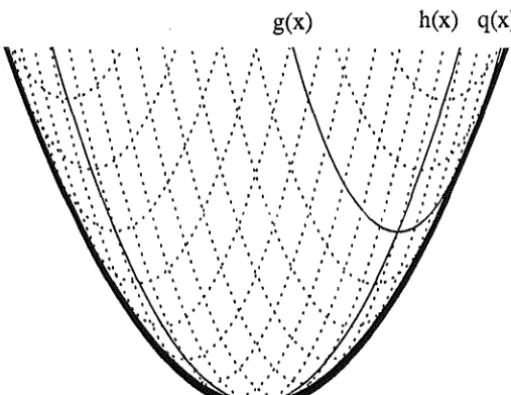
The following key lemma provides the details. It describes the effect of sliding the epigraph of one positive definite quadratic form along the graph of another. Fig. 3 illustrates this in the one dimensional case.
g(x) h(x) q(x)
I ' I I I I t
I I r 11 I f
f I f 1' I I t
[image:7.600.183.439.563.760.2]Lemma 2 Let H and G be positive definite matrices. Let S = ( H
+
G)-1and Q = HT sT GS H
+
GT ST HS G. The epigraph of the quadratic form xT Qx is obtained by sliding the epigraph of the quadratic form xT Gx along the graph of the quadratic form xT H x.Proof:
Let g and h be the two quadratic forms represented by G and H respectively. Letq(
x)
be the lower envelope obtained by sliding the graph of g along h. We now show q(x)
is a quadratic form with the required matrix.q(x)
=
min(g(x -y)+
h(y))y
=
mjn ((x -
Yl
G(x·-y)
+
yT Hy)
Tal<lng derivatives with respect toy, the minimum occurs when 2G(x - y)
=
2H y. SinceH
andG
are positive definite, the sum is invertible, thus y =(H
+
G)-1Gx. Using this value for y, gives q(x) = xT Qx with Q=
HTSTGSH+
GTSTHSG as required. IIThe following proposition shows that GPBA with Q from Lemma 2 and zero linear term can be used to give accelerated performance.
Proposition
2 Given a function f and positive definite matrices H and G as described. Let S=
(H+
G)-1 and Q = HTsTGSH+
aTsTHSG. At each iteration calculate replacement values x'f __.:.Xi+ H-1\lj(xi) and r(xi)=
J(xi)+
~('Vf(xi)f
H-1\lf(xi)· An acceleration over both (1) and (2)of proposition 1 is obtained by using the replacement values during the Update Envelope Function step of GPBA with Q and zero linear term.
Before providing the proof, it is worth looking at a few special cases. If
H
andG
commute, the formula simplifies to Q
=
HG(H+
G)-1. For H=
B1I and G=
BuI,the formula gives Q =
BB~~
I. We state this special case and note that the replacement values are appropriate to1 othe; algorithms like [ 4] which use the same building blocks for the lower envelope.Proposition
2' Given a function Jin the class Cf(Bz)n
C~(Bu)n
ZG. LetB = B1Bu/(B1 +Bu)· An acceleration is obtained by using the -replacement values
xf
andr(xi)
during the Update Envelope Function step of SPBA with Band zero linearterm. Here xf
=
x;
+
(1/
B
1) V'f( x;) and
j"(
x;)
=
f( x;)
+
llY'
~~
1
•lll
2.
The proof using the geometric ideas developed in [l] and [2] identifies a bigger region that can be removed.
Xi+ H-
1Vf(xi)
andfa(xi)
=
f(xi)
+
~('Vf(xi))TH-
1Vf(xi)
as stated. During the Update Envelope Function step of GPBA with H, the functionhi(x)
is
f(xi)
+
Vf
(x - Xi) -
~h(x- Xi)·
Expressed in terms of the replacementvalues this is
fa(xi) -
~h(x- xf).
NowH
was chosen sohi(x) :::; f(x).
So by proposition 3.2 of [2] at all points of the graph ofhi(x),
the regions below the translated graphs of -~g(x) can be removed, the union of these by Lemma 2 is the region belowr(xi) -
~q(x- xi).
It is a paraboloid with maximum at(xi' r(xi))
and contains the paraboloids used by the two methods mentioned inProposition 1. So using the replacement values for GPBA with
Q
and zero linear terms gives an acceleration over either method (1) or (2) of proposition 1. IIFigure 4 One dimensional illustration for proof of Proposition 2
3.
Relation to other algorithms and accelerations
If a Lipschitz bound M is available, the accelerations given in [l] are compatible with proposition 21
•
[image:9.602.108.472.296.542.2]Proposition
3Given ajunctionf in the class C((B1)
n
C~(Bu)n
L(M)
n
ZG. Let
B
=B1Bu/(B1 +Bu)· An acceleration is obtained by using replacement values
xf and
fa(xi) during the Update Envelope Function step of SPBA with Band zero linear term.
Here
xf
=
Xi+ (l/B1)'7f(xi) and
a . _ {
f(xi)
+
ll'V~~/)!1
2
+
2!
2
(di-li)2
di> lif
(xi) -ll'Vf(xi)ll2
where
f
(Xi)
+
2B di ::::; li-l 2
d·
=
f(x·) - a· and l·
=
M2 - ll'Vf(xi)ll
i i i ' 2B
2B1
Proof:
The paraboloid which is the region below the graph ofr(xi)
-~Bllx
-
xf
112
is removed during the ith step ofSPBA.
Usingxf
andr(xi)
in place
Qf
Xi
andf(xi)
in proposition 5 of [1] gives the result. •Algorithms using a Lipschitz bound can modified to incorporate second derivative
bounds and use the gradient. The algorithm of Mladineo [5] deals with Lipschitz
continuous function in
L( M).
It is an algorithm in Piyavskii 's scheme withhi (
x)=
f(xi) -
Mllx -
Xiii
and for dimension one reduces to that of Piyavskii [6] and Shubert[7].
Proposition
4Given ajunction fin the class C((B1)
n
C~(Bu)n
L(M)
n
ZG.
let B
=
B1Bu/(Br+ Bu)· When using the alg-orithm of Mladineo, an acceleration
using gradient information is obtained by using the replacement sample poinJ
::1
~;·(x:) :~:: ;;:,~::t:~::/:e{F=~:;:::t~l:;:::::•s :::g~n
f(xi)+
2B+
2B d, - 2B2 l
where d·
=f(x·) - a·+
ll'Vf(xi)ll
i i i
2B1
Proof:
In the notation of [ 1] and using a slight extension of Lemma 2, it follows that the MB-parabolically capped cone with apex at(xf,
r(xi))
could be removed during the ith step of Mladineo's algorithm. Usingxf
andr(xi)
in place ofXi
andf( Xi)
in proposition 3 of [l] gives the result. 111114. Comparisons
The results of this paper provide accelerations in a one-step sense. For a given
iter-ation, using an acceleration always produces a better bracket than not using it. Since the sequence of sample points used by these algorithms is determined by using the
arg min
Fi(x)
at each step, using the accelerations will produce a different sequenceof sample points, so on occasion will perform worse. We explore the convergence
Testing
RATFOR implementations of SPBA and GPBA were run with the various modifications
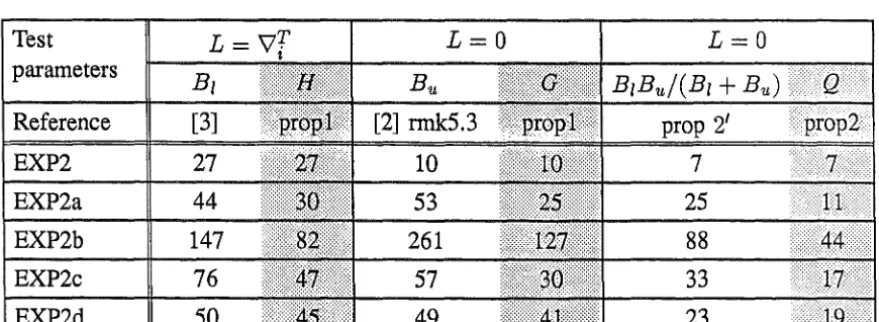
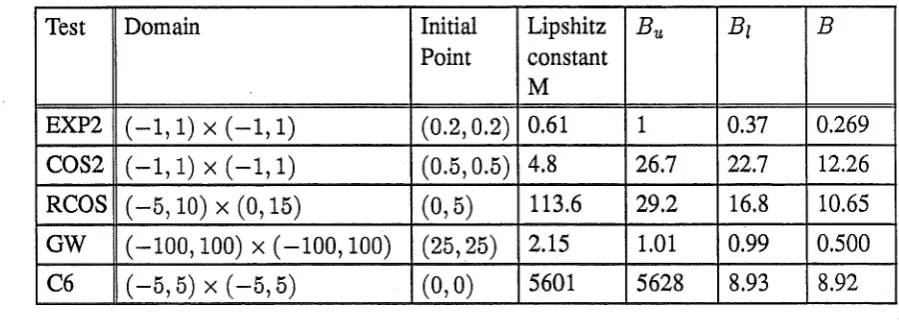
for a number of standard test functions. Each iteration requires a function and gradient evaluation. Tests were stopped when both an absolute error measure was less than 0.01 and a relative measure was less than 0.0001. The tests of the acceleration of Mladineo's algorithm were carried out only by a discrete simulation (described in [2]). The particulars are summarized in Tables 1-4.
The standard test functions are described in [3]. To illustrate the differences between using G and H, variants a-d of EXP2 of the form
f(x,y)
=
-7re-1/2(ax2+b(y-e)2) _( 2
2)
(1 -
7r)e-
112 ex +d(y+e) were used. EXP2 has circular contours, the variants have'"eliptical contours at the global minimum. EXP2b is highly curved at the global minimum. EXP2c and d have two local minimum. The contours around both these look similar for EXP2c while they are quite different for EXP2d. Table 5 gives details.
Test parameters Reference
L
=
vr
iL
=
0L
=
0Table 1 ITERATIONS TO CONVERGENCE USING SPBA AND ITS ACCELERATIONS Heavier shaded columns from methods presented in earlier references.
Test
L=O
L=O
parameters
Bu B1Bu/(B1 +Bu)
Reference [3] [2] rmk5.3 prop 2'
EXP2 27 10 7
EXP2a 44 53 25
EXP2b 147 261
88
EXP2c 76 57 33
EXP2d 50 49 23
[image:11.602.82.517.355.513.2] [image:11.602.85.525.605.766.2]Test Mladineo Mladineo [l] prop 4 prop 4
SPBA prop 3 8
COS2 39
RCOS 123
ow
282C6
55
Table 3 ITERATIONS TO CONVERGENCE (DISCRETE TESTS) Heavier shaded column from method presented in earlier reference.
Test Domain Initial Lipshitz
Point constant M EXP2
(-1, 1)
x(-1, 1)
(0.2, 0.2)
0.61 COS2(-1,1)
x(-1,1)
(0.5, 0.5)
4.8 RCOS( -5, 10)
x(0, 15)
(0,5)
113.6ow
(-100, 100)
x(-100, 100)
(25,25)
2.15C6
( -5, 5)
x (-5, 5)
(0,0)
5601Table 4 Particulars -for test functions (best bounds used)
Test 7r a b c d e Bu B1
EXP2 1 1 1 .;
-
0 1 0.37EXP2a 1 4 16
-
-
0 16 7.14EXP2b 1 40 160
-
-
0 160 71.2EXP2c .55 4 16 4 16 .5 8.77 6.51
EXP2d .55 4 16 16 4 .5 8.07 4.23
Bu 1 26.7 29.2 1.01 5628 7 34 100 283 79 Bz 0.37 22.7 16.8 0.99 8.93 G 1.0 I 1.0 D 10 D .58 D .82 D
Table 5 VARIANTS OF THE EXP FUNCTIONS (all using same initial point and domain as EXP2)
( note: D = diag(4,16), E = diag(9.4, 10.6) )
Comments
Five conclusions are apparent.
B 0.269 12.26 10.65 0.500 8.92 H
.37 I .446 D 4.45 D .407 D .399 E
• Proposition 2, 21 and 3 always provide substantial improvements. The number of iterations in right hand columns of Tables 1 and 2 are often half the size of the corresponding entries in the first two columns.
[image:12.595.150.458.63.196.2] [image:12.595.69.519.256.416.2] [image:12.595.90.521.460.580.2]• EXP2a and EXP2b reflect the differences in using G and H (rows 2 and 3 of Table 2). EXP2a is gently curved at the global minimum so using G is better than H, while EXP2b is strongly curved and H works better. • The use of the Lipschitz constant M (the darker halves of the columns in
Table 1) usually has no effect. Those accelerations using M take effect only if there is a large drop in value, and thus help only in the early stages of an algorithm. For RCOS and C6 this minimal drop is nearly the overall distance from minimum to maximum, so acceleration hardly occurred. For OW the minimal drop is quite small, the replacement values were often used, and the improvement is quite marked. Note sometimes these "accelerations" produced marginally poorer results. This is due to the fact that different sample sequences were produced. When repeated trials averaged over many different initial points were done, the accelerations were never worse.
• Both Mladineo's and the second author's algorithms when fully utilizing first and second derivative information give very similar results as shown by the similarity of columns 2 and 3 in Table 3
Concerning the discrete tests done for Mladineo's algorithm, note column 3 of Table 3 and the shaded part of column 3 of Table 1 test the same method. Likewise the heavily shaded results of Table 1 were done with discrete testing in [l]. The values are comparable and confirm that the discrete testing gives similar results to the actual running of the algorithms. The problem relates to differences in the stopping criterion. Discrete testing is appropriate for comparison testing shown in Table 3.
Conclusions and Future Directions
We have demonstrated two ways of improving the performance of some global optimiza-tion methods. The algorithms were easily modified to utilize fully both first and second derivative information.
A drawback of many methods that use bounds on first or second derivatives, including the ones presented here, concerns the calculation of the bounds. Finding good ones is often an equally difficult global optimization as the original. Work in this direction is needed. Local bounds appropriate to small regions in the domain are sometimes easier to obtain. So one area for future work appropriate to GBPA concerns incorporating subdivision of the domain, a modification that would readily lend itself to parallel computing.
References
[l] W. Baritompa, Accelerating Methods for Global Optimization, submitted
[2] W. Baritompa, Customizing methods for global optimization - a geomet-ric viewpoint, J. Global Optimization To appear
[3] Breiman & Cutler, A Deterministic Algorithm for Global Optimization,
Math. Program. To appear
[4] Yu. G. Evtushenko (1971), Numerical methods for finding global extrema (case of a non-uniform mesh), USSR Comp. Math. and Math. Phys. 11, 6,
1390-1403
[5] R. H. Mladineo (1986), An algorithm for finding the glbbal maximum of a multimodal, multivariate function, Math. Program. 34 188-200.
[6] S.A. Piyavskii (1972), An algorithm for finding the absolute extremum of a function, USSR Comp. Math. and Math. Phys. 12, 57-67
[7] Bruno 0. Shubert (1972), A sequential method seeking the global maxi-mum of a function, SIAM J. Numer. Anal. 9, 379-388
![Figure 2 One dimensional illustration of SPBA ignoring the gradient using parabolas to build up an envelope containing the global minimum of f (since the lightly marked parabola fits over the global minimum, [2] showed, turned upside down, it can be used to build the envelope)](https://thumb-us.123doks.com/thumbv2/123dok_us/9033016.399728/3.602.133.469.70.266/dimensional-illustration-ignoring-gradient-parabolas-containing-parabola-envelope.webp)