https://doi.org/10.1007/s00362-018-01071-x
REGULAR ARTICLE
Multi-part balanced incomplete-block designs
R. A. Bailey1,2 ·Peter J. Cameron1,2
Received: 2 August 2018 / Revised: 12 December 2018 © The Author(s) 2019
Abstract
We consider designs for cancer trials which allow each medical centre to treat only a limited number of cancer types with only a limited number of drugs. We specify desirable properties of these designs, and prove some consequences. Then we give several different constructions. Finally we generalize this to three or more factors, such as biomarkers.
Keywords Balanced incomplete-block design·Basket trial·Multi-part design· Orthogonal array·Orthogonal multi-array
Mathematics Subject Classification 05B05·05B15·05B30·62K10·62K15
1 First design problem
1.1 The problem
This problem was posed by Valerii Fedorov at the workshop onDesign and Analysis of Experiments in Healthcare held at the Isaac Newton Institute for Mathematical Sciences at Cambridge, UK in July 2015. The context isbasket trials, where several different drugs are tested on several different diseases in a single protocol which involves many medical centres: see Derhaschung et al. (2016) and Woodcock and LaVange (2017). The combinatorial properties listed below have been proposed by Fedorov and Leonov (2019) as potentially giving optimal designs, which may give a benchmark for designs which are achievable in practice.
A trial is being designed to compare several drugs for their effects on several different types of cancer. In order to keep the protocol simple for each medical centre
B
R. A. Bailey1 School of Mathematics and Statistics, University of St Andrews, North Haugh, St Andrews,
Fife KY16 9SS, UK
2 School of Mathematical Sciences, Queen Mary University of London, Mile End Road,
involved, it is proposed to limit each medical centre to only a few of the cancer types and only a few of the drugs. For each cancer type at that medical centre, each patient will be allocated to one of the drugs at that medical centre, the aim being that the numbers of such patients on each drug are nearly equal.
Letv1be the number of cancer types,v2the number of drugs, andbthe number of medical centres. The properties listed below are desirable. The first two are to keep the protocol simple. Fedorov and Leonov (2019) propose several statistical models for the response of each patient. The simplest is additive in the effects of medical centre, cancer type and drug. It is not knowna priorihow many suitable patients will enrol at each medical centre. If there are the same number at each medical centre then conditions (c)–(e) give a design that is optimal in the sense of minimizing the variances of the estimators of parameters of interest: see Sect.1.4.
(a) all medical centres involve the same number, sayk1, of cancer types, wherek1< v1;
(b) all medical centres use the same number, sayk2, of drugs, wherek2< v2; (c) each pair of distinct cancer types are involved together at the same non-zero
num-ber, sayλ11, of medical centres;
(d) each pair of distinct drugs are used together at the same non-zero number, sayλ22, of medical centres;
(e) each drug is used on each type of cancer at the same number, sayλ12, of medical centres.
The inequalities in conditions (a) and (b) force the medical centres to be incomplete both for cancer types and for drugs. Insisting that the parameters in conditions (c) and (d) are non-zero is necessary to prevent the confounding of either cancer types or drugs with medical centres.
For brevity, from now on the medical centres will be referred to as blocks. Figure1
shows such a design for six cancer types and five drugs using 10 blocks; it hask1=3 andk2=2.
Conditions (a) and (c) specify that the design for cancer types is a balanced incomplete-block design, also known as a design, or, more specifically, a
[image:2.439.93.350.461.591.2](v1,k1, λ11)design. Likewise, conditions (b) and (d) specify that the design for drugs is a 2-design. We call these the C-design and the D-design respectively.
We shall call a design satisfying conditions (a)–(e) a2-part 2-design or 2-part balanced incomplete-block design. These are not the same as the bipartite designs defined by Hoffman and Liatti (1995).
1.2 Previous work
In Sect.2we concentrate on designs with only two different factors (cancer types and drugs), before generalizing to three or more factors in Sect.3. This is partly to help the reader to become familiar with the ideas, and partly because this case seems likely to be of practical importance in the clinical context described.
The more general case has already been considered by Sitter (1993), Mukerjee (1998) and Hedayat et al. (1999, Sect. 10.8). Because conditions (a)–(d) specify bal-anced incomplete-block designs and condition (e) is reminiscent of the definition of orthogonal multi-array given by Brickell (1984), Sitter (1993) called these designs
balanced orthogonal multi-arrays. Brickell’s original definition was essentially a gen-eralization of orthogonal arrays of strength two and minimal size, so it included the conditions thatbis a square andλ12 = 1. Sitter (1993) acknowledged that he was removing those conditions.
However, the original definition of orthogonal multi-array continues to be in use in many areas. They give an alternative definition of semi-Latin squares: see Bailey (1992) and Soicher (1999,2013). Dually, they are used in factorial designs: see Bailey (2011). Phillips and Wallis (1996) used them in the study of tournaments. They are used in cryptography: see, for example, Anthony et al. (1990) and Martin et al. (1992). Recently, Li et al. (2015) have generalized them to strengtht, so thatbis at-th power of an integer. This generalization seems to be within the spirit of the original definition, whereas Sitter’s does not.
Thus we think that “2-part 2-design” (or, more generally, a multi-part 2-design) is a more suitable name.
Sitter (1993) also allowed the block size within each factor to vary. Mukerjee (1998) called the balanced orthogonal multi-arraysproperwhen this is not allowed. He also restricted attention to the case whereki < vi, unlike Sitter (1993). Both allowedλii
to be zero, which permits confounding: in Table 1 of Mukerjee (1998) one factor has its levels confounded with blocks.
Mukerjee (1998) gave two general constructions for designs of this type. We shall comment on the relationship of these to our constructions at the relevant places.
1.3 Representing the designs
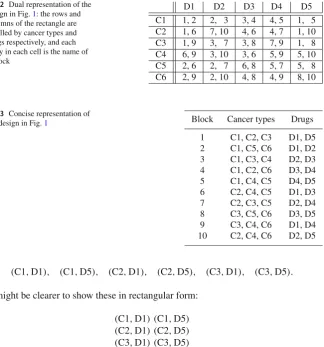
Fig. 2 Dual representation of the design in Fig.1: the rows and columns of the rectangle are labelled by cancer types and drugs respectively, and each entry in each cell is the name of a block
Fig. 3 Concise representation of the design in Fig.1
(C1,D1), (C1,D5), (C2,D1), (C2,D5), (C3,D1), (C3,D5).
It might be clearer to show these in rectangular form:
(C1,D1) (C1,D5) (C2,D1) (C2,D5) (C3,D1) (C3,D5)
The people running the clinical trial need this full representation.
A dual way to represent the design is to use av1×v2rectangle withλ12entries per cell. Equation (3) below shows that this contains the same number of items as the full representation. The rows are labelled by the cancer types, and the columns by the drugs. The name of each block is shown in each cell(i,j)for which the combination of cancer typei and drug j occurs in that block. Figure2shows the design in Fig.1
in this format. This dual representation does not extend easily to the generalization of the problem in Sects.3–4.
The most concise way to represent the design is simply to list, for each block, the cancer types and drugs allocated to it. This list hasb(k1+k2)items. This represen-tation was used by Sitter (1993) and Mukerjee (1998). Figure 3 gives the concise representation of the design in Fig.1.
[image:4.439.64.389.55.403.2] [image:4.439.213.390.58.159.2]cartesian product of these sets. This misinterpretation gives a block design forv1+v2 treatments inbblocks of sizek1+k2, which we call the zipped form of the original design.
Figure1avoids this problem, but at the cost of repeating the information about the drugs in each block. This format containsbk1k2items, as many as the full represen-tation, but it seems easier to read.
In the literature about block designs, the incidence matrix has(i,j)-entry equal
to the number of times that treatment i occurs in block j: see, for example, John and Williams (1995); Cali´nski and Kageyama (2000); Bailey and Cameron (2009). LetN1be thev1×bincidence matrix of cancer types in blocks in the zipped form of the design. The(i,j)-entry is 1 if cancer typei occurs in block j; otherwise, it is 0. LetN2be the analogousv2×bincidence matrix for drugs in blocks. Then the incidence matrices for the full design arek2N1andk1N2respectively, not allowing for the unknown number of times that each combination will eventually be used in any block.
1.4 Comparison with other designs
At first sight, the design in Fig.1appears to be a block design for two treatment factors
CandD. However, there are important differences between this and previous designs. In our application, the medical centre represented by Block 1 will accept into the trial only patients with cancer types 1, 2 or 3. It has no control in advance over how many such patients will present themselves. For each of these three cancer types, it will randomize approximately equal numbers of patients to drugs 1 and 5. In the original proposal, the listed drugs include placebo. In a later variants, placebo is not listed, and patients should be randomized approximately equally to drugs 1 and 5 and placebo, or approximately one quarter each to placebo, drug 1, drug 5 and their combination.
Sitter (1993) introduced his designs for use in sampling. In designed experiments, Mukerjee (1998) envisaged a completely different sort of application from the one we describe here. In that, each block represents a single observational unit. For each factor, subsets of the levels are applied, rather than single levels. For example, a group ofk1people might be needed, all playing similar roles, or a hybrid variety of wheat might be bred fromk2 pure lines. See also Bailey (1992). In this context, it is not problematic to haveλii =0 (so thatki =1) for eitheri=1 ori =2.
In classical factorial designs with blocks of sizek, from Yates (1933), Fisher (1935,
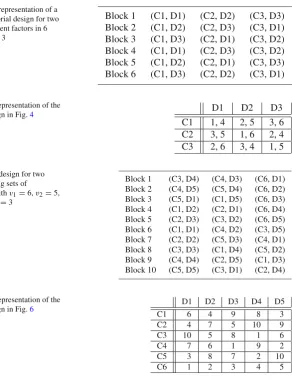
1942) and Bose (1947) onwards, combinations of factor levels do not occur more than once in any block: thusk1 = k2 = k. Moreover, the subsets of combinations allocated to blocks are chosen depending on various assumptions about main effects and interactions. For example, if v1 = v2 = 3 and there are six blocks of three plots each then the design in Fig.4permits estimation of both main effects with full efficiency and all interaction contrasts with efficiency factor 1/2.
Fig. 4 Usual representation of a classical factorial design for two 3-level treatment factors in 6 blocks of size 3
Fig. 5 Dual representation of the factorial design in Fig.4
Fig. 6 Block design for two non-interacting sets of treatments, withv1=6,v2=5,
b=10 andk=3
Fig. 7 Dual representation of the factorial design in Fig.6
row or column. Consequently, the occurrences of each block name do not have the rectangular layout that they do in Fig.2.
Later in the twentieth century there was much literature on incomplete-block designs for two non-interacting treatment factors with each treatment combination occurring once, so thatv1v2 =bk andk1 =k2= k, wherekis the block size. For example, Preece (1966b) gave the design in Fig.6. The dual form is in Fig.7.
[image:6.439.95.388.50.431.2]satisfying these conditions were calledtriple arraysby McSorley et al. (2005). The design in Fig.7is a triple array.
The statistical relevance of adjusted orthogonality is discussed in Bailey (2017, Sects. 7–8). If all medical centres recruit the same number of patients then, under condition (b) and the first version of the proposal, condition (d) gives a design which is optimal for the estimation of drug effects in the model which excludes the effects of cancer types. These estimates are obtained by adjusting for block effects. Adjusted orthogonality implies that, under the additive model for all three effects, once the responses have been adjusted for block effects then drugs are orthogonal to cancer types and so no further adjustment is needed. Hence conditions (d) and (e) give a design optimal for the estimation of drug effects under condition (b). Likewise, con-ditions (c) and (e) give a design optimal for the estimation of cancer effects under condtion (a).
In spite of the similar conditions that they satisfy, triple arrays are not special cases of 2-part 2-designs, nor vice versa. In a triple array, no block name occurs more than once in any row or column. In the dual form of a 2-part 2-design, any block name that occurs in a given row must occurk2 times in that row. A consequence of the “non-zero” part of condition (d) is thatk2>1.
Apart from the designs given by Preece et al. (2005), infinite families of triple arrays have proved frustratingly hard to find: see Bailey (2017, Sect. 13). By contrast, in Sects.2and4of this paper we give many simple constructions of 2-part 2-designs and their generalizations.
1.5 Conditions on parameters
An ordinary block design is said to beα-resolved if its set of blocks can be partitioned into classes in such a way that each treatment occurs αtimes in each class. This terminology does not extend easily to 2-part 2-designs, because cancer types may occur in different numbers of blocks from drugs. We propose calling a 2-part block designc-partitionableif the set of blocks can be grouped intocclasses ofb/cblocks each, in such a way that every cancer type occurs the same number of times in each class and every drug occurs the same number of times in each class. It is convenient to extend this terminology to ordinary block designs: such a design with replicationr
isα-resolved if and only if it isc-partitionable, whereαc=r.
Theorem 1 If there is a 2-part 2-design with the parameters given in conditions (a)– (e), then each cancer type occurs in r1 blocks and each drug occurs in r2blocks,
where
r1=bk1/v1, r2=bk2/v2. (1)
Moreover, the following equations are satisfied:
and
bk1k2=v1v2λ12, (3)
as well as the inequality
b≥v1+v2−1. (4)
If the design is c-partitionable then
b≥v1+v2+c−2. (5)
Proof The first two statements are the usual conditions for the 2-designs on cancer types and drugs respectively, while Eq. (3) equates two different ways of counting the number of choices of a cancer type, a drug, and a block containing both.
For inequality (5), letN =(N1,N2,N0), where N1andN2are the incidence matrices defined in Sect.1.3andN0is theb×cincidence matrix of blocks in classes. Then
N N=
⎡
⎣(r1−λ11)λ12IJ+λ11J (r2−λ22)λ12IJ+λ22J ((rr2/1/cc))JJ (r1/c)J (r2/c)J (b/c)I
⎤ ⎦,
whereI andJare identity and all-1 matrices of the appropriate sizes.
We claim thatN Nhas rankv1+v2+c−2, from which inequality (5) follows. First, letw1,w2andw3be column vectors of lengthsv1,v2,crespectively whose entries sum to 0. Then
N N
⎛ ⎝w1w2
w3
⎞ ⎠=
⎛
⎝((rr12−−λ11)w1λ22)w2 (b/c)w3
⎞
⎠. (6)
Because the blocks are incomplete,λ11 < r1 andλ22 < r2, and so the restriction of this matrix to the space of such vectors, which has dimensionv1+v2+c−3, is invertible. The orthogonal complement of this space consists of all vectors of the form(xj1,yj2,zj3), wherej1,j2andj3are all-1 vectors of lengthsv1,v2andc
respectively. The action of N N on this space is obtained by replacing the block matrices by their row sums: using the results in (1)–(3), this simplifies to
⎡
⎣ rr12kk11 rr12kk22 rr12 (b/c)k1(b/c)k2(b/c)
⎤ ⎦,
which has rank 1. So the claim (5) is proved.
Remark 1 Mukerjee (1998) remarked on the integrality conditions (1)–(3) without stating them explicitly, and proved inequality (4).
Remark 2 Inequality (4) can be regarded as a generalization of both Fisher’s and Bose’s inequalities: see Cameron and van Lint (1991, Chap. 1) and Bailey (2008, Chap. 11). For Fisher’s inequality, take the C-design to be any 2-design withv=v1, and take a single drug which occurs in all blocks; we haveλ12 =r1andλ22 =0: although our conditions thatλ22>0 andk2< v2fail for the D-design, the proof still works, because the only vectorw2in Eq. (6) is the zero vector: thus the proof givesb≥v+1−1. For Bose’s inequality, take the C-design to be any resolvable 2-design withv =v1and replicationr=r1, and the drugs to be labelled by the resolution classes of the design, with a drug in every block in the corresponding resolution class, so thatv2=r. We haveλ12 = 1 andλ22 = 0. Again part of condition (d) fails, but the proof works, givingb≥v+r−1. Inequality (5) seems to be the true analogue of Bose’s inequality for 2-part 2-designs.
Remark 3 Although neither triple arrays nor 2-part 2-designs are special cases of the other, they both satisfy inequality (4). Proofs for triple arrays are in Bagchi (1998), Bailey (2017) and McSorley et al. (2005), and the proof that we have given here also works for triple arrays.
2 Constructions of 2-part 2-designs
In this section, we give several constructions. In order to identify when two different constructions give designs which are essentially the same, we say that two 2-part 2-designs are isomorphic to each other if one can be obtained from the other by relabelling some of blocks, cancer types and drugs. Weak isomorphism generalizes this by also allowing the roles of cancer types and drugs to be interchanged.
Given two or more non-isomorphic designs for the same parameters, there may be practical reasons for preferring one over the rest.
Since interchanging roles does not affect conditions (a)–(e), from now on we usually adopt the convention that
v1≥v2. (7)
Given a 2-part 2-design, the procedure ofC-swapcreates a new 2-part 2-design. This simply involves replacing the set of cancer types in each block with the complementary set. This changes the parametersk1,λ11andλ12tov1−k1,b−2r1+λ11andr2−λ12, leavingb,v1,v2,k2andλ22unchanged. The new design fulfills all the conditions so long asv1−k1≥2. The combination of a C-swap and the analogous D-swap has the effect of replacing each block by its complement (in the zipped form).
Thus, in our search for design constructions, we may assume that
fori =1 andi =2,eitherki ≤vi/2 orki =vi −1. (8)
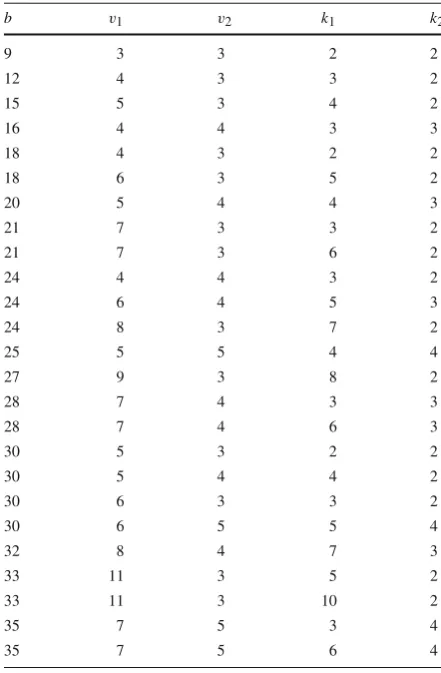
Table 1 Parameter sets for the designs with the least number of blocks that can be made by Construction1:v1is the number
of cancer types,v2is the number
of drugs, andbis the number of blocks, each of which hask1
cancer types andk2drugs
b v1 v2 k1 k2
9 3 3 2 2
12 4 3 3 2
15 5 3 4 2
16 4 4 3 3
18 4 3 2 2
18 6 3 5 2
20 5 4 4 3
21 7 3 3 2
21 7 3 6 2
24 4 4 3 2
24 6 4 5 3
24 8 3 7 2
25 5 5 4 4
27 9 3 8 2
28 7 4 3 3
28 7 4 6 3
30 5 3 2 2
30 5 4 4 2
30 6 3 3 2
30 6 5 5 4
32 8 4 7 3
33 11 3 5 2
33 11 3 10 2
35 7 5 3 4
35 7 5 6 4
Construction 1 (Cartesian products) One obvious method of construction is the carte-sian product. This starts with two balanced incomplete-block designs, one for v1 treatments inb1blocks of sizek1, the other forv2treatments inb2blocks of sizek2. Form allb1b2combinations of a block of each sort. For each combination, form the cartesian product of their subsets of treatments.
This will usually result in rather large values of b. For example, when v1 = 6,
k1=3,v2=5 andk2=2 then the smallest possible values ofb1andb2are both 10, so this construction gives a design with 100 blocks, unlike the design with 10 blocks in Fig.1.
Table1shows the parameters of the designs with the least number of blocks which can be constructed by this method with v1 ≥ v2, using the table of 2-designs in Appendix I of Hall (1986); note that design 13 in that table should havek=4.
Δ1is a 2-design forv1cancer types inb1blocks of sizek1, whereb1is a multiple ofr. Now we can achieve a 2-part 2-design without taking the full product. Partition the blocks ofΔ1intorclasses of sizeb1/rin any way at all, and match these classes to the resolution classes ofΔ2in any way. For each matched pair, construct the cartesian product design. Putting these products together gives a design of the required type withb1b2/r blocks, considerably fewer than theb1b2blocks in the entire product of Δ1andΔ2.
More generally, if the designΔ2isc-partitionable andcdividesb1then replace the resolution classes in this construction by thecclasses of blocks. This gives a 2-part 2-design withb1b2/cblocks. Puttingc=1 gives Construction1as a special case of this.
Figures8and9show two possibilities whenv1=v2=4,k1=k2=2 andr=3.
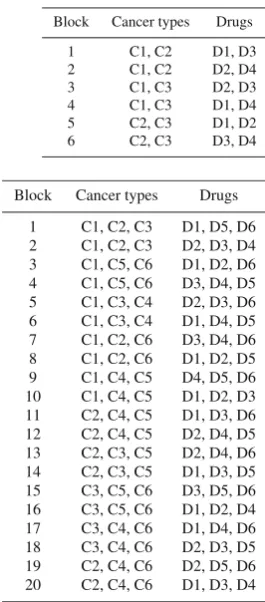
Fig. 8 Design for 4 cancer types and 4 drugs, using 12 blocks, each with 2 cancer types and 2 drugs. This can be made by Construction2and by Construction3
[image:11.439.238.389.238.586.2]Table2shows some parameter sets for designs that can be made by Construction2, possibly after an interchange or a swap, withki ≤ 10 fori =1 andi =2. See the database inDesignTheory.org(2012) for the resolved designs used.
There are two special cases. Whenb1=rthen we simply match the blocks ofΔ1 to the resolution classes ofΔ2. Whenv1=3,k1=2,v2=4,k2=2 andr =3, this gives the design in Fig.10. Whenv1=v2=6,k1=k2 =3 andr =10, this gives the design in Fig.11. Whenv1=7,k1=3,v2=15,k2=3 andr =7, this gives a 2-part 2-design withb=35,r1=15,r2=7,λ11=5,λ22 =1 andλ12=3.
On the other hand, ifΔ1is also resolved with replicationrthen we may match the resolution classes of the two designs. For example, whenv1=v2=4 andk1=k2=2 then we may taker =3 andb1=b2=6 to get the design in Fig.8. This is not even weakly isomorphic to the design in Fig.9, where the pairs of blocks fromΔ1do not form resolution classes. Whenv1/k1 =v2/k2 =2 andb1=b2, Construction3also gives designs with these parameters.
At first sight, the two general constructions given by Mukerjee (1998) are special cases of this. His first construction needs bothΔ1andΔ2to bec-partitionable, and matches the classes. This includes the cartesian product whenc=1, and whenc=3 it gives the design in Fig.8but not the one in Fig.9. His second construction uses a
c-partitionable designΔ2only whenb1 =c. However, ifcdividesb1then we may replaceΔ2byb1/ccopies of it, giving ab1-partionable design whose classes can be matched to the blocks ofΔ1.
Thus Construction2is precisely equivalent to the combination of the two in Muk-erjee (1998).
Some 2-part 2-designs in whichv1=v2andk1=k2=v1/2 arise from Construc-tion 2. Putn=k1. Suppose thatΔ0is a 2-design for 2ntreatments in 2r0blocks of size
n. IfΔ0is resolvable then we may putΔ1=Δ2=Δ0in Construction2, and match the resolution classes ofΔ1andΔ2to obtain anr0-partitionable 2-part 2-design in 4r0blocks. Figure8gives an example withn =2. IfΔ0is not resolvable, then letΔ2 be the design with 4r0blocks consisting ofΔ0and its complement. This is resolvable, withr =2r0. PutΔ1=Δ0and apply Construction2, matching the blocks ofΔ1to the replicates ofΔ2. Again, this gives a 2-part 2-design in 4r0blocks. However, this design is notr0-partitionable, because its C-design is not resolvable. Figure11shows an example withn =3.
There are sometimes be operational reasons for preferring resolvable designs. More-over, they can be used as ingredients in Construction 9 in Sect.4 to give designs without too many blocks. The next construction always give resolvable designs for such parameters.
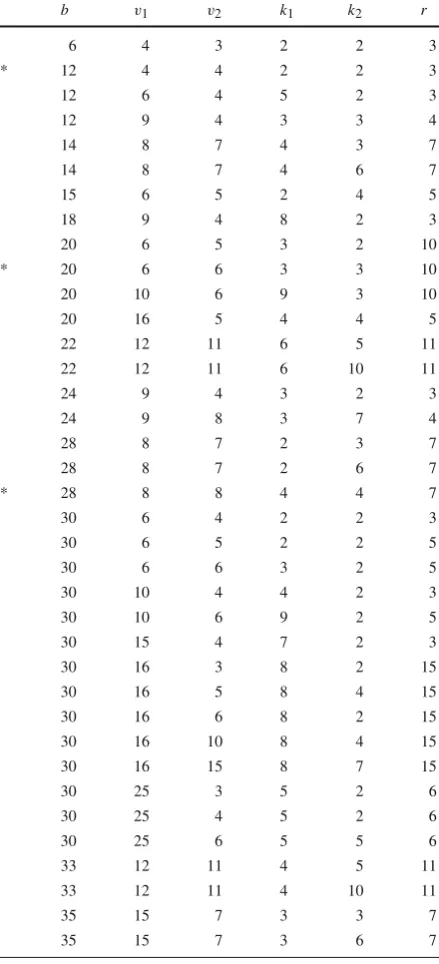
2-Table 2 Parameter sets for the designs with the least number of blocks withk1≤10 and
k2≤10 that can be made by
Constructions2or3but not1: v1is the number of cancer types,
v2is the number of drugs, andb
is the number of blocks, each of which hask1cancer types and
k2drugs;ris a number used in
Construction2
b v1 v2 k1 k2 r
6 4 3 2 2 3
* 12 4 4 2 2 3
12 6 4 5 2 3
12 9 4 3 3 4
14 8 7 4 3 7
14 8 7 4 6 7
15 6 5 2 4 5
18 9 4 8 2 3
20 6 5 3 2 10
* 20 6 6 3 3 10
20 10 6 9 3 10
20 16 5 4 4 5
22 12 11 6 5 11 22 12 11 6 10 11
24 9 4 3 2 3
24 9 8 3 7 4
28 8 7 2 3 7
28 8 7 2 6 7
* 28 8 8 4 4 7
30 6 4 2 2 3
30 6 5 2 2 5
30 6 6 3 2 5
30 10 4 4 2 3
30 10 6 9 2 5
30 15 4 7 2 3
30 16 3 8 2 15
30 16 5 8 4 15
30 16 6 8 2 15
30 16 10 8 4 15 30 16 15 8 7 15
30 25 3 5 2 6
30 25 4 5 2 6
30 25 6 5 5 6
33 12 11 4 5 11 33 12 11 4 10 11
35 15 7 3 3 7
35 15 7 3 6 7
[image:13.439.167.387.63.546.2]Fig. 10 Design for 3 cancer types and 4 drugs, using 6 blocks, each with 2 cancer types and 2 drugs
Fig. 11 A design for 6 cancer types and 6 drugs, using 20 blocks, made from Construction2
part 2-design is (4n −2)-partitionable and the lower bound in inequality (5) is achieved.
For example, whenn =3 we can take
H = ⎡ ⎢ ⎢ ⎢ ⎢ ⎢ ⎢ ⎢ ⎢ ⎢ ⎢ ⎢ ⎢ ⎢ ⎢ ⎢ ⎢ ⎢ ⎢ ⎣
+1+1+1+1+1+1+1+1+1+1+1+1
+1+1+1+1+1+1−1−1−1−1−1−1
+1−1+1−1+1−1+1−1−1+1+1−1
+1−1−1−1+1+1−1−1+1−1+1+1
+1+1+1−1−1−1−1+1+1−1+1−1
+1−1−1+1+1−1+1+1+1−1−1−1
+1−1−1+1−1+1−1+1−1+1+1−1
+1−1+1+1−1−1−1−1+1+1−1+1
+1+1−1−1+1−1−1+1−1+1−1+1
+1+1−1+1−1−1+1−1−1−1+1+1
+1+1−1−1−1+1+1−1+1+1−1−1
+1−1+1−1−1+1+1+1−1−1−1+1
⎤ ⎥ ⎥ ⎥ ⎥ ⎥ ⎥ ⎥ ⎥ ⎥ ⎥ ⎥ ⎥ ⎥ ⎥ ⎥ ⎥ ⎥ ⎥ ⎦ .
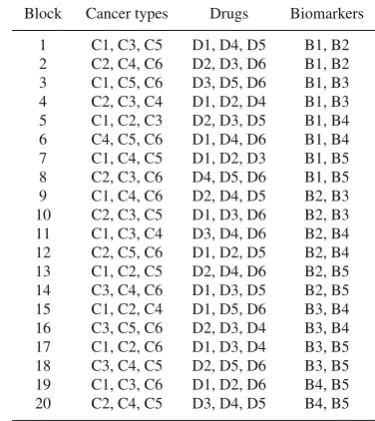
[image:14.439.103.333.430.574.2]Fig. 12 A design for 6 cancer types, 6 drugs and 5 biomarkers, using 20 blocks, made by Construction3followed by Construction9
isomorphic to the design in Fig.11, because all triples of cancer types and all triples of drugs occur.
The asterisked entries in Table2show the parameters of the smallest designs that can be constructed by this method.
Whenn = 4 this construction gives the design in Fig.8. For some values ofn, different choices of Hadamard matrix, or different designations of which row is second, can give non-isomorphic designs. It may be that there are some values ofnfor which there exists a Hadamard matrix of order 4n but no 2-(2n,n,n−1)design. If so, Construction3gives a design for these parameters but Construction2does not. Such a value ofnis likely to be too large to affect designs of practical size.
Construction 4 (Symmetric 2-designs) Here is another general method of construc-tion. Consider a symmetric balanced incomplete-block design Δ for v treatments inv blocks of sizek. Every pair of distinct treatments concur in λblocks, where λ=k(k−1)/(v−1), and every pair of distinct blocks haveλtreatments in common. Letbe one block ofΔ. Identify the treatments inwithkdrugs D1, …, Dk and the remaining treatments withv−kcancer typesC1, …,Cv−k. Now consider the
designΔ consisting of all blocks ofΔexcept. Each of these blocks contains λ drugs andk−λcancer types. InΔ, each pair of drugs concur inλ−1 blocks; each pair of cancer types concur inλblocks; and each drug occurs with each cancer type inλblocks. Thusb=v−1,v1=v−k,v2=k,k1=k−λ,k2=λ,λ11=λ12=λ andλ22=λ−1.
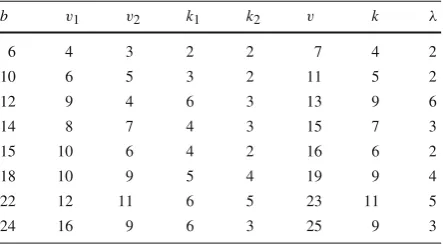
Table 3 Parameter sets for which small designs can be made by Construction4:v1is
the number of cancer types,v2is
the number of drugs, andbis the number of blocks, each of which hask1cancer types andk2
drugs;v,kandλare parameters of the symmetric 2-design used in the construction
b v1 v2 k1 k2 v k λ
6 4 3 2 2 7 4 2
10 6 5 3 2 11 5 2
12 9 4 6 3 13 9 6
14 8 7 4 3 15 7 3
15 10 6 4 2 16 6 2 18 10 9 5 4 19 9 4 22 12 11 6 5 23 11 5 24 16 9 6 3 25 9 3
The properties of symmetric 2-designs guarantee that conditions (c) and (d) hold, but they also match up the blocks of the C-design and the D-design, which typically produces fewer blocks than previous construction methods.
The design in Fig.1can be obtained by this construction withv =11,k=5 and λ=2. Figure10gives the design withv=7,k=4 andλ=2.
Table3lists parameter sets for small designs that can be constructed by this method, with an interchange and swaps where necessary: again using Table I.1 in Hall (1986). After allowing for possible interchanges and swaps, this table represents 38 designs.
Construction 5 (Augmentation) Given a 2-part 2-designΔin whichv2=2k2+1, we may augment it to one for one more drug by increasingv2tov2+1 andk2tok2+1 while merely doubling the number of blocks. Replace each block ofΔby two blocks, both with the same set of cancer types as before. One of these blocks has the previous set of drugs and the extra drug, while the other has all the remaining drugs.
For example, augmenting the design in Fig.1gives the design in Fig.11.
Applying the augmentation just to the D-design gives a resolvable 3-design, as shown in the Extension Theorem of Alltop (1972). This can be used directly in Con-struction2. However, augmentation is such a straightforward way of obtaining one 2-part 2-design from another that we think it is worth identifying.
Construction 6 (Group divisible designs) Ifv1=v2 =vandk1 =k2=kthen the zipped form of a 2-part 2-design is a semi-regular group-divisible incomplete-block design for two so-called groups ofvtreatments in blocks of size 2kwithk >1: see Bose and Connor (1952). Unzipping any one of these gives a 2-part 2-design.
Table VII of Clatworthy (1973) gives three such designs. Unzipping them gives the product design for the first parameter set in Table1, the design in Fig.8and the design in the first three columns of Fig.12.
have to be unzipped to give a 2-part 2-design. This does not give much control over
b, except that we know it is a divisor of the order ofG. A strategy for finding good designs by this method is to choose a subgroup HofGwhich acts intransitively on each ofCandD, and to use fixed sets ofHonCandDin the construction.
The three examples below arise from this construction, but can be more easily be derived from the 3-(22,6,1)designΞ whose automorphism group is the Mathieu groupM22. It has 22 points and 77 blocks of size 6, any two blocks meeting in zero or two points; see Cameron & van Lint (1991, Chaps. 1 and 9). For simplicity, we describe the cancer types as red points and the drugs as green points.
Take a blockB0of the designΞ; its points are red, and the remaining 16 points are green. For each of the 60 blocks meeting B0in two points, we define a block of our new design containing two red and four green points. Now two red points lie in five blocks, one of which isB0; so they lie in four more blocks. A red and green point lie in five blocks, each containing two red points. Two green points lie in three blocks meetingB0. For each point ofB0lies in a unique such block, and each block contains two points of B0. So we have an example withv1 = 6,v2 =16,b = 60,k1 = 2,
k2=4, and(λ11, λ12, λ22)=(4,5,3).
The other two examples use the 4-(23,7,1)designΘin which the blocks through the extra point are formed by adjoining that point to the blocks ofΞ: see Cameron and van Lint (1991). The counting arguments that verify their properties are similar to what we have just seen.
For the second design, we take a set Aof seven points which form a block ofΘ not containing the extra point. These will be red, and the remaining 15 points ofΞ green. Any block ofΞ meets Ain one or three points; we take the blocks meeting
Ain three points to be the blocks of the required design. We obtain an example with v1=7,v2=15,b=35,k1=k2=3, and(λ11, λ12, λ22)=(5,3,1).
This has the same parameters as the fifth design made using Construction2. Finally, using the 23-point designΘ but not throwing away the extra point we obtain a design with v1 = 7, v2 = 16, b = 140, k1 = 3, k2 = 4, and (λ11, λ12, λ22)=(20,15,7). Another design with these parameters is the cartesian product of the projective plane of order 2 and the affine plane of order 4; these designs are not isomorphic.
To build these from the group action construction, the relevant groups are the stabilizers of the sets of six or seven red points in the appropriate Mathieu groups; these are the groups 24:S6,A7, and 24: A7respectively.
3 Generalizing the design problem
3.1 The extended problem
The conditions for anm-part 2-design are as follows. The analogue of conditions (a)–(b) is that, for 1≤i ≤m, factori hasvi levels and each medical centre involves ki of them, whereki < vi; the analogue of conditions (c)–(d) is that, for 1≤i ≤m,
each pair of levels of factori are used together at the same non-zero numberλii of
medical centres.
The generalization of condition (e) is less clear. Wheni =3, a weak generalization is that each biomarker is used on each cancer type at the same numberλ13of medical centres and that each biomarker is used with each drug at the same numberλ23 of medical centres. For now, we use this weak version. Note, however, that this gets us into the territory of factorial design, so we might be confounding all or part of a two-factor interaction with all or part of a main effect. By analogy with orthogonal arrays (Hedayat et al.1999), we call this weak generalization a3-part 2-design with strength 2, whereas a 3-part 2-design with strength 3 would have every triple of (cancer type, drug, biomarker) at the same numberλ123of medical centres.
Thus the strength-2 generalization of condition (e) is that, for 1≤i < j ≤m, each level of factori occurs with each level of factorj at the same numberλi j of medical
centres.
3.2 Conditions on parameters in the extended problem
The definition ofc-partitionable extends tom-part 2-designs in the obvious way.
Theorem 2 In an m-part 2-design of strength 2, all of the following are satisfied.
(i) The analogues of Eqs. (1) and (2) hold for each factor.
(ii) Equation (3) generalizes to bkikj =vivjλi j for1≤i < j ≤m.
(iii) If the design is c-partitionable then b≥v1+ · · · +vm+c−m.
(iv) In particular, b≥v1+ · · · +vm−m+1.
Proofs are similar to those in Sect.1.5. Part (iv) is precisely Theorem 1 of Mukerjee (1998).
4 Constructions of
m
-part 2-designs of strength at least 2
4.1 Two main constructions
Here we give the main construction of Mukerjee (1998) in the language of this paper.
Construction 8 (Orthogonal arrays) Suppose that there is a positive integerc such that, fori =1, …,m,Δi is ac-partitionable 2-design forvi treatments inbi blocks
of sizeki. Moreover, there is an orthogonal arraywithmcolumns, where columni
containsbi/csymbols for 1≤i ≤m.
Match thecclasses of blocks ofΔ1, …,Δm. For j =1, …,cseparately, each row
ρofgives a block of the new design, as follows. Fori =1, …,m, identify the block in class j ofΔi labelled by the symbol in rowρ and columni of: then form the
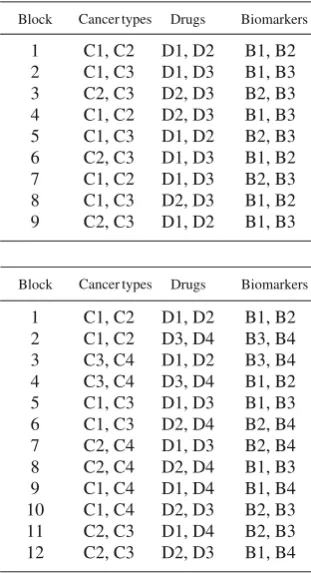
Fig. 13 A 3-part 2-design for 3 cancer types, 3 drugs and 3 biomarkers, made from Construction8
Fig. 14 A 3-part 2-design for 4 cancer types, 4 drugs and 4 biomarkers, made from Construction8
blocks, wheresis the number of rows of. The strength of this new design is equal to the strength of the orthogonal array.
In one extreme case,has all possible different rows, so thats=mi=1bi/cm.
If, in addition,c=1, thens=mi=1biand we obtain the full cartesian product.
The design in Fig.13can be made in this way withc =1, using an orthogonal array with three columns, each with three symbols.
An example with m = 3 andc = 3 is shown in Fig.14, which is contained in Table 1 of Mukerjee (1998). Here,vi =4,ki =2 andbi =6 fori=1, 2, 3, and each
ofΔ1,Δ2andΔ3can be resolved into three pairs of blocks. For each design, label the replicates 1, 2, 3 in any order. For j =1, 2, 3, combine the j-th replicates from the three designs, not by the full cartesian product, which would give eight blocks, but by using an orthogonal array of strength 2 with four rows and three columns, each with two symbols. This 3-part 2-design has strength 2 but not strength 3.
Table 1 of Sitter (1993) gives a 7-part 2-design made in this way withb=24 and vi =2ki =4 fori =1, …, 7.
extended to this method too. As in Construction2, we can allow one of the constituent designs to be notc-partitionable, so long as its numberbof blocks is divisible byc.
The full product of anm1-part 2-designΘ1withb1blocks and anm2-part 2-design Θ2withb2blocks is an(m1+m2)-part 2-design withb1b2blocks and strength 2. If Θ1has strengthm1andm2=1 then the full product has strengthm1+1. For example, ifm =3,v3=3 andk3=2 then the product of the design in Fig.1and a 2-design with three blocks of size 2 gives a 3-part 2-design with 30 blocks and strength 3.
As an example of the relaxation of thec-partionable condition, suppose thatΘis a
c-partitionable 2-part 2-design for drugs and cancer types andΔis a 2-design forv3 biomarkers incblocks of sizek3. We can simply match the blocks ofΔto the classes ofΘin any way. The 3-part 2-design in Fig.12was made like this by starting with a 2-part 2-design made by Construction3, grouping blocks into ten classes of the form
{2i −1,2i}, and matching these classes to the ten blocks of a 2-designΔfor five biomarkers. Similarly, ifv1 =v2=v3=6 andk1=k2=k3=3 we can obtain a 3-part 2-design in 20 blocks by matching the ten blocks of a 2-(6,3,2)design to the ten classes in the left-hand side of Fig.12.
The special case of the last part of this construction withb=cis the second general construction given by Mukerjee (1998). As noted in Sect.2, this specialization does not restrict his designs. However, because we have now given more constructions for the case thatm=2, applying the various product constructions to them produces new designs for higher values ofmalso.
4.2 Other constructions
The augmentation method in Construction5easily generalizes to three or more factors. Ifvi =2ki+1 thenvi andki can be increased by one while the number of blocks is
merely doubled.
Ifv1 = · · · =vm =vandk1= · · · =km =kthen the zipped form of anm-part 2-design is a semi-regular group-divisible design formvtreatments in blocks of size
mkwithk>1. Just as in Construction6, any such design can be unzipped to give a
[image:20.439.189.388.499.605.2]m-part 2-design. There are two such designs withm =3 in Table VII of Clatworthy (1973). Their unzipped forms are the designs in Figs.13and14. The one withm=4 gives the design in Fig.15, which can also be obtained from a 9×4 orthogonal array with three symbols in each column.
The group method in Construction7also easily extends to three or more factors: simply take a permutation group with more than two 2-transitive actions.
Acknowledgements We thank Valerii Fedorov for posing this interesting problem.
Open Access This article is distributed under the terms of the Creative Commons Attribution 4.0 Interna-tional License (http://creativecommons.org/licenses/by/4.0/), which permits unrestricted use, distribution, and reproduction in any medium, provided you give appropriate credit to the original author(s) and the source, provide a link to the Creative Commons license, and indicate if changes were made.
References
Agrawal HL (1966) Some methods of construction of designs for two-way elimination of heterogeneity—1. J Am Stat Assoc 61:1153–1171
Alltop WO (1972) An infinite class of 5-designs. J Comb Theory (A) 12:390–395
Anthony MHG, Martin KM, Seberry J, Wild P (1990) Some remarks on authentication systems. In: Seberry J, Pieprzyk J (eds) Advances in cryptology, Auscrypt ’90. Volume 453 of Lecture Notes in Computer Science. Springer, New York, pp 122–139
Bagchi S (1998) On two-way designs. Gr Comb 14:313–319 Bailey RA (1992) Efficient semi-Latin squares. Stat Sin 2:413–437
Bailey RA (2008) Design of comparative experiments. Cambridge University Press, Cambridge Bailey RA (2011) Symmetric factorial designs in blocks. J Stat Theory Pract 5:13–24
Bailey RA (2017) Relations among partitions. In: Claesson A, Dukes M, Kitaev S, Manlove D, Meeks K (eds) Surveys in combinatorics 2017. Volume 400 of London Mathematical Society Lecture Note Series. Cambridge University Press, Cambridge, pp 1–86
Bailey RA, Cameron PJ (2009) Combinatorics of optimal designs. In: Huczynska S, Mitchell JD, Roney-Dougal CM (eds) Surveys in combinatorics 2009. Volume 365 of London Mathematical Society Lecture Note Series. Cambridge University Press, Cambridge, pp 19–73
Bose RC (1947) Mathematical theory of the symmetrical factorial design. Sankhy¯a 8:107–166
Bose RC, Connor WS (1952) Combinatorial properties of group divisible incomplete block designs. Ann Math Stat 23:367–383
Brickell EF (1984) A few results in message authentication. Congr Numer 43:141–154
Cali´nski T, Kageyama S (2000) Block designs: a randomization approach. Volume I: Analysis. Volume 150 of Lecture Notes in Statistics. Springer, New York
Cameron PJ, van Lint JH (1991) Designs, graphs, codes and their links. Volume 22 of London Mathematical Society Student Texts. Cambridge University Press, Cambridge
Clatworthy WH (1973) Tables of two-associate-class partially balanced designs. Volume 63 of Applied Mathematics Series. National Bureau of Standards, Washington, DC
Derhaschung U, Gilbert J, Jäger U, Böhmig G, Singl G, Jilma B (2016) Combined integrated protocol/basket trial design for a first-in-human trial. Orphanet J Rare Dis 11:134. https://doi.org/10.1186/s13023-016-0494-z
DesignTheory.org(2012)http://designtheory.org/
Eccleston JA, Russell KG (1977) Adjusted orthogonality in nonorthogonal designs. Biometrika 64:339–345 Fedorov VV, Leonov SL (2019) Combinatorial and model-based methods in structuring and optimizing cluster trials. In: Beckman RA, Antonijevic Z (eds) Platform trials in drug development: umbrella trials and basket trials. Chapman & Hall/CRC Press, Boca Raton, pp 265–286
Fisher RA (1935) The design of experiments. Oliver & Boyd, Edinburgh
Fisher RA (1942) The theory of confounding in factorial experiments in relation to the theory of groups. Ann Eugen 11:341–353
Hall M Jr (1986) Combinatorial theory, 2nd edn. Wiley, New York
Hedayat AS, Sloane NJA, Stufken J (1999) Orthogonal arrays: theory and applications. Springer, New York Hoffman DG, Liatti M (1995) Bipartite designs. J Comb Des 3:449–454
Li M, Liang M, Du B (2015) A construction oft-fold perfect splitting authentication codes with equal deception probabilities. Cryptogr Commun 7:207–215
Martin KM, Seberry J, Wild PR (1992) Resolvable designs applicable to cryptographic authentication schemes. J Comb Math Comb Comput 12:153–160
McSorley JP, Phillips NCK, Wallis WD, Yucas JL (2005) Double arrays, triple arrays and balanced grids. Des Codes Cryptogr 35:21–45
Mukerjee R (1998) On balanced orthogonal multi-arrays: existence, construction and application to design of experiments. J Stat Plan Inference 73:149–162
Phillips NCK, Wallis WD (1996) All solutions to a tournament problem. Congr Numer 114:193–196 Preece DA (1966a) Some balanced incomplete block designs for two sets of treatments. Biometrika 53:479–
486
Preece DA (1966b) Some row and column designs for two sets of treatments. Biometrics 22:1–25 Preece DA, Wallis WD, Yucas JL (2005) Paley triple arrays. Aust J Comb 33:237–246
Sitter RR (1993) Balanced repeated replications based on orthogonal multi-arrays. Biometrika 80:211–221 Soicher LH (1999) On the structure and classification of SOMAs: generalizations of mutually orthogonal
Latin squares. Electron J Comb 6:R32
Soicher LH (2013) Optimal and efficient semi-Latin squares. J Stat Plan Inference 143:573–582 Woodcock J, LaVange LM (2017) Master protocols to study multiple therapies, multiple diseases, or both.
N Engl J Med 377:62–70
Yates F (1933) The principles of orthogonality and confounding in replicated experiments. J Agric Sci 23:108–145