Mihaela Baroni and M Steel
Biomathematics Research Centre
University of Canterbury
Private Bag 4800
Christchurch, New Zealand
ACCUMULATION PHYLOGENIES
Mihaela Baroni and Mike Steel Biomathematics Research Centre
University of Canterbury Christchurch, New Zealand
ABSTRACT. Directed acyclic graphs provide a convenient representation of reticulate evolution in systematic biology. In this paper we formalize and analyse a simple model in which evolved characteristics are passed on to all descendant species. We present two main results: first we show that the re-sulting observed sets of characteristics for the species at the leaves uniquely determine the digraph that described the evolution of the species, under cer-tain restrictions. Second, we characterise when this digraph is actually a tree.
1. INTRODUCTION AND DEFINITIONS
Directed trees and graphs provide useful representations of evolutionary relation-ships in biology [4], [5], [6], [7]. For such graphs, a subset of the vertices (usually of out-degree 0) correspond to present-day species, and characteristics of these species are used to estimate the structure of the remainder of the graph. One type of data which is becoming increasingly applied is the presence or absence of various genetic signals (the most simple of which is simply the presence or absence of a gene). In this paper we investigate settings in which such signals propagate down the directed graph - they arise just once, and are never (completely) lost. We are particularly interested in determining when the underlying network can be uniquely recovered from the accumulated signals at the terminal vertices, and in characterising when this graph is a tree.
1.1. Preliminaries. In this paper we deal with digraphs (directed graphs), which can be represented by a pair
CV,
A) where Vis a set (of vertices), and A is a subset of V x V of arcs. For each v E V, let d-(v) and d+(v) denote, respectively the in-degree and out-degree (number of arcs for which v is the second, respectively first co-ordinate). In this paper we will be concerned only with acyclic digraphs (i.e. digraphs that have no directed cycles). More details regarding digraphs can be found in [1]. A rooted digraph is an acylic digraph V=
(V,A) with a distinguished vertexp
(called the root) that has the property that d-(p)
=
0 and for which there exists a directed path from p to every vertex in V - {p}.Let X be a non-empty set, and suppose that V
=
(V, A) is a rooted digraph, for which X is the set of vertices of out-degree 0 (the leaves of V). We say that V is a hybrid phylogeny (on X) provided that for all v E V - X with d- ( v) ::=; 1 we have d+ ( v)>
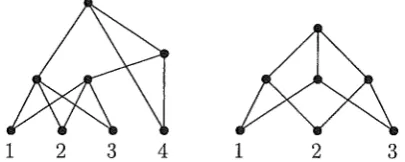
1. Two hybrid phylogenies on X, V and V' say, are regarded as equivalent if there is a digraph isomorphism from the vertices of V to the vertices of V' that restricts to the identity function on X.Two examples of hybrid phylogenies are shown in Fig. 1 (for X
=
{1, 2, 3, 4} andX
=
{1, 2, 3}, and with the arcs oriented downwards).1
23
41
2
3
FIGURE 1. Two examples of hybrid phylogenies. The example on the right is regular.
[image:3.595.190.393.544.625.2]ACCUMULATION PHYLOGENIES 3
using the symbol T. If in addition d+(v) E {O, 2} for every vertex v of T we say that Tis a rooted binary phylogenetic tree (on X).
Rooted phylogenetic trees are widely used in evolutionary biology, (and other areas of classification such as linguistics) to represent evolutionary relationships between present-day species, which are represented by the out-degree 0 vertices (the 'leaves'). More recently hybrid phylogenies have been suggested as suitable for modelling evolution in the presence of reticulation (whereby new species contain genetic contributions from two or more ancestral species) [5], [6]. Further math-ematical background on hybrid phylogenies can be found in [2], while for rooted phylogenetic trees the reader is referred to [7].
D
1.2. Accumulation phylogenies. Let S be any (finite or infinite) set. An accu-mulation phylogeny on Xis a triple (V, A, f) where (V, A) is a hybrid phylogeny on
X with the root p, and
f
is a function from AU {p} to 28 (the power set of S) that satisfies the following two properties:(Pl) the set {f(a): a EAU {p}} is a collection of pairwise disjoint sets; and (P2) for each vertex v EV - {p} we have f(a) =/=
0
for at least one arc a thatends at v.
Note that f(p), and f(a) (for certain arcs a) can be the empty set.
1.3. Relevance of accumulation phylogenies to molecular systematics. In molecular evolutionary biology we may view (V, A) as modelling the evolution of a collection X of extant species from a common ancestor p, allowing for hybrid or reticulate evolution. In this setting we may regard Sas a set of genes, f(p) as the genes present in the most recent common ancestor of the species in X, and for each arc a
=
(u, v), f(a) denotes the genes that arose in the lineage leading from (an-cestral species) u to v. An accumulation phylogeny models the situation where (i) genes arise at most once (condition (Pl)), a situation that is commonly assumed and goes under the name 'gene genesis'; and (ii) if a new gene is subsequently lost some 'trace' of that gene is at least detectable in all descendant species. Fur-thermore, we assume that S is sufficiently extensive that each descendant species acquires at least one new gene (condition (P2)).Recently, the gene content of species has been used for reconstructing phyloge-nies (see [8]) by constructing measures of (dis )similarity based on the amount of genes shared by two species (we consider this further in the next section). The approach we consider here may provide an alternative technique for reconstructing the phylogenetic history of species (not necessarily based on a phylogenetic tree)
1.4. Accumulation maps. Suppose that (V, A, f) is an accumulation phylogeny on X. Consider the map a: V -7 28, defined by setting
a(v) := f(p)
u
u
f(a). aEpath from p to vLet a := alX, the restriction of the map a to X. We refer to a (respectively a) as the accumulation map on X (respectively on V) induced by (V, A,!) (or, more briefly, by (V, A)).
1
Sg
2
3
4
1
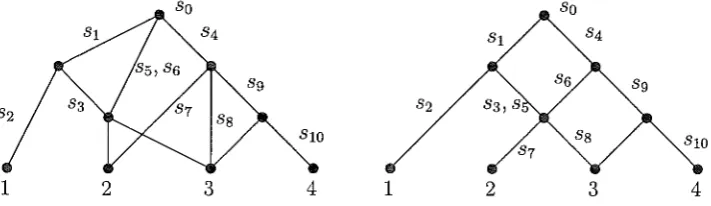
2FIGURE 2. Two accumulation phylogenies on X = {l, 2, 3, 4} with the same induced accumulation map a.
3
Informally, the map
a
describes how the elements of S 'accumulate' as one moves down the digraph, and a(x) describes the resulting subset of S at the leaf x. For example, for either of the hybrid phylogenies shown in Fig. 2 together with the values f(p) and f(a) as indicated (from the set {so, si, ... s10} ), one has a(2)=
{so, si, s3, s4, s5, s6, s7 }. Our interest in this paper is in studying what the a(x) values tell us about the underlying accumulation phylogeny (V, A, f). As Fig. 2 shows, different accumulation phylogenies can give rise to the same accumulation map on X.2. PROPERTIES OF a AND
a
We now provide three lemmas that describe the basic properties of accumulation maps. These results will be useful for us later in the paper. First we define some terminology.
Consider a map a: X - 7 28. Fors E S, let
A(s) := {x EX: s E a(x)}, and consider the associated family of subsets of X:
A(a) := {A(s): s ES} U {X}.
Suppose we have a hybrid phylogeny V
=
(V, A) on X. For v, v' E V write . v<v
v' if there is a directed path in V from v to v', and v-:;.v
v' if v<v
v' or v=
v'. For v EV, let c(v)=
{x EX: v-:;.v
x}, which we refer to as a clusterofV. [image:5.595.150.506.271.374.2]ACCUMULATION PHYLOGENIES 5
Lemma 2.1. Suppose that (V, A,!) is an accumulation phylogeny on X, with in-duced accumulation map a, and with S
=
UxExa(x).(i) For each arc a= (u,v) EA, and each s E f(a) we have A(s)
=
c(v). (ii) For each s E S, A( s)=
c( v) for at least one vertex v E V.(iii) For each vertex v E V - {p} there exists at least one element s E S such that c(v) = A(s).
(iv) A(a)
=
{c(v): v EV}.Proof. Part (i). First suppose that there exists a EA withs E f(a), and a= (u,v) for some u E V. If x E c(v) then v :::::.v x and so s E a(x). Consequently, c(v) ~ A(s). To establish the reverse inclusion, suppose that x E A(s). Then by
(Pl)
there exists a path from v to x and so x E c(v). Hence A(s) ~ c(v), and thusA( s)
=
c( v) as claimed.Part (ii). Suppose that s E S. Since S
=
UxExa(x), there exists an element w E AU {p} with s E f(w). By(Pl)
this element w is unique. If w=
p then A(s)=
X=
c(p). Otherwise, if w is an arc, let v denote the end vertex of w. By Part (i) we have that A(s)=
c(v).Part (iii). For any vertex v E V - {p},
(P2)
guarantees that there is at least one arc a that ends at v for which f(a) =I=0.
Select any s E f(a). Then c(v)=
A(s) by Part (i).Part (iv). Let A E A(a). Then A
=
X=
c(p) or there exists s E S with A= A(s). In the latter case, from (ii), it follows that A(s)=
c(v) for some v EV. Conversely, let v E V. If v=
p, then c(v) X E A(a). If v =I= p, from (iii), it follows that there exists s ES such that c(v)=
A(s), therefore c(v) E A(a). DNotice that, by Lemma 2.1, Part (iv), A(a) does not depend on
f.
Lemma 2.2. Let (V, A, f) be an accumulation phylogeny on X, and let a and a be the induced accumulation maps on X and V respectively. Let 1J
=
(V, A).(1) For any u, v EV, the following conditions are satisfied:
(2)
For any vE
V,(3) Given v EV,
(i) u =I= v # a(u) =I= a(v); (ii) u
<v
v # a(u)c
a(v); (iii) u:::::.v
v # a(u) ~ a(v).a(v) ~
n
a(x). xEc(v)n
a(x) ~ a(v) #(c(v)
~c(u)
=? u :::::.v v).Proof. Part l{i). Suppose u =/= v. The conditions u
<v
v and v<v
u cannot be satisfied simultaneously. Assuming that u<v
v does not hold, it follows that u =/= p and any arc ending in u does not lie on a path from p to v. Let a be such an arc with f(a) =/=0.
Then f(a) <;;; a(u) - a(v), hence a(u) =/= a(v).Part l{ii). Assume that u
<v
v and let s E a(u). Then either s E f(p) or s E f(a) for some arc a in a path from p to u. In the former case s E a(v) and in the latter a is an arc of a path from p to v. It follows from Part l(i) that the inclusion is strict.Conversely, suppose that a(u)
c
a(v). If u=
p, then u<v
v. Assume now that u E V - {p}. According to (P2) there exists sin S such that s E f(a) for some arc a ending in u. Therefore s E a(u), hence s E a(v). From (Pl) it follows that s E f(b) entails b=
a. Since s E a(v), there is a path from p to v containing a. Consequently,u <v
v.Part l{iii). This follows from Parts l(i) and l(ii).
Part {2) Let x E c(v). Since v ~D x, we have a(v) <;;; a(x). Consequently, a(v) <;;; nxEc(v)a(x).
Part {3). Let v EV and suppose that nxEc(v)a(x) <;;; a(v). Let u be a vertex of V with c( v) <;;; c( u). It follows that
a(u) <;;;
n
a(x) <;;;n
a(x) <;;; a(v), xEc(u) xEc(v)and so by Part l(iii) of this lemma, u ~D v.
Conversely, let v E V and suppose that c(v) <;;; c(u) entails u ~D v. Let s E nxEc(v)a(x). Ifs E f(p) thens E a(v). Otherwise, s E f(a) for some arc a= (w, u). For any x E c(v) there is at least one path from p to x, containing a. It follows that c(v) <;;; c(u), thus u ~v v. Therefore, s E a(v). D
Given a rooted digraph (V, A) and any vertex v of V let end( v) be the set
end(v) := { {p} ' if v - p· - '
{(u,v): (u,v) EA}, otherwise;
and for any function
f :
A U {p} --> 28 letf(end(v)) := {s ES: s E f(a) for some a E end(v)}.
Lemma 2.3. Let (V, A, f) be an accumulation phylogeny on X, and let a be the associated accumulation map on V. For all vertices v of V,
ACCUMULATION PHYJ;,OGENIES 7
Proof. Let v EV. If v
=
p then f(end(v))=
f(p)=
a(p) and there is no arc (u, v) in A. If v =/= p, thena(v)
= (
LJ
a(u)) U f(end(v)) (u,v)EAand the two sets in the union are disjoint. The lemma now follows.
D
3. REGULAR HYBRID PHYLOGENIES
Given a collection C of non-empty subsets of X, the cover digraph for C is the digraph with vertex set C and an arc (A, B) whenever B CA and there is no C E C
with B C C C A. We say that a hybrid phylogeny 'D is regular if the map v 1-+ c( v)
is an isomorphism from 'D to the cover digraph of its set of clusters. For example, the hybrid phylogeny on the right of Fig. 1 is regular, while that on the left is not. Clearly, every rooted phylogenetic tree is a regular hybrid phylogeny. Note that if 'D is a regular hybrid, then the clusters associated to the vertices of 'D are all distinct.
For accumulation phylogenies for which the underlying digraph 'Dis regular, the induced map a suffices (along with 'D) to reconstruct the sets a(v) and J(end(v)) for every vertex v of V, as we now show.
Proposition 3.1. ·Suppose 'D
=
(V, A) is a regular hybrid phylogeny, and that a is an accumulation map induced by (V, A, f). Then for any v E V,(i)
a(v) =
n
a(x), xEc(v) (ii)f(end(v)) =
n
a(x) -u
n
a(x). xEc(v) (u,v)EA xEc(u)Proof. Part (i). We have a(v) <;;; nxEc(v) a(x), by Lemma 2.2(2). The reverse inclusion follows from Lemma 2.2(3), since if (V, A) is regular then for u, v EV we have c(v) <;;; c(u) entails u ~'D v.
Part (ii). By Lemma 2.3 we may identify f(end(v)) with a(v) - U(u,v)EA a(u). By Part (i) of Proposition 3.1 we have a(v)
=
nxEc(v) a(x) and a(u)=
nxEc(u) a(x)from which Part (ii) now follows. D
3.1. Representations of accumulation maps on X. Our first main theorem considers the existence and uniqueness of representations of an arbitrary map a
a does not, in general, uniquely determine the underlying hybrid phylogeny (V, A).
However the following result shows that if we restrict attention to regular hybrid phylogenies then one can uniquely recover CV,A) (along with the sets f(end(v))) from a.
Theorem 3.2. Let S be an arbitrary set, X a finite non-empty set, and a a map from X to 28 with S
=
UxEX a(x). Then, a is the accumulation map induced by at least one accumulation phylogeny if and only if(1) a(x) -
LJ
a(y)#-
0,
for all x EX. yEX:y;ixMoreover, when this holds, there is a unique regular hybrid phylogeny (V, A) on
X such that a is the accumulation map induced by (V, A, f) for at least one choice of a map f. Although f is not necessarily uniquely determined by a the sets f(end(v)), v EV are uniquely determined by a.
Proof. If a is the accumulation map on X for an accumulation phylogeny (V, A, f)
then inequality (1) follows from the property (P2).
Assume now that (1) holds. For each s E S, let A(s)
=
{x E X : s E a(x)} and let x E X. It follows that A(s) = {x} for each s E a(x) Uy;ixa(y). Let C=
{A(s): s ES} U {X} and let 1J=
(V, A) be the cover digraph of C. Note that1J is a regular hybrid phylogeny. Then define
a :
V -> 28, by settinga(v)
=
n
a(x), xEc(v)and for each v EV, let
Sv
=
a(v) -LJ
a(u).(u,v)EA
It suffices to construct a map
f
from A U {p} to 28 such thatf
(end( v))=
Sv for each v EV. To this end, for each v EV - {p}, letgv : Sv-> end(v)
be an arbitrary function. Now define f: AU{p}-> 28
, by setting f(p) = a(p), and f((u,v))
=
{s: gv(s)=
(u,v)}. Clearly, (V,A, f) is an accumulation phylogeny onX and
a
is its induced accumulation map; furthermore a=alX.
This establishes the first part of Theorem 3.2. The uniqueness of (V, A) follows from Lemma 2.l(iv) since we are assuming (V,A) is regular, and so it is determined by {c(v): v EV}. The uniqueness of f(end(v)) follows from Proposition 3.l(ii) .D
Remarks
(1) Referring to Theorem 3.2, since (V,A) is uniquely determined by a, so are the numbers d- ( v). There are then exactly
IJ
(d-(v))ISulACCUMULATION PHYLOGENIES 9
ways to define the map
f :
AU {p} ---> 28. Consequently,f
(and thereby the accumulation phylogeny (V, A, f)) is uniquely determined by a if and only if (V, A) is a tree.(2)
Note that the unique regular hybrid phylogeny (V, A) that furnishes a rep-resentation of a can be reconstructed from a by an algorithm that runs in polynomial time (in IX!). Similarly, constructing a functionf
such that a is the accumulation map for (V, A, f) is computationally easy.4. RECOGNISING TREES
Accumulation maps that are induced by rooted phylogenetic trees give rise to a particular numerical and set-theoretic property. In this section we show how the set-theoretic (but not the numerical) property characterizes when the underlying digraph in an accumulation phylogeny is a rooted phylogenetic tree. We begin with some terminology.
For any map a : X -; 28 define
Do: : X x X---> 28
by Do:(x, y)
=
a(x)n
a(y).Recall that an ultrametric on X is any symmetric function d : X x X -; JR that satisfies the following two properties:
• d(x,x)
=
0 for all x EX, and• for any three distinct elements x, y,
z
EX, d(x, y) ~max{ d(x,z),
d(y,z)}.
An example of an ultrametric on X is provided by any rooted phylogerietic tree T on X together with any function h from the vertices of T into the reals that is increasing along any path from a leaf to the root and setting d(x, y)
=
h(lca(x, y))for all distinct pairs x, y (and setting d(x, x)
=
0 for all x EX). In this case we say that T provides a representation of d. It is a classic result that for any ultrametric d there is a unique rooted phylogenetic tree on X that provides a representation of d (see eg. [7]).If V is a phylogenetic tree then it is easy to recover V from any induced accu-mulation map on X by virtue of the following result.
Proposition 4.1. Suppose that a is an accumulation map on X induced by a rooted phylogenetic tree T. Define do: : X x X -; JR by setting
do:(x,y) = {
~IDo:(x,y)j,
if x
=
y; otherwise.Then do: is an ultrametric on X and T is the (unique) rooted phylogenetic tree on X that provides a representation of do:.
phylogeny V does this imply that V is a rooted phylogenetic tree? The following example shows that the answer is no.
Example. Let X
=
{1, 2, 3} and consider the cover digraph V of the following subsets: {1 }, {2}, {3}, {1, 2}, {1, 3}, {2, 3}, {1, 2, 3}; this digraph is shown on the right of Fig. 1. For the associated functionf
take S=
A and assign the singleton set {a} to each arc a of V. Then dOI is an ultrametric yet V is not a rooted phylogenetic tree.This example shows that it is impossible to distinguish between a tree and a non-tree hybrid phylogeny solely on the basis of the number of elements of S that each pair of elements x and y differ on. This raises a further question of whether it is possible to recognise when the underlying digraph is a tree if one uses more of the structure of the set system {DOI ( x, y) : x, y E X, x
#
y} than just the cardinality of these sets.To this end we say that DOI satisfies the set-ultrametric property if for any three distinct elements x, y, z E X, two of the sets DOl(x, y), DOl(y, z) and DOl(x, z) are equal.
If in addition, the two equal sets are always contained (resp. strictly contained) in the third we say that DOI has the nested (resp. strictly-nested) set-ultrametric property.
We are now ready to state our second main result.
Theorem 4.2. Let a be the accumulation map on X induced by a regular hybrid phylogeny V
=
(V,A).(1) The following are equivalent:
(i)
V=
(V, A) is a rooted phylogenetic tree, (ii) DOI has the set-ultrametric property, (iii) DOI has the nested set-ultrametric property.(2) V
=
(V, A) is a rooted binary phylogenetic tree if and only if DOI has the strictly-nested set-ultrametric property.Proof. Part (1). We first show that (i) implies (iii). Assume that V is a rooted phylogenetic tree on X and let x, y, z E X. On the one hand, for any vertices u and v of V, a(u)
n
a(v)=
a(lca(u, v)), where lca(u, v) denotes the most recent common ancestor of u and v in V. On the other hand, two of the vertices lca(x,y),
lca(y,z), and lca(z,x) are equal. We may assume that lca(x,y)
=
lca(y,z). In this case, lca(x, y) ~v lca(x, z), hence a(lca(x, y)) = a(lca(y, z)) <:;; a(lca(x, z)). Therefore, since DOl(x1, x2)=
a(lca(x1, x2)), for any pair x1, X2 E X we haveVOl(x, y)
=
VOl(y,z)
<:;; VOl(x,z).
ACCUMULATION PHYLOGENIES 11
x
z
y
FIGURE 3.
neither of the inclusions c(u1) <;;; c(u2) and c(u2) <;;; c(u1) hold, so there exist two leaves x and y with x E c(u1) - c(u2) and y E c(u2) - c(u1). Let z E c(v).
The hybrid Vis regular, so u1 f. pf. u2, hence, d-(u1) f. 0 f. d-(uz). For each i E {1, 2} let a; be an arc ending in u; with /(a;) f.
0.
Then, /(a1) <;;; a(x)n
a(z),/(a2)
<;;; a(y)n
a(z), f(a1)n
a(y)=
0
=
f(az)n
a(x). Therefore, the sets Va(x, y), Va(Y, z), and Va(x, z) are mutually distinct, which contradicts the set-ultrametric property.Part (2). If, in addition, Vis binary and x, y, z EX are mutually distinct, then lca(x, y) f. lca(x, z), hence the containment is strict. Conversely, assume that the strictly-nested set-ultrametric property is satisfied. According to (i), V = (V, A) is a tree. If Vis not binary one can find the vertices
u, v1, Vz,
V3 such that(u,
v;) EA, 1 :::;i:::;
3. If X; E c(v;), then Da(xi, Xz) = Da(xz, X3) = Da(X3, x1) = a(u), which is contradictory to the strictly-nested set-ultrametric property. DWe end this section by noting that Theorem 4.2 can also be proved using the main theorem of [3] on the representation of symbolic ultrametrics by discriminating maps on rooted phylogenetic trees (together with Theorem 3.2). However we presented the existing proof as it is self-contained, yet still reasonably short.
4.1. Concluding comments. It would be interesting to investigate variations on the model described - either by weakening one (or both) of the properties
(Pl)
or(P2),
or by allowing elements of S to be 'lost'. We describe briefly this last variation. Rather than requiring, for each arc a= (
u, v) E A thata(v)
=
a(u) U f(a)we may weaken this to require merely that
a(v) =BU f(a)
However a does still convey some phylogenetic information - for example, suppose we know that V
=
(V, A) is a tree. Then if, for some subset Y of X - { x }, we havea(x) ~ UyEYa(y),
then this places a constraint on V -namely, the most recent common ancestor of the species in Y must also be an ancestor of x.
5. ACKNOWLEDGEMENT
The authors thank the New Zealand Marsden Fund for supporting this research, and Stefan Grunwald for some helpful comments on an earlier version of this man-uscript.
REFERENCES
(1] Bang-Jensen, J. and Gutin, G. Digraphs: Theory, Algorithms and Applications, Springer-Verlag, London, 2001.
(2] Baroni, M., Semple, C. and Steel, M. A. (2003). A framework for representing reticulate evolution. Submitted manuscript. (Departmental report UCDMS 2003/22, Department of Mathematics and Statistics, University of Canterbury, Christchurch, New Zealand). (3] Bocker, S. and Dress, A.W.M. (1998). Recovering symbolically dated, rooted trees from
symbolic ultrametrics Advances in Mathematics, 138, 105-125. (4] Felsenstein, J. (2004). Inferring phylogenies. Sinauer Press.
(5] Legendre, P. Biological Applications of Reticulate Analysis, Journal of Classification 17 (2000) 191-195.
(6] Legendre, P. and Makarenkov, V. Reconstruction of Biogeographic and Evolutionary Net-works Using Reticulograms, Systematic Biology 51(2) (2002), 199-216.
[7] Semple, C. and Steel, M. (2003). Phylogenetics. Oxford University Press.
(8] Snel, B., Bork, P. and Huynen, M.A. (1999). Genome phylogeny based on gene content.