doi:10.4236/jgis.2011.32013 Published Online April 2011 (http://www.SciRP.org/journal/jgis)
Creation of New Global Land Cover Map with Map
Integration
Koki Iwao1, Kenlo Nishida Nasahara2, Tsuguki Kinoshita3, Yoshiki Yamagata4, Dave Patton4, Satoshi Tsuchida1
1
GEO Grid Research Group, Information Technology Research Institute, National Institute of Advanced Industrial Science and Technology, Tsukuba, Japan
2
Institute of Agricultural and Forest Engineering, University of Tsukuba, Tsukub, Japan
3
School of Agriculture, Ibaraki University, Ibaraki, Japan
4
Center for Global Environmental Research, National Institute for Environmental Studies, Tsukuba, Japan
5
Degree Confluence Project, Victoria, Canada E-mail: [email protected]
Received January 12,2011; revised February 4,2011; accepted February 9, 2011
Abstract
We present here a new approach to the development of a global land cover map. We combined three existing global land cover maps (MOD12, GLC2000, and UMD) based on the principle that the majority view pre-vails and validated the resulting map by using information collected as part of the Degree Confluence Project (DCP). We used field survey information gathered by DCP volunteers from 4211 worldwide locations to validate the new land cover map, as well as the three existing land cover maps that were combined to create it. Agreement between the DCP-derived information and the land cover maps was 61.3% for our new land cover map, 60.3% for MOD12, 58.9% for GLC2000, and 55.2% for UMD. Although some of the improve-ments we achieved were not statistically significant, this project has shown that an improved land cover map can be developed and well-validated globally using our method.
Keywords:Global Land Cover Map, Map Integration, Validation
1. Introduction
Many organizations have developed and distributed glo- bal land cover maps. The differences among the various maps hinder their effective use for modeling phenomena such as the carbon cycle and the water cycle, as well as for ecosystem modeling. For example, terrestrial ecosys-tem models rely on land cover maps to estimate total net primary production and to model its spatial distribution; consequently, the accuracy of existing land cover maps needs to be quantitatively evaluated [1-4]. Land cover maps are also used to model changes in global land cover. The model outputs of these studies are also hindered by the differences in the available maps used as input [5]. There is a crucial need for systematic validation of land cover maps and improvement of their accuracy.
Studies comparing several land cover maps have found that the total global areas for particular land cover classes are similar, but vary significantly by region [6,7].
re-K. IWAO ET AL. 161
sults suggest that further improvement of the accuracy of land cover maps is needed and that their validation method should be applied to global land cover maps. A similar approach to integrate volunteers input to develop validation of global land cover map is conducted under the GEO-Wiki project [9].
Several methods have been proposed to improve the accuracy of existing land cover maps. One such example is by the integration of land-classification methods [10]. The fuzzy agreement technique is another method that has been applied, for example, in the development of the SYNMAP land cover map [4]. Based on the existing ecophysiological model, they defined a new legend and made a relationship between defined legend classes and the combinations with the legend classes of the original maps by assigning affinity scores between them based on fuzzy. They merged map data from MODIS Land Cover (MOD12), Global Land Cover 2000 (GLC2000), and Global Land Cover Characteristics (GLCC) to produce SYNMAP, and described the synergies of the different map products they used. However, Jung et al. [4] con-cluded that there was insufficient reference data available to allow them to thoroughly validate SYNMAP and show that it was more accurate than its predecessors.
In this study, we present a new approach for the de-velopment of a global land cover map by combining three existing land cover maps and adopting the land classifi-cation favored by the majority of the contributing maps. We then validated the new land cover map, and the three maps that contributed to it, by using newly developed information from 4211 DCP-derived points.
2. Methodology
In our new approach we compared the land cover classes at corresponding pixels on the three existing land cover maps and adopted the classification favored by the ma-jority of those maps. That is, where either two or three classes at a particular sample point were in agreement, we used that class. For sample points with three different classifications, we adopted the classification of the ex-isting land cover map with the highest level of accuracy. For our study, we used the three most accurate land cover maps as determined by the validation results of Iwao et al. [8]: these were MOD12 (Boston University, Land cover and land cover dynamics products user guide, 2003; available at http://geography.bu.edu/landcover/userguidelc/ index.html), GLC2000 (Joint Research Centre, Global land cover 2000; available at http://www-gvm.jrc.it/ glc2000/), and the University of Maryland’s 1-km Global Land Cover product (UMD) [11].
The simplified IGBP class scheme (14 classes) was
previously used to compile MOD12 and UMD (hereafter, MOD12_sigbp and UMD_sigbp, respectively), whereas the LCCS class scheme (22 classes) was used for GLC 2000 (GLC2000_lccs hereafter). To properly reach a majority decision, the land cover classification schemes used for the contributing maps must be the same. We therefore adopted the six classes (forest, croplands, grassland, wetlands, settlements, and other land) of the LULUCF (Land Use, Land Use Change and Forestry) classification scheme established by the Intergovern-mental Panel on Climate Change (IPCC). This scheme is available at http://www.ipcc-nggip.iges.or.jp/public/gpglu- lucf/gpglulucf_contents.htm [12]. The relationships we used between the LULUCF scheme and the three classi-fication schemes of the three maps that contributed to our new map were those proposed by Sato and Tateishi [13]. We refer hereafter to the three contributing land cover maps after conversion to the LULUCF scheme as MOD12_6c, GLC2000_6c, and UMD_6c.
Because MOD12 had the highest accuracy of the three contributing maps described in section 3, the land class of MOD12_sigbp was replaced by the others only when the classes of GLC2000_6c and UMD_6c agreed, and only the MOD12_6c class differed. For GLC2000 and UMD, we assumed the same accuracy of the GLC2000_lccs and UMD_sigbp classes at a particular sample point if each pixel showed the same class for all six classes. If this was the case, we used UMD_sigbp as the replacement because it used the classification system we needed for our new land cover map. Compared to SYNMAP, which employed a new land cover classifica-tion scheme, this map is more user-friendly for existing global land cover map users.
Using the rules described above, we produced a new land cover map based on the simplified IGBP class scheme (Figure 1). As the new map reflects the Simpli-fied IGBP class scheme, past users of MOD12_sigbp and UMD_sigbp can use the new land cover map without the need to convert classification schemes. The agreement between the new map and MOD12_sigbp was 97%.
3. Results and Discussion
Figure 1. The new global land cover map developed by merging land cover maps MOD12, GLC2000, and UMD. Spatial resolution: 30 arc seconds; Map projection: Plate Caree (Geographic); Classification scheme: Simplified IGBP.
Figure 2. Distribution of the 4211 DCP-derived validation points used in this project. Green, forest; Yellow, croplands; Or-ange, grasslands; Blue, wetlands; Red settlements; and Gray, other land.
validation data we developed is one of the best available global validation datasets for global land-cover maps. For example, in the case of SYNMAP, the author men-tioned the insufficient reference data available, compared to the validation information published by Boston Uni-versity for MOD12 (IGBP land cover validation
[image:3.595.58.541.360.610.2]cover-K. IWAO ET AL. 163
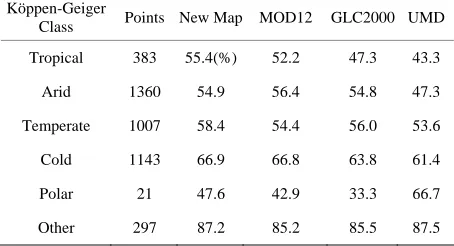
age has drastically improved. than that of our new land cover map, but still higher than those of GLC2000 and UMD in the arid climatic zone. Moreover, there is little DCP-derived validation data for the polar zone. Because this zone is vulnerable to the effects of global warming, much more DCP-derived validation data is required in polar zone.
Comparison of the DCP-derived validation informa-tion with the new land cover map and the existing land cover maps produced overall agreement rates of 61.3% for our new land cover map, 60.4% for MOD12, 58.9% for GLC2000, and 55.2% for UMD. Similarly, compari-son of the DCP-derived validation information with the new land cover map and the existing land cover maps produced kappa coefficient of 0.5 for our new land cover map, 0.47 for MOD12, 0.47for GLC2000, and 0.41 for UMD. (Table 1).
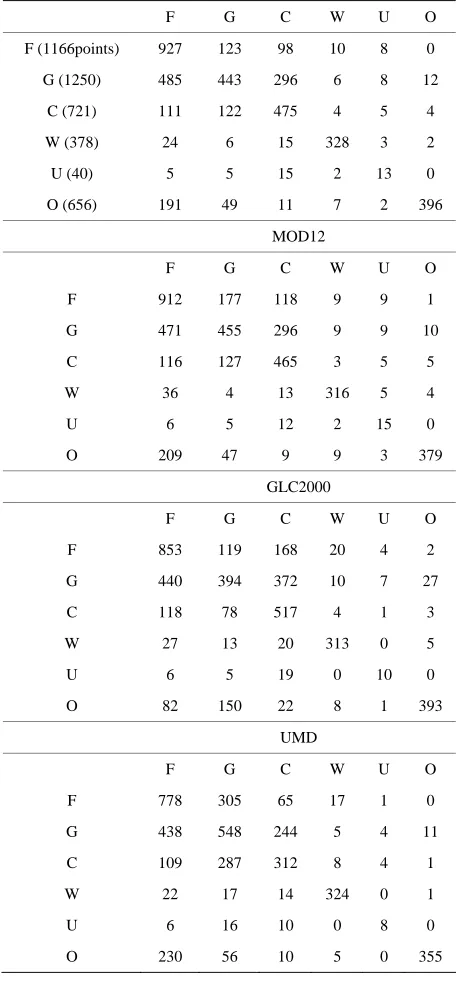
Although accurate evaluation data for each of the six LULUCF land cover classes (Table 3) show that the overall agreement with DCP data was higher for our new land cover map than for the existing three maps, UMD showed the highest agreement for grasslands, GLC2000 for croplands, and MOD12 for settlements. However, the agreement rate of GLC2000 with 721 croplands DCP validation points is only 46%. This suggests that the ar-eas of grassland shown by UMD, and of cropland shown by GLC2000, are excessive. There are comparatively few incorrect classifications of forest. There are many places in existing land cover maps where grassland that has been validated by DCP data has been misclassified as forest. These findings suggest that further work is re-quired to improve the classification methodology for grassland as well as to incite the definition of forest. We compared mod12_6c, glc_6c and umd_6c and the agree-ments between them were 87% between mod12_6c and glc_6c, 86% between glc_6c and umd_6c and 90% be-tween mod12_6c and umd_6c respectively. According to the report of Giri, agreement between original MOD12 and GLC2000 is 59% which means that increasing the number of class makes uncertainty in classification and could assume that we need further investigation for the integration in class as mod12_6c and umd_6c are much similar than those mod12_6c and glc_6c.
These rates of agreement are similar to those obtained by Iwao et al. [8] in their validation of Eurasian land cover maps.
[image:4.595.57.285.368.535.2]We used the 4211 DCP points to determined the rates of agreement of each land cover map with DCP data for six major climatic zones (tropical, arid, temperate, cold, polar, and other) according to the Köppen-Geiger climate classification map [14] (Table 2). Although our results show that the agreement rate for MOD12 was higher
Table 1. Rates of agreement (%) between the global land cover maps of this study with DCP-derived validation data for six LULUCF land cover classes.
LULUCF class
(Points) New MOD12 GLC2000 UMD
Forest land 1166 79.5 78.2 73.2 66.7
Grassland 1250 35.4 36.4 31.5 43.8
Cropland 721 65.9 64.5 71.7 43.8
Wetland 378 86.8 83.6 82.8 85.7
Settlements 40 32.5 37.5 25.0 20.0
Other land 656 60.4 57.8 59.9 54.1
Overall agreements(%)
4211 61.3 60.4 58.9 55.2
Kappa Coefficient 0.5 0.47 0.47 0.41
The integration and construction of SYNMAP included data from the GLCC Data Base Version 2.0 (U.S. Geo-logical Survey, Global land cover, 1999; available at http://edcsns17.cr.usgs.gov/glcc/globdoc2_2.html) as well as MOD12 and GLC2000. As a further test of our new integration method, we also merged the data from MOD12, GLC2000, and GLCC, and compared both the output of this merged data set and GLCC data with DCP validation points (Table 4). For GLCC, we used the simplified IGBP class scheme (GLCC_sigbp) as a re-placement for UMD_sigp of our previous integration. The overall agreement rate for GLCC with 4211 DCP validation points was 53.2% (Table 4), which is lower than the three land cover maps we had already validated.
Table 2. Rates of agreement j(%) between the global land cover maps of this study and DCP-derived validation data for the six climatic zones of the Köppen-Geiger climate classification scheme.
Köppen-Geiger
Class Points New Map MOD12 GLC2000 UMD
Tropical 383 55.4(%) 52.2 47.3 43.3
Arid 1360 54.9 56.4 54.8 47.3
Temperate 1007 58.4 54.4 56.0 53.6
Cold 1143 66.9 66.8 63.8 61.4
Polar 21 47.6 42.9 33.3 66.7
Other 297 87.2 85.2 85.5 87.5
[image:4.595.58.285.596.719.2]Table 3. Agreement pattern between the land cover maps of this study with DCP-derived validation data for six LU- LUCF land cover classes. F, Forest lands; G, Grasslands; C, Croplands; W, Wetlands; U, Settlements; O, Other.
Table 4. Rates of agreement (%) between the combined MOD12, GLC2000, and GLCC global land cover map and GLCC alone with DCP-derived validation data for six LULUCF land cover classes.
F G C W U O
F (1166points) 927 123 98 10 8 0
G (1250) 485 443 296 6 8 12
C (721) 111 122 475 4 5 4
W (378) 24 6 15 328 3 2
U (40) 5 5 15 2 13 0
O (656) 191 49 11 7 2 396
MOD12
F G C W U O
F 912 177 118 9 9 1
G 471 455 296 9 9 10
C 116 127 465 3 5 5
W 36 4 13 316 5 4
U 6 5 12 2 15 0
O 209 47 9 9 3 379
GLC2000
F G C W U O
F 853 119 168 20 4 2
G 440 394 372 10 7 27
C 118 78 517 4 1 3
W 27 13 20 313 0 5
U 6 5 19 0 10 0
O 82 150 22 8 1 393
UMD
F G C W U O
F 778 305 65 17 1 0
G 438 548 244 5 4 11
C 109 287 312 8 4 1
W 22 17 14 324 0 1
U 6 16 10 0 8 0
O 230 56 10 5 0 355
LULUCF class (Points)
New (MOD12,
GLC2000, GLCC) GLCC
Forest land 1166 79.1 67.4
Grassland 1250 29.9 23.4
Cropland 721 73.1 72.0
Wetland 378 84.9 83.9
settlements 40 30.0 27.5
Other land 656 57.5 48.2
Overall
agreements(%) 4211 60.2 53.2
ments than MOD12_6c did. As a result, the overall agreement rate for MOD12, GLC2000 and GLCC with the new combined map with 4211 DCP validation points was 60.2%, which is slightly lower than that of MOD12. These results suggest that the accuracy of the resultant map produced by using our new method is very reliant on the accuracy of the input land cover maps and does not always provide improvement. DCP-derived valida-tion informavalida-tion is indispensable for the assessment of land cover maps.
Our results show statistically significant differences between our new land cover map and both GLC2000 and UMD, and also showed the improvement in kappa coef-ficient, but no statistically significant difference between our new land cover map and MOD12.
Several new land cover maps that can be usefully in-tegrated to produce another DCP-validated land cover are available such as Global Land Cover by National Mapping Organizations (GLCNMO) produced by the International Steering Committee for Global Mapping (ISCGM) (available at http://www.iscgm.org/cgi-bin/fs- wiki/wiki.cgi) and GlobCover Land Cover produced by the European Space Agency (available at http://ionia1.
esrin.esa.int/index.asp).
4. Conclusions
We developed a new map integration method based on the principle of favoring the majority view to produce a new global land cover map by combining data from three existing land cover maps. The method we have proposed in this paper enables the combination of existing global land cover maps based on different classification schemes and provides a user-friendly map which utilizes an exist-ing land cover classification scheme. We validated the resultant map, and the individual maps merged to produce it, by comparing them to 4211 terrestrial DCP-derived better agreement rates than MOD12_6c.
[image:5.595.307.536.126.260.2]K. IWAO ET AL. 165
validation points worldwide. The validation data we have developed is one of the best available land cover valida-tion datasets based on field observavalida-tions in terms of its numbers and its distribution. The validation showed agreement rates of 61.3% for the new land cover map, 60.4% for MOD12, 58.9% for GLC2000, 55.2% for UMD, and 53.2% for GLCC which showed the same tendency compared with the previous work applied for Eurasia using 749 DCP-derived validation points. Our analysis shows statistically significant differences be-tween the new land cover map and both GLC2000 and UMD. The agreements were improved in most of the classes as well as major climate zones. Some existing maps might overestimate specific classes such as an overestimate of cropland in GLC2000, which might ap-pear as high agreements. Also, our findings suggest that further work is required to improve the classification methodology for grassland as well as to clarify the defi-nition of forest. Moreover, there is little DCP-derived validation data for the polar zone. Because this zone is vulnerable to the effects of global warming, much more DCP-derived validation data is required. DCP-derived validation data will be available in 2011 at the GEO Grid (Global Earth Observation Grid). A map integration sys-tem based on the principle of favoring the majority view will also be available as a service at the website.
5. Acknowledgements
We acknowledge with gratitude funding support for this study from the Global Environmental Research Fund of the Ministry of the Environment of Japan (Study leader: Takehisa Oikawa) under program S-1: Integrated Study for Terrestrial Carbon Management of Asia in the 21st Century Based on Scientific Advancements. We thank the founder, organizers, and all participants in the Degree Confluence Project. We also acknowledge ongoing sup-port from the National Institute of Advanced Industrial Science and Technology and the National Institute for Environmental Studies.
6. References
[1] R. S. DeFries, C. B. Field, I. Fung, G. J. Collatz and L. Bounoua, “Combining Satellite Data and Biogeochemical Models to Estimate Global Effects of Human-Induced Land Cover Change on Carbon Emissions and Primary Productivity,” Global Biogeochemical Cycles, Vol. 13, No. 3, 1999, pp. 803-815.
doi:10.1029/1999GB900037
[2] D. E. Ahl, S. T. Gower, D. S. Mackay, S. N. Burrows, J. M. Norman and G. R. Diak, “The Effects of Aggregated Land Cover Data on Estimating NPP in Northern Wis-consin,” Remote Sensing of Environment,2005, Vol. 97, pp. 1-14.
doi:10.1016/j.rse.2005.02.016
[3] T. Sasai, K. Ichii, Y. Yamaguchi and R. Nemani, “Simu-lating Terrestrial Carbon Fluxes Using the New Bio-sphere Model ‘BioBio-sphere Model Integrating Eco-Physio- logical and Mechanistic Approaches Using Satellite Data’ (BEAMS),” Journal of Geophysical Research, Vol. 110, 2005.
[4] M. Jung, H. Kathrin, H. Martin and C. Galina, “Exploit-ing Synergies of Global Land Cover Products for Carbon Cycle Modeling,” Remote Sensing of Environment, Vol. 101, 2006, pp. 534-553. doi:10.1016/j.rse.2006.01.020
[5] M. Obersteiner, G. Alexandrov, P. Benítez, I. McCallum, F. Kraxner, K. Riahi, D. Rokityanskiy and Y. Yamagata, “Global Supply of Biomass for Energy and Carbon Se-questration from Afforestation/Reforestation Activities,” Mitigation and Adaptation Strategies for Global Change, Vol. 11, No. 5-6, 2006, pp. 1003-1021.
doi:10.1007/s11027-006-9031-z
[6] C. Giri, Z. Zhu and B. Reed, “A Comparative Analysis of the Global Land Cover 2000 and MODIS Land Cover Data Sets,” Remote Sensing of Environment, Vol. 94, 2005, pp. 123-132. doi:10.1016/j.rse.2004.09.005
[7] I. McCallum, M. Obersteiner, S. Nilsson and A. Shvi-denko, “A Spatial Comparison of Four Satellite Derived 1 km Global Land Cover Datasets,”International Journal of Applied Earth Observation and Geoinformation, Vol. 8, No. 4, 2006, pp. 246-255.
doi:10.1016/j.jag.2005.12.002
[8] K. Iwao, K. Nishida, T. Kinoshita and Y. Yamagata, “Validating Land Cover Maps with Degree Confluence Project Information,” Geophysical Research Letters, Vol. 33, 2006.
[9] F. Fritz, I. McCallum, C. Schill, C. Perger, R. Grillmayer, F. Achard, F. Kraxner and M. Obersteiner, “Geo- Wiki.Org: The Use of Crowdsourcing to Improve Global Land Cover,” Remote Sensing of Environment, Vol. 1, 2009, pp. 345-354.
[10] X. H. Liu, A. K. Skidmore and O. H. Van, “Integration of Classification Methods for Improvement of Land-Cover Map Accuracy,” The ISPRS Journal of Photogrammetry and Remote Sensing, Vol. 56, 2002, pp. 257-268.
doi:10.1016/S0924-2716(02)00061-8
[11] M. Hansen, R. DeFries, J. R. G. Townshed and R. Sohl-berg, “Global Land Cover Classification at 1km Resolu-tion Using a Decision Tree Classifier,” International Journal of Remote Sensing, Vol. 21, No. 6-7, 2000, pp. 1331-1365. doi:10.1080/014311600210209
[12] Intergovernmental Panel on Climate Chang, “Good Prac-tice Guidance for Land Use, Land-Use Change, and For-estry,” 2003.
[13] H. Sato and R. Tateishi, “The Review of a Global Land Use, Land Cover, and Vegetation Classification System,” Geogr. Surv. Inst. Japan Annu. Rep., 2001, Vol. 96, pp. 69-99.
[14] M. C. Peel, B. L. Finlayson and T. A. McMahon, “Up-dated World Map of the Köppen-Geiger Climate Classi-fication,” Hydrology and Earth System Sciences, Vol. 11, No. 5, 2007, pp. 1633- 1644.