In situ Distributed Genetic Programming: An Online Learning
Framework for Resource Constrained Networked Devices
PHILIP JUAN VALENCIA
A thesis submitted for the degree of Doctor of Philosophy at The University of Queensland in 2015
© Philip Juan Valencia, 2016. Typeset in LATEX 2ε.
This research presents In situ Distributed Genetic Programming (IDGP) as a framework for distributively evolving logic while attempting to maintain acceptable average perfor-mance on highly resource-constrained embedded networked devices.
The framework is motivated by the proliferation of devices employing microcontrollers with communications capability and the absence of online learning approaches that can evolve programs for them. Swarm robotics, Internet of Things (IoT) devices including smart phones, and arguably the most constrained of the embedded systems, Wireless Sensor Networks (WSN) motes, all possess the capabilities necessary for the distributed evolution of logic - specifically the abilities of sensing, computing, actuation and com-munications. Genetic programming (GP) is a mechanism that can evolve logic for these devices using their “native” logic representation (i.e. programs) and so technically GP could evolve any behaviour that can be coded on the device.
IDGP is designed, implemented, demonstrated and analysed as a framework for evolv-ing logic via genetic programmevolv-ing on highly resource-constrained networked devices in real-world environments while achieving acceptable average performance.
Designed with highly resource-constrained devices in mind, IDGP provides a guide for those wishing to implement genetic programming on such systems. Furthermore, an implementation on mote class devices is demonstrated to evolve logic for a time-varying sense-compute-act problem and another problem requiring the evolution of primitive com-munications. Distributed evolution of logic is also achieved by employing the Island Model architecture, and a comparison of individual and distributed evolution (with the same and
slightly different goals) presented. This demonstrates the advantage of leveraging the fact that such devices often reside within networks of devices experiencing similar conditions. Since GP is a population-based metaheuristic which relies on the diversity of the pop-ulation to achieve learning, many, if not most, programs within the poppop-ulation exhibit poor performance. As such, the average observed performance (pool fitness) of the population using the standard GP learning mechanism is unlikely to be acceptable for online learning scenarios. This is suspected to be the reason why no previous attempts have been made to deploy standard GP as an online learning approach. Nonetheless, the benefits of GP for evolving logic on such devices are compelling and motivated the design of a novel sat-isficing heuristic called Fitness Importance (FI). FI is population-based heuristic used to bias the evaluation of candidate solutions such that an “acceptable” average fitness (AAF) is achieved while also achieving ongoing, though diminished, learning capacity. This trade off motivated further investigation into whether dynamically adjusting the average perfor-mance in response to AAF would be superior to a constant, balanced, performing-learning approach. Dynamic and constant strategies were compared on a simple problem where the AAF target was changed during evolution, revealing that dynamically tracking the AAF target can yield a higher success rate in meeting the AAF.
The combination of IDGP and FI offers a novel approach for achieving online learning with GP on highly resource-constrained embedded systems. Furthermore, it simultane-ously considers the acceptable average performance of the system which may change during the operational lifetime. This approach could be applied to swarm and cooperative robot systems, WSN motes or IoT devices allowing them to cooperatively learn and adapt their logic locally to meet dynamic performance requirements.
This thesis is composed of my original work, and contains no material previously pub-lished or written by another person except where due reference has been made in the text. I have clearly stated the contribution by others to jointly-authored works that I have included in my thesis.
I have clearly stated the contribution of others to my thesis as a whole, including statistical assistance, survey design, data analysis, significant technical procedures, professional editorial advice, and any other original research work used or reported in my thesis. The content of my thesis is the result of work I have carried out since the commencement of my research higher degree candidature and does not include a substantial part of work that has been submitted to qualify for the award of any other degree or diploma in any university or other tertiary institution. I have clearly stated which parts of my thesis, if any, have been submitted to qualify for another award.
I acknowledge that an electronic copy of my thesis must be lodged with the University Li-brary and, subject to the policy and procedures of The University of Queensland, the the-sis be made available for research and study in accordance with the Copyright Act 1968 unless a period of embargo has been approved by the Dean of the Graduate School. I acknowledge that copyright of all material contained in my thesis resides with the copy-right holder(s) of that material. Where appropriate I have obtained copycopy-right permission from the copyright holder to reproduce material in this thesis.
Publications during candidature
Valencia, P., Haak, A., Cotillon, A., and Jurdak, R. (2014). Genetic programming for smart phone personalisation. Applied Soft Computing, 25(0):86-96.
Cotillon, A., Valencia, P., and Jurdak, R. (2012). Android Genetic Programming Frame-work. In Lecture Notes in Computer Science, pages 13-24. Springer Berlin Heidelberg, Berlin, Heidelberg.
Valencia, P., Lindsay, P., and Jurdak, R. (2010). Distributed genetic evolution in WSN. In IPSN’10: Proceedings of the 9th ACM/IEEE International Conference on Information Processing in Sensor Networks, pages 13-23, New York, New York, USA. ACM
Valencia, P., Jurdak, R., and Lindsay, P. (2010). Fitness Importance for Online Evolution. In Proceedings of the 12th Annual Conference Companion on Genetic and Evolutionary Computation, pages 2117-2118, New York, NY, USA. ACM.
Valencia, P. (2007). In situ genetic programming for wireless sensor networks. In Hazas, M., Boulis, A., and Girod, L., editors,SenSys 2007 Doctoral Colloquium, pages 37-41.
Publications included in this thesis
Valencia, P., Lindsay, P., and Jurdak, R. (2010). Distributed Genetic Evolution in WSN. In Proceedings of the 9th ACM/IEEE International Conference onInformation Processing in Sensor Networks, IPSN ’10, pages 13-23, New York, NY, USA. ACM - Incorporated with significant modification and extension into Chapter 3
Philip Valencia Concept (90%)
Implementation (100%) Drafting and writing (70%)
Raja Jurdak Concept (5%)
Drafting and writing (20%)
Peter Lindsay Concept (5%)
Valencia, P., Jurdak, R., and Lindsay, P. (2010). Fitness Importance for Online Evolution. In Proceedings of the 12th Annual Conference Companion on Genetic and Evolutionary Computation, pages 2117-2118, New York, NY, USA. ACM - Incorporated with modifica-tion and extension into Chapter 3 and Chapter 4
Philip Valencia Concept (80%)
Drafting and writing (90%)
Raja Jurdak Concept (10%)
Drafting and writing (5%)
Peter Lindsay Concept (10%)
Drafting and writing (5%)
Contributions by others to the thesis
No contributions by others.
Statement of parts of the thesis submitted to qualify for the award of another degree
My PhD was motivated by a passion for Artificial Intelligence that grew from working with a number of distinguished scientists at the CSIRO in Sydney who fostered very forward-looking scientific thinking by junior staff. With their inspiration and support from the CSIRO (with particular thanks to Alex Zelinsky, Steve Guigni and Peter Corke), I was able to commence a part-time PhD candidature.
As a part-time PhD student (and full time employee), I have been present “part-time” to my university and work supervisors, project leaders, family and friends. Luckily, I have been fortunate enough to have people in my life who could appreciate my predicament and support me anyway, for which I am extremely grateful. I wish to thank my past PhD supervisors, Professor Peter Corke and Professor Mikhail Prokopenko, and my work su-pervisors Dr Brano Kusy, Dr Tim Wark and Dr Michael Brünig for their many efforts to align my PhD with my career research. I also thank Mr Les Overs, Mr Stephen Brosnan and Mr John Whitham who designed, sourced, built and repaired various equipment used during my studies.
I am however truly indebted to my current supervisors, Prof. Peter Lindsay who has guided and stuck with me from the very beginning, and Dr Raja Jurdak for his sage-like writing advice and motivation.
Finally to my wife, my children who have only ever known a “part-time PhD dad” and my family and friends who have seen a lot less of me than they ought - Thank You - for understanding, supporting and believing in me.
Keywords
genetic programming, embedded systems, internet of things, wsn, online learning, ma-chine learning, metaheuristic, exploration and exploitation, robotics
Australian and New Zealand Standard Research Classifications (ANZSRC):
080101 Adaptive Agents and Intelligent Robotics 40% 080108 Neural, Evolutionary and Fuzzy Computation 30% 080504 Ubiquitous Computing 30%
Fields of Research (FoR) Classification:
Abstract iii
Declaration by Author v
Acknowledgements ix
List of Figures xix
List of Tables xxv 1 Overview 1 1.1 Motivation . . . 2 1.2 Thesis Overview . . . 3 1.2.1 Thesis Question . . . 3 1.2.2 Thesis Outcomes . . . 3
1.2.3 Thesis Scope and Limitations . . . 4
1.3 Methodology . . . 5
1.4 Original Contributions . . . 6
1.5 Thesis Structure . . . 7
2 Related Work: Genetic Programming on Embedded Systems 9 2.1 Basic Ideas and Concepts . . . 10
2.1.1 No Free Lunch Theorem . . . 11 xi
2.1.2 Evolutionary and Genetic Algorithms . . . 11 2.1.3 Genetic Programming . . . 12 2.1.4 Island Model . . . 15 2.1.5 Online Learning . . . 15 2.1.6 Neural Networks . . . 16 2.1.7 Reinforcement Learning . . . 17
2.1.8 Wireless Sensor Networks . . . 18
2.2 GP on Small Robotic Platforms . . . 19
2.2.1 SAMUEL . . . 19
2.2.2 Genetic Evolution of PDL Processes . . . 23
2.2.3 Automatic Induction of Machine Code - Genetic Programming (AIM-GP) on Khepera Robots . . . 26
2.2.4 Genetically Programmed Networks (GPN) . . . 29
2.2.5 Embodied Evolution (EmEvo) . . . 31
2.2.6 Distributed Agent Evolution with Dynamic Adaptation to Local Un-expected Scenarios (DAEDALUS) . . . 31
2.3 GP on WSN Motes . . . 33
2.3.1 Broadcast-Distributed Parallel (BDP) Genetic Programming . . . 34
2.3.2 Distributed Genetic Programming Framework (DGPF) . . . 36
2.3.3 Distributed Optimization for WSN (DOWSN) . . . 37
2.4 GP on IoT Devices . . . 40
2.4.1 Ulfsark Framework . . . 41
2.4.2 The Android Genetic Programming (AGP) . . . 42
2.5 Summary of Related Work . . . 43
3 In situ Distributed Genetic Programming Framework 47 3.1 Scope . . . 48
3.1.1 Mote-class Embedded System . . . 49
3.1.2 Communications Capability . . . 50
3.1.4 Tree-based GP with Human Readable Program Representation . . 51
3.1.5 Scope Summary . . . 51
3.2 Design . . . 52
3.2.1 Memory Considerations . . . 52
3.2.2 Compact Program Representation . . . 54
3.2.2.1 Virtualisation of Hardware . . . 54
3.2.2.2 Prefix Notation . . . 55
3.2.2.3 Program Metadata . . . 58
3.2.3 Program Generation . . . 59
3.2.3.1 Generating Random Programs . . . 59
3.2.4 Program Execution and Evaluation . . . 65
3.2.4.1 Program Scheduling and Execution . . . 65
3.2.5 Communications Subsystem . . . 66
3.2.6 IDGP Design Overview . . . 67
3.3 Implementation on Motes . . . 68
3.3.1 The Fleck3b Mote Platform . . . 68
3.3.2 Program Representation . . . 71
3.3.3 Program Evaluation on Fleck OS . . . 72
3.4 Evaluation on a Sensing-Actuation Problem . . . 72
3.4.1 LED - Photodiode “Blink3” Problem . . . 73
3.4.1.1 Time-Varying Sensing-Actuation Requirement . . . 73
3.4.1.2 An Optimal Solution . . . 77
3.4.2 Results and Discussion . . . 78
3.4.2.1 Random Search Baseline . . . 78
3.4.2.2 Single Mote (Local) Evolution . . . 80
3.4.2.3 Multiple Mote Homogeneous Logic . . . 83
3.4.2.4 Multiple Mote Heterogeneous Logic . . . 84
3.4.2.5 Adaptation to Dynamic Environmental Conditions . . . 86
3.5 Evaluation on Evolution of Comms Problem . . . 87
3.5.1.1 Packet Receiving-Sending Requirement . . . 88
3.5.1.2 An Optimal Solution . . . 89
3.5.2 Results and Discussion . . . 91
3.6 Discussion . . . 92
3.6.1 Challenges of In Situ Evolution . . . 92
3.6.2 The Performing-Learning Paradox . . . 94
3.6.3 Challenges of Distributed Evolution . . . 94
3.6.4 IDGP Configuration . . . 96
3.7 Conclusion . . . 97
4 Fitness Importance 99 4.1 Motivation . . . 100
4.1.1 Online Learning with a Minimum Performance Constraint . . . 101
4.1.2 Inspiration from Natural Systems . . . 101
4.1.2.1 Sprinter Allegory . . . 101
4.1.3 Population-based Performance . . . 102
4.1.4 An Ideal Fitness Importance Heuristic . . . 103
4.2 Related Heuristics . . . 104
4.2.1 Satisficing . . . 104
4.2.2 Exploration-Exploitation (EE) . . . 105
4.2.3 Multi-Armed Bandit (MAB) . . . 106
4.2.4 Performance Metrics for Learning Algorithms . . . 108
4.3 FI Analytic Model . . . 110
4.3.1 Acceptable Average Fitness . . . 110
4.3.2 Fitness Importance Function,Φ . . . 111
4.3.3 Application Scenarios . . . 123
4.3.4 FI Performance Metrics . . . 124
4.3.4.1 Normalised Average Performance . . . 124
4.3.4.2 FI Success Rate Metric . . . 125
4.5 Integrating FI into the IDGP Framework . . . 134
4.5.1 UsingGsimpleto achieve desired performance . . . 135
4.6 Discussion . . . 137
4.6.1 Slack: Excess Energy and Time . . . 137
4.6.2 Practicalities of Online Learning . . . 140
4.6.3 Challenges of In situ Evolution . . . 141
4.7 Conclusion . . . 141
5 Constant FI Parameter Management Strategies 143 5.1 Introduction . . . 144
5.2 Instantaneous Performance Control . . . 144
5.2.1 Experimental Setup . . . 144
5.2.2 Analysis . . . 145
5.2.3 Impact on Learning and Performance . . . 146
5.2.4 Discussion . . . 151
5.3 Long Term Performance Effects . . . 153
5.3.1 Empirical Evaluation . . . 153
5.3.2 Setting FI Online . . . 158
5.4 Conclusion . . . 163
6 Dynamic FI Management Strategies 165 6.1 Introduction . . . 166
6.2 Methodology . . . 166
6.2.1 Constant FI Parameter Management Strategies . . . 168
6.2.1.1 Pure Exploration Strategy . . . 169
6.2.1.2 Pure Exploitation Strategy . . . 170
6.2.1.3 Constant FI Parameter Strategy . . . 170
6.2.2 Dynamic FI Parameter Management Strategies . . . 171
6.2.2.1 Greedy Strategy . . . 171
6.2.2.2 Dynamic FI Tracking Strategy . . . 172
6.2.3.1 The OneMax Problem . . . 174
6.2.3.2 The Concatenated-V Problem . . . 175
6.2.4 Solver Selection and Description . . . 178
6.2.4.1 Selection of GA as the Solver . . . 178
6.2.4.2 GA Settings . . . 179
6.2.5 Evaluation . . . 183
6.2.5.1 Fitness Importance Function for this Experiment . . . 183
6.2.5.2 Performance Metric and Evaluation Period . . . 185
6.2.5.3 Evaluation Period . . . 187
6.3 Results . . . 189
6.3.1 Pure Learning (Exploration) Strategy . . . 190
6.3.2 Constant FI Parameter Strategy . . . 191
6.3.3 Greedy Strategy . . . 192
6.3.4 FI Tracking Strategy . . . 192
6.4 Discussion . . . 193
6.5 Conclusion . . . 194
7 Conclusion 197 7.1 Summary and Conclusions . . . 197
7.2 Future Research . . . 201
A Mathematical Nomenclature 205
B Derivation of the Reduction of Learning Rate due toφ>0 207
C Estimation of Expected Pool Fitness 211
D Design of the Acceptable Average Fitness (AAF)-Tracking Strategy 215
E Usefulness of Randoms 219
References 225
2.1 An example tree-based GP program representing an equation. . . 14
2.2 An example PDL process configuration. Recreated from Fig. 3.11 in [124]. The original figure description reads "Emergent functionality pattern ob-served in process networks. There are two opposing forces, possibly sta-bilised. The processes impact a controlled quantity that indirectly gives rise to emergent functionality. The positive process feeds on itself." . . . 24
3.1 An example of 2 programs using the linear-tree-based-hybrid representa-tion (top) and how crossover and mutarepresenta-tion can be applied to generate off-spring. . . 59
3.2 Relationship between nesting level and the average lines of code for gener-ated programs. The nesting level and number of lines for 5a (c.f. page 78) is indicated by a cross. . . 61
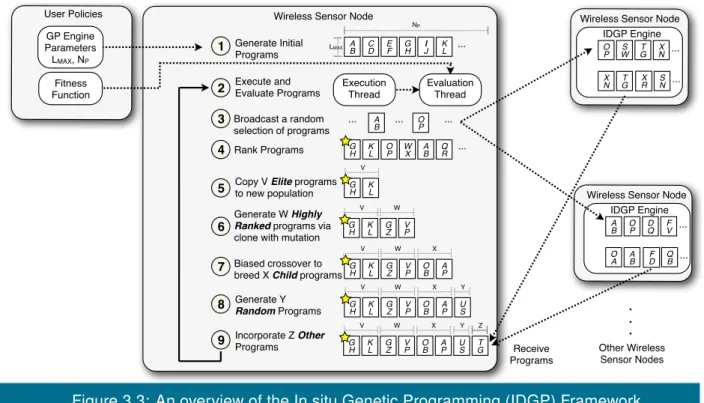
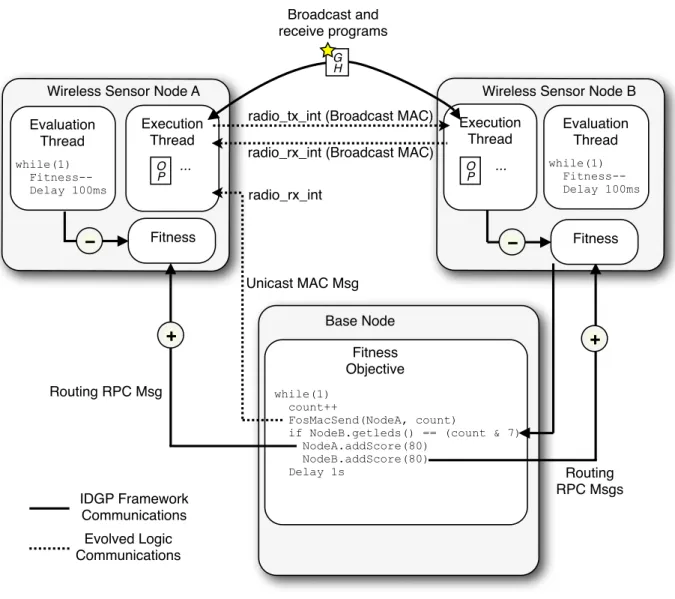
3.3 An overview of the In situ Genetic Programming (IDGP) Framework. . . 68
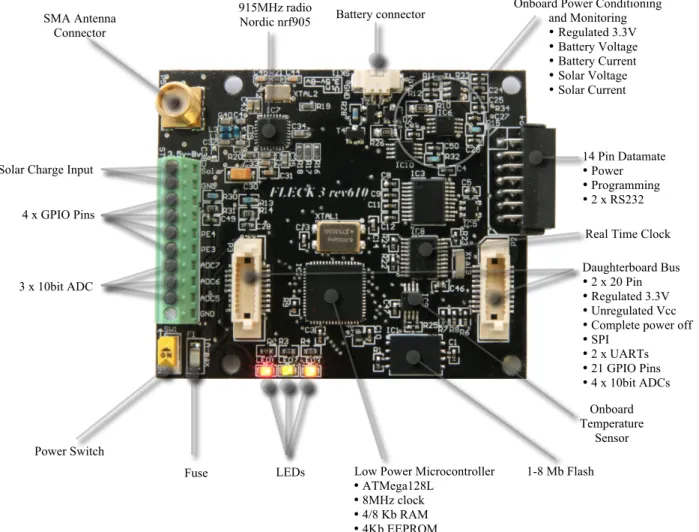
3.4 Fleck3b hardware functionality overview. . . 69
3.5 Fleet of “Fleck cars” (circa 2008). . . 70
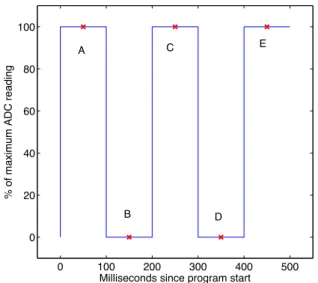
3.6 Sample points shown for the Blink3 objective on an optimal solution (Pro-gram 5c) . . . 76
3.7 Fleck™3b motes with a photodiode connected to an ADC input (shown left) which is facing the onboard LEDs (shown right) . . . 77
3.8 PDF of randomly generating a solution with a specific fitness. . . 80 xix
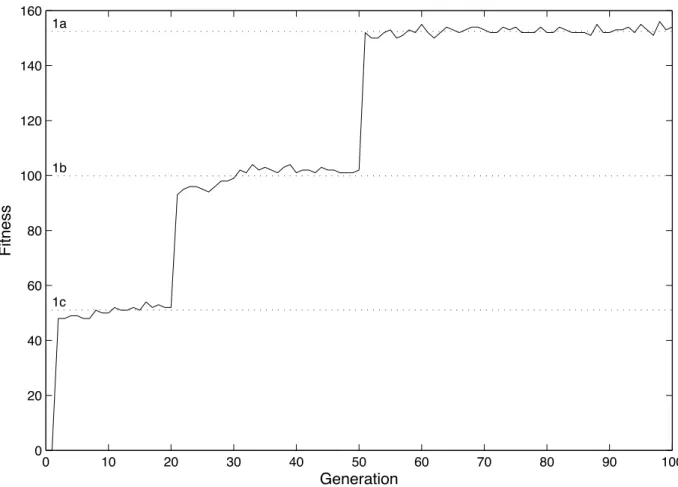
3.9 Discrete Evolution - this evolutionary run exhibits jumps in performance to discrete levels corresponding to mostly functionally equivalent solutions of Programs 5c to Program 5b and finally to an equivalent optimal solution of Program 5a. Such behaviour is typical to evolution of solutions to the
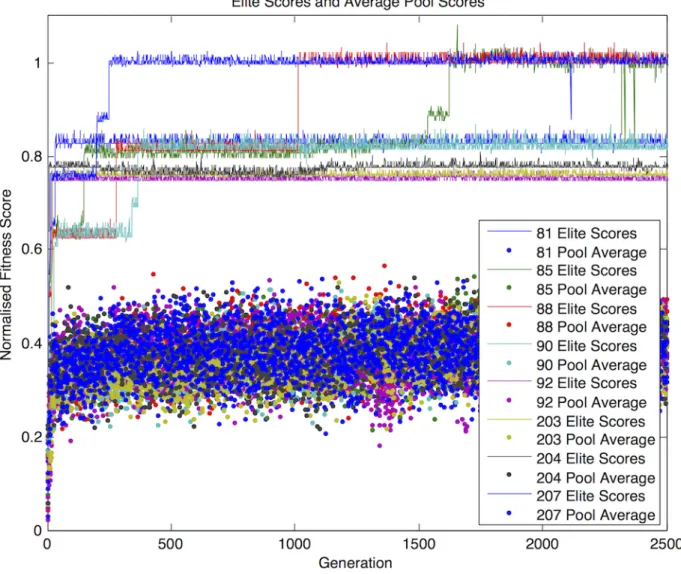
Blink-3 problem. . . 81 3.10 An example of typical evolution trajectories (elite and pool) from 8
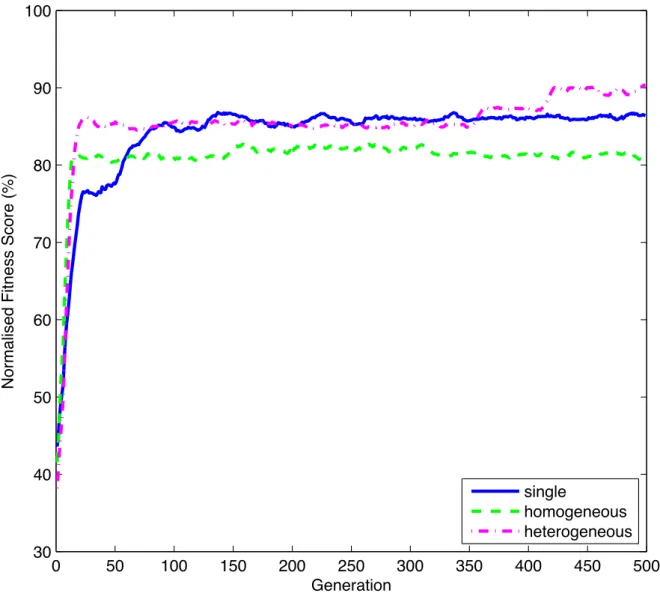
individu-ally evolving motes. . . 82 3.11 Comparison of optimisation trajectories: evolution in isolation, Island Model
(homogeneous) and Island Model (heterogeneous). . . 85 3.12 Adaptation to the “unexpected event” (change in fitness landscape) where
the devices (nodes) were removed from the bag and exposed to ambient lighting conditions. . . 87 3.13 Communications topology for the“PacketForwarder-RfmToLeds” experiment. 90 3.14 “PacketForwarder-RfmToLeds” fitness evolution . . . 92
4.1 λelite∗ for various values ofφaccept showing that the Learning Reduction fac-tor can be estimated more accurately later during evolution. The analytic model suggests that λelite∗ =1−φ, however due to the stochastic and
dis-crete nature of an evolutionary population performance, the trend is hard to see until close to convergence. . . 118 4.2 This figure showsλeliteVsφ. Also shown is the line of1−φ. There is good
correlation with this indicating that Felite(φ, g) = (1−φ) ∫ g
x=k
Felite(0, x)dx is reasonable assumption. . . 120 4.3 λpool∗ for various values ofφ. . . 121 4.4 λpool shows the learning rate reduction in the population including the Elites.
The calculation requires division by(1−φ)so asφincreases, small stochas-tic changes become highly magnified leading to “noisy” calculated values. This is particularly evident forφ=1(bottom right). . . 122
4.5 Expected evolutionary trajectories (of pool and elite fitnesses) with IDGP in a scenario where the fitness landscape suddenly changes (at T3). . . 127
4.6 FI, F I =0,0.2,0.4,0.5,0.6,0.8,1.0, is applied to idealised the pool and elite
fitness curves to demonstrate the complex trade-off for performance and learning over time. . . 129 4.7 An overview of the In situ Genetic Programming (IDGP) framework
ex-tended to use the Fitness Importance heuristic. Note, the population gen-eration is the same build order as shown in Figure 3.3. . . 135 4.8 Hypothesis of how experiments will be evaluated. Show g0, gstart, gf inish,
change of landscape, Faccept1,Faccept2 . . . 139
5.1 Evolution of system performance (pool fitnesses) and learning capability (elite fitnesses) with fixed FI. . . 147 5.2 Cooperative evolution of system performance (pool fitnesses) and learning
capability (elite fitnesses) with various values of FI. . . 148 5.3 As the Fitness Importance is varied, the performance of the nodes, as
measured by the average normalised fitnesses of all programs within a generation, responds accordingly. The change in acceptable performance is produced by employing a population distribution generated by the simple
γ function (refer to Table 4.4). . . 152
5.4 Average elite and pool fitness as a function of generation. The 25th and 75th percentiles are also shown. . . 155 5.5 A snapshot of the Normalised Average Performance (NAP) after generation
500. Higher NAP is achieved as a result of exploiting learnt logic later in the evolution (after good solutions have been discovered) but not so late in the run that it cannot exploit the good solutions over many generations. As such, there is a “sweet spot” for values ofφ and k which are unlikely to be knowable in advance. . . 156
5.6 A snapshot of the standard deviation of NAP after generation 500. There is a trend indicating that there is greater variability in the fitnesses achieved with higher values of FI being applied. This can be interpreted as a “risky” strategy in that you lock in exploitation whatever was learnt at a particular time (which may or may not be high fitness). . . 157 5.7 Standard deviation (N=120) of the Elite fitnesses shows how diverse the
learning rate is between evolutionary runs. . . 157 5.8 The average curve fitting error for a sweep of FI values applied at various
generations. . . 159 5.9 Predicted NAP versus the empirically measured NAP (N=20) with (φ ∈
{0,0.05,0.15,0.4,0.5,0.7,0.95,1}) applied generations (k∈ {5,10,15,25,50,250}).161 5.10 Predicted (blue) versus achieved (red) rankings (N=160) of performance of
individuals in the next generation after FI is applied at various generations. The good correlation provides reassurance that the expected effect of FI reflects the actual performance impact likely to occur. . . 162
6.1 Hypothesis of the expected evolutionary trajectories for variousφ-management strategies. . . 167 6.2 The OneMax objective function fitness landscape forN =7 . . . 174
6.3 Concatenated-V objective function fitness landscape forM =1, k=7(∴N =7)176
6.4 Block fitness, FB, can be described by a V-shaped function of the number of ones in the block. The block fitnesses are combined to generate the
Concatenated-V fitness score. . . 177
6.5 Mean (N =100) elite and pool fitnesses for a variety of population structures
atg=5000for theConcatenated-V problem. The 95% confidence intervals
are indicated with the bars. Note that the elite fitnesses are also shown on the pool fitness plot to highlight how the pool fitness becomes closer to the elite fitness with the removal of ’randoms’ from the population structure. . . 182
6.6 Average (n=100) elite and pool evolutionary trajectories for the standard learning configuration on theConcatenated-V problem. Note that the AAF threshold of 350 is exceeded, on average, after 1215 generations (about a quarter of the 5000 generation evolutionary run). . . 183 6.7 Mean (N = 100) elite and pool fitnesses for a variety of population
struc-tures at g = 5000 for the Concat-V-Change objective function landscape.
The 95% confidence intervals are indicated with the bars. Note that the elite fitnesses are also shown on the pool fitness plot. Unlike inFigure 6.5 however, the exclusion of ’randoms’ from the population structure has a significant deleterious effect on the best solution obtained during the run. . 184 C.1 Variations in the achieved pool fitness,Fpoola from the desired pool fitness,
Fpoold, as well as variations in the achieved Elite fitness, Felite(g) from that of the previous generation, can significantly affect the error in estimation of
Fpoolφ=0. Variations of approximately 1% and 5% are shown. . . 213
E.1 For the "Concat-V-abundance@2500" objective function, it is beneficial to include "Random" individuals in the population. . . 220
2.1 Summary of related research. IDGP (this research) included for comparison. 44 3.1 IDGP Program metadata structure. . . 58 3.2 Example instruction histogram for the code fragments in Figure 3.1 (top). . 60 3.3 Instruction Representation . . . 72 3.4 Both with filter transmissivity of 75% and using the Intor T5 detector. Note
that LEDs that do not correspond to the centre frequency of the filter will still contribute to the ADC reading however, the value is attenuated substantially compared to the matching LED colour. . . 74 3.5 Mean ADC readings (std) for all combinations of LEDs for the 5 nodes with
no other external light sources present. R,G,Y indicates which LEDs (red, green and yellow) were on. Note each mean value was calculated from 200 samples taken periodically every 100 ms. . . 75 4.1 Learning problem type . . . 123 4.2 Symbols . . . 124 4.3 Expected Fitness for Specific Demographics . . . 131 4.4 Subpopulation distributions generated usingγsimplelinearly increasing
num-bers of elites,NE, then iteratively scaling and quantising the remaining sub-populations . . . 136
5.1 Note gains are represented as percentages of the optimal solution fitness during the period when the FI was altered. . . 151 5.2 Goodness of fit for log curve prediction . . . 158 6.1 φ-tracking strategy parameter descriptions . . . 173 6.2 Distribution of fitness scores in the Concatenated-V block landscape for
k =7. p(FB)is the probability of fitnessFB(XR)occurring given a random
bit string,XR. . . 176 6.3 GA “pure learning” configuration and settings. . . 181 6.4 Mean (N=100) success rates for the φ-management strategies. Shaded
cells are within the 95% confidence interval of the best result for that mea-surement. The confidence interval is shown for the whole period perfor-mance. The average final elite fitness is also shown. . . 190 6.5 Elite and pool fitnesses (N=100) for the φ-management strategies after
each AAF target period. The final column shows the average “actual φ” observed for each strategy based on the pool fitness achieved of the pure learning strategy at generation 1000 with the variation from the ideal be-haviour (shown in parenthesis) where applicable. . . 192 A.1 Symbols . . . 206 F.1 Parameter sweep of tracking strategy performances . . . 224
1
Overview
This chapter briefly introduces the motivation of this research; specifically the need for a framework to allow resource constrained embedded devices to evolve their logic while si-multaneously providing utility throughout their lifetimes. The overarching focus and scope of the thesis is then presented along with the major original contributions of this disserta-tion. Following this, the thesis structure is presented.
1.1
Motivation
Microcontrollers (MCU) are processors with vastly inferior computational capability com-pared to that of everyday personal computers. Yet, despite their significant resource constraints, more than 20 billion microcontrollers were sold during 2015, and the number is expected to rise in coming years. Such processors are the preferred choice for the embedded systems that are now ubiquitous throughout our society due to their low price, small size and low power processing.
In recent years, MCU’s have been augmented with wireless communications tech-nology and increasingly sensing and actuation capability. This has enabled “networked” embedded systems such as swarm robotics, smart phones, Wireless Sensor Network (WSN) devices and more generally, the Internet of Things (IoT).
The logic for the devices comprising these systems is represented as programs, or code. These instructions allow the device to read sensor values and perform logic to determine what actions or communications should be performed. Such programs are handcrafted by professional programmers who attempt to consider the many real-world conditions these devices will be subject to. Unfortunately, fixed logic can fail for a variety of reasons and will typically remain broken until human intervention occurs. Excluding failure of hardware or software bugs in the code, the most likely reason for failure is an unanticipated change in the environmental conditions or a change in the context to expect different performance. Predicting and adapting to such changes is a complex task since the changes are often context or locality specific which cannot be known in advance by the programmer.
There is however a means for automatically generating programs known as Genetic Programming (GP). GP has been demonstrated as a mechanism for producing human-level competitive behaviours and ideas. However, employing GP on such resource con-strained devices would be a significant challenge. GP requires a population of programs to be evaluated over a number of generations in order to evolve programs that can achieve acceptable performance. However, executing a population of various programs with un-known behaviours would be unacceptable in many situations. As such, not only must the
issues of resource constraints be addressed, but a mechanism for achieving acceptable performance while learning is also necessary.
This thesis attempts to address this challenge by answering the question: “Can logic be evolved via genetic programming on highly resource-constrained networked de-vices deployed in real-world environments while achieving acceptable average per-formance?"
1.2
Thesis Overview
1.2.1
Thesis Question
This thesis aims to address the question:
Can logic be evolved via genetic programming on highly resource-constrained networked devices deployed in real-world environments while achieving accept-able average performance?
To answer this, the question is broken into the following 3 subquestions:
1. Can distributed GP be implemented on such highly-constrained embedded devices? 2. Can acceptable average performance be achieved when needed while continuing
to learn?
3. Can dynamically balancing performing and learning achieve better success at meet-ing acceptable average performance targets durmeet-ing the system lifetime?
1.2.2
Thesis Outcomes
To answer the first sub-question, a framework for evolving logic on networked, yet re-source constrained, devices was formulated. The In situ Distributed Genetic Programming (IDGP) framework (designed and detailed in Chapter 3) was implemented and demon-strated on arguably the most highly resource-constrained embedded class of devices known as WSN motes. The framework was used to demonstrate cooperative evolution
of programs across a network of devices using the Island Model to solve a time varying sensing-actuating task and a task requiring evolution of communications, under environ-ments subject to real-world effects. z Online learning via GP was successfully demon-strated, however the average observed behaviour (performance) of devices however was deemed unacceptable for many situations. To address this, and the second sub-question, a novel heuristic called Fitness Importance (FI) was developed (seeChapter 4). FI is used to bias the selection of candidate solutions evaluated such that an “acceptable” average fitness (AAF) is achieved. Using FI, it was demonstrated that it is possible to continue to learn while attaining AAF (as shown in Chapter 5). However it was also found that the learning capacity decreases as the AAF target is increased.
This contention, captured within sub-question 3, motivated a final investigation (in
Chapter 6) into whether dynamically adjusting performance in response to AAF would be superior to a constant balanced approach to performing-learning. Dynamic and constant strategies of balancing learning versus performing were compared on a simple problem where the AAF target was changed during evolution, ultimately revealing that dynamically tracking the AAF target can indeed yield a higher success rate of meeting the AAF.
The combination of IDGP and FI offers a novel approach for achieving online learning with GP on highly resource-constrained embedded systems. It also enables simultaneous learning while attempting to meet an acceptable average performance which may change throughout the operational lifetime. As such, this thesis presents a novel approach that could be applied to small robots, WSN motes or IoT devices to allow them to cooperatively learn and adapt their logic in order to meet dynamic performance requirements.
1.2.3
Thesis Scope and Limitations
From a broad perspective, this research is interested in evolving logic on constrained devices and achieving acceptable performance. There are many avenues one could take to achieve this and so some limitation of research scope is necessary.
First, Genetic Programming (GP) will be used as the logic evolving mechanism. This is largely justified by the fact that GP can automatically generate programs and that the
processors of embedded systems can run programs. Hence, this is an automated means for generating logic. Other approaches will not be investigated.
Second, this thesis focusses on how highly resource-constrained devices might achieve evolution of logic. As such WSN mote devices will be employed as representative of this highly resource-constrained class of embedded systems and devices with significant com-putational resources (PC-class) will not be considered.
Finally, achieving “acceptable” performance using online machine learning is by no means a new concept. Using GP as an online machine learning mechanism to achieve acceptable performance however has not been extensively studied. Due to the first reduc-tion in scope limiting the learning mechanism to GP, a method for achieving “acceptable” performance with GP will need to be addressed. Further discussion and justifications of the thesis scope appears in3.1 Scope.
1.3
Methodology
To address thethesis questions, a framework was designed to achieve distributed genetic programming with consideration of the significant computational and memory constraints of mote-class devices. Specifically, the scenario where there is less memory (RAM/ROM) available to store a typical population of programs is considered. The literature survey on related research was conducted to formulate considerations specific to a framework that evolves logic on resource constrained devices. The framework was then implemented on a collection of devices representative of the resource-constrained class of embedded de-vices to address problems that requires logic to perform time-dependant actions based on real-world sensor inputs. The distributed evolution capability was demonstrated through experiments on multiple devices where devices have the same objective and also where devices have slightly differing objectives. After the learning capability was demonstrated, achieving acceptable performance was then be studied. “Acceptable” performance was defined and an online learning heuristic for achieving acceptable performance was devel-oped. Finally, the implications of applying the heuristic(s) in various modes (constant and dynamic) was studied. Section 1.5details which chapters relevant to each of these steps.
1.4
Original Contributions
The overarching contribution of this thesis is a framework (IDGP) for achieving in situ distributed evolution of logic on highly resource-constrained embedded devices and a heuristic (FI) to bias their average performance on demand. Both the IDGP framework and the FI heuristic can be used independently, however, together they offer a framework for distributively evolving logic while achieving an acceptable average performance. This combination should be applicable to swarm robotics, IoT devices such as smart phones and WSN motes, and offer these platforms a mechanism .
A list of more specific contributions by this thesis is as follows:
• In situ Distributed Genetic Programming (IDGP) as a framework for embedded sys-tems engineers to achieve online evolution of logic on resource-constrained devices. • The Fitness Importance (FI) heuristic as a means of indicating “acceptable average performance” in terms of the current population characteristics as a function of time. • A metaheuristic for population-based learners which generates a biased population to increase the expected fitness of the population based on an input parameter for the desired improvement and the optimal learning population configuration.
• The extension of the IDGP framework with FI and an analysis of an implementation of the framework on physically deployed devices.
• Demonstration and analysis of the effect of applying the Island Model with GP where entities may have slightly different objectives.
• Demonstration that balancing learning and performing to minimally meet an accept-able average fitness allows future increases to be more readily met.
• A hybrid (tree-based and Linear-GP) program representation which facilitates easy crossover operations and improved human readability.
• A program ID hashed from the frequency of instructions within the program which can be used to calculate a crude metric of diversity between programs suitable for implementation on microcontrollers.
1.5
Thesis Structure
Chapter 2presents a survey of research relating to online and/or distributed genetic pro-gramming approaches that have been applied on resource-constrained embedded sys-tems.
Chapter 3 uses insights from this to design the In situ Distributed Genetic Program-ming (IDGP) framework. The framework is implemented on WSN motes and validated by evolving logic to address some challenges where real-world effects interfere. Additionally, the distributed evolution is validated for motes with the same and similar objectives and contrasted against local-only evolution.
Chapter 4 introduces the Fitness Importance (FI) heuristic to convey the average ac-ceptable fitness as a function of time and a metaheuristic for generating populations with a specified (using theφ parameter) expected average acceptable fitness. FI is then inte-grated into IDGP framework.
Chapter 5 conducts numerous experiments to observe the responses of applying dif-ferent values ofφat various times during evolution to gain an intuition of how learning and performance of the devices are affected during evolution.
Chapter 6focusses on ascertaining whether dynamic approaches toφoffer any benefit over a constant/balanced use ofφ. Empirical studies using a standard genetic algorithm are employed for simplicity and without loss of generality to the framework.
Chapter 7 concludes the thesis with a summary and provides directions for possible future research.
2
Related Work: Genetic Programming on
Embedded Systems
This chapter attempts to capture relevant research employing GP (or evolution of logic) on embedded systems. Much of the pioneering research applying GP on embedded systems occurred in the late 80’s and early 90’s when processors were becoming small, yet powerful enough to support GA approaches. Such processors were typically being deployed for small robotic platforms and so relevant research is centred around attempting to evolve useful behaviours on these robots. This is discussed inSection 2.2.
“Moore’s Law” [86] suggests that the available computational capability of comput-ers doubles roughly every 1.5 - 2 years whilst maintaining essentially the same physical space and power requirements. The corollary of this however is that the same computa-tional capability can be delivered in smaller packaging, requiring less power and available
at very low cost. At this end of the spectrum, computational capability is realised by micro-controllers rather than CPUs. Philosophically the computational distinction is somewhat arbitrary, however microcontrollers are typically identified as having program memory, RAM, the CPU and numerous peripherals colocated on a single microchip.
By the early 2000’s, WSN motes had enough computational capability, but at the low power required for their usage scenario, to become a viable option for performing GP on the devices. Furthermore, networking of PC-class machines was commonplace. The obvious synergy between the distributed capability of networks of computing elements and distributed GA approaches inspired research into applying GP on WSN mote-class devices. Key contributions in this area are discussed inSection 2.3.
With the remarkable continuation of “Moore’s Law” [76] and improvements in network-ing technologies, there has been a proliferation of Internet-connected devices known as “Internet of Things” (IoT) devices. The computational capabilities of IoT devices varies greatly, however there will likely always be a niche for computationally contained devices since they can generally be fabricated at a much lower cost, be lower power and hence a smaller form factor. These are critical factors in numerous application scenarios. Re-search employing GP on IoT-class devices has only recently been attempted (including one based on the framework developed in this thesis) and are discussed inSection 2.4.
Section 2.1 is provided as a brief primer on some basic concepts used throughout this thesis, namely, Genetic Algorithms, Genetic Programming, the Island Model and the “No Free Lunch theorem". The reader with a solid understanding of these concepts may wish to skip this section while others wishing for a more comprehensive detailing of the concepts are referred to the many good textbooks covering these topics such as [107].
2.1
Basic Ideas and Concepts
The concepts described in this section are extensively detailed in most textbooks that discuss genetic programming and machine learning more generally. Nonetheless, the concepts within this section are referred to throughout this thesis and so are briefly de-scribed for the reader’s convenience.
2.1.1
No Free Lunch Theorem
The “No Free Lunch Theorem” (NFL) [153] essentially states that no solution finding NFL
mechanism is better than all others over all problems. In the words of [153], "Elevated per-formance over one class of problems is exactly paid for in the perper-formance over another class." However, despite this, some algorithms deliver good performance across many different types of problems, while other, highly specialised algorithms, may outperform on a smaller subset of problems [144]. Evolutionary algorithms (EA),genetic algorithms(GA) andgenetic programming(GP) are generally considered as general problem solvers and demonstrate useful performance across a range of problems where finding an acceptable solution, rather than an optimal solution, is required.
Acceptable solutions often exist as subspaces within the entire search space (or so-lution space) of all possible soso-lutions. The technique of iteratively searching through the search space in order to find a better solution is known as optimisationand the choice of candidate solutions evaluated along the way is referred to as the optimisation trajectory. Evaluating every potential solution yields thefitness landscape . However, the best opti-miser (or solution finder) will be domain, or even problem specific, as highlighted in the well known "No Free Lunch Theorem" [153]. For many real-world problems, the dynamic environment causes the fitness landscape to vary with time [14], [80], [3]. As such, on-line (in situ) approaches are a logical choice of solution finder for systems dealing with dynamic, real world environments.
2.1.2
Evolutionary and Genetic Algorithms
Evolutionary Algorithms (EA) describe the class of optimisers (and search algorithms) EA
that employ mechanisms inspired by biological evolution. Typically they employ a popula-tion of candidate solupopula-tions that undergo a selecpopula-tion process that is biased towards better performing individuals. Successfully selected individuals either remain in the population or contribute to the generation of the next population. Individuals of this next population undergo a process of variation, thus exploring new potential solutions. The cycle of selec-tion and variaselec-tion continues until either an acceptable soluselec-tion is found or the resources
available for evolution (usually a time constraint) have been exhausted.
Genetic Algorithms are a subclass of Evolutionary Algorithms that use a gene
rep-GA
resentation (genetic sequences, codes, strings) for each individual and ’express’ this genetic representation in an ’environment’ to produce the phenotype. The phenotypic performance is used by the selection process with a bias towards survival of genetic ma-terial from individuals with greater fitness. Individuals selected as a ’parent’ for offspring (children) in the next generation, pass on their genes through genetic operators such as crossover which takes genetic material from two (or more) individuals in a process known as crossover. Other genetic operators, such as mutation, are also applied to introduce variation of the genetic sequences which ultimately lead to variation of the phenotypes.
The ability to pass on learnings that occur or desirable characteristics that are discov-ered during the lifetime of an individual to its offspring is commonly referred to as Lamarck-ian learning or LamarckLamarck-ianism. In the early 1800s [73], the French biologist Jean-Baptiste
LAMARCKIAN LEARNING
Lamarck proposed that such a mechanism may exist to account for the adaption of ani-mals to their environments. However standard GA is based on the“Darwinian” viewpoint where genes that are passed onto offspring are not affected by what the phenotype does during its life.
For further details on GA the reader is recommended to [84].
2.1.3
Genetic Programming
Genetic programming (GP) is a biologically inspired, population-based search
metaheuris-GP
tic that attempts to generate computer programs that satisfy a high-level problem state-ment. GP is essentially a genetic algorithm(GA) and employs the same basic principles such as mutation, crossover and a selection pressure, however the concept is extended to genetic representations of programs.
Like GA, GP can build up substructures (referred to as schemata by Holland [58]) which offers a hyper plane exploration mechanism. The advantage of GA is then achieved through the combination of the substructures to achieve superior performance to either of the individual structures while the population becomes a reservoir of useful schema
which are recombined into new combinations with assumably higher and higher fitness. This constructive progression is known as the building block hypothesis. As such, general (domain-independent) good performance is achieved through the combination of local search (akin to optimisation through mutation) and global search (through the crossover and other genetic operators).
The syntactic richness offered by a program (defined by the terminal and function in-struction set) makes GP more general than GA since it requires fewer assumptions about the structure of possible solutions [144]. A further benefit of program representation is that it is often more intelligible to humans compared to other approaches (such as Neural Net-works or Support Vector Machines that use weights/numbers for thier representations). Similarly, programs can be readily coded by humans and used by the GP process. A dis-advantage of the rich representation is that the additional degrees of freedom can make the fitness landscape more difficult to search, and at the extreme, this problem represen-tation can be as bad as a needle in a haystack (NIAH) problem. Nonetheless, GP has the potential to generate novel (human-competitive1[71]) solutions that can be readily shared,
incorporated and built upon by other entities.
Two popular program representations are that of Linear Genetic Programming LGP and Tree-based (Koza-style) GP.
Linear Genetic Programming (LGP) was proposed by Cramer in 1985 [23], and typ- LGP
ically directly encodes the program as a string of operations in a linear fashion. The advantages of this are: no recursion, a one-to-one mapping on genotype to phenotype is easy to understand and easy to implement. Program 1 is an example of how a program may appear. Note the largely repetitive syntactic structure of “register = terminal function terminal”.
Tree-based (Koza-style) GP (also known as hierarchical GP or standard GP) first ap-peared in [23], however was popularised by John Koza [67,68] who demonstrated that the (parse) tree representation of programs provided a method for a more meaningful
1GP has demonstrated an ability for devising novel solutions comparable to the creativity possessed by human thinking through generating patentable algorithms and implementations [71].
Program 1LGP code representing the same equation shown in Figure 2.1.
REG1 = 4 * A REG2 = Sin REG1 REG1 = Cos B REG3 = 8 + REG1 REG1 = REG3 / -2 REG3 = REG2 - REG1
crossover operator. Koza’s tree-based GP is now generally regarded as Standard Ge-netic Programming (SGP) method.
Figure 2.1 shows the representation of the same logic described in Program 1 as a Tree-based mechanism. Despite the fact that both approaches represent exactly the same functionality, one can see that the representations differ greatly. While Tree-based GP offers greater flexibility in programs, this comes with the inconvenience of additional logic required to ensure the code representation lies within the limits of what is possible by the hardware the algorithm is running on.
sin(4
A)
−
8
+
cos(B)
−
2
+
÷
--2
cos
4
A
8
⨉
sin
B
Figure 2.1: An example tree-based GP program representing an equation.
To allow the greater syntactic richness while maintaining reasonable simplicity in pro-gram representation, this thesis employs a hybrid approach which extends the tree-based representation such that nested statements form a single line of a multi-line program as
per conventional C programs. Effectively, the interpreter parses one code tree per line of code until an END_OF_PROGRAM instruction byte is reached (which need not be reached - for example if an infinite loop is entered).
2.1.4
Island Model
The Island Model [154], [64] concept essentially uses multiple, isolated (island) popula- ISLAND MODEL
tions where occasionally (as determined by the migration rate) individuals from one island migrate to another population (island). Often an individual migrating to another population is a copy of an individual that remains in the local population. While the genetic diversity of a local population in isolation can decrease quickly, the diversity between populations is likely to remain high since evolution is largely independent of other islands. As such, a local population receives in injection of diversity each time a migrant in incorporated in the population. Prolonging increased diversity typically yields more efficient search and superior solution quality. Additionally, and equally important to this thesis, is that this al-gorithm can be implemented on parallel computing elements, however it also introduces the need for communication.
Approaches employing the Island Model typically exploit the divide and conquer (par-allelising) approach to find a single better solution. However, the approach can also be used to expedite learning per individual island even when islands may be solving slightly different problems (due to variations in local conditions). This second usage is much less studied, however of greater interest to this research.
For more detailed explanation and analysis of the Island Model, the reader is referred to [126], [79] as suggested reading.
2.1.5
Online Learning
Online learning allows a system to dynamically change its behaviour during the system lifetime in order to improve and/or adapt. Unlike offline learning, where the learning oc- ONLINE
LEARNING
curs before the system needs to perform, online learning has the additional challenge of achieving performance while attempting to learn. Unfortunately performing evaluations
that gain the most information (learning) typically have the lowest expected performance. Conversely, evaluating potential solutions with the best expected performance gains little or no learning. Balancing this contention is known as the Exploration Vs Exploitation (EE)
EE
tradeoff and will be discussed further in the context to the Fitness Importance metaheuris-tic presented in this work.
2.1.6
Neural Networks
Artificial Neural Networks (ANN), or Neural Networks (NN) is a biologically inspired
ma-NN
chine learning approach capable of generalisation (function approximation, mapping in-puts to desired outin-puts, pattern recognition and classification). Originally based on simple models of nerve cells (neurons), each neuron aggregates inputs (typically weighted) from other neurons and applies a function to determine whether the neuron will fire and sub-sequently supply “excitation” to the inputs of other neurons. Through various techniques (back-propagation being the most widely used) the network can be trained using the dif-ference between desired output and actual output via supervised learning. NN can also be used in an unsupervised manner for clustering, compression, filtering, etc. For a number of decades NN were the predominant machine learning approach before being supplanted by Support Vector Machines (SVM), Bayesian Classifiers and Reinforcement Learning approaches which demonstrated superior performance (in some cases provably superior) in numerous application scenarios. However, NN have their own intrinsically desirable properties. For example, they are readily parallelisable, readily allow multi-class and real value outputs, and can be incrementally updated with additional training samples without the need to reprocess the entire training set
In recent years however, a class ofNNknown as recurrent neural networks (RNN) are
RNN
being increasingly employed on more complex, time series data problems. The significant difference from traditional NN is that outputs from neurons can ultimately feedback into themselves through various interconnections. This provides an internal state (or memory) that can be used to generate more complex functionality particularly suited to temporal data such as sequences.
Perhaps the most exciting incorporation of NN recently is as Restricted Boltzmann ma-chines (RBMs) which are then used in the construction of Deep Belief Networks. Deep Belief Networks and more broadly Deep learning, are receiving a lot of recent attention as they have demonstrated [25],[85] the ability to model high-level (abstract) concepts by constructing their own layers of lower-level abstractions (with various non-linear trans-formations, sub-formulae) from just the very high-dimensional data input and a notion of performance [12].
2.1.7
Reinforcement Learning
Reinforcement learning (RL) is a machine learning technique that attempts to find rules for RL
selecting actions given the current environment (state) in order to maximise a cumulative reward. Standard RL models the environment as a set of states and uses rules to choose an action given the current state. The transition to a new state has a reward associated with it and is appropriated to the rules which caused the transition (and reward). Rules, often stochastic, are employed for transitioning between states and attributing reward of a transition. A common implementation uses an action-utility function known as a Q-function which estimates the reward of a given state-action pair. Through experience this estimate becomes more precise over time. This allows actions that maximise cumulative reward to be identified and employed more frequently.
Despite its obvious application to online learning scenarios, RL has largely been ap-plied to offline scenarios with many researchers considering online learning using RL as not fully addressed [151]. Nonetheless, a significant amount of research has been invested into analysis of RL for online learning. A key challenge with online learning prob-lems is that of Exploration-Exploitation (described in Section 4.2.2). This has formulated into an idealised problem called the "Multi-Armed Bandit" (MAB) [106] problem (described inSection 4.2.3) which has been studied mostly by the RL community. The idealised na-ture of the problem (maximising reward from levers with unknown payout distributions) facilitates the easy comparison of approaches, however does not necessarily provide in-sight into applicability of RL to real world scenarios with high dimensional inputs.
2.1.8
Wireless Sensor Networks
More recently, microcontrollers are also featuring wireless communications and sensing capabilities which has made them ideal for wireless sensor networks (WSN), robotics and
WSN
adding sensing, computing and communication functionality to a plethora of machines and objects. WSN devices (commonly called "motes" in the field) are often deployed as passive sensing networks for environmental [20] and industrial applications where higher spatiotemporal sensing resolution is needed over large areas or where it is prohibitively expensive or too cumbersome to deploy "wired" solutions. Like other embedded solutions, motes utilise a microcontroller for low power, though constrained, processing of logic and for other low power peripherals such as storage and sensing. By definition they must support wireless communications capability - most commonly in the form of a digital radio (transceiver) chip, though increasingly the radio and microcontroller are being placed on the same microchip which is referred to as a "System on Chip" (SoC). (see [74] for a listing of the various radio communications technologies employed by motes). The most common application for WSN is to sense data and wirelessly transmit the data back to a central data sink (base). However increasingly WSN applications are additionally per-forming actuation [6,72,129], which arguably overlaps with challenges faced in robotics and even IoT research. Systems that perform actuation are sometimes differentiated as Wireless Sensor and Actuator Networks (WSAN) [4], however within this thesis, WSN is
WSAN
treated as inclusive of WSAN.
More recently there has been an exponential rise in the number of devices with com-munications capability. While these devices often communicate to humans directly, it is increasingly common for them to connect to the Internet and each other, which has re-sulted in the concept of the "Internet of Things" (IoT). By 2020, it is estimated that 26
IOT
2.2
GP on Small Robotic Platforms
Robots, like all embedded systems, perform sense-compute-act cycles. However robots are somewhat defined by their ability to actuate (do something physically in the world) rather than by sensing and communicating (as with WSN) or benefits gained from in-ternet connectivity (as with IoT). Nonetheless, the system must perform computation on sensory signals in order to actuate appropriately. The logic to achieve this is typically referred to as the controller (or controller-logic, controller-function, control-process) and can be implemented via many mechanisms. Controllers evolved by GP or using GP as a method for control, have mostly been studied within the field of Evolutionary Robotics (ER). Within ER, approximately 40% of the implementations employ NN-based mecha-nisms while about 30% employGP(or "evolvable programming structures") [89].
There are many potential issues with using EA approaches to evolve controllers for robots [81], largely due to complex, dynamic environments robots are deployed in which is made more complex by their ability to change their environment and move themselves within the environment. Yet, despite the dynamic environment, robots are expected to maintain a constant level of acceptable performance and in some scenarios, this can only be achieved through online learning.
Robotics research was the first to employ GP approaches on computationally impov-erished platforms [45] and so has a larger body of research than GP used in WSN and IoT contexts. The following describes key robotics research utilising GP with particular in-terest on computationally constrained platforms and distributed evolutionary approaches.
2.2.1
SAMUEL
SAMUEL (Strategy Acquisition Method Using Empirical Learning) [45] is a complex SAMUEL
feature-rich rule-based learning system developed over a number years (1990-1997). A brief overview of the salient features will be discussed in the following, however for a detailed understanding, the reader is referred to [43,45,46].
with the real-world environment via sensor and actuators and also assesses the real-world performance of the system; a performance module that determines the behaviour/plan (set of rules) that is executed in the real-world and is also responsible for credit assignment to rules; and a learning module that evolves the rules and plans using a custom EA approach.
At the lowest layer, the fundamental unit of logic used by the system is a condition-action rule (also referred to as stimulus-response). A condition-condition-action rule is a fixed IF-THEN logic structure that trigger actions based on a combination of sensor/state values (feature vector) matching a condition statement.
The general fixed-logic structure has the form:
IF AND(condition1, condition2, ... conditionX)
THEN AND(action1, action2, ... actionY)
An example rule could be:
IF time in [1,100] AND sonar in [0,30] AND bearing in[10,180]
THEN turn = 20
If, for example the current feature vector of (time sonar bearing) was (40 25 90), then if this rule was "fired" (executed), it would turn the system by 20 degrees.
A key advantage of this approach, and GP more generally, is that rule sets (or pro-grams) supplied by humans can be incorporated into the evolutionary process at any time. Seeding the initial population for instance provides a useful mechanism for incorpo-rating existing domain knowledge with the ability to evolve it as necessary to meet needs specific to the real-world problem scenario.
An ensemble of these rules comprises a candidate system plan (or behaviour). Within the learning module a population of such plans is maintained with the "best" plan available to be used by the performance module. When a plan is being employed, the rule with the highest expected fitness ("strength") that best matches the current feature vector is executed. Other (lower strength) rules whose conditions also match the current conditions are classified as being activated (but not executed). If no rules match completely, rules
with partial matching conditions are then found and fired/activated. Periodic evaluations of plans (whether in an internal simulation or in the real world) are then used to adjust the "strength" of rules that fired or were activated in the period between evaluations.
As mentioned, SAMUEL employs an EA approach for evolving rules, however unlike traditional GA approaches,SAMUELevolves logic (both plans and condition-action rules) through a combination of Lamarckian and Darwinian evolutionary strategies. Lamarck-ian learning is particularly noticeable where the system is applied to learning sequential logic[45], however even in the non-sequential implementation, rules are updated based on the experiences of the system during a trial. This is achieved through a number of custom operators (specialise, generalise, cover, avoid, merge, delete) that adjust condition-action parameters based on the observed values that caused the firing of rules. For example, if the previous rule fired due to the feature vector (40 25 90), then an updated version of the rule after the "specialise" operator could be:
IF time = [20,60] AND sonar = [15,35] AND bearing = [45,135]
THEN turn = 20
If the more general rule was assigned credit for useful behaviour, then this operator attempts to encode more concise representation of the distributions of conditions that are known to work.
Feedback of real-world fitness is intermittent since real-world evaluations occur only periodically (every nth generation). To increase the evolution rate, a simulation model of the task environment is used to estimate the expected fitness of the plans. This approach of being able to test solutions offline while running the current best known solution online
is referred to as "Anytime Learning" [44] . How well solutions’ performances translate into ANYTIME LEARNING
the real world will depend on the fidelity of the simulation model, however this model can be updated based on the results of the intermittent evaluations in real world. Additionally, in an attempt to make solutions more robust in the real world (i.e. avoid the ’translation’ problem), noise (above what is expected in the real world) is added to the sensor mod-els [45]. Furthermore, a consistent selective pressure for ever-improving performance is achieved by normalising the fitnesses of plans to a baseline one standard deviation less
than the mean payoff received by the population.
SAMUEL has been studied with respect to a number problems: navigating an au-tonomous underwater vehicle (AUV) through a simulated environment of mines [110], a cat-and-mouse "chasing" toy problem [43], robot navigation and obstacle avoidance [42,111] and evasive manoeuvring in air combat simulation [46]. Through these chal-lenges,SAMUEL demonstrated the ability to utilise human supplied solutions and evolve new solutions and dynamically adjust behaviour during operation based on simulated and real world feedback. Interestingly, it was pointed out that SAMUEL was not designed for learning from tabula rasa and in fact the system would "flounder badly" in complex environments unless given sufficient initial knowledge.
SAMUEL was implemented in ANSI C and ran on a UNIX-based PCs. However plans could be executed directly on a robotic platform or remotely via a radio modem. Au-tonomous behaviour was demonstrated in [42,111], where an (offline) evolved program was ran on an "embedded PC"-class robot2in the problem scenario of navigating a robot
through a room to a goal location whilst avoiding collisions. While the rule set was evolved offline, some online learning occurs due to how SAMUELuses and updates rules during operation.
This discussion has provided a brief and simplified description of the SAMUEL learn-ing framework. SAMUEL partially addresses many aspects of interest to this thesis. The framework is implemented on a UNIX workstation and not an embedded system, but po-tentially could be implemented on an embedded-PC-class system. It does not employ any distributed computing/learning mechanisms, but one could imagine applying the Is-land Model to the population of plans as well as the generated rules. It does not employ a full GP approach, but rather EA is applied to sets of condition-action rules which appears to equivalent to a constrained GP implementation. Finally, the system is not a completely online learning system, but instead requires some seeding of logic (derived offline) after which it can be modified (but not evolved) during runtime.
2The Nomad-200 robot used a 80486 processor running at 66 megahertz. See [19] for a detailed description of the robot platform.
2.2.2
Genetic Evolution of PDL Processes
PDL (Process Description Language) [124] is a tool for representing behaviours as pro- PDL
cess networks. A process network generates behaviours by representing sub-cognitive actions, like forward motor speed and button pressed etc, as quantitive entities that are influenced by logic (often in feedback loops) which act to drive the action quantities over a number of iterations. PDL has been implemented in LISP, for simulation experiments, and in C for robots [123–125] to generate dynamic emergent behaviours (typically using "PC-like" computers). WhilePDLitself is not an EA approach, further explanation of how
PDLis used to generate behaviours is provided to aid understanding of how EA has been applied.
Program 2PDL code for a process to achieve a desired forward speed behaviour.
void up_to_default_forward_tend (void) {
if (value(go_forward) < 10) add_value(go_forward,1); }
Program 3PDL code for a reversing “reflex response” to front collisions.
void front_collision(void) { if ((value(bumper0) > 0) || (value(bumper1) > 0) || (value(bumper11) > 0) || (value(bumper2) > 0) || (value(bumper10)> 0)) add_value(go_forward,-80); }
Program 2 andProgram 3 are examples of behaviours using thePDL with the C lan-guage. It can be seen in Program 2 that the desired speed (10) is not simply set with
go_forward = 10 but rather the motor speed quantity (go_forward) is iteratively
is that different behaviours can be included that influence the same action quantities, re-sulting in complex emergent behaviours with smoother transitions between action states.
Figure 2.2shows an example of multiple processes feed in to reveal an emergent function which in turn self-enforces change (positive or negative) at the low layer, which ultimately drives the emergent behaviour.
Controlled
Quantity
Stabilisation
Negative
Change
Positive
Change
Self
Enforcing
Emergent Functionality
Figure 2.2: An example PDL process configuration. Recreated from Fig. 3.11 in [124]. The original figure description reads "Emergent functionality pattern observed in process networks. There are two opposing forces, possibly stabilised. The processes impact a controlled quantity that indirectly gives rise to emergent functionality. The positive process feeds on itself."
An example of this occurs with the inclusion of Program 3 which affects the same motor speed quantity by significantly decrementing it when a sensor detects collision i.e.
add_value(go_forward,-80). SinceProgram 2will push the system to a limit of forward
speed 10, whenProgram 3 subtracts 80, the system will suddenly reverse at speed -70. However, in the absence of further collisions detected from the front sensors, the system will decelerate but still travel in reverse for 70 iterations, before ramping up forward speed back to 10. Representing this same smooth behaviour with sequential logic would be significantly more complicated.