June 10, 2019
Temporal evolution and correlations of optical activity indicators
measured in Sun-as-a-star observations
J. Maldonado
1, D. F. Phillips
2, X. Dumusque
3, A. Collier Cameron
4,5, R. D. Haywood
2,18, A. F. Lanza
6, G. Micela
1,
A. Mortier
7, S. H. Saar
2, A. Sozzetti
8, K. Rice
9,10, T. Milbourne
11,2, M. Cecconi
12, H. M. Cegla
3,19, R. Cosentino
12, J.
Costes
13, A. Ghedina
12, M. Gonzalez
12, J. Guerra
12, N. Hernández
12, C.-H. Li
2, M. Lodi
12, L. Malavolta
6, E.
Molinari
14, F. Pepe
3, G. Piotto
15,16, E. Poretti
12,17, D. Sasselov
2, J. San Juan
12, S. Thompson
7, S. Udry
3, and C.
Watson
131 INAF - Osservatorio Astronomico di Palermo, Piazza del Parlamento 1, 90134 Palermo, Italy e-mail:[email protected]
2 Harvard-Smithsonian Center for Astrophysics, 60 Garden Street, Cambridge, MA 02138, USA
3 Observatoire Astronomique de l’Université de Genève, 51 Chemin des Maillettes, 1290 Sauverny, Suisse 4 SUPA, School of Physics and Astronomy, University of St Andrews, North Haugh, St Andrews KY16 9SS, UK 5 Centre for Exoplanet Science, University of St Andrews, St Andrews, UK
6 INAF - Osservatorio Astrofisico di Catania, Via S. Sofia 78, 95123 Catania, Italy
7 Astrophysics Group, Cavendish Laboratory, University of Cambridge, J.J. Thomson Avenue, Cambridge CB3 0HE, UK 8 INAF - Osservatorio Astrofisico di Torino, via Osservatorio 20, 10025 Pino Torinese, Italy
9 SUPA, Institute for Astronomy, Royal Observatory, University of Edinburgh, Blackford Hill, Edinburgh EH93HJ, UK 10 Centre for Exoplanet Science, University of Edinburgh, Edinburgh, UK
11 Department of Physics, Harvard University, 17 Oxford Street, Cambridge MA 02138, USA
12 INAF - Fundación Galileo Galilei, Rambla José Ana Fernandez Pérez 7, E-38712 Breña Baja, Tenerife, Spain
13 Astrophysics Research Centre, School of Mathematics and Physics, Queen’s University Belfast, University Road, Belfast, BT7 1NN, UK
14 INAF - Osservatorio Astronomico di Cagliari, via della Scienza 5, 09047, Selargius, Italy 15 INAF - Osservatorio Astronomico di Padova, Vicolo dell’Osservatorio 5, 35122 Padova, Italy
16 Dipartimento di Fisica e Astronomia “Galileo Galilei”, Università di Padova, Vicolo dell’Osservatorio 3, I-35122 Padova, Italy 17 INAF - Osservatorio Astronomico di Brera, Via E. Bianchi 46, 23807 Merate (LC), Italy
18 NASA Sagan Fellow
19 CHEOPS Fellow, SNSF NCCR-PlanetS
Received September 15, 1996; accepted March 16, 1997
ABSTRACT
Context. Understanding stellar activity in solar-type stars is crucial for the physics of stellar atmospheres as well as for ongoing exoplanet programmes.
Aims.We aim to test how well we understand stellar activity using our own star, the Sun, as a test case.
Methods.We perform a detailed study of the main optical activity indicators (CaiiH & K, Balmer lines, NaiD1D2, and HeiD3)
measured for the Sun using the data provided by the HARPS-N solar-telescope feed at the Telescopio Nazionale Galileo. We make use of periodogram analyses to study solar rotation, and we use the pool variance technique to study the temporal evolution of active regions. The correlations between the different activity indicators as well as the correlations between activity indexes and the derived parameters from the cross-correlation technique are analysed. We also study the temporal evolution of these correlations and their possible relationship with indicators of inhomogeneities in the solar photosphere like sunspot number or radio flux values.
Results.The value of the solar rotation period is found in all the activity indicators, with the only exception being Hδ. The derived values vary from 26.29 days (Hγline) to 31.23 days (Hei). From an analysis of sliding periodograms we find that in most of the
activity indicators the spectral power is split into several “bands” of periods around 26 and 30 days, that might be explained by the migration of active regions between the equator and a latitude of∼30◦
, spot evolution or a combination of both effects. In agreement with previous works a typical lifetime of active regions of∼ten rotation periods is inferred from the pooled variance diagrams. We find that Hα, Hβ, Hγ, H, and Heishow a significant correlation with theSindex. Significant correlations between the contrast, bisector
span, and the heliocentric radial velocity with the activity indexes are also found. We show that the full width at half maximum, the bisector, and the disc-integrated magnetic field correlate with the radial velocity variations. The correlation of theS index and Hα changes with time, increasing with larger sun spot numbers and solar irradiance. A similar tendency with theSindex - radial velocity correlation is also present in the data.
Conclusions.Our results are consistent with a scenario in which higher activity favours the correlation between theS index and the Hαactivity indicators and between theSindex and radial velocity variations.
Key words. Sun: activity – Sun: chromosphere – Sun: rotation – Techniques: spectroscopic
1. Introduction
Our own star, the Sun, constitutes a benchmark in the study of stellar magnetic activity. Unlike other stars, the solar surface can be resolved, and direct information about the size, contrast, or the location of surface inhomogeneities can be obtained.
Understanding stellar activity is crucial for the detection of small, rocky, potentially habitable planets around low-mass stars (e.g. Fischer et al. 2016). The detection of Earth-twins via the radial velocity technique requires a radial velocity precision of the order of 10 cms−1which is an order of magnitude lower than the radial velocity variations induced by the presence of inhomo-geneities (cool spots, hot faculae, plages) in the stellar surface, typically between 1 and 200 ms−1 with timescales of 2-50 days in solar-type stars (e.g. Hatzes 2016). Regarding the Sun, its ap-parent radial velocity variations as a star are between 1 and 20 ms−1 over timescales from days to years (Meunier et al. 2010b; Dumusque et al. 2015; Haywood et al. 2016; Lanza et al. 2016). Variations as large as 200 ms−1are localised into spotted and fac-ular regions (Meunier et al. 2010b), but they are much reduced when averaged over the whole solar disc.
With the aim of a better understanding of stellar signals the small solar telescope at the Telescopio Nazionale Galileo (TNG) is able to obtain precise full-disc radial velocity measurements of the Sun using the HARPS-N spectrograph (Dumusque et al. 2015; Phillips et al. 2016; Milbourne et al. 2019; Cameron et al. 2019). The approach is to observe the Sun as a star, allowing us to directly correlate any change in the observed surface inhomo-geneities with variations in the full-disc radial velocity.
The HARPS-N solar data offer an unique opportunity to achieve a deeper understanding of how solar (and by exten-sion stellar) activity produces apparent radial velocity variations. Therefore, in this paper we present a detailed analysis of the main optical activity indicators (CaiiH & K, Balmer lines, Nai D1D2, and HeiD3) measured during the first three years of the solar telescope operations.
This paper is organised as follows. Section 2 describes the observations. The periodogram analysis and the correlations be-tween different activity indicators is presented in Sect. 3. The results are discussed at length in Sect. 4. Our conclusions follow in Sect. 5.
2. Observations
To date, the Sun has been observed for a period of 1049 days (i.e.,∼2.9 yrs) from BJD=2457218 (July 14, 2015) to BJD= 2458267 (May 29, 2018), corresponding to the late phase of the 24th solar cycle. A total of 48335 HARPS-N observations were collected during this period. The median number of observations per day is 45, although in some days the number of observations can be as high as 80.
[image:3.595.327.530.76.469.2]HARPS-N spectra cover the wavelength range 383-693 nm with a resolving power ofR∼115000. Data were reduced using the latest version of the Data Reduction Software (DRS V3.7, Lovis & Pepe 2007) which implements the typical corrections involved in échelle spectra reduction, i.e. bias level, flat-fielding, order extraction, wavelength calibration, and merge of indi-vidual orders. Radial velocities (RVs) are computed by cross-correlating the spectra of the target star with an optimised binary mask (Baranne et al. 1996; Pepe et al. 2002). For the Sun the G2 mask was used. The HARPS-N DRS also provides several CCF asymmetry diagnostics, such as the CCF width (FWHM), the bi-sector span (BIS), and the CCF contrast. Typical values of the signal-to-noise ratio (SNR) around 5500 Å are∼380, although
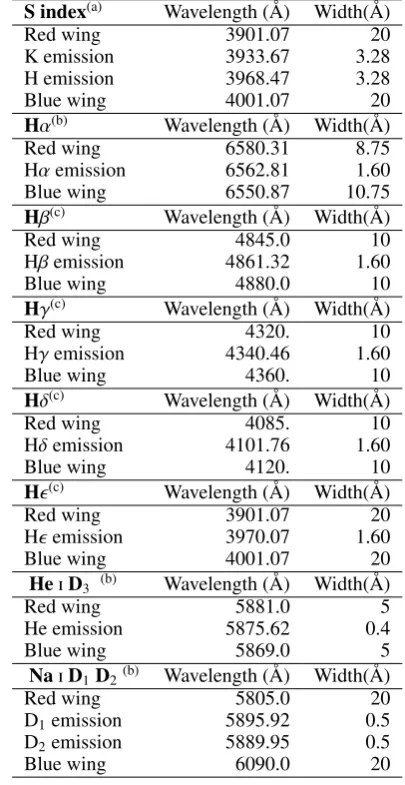
Table 1. Bandpasses for the activity indexes considered in this work.
S index(a) Wavelength (Å) Width(Å)
Red wing 3901.07 20
K emission 3933.67 3.28
H emission 3968.47 3.28
Blue wing 4001.07 20
Hα(b) Wavelength (Å) Width(Å)
Red wing 6580.31 8.75
Hαemission 6562.81 1.60
Blue wing 6550.87 10.75
Hβ(c) Wavelength (Å) Width(Å)
Red wing 4845.0 10
Hβemission 4861.32 1.60
Blue wing 4880.0 10
Hγ(c) Wavelength (Å) Width(Å)
Red wing 4320. 10
Hγemission 4340.46 1.60
Blue wing 4360. 10
Hδ(c) Wavelength (Å) Width(Å)
Red wing 4085. 10
Hδemission 4101.76 1.60
Blue wing 4120. 10
H(c) Wavelength (Å) Width(Å)
Red wing 3901.07 20
Hemission 3970.07 1.60
Blue wing 4001.07 20
HeiD3 (b) Wavelength (Å) Width(Å)
Red wing 5881.0 5
He emission 5875.62 0.4
Blue wing 5869.0 5
NaiD1D2(b) Wavelength (Å) Width(Å)
Red wing 5805.0 20
D1emission 5895.92 0.5
D2emission 5889.95 0.5
Blue wing 6090.0 20
Notes.(a)Henry et al. (1996);(b)Gomes da Silva et al. (2011);(c)West & Hawley (2008)
in the period between BJD 2458060 and 2458160 the achieved SNR decreases due to a damaged optical fiber and typical values are around 130.
using the IRAF1tasksbands. Before measuring the fluxes, each individual spectrum was corrected for its corresponding radial velocity (see below) using the IRAF taskdopcor. Uncertainties in the activity indexes are computed from the uncertainties in each bandpass which are computed as:
∆F= √1
n
F
S NR
(1)
whereFis the mean flux in the band, SNR is the signal-to-noise ratio, andnis the number of integration points. Here, we assume that both the flux and the SNR are constants in each bandpass, which is a reasonable assumption given their small width. A con-servative approach was taken and for each index the SNR of the red bandpass was chosen as the representative value for all the bandpass. Nevertheless, given the high SNR of our spectra, un-certainties in the activity indexes are quite small, of the order of 0.16% for theS index and∼0.04% for the Hαindex.
The solar RVs derived by the DRS are dominated by the mo-tion of the Solar System’s giant planets (Jupiter and Saturn). The RV effects of these motions are removed following the procedure by Cameron et al. (2019) which can be consulted for further de-tails.
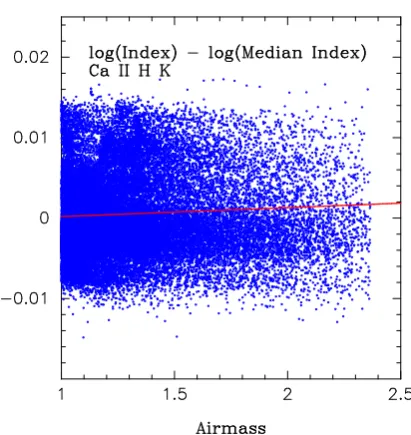
In order to remove outliers in the different activity indexes a 3σ clipping procedure was applied for all indexes. A quick inspection of the activity indexes reveals a daily variation cor-related with the airmass of the observations. In order to correct for this effect we compute a daily median index. The quantity (log(index) - log(mediandailyindex)) is then plotted against the airmass and a linear fit is performed, see Figure 1 for the CaiiH & K index. We note that the daily median values are only used to keep the indexes in their original scale values thus favouring possible comparisons with other works or stars. The fit is used to correct for the airmass effect. Finally, the median values are added again. It is clear from the figure that the airmass effect has a minor impact on the indexes. Nevertheless, we prefer to perform this correction in order to avoid possible annual peri-ods in the analysis. We note that the scatter in theS index data is ∼0.0019 (value corresponding to the standard deviation of the data) which is consistent with a scatter dominated by photon noise error.
3. Data analysis
3.1. Periodogram analysis
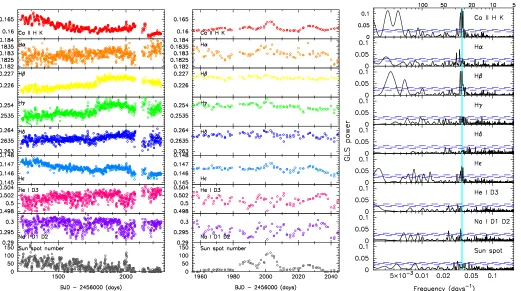
Figure 2 (left) shows the temporal variations of the analysed ac-tivity indexes. The median index per day is shown. From now on, we refer to the median index per day in all the analysis per-formed. A search for periodicities was performed by using the generalised Lomb-Scargle periodograms (GLS, Zechmeister & Kürster 2009). The periodograms are dominated by long-term signals. In order to clearly identify signals at the solar rotation period, we subtracted the main long-period trends for each index by fitting a sinusoidal function (a procedure usually referred to as prewhitening). The subtracted periods are∼27000 days for Caii, and H,∼3800 days for Hα, and of the order of∼1200 days for Hβ, Hγand Hδ. Additional long-term signals with periods be-tween 200 and 600 days were removed from most of the indexes.
[image:4.595.326.532.70.288.2]1 IRAF is distributed by the National Optical Astronomy Observato-ries, which are operated by the Association of Universities for Research in Astronomy, Inc., under cooperative agreement with the National Sci-ence Foundation.
Fig. 1. Airmass effect correction for the CaiiH & K index.
The subtracted periods as well as the number of prewhitenings performed are given in Table 2 while Figure 2 (right) shows the corresponding GLS periodograms. Periods were subtracted in a sequential way, until a period inside the time interval of the Sun’s rotation (between 25-34 days) dominates the periodogram. For example, for the S index, the period labeled as P1in Table 2 was subtracted, while for Hβthe periods labeled as P1and P2 were prewhitened. We note that the time series are those of the original datasets, i.e, before any prewhitening procedure is applied, while we show the periodograms after the described prewhitening pro-cedure. Several conclusions can be drawn from this figure. First, long-periods still remain, in particular for the Hβindex. Second, the solar rotation is found in all activity indicators with the ex-ception of Hδwhere it is not clearly detected and which shows a lot of periods close to∼22 days. The most significant periods that we identify with the solar rotation for each index are given in Table 2. Their uncertainties are those provided by the GLS analysis. We note that these are synodic periods and therefore not corrected from effects due to the Earth’s revolution around the Sun. Our results show that the rotation period depends on the indicator used. It varies from 26.29 days (Hγindex) to 31.23 days (Hei).
Figure 2 also reveals an increase in the Hβ, Hγ, and to a lesser extent Hδvalues at BJD ∼2457800 days. Then, around BJD 2458100 days the indexes show a small decline. These val-ues do not correspond to the period of reduced SNR. We checked whether large plages were present in the solar surface at these epochs by carefully analysing the USET images2at the Solar In-fluence Data Analysis Center of the Royal Observatory of Bel-gium as well as the NASA/SDO AIA 1600 images3. We find that while at BJD∼2457800 days the solar surface does not dif-fer in a significant way from other epochs, at BJD∼2458000 days (where the Hβindex shows a peak) several active regions (with associated NOAA numbers from 12673 to 12677) formed by plages and dark spots are visible across the solar surface.
Furthermore, for the Hei, Nai, and perhaps Hαlines several periods of low values can be seen. As they are separated by∼350
Fig. 2. Left: Activity indexes (defined in the text) as a function of time. Daily median values are shown. Centre: Zoom on the time series covering a period of two rotations. Right: Corresponding generalised Lomb-Scargle periodograms (after the subtraction of the main long-term periods, see text for details). The light blue lines indicate the solar synodic period of 27.2753 days (Allen 1977) while values corresponding to a FAP of 10%, 1%, and 0.1% are shown with dashed lines.
days we suspect that this effect could be related to the presence of weak telluric lines contaminating the cores or continua of these indexes and thus inducing annual variations.
We finally study the impact of the prewhitening in the de-termination of the rotation period. This is illustrated in Fig. 3 where we show the periodograms corresponding to the S index (left panel) and Hαindex (right panel) after each prewhitening. The plot shows a zoom around the region of the solar rotation. It is clear from the figure that the prewhitening procedure does not change the found periods, only their relative strength. The GLS power of the periods increase after each prewhitening. The periodogram corresponding to the S index show a more complex pattern than in the Hαcase. For the S index three main periods at
∼26.30, 27.31 and 28.62 days are clearly dominant in all cases. The latest period is broad and seems to be mixed with a close pe-riod at 29.44 days. In addition, two secondary peaks appear at∼
25.33 and 32.08 days, respectively. Regarding Hα, another three period structure can be seen that dominates the periodogram with power at∼26.57, 29.42, and 32.58 days.
We note that the period at 32 days which is dominant in Hα is also seen in the S index, although it is not among the dominant signals for this indicator. The other main difference between the S index and Hαperiodograms is that the periods at∼27.3 days and∼26.3 days which are dominant in the S index are much less significant in the Hαdata.
3.2. Temporal evolution of active regions
In order to study the temporal evolution of active regions we made use of the pooled variance technique (Donahue et al. 1997a,b; Lanza et al. 2004; Scandariato et al. 2017). In brief, for a given time interval,t, the data are binned into segments of lengtht, and the average variance of the set of these segments is computed. It is expected that as the time scale increases, the effects from processes at longer time scales become more notice-able and therefore the pooled variance increases.
For example, the light curve of a star with a fixed, non evolv-ing, spot pattern and rigid rotation will be perfectly periodic. The variance of this light curve will increase with t, until Prot is reached. For timescales longer than the rotation period, the mean variance will stay approximately constant. If we now in-troduce the evolution of active regions, and the timescale of evo-lution is significantly longer thanProt, the variance of the light curve will increase for timescales longer thanProtuntil the mean timescale of evolution of the active regions is reached. We will have a change in slope because the increase of the variance with tis generally different from that produced by rotation, given that the shape of the rotational modulation is different from the light changes associated with active region evolution.
Fig. 3. GLS periodograms of the S (left) and Hαindexes (right) after each prewhitening zoomed around the periods of interest. Vertical dashed-to-dot lines show the periods discussed in the text.
days which corresponds to the solar rotation period and a second one around 300 days from which we infer a typical lifetime for active regions of∼10 rotation periods. We note that the second slope change around 300 days is not so strong in the He iand Na iactivity indicators. The time scale of∼300 days is quite similar to the mean life time of complexes of activity dominated by faculae and plage (e.g. Castenmiller et al. 1986) while sun spots are known to live for hours to months (e.g. Solanki 2003). We finally note the peculiar behaviour of the Hαindex, which shows almost no variation after 300 days in contrast to the other indexes.
We study solar rotation via time-varying periodogram power of the activity indexes. Power spectra are computed for each ac-tivity index time series in overlapping segments of 600 days, with a two day time shift between consecutive segments. Be-fore computation, the long-term periods identified in the GLS analysis described above were prewhitened in a sequential way. Additionally, we perform a linear detrending of the data in each 600 days temporal window independently. The corresponding sliding periodograms are shown in Figure A.1.
We note that a large window is needed if we want to average the effect of the different surface inhomogeneities (e.g. Bertello et al. 2012). Figure A.2 shows the corresponding sliding peri-odogram for the S index computed using a temporal window of 300, 600, and 900 days, respectively. Although similar in form, i.e, the Scargle power is found at roughly the same periods, it is clear from the figure than when using a small temporal window the revealed signals tend to be broader. In addition, discontinu-ities appear for periods larger than ∼40 days. If a window of 900 days (i.e., almost the full temporal coverage of our data) is considered (bottom panel) the periods appear significantly nar-rower, but many white vertical strips (meaning that no tempo-ral window is centred at the corresponding date) appear in the plot. Note that gaps in the data should not been quite diff er-ent from one window size to another. After all, all windows are quite large. However, with increasing the temporal window we are covering a shorter global time scale (i.e, we are making a kind of zoom, see the range of dates in the X axe for the different
plots of Figure A.2) so the gaps in the data are more easily seen in the plots. We choose 600 days as a compromise between hav-ing a large temporal window (so periods are narrow enough) and having a large temporal coverage. We also investigated whether the prewhitening procedure performed to the data does have an impact on the sliding periodograms. This is illustrated in Fig-ure A.3 where sliding periodograms for the S index are shown for the original time series (up panel), and after prewhitening the long-term signal (middle panel). see Table 2 for the exact val-ues of the subtracted periods. We can see that the periodograms are nearly identical, with only very small differences. We con-clude that the prewhitening procedure has a small impact on the periodograms.
We use the periodograms to search for a signature of diff er-ential rotation. Table 2 shows the spread in rotation periods,α, defined as (PMax−PMin)/PMaxbeing PMax andPMin the max-imum and minmax-imum rotation periods. It was measured by vi-sual inspection of the drift in the mean frequency of the for-est of peaks around the rotation frequency. Uncertainties onα are computed by assuming an error on PMax andPMin of 0.07 days (median values of the errors in the periods listed in Table 2) and applying uncertainties propagation. These uncertainties are clearly underestimated. This is because our real uncertainty de-pends on the choice ofPMaxandPMinwhich in turn rely on the noise level of each index. This effect might lead to a lowerα value as peaks on the outside are in general weaker and most likely to be missed. Furthermore, a period which is present in one index might not be present in another index with a higher level of noise. The value ofαdepends significantly on the in-dex. It is higher for theS index and H. We note that for Hδand Heiwe were not able to determineα. That (in addition to the previous results) suggests that either the Hδline is less sensitive to stellar activity than other indicators or that the definition of this index should be revised. Finally, for Hγthe value ofαwas derived from the first harmonic of the rotation period.
induce similar beat patterns, broadening or splitting peaks in the periodograms (e.g. Lanza et al. 1994; Aigrain et al. 2015). As discussed, we measured typical activity complex lifetimes of 10 rotation periods. However, the presence of small-scale features evolving over shorter timescales cannot be excluded. The pres-ence of several close periods might, indeed, be a combination of differential rotation and spot evolution.
In addition to the periods inside the 20-36 days time interval of the Sun’s rotation, other periodicities are found in the slid-ing periodograms, see Figure A.1. In particular, one period at∼
14.5 days is visible in most of the indicators, specially in Hγ. When considering theS index, a secondary peak at∼13.5 days is also visible. We believe that these features might correspond to a 12-14 days periodicity previously identified in the litera-ture. This period has been shown to be an effect of an active longitude, i.e., the result from two different active regions sepa-rated by 180 degrees in longitude (Donnelly 1988; Donnelly & Puga 1990; Bouwer 1992). The harmonic of the rotation period is also present and both effects contribute to this signal. It is also partly caused by the light curve of a single spot being similar to a truncated sinusoid (it is flat when the spot is on the invisible hemisphere).
A period close to ∼18 days is seen in Hα. To the best of our understanding, no reference to such a period has been found in the literature. Periodicities around∼43.5 and 47.5 days are visible in theS index analysis, in agreement with previous works (e.g. Zie¸ba et al. 2001). For Hγa periodicity close to∼51 days is found. The origin of this periodicity at 51 days is still unclear, although it seems that it appears most strongly in measurements related to emerging magnetic flux (Bouwer 1992).
Finally, several signals at larger periods are found. For the S index, there is a signal ranging from 70 to 76 days, as well as another one from 86 to 92 days. Additional signals around∼125, 135 days also appear in the periodogram of the S index. A clear signal at 100 days is seen in Hγ, while Hshow a signal at∼80 days and another one ranging from∼98 to 113 days. Signals at these periods have already been reported in other solar studies (e.g. Zie¸ba et al. 2001).
Another clear signal at ∼ 170 days appears in the peri-odogram of the S index. This periodicity is a bit longer to the so-called Rieger cycles discovered in the periodicity of high-energy solar flares Rieger et al. (1984) and it has been also found in in-dicators for solar activity such as sunspot areas (e.g. Oliver et al. 1998). It has a periodicity around 155-160 days, and it usually appears only near the maxima of solar cycles. Zaqarashvili et al. (2010) suggested that this periodicity might be connected to the dynamics of magnetic Rosbby waves in the tachocline.
We finally comment on the large period of 31.23 days de-rived from the analysis of the Heitime series. This line is known to be formed at somewhat higher temperatures than other optical diagnostics of activity (Saar et al. 1997) and it is often used to study prominences and flares (Zirin 1988). We note that such a period would correspond to active regions located at significant high latitudes,∼60◦(but see next Section). From Fig. 2 it can be seen that its significance level is lower (false alarm probability, FAP∼1%) than the periods corresponding to other indexes that show FAP values highly below 0.1%. This is also evident in the corresponding sliding periodogram, Fig. A.1 (bottom left panel) where the period is not seen, as only periods with FAPs lower than 0.01 are shown. Instead, two periods are clearly visible, al-though only at the end of the observing window. These are the period at 12-14 days discussed above, and another period at∼40 days.
3.3. Comparison with previous work
It is not straightforward to determine the rotation period from a periodogram analysis. For the Sun, we usually take advantage of the fact that we already know the value of the rotation period we are searching for (see Hall & Lockwood 1998). An early attempt to measure the solar surface differential rotation of the Sun as a star was made by Donahue & Keil (1995) based on the peri-odogram analysis of CaiiK disc-integrated data. The authors re-produce the expected behaviour of the rotation period with time (with periods ranging from 22.8 to 28.0 days) with an abrupt jump in period in the transition between cycles 21 and 22. They also studied the pooled variance, finding that the evolution of ac-tive regions contribute to the total variance of the disc-integrated CaiiK line at time scales from 20 to 400 days, which is a time scale compatible, although slightly longer time scale, than our results, see Figure 4.
Hempelmann & Donahue (1997) performed a wavelet anal-ysis of disc-integrated solar CaiiK line core emission measure-ments. The authors found the solar synodic rotation with a max-imum power at a period of 28.3 days corresponding to the solar rotation at latitude 30◦. They also found a second (less domi-nant) period at 26.8 days as well as a third peak at 30.2 days related to the existence of active regions at 5◦ and 50◦, respec-tively. Our data, see Figure 2, shows a period of 27.31 days as the dominant one, while secondary peaks at 28.62 and∼26.30 days also appear. Using the known relationship between solar rotation rate and latitude it is possible to estimate the latitude of active regions at which our peaks would correspond. There is a large amount of determinations of the solar rotation rate which depend on the methods and the type of data used, i.e., the type of feature used as a tracer, for a review see Beck (2000). It is known that chromospheric indicators provide higher rotation rates than those based on photospheric disc observations. This can be eas-ily shown by comparing the equatorial rotation rates provided in Table 2 (based on measurements of solar features) and Ta-ble 1 (spectroscopic measurements) provided by Beck (2000). It is also clear from Table 2 that our assumed rotation periods are more similar to the values derived from Table 1 of Beck (2000). Snodgrass & Ulrich (1990) derived three relationships, one re-lated to magnetic features, a second one that refers to the rotation of supergranules (which are found to rotate faster than magnetic structures), and a third spectroscopic (i.e., based on doppler mea-surements of spectral features) relation. Using the coefficients provided by the latest relationship, our peaks would correspond to active regions located between the equator and 30◦.
We have checked whether this could be the case by analysing the available data on active regions and solar spots at the Helio-physics Feature Catalogue4. Given the dates of our observations, the beginning of our time series should correspond to a fast ro-tation rate, while the end to a low roro-tation rate. At the beginning of our observations, active regions were located at latitudes be-tween -30◦ and 20◦ and sunspots were distributed into two re-gions between -10◦ and -20◦ and between 10◦ and 20◦. At the end of our observing window, active regions are mostly located between -10◦and+20◦, while spots are seen into three groups at -10◦, 5◦, and 15◦, respectively. We conclude that the presence of active regions located between the equator and 30◦are indeed a plausible explanation for the observed periods. We also see that there seems to be no significant variation in the maximum lati-tude of active regions during our observation window.
In their wavelet analysis, Hempelmann & Donahue (1997) found three “bands” of periods at around 26, 28, and 30 days.
Table 2. Periods found in the GLS periodogram analysis, assumed rotation periods, and relative spread in rotation periodα, potentially indicative of differential rotation, measured from the sliding periodograms for the different activity indicators. Periods shown in italics are unlikely to be realistic. They should be understood as a way to represent and remove long term variability.
Index P1 P2 P3 P4 P5 P6 Prot α
(days) (days) (days) (days) (days) (days) (days) (%)
CaiiH & K 27100.06 27.32 27.32±0.06 4.97±0.25
Hα 3870.01 29.42 29.42±0.09 2.44±0.24
Hβ 1182.67 473.21 28.69 28.69±0.07 2.63±0.25
Hγ 1280.30 444.17 288.01 75.11 26.29 26.29±0.08 0.79±0.26
Hδ 1029.74 511.25 310.59 199.35 42.95 46.84 -
-H 39958.61 606.49 305.62 27.33 27.33±0.06 4.64±0.25
HeiD3 363.09 6908.08 114.99 31.23 31.23±0.15
-NaiD1D2 358.79 7949.04 28.36 28.36±0.09 2.87±0.25
Sun spot number 42178.78 31.35 31.35±0.19
-Fig. 4.Pooled variance diagrams for the different activity indicators analysed in this work (see text). The red line is a smoothed function for ease reading of the plots.
This is consistent with our sliding periodogram shown in Fig-ure A.1 where we see three main periods at around 26, 28, and 30 days. A fourth period beginning at∼32 days is also visible.
More recently Bertello et al. (2012) measured disc-integrated CaiiK line and observed periods in the range 27.7 - 28 days. They find most of the power spectral density concentrated into
[image:8.595.158.503.280.639.2]bands. Bertello et al. (2012) noted that while parameters defined in terms of wavelength separation show a spectrum with a single predominant peak, intensity-related parameters (like our mea-sured indexes) show a power spectrum with a more complex pattern. Further differences can arise from the spectral estima-tor used by these authors (the maximum entropy method) that seems to produce less complex spectral patterns than the gener-alised Lomb-Scargle periodogram used here.
Other attempts to measure the solar differential rotation have been performed using a combination of UV and optical lines us-ing UARS SOLSTICE data (Hasler et al. 2002; Hempelmann 2002) but no clear signatures of differential rotation were de-tected. We note that this result refers to integrated light. Us-ing Sun-as-a star radial velocities measured durUs-ing an eclipse, Takeda et al. (2015) tried to determine the coefficients of the so-lar rotation law5 finding a relationship between the coefficients A, and B. However, an individual estimate of the parameters A and B were not possible.
Livingston (1969) noted an increase of the order of 8% of the angular velocity measured in the chromospheric Hαline with re-spect to other photospheric lines. Regarding the activity indexes measured in this work, NaiD1D2is known to form in the up-per photosphere and lower chromosphere, Hα, Hβ, and CaiiH & K in the middle cromosphere, while HeiD3 is formed in the upper chromosphere (e.g. Montes et al. 2000). No clear relation-ship between formation height and rotation rate is seen in our data. This conclusion is based on three facts: i) the rotation pe-riod derived from the NaiD1D2 is similar to the one from Hβ; ii) Hαshow a higher period (between 2.5 and 7%) than Caiiand Hβ; and iii) as discussed above the rotation period found for the Heiindex is less significant. Nevertheless, we acknowledge that further studies should be performed, in particular the analysis of photospheric and coronal lines as well as a better knowledge of the lines’ formation height would help to clarify this issue. We also tried to plot the assumed rotation period as a function of the line’s excitation potential but no clear trend was evident. We fi-nally checked for a tendency with the quantum number within the Balmer series, where Hαshow a higher period than Hβand both lines provide higher rotation levels than H. Unfortunately, we were not able to detect the rotation period in Hδand the ro-tation period of Hγdoes not follow this tendency.
3.4. Correlation between activity indexes
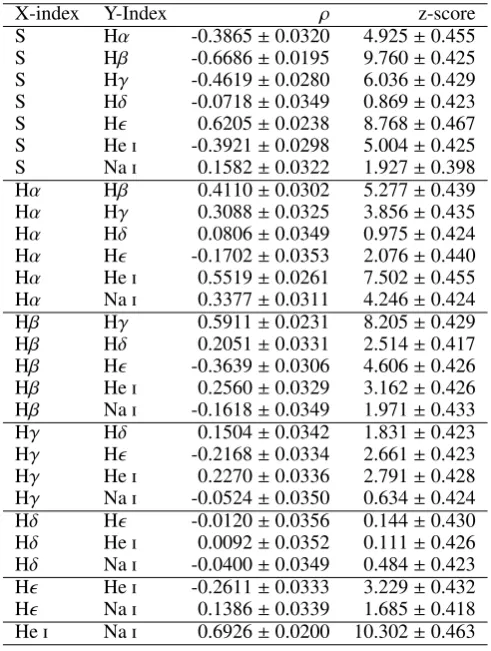
We also investigated the correlations between the different ac-tivity indexes described in Table 1. Using the code MCSpear-man6(Curran 2014) we calculated correlations using a bootstrap Monte Carlo by adding a Gaussian random variate with stan-dard deviation equal to the measurement uncertainty to each data point. For each pair of activity indexes, the corresponding Spear-man coefficient correlation,ρ, and its z-score7were determined from 104synthetic datasets. Figure 5 shows the correlations be-tween the different activity indexes, and the results from the sta-tistical tests are provided in Table 3. We note that the analysis presented in this section was made on the original time series (i.e., without any prewhitening applied).
It can be seen that Hα, Hβ, Hγ, and Heishow a significant anticorrelation with theS index although the correlation coeffi
-5 ω=A+Bsin2ψ, whereψis the latitude. 6 https://github.com/PACurran/MCSpearman
[image:9.595.308.554.74.400.2]7 The z-score measures the degree of significance of the correlation. A z-score of z approximately corresponds to a Gaussian significance of the correlation ofσ∼z.
Table 3.Correlations between the activity indexes as defined in the text.
X-index Y-Index ρ z-score
S Hα -0.3865±0.0320 4.925±0.455
S Hβ -0.6686±0.0195 9.760±0.425
S Hγ -0.4619±0.0280 6.036±0.429
S Hδ -0.0718±0.0349 0.869±0.423
S H 0.6205±0.0238 8.768±0.467
S Hei -0.3921±0.0298 5.004±0.425
S Nai 0.1582±0.0322 1.927±0.398
Hα Hβ 0.4110±0.0302 5.277±0.439
Hα Hγ 0.3088±0.0325 3.856±0.435
Hα Hδ 0.0806±0.0349 0.975±0.424
Hα H -0.1702±0.0353 2.076±0.440
Hα Hei 0.5519±0.0261 7.502±0.455
Hα Nai 0.3377±0.0311 4.246±0.424
Hβ Hγ 0.5911±0.0231 8.205±0.429
Hβ Hδ 0.2051±0.0331 2.514±0.417
Hβ H -0.3639±0.0306 4.606±0.426
Hβ Hei 0.2560±0.0329 3.162±0.426
Hβ Nai -0.1618±0.0349 1.971±0.433
Hγ Hδ 0.1504±0.0342 1.831±0.423
Hγ H -0.2168±0.0334 2.661±0.423
Hγ Hei 0.2270±0.0336 2.791±0.428
Hγ Nai -0.0524±0.0350 0.634±0.424
Hδ H -0.0120±0.0356 0.144±0.430
Hδ Hei 0.0092±0.0352 0.111±0.426
Hδ Nai -0.0400±0.0349 0.484±0.423
H Hei -0.2611±0.0333 3.229±0.432
H Nai 0.1386±0.0339 1.685±0.418
Hei Nai 0.6926±0.0200 10.302±0.463
cients are rather modest: 0.3-0.5. The Hline, however, shows a positive correlation. Hδ, and Naishow no statistically significant correlation with theS index.
Table 3 also reveals that the strongest correlation is typically with the closest index in wavelength (i.e, Caiiwith H, Hαwith Hei, Naiwith Hei, and Hβwith Hγ). While this could be an instrumental effect (scattered light as a function of wavelength), if real, it could indicate a dependence on the formation height of the different indexes.
0.16 0.165 C a II 0.182 0.184 H α 0.226 0.227 H β 0.253 0.254 H γ 0.2630 0.2635 0.2640 H δ 0.146 0.147 H ε 0.500 0.505 He I 0. 16 0 0. 16 5 Ca II 0.295 0.300 Na I 0. 18 2 0. 18 4 Hα 0. 22 6 0. 22 7 Hβ 0. 25 3 0. 25 4 Hγ 0. 26 30 0. 26 35 0. 26 40 Hδ 0. 14 6 0. 14 7 Hε 0. 50 0 0. 50 5
He I 0.
[image:10.595.136.460.59.317.2]29 5 0. 30 0 Na I
Fig. 5. Correlation plot between the different activity indexes. The diagonal panels show the histogram of each index.
note that these authors found negative correlations even in stars with [Fe/H]∼-0.15.
In order to test whether the negative correlation coefficient betweenS and Hαis related to the time scale of the observations we study how the correlation depends on the timescale of the observations. This is shown in Fig. 6. The correlation between S and Hαis computed for different time intervals and different starting times in the series (i.e. different cycle phases). For each time interval, individual circles correspond to a different starting time in the series. We overplot with red stars the lower boundary of the data presented in Meunier & Delfosse (2009, Figure 3) while with green stars we show the upper boundary. The figure shows that shorter time lags lead to more negative correlation coefficients. In particular, negative correlation coefficients as the ones obtained in this work are consistent with the findings of Meunier & Delfosse (2009). However, unlike these authors we are not able to obtain correlations close to one in any of the in-spected time lags.
We conclude that correlation coefficients as low as∼-0.30 can be obtained for short timescales in agreement with previous results. However, the question of why we do not get any value close to one remains open. At this point two explanations are possible: either the two lines show a different response to in-creasing activity or the correlation between S and Hαdepends on the level of activity. We should note that the data by Meu-nier & Delfosse (2009) covers almost 30 years of observations, so they can really test different parts of the solar cycle in each temporal window. However, our observations do cover∼2.9 yrs so even if we choose different starting times we do not trace dif-ferent parts of the cycle, only the end of the decreasing phase and around the minimum. This is specially evident when large windows are considered, for example, if a window including 900 days is explored, starting dates can not be separated by more than 32 days, so we are essentially in the same phase of the cycle.
Regarding the behaviour of Caiiand Hαwith activity, it is well known that the Hαline is radiation-dominated and it first
shows a deeper absorption profile as activity increases until the electron density is high enough and the line becomes collision-ally excited, then increasing the emission at its core. On the other hand, chromospheric CaiiH & K emission lines are collisionally dominated, thus the radiated flux steadily increases with electron pressure (Cram & Mullan 1979; Cram & Giampapa 1987; Rutten et al. 1989; Houdebine et al. 1995; Houdebine & Stempels 1997; Scandariato et al. 2017). On the other hand, the dependency of the correlation between S and Hαwith the level of activity is discussed at length in Section 4.
Some degree of correlation between Ca ii and Hαis how-ever visible in our data. This can be seen in Figure 2. At the beginning of the time series, the S index shows a variation due to the crossing of active regions (we have checked using solar images that several active regions were effectively crossing the solar disc during these days). This is also visible in Hα, i.e., there seems to be a correspondence between peaks in both indexes, al-though the higher noise level in the Hαindex makes the compar-ison difficult. Another hint of correspondence between peaks in both indexes can be seen in the middle panel of Figure 2 which shows a zoom around BJD =2458000 days. We should note that we do not have a clear reason of why the Hαtime series is noisier. We expeculate that it could be related to contamination by some non-corrected nearby telluric line. Whether the higher noise level in the Hαdata might contribute to hide a clearer S index - Hαcorrelation is unclear. As mentioned, there are other factors that should be considered.
observations of the 1083 nm line have been shown to show vari-ations correlated with the solar cycle (Livingston et al. 2007). We should note that the Heiline at 1083 nm has been shown to be negatively correlated with activity, i.e., it becomes deeper when the Sun is more active (Andretta & Giampapa 1995), in line with the findings of our work. Furthermore, Gomes da Silva et al. (2011) found little variation of He iindex (measured in the same line than our work) as well as a low correlation with activity, although their results refers to M dwarfs.
We believe that as might happens with the Hαthe lack of a clear (positive) correlation of these indexes with theS index is due to the relatively small temporal window covered in this work as well as a possible dependence of the correlations on the level of activity, note that our observations cover the decreasing phase and the minimum of the solar cycle. Furthermore, these indexes also show higher levels of noise.
We finally caution that the presence of etalon ripples on the HARPS-N solar data has been reported (see Thompson et al., in prep.). In order to understand whether they can effect the corre-lations between activity indexes we took several random spectra and computed the GLS periodogram of 50 and 100 Å width re-gions centred around the activity indexes, finding no evidence of ripples in these regions. At the time of writing, we are not aware of any other possible anomaly in the data that might affect our measurements.
[image:11.595.83.279.413.631.2]A future analysis of the solar images covering the same time span analysed in this work would be helpful to clarify the trends between the different activity indicators found in this work as well as the different significance levels of the periods found in these indices.
Fig. 6. Correlations between theS and Hαactivity indexes as a func-tion of the time span. Red and green stars denotes the lower and upper boundary of the data shown in Meunier & Delfosse (2009, Figure 3).
3.5. Correlation activity indexes - CCF parameters
Possible correlations between the RVs and several CCF asym-metry diagnostics were also investigated. We considered the CCF width (FWHM), the bisector span (Queloz et al. 2001, BIS), and its contrast. The heliocentric radial velocity (as
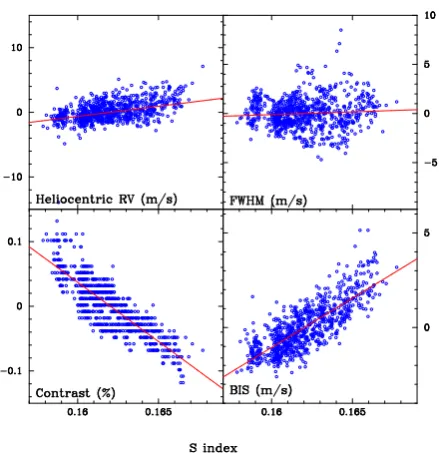
de-scribed in Sect. 2) was also considered. In addition, FWHM values were also corrected to the sidereal frame, see Cameron et al. (2019). Spearman correlation coefficients,ρand z-scores for these correlations are given in Table 4, and Figure 7 shows the correlations for the CaiiS index. The analysis presented in this section corresponds to the original time series (i.e., without any prewhitening applied).
We search for significant correlations using a z-score larger than 3.0 in absolute value, the usual threshold for statistical sig-nificance. These are shown in bold face in Table 4. The Caii index shows a significant correlation with the bisector and the heliocentric RV values while it shows an anticorrelation with the contrast. A similar behaviour is seen for the H line. Also Hβ shows the same correlations but in all cases with the opposite sign. Additional significant correlations are found between the Hαindex and the CCF contrast and between the Hγand Na i indexes and the contrast and bisector (with opposite signs). Fur-thermore, the Heiindex also correlates with the CCF contrast. No correlations are found between the Hδindex and the CCF parameters.
It is important to note the positive correlation between the heliocentric radial velocity and the activity index S. Our de-rived Spearman’s correlation coefficient of 0.40±0.03 (with a 5.1σconfidence level) is in agreement with the value of 0.357 found by Lanza et al. (2016). The rms of the RV variations is 4.9 ms−1, also in agreement with these authors. Time delays be-tween the FWHM and BIS values with the RV variations have been predicted by models (Dumusque et al. 2014) and found in the HARPS-N solar data by Cameron et al. (2019). We searched for similar time delays between theS index and RV variations but no evidence was found. The correlation between the emis-sion in the Caii line and the radial velocity supports the idea of the quenching of local convective motions in active regions being the main effect on the Sun as a star radial velocities, as predicted by Meunier et al. (2010b) and Meunier & Lagrange (2013). This has been observationally confirmed by Haywood et al. (2016) and Milbourne et al. (2019) On the other hand, the effect of inhomogeneities in the solar surface (such as dark spots or bright faculae) can be either positive or negative depending on the filling factors and the location of active regions (receding or approaching half of the solar disc), leading to a weakerS index - RV correlation (Lagrange et al. 2010; Meunier et al. 2010b,a; Dumusque et al. 2014).
Along these lines, Haywood et al. (2016) searched for cor-relations between the RV variations of the Sun-as-a-star and the RV component due to the suppression of the convective blueshift with the log(R’HK) values. When considering the overall RV, they find a correlation coefficient of 0.18, i.e, significantly lower than our value, while the coefficient increases to 0.35 (more simi-lar to our value) when only the RV due to the suppression of con-vective blueshift is taken into account. It is important to note that this comparison may be biased by the fact that the radial veloci-ties from this previous work were taken at a different time in the activity cycle (in particular the Sun was more active than in our observing season), so the fact that we obtain similar correlation coefficients to the Haywood et al. (2016) values might be coinci-dental. We note that the data by Haywood et al. (2016) were col-lected from September 29 to December 7, 2011 and were spread over 38 nights for a total of 98 datapoints. Note also that the first part of the RV data suffered from an additional scatter owing to the finite diameter of the asteroid 4/Vesta being comparable with the fiber diameter on the focal plane.
Table 4.Correlations between the different activity indexes and the CCF indexes. The correlations with a z-score larger than 3.0 are shown in bold face.
Heliocentric RV FWHM CONTRAST BIS
CaiiH&K
ρ 0.452±0.029 0.048±0.035 -0.835±0.012 0.642±0.022
z-score 5.890±0.440 0.585±0.424 14.528±0.465 9.198±0.452
Hα
ρ -0.035±0.035 0.132±0.034 0.286±0.033 -0.173±0.034
z-score 0.425±0.419 1.610±0.417 3.557±0.431 2.110±0.423
Hβ
ρ -0.248±0.034 0.129±0.035 0.592±0.023 -0.481±0.027
z-score 3.059±0.437 1.562±0.425 8.227±0.421 6.330±0.431
Hγ
ρ -0.130±0.035 0.101±0.035 0.380±0.030 -0.280±0.032
z-score 1.577±0.428 1.224±0.426 4.838±0.421 3.478±0.421
Hδ
ρ 0.036±0.035 0.086±0.035 0.035±0.036 -0.063±0.035
z-score 0.436±0.428 1.047±0.423 0.424±0.429 0.763±0.427
H
ρ 0.328±0.032 -0.018±0.035 -0.651±0.022 0.497±0.028
z-score 4.111±0.436 0.217±0.423 9.385±0.470 6.585±0.442
HeiD3
ρ -0.106±0.035 0.066±0.035 0.320±0.032 -0.142±0.034
z-score 1.286±0.425 0.802±0.421 4.011±0.426 1.721±0.413
NaiD1D2
ρ 0.185±0.035 0.019±0.035 -0.213±0.033 0.291±0.032
z-score 2.262±0.437 0.229±0.421 2.613±0.416 3.617±0.421
Fig. 7. CCF parameters vs. the CaiiH & K index. Best linear fits are
shown in red lines.
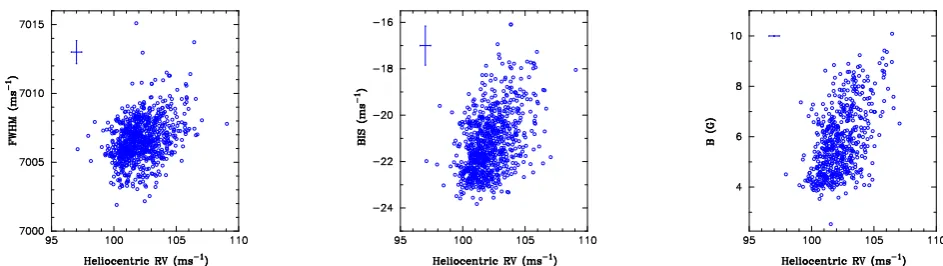
the BIS, with the radial velocity variations for a sample of 15 solar-type stars. The authors found significant correlation in 13 (FWHM) and 27 (BIS) percent of the stars. A search for similar correlations were performed in our data. The results are shown in Figure 8 where the FWHM and BIS values are plotted against the heliocentric radial velocity. Our analysis reveals a signifi-cant positive correlation between the FWHM and the BIS with
the heliocentric radial velocity. For the FWHM the Spearman’s rank coefficient is 0.267±0.033 with a z-score value of 3.310
±0.429. When considering the BIS values, we obtain a Spear-man’s rank coefficient of 0.325±0.032 and a z-score value of 4.075±0.435.
Finally, we studied the relationship between the mean mag-netic flux derived from SOLIS/VSM full-disc line-of-sight mag-netograms which correspond to the core of the photospheric 630.15 nm Fe line (Jones et al. 2002)8 and the heliocentric ra-dial velocity. The corresponding plot is shown in the right panel of Figure 8. A significant correlation is found with a Spearman’s rank coefficient of 0.463 ±0.04 and a significance z-score of 5.026±0.452. We note that our derived Spearman’s coefficient is significantly larger than the 0.131 found by Lanza et al. (2016), and is in agreement with the 0.58 value found by Haywood et al. (2016). It is lower than the 0.87 value found when only the radial velocity contributions from convective blueshift (the factor that dominates the radial velocity of the Sun as a star) is considered (Haywood et al. 2016).
4. Discussion
The temporal variation of the correlations coefficients described in Sect. 3.4 and 3.5 was also studied. As in Sect. 3.2, correla-tions tests were performed considering a large window of 600 days period of observations every two days. We focus on two correlations: those between Hαand the CaiiH & K indexes and between the heliocentric RV and the CaiiH & K index. The top of Fig. 9 shows variations in the correlation of these quantities changes with time.
[image:12.595.66.286.406.633.2]Fig. 8. Sidereal FWHM (left), bisector span (centre), and disc-integrated magnetic flux (right) as a function of the heliocentric radial velocity.
Table 5.Correlations between the slope of theSindex and Hα relation-ship and different observables of the evolution of magnetic structures in the solar atmosphere.
ρ z-score
Sun spot -0.2797±0.0582 1.788±0.393 Irradiance -0.2932±0.0582 1.880±0.396 Radio flux -0.4068±0.0501 2.623±0.364
4.1. Understanding the Ca - Hαcorrelation
In order to understand the correlations between the emission in the CaiiH & K and the Hαlines, in each temporal window the slope of the S versus Hαindex relationship was computed. The slopes are then plotted versus the mean time of the temporal win-dow as well as versus the mean values of different observables related to the evolution of magnetic structures in the solar atmo-sphere, Figure 9 (left). These observables are i) the daily total sunspot number by the Royal Observatory of Belgium9; ii) the total solar irradiance data from the University of Colorado10; and iii) the solar f10.7 radio flux from the University of Colorado11. While other possible diagnostics are available, they do not cover the dates of our HARPS-N observations.
In this analysis we use the original time series of the indexes. The figure reveals a tendency of less negative slopes as we move towards larger sun spot numbers, irradiance, or radio flux values. We finally tested whether the derived slope correlates with these quantities. For this purpose we use the procedure described in Sect 3.4. The results are given in Table 5. It shows the correlation coefficient and z-score between the slopes (of theS index vs. Hα index relationship) and the sun spot, irradiance, and radio flux values. The results from this statistical test do not exclude that correlations are present but suggest that they are relatively weak. A dependence of the S index - Hα correlation with the level of activity has also been found in FGK stars (Gomes da Silva et al. 2014) as well as in a sample of early-M dwarfs by Gomes da Silva et al. (2011). It is interesting to note that Gomes da Silva et al. (2014) also found this correlation to be dependent on the stellar metallicity suggesting that negative correlations were present among higher metallicity stars, but as we are studying one single star we are not able to test this result.
It is well known that at short time scales the emission in the Ca ii H & K and Hα do not always correlate. Meunier & Delfosse (2009) suggest that the presence of plages might lead
9 http://www.sidc.be/silso/datafiles
10 http://lasp.colorado.edu/home/sorce/data/tsi-data/
11 http://lasp.colorado.edu/lisird/data/penticton_radio_flux_observed/
Table 6. Correlations between the slope of theSindex and heliocentric radial velocity relationship and different observables of the evolution of magnetic structures in the solar atmosphere.
ρ z-score
Sun spot -0.4992±0.0515 3.414±0.426 Irradiance -0.4051±0.0547 2.675±0.407 Radio flux -0.5050±0.0586 3.385±0.478
to a correlation coefficient lower than 1 as the surface covered by the Hαplages is slightly smaller than the surface covered in Ca (the calcium lines are formed higher in the chromosphere), and that also the chromospheric network is more prominent in calcium. The different contrast of dark filaments in Ca and Hα might also decrease the correlation coefficient between Ca and Hαor even lead to an anti-correlation, if strong filaments cor-related with plages are present (Meunier & Delfosse 2009). In-deed, it could be that filaments are actually more prominent in all Balmer’s lines, which might partly explain their anticorrelation with the Ca index (see Table 3).
Our results seem to be consistent with the scenario described above. At large sunspot numbers the emission in Ca and Hα show less negative slopes suggesting different relative contribu-tions of the bright plages and dark filaments when compared to time intervals with a lower level of activity.
4.2. Understanding the Ca - RV correlation
We now search for correlations between the emission in the Caii H & K and the heliocentric radial velocity. Figure 9 (right) shows the slope between the daily median S and the daily median he-liocentric RV as a function of time and sunspot indexes.
A general tendency of a larger degree of correlation towards larger activity levels is present in the data, see Table 6, suggest-ing that a higher presence of surface inhomogeneities produces larger radial velocity variations. As mentioned, the correlation between the CaiiH & K and the heliocentric radial velocity is due to the suppression of convective blueshift by magnetic areas, leading to a net redshift. Therefore on cycle timescales, as total magnetic areas increase and decrease, the associated redshift will do likewise (e.g. Saar & Fischer 2000).
Fig. 9. Slope of the relationship between Ca, and Hαindexes (left), and slope of the relationship between Ca, and the heliocentric RV (right) as a function of time, the sunspot index, the solar irradiance, and the solar radio flux.
5. Conclusions
In this work a detailed analysis of the main optical activity indi-cators including the Ca II H & K doublet, the Balmer lines, the NaiD1D2 doublet, and the HeiD3measured in the Sun-as-a-star observations has been presented. Nearly three years of data were analysed.
The periodogram analysis of the data reveals the solar rota-tion period in almost all activity indicators with values ranging from 26.29 days to 31.23 days. The Hδline is the only excep-tion in which the rotaexcep-tion period was not found, suggesting that either this line is less sensitive to activity or that its definition should be revised. Furthermore, there is no clear reason why it does not correlate with other Balmer lines. The pooled vari-ance analysis reveals two main slope changes. The first one is at around 30 days corresponding to the solar rotation period. The second slope change occurs at ∼300 day, suggesting that the typical lifetime of complexes of activity dominated by plage and faculae is around 10 rotations periods, in agreement with previ-ous results (e.g. Castenmiller et al. 1986). The study using slid-ing periodograms shows that the spectral power is usually split into several bands with periods ranging from 26 to 30 days. This effect might be due to differential rotation (migration of active
regions between the solar equator and a latitude of∼30◦), ac-tive region evolution, or a mixture of both phenomena. Again, no significant periods are found for the Hδline.
We studied the correlations between the different activity in-dicators. Excluding Hδand the Naiidoublet, all the indicators show a modest but statistically significant correlation with the S index. In all cases, with the exception of H, the sign of the correlation is negative.
Significant positive correlations are found between the bisec-tor and the heliocentric radial velocity with theS index and the Hindex, as well as an anticorrelation with the contrast. The Hβ line show similar correlations, but always with an opposite sign. Additional correlations with the bisector and the contrast and other activity indicators are also found. Further relationships be-tween the FWHM, and the BIS with the radial velocity variations are found in agreement with previous results based on solar-type stars (Lanza et al. 2018). The disc-integrated magnetic field also is shown to correlate with the radial velocity variations as al-ready found (Haywood et al. 2016; Lanza et al. 2016).
inhomo-geneities on the solar surface (as measured by sun spot numbers, irradiance, and radio flux values). At larger levels of activity Ca and Hα(and Ca and radial velocity variations) show a higher de-gree of correlation, suggesting significant changes in the relative contributions of bright plages and dark filaments.
Combining the results from this work with additional studies of solar observations will help us to improve our understanding of stellar signals, allowing us to develop mitigation techniques that could be used to confirm small planets around low-mass stars. In particular, an in-depth analysis of solar images would help us to unravel the correlation between the S and Hαindexes, and to better understand the behaviour of these lines in the min-imum phase of the activity cycle.
Acknowledgements. J.M., A.F.L., G.M., A.S., L.M., E.M., G.P., and E.P. ac-knowledge the support by INAF/Frontiera through the “Progetti Premiali” fund-ing scheme of the Italian Ministry of Education, University, and Research. D.F.P. is supported by NASA award number NNX16AD42G. X.D. is grateful to the Branco-Weiss Fellowship—Society in Science for financial support. A.C.C. ac-knowledges support from the Science and Technology Facilities Council (STFC) consolidated grant number ST/R000824/1. This work was performed in part un-der contract with the California Institute of Technology (Caltech)/Jet Propul-sion Laboratory (JPL) funded by NASA through the Sagan Fellowship Program executed by the NASA Exoplanet Science Institute (R.D.H.) S.H.S. was sup-ported by a NASA Heliophysics LWS grant NNX16AB79G. H.M.C. acknowl-edges support from the National Centre for Competence in Research (NCCR) “PlanetS” supported by the Swiss National Science Foundation (SNSF). Based on observations made with the Italian Telescopio Nazionale Galileo (TNG), op-erated on the island of La Palma by the Fundación Galileo Galilei of the INAF (Istituto Nazionale di Astrofisica) at the Spanish Observatorio del Roque de los Muchachos of the Instituto de Astrofísica de Canarias. The solar telescope used in these observations was built and maintained with support from the Smith-sonian Astrophysical Observatory, the Harvard Origins of Life Initiative, and the TNG. The HARPS-N project has been funded by the Prodex Program of the Swiss Space Office (SSO), the Harvard University Origins of Life Initiative (HUOLI), the Scottish Universities Physics Alliance (SUPA), the University of Geneva, the Smithsonian Astrophysical Observatory (SAO), the Italian National Astrophysical Institute (INAF), the University of St Andrews, Queen’s Univer-sity Belfast, and the UniverUniver-sity of Edinburgh. Based on SOLIS data obtained by the NSO Integrated Synoptic Program (NISP), managed by the National Solar Observatory, which is operated by the Association of Universities for Research in Astronomy (AURA), Inc. under a cooperative agreement with the National Science Foundation, data obtained by the WDC-SILSO, Royal Observatory of Belgium, Brussels, data obtained by the Solar Radiation and Climate Experi-ment (SORCE) satellite mission operated by the Laboratory for Atmospheric and Space Physics (LASP) at the University of Colorado (CU) in Boulder, Col-orado, USA, and Penticton radio fluxes data from NOAA’s NGDC. We sincerely appreciate the careful reading of the manuscript and the constructive comments of the anonymous referee.
References
Aigrain, S., Llama, J., Ceillier, T., et al. 2015, MNRAS, 450, 3211 Allen, K. W. 1977, Astrophysical quantities.
Andretta, V. & Giampapa, M. S. 1995, ApJ, 439, 405
Baranne, A., Queloz, D., Mayor, M., et al. 1996, A&AS, 119, 373 Beck, J. G. 2000, Sol. Phys., 191, 47
Bertello, L., Pevtsov, A. A., & Pietarila, A. 2012, ApJ, 761, 11 Bouwer, S. D. 1992, Sol. Phys., 142, 365
Cameron, A. C., Mortier, A., Phillips, D., et al. 2019, MNRAS, 1180
Castenmiller, M. J. M., Zwaan, C., & van der Zalm, E. B. J. 1986, Sol. Phys., 105, 237
Cincunegui, C., Díaz, R. F., & Mauas, P. J. D. 2007, A&A, 469, 309 Cram, L. E. & Giampapa, M. S. 1987, ApJ, 323, 316
Cram, L. E. & Mullan, D. J. 1979, ApJ, 234, 579 Curran, P. A. 2014, ArXiv e-prints [arXiv:1411.3816]
Donahue, R. A., Dobson, A. K., & Baliunas, S. L. 1997a, Sol. Phys., 171, 191 Donahue, R. A., Dobson, A. K., & Baliunas, S. L. 1997b, Sol. Phys., 171, 211 Donahue, R. A. & Keil, S. L. 1995, Sol. Phys., 159, 53
Donnelly, R. F. 1988, Annales Geophysicae, 6, 417 Donnelly, R. F. & Puga, L. C. 1990, Sol. Phys., 130, 369 Dumusque, X., Boisse, I., & Santos, N. C. 2014, ApJ, 796, 132 Dumusque, X., Glenday, A., Phillips, D. F., et al. 2015, ApJ, 814, L21 Fischer, D. A., Anglada-Escude, G., Arriagada, P., et al. 2016, PASP, 128,
066001
Flores, M., González, J. F., Jaque Arancibia, M., Buccino, A., & Saffe, C. 2016, A&A, 589, A135
Giampapa, M. S., Cram, L. E., & Wild, W. J. 1989, ApJ, 345, 536
Gomes da Silva, J., Santos, N. C., Boisse, I., Dumusque, X., & Lovis, C. 2014, A&A, 566, A66
Gomes da Silva, J., Santos, N. C., Bonfils, X., et al. 2011, A&A, 534, A30 Hall, J. C. & Lockwood, G. W. 1998, ApJ, 493, 494
Hasler, K.-H., Rüdiger, G., & Staude, J. 2002, Astronomische Nachrichten, 323, 123
Hatzes, A. P. 2016, in Astrophysics and Space Science Library, Vol. 428, Meth-ods of Detecting Exoplanets: 1st Advanced School on Exoplanetary Science, ed. V. Bozza, L. Mancini, & A. Sozzetti, 3
Haywood, R. D., Collier Cameron, A., Unruh, Y. C., et al. 2016, MNRAS, 457, 3637
Hempelmann, A. 2002, A&A, 388, 540
Hempelmann, A. & Donahue, R. A. 1997, A&A, 322, 835
Henry, T. J., Soderblom, D. R., Donahue, R. A., & Baliunas, S. L. 1996, AJ, 111, 439
Houdebine, E. R., Doyle, J. G., & Koscielecki, M. 1995, A&A, 294, 773 Houdebine, E. R. & Stempels, H. C. 1997, A&A, 326, 1143
Jones, H. P., Harvey, J. W., Henney, C. J., Hill, F., & Keller, C. U. 2002, in ESA Special Publication, Vol. 505, SOLMAG 2002. Proceedings of the Magnetic Coupling of the Solar Atmosphere Euroconference, ed. H. Sawaya-Lacoste, 15–18
Lagrange, A.-M., Desort, M., & Meunier, N. 2010, A&A, 512, A38 Lanza, A. F., Malavolta, L., Benatti, S., et al. 2018, A&A, 616, A155
Lanza, A. F., Molaro, P., Monaco, L., & Haywood, R. D. 2016, A&A, 587, A103 Lanza, A. F., Rodonò, M., & Pagano, I. 2004, A&A, 425, 707
Lanza, A. F., Rodono, M., & Zappala, R. A. 1994, A&A, 290, 861
Livingston, W., Wallace, L., White, O. R., & Giampapa, M. S. 2007, ApJ, 657, 1137
Livingston, W. C. 1969, Sol. Phys., 9, 448
Lovis, C., Dumusque, X., Santos, N. C., et al. 2011, arXiv e-prints [arXiv:1107.5325]
Lovis, C. & Pepe, F. 2007, A&A, 468, 1115
Mamajek, E. E. & Hillenbrand, L. A. 2008, ApJ, 687, 1264 Meunier, N. & Delfosse, X. 2009, A&A, 501, 1103
Meunier, N., Desort, M., & Lagrange, A.-M. 2010a, A&A, 512, A39 Meunier, N. & Lagrange, A.-M. 2013, A&A, 551, A101
Meunier, N., Lagrange, A.-M., & Desort, M. 2010b, A&A, 519, A66 Milbourne, T. W., Haywood, R. D., Phillips, D. F., et al. 2019, ApJ, 874, 107 Montes, D., Fernandez-Figueroa, M. J., de Castro, E., & Cornide, M. 1995,
A&AS, 109, 135
Montes, D., Fernández-Figueroa, M. J., De Castro, E., et al. 2000, A&AS, 146, 103
Oliver, R., Ballester, J. L., & Baudin, F. 1998, Nature, 394, 552 Pepe, F., Mayor, M., Galland, F., et al. 2002, A&A, 388, 632
Phillips, D. F., Glenday, A. G., Dumusque, X., et al. 2016, in Proc. SPIE, Vol. 9912, Advances in Optical and Mechanical Technologies for Telescopes and Instrumentation II, 99126Z
Queloz, D., Henry, G. W., Sivan, J. P., et al. 2001, A&A, 379, 279 Rieger, E., Share, G. H., Forrest, D. J., et al. 1984, Nature, 312, 623 Robinson, R. D., Cram, L. E., & Giampapa, M. S. 1990, ApJS, 74, 891 Rutten, R. G. M., Schrijver, C. J., Zwaan, C., Duncan, D. K., & Mewe, R. 1989,
A&A, 219, 239
Saar, S. H. & Fischer, D. 2000, ApJ, 534, L105
Saar, S. H., Huovelin, J., Osten, R. A., & Shcherbakov, A. G. 1997, A&A, 326, 741
Scandariato, G., Maldonado, J., Affer, L., et al. 2017, A&A, 598, A28 Snodgrass, H. B. & Ulrich, R. K. 1990, ApJ, 351, 309
Solanki, S. K. 2003, A&A Rev., 11, 153
Strassmeier, K. G., Fekel, F. C., Bopp, B. W., Dempsey, R. C., & Henry, G. W. 1990, ApJS, 72, 191
Takeda, Y., Ohshima, O., Kambe, E., et al. 2015, PASJ, 67, 10 West, A. A. & Hawley, S. L. 2008, PASP, 120, 1161
Zaqarashvili, T. V., Carbonell, M., Oliver, R., & Ballester, J. L. 2010, ApJ, 724, L95
Zechmeister, M. & Kürster, M. 2009, A&A, 496, 577
Fig. A.1. Sliding periodograms computed with a time window of 600 days. From left to right and from top to bottom: Caii, Hα, Hβ, Hγ, Hδ, H,
Hei, and Nai. The X-axis shows the median time over which the GLS periodograms are calculated. Vertical white strips corresponds to gaps in
Fig. A.2. Sliding periodograms for Caiicomputed with a time window of 300 (top), 600 (middle), and 900 days (bottom). The X-axis shows the
Fig. A.3. Sliding periodograms for Caiicomputed for the original time series (top), and after prewhitening of the long-term period (bottom). The