CONTENTS
Acknowledgements . . . .iii
Foreword . . . .v
Introduction . . . .1
1. Background . . . .1
2. Aims of this study . . . .9
3. Methods . . . .9
4. Outline of this report . . . .13
The views of prisoners . . . .15
1. Prison life and the prison education context . . . .15
1.1 Induction and assessment . . . .15
1.2 Getting access to education . . . .16
1.3 Personal choice . . . .17
1.4 Sentence planning . . . .18
1.5 Pay . . . .19
1.6 A right or a privilege? . . . .20
1.7 The prison timetable . . . .21
1.8 Security categories and their knock-on effects . . . .22
2. The curriculum . . . .23
2.1 What courses were available in the prisons visited? . . . .23
2.2 The variability of provision in different types of establishment . . . .24
2.3 The core curriculum . . . 26
2.4 The broader curriculum . . . .29
2.5 Continuity . . . .30
2.6 Formal and informal opportunities: learning elsewhere in the prison . . . .32
2.7 What else prisoners would like to learn and why . . . .37
3. Past learning experiences . . . .39
3.1 Experiences of school . . . .39
3.2 Experiences of further and higher education . . . .40
4. Experience of education in prisons . . . .41
4.1 Positive and negative aspects of prison education . . . .41
4.2 Relationships with education staff . . . .43
5. The value of education . . . .45
5.1 Making progress: using the time . . . .45
5.2 Education as a life-changing force . . . .46
5.3 Prisoner-learners’ reasons for enrolling in education . . . .47
5.4 Improving employment prospects upon release . . . .47
6. Prisoners’ perceptions of others’ attitudes towards education . . . .49
7. Release and resettlement . . . .55
7.1 The benefit of education . . . .55
7.2 Continuing with education after release . . . .56
7.3 Getting jobs . . . .57
Encouraging Learning in Prison . . . .59
1. Prisoners’ recommendations for change . . . .59
2. Encouragers and discouragers: process issues . . . .60
3. Encouragers and discouragers: people issues . . . .63
4. Overview . . . 64
Recommendations . . . .66
References . . . .71
Appendices: . . . .73
Appendix 1: Advisory Group Membership . . . .73
Appendix 2: Questionnaire . . . .74
Appendix 3: List of prisons approached . . . .79
ACKNOWLEDGEMENTS
Prison Reform Trust is grateful to Barclays Plc for supporting this unique study of prison education from the prisoners’ perspective.
The Time to Learn research project has been guided by an expert Advisory Group chaired by Professor Gus John.
Two independent research associates, Julia Braggins and Jenny Talbot, undertook the study on behalf of Prison Reform Trust supported by Kimmett Edgar, Research Manager, PRT and PRT volunteer, Cecilia Yardley.
We are most grateful for the support of the prisons involved in this study and thank
FOREWORD
At its best, prison education can open up opportunities, enlighten people, broaden their horizons and build their self-confidence. It can increase their awareness of options, giving them a real choice of a life away from crime. Education can open up the legitimate means of
achieving success.
But this raises the issue of the educational experience of prisoners prior to custody. A lack of education constitutes a bar to full participation in society as a valued and productive citizen. Half of all prisoners do not have the skills required by 96 per cent of jobs. As this report makes clear, education can also exclude people when what is offered does not fit the needs, interests, the culture or the lifestyle of the person to whom it is provided.
Prison education is, for many, a second chance to learn the skills and social competences they will need in order to be reintegrated. But there is a catch: that education is offered in an institution which by its very nature isolates still further many who are already excluded from society. Imprisonment widens the gap between those people and mainstream society and brands them in a manner that compounds their social exclusion.
Time to Learnexplores the prisoners’ experience of education – the benefits and drawbacks of learning in a prison environment, the relevance of the curriculum to their diverse needs, the range of resources available and the limitations imposed upon learning by prison routines.
The prisoners in this study suggest, in different ways, that the education department is an oasis of humanity in an otherwise cold and impersonal environment. Certainly education should play a vital role in preparing prisoners for reintegration upon release, but it is doubtful how many offenders regard this as a realistic aspiration.
This study represents people in prison as an indispensable source of first-hand information about learning experiences in custody: the ways that prison education can transform lives and the obstacles posed to learning development by the prison environment.
I welcome this report because it brings the views of prisoners to bear on the debate
regarding the nature of prison education. If prison education is to meet the needs of offenders in custody, then it is essential that we learn what those needs are. If prison education is to be part of the ‘Learning Revolution’, in the knowledge-based economy, and empower people with the knowledge and skills so that they can become responsible members of society, then an obvious first step is to consult prisoners, respecting their unique perspective on the kinds of services required and the quality of current provision.Time to Learnprovides a prism through which policy makers and practitioners could develop a vision of the future role and
organisation of prison education.
Professor Gus John
INTRODUCTION
“Our vision is that offenders according to need should have access to education and training both in prisons and in the community, which enables them to gain the skills and qualifications they need to hold down a job and have a positive role in society, and that the content and quality of learning programmes in prisons, and the qualifications to which these lead, are the same as comparable provision in the community.”1
But what do prisoners think about education in prisons? What have their experiences been? What might they recommend for the future of prison education? Despite a great deal of interest in prison education, the voices of prisoners are rarely heard.To our knowledge, there have been few studies that set out with the sole intention of eliciting prisoners’ views about their experience of education in prison.
Against a background that places the consumer at the very heart of public service reform, the Prison Reform Trust (PRT), supported by Barclays, decided to gather prisoners’ views on prison education and to use that information to influence change. More than simply a ‘consumer satisfaction survey’,Time to Learn explores the perceptions of prisoner-learners drawing on their experiences and their ideas to develop a wide range of recommendations for prison education. From the immediate and the practical through to longer-term changes in policy and culture, the recommendations drawn from this study are based on the views of prisoners.
1.
Background
We felt it was important to look at the wider context in which prison education takes place: the delivery of prisoner education; its aims; the curriculum; funding; the impact of
overcrowding; prisoners’ previous experience of education; and other research on the topic.
• The Delivery of Prisoner Education
The publication of this report coincides with significant and rapid developments in prison education and training policy and funding.The structure and management of education in prisons has changed dramatically over the last 10 years. In 1993, prison education, which had formerly been delivered through local education authorities, was contracted out on a five yearly basis to colleges of further education and other external providers. Currently 28 external providers, including 25 colleges of further education, two local education authorities and one private company, are delivering education in prisons. Existing contracts will be re-tendered in April 2004.
The wide variety of providers can affect the continuity of a prisoner’s learning career, as their time in prison may involve a number of transfers from one establishment to another.
The provision of education was directed by the Prisoners’ Learning and Skills Unit, created in April 2001. In May 2003, the Unit was given additional responsibility for probation education and training policy and development and renamed the Offenders’ Learning and Skills Unit (OLSU).
2 Personal communication from OLSU, 2003.
3 DfES/PLSU (2003).
4 Ron Dearing (2002) 'Education should be the key to prisoners' freedom,' The Independent, 25 July 2002.
5 DfES (2002) 'Education and Skills: Delivering Results - A Strategy to 2006.
A strategic partnership between the Department for Education and Skills (DfES) and the Prison Service generated a delivery plan for 2003/04-2005/06,Improving Offenders’ Learning and Skills.The plan calls for a range of changes in the way education in prison is to be delivered, including:
• The redesign and re-tendering of education contracts for all prison
establishments, including the incorporation of vocational training in contracts from April 2004
• A major review of the prison curriculum
• Increased funding for prison education of 47 per cent over the next three years,
from £85 million this year to £125 million in 2005/06
• Developing criteria and arrangements for a Standards Fund to improve the
quality of learning and skills provision.
Under the delivery plan the OLSU is committed to providing education in prison to as equal standard as could be gained outside. Consistent with this aim, prison education will be subject to the same inspection regimes as for mainstream education including visits from the Adult Learning Inspectorate and Ofsted as well as from Her Majesty’s Chief Inspector of Prisons.
As with most public service provision, Key Performance Targets (KPTs) are a feature of prison education. National targets are set for Basic and Key skills at entry level and for levels 1 and 2 and disaggregated between individual prisons. (Level 1 represents the educational skill level expected of an 11 year old child.) Performance against them is monitored on a monthly basis. For the year ending March 2003, targets for Basic and Key Skills for the 118 prisons for which figures were available were exceeded by 44 per cent, a major achievement. However, 35 prisons failed in one or more target areas.2
• Aims
“Education is an important factor in reducing re-offending.The work we are doing in our prisons to rehabilitate, educate and prepare offenders for their return to society is critical in providing them with an alternative to crime.”3
Writing for The Independent, Lord Dearing, who chaired the National Committee of Inquiry into Higher Education, put it like this:
“Whatever the basis for getting prisoners’ commitment to education, the potential return through reduced reoffending rates by people who can hold down a decent job is
compelling.”4
The aim of the DfES, which, it must be assumed, applies as much to prisoners as to the rest of the population is:
“To help build a competitive economy and inclusive society by: Creating opportunities for everyone to develop their learning Releasing potential in people to make the most of themselves Achieving excellence in standards of education and level of skills.”5
The executive summary to the OLSU delivery plan acknowledges some of the difficulties of the prison regime:
• A historical lack of priority given to education and training
• The sudden movement of prisoners during courses
• Lower pay for prisoners to undertake education than to work
• Separate planning and delivery of education and training in most establishments.6
Some of these issues are already being tackled – vocational training is to be incorporated in education contracts from April 2004 and there is no doubt that a greater priority is now being given to education in prisons. As to sudden movement and lower pay, it must be hoped that these will be given the same priority in the very near future.
The OLSU delivery plan (DfES/Prison Service, 2003) aspires to a joined up approach to offender education from within the constraints of the prison to the wider community. It sets out a commitment:
“...to explore ways in which we can make learning for offenders more continuous, cohesive and more aligned with provision for learners in mainstream education.”
Yet, according to Shared Responsibilities, a report jointly published by NATFHE and the Association of Colleges:
“Only one third of education managers said that they regularly receive prisoners’ records following transfers.”7
The study set out to gain prisoners’ views on the extent to which such continuity was achieved in their experience (between one prison and another, but also between prison and the outside community).The ideal of a seamless link between learning inside and outside prison should be a key part of effective resettlement. We recognised the importance of a seamless provision of education and sought the views of prisoners on the extent to which they believed that their in-prison education would lead to improved educational opportunities outside.
According to the Social Exclusion Unit report,Reducing re-offending by ex-prisoners, “...as few as six per cent of prisoners have an education or training place to go to on release.” The SEU report concludes that: “Without very clear and well-supported routes into learning, any progress made in prison will end on release.”8
The introduction of the joint prison/probation offender assessment system, OASys, may help. OASys is an IT-based risk/needs assessment tool, shared between and accessible to both the National Probation Service and the Prison Service. It seeks to better inform and enhance sentence planning, including in part a focus on education and training. Following pilots, OASys will start in early 2004 and has the potential to join up the information flow and service provision for the individual prisoner before, after and during their sentence.The responsibility for implementing OASys within the Prison Service will rest with prison officers.
6 PLSU (2002) 'Prisoners Learning and Skills Delivery Plan: Executive Summary'.
7 Julia Braggins (2002) Shared Responsibilities: Education for prisoners at a time of change, NATFHE and the Association of Colleges.
9 Offenders Learning and Skills Unit website (2003) 'Initiatives: Curriculum, Key Facts,' (see also: Prison Service Order 4205, June 2000).
10 Braggins (2002). 11 DfES/PLSU (2003).
12 DfES (2001) Statistical Bulletin, 'Education and Training Expenditure since 1991-1992. 13 Ron Dearing (2002).
• Curriculum
According to the OLSU’s website:
“The main thrust of education in prisons is to provide opportunities for offenders to attain a range of nationally recognised qualifications up to level 2, and in some cases beyond, which will enhance their employability on release. All prisons must provide a core curriculum, which includes:
• Initial assessment
• National Record of Achievement • Basic Skills
• Key Skills
• English for speakers of other languages • Information and Communications Technology • Social and Life Skills
• Generic preparation for work.”9
According to Shared Responsibilities, less than half of prison governors, education managers and providers of prison education were satisfied with the curriculum in terms of its relevance to the needs of prisoners.
The report states that, “The narrowing of the curriculum was the shared concern of governors, education managers and providers of prison education”. A particular issue for many was the omission of the creative arts. As one respondent put it:
“The curriculum broadly ignores the positive contribution creative education – e.g. art, music, dance and drama – can have when dealing with very damaged individuals with low
self esteem ... and a low opinion of formal education.”10
The OLSU delivery plan is committed to:
“... undertaking a major review of the prison curriculum, ensuring that it is developed in line with government priorities both within the FE/Adult learning sectors and the criminal justice system.”
• Funding
Total funding for prisoner education in 2002/03 totalled £66.7m, out of which teaching costs, educational materials and library costs were met.The 2002 Spending Review increased funding for prison education and figures for the next three years, in millions, stand at £85M for 2003-4; £110M for 2004-5; and £125M for 2005-6. In addition, funding for vocational training of £12M per year for the three years, ring-fenced from 2003/04, will transfer to the OLSU. A further £20M from the Capital Modernisation Fund is being allocated to prisons for
improvements to learning facilities.11
Despite these investments, prisoner-learners have always been the poor relation when compared to other adult learners. Even with the recent increase in spending and the promise of more to come, the 2002-3 average of £1,185 per prisoner (based on the Certified Normal Accommodation – CNA – spend per head as at 31 March 2002, in 122 establishments) remains less than half the average cost of secondary school education at £2,590 per student per year, which many prisoners will have missed.
With the creation in 2001 of the PLSU came ring-fenced budgets for education but not for vocational training. Lord Dearing wrote in The Independent:
There are also significant disparities in education funding per head among prisons. Funding has been allocated primarily on the basis of spending patterns largely determined by the number of teaching hours ordered in the past by establishments.This has meant that prisons delivering the same core curriculum with similar types of prisoners have received very different funding allocations.
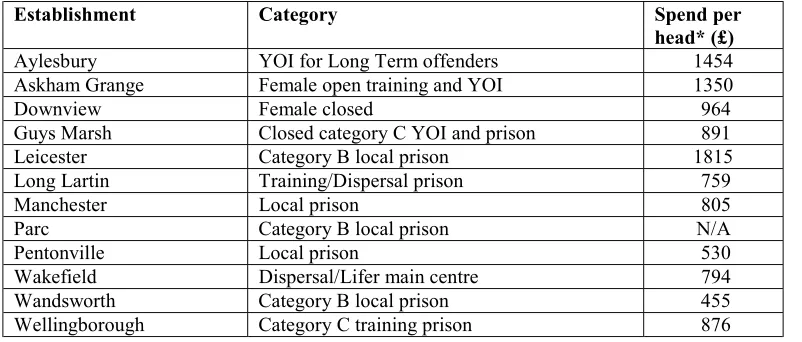
The amount of spend per head across the prison estate for 2002/03 ranges from as little as £195 (HMP Latchmere House, Category C/D Resettlement) to £5,707 (HMP & YOI Hatfield, Open YOI) with an average spend of £1,185. (Spend per head is based on CNA as at 31 March 2002.14)
[image:11.595.101.502.327.498.2]In this study, eight out of the twelve prisons spent below the average spend per head.The local prisons tended to feature low per prisoner spend, while the YOI was above the national average as was one of the two women’s prisons visited. For HMP Parc, spend per head is not available because it is a matter of ‘commercial confidentiality’.The amount per head spent by eleven of the twelve prisons in this study for the year to March 2003 is shown below:
Table One: Spending levels on education in the prisons visited
According to the SEU report, cited above:
“The inequality of funding between prisons with similar roles is a key barrier to raising standards of education.”
The SEU report goes on to say that whilst the OLSU will address this issue, “the challenge is considerable.”
The OLSU delivery plan requires prisons in future to have in place, ”three year development plans to raise achievement levels and improve education and training outcomes for prisoners” on which funding will be dependent.
• Learners in prison
“In any one year, 130,000 people are or have been in prison, with a further 200,000 supervised by the Probation Service in the community. Around 50% of these individuals have poor reading skills, 66% have poor numeracy skills, and a staggering 81% of prisoners have writing skills below Level 1.This is a serious obstacle to the rehabilitation of ex-offenders and to their search for employment once they leave prison.” 15
Establishment Category Spend per
head* (£)
Aylesbury YOI for Long Term offenders 1454 Askham Grange Female open training and YOI 1350 Downview Female closed 964 Guys Marsh Closed category C YOI and prison 891 Leicester Category B local prison 1815 Long Lartin Training/Dispersal prison 759 Manchester Local prison 805 Parc Category B local prison N/A Pentonville Local prison 530 Wakefield Dispersal/Lifer main centre 794 Wandsworth Category B local prison 455 Wellingborough Category C training prison 876
*Spend per head based on CNA as at 31 March 2002
14 Personal communication from OLSU, 2003.
16 RDS (2002) 'Prison Population Brief, England and Wales, December 2002.
17 RDS (2002) Projections of long term trends in the prison population to 2009. 18 Prison Statistics England and Wales 2000, 2001. 19 DfES (2003). 20 Mike Tomlinson (2003) 'Learning for all: can it be made a reality?' RSA Journal, June 2003.
21 DfES (2003) 14-19: opportunities and excellence, DfES.
22 Social Exclusion Unit (2002) Reducing re-offending by ex-prisoners, London:The Social Exclusion Unit.
Over the last three years the prison population has increased by 10 per cent.The prison population as at 11 July 2003 was 74,012 (an increase of 2,532 on the previous year),
compared with a CNA (the in use uncrowded capacity of the prison estate) of 66,101 and an Operational Capacity (maximum safe overcrowded capacity of the prison estate) of 76,405.16
According to recent Home Office statistics, further growth of between 28 and 54 per cent can be expected.This will increase the prison population to a minimum of 91,400 and a maximum of 109,600 by 2009.The figures predict a continued rise in the number of
sentenced women prisoners and sentenced young offenders, which are expected to grow by some 76 per cent and 41 per cent respectively to 2009.17
At the same time as the population has increased, it is a major accomplishment that the amount of time spent by prisoner-learners attending education classes has also increased in recent years. In 2000, prisoner-learners in local prisons spent an average of 4.86 hours per week attending education classes and 8.23 hours per week in open prisons.18According to OLSU figures, just under one third of the prison population is attending education classes.The Home Office Resettlement Survey 2001 found that nearly 50 per cent of prisoners attended some form of education and training during their time in prison.
• Prisoners’ educational backgrounds
The education offered to prisoners must necessarily take into account their previous experience, and this means that problems in education in the wider social context are important.The DfES acknowledges that the current system “has significant weaknesses”19.
According to Mike Tomlinson, Chair of the Learning Trust, the “significant weaknesses” of the current system impact particularly on “key groups such as white boys from lower socio-economic backgrounds, black boys, children in public care and refugee children.”20
Whilst every other black and minority ethnic group made progress in attainment at secondary level in the period 2000-02, Mike Tomlinson notes:
“The proportion of Afro-Caribbean teenagers achieving at least five good GCSE grades actually fell between 2000 and 2002 from 39% to 36%.”
The DfES also acknowledged that “too many young people lose interest in learning before the age of 16.” In the summary to 14-19: opportunities and excellence, the DfES states:
“This disengagement from learning is often just the beginning of a cycle of low expectations and disaffection, with consequences felt not only by individuals but by local communities and wider society.”21
Many prisoners, although by no means all, come into custody with a history of educational under-achievement and poor skills.The SEU report,Reducing re-offending by ex-prisoners, presented a disturbing picture of the educational level of the prison population. Prisoners are over twenty times more likely than the general population to have been excluded from school; and ten times as likely to have been a regular truant. Further, the SEU found that half of all prisoners were at or below Level 1 (the level expected of an 11 year old) in reading; two-thirds in numeracy; and four-fifths in writing.22
The SEU report also notes that specific groups are likely to be disadvantaged by prison education, including black and minority ethnic prisoners, people on remand, women, and young prisoners:
“Although one in two remands go on to receive a custodial sentence they often have little opportunity to attend education and training.”
“Women prisoners are particularly likely to have poor education history and few qualifications.
A quarter (of young adult prisoners) will have terminated their education by the time they are aged 14.”
Thus, the DfES objective to, “enable all young people to develop and to equip themselves with the skills, knowledge and personal qualities needed for life and work” is particularly relevant to prison education, making up for what many prisoners will have missed in secondary school education. But the DfES’ commitment to increased participation in higher education and fair access is not reflected in practice and in performance targets for prison education.
At the other end of the scale, there are highly qualified prisoners who both enjoyed and did well at school, many of whom would like to continue their education.There are prisoners who seize the opportunity for what they see as a second chance at education and who excel.The massive range of ability, motivation, prior learning experience and attainment presented by prisoners, together with the prison regime within which prison education takes place, make for a unique and often less than satisfactory experience, for prisoner-learners and education staff alike.
A ‘one size fits all’ approach to education cannot work.The recent DfES publication,14-19: opportunity and excellence, promises to transform education and training through the
introduction of more flexibility into the system and by placing the needs of the learner at the centre of provision. Placing the needs of the individual prisoner at the centre of prison education and creating flexibility of provision would therefore be consistent with mainstream education. In order for prisoners to develop the skills, knowledge and personal qualities necessary to manage effectively both inside prison and on release, a wide range of different opportunities that reflect the diverse needs of the prison population is fundamental. Simply offering more of the same in terms of a relatively inflexible, academically inclined, school-based curriculum will not work. And that has implications for education staff, too.The need to recruit and retain high quality education staff, supported by a structured programme of continuing professional development and a rigorous inspection framework would seem to be integral to ensuring progress.
• Previous research on the topic
Time to Learnbuilds on a range of studies into prison education.
For example,Shared Responsibilities, published in January 2002 jointly by NATFHE and the Association of Colleges, presents an overview of the perceptions of prison governors, education managers and contractors on the state of prison education in England and Wales.
A high priority for Government is to establish links between prison education and a reduced risk of reoffending upon release.The SEU report cited above states bluntly that, “Prisoners attending education and training are less likely to re-offend.” The report lists some of the specific benefits:
23 Claudia Gosse (2002) Is education valued in prisons? unpublished MA thesis, University of Southampton.
24 David Wilson (2001) 'Valuing prisoner education,' The Prison Report, No. 54, 18-19.
25 Nick Flynn and David Price, 'Education in Prisons - A National Survey, Prison Reform Trust, 1995.
26 David Wilson and Anne Reuss, eds (2000) Prison(er) Education: Stories of Change and Transformation, Winchester: Waterside Press.
The high proportion of prisoners in need of basic education also shapes the type of provision that is made available. A recent study by Claudia Gosse, Is education valued in the prison?notes:
“The emphasis placed on basic skills ... reflects the growing awareness of the difficulties caused by lack of these skills, and government targets are based on this.”23
Gosse refers to research undertaken by the London University Institute of Education which:
“...establishes for the first time a firm link between crime and poor basic skills. Raising standards of literacy and numeracy won’t lead to a crime free society, but it will make it less likely that frustration and failure result in criminality.”
A different view is argued by David Wilson, in an article,Valuing prisoner education:
“Whilst no one would deny that there is a great deal of evidence to suggest that basic literacy and numeracy skills are lacking in some of the prison population – especially those on remand – a policy based solely on this approach implicitly suggests that those with literacy and numeracy skills do not commit crime, and leads to a void in regime provision for development beyond this level. In short art, drama and vocational classes start to disappear and it becomes even harder to work towards higher educational achievement.”24
The role of the arts in prison remains contested.The arts are seen by some as a soft option. For prisoners who have rejected, or have been rejected by, formal education the arts can provide a route back into learning. A report published by the Prison Reform Trust sheds some light on the importance of arts education in prisons:
“Arts activities then are more concerned with internal goals – development of the ‘self ’, communication, respect – than with external goals – gaining qualifications, or skills directly applicable to employment or survival. Progress cannot be demonstrated as easily as
examination results. Achievements are more subtle, more psychological and more difficult to put into words.”25
Thinking about how prisoners view the possible benefits of arts in prison already begins to move us away from an image of prisoners as passive recipients to seeing them as active in their learning experience.
Prison(er) Educationis a powerful collection of ‘Tales of Change and Transformation’ that demonstrates the huge diversity in prisoners as learners. Emma Hughes, a contributor, draws on prisoners’ letters, written to the Prisoners’ Education Trust, to highlight positive effects of education:
“Having a meaningful course to study is a great help in coping with prison life.”
“Forms and tests have always frightened me, so I find this new experience really beneficial to me.”
“I just really wish more people were able to take education seriously in prison. It really is the only place you feel both human and confident. Achievement I believe is the best possible form of rehabilitation.”26
In another chapter in the same volume, Anne Reuss and David Wilson advocate an emphasis on prisoner, as opposed to prison, education:
The present study was conducted in the same spirit, exploring the experience of people who are engaged in the process of learning, and happen to be in a prison environment.
2.
Aims of this study
The principal objective of Time to Learnwas to elicit and explore prisoners’ perceptions of education in prison in order to influence change.The study did not attempt to judge practice or to isolate specific issues for particular groups of prisoners, for example women prisoners, black and minority ethnic prisoners, younger and older prisoners, neither was it concerned with the purpose of education in prison.
A plethora of Government initiatives have urged providers of public services to establish the ‘consumer’ perception and to respond accordingly. And this is not simply about giving people what they want, regardless. It’s about improving accessibility, enhancing the relevance and quality of service provision and above all it’s about responding to consumer need, in this case, the needs of the learner. If we don’t know what the perception of the prisoner-learner is, how can we respond in a way that is both relevant to their needs and that encourages participation?
We did not set out to test hypotheses or to prove our own pre-conceived notions. Our goal has been to explore, appreciate and to present the perceptions of prisoner-learners of education in prison.Throughout the study, we have tried not to find-fault or to compare establishments. We have sought to adopt an “appreciative inquiry” stance recognising the very difficult environment in which education in prison frequently finds itself placed.
3.
Methods
• Sample
The study took place between January and May 2003.The scale was small, incorporating 12 prisons over six months. It involved listening to adult prisoners and young offenders, aged 18 – 21 years old. It was decided not to include juveniles in the study given their statutory
entitlement to education and the consequent differences in provision such an entitlement brings. We conducted semi-structured group discussions with 8-10 prisoner-learners in each establishment and three to five prisoners not in education (henceforth ‘NIE’) in 10 prisons. In total, the report is drawn from the views expressed by 153 prisoners.
Participants in the research were recruited according to the purpose of the study; that is, the focus was on prisoner-learners. In selecting members of the discussion group, prisoners identified as being involved in education were those currently attending education classes provided by the education department.The NIE group were not attending education classes at the time we interviewed them, although some of them had attended prison education at some time in the past.
We were aware that different prisoner groups were likely to have experienced different issues and challenges in terms of education both inside prison and out.The prisoners who took part represented a wide range, including:
• Sentenced prisoners and those on remand
• Young offenders and adults
• Black and minority ethnic prisoners
• Women prisoners, and
27 Prison Population Brief, England and Wales: December 2002,Veronica Hollis and Michelle Goodman, Research Development Statistics, London: Home Office.
The selection of prisoners for our discussions was intended to avoid an imbalance of any specific kind of educational group. Of the 153 prisoners involved in the study:
• 16% were women
• 12% were young offenders
• 72% were adult men and
• 28% were from black and minority ethnic groups (this percentage was derived
from a visible headcount in each of the discussion groups)
This compares with the prison population breakdown as at December 200227of which:
• 6% were women
• 16% were young offenders
• 78% were adult men and
• 25% were from black and minority ethnic groups.
For each discussion our main contact at the individual prison, generally the education manager, was asked to gather a random cross-section of prisoner-learners and from this group to ask for volunteers. Although at most prisons this procedure was followed, it clearly wasn’t in all. However at no prison did we believe that our sample had been hand-picked to offer the best response. For the NIE groups, a range of different methods were used, including the use of posters on the wings asking for volunteers, handing us over to prison officers deputised to find us a group from one of the workshops or on the wings, or arranging for a small group from a specific work area to join us in the education department, e.g. cleaners or gardeners.
• Definitions
In our discussions, prisoners were encouraged to consider education from a broad viewpoint – encouragement that was frequently pre-empted by prisoners themselves who volunteered examples and comment on a wide range of education that took place beyond the classroom. Indeed it was during our initial pilot discussion that one prisoner-learner suggested that to focus on education experienced purely within the classroom, as if in a vacuum away from the rest of the prison, would be to miss much of the learning that takes place throughout the prison. In as much as the prisoners themselves brought their perceptions of all of the following learning opportunities into our discussions, they are included in our definition of education for the purpose of this study:
• Classroom-based learning
• Distance learning
• Cell work, for example ‘home work’ or other self-motivated learning
• Vocational training, run by civilian prison staff
• Peer education/support, e.g.Toe by Toe
• Basic/key skills classes attached to workshops provided by the education
department
• Gym-based learning, e.g. Learning through Sport run by prison PE instructors and
at one of the prisons visited by a local university
• NVQs achieved through work, e.g. Industrial cleaning, kitchen work
The study is qualitative in that it is concerned with understanding nuances, motivations, attitudes and feelings. Occasionally we discovered that what we had been told by an individual prisoner or group of prisoners was not wholly accurate. Sometimes we already knew that what we were being told was inaccurate. But there is no reason to doubt that the individual prisoner (or the group) believed it to be true at that point in time.
Questionnaire
In Shared Responsibilities, governors, education managers and contractors raised a number of concerns on prisoners’ behalf.These concerns helped to shape the key headings for our questionnaire on which this study is based.The subjects of interest include:
The importance of education:
• Why prisoners participate
• What they hope to get out of it
• Their experience of education in prison
• What’s on offer?
• How it was decided which classes prisoners would attend
• Education and sentence planning
• The range and limitations of available opportunities
• Whether some groups of prisoners get priority or are left out
Facilities, teaching and learning preferences:
• The quality of the learning experience
• Prior learning experience
• What helps or hinders learning
Barriers and opportunities:
• Relevance of the curriculum
• Prisoner transfer between prisons
• Competing demands on prisoner time available for education
• Waiting lists
On release:
• The extent to which having participated in education might help on release
• Desire to continue education on release and perceived ease with which this
might be possible
• Prisoner recommendations for the future of prison education.
We felt it important that the questionnaire was subject to feedback and our first prison visit, which was to HMP Wandsworth, provided that opportunity. Prisoner-learners at HMP Wandsworth both participated in a semi-structured discussion and provided feedback on the questionnaire, which subsequently informed its revision.The full questionnaire is at Appendix 2. A shorter version of this questionnaire was used for the NIE group.
The questionnaire was not designed with any one group in mind, although under section 5, which explored Barriers and Opportunities, we did ask specific questions in relation to
particular groups, including women prisoners, black and minority ethnic prisoners, younger and older prisoners and prisoners who are also foreign nationals.
During the fieldwork, very little in the way of modification of the questionnaire took place, except in the important development of what we started to think of as the ‘personal impact’ agenda. In some of the discussions some prisoners began to volunteer information relative to their educational experiences of a more personal or sensitive nature than our questionnaire sought to elicit. For example about the more fundamental impact prison education had made on their lives, how it had changed their approach to family relationships or how a relationship with a particular tutor had changed the way they thought about things. We began to seek out such stories about the personal impact of the prison educational experience.
• The prisons in the study
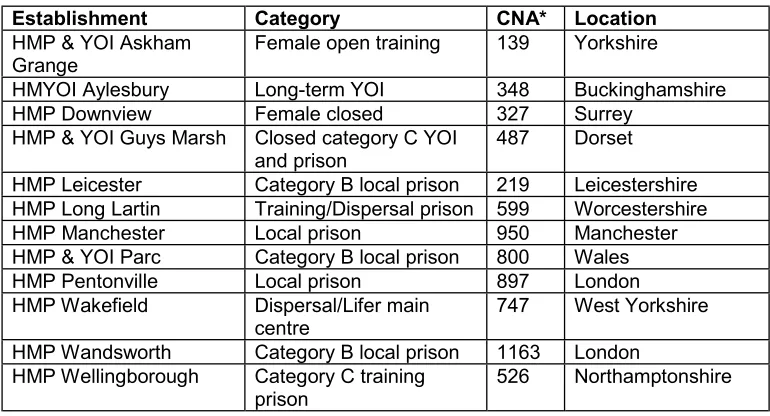
A list of 15 prisons was identified on the basis of geographical spread and category, including male and female prisoners and young offenders, from which we hoped that 10 would agree to be part of the study. Our selection process was not based on any prior knowledge of the quality or range of educational provision in individual prisons. We deliberately decided not to try to select a mix of ‘good’ and ‘improving’ prison education departments. Appendix 3 shows the full list of prisons identified.
[image:18.595.101.486.536.744.2]Judith Williams, Chief Education Officer, OLSU and member of the Advisory Group for the study, wrote to each of the identified prisons encouraging their participation, from which we received an immediate and positive response from 11 establishments. After conducting visits at roughly half of the prisons, it was decided that we should try again to arrange a visit to a dedicated YOI to ensure that the unique voice of the young offender would not be missed. And so HMYOI Aylesbury, one of our initial list of 15, was approached and agreed to join in the study.
Table Two: List of prisons visited in the study
Establishment Category CNA* Location
HMP & YOI Askham Grange
Female open training 139 Yorkshire
HMYOI Aylesbury Long-term YOI 348 Buckinghamshire
HMP Downview Female closed 327 Surrey
HMP & YOI Guys Marsh Closed category C YOI and prison
487 Dorset
HMP Leicester Category B local prison 219 Leicestershire
HMP Long Lartin Training/Dispersal prison 599 Worcestershire
HMP Manchester Local prison 950 Manchester
HMP & YOI Parc Category B local prison 800 Wales
HMP Pentonville Local prison 897 London
HMP Wakefield Dispersal/Lifer main
centre
747 West Yorkshire
HMP Wandsworth Category B local prison 1163 London
HMP Wellingborough Category C training prison
526 Northamptonshire
In all but two establishments, the responsibility for organising the visit was passed to the education department.The education manager generally welcomed us and introduced us to other members of the education team. At one prison we were invited to meet a governor who expressed a keen interest in the study and thanked us for giving her prison the opportunity to participate.
Positive relationships within the education staff team and between education and prison staff seemed to spill over into relationships with prisoner-learners. Where relationships appeared positive, we were better able to stimulate discussion. Where relationships were not so positive, it took a while longer to encourage free flowing discussion. At one prison, prisoner-learners spontaneously applauded the ‘note taker’ for her efforts.
At only one prison and in relation to only one prison officer did we feel that our efforts were being made light of when the prison officer concerned contrived – unsuccessfully – to disrupt the group.
The majority of discussion group participants appeared interested in and willing to help with the study, and pleased to be asked for their opinions. However, most were sceptical about the extent to which our report, or their views, would be taken on board by those in a position to make a difference. Responses to our questionnaire were in the main considered and
thoughtful. Levels of tolerance between group members were generally high and it was interesting to hear the differing perceptions that individual group members brought to the discussion.The most vociferous group members were the young offenders.
In only two prisons did education staff sit in on the discussion. It is difficult to comment on the extent to which their presence influenced the discussion. In one of the groups, prisoner-learners clearly had a positive relationship with the member of staff and most were familiar with and confident at participating in a group discussion.The second smaller group of prisoners not in education were less forthcoming.This may well have been as a result of a member of staff being present.
4.
Outline of this report
THE VIEWS OF PRISONERS
1.
Prison Life and The Prison Education
Context
1.1 Induction and assessment
Going to prison is bound to be a dislocating and distressing experience. In the first few days educational needs are unlikely to be at the forefront of any prisoner’s mind. Amongst the many orders, examinations and assessments to which prisoners will be subject, they may be asked to take a test to assess their educational abilities.
How are educational needs assessed in prison? There was some variation in the responses from the groups. It appeared that some prisons were running a standard basic skills test as a part of the induction process. In some of these, the assessments seemed to be working well:
‘You do literacy and numeracy and then there’s a dyslexia test so they can spot if you’ve got special needs.’ (adult and YOI Cat B).
‘I did an English and numeracy test – they grade you to see your level.’ (C Cat Training – NIE)
But this was not the case everywhere. Some groups, particularly in local prisons, reported a lack of any educational assessment:
‘I came in.There was no assessment. I was allocated to a certain job. On D wing you do teabags. On C wing you do wheelchairs.’ (local)
‘Some other prisons assess you. It doesn’t seem to happen here.’(local)
‘Other gaols do assessments as part of induction.’(local NIE)
‘I think they should assess everyone when you start.’(local NIE)
In three prisons we heard that the same test was repeated everywhere:
‘I’ve done exactly the same educational needs assessment half a dozen times in other prisons.’ (C Cat training)
Some prisoners said that they had declined to take the test:
‘I didn’t do the test because I didn’t want to. She tried her best to get me on it.’ (Prisoner who has trouble reading, C Cat Training – NIE)
In his prison, there seemed no alternative ways of getting your learning needs met. But even where assessments were undertaken, there seemed to be a gap between low achievement and help with basic skills:
‘I couldn’t do the test. So they said they’d put me on education.’ (adult and YOI B Cat NIE)
Another prisoner, who had not gained a place on education, was anxious that he had been left out:
‘I’ve been in two months. People coming down after me have gone down there [to the education department]. I’m dyslexic. I should be going down there before them.’ (adult and YOI B Cat NIE)
1.2 Getting access to education
How do prisoners who want to pursue education get on courses?
We were told frequently by those in the NIE groups that they had tried to get to classes, but their applications had not borne fruit. Nor did they seem to know whether their application had ever been received by the education department, let alone actioned.There was simply no response. From the prisoners’ perception, the process of dealing with their applications to attend classes was often unintelligible.The suspicion that unwanted applications were simply ‘lost’ in the system came through regularly from these groups.
A young prisoner expressed an unmet desire for education:
‘I think everyone should go.They should be made to go. I’ve been stuck working on the wings for 13 months. I’d do history. I’d do anything.’ (adult and YOI B cat NIE)
But for some reason his applications were not acted on.
It was striking how many prisoners not in education said they wanted to be ‘on classes’. In five of the ten NIE groups, prisoners said they had been trying repeatedly, unsuccessfully, to get there.They did not know what had happened to their applications. In seven groups,
respondents said they would like to do education, but either what they wanted to do was not available, or they weren’t allowed to do it (e.g., Open University courses) or they would have to sacrifice too much (gym, their job, pay) to go. Even those who hadn’t tried to get on classes thought they should:
‘I ain’t done it. But really and truly I know education is the key. All the successful people are well educated.’ (local NIE)
Right from the start of our discussions, the need and desire for more opportunities for learning were expressed convincingly.
We heard frequently that getting onto classes seemed to depend more on luck, or influence, than judgement.
‘I got onto education completely accidentally. I’m a white guy and I found myself on a black drama group.They mixed up the names. But once I got down here, I could get on the classes I wanted.’ (local)
The influence of staff was significant:
‘If [the administrator is] not here, it’s down to luck. X is for the inmates.’ (local)
Knowing the education orderly (prisoner assistant in the education department) was also a help, as was a spell in the hospital:
Prisoners in local prisons, in particular, seemed to feel that access to educational opportunity was a hit-and-miss affair, that favouritism might be a factor, and that it was a matter of who you knew, or who was on duty.The sense of a reliable application procedure, with an understandable system of priorities, was lacking.
Waiting lists seemed to be a problem everywhere. Predictably, the popular classes, like cooking and computers, often had waiting lists.
‘Everything has waiting lists but cookery has the longest waiting lists – 70 people. It’s a joke. I waited three months, then the teacher was on holiday, then she dropped something on her foot and was off sick. That’s another three months.’ (YOI)
Other NIE respondents said there was a waiting list just to get on education:
‘It was offered in November, but it’s March and I’m still waiting.’ (local, NIE)
‘Only every now and then do you see vacancies on the labour board saying there are places on education.’ (dispersal)
Nearly all the groups criticised the limitations on budgets and space for education, which meant that few prisoners could benefit. We were also told regularly that the education department did not advertise its classes: there was no published programme, or regular information about what classes were running. Given the waiting lists for popular classes, perhaps this was unsurprising. However this was another way in which prison education departed from common practice in the community.
1.3 Personal choice
To what extent were prisoners free to decide what they wanted to study?
Most prisoners, especially those in the longer-term gaols, felt their personal choice of courses and classes was limited, not only in terms of what was on offer, and their chances of getting to classes, but also by what the prison would or would not allow.
‘First they see how long you’re doing, whether you’re a lifer etc.Then they look at your offence, and what character you are.Then they...The short version is, the prison decides!’ (dispersal)
Access to Open University courses appeared to be strictly limited. Prisoners in the dispersal prisons particularly resented this, and the extent to which eligibility was determined by your category, sentence length, and regime status. (In one prison, we were told that only those on an enhanced regime could apply.) We discuss this further below.
Whilst most who wanted to (though not all, especially in the local prisons) could come to basic skills classes, there were problems for those wanting to do some manual skills training courses, as well as the higher-level academic options, on security grounds.
1.4 Sentence planning
Was education included in sentence planning?
There was a wide disparity of views. People who had been in longer on the same sentence seemed more likely to have a sentence plan, but still there were puzzling discrepancies.The first question was whether the prisoners had a sentence plan or not.The second was whether educational needs were included in the sentence plan.
In most of the local prisons, groups said they did not have sentence plans.
‘What sentence plan?’ (adult and YOI Cat B NIE)
There was often a sense of grievance that sentence plans had not been completed, or reviewed:
‘My last gaol, I was there nine months and not one of them was done.That’s what makes the inmate go back to his cell and kick off.’ (YOI)
The general impression from the groups was that even where sentence planning was done, education rarely featured. Prisoner-learners felt that staff considered education an occasional add-on, rather than a core aspect of sentence planning. As prisoners saw it, offending
behaviour programmes took priority:
‘To be truthful, it seems they want you to do the courses that look good for them other than education, like ETS [Enhanced Thinking Skills]. And it’s not that people want to do them; they have to. It’s part of their SP [sentence plan].’ (dispersal)
‘I have a sentence plan. Education is not on it. ETS is on it. ETS has a 600 people waiting list. I’ve got to meet targets by a certain date. Do I get priority?’ (local NIE)
Only a few prisoners described a sentence plan that included education. Other respondents certainly thought it should:
‘Education should be on the sentence plan for some people, if they can’t read or write.’ (C Cat training – NIE)
Another long-term prisoner commented:
‘After a few years they run out of things to say. So it’s just,“Carry on with education.” It’s not really a plan.’ (dispersal)
In contrast, some of the groups also described encouragement coming through less formal routes:
‘I was called into the office – the probation officer, my personal officer and someone else – all they said was,“You can carry on going to the gym and the workshop,” and recommended that I did some education.’ (dispersal NIE)
This group member went on to say:
‘I done a test and that was it. I was offered some classes but it didn’t fit in with the gym and I’m happy with what I’m doing now.’ (dispersal NIE)
Another prisoner spoke of a more coercive type of encouragement:
‘A number of guys have been told,“You’re going on education or you’re going UB40.”’ (dispersal, NIE)
these discussions appeared to accept, in principle, the idea of sentence planning. However there was little sense that they felt themselves to be joint negotiators in these target-setting exercises. Sentence plans seemed to be yet another thing that was done to them, rather than with them.
1.5 Pay
How did prisoners feel about rates of pay for education?
Pay was certainly a topic of concern, in every group, once we had raised it. Once again, there was no consistent pattern across the prisons in our study. For example, it appeared that some prisons offered educational bonuses; others did not:
‘You get £2.50 for passing exams.’ (YOI)
The irony in being paid to receive education did not escape some. Several prisoners recognised that, on the outside, they would have to pay for it themselves:
‘My girlfriend’s doing Spanish and it costs her. She tells me at least I’m getting it for free.’ (dispersal)
For the majority, however, it seemed there were better paying opportunities to be found, as this exchange from an adult and YOI B category prison (NIE group) makes clear. When asked whether anything put them off going to education they said:
‘The pay. It’s £6-9 here.’
‘Industries is £15-20 a week.’
‘I was working on the hospital wing. I was used to £15 a week.’
For prisoners with limited private cash, this was hard. It meant that prisoner-learners were significantly worse off when it came to buying toiletries, phone cards, or tobacco. It was harder still for particular minority groups, as a woman pointed out:
‘A lot of us are foreign nationals. If you want to call home it costs £9 to talk to your relatives for half an hour.’ (closed prison)
Poor pay for coming to classes was a serious disincentive for many. And there seemed no other way to get those educational needs met – or none that we heard about.
But in some prisons, however, the differential between pay for work and education was not significant, unless you worked in one of the contract workshops. According to the
respondents, the contract workshops were, in many prisons, both better paid, and desperate for workers. But at least one prisoner expressed an objection to this policy:
‘People are just stuck in workshops and not really asked if they want any help. Instead of just allocating people to an activity, you should match people to their level and to their need.’ (Local NIE)
The workshops were the big payers. However, as one group member noted, if they did not pay so well they would be empty.The work was tedious, on the whole. Further, work did not seem readily available in all prisons we visited, and there was some frustration amongst those waiting in their cells, unemployed.
There was a view that the pay was irrelevant:
‘A lot of inmates would do education for nothing. It’s not about the money.We said,“We don’t do LTS [Learning Through Sport] for money.We’ll just do it.”’ (local NIE)
There must be a better way to factor in the educational component, so that this false link with pay could be broken. If education attracts low pay in some prisons, what messages does this give out to prisoners about its value?
1.6 A right or a privilege?
The principle that prisoners are entitled to the same quality of education as they could access outside suggests that education in prison is a right. In practice, it seems that, given the demand for places, education is often treated as a privilege.The notion that prisoners might be
punished by the withdrawal or withholding of education undermines the use of time in prison for rehabilitative aims. But although no one actually said they had been taken off education as punishment, we heard that prisoners, or others they knew, had been taken off classes for disruptive behaviour:
‘I got kicked off my other English class. I was asking her how to spell a word and she wouldn’t tell me. She kicked me out and said I was bad.’ (YOI)
One young offender spoke of penalties for non-attendance:
‘The thing I don’t like is, if you don’t feel like going [to classes] in this prison you get nicked. You might just feel depressed.You might have had a confrontation with your officer, or a phone call with your Mum.You might just want to rest on your bed. But you’ve got to go.’ (YOI)
Another spoke of officers in his previous prison, who had adopted a punitive attitude to the whole enterprise:
‘In HMP X, the POs said,“If they [the prisoners] do education we’ll make them do it instead of exercise”.’ (YOI)
Halfway into the series of visits, we started to ask prisoners explicitly whether they regarded education in prison as a right or a privilege. There was a mixture of views. The majority, where asked, thought education was a right.
‘If a prisoner wants to improve his education he should have a right.’ (adult and YOI C Cat)
Another noted:
‘They have race relations officers, anti-bullying officers.We need education officers, to champion it.’ (local).
The ‘privilege’ part of the question switched many straight in to the mindset cultivated by the Incentives and Earned Privileges (IEP) scheme.The scheme was introduced several years ago to help manage behaviour in prison.Three separate regimes exist: basic, standard and
It appeared that IEP status was being used to restrict educational opportunities, particularly in the long-stay prisons. In one prison, we were told you could not do some things like degree level work unless you were on enhanced status – the highest level. And it seemed you would not get this privilege unless you took part in offending behaviour groups.
‘I was prevented from doing a law course here.You have to be on enhanced status.They’re making it tricky.To get on enhanced status you have to go on groups.The governor says you’ve got to. I asked to pay for my course myself but [the education manager] says I can’t.’ (dispersal)
The impact of earned incentives on all aspects of prison life was, where it occurred, much resented. Just as strongly resented was the involvement of education staff with prison discipline – though we only heard of a couple of instances where this happened.
Sometimes, where there were not many options for purposeful activity during the day, education appeared to be the dumping ground for those who had not applied for jobs. Governors have had targets for hours spent out of cell on ’purposeful activity’ for longer than they have had education targets to meet:
‘In this prison, education is not a privilege. If you don’t apply for work, you’ll get put on education.’ (adult male and YOI B Cat)
The right to choose did not seem to feature here. But when asked for their impressions of what prison staff thought, the boot was on the other foot. Without exception, where asked, respondents thought prison staff saw education for prisoners as a privilege:
‘Here the prison officers will tell you it’s a privilege.’ (local)
‘They want to keep education small. Exams cost a lot.They’re always moaning about the budget.’ (local)
The message seemed to be that these were scarce resources, for non-essentials, to be distributed parsimoniously. Education meant exams, and these were expensive. In this prison, it did not sound as though education was seen as a vital part of the reform and resettlement agenda for inmates – at least from a prisoner’s perspective.
1.7 The prison timetable
Far more significant than pay, for some, were the other sacrifices called for if you came to classes. Gym was universally a casualty. But in one prison it was worse than that:
‘If you’re on education you miss out on everything: exercise, showers, phone calls, kit change. You sacrifice a lot.’ (local)
‘You can have showers at the weekend, but there’s no hot water. Everyone wants one.’ (local)
‘You know who’s on education: they smell!’ (local)
In more than one prison we heard vigorous complaints about the shortage of time in the mornings:
‘Disgraceful.They open us up at 8.05 and we have to do everything by 8.30. It’s ridiculous.’ (dispersal)
When shortage of time combined with negative attitudes towards education on the part of officers, the results could be explosive:
‘I was brushing my teeth when the officer unlocked me. I said,“Just one second governor,” and he said,“No,” and slammed the door. I flipped.’ (local)
1.8 Security categories and their knock-on effects
The longer-term prisoners found the restrictions and (in their eyes) the lack of logic, in hampering their access to these and similar educational opportunities, irksome:
‘They’ve got a plastering course but because I’m Cat A I can’t do it.There’s guys on the plasterers that won’t be out for 20 years. I’m Cat A but I’ll be out in two years.That’s the only useful thing I could do here that’d give me a job on release. I could leave prison a bricklayer, plasterer and plumber. I’ve done plumbing at HMP X.’ (dispersal)
As one member of our advisory group put it:
2.
The Curriculum
2.1 What courses were available in the prisons visited?
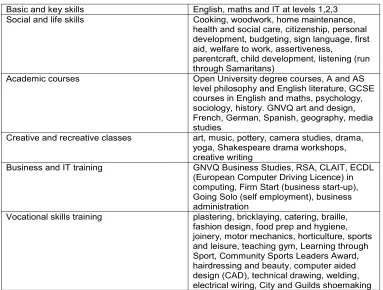
[image:29.595.104.487.250.540.2]We asked everyone in our study what education they were doing, in their current prison, and what they had studied previously, either as part of this or earlier sentences.The variety of responses indicated the range of what was on offer, across the prison estate. In terms of class-based learning we heard about:
Table Three: Prisoners’ list of subjects available to them
Some of these courses were certificated and some were not. The majority were run by the education department: others were undertaken in the vocational training workshops, through the chapel, or through charities.The prisoners did not always differentiate.
Sometimes prisoner-learners told us, under this heading, about courses which sounded like Offending Behaviour Programmes, run by psychology or probation departments: CARAT (Counselling, Assessment, Referral, Advice,Throughcare), ETS (Enhanced Thinking Skills), R and R (Reasoning and Rehabilitation), anger management, drug and alcohol awareness. What is within the education manager and the contractor’s remit sometimes appeared arbitrary. To the prisoners, there didn’t seem much difference: they listed these as ‘courses’ and so they were.
Basic and key skills English, maths and IT at levels 1,2,3 Social and life skills Cooking, woodwork, home maintenance,
health and social care, citizenship, personal development, budgeting, sign language, first aid, welfare to work, assertiveness,
parentcraft, child development, listening (run through Samaritans)
Academic courses Open University degree courses, A and AS level philosophy and English literature, GCSE courses in English and maths, psychology, sociology, history. GNVQ art and design, French, German, Spanish, geography, media studies
Creative and recreative classes art, music, pottery, camera studies, drama, yoga, Shakespeare drama workshops, creative writing
Business and IT training GNVQ Business Studies, RSA, CLAIT, ECDL (European Computer Driving Licence) in computing, Firm Start (business start-up), Going Solo (self employment), business administration
2.2 The variability of provision in different types of establishment
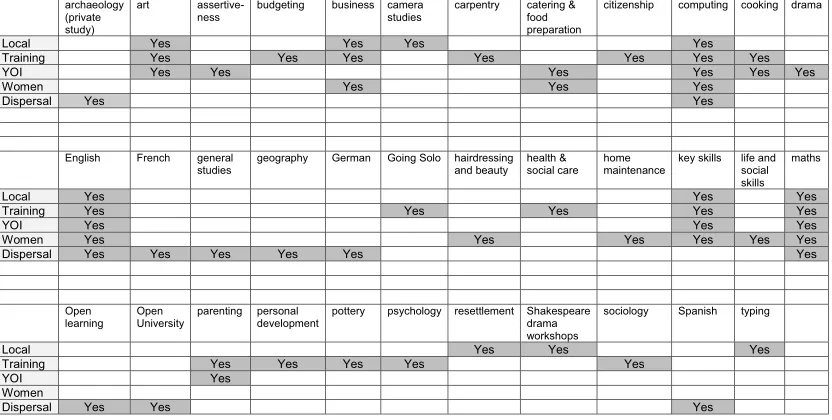
[image:30.595.91.507.200.410.2]The table below shows prisoner-learners’ perceptions of what was on offer in five of the prisons in the study. There were differences between similar types of prison, as well as between prisons in different categories. The table shows both the rich mix of subjects available, and also some of the discontinuity.
Table Four: Prisoners’ lists of courses available by type of prison
Local prisons
There were certainly some anomalies, with the short-stay big locals apparently the most versatile in what they offered. Short, roll-on roll-off courses, with an emphasis on basic skills, recreational and creative subjects, were commonplace.
Training prisons
Within the prisons in our survey there were marked inconsistencies, even within the same categories, in what was on offer.
The sparsest curriculum, appeared to be at one of the cat C training prisons.
‘There’s no pottery here, no art, nothing. Just English, maths and computers.’
Another had the most varied curriculum of any of the prisons we visited.There may well have been good reasons for this difference, but the contrast between prisoners’ perceptions of the two programmes was marked.
Long-term prisons
The dispersal prisons offered more of an academic curriculum, which was clearly geared to the needs of prisoners who would be staying a while.
Both long-stay prisons offered open learning schemes.This involved prisoner-learners coming down to the education wing and working on their own with some tutorial support. We also heard of ‘flexi’ which sounded like the same sort of thing, in a number of establishments.
archaeology (private study)
art assertive-ness
budgeting business camera studies
carpentry catering & food preparation
citizenship computing cooking drama
Local Yes Yes Yes Yes
Training Yes Yes Yes Yes Yes Yes Yes
YOI Yes Yes Yes Yes Yes Yes
Women Yes Yes Yes
Dispersal Yes Yes
English French general studies
geography German Going Solo hairdressing and beauty
health & social care
home maintenance
key skills life and social skills
maths
Local Yes Yes Yes
Training Yes Yes Yes Yes Yes
YOI Yes Yes Yes
Women Yes Yes Yes Yes Yes Yes
Dispersal Yes Yes Yes Yes Yes Yes
Open learning Open University parenting personal development
pottery psychology resettlement Shakespeare drama workshops
sociology Spanish typing
Local Yes Yes Yes
Training Yes Yes Yes Yes Yes
YOI Yes
Women
Women’s prisons
In both women’s prisons there seemed to be a focus on vocational courses and life skills. There was no discernible academic curriculum, as far as group members reported it.
One prisoner-learner remarked:
‘Other prisons offer basic maths, English, craft skills: most offer the same range of courses. A nice range of useless things.’ (women’s prison)
In the women’s prisons we visited arts and crafts was the subject most missed, and particularly sewing.
‘There are not even machines here. At [HMP X] they had a tailoring department.We made clothes for third world countries.’(women’s prison)
We asked both groups in the two women’s prisons whether there were classes that
particularly supported the needs of women. A discussion of this topic revealed some varied opinions.
The closed women’s prison had re-roled from male to female within the previous eighteen months to address the escalating numbers within the women’s estate. One woman thought this still showed in the curriculum:
‘In HMP X and HMP Y they had domestic violence and hygiene [classes] which taught about sexually transmitted diseases and other classes specifically focused on women. Here we’re still a male prison.They still address us with the attitude as for a mister.’
(women’s prison)
When a fellow group member noted that there were ‘quite a few leaflets in the health centre’, the same respondent replied:
‘They’re very good at having leaflets, but what’s the point if people have a problem reading?’ (women’s prison)
The same cluster of topics came up in the open women’s prison. A desire for more on ‘personal health’ was expressed, with an emphasis on drug and alcohol awareness and healthy eating.
Young Offenders
Although we visited three prisons in which adult and young offenders were both held, we only visited one prison exclusively for 18-21 year olds.
A young man on the parenting course in this prison felt very positive about the course:
‘We get opportunities to write books for our kids. It’s good.What a woman feels going through labour.You learn things.You know some different stuff for next time, when she’s worrying about it.’ (YOI)
We heard a lot about the cookery course, which was the one with the longest waiting list. We also heard about the trade courses, run in the workshops.The motor mechanics course was particularly popular. But many were irritated by the shortage of places: