ARTICLE
Full Breastfeeding Duration and Associated Decrease
in Respiratory Tract Infection in US Children
Caroline J. Chantry, MDa, Cynthia R. Howard, MD, MPHb, Peggy Auinger, MSb,c
aDepartment of Pediatrics, University of California Davis Medical Center, Sacramento, California;bDepartment of Pediatrics, University of Rochester School of Medicine
and Dentistry, Rochester, New York;cAmerican Academy of Pediatrics Center for Child Health Research, Rochester, New York
The authors have indicated they have no financial relationships relevant to this article to disclose.
ABSTRACT
OBJECTIVE.The American Academy of Pediatrics recommends exclusive breastfeeding
for an infant’s first 6 months of life. When compared with exclusive breastfeeding for 4 months, greater protection against gastrointestinal infection, but not respi-ratory tract infection, has been demonstrated for the 6-month duration. The objective of this study was to ascertain if full breastfeeding ofⱖ6 months compared with 4 to ⬍6 months in the United States provides greater protection against respiratory tract infection.
METHODS.Secondary analysis of data from the National Health and Nutrition
Examina-tion Survey III, a naExamina-tionally representative cross-secExamina-tional home survey conducted from 1988 to 1994, was performed. Data from 2277 children aged 6 to⬍24 months, who were divided into 5 groups according to breastfeeding status, were compared. Children who required neonatal intensive care were excluded. SUDAAN software was used to account for the complex sampling design. Logistic regression adjusted for confounding factors. Outcome measures included adjusted odds of acquiring pneu-monia,ⱖ3 episodes of cold/influenza,ⱖ3 episodes of otitis media (OM), or wheezing in the past year or acquiring first OM at⬍12 months of age.
RESULTS.In unadjusted analyses, infants who were fully breastfed for 4 to ⬍6
months (n⫽223) were at greater risk for pneumonia than those who were fully breastfed forⱖ6 months (n⫽136) (6.5% vs 1.6%). There were not statistically significant differences inⱖ3 episodes of cold/influenza (45% vs 41%), wheezing (23% vs 24%),ⱖ3 episodes of OM (27% vs 20%), or first OM at⬍12 months of age (49% vs 47%). Adjusting for demographic variables, childcare, and smoke exposure revealed statistically significant increased risk for both pneumonia (odds ratio [OR]: 4.27; 95% confidence interval [CI]: 1.27–14.35) and ⱖ3 episodes of OM (OR: 1.95; 95% CI: 1.06 –3.59) in those who were fully breastfed for 4 to⬍6 months compared withⱖ6 months.
CONCLUSIONS.This nationally representative study documents increased risk of
respi-ratory tract infection including pneumonia and recurrent OM in children who were fully breastfed for 4 vs 6 months. These findings support current recommen-dations that infants receive only breast milk for the first 6 months of life.
www.pediatrics.org/cgi/doi/10.1542/ peds.2004-2283
doi:10.1542/peds.2004-2283
Key Words
breastfeeding, benefits, respiratory infections, infant feeding, nutrition-infant
Abbreviations
WHO—World Health Organization URI— upper respiratory infection OM— otitis media
NHANES—National Health and Nutrition Examination Survey
ROM—recurrent otitis media OM⬍12— otitis media at⬍12 months of age
FullBF⬍1—fully breastfed for⬍1 month FullBF1-3—fully breastfed for 1 to⬍4 months
FullBF4-5—fully breastfed for 4 to⬍6 months
FullBFⱖ6 —fully breastfed forⱖ6 months OR— odds ratio
CI— confidence interval no BF—not breastfed
B
REASTFEEDING BENEFITS HAVEbeen demonstrated in multiple studies to be dose-responsive or, in other words, related to the amount of breast milk received.1–5 For example, fully breastfed infants have been shown to have lower overall illness rates, whereas minimal breast-feeding has not been found to be protective.1 Breastfeed-ing duration also affects child morbidity. A recent com-prehensive review of the world literature to determine health benefits of exclusive breastfeeding for 6 months compared with exclusive breastfeeding for 3 to 4 months noted a decrease in the risk of gastrointestinal infection even in developed settings.2 No study, however, has documented a decrease in the risk of respiratory in-fection with 6 compared with 4 months of exclusive breastfeeding. Currently, most national and interna-tional authorities, including the American Academy of Pediatrics,6 American Academy of Family Physicians,7 World Health Organization (WHO),8and United Nations Children’s Fund,9 recommend 6 months of exclusive breastfeeding.In 2001, the WHO changed their recommendations from 4 to 6 months of exclusive breastfeeding, in part, on the basis of a study in Belarus that noted decreased gastrointestinal morbidity with 6 months of exclusive breastfeeding,10 combined with the estimate that up to 55% of infant deaths worldwide annually are from di-arrheal disease, acute respiratory infections, and other infectious diseases that are attributed to inappropriate feeding practices.5,11 At that time, the WHO noted a paucity of evidence regarding both benefits and risks of 4 vs 6 months of exclusive breastfeeding and called for more research.8This study was undertaken to investi-gate whether the longer duration of exclusive breast-feeding provides children additional protection against acute respiratory illnesses in a developed country such as the United States. Specifically, the objective of this study was to evaluate whether 4 to⬍6 months compared with
ⱖ6 months of full (exclusive or almost exclusive12) breastfeeding is an independent risk factor for respira-tory tract disease, including pneumonia, wheezing, early otitis media (OM), and recurrent bouts of upper respi-ratory tract infections (URIs) and OM in a nationally representative sample of children.
METHODS
Secondary analysis of data from the third National Health and Nutrition Examination Survey (NHANES III),13 a population-based cross-sectional survey of US household residents aged ⱖ2 months that was con-ducted from 1988 to 1994, was performed. NHANES was designed to be nationally representative of the noninsti-tutionalized, civilian population. A household youth questionnaire collected information on children who were ⱕ16 years and was administered to a proxy re-spondent, usually the child’s parent or guardian. For this study, data on respiratory tract infections were
com-pared for children aged 6 to⬍24 months (N⫽2277) by breastfeeding status. The duration of full breastfeeding, defined in this study as receiving nothing other than breast milk on a daily basis, was the breastfeeding vari-able considered. Standard definitions of breastfeeding12 divide full breastfeeding into 2 subcategories: exclusive (child has never received any food or liquid other than breast milk) and full almost exclusive (child has received occasional but does not receive other foods/liquids on a regular or daily basis). We chose full breastfeeding be-cause it more accurately represents the period of time during which breast milk is the overwhelming majority of the diet.
The reported number of episodes of pneumonia, colds or influenza, and wheezing or whistling in the past 12 months was used to identify respiratory tract infections. In addition, the number of and age at first ear infection or earache were used as indicators of OM. The percent-age of children with pneumonia,ⱖ3 episodes of cold or “influenza” (recurrent URI),ⱖ3 episodes of OM (recur-rent OM [ROM]), or wheezing in the past 12 months or experiencing the first episode of OM before 12 months of age (OM⬍12) were compared for 5 groups: formula fed only (n ⫽ 1149) or full breastfeeding for ⬍1 month (FullBF⬍1;n⫽426), 1 to⬍4 months (FullBF1-3;n⫽ 343), 4 to ⬍6 months (FullBF4-5; n ⫽ 223), and ⱖ6 months (FullBFⱖ6;n⫽136). Children with a history of admission to the NICU were excluded. Identical analyses were performed for children who were 6 to⬍72 months of age (N⫽6548). The sample sizes of the 5 groups with this greater age range are as follows: formula fed only (n ⫽ 3464), FullBF⬍1 (n ⫽1101), FullBF1-3 (n ⫽ 902), FullBF4-5 (n⫽561), and FullBFⱖ6 (n⫽520).
exposures, only prenatal, only household, and neither exposure) and (2) as 2 distinct variables (prenatal and household exposure).
Unless otherwise stated, results are given using FullBFⱖ6 as the referent. Adjusted odds ratios (ORs) with 95% confidence intervals (CIs) are reported for all demographic and lifestyle variables included in the model for a specific respiratory outcome. Reported P values are 2-sided; P⬍ .05 was considered statistically significant.
RESULTS
Median durations of full breastfeeding in the 4 breastfed groups were 7 days (FullBF⬍1), 61 days (FullBF1-3), 122 days (FullBF4-5), and 182 days (FullBFⱖ6). Demo-graphic characteristics of the 5 groups of children aged 6 to⬍24 months are shown in Table 1. There were min-imal differences in age and gender among the groups, but children in the FullBFⱖ6 group had greater mean birth weight compared with the other groups. In accor-dance with usual breastfeeding patterns in the United States,15,16infants who were not breastfed (no BF) were of lower socioeconomic status, lived in households with less educated adults, were more likely to be black and less likely to be white, and were less likely to live in 2-parent households than those in the FullBFⱖ6 group. Infants in the no-BF group were also more likely to experience passive smoke exposure. Similarly, children in the FullBF⬍1 group were less likely to be white, more likely to be Mexican American, and more likely to live in
less-educated and single-parent households than those in the FullBFⱖ6 group. Other than birth weight as noted above, there were no statistically significant differences between the FullBF1-3, FullBF4-5, and FullBFⱖ6 groups in any of the variables evaluated.
In unadjusted analyses, infants in the FullBFⱖ6 group were at less risk for having had pneumonia in the past year than those in the FullBF4-6 group (1.6% vs 6.5%;P⫽.017). Additionally, the FullBF1-3 group was more likely to have had the first episode of OM before 1 year of age (61.7% vs 47.2%;P⫽.026) and to have had ROM during the past year than the FullBFⱖ6 group (32.5% vs 20.4%; P ⫽ .016). Differences between the FullBFⱖ6 and FullBF4-5 groups for other outcomes, incidence of recurrent URI (40.8% vs 45.3%), wheezing (24.4% vs 22.6%), ROM (20.4% vs 27.3%), and first episode of OM before 1 year of age (47.2% vs 49.3%), did not reach statistical significance.
Adjusting for demographic and lifestyle variables that are associated with respiratory outcomes demonstrated that infants in the FullBF4-5 group had significantly increased odds of both pneumonia (OR: 4.27; 95% CI: 1.27–14.35) and ROM (OR: 1.95; 95% CI: 1.06 –3.59) compared with those in the FullBFⱖ6 group. Children in the no-BF and FullBF1-3 groups were also at signifi-cantly greater risk for ROM compared with those in the FullBFⱖ6 group. Additionally, those in the FullBF1-3 group were at significantly increased risk for having the first episode of OM at⬍1 year compared with the ref-erent group but not compared with the FullBF4-5 group.
TABLE 1 Demographic Characteristics of Children in the NHANES III Aged 6 to<24 Months According to Breastfeeding Status
No BF (n⫽1149)
FullBF⬍1 (n⫽426)
FullBF1-3 (n⫽343)
FullBF4-5 (n⫽223)
FullBFⱖ6 (n⫽136)
Age, %
6 to⬍12 mo 35 37 33 35 24
12 to⬍24 mo 65 63 67 65 76
Gender, %
Male 51 54 51 50 48
Female 49 46 49 50 52
Race/ethnicity, %
White 54.7a 61.5a 76.6 77.4 79.3
Black 26.5a 9.3 7.3 7.2 7.8
Mexican American 8.2 16.4a 9.4 6.2 7.2
Other 10.7 12.9 6.7 9.2 5.7
Two-parent household, % 70.6a 84.1a 90.2 88.9 92.6
Child careⱖ10 h/wk 13.7 11.1 22.4 9.3 17.7
Smoke exposure, %
Prenatal and postnatal 26.7a 12.0 13.0 9.8 6.6
Prenatal only 4.5 3.4 3.3 1.3 2.8
Postnatal only 22.8 11.7 14.4 12.2 14.0
None 46.0a 72.9 69.3 76.6 76.6
Birth weight, mean (SE), kg 3.33 (0.02)a 3.42 (0.03)a 3.51 (0.03)a 3.51 (0.04)a 3.64 (0.06)
Poverty index, mean (SE) 1.7 (0.1)a 2.5 (0.2) 2.9 (0.2) 2.8 (0.2) 2.8 (0.2)
Head-of-household education, mean (SE), y 11.4 (0.2)a 12.6 (0.2)a 13.5 (0.2) 13.6 (0.4) 14.1 (0.5)
There were no other statistically significant differences; specifically, risks in the FullBFⱖ6 group were not statis-tically different for recurrent URI or wheezing compared with any of the other groups. Although failing to reach statistical significance, for each respiratory outcome the adjusted OR is ⬎1.0 for children in the no-BF, FullBF1-3, or FullBF4-5 groups, with the exception of wheezing in those in the FullBF4-5 group.
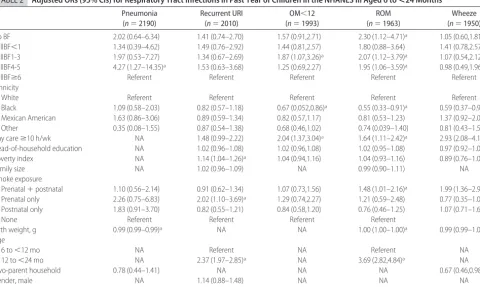
Adjusted ORs for each variable in the model, includ-ing breastfeedinclud-ing status, are shown in Table 2. It is notable that children in day care were at increased risk and black children were at decreased risk for both OM outcomes and wheezing. Smoke exposure was associ-ated with recurrent URI, ROM, and wheezing. Repeat multivariate analysis with prenatal and household smoke exposure treated independently did not substan-tively change any of the other associations (data not shown).
Analyses of data from children aged 6 to⬍72 months of age revealed that for each respiratory outcome other than recurrent URI, the adjusted OR is⬎1.0 for children in the no-BF, FullBF1-3, or FullBF4-5 groups when adjusting for the same covariates as in the younger age range. As before, the increased risks did not reach sta-tistical significance in most cases. Specifically, there was not a significant decrease in the odds of respiratory tract infections or wheezing within the past year or of
acquir-ing the first episode of OM at ⬍12 months of age for children in the FullBFⱖ6 group compared with the FullBF4-6 group. Children in the FullBFⱖ6 group were at lower risk of experiencing the first episode of OM before 1 year compared with each of the other breast-feeding groups (no BF, FullBF⬍1, and FullBF1-3). How-ever, the risk of acquiring OM in the first year was not decreased in the FullBF4-5 group compared with the FullBF1-3 or no-BF groups. Similarly, the risk for wheezing for those in the FullBF⬍1 group was greater than the risk for those in the FullBFⱖ6 group (OR: 1.66; 95% CI: 1.05–2.62) but not greater than those in the FullBF1-3 or FullBF4-5 groups. Adjusted ORs for respi-ratory outcomes according to breastfeeding status in the wider age range are depicted in Table 3.
DISCUSSION
This study documents that full breastfeeding for ⱖ6 months provides greater protection against respiratory tract infection than does full breastfeeding for⬎4 but⬍6 months. This protection is independent of other factors that are known to be associated with rates of respiratory illness, including age, smoke exposure, day care, race/ ethnicity, family size, education, and socioeconomic sta-tus.
Our findings are most convincing for the outcome of ROM in children between the ages of 6 and 24 months,
TABLE 2 Adjusted ORs (95% CIs) for Respiratory Tract Infections in Past Year of Children in the NHANES III Aged 6 to<24 Months Pneumonia
(n⫽2190)
Recurrent URI (n⫽2010)
OM⬍12 (n⫽1993)
ROM (n⫽1963)
Wheeze (n⫽1950)
No BF 2.02 (0.64–6.34) 1.41 (0.74–2.70) 1.57 (0.91,2.71) 2.30 (1.12–4.71)a 1.05 (0.60,1.81)
FullBF⬍1 1.34 (0.39–4.62) 1.49 (0.76–2.92) 1.44 (0.81,2.57) 1.80 (0.88–3.64) 1.41 (0.78,2.57) FullBF1-3 1.97 (0.53–7.27) 1.34 (0.67–2.69) 1.87 (1.07,3.26)a 2.07 (1.12–3.79)a 1.07 (0.54,2.12)
FullBF4-5 4.27 (1.27–14.35)a 1.53 (0.63–3.68) 1.25 (0.69,2.27) 1.95 (1.06–3.59)a 0.98 (0.49,1.96)
FullBFⱖ6 Referent Referent Referent Referent Referent
Ethnicity
White Referent Referent Referent Referent Referent
Black 1.09 (0.58–2.03) 0.82 (0.57–1.18) 0.67 (0.052,0.86)a 0.55 (0.33–0.91)a 0.59 (0.37–0.92)a
Mexican American 1.63 (0.86–3.06) 0.89 (0.59–1.34) 0.82 (0.57,1.17) 0.81 (0.53–1.23) 1.37 (0.92–2.04) Other 0.35 (0.08–1.55) 0.87 (0.54–1.38) 0.68 (0.46,1.02) 0.74 (0.039–1.40) 0.81 (0.43–1.50) Day careⱖ10 h/wk NA 1.48 (0.99–2.22) 2.04 (1.37,3.04)a 1.64 (1.11–2.42)a 2.93 (2.08–4.14)a
Head-of-household education NA 1.02 (0.96–1.08) 1.02 (0.96,1.08) 1.02 (0.95–1.08) 0.97 (0.92–1.02)
Poverty index NA 1.14 (1.04–1.26)a 1.04 (0.94,1.16) 1.04 (0.93–1.16) 0.89 (0.76–1.05)
Family size NA 1.02 (0.96–1.09) NA 0.99 (0.90–1.11) NA
Smoke exposure
Prenatal⫹postnatal 1.10 (0.56–2.14) 0.91 (0.62–1.34) 1.07 (0.73,1.56) 1.48 (1.01–2.16)a 1.99 (1.36–2.92)a
Prenatal only 2.26 (0.75–6.83) 2.02 (1.10–3.69)a 1.29 (0.74,2.27) 1.21 (0.59–2.48) 0.77 (0.35–1.08)
Postnatal only 1.83 (0.91–3.70) 0.82 (0.55–1.21) 0.84 (0.58,1.20) 0.76 (0.46–1.25) 1.07 (0.71–1.62)
None Referent Referent Referent Referent
Birth weight, g 0.99 (0.99–0.99)a NA NA 1.00 (1.00–1.00)a 0.99 (0.99–1.00)
Age
6 to⬍12 mo NA Referent NA Referent NA
12 to⬍24 mo NA 2.37 (1.97–2.85)a NA 3.69 (2.82,4.84)a NA
Two-parent household 0.78 (0.44–1.41) NA NA NA 0.67 (0.46,0.98)a
Gender, male NA 1.14 (0.88–1.48) NA NA NA
Parent asthma/hay fever NA NA NA NA 0.87 (0.66–1.15)
Adjusted for all variables except those indicated by NA (not included in regression model for the corresponding outcome).
in whom the odds of havingⱖ3 episodes were doubled if full breastfeeding was stopped between 4 and 6 months compared with atⱖ6 months. A dose-response effect is noted wherein the risks were higher yet in those who were fully breastfed for 1 to ⬍4 months or not breastfed at all. Protection was also found in this age group against pneumonia, in whom the odds of experi-encing pneumonia were more than fourfold lower if full breastfeeding was continued through 6 months. The latter evidence is less convincing, however, because the adjusted OR for acquiring pneumonia did not reach statistical significance in those who were fully breastfed for ⬍4 months. The inability to detect a clear dose-response curve for this outcome may relate to the rela-tive rarity of pneumonia as an outcome in comparison to outcomes such as OM and URI. It also may be a result of unrecognized differences between the FullBF4-5 and FullBFⱖ6 groups and those who were fully breastfed for shorter durations or not breastfed that were not cap-tured in our adjusted analyses. The possibility that this finding is the result of multiple comparisons must be acknowledged.
In the wider age range of 6 months to 6 years, ⱖ6 months of full breastfeeding protected against acquiring OM in the first year of life compared with all groups of those who were fully breastfed for⬍4 months, whereas 4 to 6 months did not. This also suggests a dose-response effect. This study did not demonstrate continued greater protection against respiratory tract infections through 6 years of age. It is important in interpreting these analyses to remember that parents were asked to report respira-tory illness in the past year only rather than the cumu-lative experience over the lifetime of the child. If effects resulting from breastfeeding wane after discontinuation, it may have been easier to demonstrate results in the younger cohort in whom breastfeeding was more likely to be concurrent or recent.
The mechanisms by which an increased breastfeeding dose may provide extended protection against respira-tory infections are incompletely understood. In addition to passive protection, breast milk seems to affect the infant’s systemic immune response via multiple ave-nues: maturational, antiinflammatory, immunomodula-tory, and antimicrobial.17 Some immune effects that
could result in prolonged protection against respiratory infections include, for example, changes in immune phenotype after exposure to maternal milk, including increases in postvaccination interferon-␥levels18and in natural killer cell numbers, which is consistent with age-related changes and suggests enhanced immune maturation.19In addition, there is experimental evidence in animals that maternal milk lymphocytes cross the infant’s intestinal wall and enter the circulation20; it is postulated that these cells activate the infant’s immune system. Antiinflammatory cytokines such as interleukin 10 and transforming growth factorare also present in maternal milk and taken up by neonatal tissues, in which they are associated with a decrease in inflamma-tory immune responses21 and augmented secretory im-munoglobulin A synthesis.22,23These findings of altered infant immune responses associated with breastfeeding lend biological credence to the findings in our study, ie, that an increased breastfeeding dose between 4 and 6 months could result in a decrease in respiratory infec-tions for many months or even years.
Our findings are consistent with numerous other studies,1–5,10,24–28most of which have been performed in other countries and have adjusted for appropriate con-founders. These studies describe a protective effect of breastfeeding dose and/or duration on the rates of both upper and lower respiratory tract illness. Study results are difficult to compare, because breastfeeding doses and durations used for comparisons differ widely between studies, as does the duration over which outcomes are measured. Results are even more difficult to generalize because the degree of industrialization and availability of resources within the study settings vary tremendously.
In the United States, the secondary analysis of data from the US National Maternal and Infant Health Survey by Raisler et al1found full, most, or “equal” breastfeed-ing (⬃50% of feedings were breast milk), but not “less” breastfeeding, to decrease cough or wheeze, as well as OM in infants without siblings, compared with non-breastfeeders. Similarly, a longitudinal analysis of infant-feeding practices during the first 6 months in the United States noted that both not breastfeeding and “low mixed feeding” (defined as breastfeeds for⬍57% of all feeds) in the prior month were associated with an increased risk
TABLE 3 Adjusted ORs (95% CIs) of Respiratory Tract Infections in Past Year For Children in the NHANES III Aged 6 to<72 Months
Pneumonia Recurrent URI OM⬍12 ROM Wheeze
No BF 2.12 (0.84–5.32) 0.93 (0.68–1.27) 1.40 (1.05–1.87)a 1.15 (0.79–1.67) 1.19 (0.80–1.80)
FullBF⬍1 1.76 (0.48–6.48) 1.33 (0.87–2.03) 1.62 (1.18–2.24)a 1.04 (0.73–1.48) 1.66 (1.05–2.62)a
FullBF1-3 1.42 (0.43–4.74) 1.20 (0.79–1.93) 1.48 (1.04–2.12)a 1.30 (0.86–1.96) 1.30 (0.80–2.10)
FullBF4-5 2.47 (0.94–6.48) 1.23 (0.79–1.93) 1.15 (0.78–1.70)b 1.02 (0.65–1.61) 1.58 (0.89–2.80)
FullBFⱖ6 Referent Referent Referent Referent Referent
Adjusted for the same variables as listed in Table 2.
aStatistically significant results.
of developing an ear infection (adjusted ORs of 1.7 and 1.6, respectively) in the following month. These findings suggest at least a short-term effect of both breastfeeding dose and duration.3 In a prospective study in Bang-ladesh, exclusive breastfeeding in the first few months of life compared with partial or no breastfeeding resulted in a 2.4-fold lower risk of death from acute respiratory infection.4 Similarly, data from Latin America indicate that for those at⬍4 months of life, partial breastfeeding carried a 2.9-fold (and no breastfeeding carried a 4.0-fold) increased risk of death from acute respiratory in-fection compared with exclusive breastfeeding.5 There-after, partial breastfeeding until 1 year of age still protected against respiratory infection compared with no breastfeeding by 2.1-fold. Not all studies, however, have demonstrated exclusive breastfeeding to provide greater protection than partial breastfeeding. For example, a case-control study in Brazil of children who were 1 to 12 months of age demonstrated that the adjusted odds of hospital admission for pneumonia were not statistically greater in partial breastfeeders compared with exclusive breastfeeders.24Possible reasons for this discrepancy in-clude not differentiating between degrees of partial breastfeeding (ie, almost exclusive breastfeeders would have been included with token breastfeeders as partial breastfeeders); confounding by other variables, because controls were only matched to cases by age; and inade-quate power. The adjusted OR for hospital admission for pneumonia in partial versus exclusive breastfeeders at 1 to 2.9 and 3 to 6 months of age were 2.9 and 3.4, respectively, but this substantial increase in odds was not statistically significant.
Breastfeeding duration has also been shown to have an effect, although no studies have specifically compared 4 to 6 months of exclusive or full breastfeeding. Studies in Norway25 and Saudi Arabia26 have noted lactation duration to correlate inversely with respiratory infec-tions in the first 1 and 2 years of life, although these studies did not also consider exclusivity (or “dose”) of breastfeeding, which may have confounded the results (eg, more exclusively breastfed infants may also breast-feed longer). In Mexico, the probability of having an acute respiratory infection during the first 4 months of life was associated with the duration of full breastfeeding between 1 and 4 months; the effect did not extend to 6 months in that study.27In Greenland, exclusive breast-feeding compared with no breastbreast-feeding or having weaned was found in a prospective study to protect against lower respiratory tract infection in multivariate analysis.28The case-control study in Brazil noted above, which did not demonstrate a protective effect of dose, did demonstrate a protective effect of duration: exclusive breastfeeding between 1 and 12 months (evaluated in groups of those at⬍3, 3 to⬍6, and⬎6 months) resulted in a large decrease in the adjusted odds of hospital ad-mission for pneumonia when compared with infants
who were already weaned.24 Similarly, a prospective study in Chile noted pneumonia during the first 18 months of life to be associated in multivariate analysis with duration of breastfeeding.29 As with breastfeeding dose, however, all studies that examined duration have not shown increased protection with increased duration. There were 2 small studies in Sweden that did not sup-port an association between breastfeeding duration and respiratory illness, one with an outcome of ROM and another with the outcome of number of respiratory tract infections treated with antibiotics.30,31The observational study of morbidity by exclusive breastfeeding duration in Belarus also failed to demonstrate increased protec-tion against infectious respiratory outcomes with 6 months of exclusive breastfeeding when compared with 3 months of exclusive breastfeeding followed by partial breastfeeding at least through 6 months.10It is unclear why our results differ from those found in Sweden and Belarus. Possibilities include differing uses of the health care system (and therefore subsequent diagnoses), race/ ethnicity differences in susceptibility to OM (such as that seen with black compared with white infants in this country),32and/or different patterns of pacifier use.
This study has several limitations. First, and perhaps foremost, is that the day care question in the NHANES III did not account for the number of children in attendance and furthermore only allowed a dichotomous response, simply⬍10 orⱖ10 hours per week. This dichotomy may not adequately capture the relative increase in risk of acquiring respiratory tract infections at day care. We were unable to adjust for pacifier use, because this in-formation was not available in the NHANES database; pacifier use has been noted to be associated with risk for OM.33Differing pacifier use between the groups of those who were fully breastfed for 4 to ⬍6 vs ⱖ6 months, however, would not explain the nearly twofold increase in risk of ROM seen in our study. The NHANES also relies on parental report of infections over the last year, which is likely to be inaccurate in some instances. It seems unlikely, however, that recall bias would differ by breastfeeding status. Using family size as a surrogate for number of siblings also may be a source of error. Finally, it is very limiting that the history of respiratory tract infection only within the past year is available. As pre-viously noted, this would lead to an underestimate of the cumulative effect of breastfeeding on respiratory illness in both age groups. Accordingly, our findings should not be interpreted as proof that extended full breastfeeding is not protective beyond 2 years of age. This study’s major strengths include a relatively large, nationally representative sample size with the ability to adjust for factors known to affect the incidence of respi-ratory tract infections in childhood.
in-creased odds seen with smoke exposure (OR: 1.48) or day care ⱖ10 vs ⬍10 hours weekly (OR: 1.64). This substantial difference in morbidity supports the current national and international recommendations that in-fants be exclusively breastfed for 6 months. Heretofore, the main difference in morbidity that has been reported between 3 vs 6 months of exclusive breastfeeding is a decrease in diarrheal disease.10 There are no previous reports that detailed specific differences in respiratory morbidity between 4 and 6 months of exclusive or full breastfeeding, despite the fact that the question of whether to introduce solids at 4 vs 6 months is a matter of considerable public health debate.
CONCLUSIONS
This analysis is the first to document decreased risk for respiratory tract infection, particularly ROM, in children who are fully breastfed for 6 vs 4 months. Our findings add to growing evidence that breastfeeding benefits are dose- and duration-responsive and support current rec-ommendations that infants receive only breast milk dur-ing the first 6 months of life.
ACKNOWLEDGMENTS
This study was supported in part by a Special Projects Award of the Ambulatory Pediatric Association (2000 – 2001).
We gratefully acknowledge Dr Robert S. Byrd for his guidance.
REFERENCES
1. Raisler J, Alexander C, Camp P. Breast-feeding and infant illness: a dose-response relationship?Am J Public Health.1999; 89:25–30
2. Kramer MS, Kakuma R. Optimal duration of exclusive breast-feeding.Cochrane Database Syst Rev.2002;(1):CD003517 3. Scariati PD, Grummer-Strawn LM, Fein SB. A longitudinal
analysis of infant morbidity and the extent of breastfeeding in the United States. Pediatrics.1997;99(6). Available at: www. pediatrics.org/cgi/content/full/99/6/e5
4. Zaman K, Baqui AH, Yunus MD, Bateman OM, Chowdhury HR, Black RE. Acute respiratory infections in children: a com-munity-based longitudinal study in rural Bangladesh. J Trop Pediatr.1997;43:133–137
5. Bertran AP, de Onis M, Lauer JA, Villar J. Ecological study of effect of breast feeding on infant mortality in Latin America.
BMJ.2001;323:303–306
6. Gartner LM, Morton J, Lawrence RA, et al. Breastfeeding and the use of human milk.Pediatrics.2005;115:496 –506 7. American Academy of Family Physicians. Breastfeeding
(posi-tion paper). Available at: www.aafp.org/x6633.xml. Accessed April 6, 2005
8. Department of Nutrition for Health and Development, World Health Organization. The optimal duration of exclusive breastfeeding: report of an expert consultation. WHO/NHD/ 01.09.2002. Available at: www.who.int/child-adolescent-health/New㛭Publications/NUTRITION/WHO㛭CAH㛭01㛭24.pdf. Accessed April 6, 2005
9. United Nations Children’s Fund. What we do: nutrition. Avail-able at: www.unicef.org/nutrition/index㛭breastfeeding.html. Accessed April 6, 2005
10. Kramer MS, Guo T, Platt RW, et al. Infant growth and health outcomes associated with 3 compared with 6 mo of exclusive breastfeeding.Am J Clin Nutr.2003;78:291–295
11. World Health Organization. Causes of under-five mortality. Available at: www.who.int/disasters/repo/8290.pdf. Accessed April 6, 2005
12. Labbok M, Krasovec K. Toward consistency in breastfeeding definitions.Stud Fam Plann.1990;21:226 –230
13. National Center for Health Statistics. Plan and operation of the Third National Health and Nutrition Examination Survey, 1988 –94. Series 1: programs and collection procedures.Vital Health Stat 1.1994;32:1– 407
14. Shah BV, Barnwaell BG, Bieler GS.SUDAAN User’s Manual, Release 7.5. Research Triangle Park, NC: Research Triangle Institute; 1997
15. Grossman LK, Larsen-Alexander JB, Fitzsimmons SM, Cordero L. Breastfeeding among low-income, high-risk women. Clin Pediatr (Phila).1989;28:38 – 42
16. Ryan AS, Wenjun Z, Acosta A. Breastfeeding continues to in-crease into the new millennium.Pediatrics.2002;110:1103–1109 17. Kelly D, Coutts AGP. Early nutrition and the development of immune function in the neonate. Proc Nutr Soc. 2000;59: 177–185
18. Pabst HF, Spady DW, Pilarski LM, Carson MM, Beeler JA, Krezolek M. Differential modulation of the immune response by breast- or formula-feeding of infants.Acta Paediatr.1997;86: 1291–1297
19. Hawkes JS, Neumann MA, Gibson RA. The effect of breast feeding on lymphocyte subpopulations in healthy term infants at 6 months of age.Pediatr Res.1999;45:648 – 651
20. Jain L, Vidyasagar D, Xanthou M, Ghai V, Shimada S, Blend M. In vivo distribution of human milk leucocytes after ingestion by newborn baboons.Arch Dis Child.1989;64:930 –933 21. Letterio JJ, Geiser AG, Kulkarni AB, Roche NS, Sporn MB,
Roberts AB. Maternal rescue of transforming growth factor-beta 1 null mice.Science.1994;264:1936 –1938
22. Rousset F, Garcia E, Defrance T, et al. Interleukin 10 is a potent growth and differentiation factor for activated human B lym-phocytes.Proc Natl Acad Sci USA.1992;89:1890 –1893 23. Ogawa J, Sasahara A, Yoshida T, et al. Role of transforming
growth factor-beta in breast milk for initiation of IgA produc-tion in newborn infants.Early Hum Dev.2004;77:67–75 24. Cesar JA, Victora CG, Barros FC, Santos IS, Flores JA. Impact of
breast feeding on admission for pneumonia during postneona-tal period in Brazil: nested case-control study.BMJ.1999;318: 1316 –1320
25. Nafstad P, Jaakkola JJK, Hagen JA, et al. Breastfeeding, ma-ternal smoking and lower respiratory tract infections.Eur Re-spir J.1996;9:2623–2629
26. Abdulmoneim I, Al-Ghamdi SA. Relationship between breast-feeding duration and acute respiratory infections in infants.
Saudi Med J.2001;22:347–350
27. Lopez-Alarco´n M, Villalpando S, Fajardo A. Breast-feeding lowers the frequency and duration of acute respiratory infec-tion and diarrhea in infants under six months of age.J Nutr.
1997;127:436 – 443
28. Koch A, Molbak K, Homoe P, et al. Risk factors for acute respiratory tract infections in young Greenlandic children.
Am J Epidemiol.2003;158:374 –384
29. Lopez Bravo IM, Sepulveda H, Valdes I. Acute respiratory illnesses in the first 18 months of life.Rev Panam Salud Publica.
30. Harsten G, Prellner K, Heldrup J, Kalm O, Kornfalt R. Recur-rent acute otitis media: a prospective study of children during the first three years of life.Acta Otolaryngol.1989;107:111–119 31. Hakansson A, Carlsson B. Maternal cigarette smoking, breast-feeding, and respiratory tract infections in infancy: a population-based cohort study.Scand J Prim Health Care.1992;10:60 – 65
32. Niemela M, Pihakari O, Pokka T, Uhari M. Pacifier as a risk factor for acute otitis media: a randomized, controlled trial of parental counseling.Pediatrics.2000;106:483– 488
DOI: 10.1542/peds.2004-2283
2006;117;425
Pediatrics
Caroline J. Chantry, Cynthia R. Howard and Peggy Auinger
Infection in US Children
Full Breastfeeding Duration and Associated Decrease in Respiratory Tract
Services
Updated Information &
http://pediatrics.aappublications.org/content/117/2/425
including high resolution figures, can be found at:
References
http://pediatrics.aappublications.org/content/117/2/425#BIBL
This article cites 26 articles, 11 of which you can access for free at:
Subspecialty Collections
http://www.aappublications.org/cgi/collection/breastfeeding_sub Breastfeeding
http://www.aappublications.org/cgi/collection/nutrition_sub Nutrition
b
http://www.aappublications.org/cgi/collection/infectious_diseases_su Infectious Disease
http://www.aappublications.org/cgi/collection/otitis_media_sub Otitis Media
orders_sub
http://www.aappublications.org/cgi/collection/ear_nose_-_throat_dis Ear, Nose & Throat Disorders
following collection(s):
This article, along with others on similar topics, appears in the
Permissions & Licensing
http://www.aappublications.org/site/misc/Permissions.xhtml
in its entirety can be found online at:
Information about reproducing this article in parts (figures, tables) or
Reprints
http://www.aappublications.org/site/misc/reprints.xhtml
DOI: 10.1542/peds.2004-2283
2006;117;425
Pediatrics
Caroline J. Chantry, Cynthia R. Howard and Peggy Auinger
Infection in US Children
Full Breastfeeding Duration and Associated Decrease in Respiratory Tract
http://pediatrics.aappublications.org/content/117/2/425
located on the World Wide Web at:
The online version of this article, along with updated information and services, is
by the American Academy of Pediatrics. All rights reserved. Print ISSN: 1073-0397.