OPTIMIZATION OF CAPACITATED
VEHICLE ROUTING PROBLEM USING
PSO
S.R.VENKATESAN* Assistant Professor
Department of Mechanical Engineering, Adhiyamaan College of Engineering, Hosur, Tamil Nadu, India.
[email protected] D.LOGENDRAN** Assistant Professor
Department of Mechanical Engineering, Adhiyamaan College of Engineering, Hosur , Tamil Nadu, India.
D.CHANDRAMOHAN***
Assistant Professor
Department of Mechanical Engineering, Adhiyamaan College of Engineering, Hosur , Tamil Nadu, India.
Abstract:
This paper presents solution techniques for Capacitated Vehicle Routing Problem (CVRP) using metaheuristics. Capacitated Vehicle Routing Problem is divided into set of customers called cluster, and find optimum travel distance of vehicle route. The CVRP is a combinatorial optimization problem; particle swarm optimization (PSO) technique is adapted in this paper to solve this problem. The main problem is divided into subprograms/clusters and each subprogram is treated as travelling salesman problem and solved by using particle swarm optimization techniques (PSO). This paper presents a sweep, Clark and wright algorithm to form the clusters. This model is then solved by using a particle swarm optimization (PSO) method to find optimum travel distance of vehicle route. Our analysis suggests that the proposed model enables users to establish route to serve all given customers with minimum distance of vehicles and maximum capacity.
Keywords: Capacitated Vehicle Routing Problem (CVRP); Traveling Salesman Problem (TSP); Particle Swarm Optimization (PSO).
1. Introduction
The Capacitated Vehicle Routing Problem (CVRP) was first formulated by Christofides N et al(1979), a fixed capacity of vehicle serves set of customer from a common point called warehouse. Further CVRP is formally defined as ‘n’ number of customer needs service from a common point of warehouse. The each customer ‘i’ has a demand of ‘di’ and served by vehicle ‘k’ having capacity ‘c’.
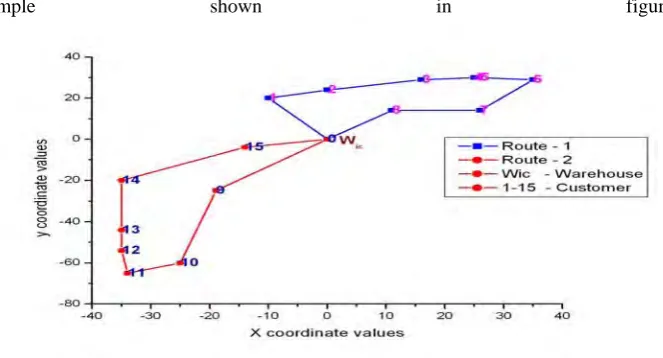
example shown in figure 1).
Figure 1 Vehicle route with more then one DC’s and its optimal route
2. Literature Survey
Shi et al. (2007) has presented a novel method based on pso for traveling salesman problem. An uncertain strategy is added in the approach for optimizing the tsp and gtsp (generalized traveling salesman problem). Jesus et al. (2005) has presented multi-echelon vrp the model and the inequalities have been tested on new benchmarks derived from the cvrp instances of the literature, showing a good behavior of the model for small and medium sized instances. Ammar et al. (2008) has presented a modified priority-based encoding incorporating a heuristic operator for reducing the possibility of loop-formation in the path construction process is proposed for particle representation in pso. Pso-based approach can find the optimal path with good success rates and also can find closer sub-optimal paths with high certainty for all the tested networks. Peng yong et al. (2008) has discussed vehicle routing problem (vrp) with stochastic demand. The pso (particle swarm optimization)-dp (dynamic programming) algorithm with inver-over operator was provided to find the priori tour with the minimal expected cost. Paolo toth et al. (2002) has discussed vrp and cvrp. Branch-and-bound algorithms for the capacitated vrp. Branch-and-cut algorithms for the capacitated vrp. Set-covering-based algorithms for the capacitated vrp. Jin et al. (2008) has discussed formulation of the vehicle routing problem with simultaneous pickup and delivery and a particle swarm optimization (pso) algorithm for solving it.
From the above discussion it is observed that particle swarm algorithm is successfully applied in various capacitated vehicle routing problem (Jesus et al. 2008; Shi et al.2007). In this context, the present work attempts to find out shortest path between warehouse and customers involved in the capacitated vehicle routing problems.
3. Mathematical Model
The present work involves clustering the several customer points from the warehouse and find out optimal path of each cluster. Here the problem involves both the case i.e., allocation of vehicle for warehouse to customer and to find out shortest path between them. The mathematical model for the above problem is as follows:
n i n i j j N k ijk ijX
C
Minize
0 0, 1
(1) Subject to
n j i i n i j j jikijk
X
j
n
k
N
N k n j i in
j
X
ijk 1 0,...,
2
,
1
,
1
(3)
n i n i j jC
X
d
j ijk0 1 (4)
n
s
k
N
s
X
s
i j s
ijk
1
,
1
,
2
,...
,
,
1
,...
i
n
j
n
i
j
k
N
X
ijk
0
,
1
,
0
,
1
,...
,
0
,
1
,...
,
,
1
,...
Where
di = Demand of customer (i)
C = Vehicle Capacity
Xijk = 1 for vehicle k visits customer i and then customer j
1.for all j = 0,1,….n , i≠j , k=1,2,…N
The Equation 1 represents the number of customers with respect to total capacity of vehicle. Equation 2 to 4 represents, the Constraint i.e., how to visit customer i customer j. Here, the traveling Salesman Problem (TSP) is used to form a cluster. In the problem, there are N cities that should be visited exactly once by the traveling salesperson, with the minimum cost of course. Once the cluster is formed for each vehicle, then to find out shortest path between them, will be the solution to the problem, which is computationally complex. If the number of customer is more, it makes the problem still difficult to solve. Hence particle swarm optimization is proposed to solve the model. Each cluster is representing a warehouse and associated customer.
4. Methodology
4.1 Clustering
4.1.1 Sweep Algorithm
The sweep algorithm is a method for clustering customers into groups so that customers in the same group are geographically close together and can be served by the same vehicle. The sweep algorithm uses the following steps.
1. Locate the depot as the center of the two-dimensional plane.
2. Compute the polar coordinates of each customer with respect to the depot. 3. Start sweeping all customers by increasing polar angle.
4. Assign each customer encompassed by the sweep to the current cluster.
5. Stop the sweep when adding the next customer would violate the maximum vehicle capacity. 6. Create a new cluster by resuming the sweep where the last one left off.
7. Repeat steps 4 – 6, until all customers have been included in a cluster.
General formula for calculating polar coordinates
ta
n
1
(
y
/
x
)
(5)where
4.1.2 Euclidean distance
o Distance: there isn’t a unique concept of distance, because the real world, presents a mixture of distances (economic, physical, etc.)
o Distance could be considered as the actual space traveled on a certain trip, and it could be expressed in time, economical cost, etc.
o Distance can be calculated in 2D (Euclidean space)
The equation 6 is used to find out the distance between two nodes (i.e., distance between customers or customer to warehouse. This will be used for calculating savings matrix for clark and wright algorithm and for calculating fitness values in PSO.
General formula for calculating Euclidean distance
(6)
Where
dij -distance between two nodes
xi -X co-ordinate value for node i
xj -X co-ordinate value for node j
yi -Y co-ordinate value for node i
yj -Y co-ordinate value for node j
4.1.3 Clarke and Wright Savings Algorithm
It is based on the notion of savings. When two routes (0,..., i, 0) and (0, j,..., 0) can feasibly be merged into a single route (0,..., i, j,..., 0), A distance savings is generated (7)
Where
Sij - Savings between two depot
d0i - distance between depot i to warehouse
dj0 - distance between warehouse to depot j
dij - distance between depot i to depot j
4.2 Routing
4.2.1 Particle swam optimization (PSO)
The PSO algorithm is a method, used for find out shortest path of each cluster so that vehicle will be travel in minimum distance to each city in the same group
Figure 2. PSO concept
Figure 2. shows Swarms of ambivalent bees (agents or particles) are flying in a field to find the location with the highest flower densities. The attractions from the personal best (pid) and the global best (gid) on each agent
are modeled by Newtonian mechanics as two spring-like forces. C1 and C2 are constants, multiplied by random
numbers r1and r2 with uniform distributions in (0,1). W is a inertial weight. The formula for calculating the position and velocity of the particle are as follows.
2
2j i j
i
x
y
y
x
dij
dij
j
d
di
t 1 *vid
t c1r1
pid x
c2r2
pgd xid
idv w id (8)
1
)
1
(
t
x
t
v
t
x
id id id (9)where,
vid - velocity of dimension d of the i th particle
pid - best previous position of the i th Particle
pgd - is the best position of the neighbors
xid - current position of the ith particle
c1 & c2 - are acceleration constants r1, r2 - random function in the range [0, 1] w - Inertia weight
The inertia weight is taken as 0.41 and the acceleration constants are set as c1 = c2 = 2 as proposed in Ying et al. (2003). The velocity of the particle is calculated using equation 8 and the position using equation 9.
5. Results And Discussions
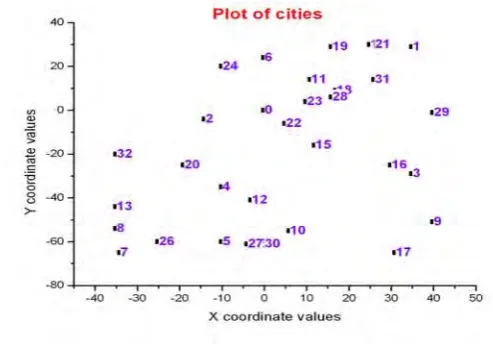
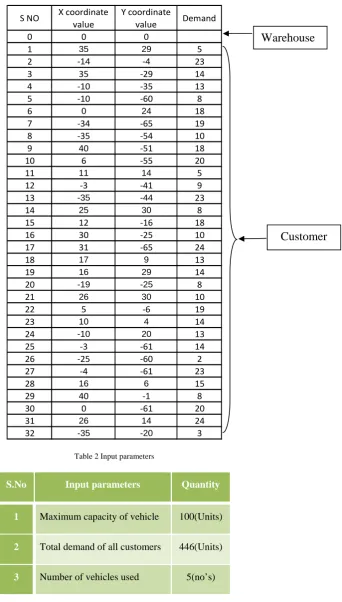
The input data are the number of customer, the distance between each pair of nodes and demand at each customer. In this study the demand at each customer is considered as unit and maximum capacity of vehicle also be considered as unit, these are shown in table 1 and figure 3 shows its graphical representation. The table 2 represents some of input parameters which was used to form the clusters.
In this research the total network size is taken as 33 (i.e., 32 customer’s and one warehouse) to study the performance of proposed methodology. The distance matrixes for various customers are calculated according to the X, Y Co-ordinate values given in the table 1.
Figure 3 Graphical representations of 32 customers and one warehouse
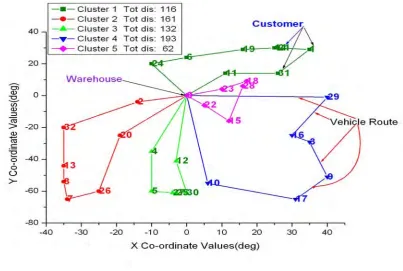
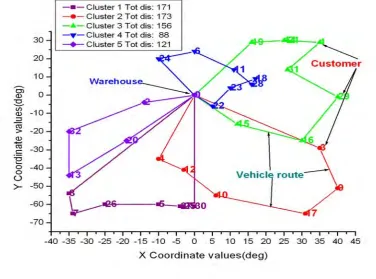
From the table 3, it can be observed that the sweep method gives the minimum distance then the clark and wright results. Here the proposed sweep method is obtained the total distance travelled by all vehicles is 664 units but the clark and wright result of problems is 709. So the sweep method is reduces overall traveling distance by 45 units i.e., 6.35% than the clark and wright result. Figure 4 represents optimal route obtained by using sweep with pso. Figure 5 represents optimal route obtained by using clark and wright with pso.
6. Conclusion
than the clark and wright with PSO results. From the results, it can be observed that sweep with PSO can reduce the costs in vehicle routing problem, by sweeping with respect to angular position of the customers.
Table 1 X, Y Coordinate values and demand of each customer and a warehouse
S NO X coordinate value
Y coordinate
value Demand
0 0 0
1 35 29 5
2 -14 -4 23
3 35 ‐29 14
4 ‐10 ‐35 13
5 ‐10 ‐60 8
6 0 24 18
7 ‐34 ‐65 19
8 ‐35 ‐54 10
9 40 ‐51 18
10 6 ‐55 20
11 11 14 5
12 ‐3 ‐41 9
13 -35 -44 23
14 25 30 8
15 12 ‐16 18
16 30 ‐25 10
17 31 ‐65 24
18 17 9 13
19 16 29 14
20 -19 -25 8
21 26 30 10
22 5 ‐6 19
23 10 4 14
24 -10 20 13
25 ‐3 ‐61 14
26 ‐25 ‐60 2
27 ‐4 ‐61 23
28 16 6 15
29 40 ‐1 8
30 0 ‐61 20
31 26 14 24
32 -35 -20 3
Table 2 Input parameters
S.No Input parameters Quantity
1 Maximum capacity of vehicle 100(Units)
2 Total demand of all customers 446(Units)
3 Number of vehicles used 5(no’s)
Warehouse
Table 3 New best solutions for instance AN33k5
S.No Sweep Algorithm Clark and right Algorithm
Vehicle Route
Vehicle load
Total distance traveled
Vehicle Route
Vehicle load
Total distance traveled
1 0,24,6,19,14,21,1,31,11,0 95 116 0, 8, 7, 26, 5, 27, 25, 30, 0 96 171
2 0,20,26,7,8,13,32,2,0 94 161 0, 4, 12, 10, 17, 9, 3,0 98 173
3 0,12,30,25,27,5,4,0 92 132 0, 19, 14, 21, 1, 31, 29, 16, 15, 0 98 156
4 0,10,17,9,3,16,29,0 94 193 0, 24, 6, 11, 28, 18, 23, 22, 0 97 88
5 0,22,15,18,28,23,0 71 62 0, 2, 32, 13, 20, 0 57 121
Total 446 664 Total 446 709
Figure 5 Graphical representation of best solution for instance an33k5 by using Clark and Right algorithm
References
[1] Christofides N, Mingozzi A, Toth P. The vehicle routing problem. In: Christofides N, Mingozzi A, Toth P, Sandi C, editors. Combinatorial Optimization. Chichester: Wiley; 1958; 1979. p. 315–38
[2] Shi, x.h., liang, y.c., lee, h.p., lu, c., and wang, q.x., “particle swarm optimization-based algorithms for tsp and generalized tsp” information processing letters 103 (2007) 169–176
[3] Jesus gonzalez feliu1, guido perboli, roberto tadei, and daniele vigo., “the two-echelon capacitated vehicle routing problem” the ministero dell’universit`a e della ricerca (2005).
[4] Ammar w. Mohemmed, nirod chandra sahoo, tan kim geok., “solving shortest path problem using particle swarm optimization” journal of applied soft computing 8 (2008) 1643–1653
[5] Peng yong, zhu hai-ying., “research on vehicle routing problem with stochastic demand And pso-dp algorithm with inver-over operator” setp, 2008, 28(10): 76–81
[6] Paolo toth, daniele vigo., “the vehicle routing problem” universita degli studi di bologna, italy copyright © 2002 by society for industrial and applied mathematics .
[7] The jin ai, voratas kachitvichyanukul., “a particle swarm optimization for the vehicle routing problem with simultaneous pickup and delivery” computers & operations research 36 (2009) 1693 – 1702
[8] Chen, a. L., yang, g. K., & wu, z. M. (2006). Hybrid discrete particle swarm optimization algorithm for capacitated vehicle routing problem.Journal of zhejiang university science a, 7, 607–614.
Authors
He received his M.E., Degree at PSG College of Technology, Coimbatore from Anna University of Technology, Coimbatore. He is an Assistant Professor in Department of Mechanical Engineering, Adhiyamaan College of Engineering (Autonomous),Hosur.
**
He is a Ph.D., Research scholar in Department of Mechanical Engineering, Anna University of Technology Coimbatore, Coimbatore, India. He received his M.E., Degree at Bannari Amman Institute of Technology, Sathyamangalam from Anna University, Chennai. He is an Assistant Professor in Department of Mechanical Engineering, Adhiyamaan College of Engineering (Autonomous), Hosur.
***