Association Between
Uropathogen and Pyuria
Nader Shaikh, MD, MPH, Timothy R. Shope, MD, MPH, Alejandro Hoberman, MD, Alyssa Vigliotti, BA, Marcia Kurs-Lasky, MS, Judith M. Martin, MDabstract
OBJECTIVE: We sought to determine factors associated with the absence of pyuria insymptomatic children whose urine culture was positive for a known uropathogen.
METHODS: We obtained data on children evaluated at the Children’s Hospital of Pittsburgh emergency department between 2007 and 2013 with symptoms of urinary tract infection (UTI) who had paired urinalysis and urine cultures. We excluded children with an unknown or bag urine collection method, major genitourinary anomalies, immunocompromising conditions, or with multiple organisms on culture. We chose a single, randomly-selected urine specimen per child and limited the analysis to those with positive cultures.
RESULTS: There were 46 158 visits during the study period; 1181 children diagnosed with UTI met all inclusion criteria and had a microscopic urinalysis for pyuria. Pyuria (≥5 white blood cells per high-powered field or ≥10 white blood cells per cubic millimeter) was present in 1031 (87%) children and absent in 150 (13%). Children with Enterococcus
species, Klebsiella species, and Pseudomonas aeruginosa were significantly less likely to exhibit pyuria than children with Escherichia coli (odds ratio of 0.14, 0.34, and 0.19, respectively). Children with these organisms were also less likely to have a positive leukocyte esterase on dipstick urinalysis. Results were similar when we restricted the analysis to children whose urine samples were collected by bladder catheterization.
CONCLUSIONS: We found that certain uropathogens are less likely to be associated with pyuria in symptomatic children. Identification of biomarkers more accurate than pyuria or leukocyte esterase may help reduce over- and undertreatment of UTIs.
Division of General Academic Pediatrics, Department of Pediatrics, Children’s Hospital of Pittsburgh of UPMC, University of Pittsburgh School of Medicine, Pittsburgh, Pennsylvania
Dr Shaikh had full access to all data in the study and takes responsibility for the integrity of the data and the accuracy of the data analysis and participated in study concept and design and acquisition of data; Dr Shope participated in study concept and design analysis and interpretation of data; Ms Kurs-Lasky participated in analysis and interpretation of the data and statistical analysis; Drs Martin, Hoberman, and Vigliotti participated in analysis and interpretation of data; and all authors participated in drafting of the manuscript.
DOI: 10.1542/peds.2016-0087 Accepted for publication Apr 13, 2016
Address correspondence to Nader Shaikh, MD, MPH, Children’s Hospital of Pittsburgh of UPMC, One Children's Hospital Drive, 4401 Penn Ave, Pittsburgh, PA 15224. E-mail: [email protected] PEDIATRICS (ISSN Numbers: Print, 0031-4005; Online, 1098-4275).
Copyright © 2016 by the American Academy of Pediatrics
FINANCIAL DISCLOSURE: The authors have indicated they have no fi nancial relationships relevant to this article to disclose.
FUNDING: No external funding.
To cite: Shaikh N, Shope TR, Hoberman A, et al. Associ-ation Between Uropathogen and Pyuria. Pediatrics. 2016; 138(1):e20160087
WHAT’S KNOWN ON THIS SUBJECT: Approximately 10% of children with a positive urine culture and symptoms of a urinary tract infection lack pyuria on urinalysis. The reasons for this have not been systematically evaluated. Lack of pyuria could lead to delayed antimicrobial treatment.
Clinicians rely heavily on the degree of pyuria (white blood cells [WBC] in the urine) when making a presumptive diagnosis of urinary tract infection (UTI). Lack of pyuria on an initial urinalysis may result in delayed diagnosis and delayed antimicrobial therapy. Accordingly, we sought to determine factors associated with the absence of pyuria in symptomatic children whose urine culture was positive for a known uropathogen.
We hypothesized, based on some preliminary data in adults, 1
that Gram-positive organisms (Staphylococcus saprophiticus and
Enterococcus species) would cause less inflammation of the urinary tract and consequently cause less pyuria on urinalysis than infections caused by Gram-negative organisms (Escherichia coli, Pseudomonas aeruginosa, Klebsiella species, Proteus
species, and Enterobacter species), in which pyuria is observed in the vast majority of cases.2, 3
METHODS
We obtained data on all children evaluated at the emergency
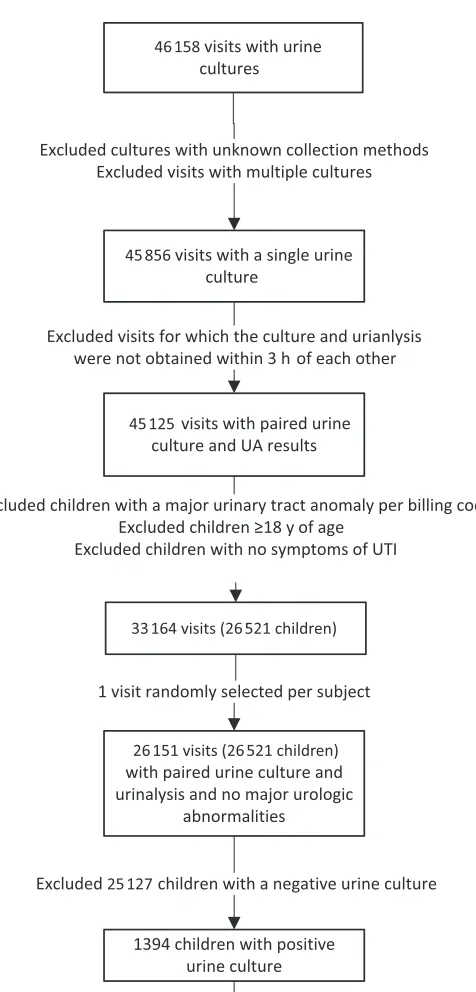
department of Children’s Hospital of Pittsburgh of UPMC between 2007 and 2013. We included only children <18 years of age with symptoms consistent with a diagnosis of UTI (Supplemental Table 3). We restricted eligible visits to those with a single urinalysis (UA) and a single urine culture, each obtained within 3 hours of the other. Children with known urinary tract abnormalities (eg, myelomeningocele, urinary stents) were excluded (see Supplemental Table 3). If a child had ≥1 eligible visit during the study period, a single episode of UTI was randomly selected. We then considered only children who had a positive urine culture (see below). Specimens obtained using a urine collection bag were excluded. We reviewed the electronic medical
records of children included; those who were immunocompromised or taking immunosuppressive medications were excluded from all analyses. The study was approved by the University of Pittsburgh institutional review board.
Semiquantitative urine cultures were performed by using standard techniques. A positive urine culture was defined as growth of a single uropathogen at a concentration of ≥50 000 colony-forming units per milliliter from a catheterized specimen or a single uropathogen at a concentration of ≥100 000 colony-forming units per milliliter from a clean-voided specimen.
To determine the degree of pyuria, urine WBCs were counted either per high-powered microscopic field (hpf) or per cubic millimeter. The former was performed by using the IRIS urine chemistry analyzer (Iris Diagnostics, Chatsworth, CA), whereas the latter was performed manually by a laboratory technician using a hemocytometer. The type of test performed depended on the ordering physician’s preference. No child had both tests performed. Pyuria was defined by the presence of a significant number of WBCs on microscopic urinalysis (≥5/hpf or ≥10/mm3).
A positive leukocyte esterase (LE) test on the urine dipstick was defined as 1+, 2+, or 3+ LE (0 or trace were considered negative). A total of 1181 children had a microscopic urinalysis for pyuria; of these, 1179 also had a LE test performed.
We used univariate logistic
regression models to identify factors associated with the absence of pyuria and a positive LE test, respectively and calculated odds ratios (OR) and corresponding 95% two-sided confidence intervals (CI) accordingly.
RESULTS
Of the 1394 children <18 years of age with symptoms consistent with
a diagnosis of UTI, paired UA and urine culture results, and a positive culture, 1181 (85%) met all inclusion criteria and had a microscopic urinalysis assessing for pyuria (Fig 1). In 694 (59%) children, urine was obtained by bladder catheterization. Table 1 describes demographic and clinical characteristics of the 1181 children. Overall, 89% were girls and 80% were white; median age was 23 months. Pyuria (≥5 WBC/hpf or ≥10 WBC/mm3) was present in 1031
(87%) of children and absent in 150 (13%). Demographic characteristics were similar in children with and without pyuria. Of note, we found no difference between children <2 months of age and children ≥2 months of age regarding the proportions with pyuria (81.1% vs 87.9%, P = .09) or the proportions with a positive LE test (83.3% vs 88.8%, P = .17). The most frequently isolated organisms were E coli,
Klebsiella species (41 K pneumoniae, 5 K oxytoca), Enterococcus species (34 E faecalis, 1 other), Proteus
species (29 P mirabilis, 2 other), and
Enterobacter species (13 E cloacae, 2 other) representing 85%, 4%, 3%, 3%, and 1% of positive urine cultures, respectively.
Children whose urine culture yielded organisms other than E coli were significantly less likely to have pyuria (OR and 95% CI: 0.39 [0.26–0.58],
P < .001) or a positive LE test (OR and 95% CI: 0.27 [0.18–0.41], P < .001 when compared with those whose urine culture yielded E coli. Specifically, children with P aeruginosa, Enterococcus species, or
Klebsiella species were significantly less likely to have pyuria than children with E coli (OR and 95% CI: 0.19 [0.06–0.60], P = .004; 0.14 [0.07–0.28], P < .001; 0.34 [0.17– 0.68], P = .002, respectively) (Table 2). Results were similar for the LE test (Table 2).
obtained by bladder catheterization (Supplemental Table 4). Children with Enterococcus or Klebsiella
species were significantly less likely to have pyuria than children with
E. coli (OR and 95% CI: 0.14 [0.05– 0.38], P < .001; 0.37 [0.17– 0.80],
P = .01, respectively) (Supplemental Table 4). Results for children with
P aeruginosa differed from the main analysis; however, this finding may be related to a relatively small number of children (n = 7). Results were similar for the LE test.
DISCUSSION
We found that in children with apparent UTI, the proportion with pyuria varied significantly according to the uropathogen present. Compared with E coli, the odds of pyuria were 3 to 5 times lower with certain organisms (Enterococcus and Klebsiella species and P aeruginosa). Contrary to what we had hypothesized, however, Gram-stained smear characteristics of the uropathogen were not a good predictor of the odds of pyuria. Rather, within Gram-stained smear groups, there were differences among species.
The most recent American Academy of Pediatrics guideline suggests that pyuria should be present when diagnosing a UTI.4 The rationale for
this recommendation is to prevent children whose urine culture may be contaminated as a result of poor collection technique (bag-collected urine specimen), or children with asymptomatic bacteriuria, from being diagnosed as having a UTI and receiving unnecessary antimicrobial agents. However, only 90%5 of
children with UTI exhibit pyuria even when the urine specimen is collected by bladder catheterization or suprapubic aspiration. Furthermore, the prevalence of asymptomatic bacteriuria is too low (<1%)6 to fully
explain why many children with an apparent UTI lack pyuria. Findings
FIGURE 1
of our study offer an additional explanation for the absence of pyuria: some uropathogens may not elicit a strong host inflammatory response. Accordingly, our findings suggest that bedside biomarkers that are more sensitive and specific than pyuria are needed to improve the accuracy of early diagnosis.
Multiple reasons could explain differences in the occurrence of pyuria in children diagnosed with UTI with different uropathogens. Some uropathogens form biofilms, which could affect the host’s ability to mount an inflammatory response.7
Other uropathogens (E coli,
Klebsiella species, and Enterococcus
species) form intracellular bacterial
communities, which may also affect the immune response.7 Other
yet-to-be-determined genetic or anatomic factors linked to susceptibility to certain pathogens may also be related to the host’s immune response.
We found that children with certain non–E coli organisms had lower odds of exhibiting pyuria than children with E coli. Absence of pyuria can lead to a delay in diagnosis and treatment of UTIs. A delay in treatment has been associated with a higher likelihood of renal scarring.8–11 This may
partly explain why, in a recent meta-analysis, children with UTIs caused by non-E coli organisms
were more likely to develop renal scarring.12
Our results suggest that pyuria may not always be present in children with UTIs, especially those caused by Enterococcus species, Klebsiella
species, or P aeruginosa. Accordingly, in acutely ill children suspected of having a UTI, empirical therapy while awaiting culture results may represent a reasonable approach if there are indications (see below) that organisms other than E coli may be involved. The presence of nitrites is highly specific for UTI caused by bacteria in the Enterobacteriaceae family (E coli, Klebsiella species, and
Proteus species). Therefore, a child in whom the clinical suspicion is high who presents with a positive nitrite test on the dipstick UA but no pyuria may have a UTI caused by
E coli or Klebsiella and could be treated empirically. Similarly, a child with Gram-positive cocci on a Gram stain smear who presents without pyuria may have an
Enterococcal UTI. Our results also suggest that in children suspected of having UTI on clinical grounds, both a urinalysis and a urine culture should be performed.
Limitations of our study include use of a database to identify a large sample retrospectively. Although we depended on accurate coding for entry into the study, we conducted a chart review to ascertain that included children did not meet any of our exclusion criteria. Some children in this study may not have had a true UTI; as previously mentioned, a positive urine culture in the absence of pyuria may result from asymptomatic bacteriuria or contaminated specimens. However, because we excluded bag-collected specimens, we expect this proportion to be relatively low.6 Furthermore,
our results did not vary by urine specimen collection method. In addition, we only included children who presented with symptoms consistent with UTI and used TABLE 1 Demographic and Clinical Characteristics of the 1181 Children With a Positive Urine Culture
According to the Presence of Pyuria
Characteristic Pyuriaa, N = 1031 No Pyuria, N = 150 Pb
Age (%) .06
<2 mo 73 (81.1) 17 (18.9)
2–11 mo 321 (87.0) 48 (13.0)
12–23 mo 114 (83.8) 22 (16.2)
2–5 y 242 (87.1) 36 (12.9)
6–17 y 281 (91.2) 27 (8.8)
Gender (%) .35
Boy 120 (90.2) 13 (9.8)
Girl 910 (86.9) 137 (13.1)
Missing 1 0
Race (%) .93
White 811 (87.0) 121 (13.0)
African American 165 (87.8) 23 (12.2)
Other 30 (85.7) 5 (14.3)
Missing 22 1
Temperature (%) .78
<39°C 666 (87.5) 95 (12.5)
≥39°C 354 (86.8) 54 (13.2)
Missing 11 1
a Pyuria = ≥5 WBC/hpf or ≥10 WBC/mL3. b Proportions were compared by using a χ2 test.
TABLE 2 Presence of Pyuria or LE in Urine Samples of 1181 Children With UTI According to Uropathogen
Pathogen Diagnostic Test
Pyuriaa, % (No.) LE ≥1, % (No.)
E. coli 89.3 (892/999) 91.1 (908/997)
P. aeruginosa 61.5b (8/13) 61.5b (8/13)
S. saprophiticus 100 (27/27) 96.3 (26/27)
Enterococcus species 54.3b (19/35) 48.6b (17/35)
Klebsiella species 73.9b (34/46) 71.7b (33/46)
Proteus species 80.6 (25/31) 83.9 (26/31)
Enterobacter species 86.7 (13/15) 80.0 (12/15)
Other 86.7 (13/15) 80.0 (12/15)
stringent criteria to define a positive urine culture. Accordingly, it is likely that a large portion of children with no pyuria who were included had true UTIs. Finally, neither asymptomatic bacteriuria nor contamination explain the marked differences we found in the occurrence of pyuria among uropathogens.
This study suggests that pyuria may be absent in some children with certain uropathogens. Accordingly, urine cultures should be performed in all children clinically suspected of having a UTI. New point-of-care tests that are more sensitive and specific than pyuria could help reduce over- and undertreatment of this frequently occurring pediatric problem.
ABBREVIATIONS
CI: confidence interval
hpf: high-powered microscopic field
LE: leukocyte esterase OR: odds ratio UA: Urinalysis
UTI: urinary tract infection WBC: white blood cell
POTENTIAL CONFLICT OF INTEREST: The authors have indicated they have no potential confl icts of interest to disclose.
COMPANION PAPER: A companion paper to this article can be found online at www. pediatrics. org/ cgi/ doi/ 10. 1542/ peds. 2016- 1247.
REFERENCES
1. Lin E, Bhusal Y, Horwitz D, Shelburne SA III, Trautner BW. Overtreatment of enterococcal bacteriuria. Arch Intern Med. 2012;172(1):33–38
2. Chakupurakal R, Ahmed M, Sobithadevi DN, Chinnappan S, Reynolds T. Urinary tract pathogens and resistance pattern. J Clin Pathol. 2010;63(7):652–654
3. Hoberman A, Wald ER, Hickey RW, et al. Oral versus initial intravenous therapy for urinary tract infections in young febrile children. Pediatrics. 1999;104(1 pt 1):79–86
4. Roberts KB; Subcommittee on Urinary Tract Infection, Steering Committee on Quality Improvement and Management. Urinary tract infection: clinical practice guideline for the diagnosis and management of the initial UTI in febrile infants and children 2 to 24 months.
Pediatrics. 2011;128(3):595–610
5. Williams GJ, Macaskill P, Chan SF, Turner RM, Hodson E, Craig JC.
Absolute and relative accuracy of rapid urine tests for urinary tract infection in children: a meta-analysis. Lancet Infect Dis. 2010;10(4):240–250
6. Wettergren B, Jodal U, Jonasson G. Epidemiology of bacteriuria during the fi rst year of life. Acta Paediatr Scand. 1985;74(6):925–933
7. Scott VC, Haake DA, Churchill BM, Justice SS, Kim JH. Intracellular Bacterial Communities: A Potential Etiology for Chronic Lower Urinary Tract Symptoms. Urology. 2015;86(3):425–431
8. Coulthard MG, Lambert HJ, Vernon SJ, Hunter EW, Keir MJ, Matthews JN. Does prompt treatment of urinary tract infection in preschool children prevent renal scarring: mixed retrospective and prospective audits. Arch Dis Child. 2014;99(4):342–347
9. Oh MM, Kim JW, Park MG, Kim JJ, Yoo KH, Moon G. The impact of therapeutic delay time on acute scintigraphic
lesion and ultimate scar formation in children with fi rst febrile UTI. Eur J Pediatr. 2012;171(3):565–570
10. Shaikh N, Mattoo T, Keren R, et alEarly antibiotic treatment of febrile urinary tract infection decreases the risk of renal scarring. JAMA Pedaitr. 2016, In press
11. Falakolafl aki B, Jamshidi MR. Risk factors for renal scarring in children with fi rst pyelonephritis. In: Proceedings from The Sixteenth Congress of the International Pediatric Nephrology Association; August 30-September 3, 2013; Shanghai, China. Abstract 57
DOI: 10.1542/peds.2016-0087 originally published online June 21, 2016;
2016;138;
Pediatrics
Kurs-Lasky and Judith M. Martin
Nader Shaikh, Timothy R. Shope, Alejandro Hoberman, Alyssa Vigliotti, Marcia
Association Between Uropathogen and Pyuria
Services
Updated Information &
http://pediatrics.aappublications.org/content/138/1/e20160087
including high resolution figures, can be found at:
References
http://pediatrics.aappublications.org/content/138/1/e20160087#BIBL
This article cites 10 articles, 4 of which you can access for free at:
Subspecialty Collections
b
http://www.aappublications.org/cgi/collection/infectious_diseases_su
Infectious Disease
following collection(s):
This article, along with others on similar topics, appears in the
Permissions & Licensing
http://www.aappublications.org/site/misc/Permissions.xhtml
in its entirety can be found online at:
Information about reproducing this article in parts (figures, tables) or
Reprints
http://www.aappublications.org/site/misc/reprints.xhtml
DOI: 10.1542/peds.2016-0087 originally published online June 21, 2016;
2016;138;
Pediatrics
Kurs-Lasky and Judith M. Martin
Nader Shaikh, Timothy R. Shope, Alejandro Hoberman, Alyssa Vigliotti, Marcia
Association Between Uropathogen and Pyuria
http://pediatrics.aappublications.org/content/138/1/e20160087
located on the World Wide Web at:
The online version of this article, along with updated information and services, is
http://pediatrics.aappublications.org/content/suppl/2016/06/19/peds.2016-0087.DCSupplemental
Data Supplement at:
by the American Academy of Pediatrics. All rights reserved. Print ISSN: 1073-0397.