Volume-7 Issue-2
International Journal of Intellectual Advancements
and Research in Engineering Computations
Partial replacement of coarse aggregate by using ceramic tile aggregate in
concrete
Prakash.S
1, Baskar.S
1, Tamilarasan.A
1, Venkatesh Prasath. P
1, Abdul Hameed. A
21
UG – Scholars, Department of Civil Engineering, Nandha Engineering College, Erode, Tamilnadu
2
Assistant professor, Department of Civil Engineering, Nandha Engineering College, Erode,
Tamilnadu
ABSTRACT
There is a growing interest in using waste materials such as ceramics as alternative aggregate materials for construction. The current study focuses on the mechanical properties of waste ceramic floor tiles aggregate concrete. Ceramic wastes sourced from construction and demolition wastes were separated from other debris and crushed using a quarry metal hammer. Ceramic tiles were sieved into coarse aggregates in line with standards. Other materials used were gravel, river sand, cement and portable water. Workability of the fresh concrete was checked through slump test, and concrete cubes of 150 mm dimensions and cylinders of 100mm were cast in the laboratory. After 24 hr of casting, the concrete samples were demoulded and were cured by immersion in water tank at temperature of 22 °C. The compressive and split-tensile strengths of the hardened concrete samples were determined a fter curing them for 7 and 28 days. Results showed that both the compressive strength and split tensile strength increased appreciably with the curing age than the conventional concrete.
Keywords:
Ceramic Tile Aggregate (CTA), Normal aggregate, Water-cement ratio, Compressive strength, split tensile strength, Specific gravity, Sieve analysisINTRODUCTION
Rapid industrial development causes serious problems all over the world such as depletion of natural aggregates and creates enormous amount of waste material from construction and demolition activities. One of the ways to reduce this problem is to utilize the waste. A large quantity of wastages produced annually in all countries, in particular construction and demolition waste contribute the highest percentage of wastes worldwide about Furthermore, ceramic materials contribute the highest percentage of wastes within the construction and demolition wastes about 54%. Ceramic waste is durable, hard and highly resistant to Biological, Chemical and Physical degradation forces. Ceramic tile aggregate are hard having considered value of specific gravity, rough surface on one side and smooth on other side, are lighter in
and reduces the space required for land fill disposal. [1-4]
MATERIALS
Cement
The ordinary Portland cement of 53 grade whose specific gravity of cement is 3.14, normal consistency of the cement was found as 28% and the initial and final setting times were found as 120 min and 238 min respectively was used. [5-10]
Coarse aggregate
The coarse aggregate with 20 mm nominal size having specific gravity 2.72 was used. The impact value is 20.44%. And the water absorption of the coarse aggregate is 0.38%.
Fine aggregate
Locally available river sand is used. As per IS 383:1970, sand is confirming to Zone III. Specific gravity of the sand used is 2.69. And the water absorption value is 0.45%.
Crushed Tiles
Broken tiles were collected from the solid waste of ceramic manufacturing unit. Crushed them into small pieces by manually and separated. the coarse material to use them as partial replacement to the natural coarse aggregate. Specific gravity of the crushed waste tiles is2.39. Impact value of these crushed tiles is 25.81%.
Table-1: Comparison of properties of ceramic tile aggregates and normal aggregates
S No. Particulars Normal Aggregate Ceramic Tile Aggregate
1 Shape Angular Flaky
2 Texture Rough All sides rough except top
face
3 Specific gravity 2.72 2.39
4 Impact value 20.44% 25.%
5 Water absorption 0.38% 14.4%
METHODOLOGY
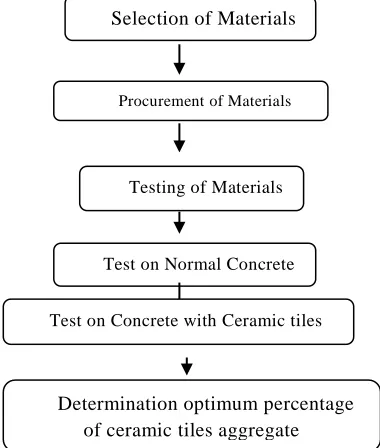
Figure – 1: Hierarchy of processes Selection of Materials
Procurement of Materials
Testing of Materials
Test on Normal Concrete
Test on Concrete with Ceramic tiles
Fig (3.1) indicates the flowchart of the whole process which consists of selection of materials such as cement, fine aggregate, coarse aggregate and ceramic tile aggregate. Concrete is prepared for M20 mix designed for plain concrete. Ceramic tile aggregate is used as partial replacement with coarse aggregate. Materials are mixed by considering the proportions as per the mix design. The mould of dimension 150x150x150 mm. In each layer compaction is done by using tamping rod/shake table. Moulds are prepared for different proportions as
per the design IS: 10262 – 2009. The cubes are cured for 07 & 28 days under no dry condition .The concrete cube specimens are tested at the age of 7 & 28 days of curing period. Concrete cubes are placed on compression test machine & the maximum load applied to the cube, at which the resistance of the specimen to the increasing load breaks & no greater load can be sustained is recorded. Similarly split tensile tests are carried out and the values are recorded.
Table -2: Mix proportion of samples
% re p la ce m en t o f CTA W/C Ra tio Ce m en t co n te n t(k g /m 3) W a te r (k g /m 3 ) F in e A g g re g at e (k g /m 3) Co a rse A g gr ega te (k g /m 3) C er a m ic T il e A g gr eg a te (k g /m 3)
0% 0.45 438 2.21 1.45 10 NA
30% 438 2.21 1.45 9.03 3.87
60% 438 2.21 1.45 5.16 7.74
90% 438 2.21 1.45 1.29 11.6
1
MIX DESIGN
M20 grade of concrete was designed by following the specification given in the IS 10262: 2009. Water – Cement ratio (w/c) was selected as 0.45 based on conducting slump tests for different design trails. Mix proportion obtained for M20 mix is 1:1.45:2.61
EXPERIMENTAL PROGRAM
Compressive strength
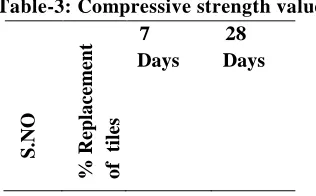
Compressive strength of the hardened concrete was determined in (0%, 30%, 60%, 90%) for 7, 28 days. As shown in compressive strength increased with increasing CCA substitution. There was about 36.1%strength gain in concrete with 100% CCA when compared with the control mix at 28 days. At all testing ages, CCA mixes yielded higher strength.
Table-3: Compressive strength values
1 0% 13.50 20
2 30% 14.40 21.30 3 60% 13.83 20.43 4 90% 13.68 20.23
Graph 5.1 showing M20grde concrete and CTA concrete compressive strength for7, 28days
Split tensile test
The split tensile strength is another method for determining performance of concrete under tensile stress and also gives its progressive cracking pattern. The test was conducted in accordance with the provision of BS EN 12390-Similar to on compressive strengths, show parallel graphs for split tensile strengths. The graphs show similar patterns, only smaller in nature.The split tensile strength results of concrete mixes with ceramic coarse aggregate substitution and ceramic fine aggregate substitution are shown in respectively. For the
CCA concrete, split tensile strength increased with increasing CCA. This result is synonymous with other findings. Med ina et al. obtained similar results with concretes made by replacing natural aggregates with ceramic sanitary ware aggregates. It can be seen that the control concrete developed early and 7 days split tensile strength than the CCA concrete. On the other hand, for concrete with CFA, split tensile strength was adequately developed and 28 days of curing age, which yielded results between 2.8 N/mm2 and 3.6 N/ mm2.
Table-4: Split tensile strength values
S.NO
%
Repla
ce
ment
o
f
t
iles
7 Days
28 Days
1 0% 2.62 3.21
2 30% 2.83 3.63
3 60% 2.31 3.36
Graph 5.2 showing M20grde concrete and CTA concrete Split tensile strength for7, 28days.
CONCLUSION
Research on the usage of waste construction materials is very important since material waste is gradually increasing with the increase in population and increasing of urban development. The main aim of this investigation was the utilization of tiles collected from the tile industries. The use of these tile aggregates as partial replacement in coarse aggregate in concrete has positive effect on the environment and obtaining lower costs since the tile aggregates are easy to obtain. Their cost is cheaper than the natural aggregates. The ceramic tile aggregate are partial replaced with coarse aggregate because their cost is cheaper than the natural aggregate.
After completions of all experimental, programs are conducted that ceramic tile aggregate can be used in place of coarse aggregate with certain percentage of replacement, Based on the compression strength test, split tensile strength test. The following are the
conclusions obtained after performing the above experiments,
The maximum compression strength is obtained when 30% of ceramic tile aggregate was replaced with coarse aggregate.
The maximum split tensile strength is obtained when 30% of Ceramic tile aggregate was replaced with coarse aggregate.
The compressive strength and split tensile strength for 60% and 90% replacement of CTA is not increased. There is little variation in the strength when compared with normal concrete. The optimum result is obtained for 30% replacement of CTA with coarse aggregate.
By addition of ceramic tile aggregates into coarse aggregate, proper utilization of ceramic tile waste can be achieved.
In case of combinations, the compressive strength is increasing for all the cases.
REFERENCES
[1]. IS: 456-2000, Indian Standard “Plain and reinforced concrete”-code of practice.
[2]. IS: 10262-2009, Indian Standards “Recommended guidelines for concrete mix design proportioning” - code of practice.
[3]. IS: 383-1970, “Specifications for coarse and fine aggregate from natural source for concrete”, (Second revision), Bureau of Indian Standards, New Delhi, India.
[4]. “Concrete technology” Theory of practice, A text book of M.S Shetty, 2005.” 0
1 2 3 4
0% 30% 60% 90%
Sp
lit
ten
sile
s
tren
gth
N
/m
m
2
Mix proportion (%)
[5]. A Mitkuar D. Raval, Indrajit N. Patel, Jaeshkumar Pitroda, "Eco- Efficent Concretes: Use of Ceramic Powder as a partial replacement of cement ", International Journal of Innovative Technology and Exploring Engineering, ISSN: 2278-3075, 3(2), 2013.
[6]. BS EN 12350-2:2006, Testing fresh concrete -part 2: Slump test.
[7]. M.G Osama, Properties of hardened concrete using crushed clay bricks as aggregates , J. Eng 17, 2011, 1022-1038.
[8]. B. Gonzalez - Fonteboa, F. Martinez - Abella, Recycled aggregates concrete: aggregate and mix properties, Mater. Constr .55, 2005, 53-66.
[9]. Raminder Singh, Manish Bhutani, Tarun syal, “Strength evaluation of concrete using marble powder and waste crushed tile aggregates”, International Journal for Science and Emerging Technologies with Latest Trends, ISSN : 2250-3641