University of Pennsylvania
ScholarlyCommons
Publicly Accessible Penn Dissertations
1-1-2015
Cancer Absolute Risk Projection with Incomplete
Predictor Variables
Lu Chen
University of Pennsylvania, [email protected]
Follow this and additional works at:http://repository.upenn.edu/edissertations Part of theBiostatistics Commons
This paper is posted at ScholarlyCommons.http://repository.upenn.edu/edissertations/1027 For more information, please [email protected].
Recommended Citation
Chen, Lu, "Cancer Absolute Risk Projection with Incomplete Predictor Variables" (2015).Publicly Accessible Penn Dissertations. 1027.
Cancer Absolute Risk Projection with Incomplete Predictor Variables
Abstract
A popular approach to projecting cancer absolute risk is to integrate a relative hazard function of predictors with hazard rates obtained from different sources, where the relative hazard function is often approximated by an odds ratio function. To assess added values of candidate risk predictors, it is very common that data for standard risk predictors is fully available from a frequency-matched case-control study, but that of candidate predictors is available only for a subset of cases and controls. In the first project, we developed statistical measures for quantifying predictive accuracy of cancer absolute risk prediction models, accommodating incomplete predictor variables. We particularly focused on a measure that is useful for evaluating efficiency of model-based cancer screening, the proportion of cases that can be captured by screening only people with high projected risk. In the second project, using a logistic regression model to describe the relationship between cancer status and risk predictors, we developed a novel semiparametric maximum likelihood approach that accommodates incomplete predictor data under rare disease approximation for the estimation of odds ratio parameters and the distribution of candidate predictors. Through theoretical and simulation studies, we showed that our estimator is consistent with an asymptotically normal distribution and has improved statistical efficiency. In the third project, we applied the statistical methods developed in the first two to evaluate the added values of percent mammographic density and breast cancer risk SNPs in breast cancer absolute risk projection. Our results showed that the two sets of predictors had similar added values and can lead to more efficient model-based screening for breast cancer. In the fourth project, we applied the semiparametric maximum likelihood method to a family-supplemented study design that we proposed to address survival bias in case-control genetic association studies.
Degree Type
Dissertation
Degree Name
Doctor of Philosophy (PhD)
Graduate Group
Epidemiology & Biostatistics
First Advisor
Jinbo Chen
Keywords
Absolute risk prediction, Breast cancer, Predictive accuracy, Semi-parametric maximum likelihood, Stratified case-control study, Two phase design
Subject Categories
CANCER ABSOLUTE RISK PROJECTION WITH INCOMPLETE PREDICTOR VARIABLES
Lu Chen
A DISSERTATION
in
Epidemiology and Biostatistics
Presented to the Faculties of the University of Pennsylvania
in
Partial Fulfillment of the Requirements for the
Degree of Doctor of Philosophy
2015
Supervisor of Dissertation
Jinbo Chen, Associate Professor of Biostatistics
Graduate Group Chairperson
John H. Holmes, Professor of Medical Informatics in Epidemiology
Dissertation Committee
Hongzhe Li, Professor of Biostatistics
Rebecca A. Hubbard, Associate Professor of Biostatistics
Andrea B. Troxel, Professor of Biostatistics
CANCER ABSOLUTE RISK PROJECTION WITH INCOMPLETE PREDICTOR
VARIABLES
c
COPYRIGHT
2015
Lu Chen
This work is licensed under the
Creative Commons Attribution
NonCommercial-ShareAlike 3.0
License
To view a copy of this license, visit
ACKNOWLEDGEMENT
I would like to thank my advisor and mentor, Dr. Jinbo Chen, for her guidance
thoughout my dissertation. She is patient, kind, encouraging, and always willing to
answer questions. She is also a great instructor who teaches enthusiastically and
sin-cerely. Without Dr. Chen, it would be impossible for me to complete this work. I
am grateful to Dr. Hongzhe Li for his support throughout the program. Dr. Li is my
committee chair who has been providing many insightful advices, and the instructor
of the course Probability, which was the first class I took in this department and the
stepping stone for me in this field. I would also like to thank my committee members
Dr. Rebecca Hubbard, Dr. Andrea Troxel, Dr. Emily Conant and Dr. Daniel
Heit-jan (my candidacy examination committee member) who provided numerous helpful
suggestions for my research. I further would like to thank all the faculty members
and staff in the Department of Biostatistics and Epidemiology. Their instruction,
kindness and considerateness have led me to learn and grow up. I also need to thank
the fellow students Jarcy, Daniel, Matthew, Jiwei, Emin and Vicky. We have spent
much time together to get though all the course work and qualifying examination.
Their love and help made me quickly accustomed to the academic environment and
life in University.
I would also like to thank my husband Xiao Ji for his love and support during the
dissertation. Grateful thanks to my best friend Christy Wang who helped me find
out the reason why I do research - to re-discover His creation and to re-search for His
ABSTRACT
CANCER ABSOLUTE RISK PROJECTION WITH INCOMPLETE PREDICTOR
VARIABLES
Lu Chen
Jinbo Chen
A popular approach to projecting cancer absolute risk is to integrate a relative hazard
function of predictors with hazard rates obtained from different sources, where the
relative hazard function is often approximated by an odds ratio function. To assess
added values of candidate risk predictors, it is very common that data for standard
risk predictors is fully available from a frequency-matched case-control study, but that
of candidate predictors is available only for a subset of cases and controls. In the first
project, we developed statistical measures for quantifying predictive accuracy of
can-cer absolute risk prediction models, accommodating incomplete predictor variables.
We particularly focused on a measure that is useful for evaluating efficiency of
model-based cancer screening, the proportion of cases that can be captured by screening
only people with high projected risk. In the second project, using a logistic
regres-sion model to describe the relationship between cancer status and risk predictors, we
developed a novel semiparametric maximum likelihood approach that accommodates
incomplete predictor data under rare disease approximation for the estimation of odds
ratio parameters and the distribution of candidate predictors. Through theoretical
and simulation studies, we showed that our estimator is consistent with an
asymptot-ically normal distribution and has improved statistical efficiency. In the third project,
values of percent mammographic density and breast cancer risk SNPs in breast
can-cer absolute risk projection. Our results showed that the two sets of predictors had
similar added values and can lead to more efficient model-based screening for breast
cancer. In the fourth project, we applied the semiparametric maximum likelihood
method to a family-supplemented study design that we proposed to address survival
TABLE OF CONTENTS
ACKNOWLEDGEMENT . . . iii
ABSTRACT . . . iv
LIST OF TABLES . . . ix
LIST OF ILLUSTRATIONS . . . x
CHAPTER 1 : Introduction . . . 1
1.1 . . . 2
1.2 . . . 4
1.3 . . . 6
1.4 . . . 7
CHAPTER 2 : Quantifying Predictive Accuracy of Cancer Abso-lute Risk Prediction Models . . . 8
2.1 Introduction . . . 9
2.2 Methods . . . 12
2.3 The analysis of BCDDP data . . . 20
2.4 Simulation Study . . . 26
2.5 Conclusion . . . 33
CHAPTER 3 : Semiparametric Maximum Likelihood Estimation with Two-Phase Stratified Case-Control Sampling . . . 36
3.1 Introduction . . . 37
3.3 The analysis of BCDDP data . . . 44
3.4 Simulation Study . . . 48
3.5 Conclusion . . . 51
CHAPTER 4 : Evaluation of the Added Value of Percent Mam-mongraphic Density and SNPs in Breast Cancer Ab-solute Risk Projection . . . 53
4.1 Introduction . . . 54
4.2 Methods . . . 55
4.3 Results . . . 57
4.4 Discussion . . . 62
CHAPTER 5 : Using Family Members to Augment Genetic Case-Control Studies of a Life Threatening Disease . . 64
5.1 Introduction . . . 65
5.2 Methods . . . 66
5.3 Simulation Study . . . 79
5.4 More Complex Family Structures . . . 85
5.5 Discussion . . . 86
CHAPTER 6 : Conclusion . . . 91
APPENDICES . . . 93
LIST OF TABLES
TABLE 2.1 : Estimates of the OR Parameters for BCDDP. . . 24 TABLE 2.2 : Estimates of Predictive Accuracy Statistics for the BCRAT
and its Variants. . . 25 TABLE 2.3 : OR Estimates in Simulation Studies with 2 SNPs. . . 29 TABLE 2.4 : Estimates of Predictive Accuracy Statistics in Simulation
Stud-ies with 2 SNPs. . . 31 TABLE 2.5 : Estimates of Predictive Accuracy Statistics in Simulation
Stud-ies with 74 SNPs. . . 33
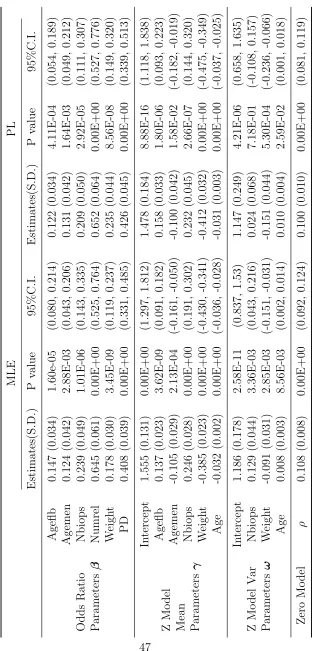
TABLE 3.1 : Estimates of Odd Ratio Parameters for the BCDDP Study. . 47
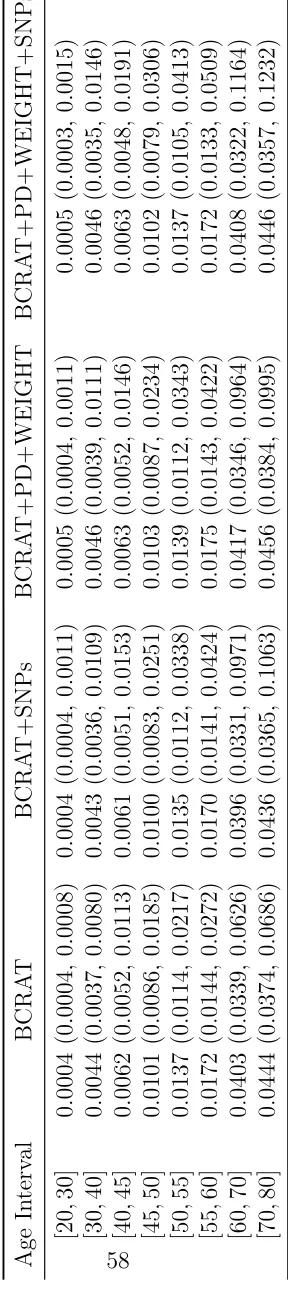
TABLE 4.1 : Estimates of Absolute Risk by Model: Mean (Median, 95% Range). . . 58 TABLE 4.2 : Proportion of Women with Absolute Risk Greater than
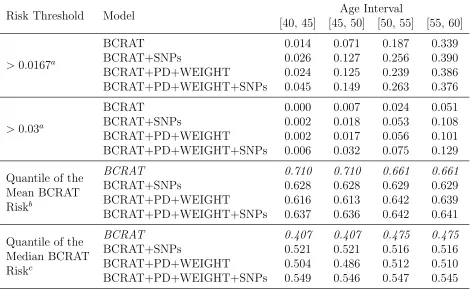
Cer-tain Risk Cutoff in Each Age Intervals by Model. . . 59 TABLE 4.3 : Estimates of Predictive Accuracy Statistic by Age Interval,
Cutoff and Model. . . 60 TABLE 4.4 : Mean Absolute Risk in Every Quintile by Model. . . 61
TABLE 5.1 : Estimated Type I Error Rates for Testing Association (nomi-nal level=0.5) When Deceased Cases were Na¨ıvely Ignored. . 81 TABLE 5.2 : Parameter Estimation under Different Models and Scenarios
for Genotyping Family Members of Deceased Cases. . . 82
TABLE B.1 : Estimates of Z model Parameters in Real Data Analysis. . . 107 TABLE B.2 : 74 SNPs from External Sources in Real Data Analysis. . . . 108 TABLE B.3 : Estimates of Predictive Accuracy Statistics with Absolute Risk
Cutoff in Real Data Analysis. . . 110 TABLE B.4 : Estimates of Z Model Parameters in Simulation with 2 SNPs
(Moderate Assocation). . . 111 TABLE B.5 : Estimates of Predictive Accuracy Statistics with Absolute Risk
Cutoff in Simulation Studies with 2 SNPs. . . 112 TABLE B.6 : Estimates of Z Model Parameters in Simulation with 74 SNPs. 113 TABLE B.7 : Estimates of 74 SNPs Odds Ratio Parameters in Simulation. 114 TABLE B.8 : Estimates of Parameters under Full Model in Real Data
Anal-ysis. . . 118 TABLE B.9 : Estimates of AUC under Final Model in Real Data Analysis. 119 TABLE B.10 :Estimates of PPV under Final Model in Real Data Analysis. 119 TABLE B.11 :Observed and Estimated Breast Density Values in Phase II
TABLE B.12 :Joint and Conditional Distribution of Family Genotypes. . . 120 TABLE B.13 :Notational Glossary. . . 121 TABLE B.14 :Multinomial Distribution for Families of Cases and Controls. 122 TABLE B.15 :Parameter Estimation and Power When Survival Model is
LIST OF ILLUSTRATIONS
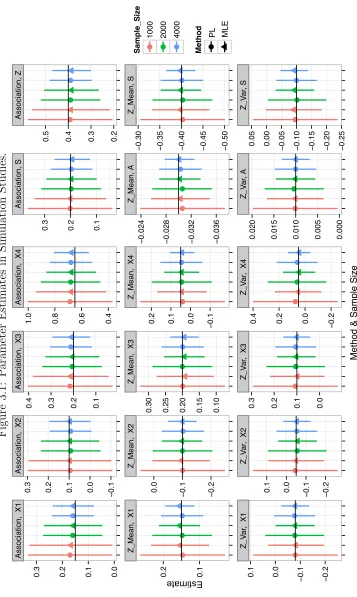
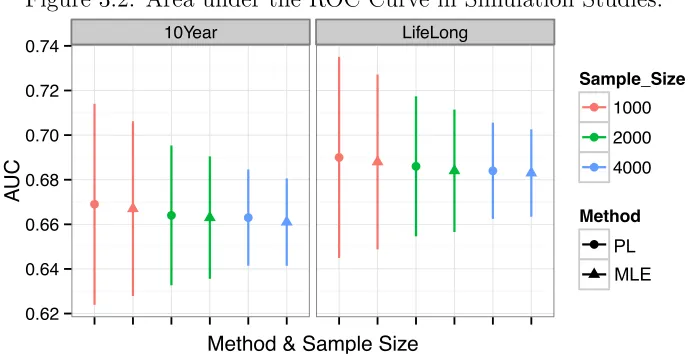
FIGURE 3.1 : Parameter Estimates in Simulation Studies. . . 50 FIGURE 3.2 : Area under the ROC Curve in Simulation Studies. . . 51
FIGURE 5.1 : Power Plot. . . 83
CHAPTER 1
1.1.
Cancer absolute risk is the probability that an individual will develop cancer in a
certain age interval without dying from competing causes. Its computation involves
the relative hazard function, the age specific baseline hazard, and age specific
com-peting risk hazard. The relative hazard function can be approximated by the odds
ratio (OR) function of the predictors since cancer outcomes are rare. The baseline
hazard rates can be calculated from composite hazard rates available from population
databases such as the Surveillance, Epidemiology, and End Results (SEER) program
when coupled with the OR function and distribution of risk predictors. The hazard
rates of mortality can be obtained from the National Death Index. This composite
approach to cancer absolute risk projection was first used by Gail et al. (1989) to
develop the breast cancer risk assessment tool (BCRAT), commonly referred to as
the ”Gail model”. The BCRAT is the current National Cancer Institute (NCI)
stan-dard for predicting breast cancer absolute risk. It has been widely used for designing
clinical trials and counseling individual woman. It can also be usefulness for selecting
high-risk women to engage in breast cancer screening programs (Saslow et al., 2007).
The BCRAT includes four risk predictors, age at menarche (Agemen), age at first
live birth (Ageflb), number of previous breast biopsies (Bbiops), and number of
first-degree relatives (Numrel) (mother/sisters) who have had breast cancer (Gail et al.,
1989). It calibrates well but only has a modest discriminatory accuracy with area
under the ROC curve (AUC) ranging from 0.58 to 0.64 (Costantino et al., 1999;
Freedman et al., 2005; Rockhill et al., 2001). Therefore, it has been of great
in-terest to increase the predictive accuracy of the BCRAT by incorporating emerging
density as the percent of dense area on the mammogram image, has recently been
established as one of the strongest risk predictors for breast cancer (Byrne et al.,
1995; Tice et al., 2008). Chen et al. (2006) and Chen et al. (2008) developed an
OR function and corresponding absolute risk prediction model that includes PD as
a new predictor, and found that it led to a modest increase in the AUC statistic.
Breast cancer risk associated SNPs, independently or in combination with PD, have
recently been extensively evaluated for their added values in improving breast cancer
risk prediction. A Swedish study showed that adding PD, body mass index, and
18 breast cancer risk SNPs can improve the AUC of a Swedish-Gail risk prediction
model from 0.55 to 0.62 (Darabi et al., 2012a). A theoretical study conducted in
the United Kingdom population showed that a 76-locus polygenetic risk score can
lead to improved risk stratification and added value more than a clinical measure of
breast density, the BI-RADS (Garcia-Closas, Gunsoy, and Chatterjee, 2014). In the
Breast Cancer Surveillance Consortium (BCSC) risk prediction model, the 76-locus
polygenetic risk score was shown to predict independently of BI-RADS breast density
(Vachon et al., 2015). It improved the BCSC model that includes BI-RADS breast
density as a predictor, increasing AUC from 0.66 to 0.69 and improving classification
of the high-risk women. To date, the combined value of PD and the 76 breast cancer
risk SNPs for improving the accuracy of the BCRAT has not been evaluated.
Notably, the evaluation of the BCRAT and other models has largely been based on
the AUC statistic, which has been argued to be of limited relevance for clinical
ap-plications. Alternative measures of predictive accuracy have been proposed, such as
predictive curves (Gail and Pfeiffer, 2005; Gu and Pepe, 2009; Pepe, Gu, and Morris,
2010; Pepe et al., 2008), the proportion of cases followed (PCF) and the proportion
de-signed for binary outcomes and are not directly applicable for evaluating absolute risk
models that were developed using the composite approach described above. In
Chap-ter 2, we adapt several existing predictive accuracy statistics to accommodate the
composite approach to absolute risk prediction, and fully evaluate the added value of
PD and/or breast cancer risk SNPs using the adapted measures, including AUC,
posi-tive predicposi-tive values(PPV), and PCF/PNF. For the BCRAT risk predictors and PD,
we use data from the Breast Cancer Detection and Demonstration Project (BCDDP).
BCDDP started in 1973 and was originally designed to assess whether mammographic
screening can reduce morbidity and mortality of breast cancer. It recruited 243,221
white women from 1973 to 1975 and followed each woman for at least 5 years. A
age-stratified case-control study was conducted in 1979, and the BCRAT risk
predic-tors were available for all 2,808 cases and 3,119 controls. But only 1,217 cases and
1,616 controls had PD measurements available. SNP genotype data is not available
from the BCDDP. Therefore, it is necessary to utilize estimates of OR parameters
and minor allele frequencies from the literature. Our proposed method of estimating
adapted accuracy statistics can accommodate these additional complications.
1.2.
The challenge of incomplete predictor data as in the BCDDP in the development
of absolute risk prediction models is widespread. For example, it may require
up-to-date high technology to measure emerging risk factors, which may be too
expen-sive or technically infeasible to use on all subjects. One such example is estrogen
metabolomic measurements. It may also be possible that genotype data cannot be
made available for all subjects. When standard risk predictors are available from
a stratified/frequency-matched case-control study but candidate predictors are only
stratified case-control design. In phase I, the case-control status and standard risk
predictors are collected on all cases and controls. In phase II, the costly predictor is
measured on a subset selected based on case-control status and phase I variables. The
incomplete data conforms to a missing at random mechanism (Little and Rubin, 1987)
because the missingness happened by study design. The development of statistical
methods for analysis has been focused on integrated analysis of phase I and phase
II data to achieve increased precision for estimating OR parameters that quantify
association between the binary outcome and risk variables (Breslow and Cain, 1988;
Breslow and Chatterjee, 1999; Breslow and Holubkov, 1997; Chen et al., 2008; Scott
and Wild, 1997). In particular, Chen et al. (2006) and Chen et al. (2008) proposed
a pseudo-likelihood approach to analyzing the two-phase stratified case-control data.
This approach was applied to analyze the BCDDP data in Chapter 2.
We are interested in developing a more efficient approach to estimating cancer
ab-solute risk, which requires efficient estimation of both OR parameters and the joint
distribution of both the standard and candidate predictors given age. Usually the
distribution of standard risk predictors can be obtained from national population
databases, which is preferable to assure the applicability of the model to the general
population. But the candidate predictor is often not included in these databases.
Therefore, our goal of efficient estimation involves that of the OR parameters and the
conditional distribution of the new predictor given standard predictors and
match-ing variables. The latter has to be estimated separately from phase II controls if
the pseudo-likelihood approach (Chen et al., 2006) is adopted for estimating the OR
parameters. In Chapter 3, we proposed a semiparametric maximum likelihood
esti-mation approach to jointly estimating the distribution of the new predictor and the
Chen et al. (2006) studied the large sample approximation of the distribution of their
proposed pseudo-likelihood estimator (Chen et al., 2006), but they did not assess the
finite sample performance nor the accuracy of the large sample approximation of the
distribution. Through extensive simulation studies and application to the analysis of
the BCDDP data, we fully evaluate the finite sample performance of our new and the
pseudo-likelihood estimators. In particular, we evaluate the corresponding efficiency
gain for estimating model parameters as well as statistics for quantifying predictive
accuracy when these approaches are used in the development of the BCRAT that
incorporates PD.
1.3.
In Chapter 4, we apply the adapted predictive measures developed in Chapter 2
to assess the incremental values of PD and 76 breast cancer risk associated SNPs
discovered to date for improving the breast cancer risk assessment tool (BCRAT)
Gail et al. (1989) for risk stratification, and thereby assess their potential in improving
model-based breast cancer screening in the United States female population. PD is
now automatically provided by most breast imaging process software. Incorporation
of PD into the BCRAT was found to lead to a modest increase in AUC Chen et al.
(2008). A small number of genetic susceptible variants for breast cancer Gail (2008);
Wacholder et al. (2010) were found to lead to a smaller increase in AUC than the PD.
But no data is available yet for quantifying the combined values of PD and breast
cancer risk SNPs in improving risk stratification in the U.S. female population. The
U.S. Preventive Task Force recommended not to routinely screen women aged 40∼49
years, which has been heavily debated by the radiology society. Therefore, we also
calculate the percentage of women in the United States aged 40∼49 years whose
1.4.
In Chapter 5, we apply the semi-parametric maximum likelihood method developed in
Chapter 2 to address the issue of survival bias in genetic association studies. Survival
bias is difficult to detect and adjust for in case-control genetic association studies
but can invalidate findings when only surviving cases are studied and survival is
associated with the genetic variants under study. We propose a design where one
genotypes genetically-informative family members (such as offspring, parents, and
spouses) of deceased cases and incorporates that surrogate genetic information into
a retrospective maximum likelihood analysis. We show that inclusion of genotype
data from first-degree relatives permits unbiased estimation of genotype association
parameters. We derive closed-form maximum likelihood estimates for association
parameters under the widely used log-additive and dominant association models.
Our proposed design not only permits a valid analysis but also enhances statistical
power by augmenting the sample with indirectly studied individuals. Gene variants
associated with poor prognosis can also be identified under this design. We provide
CHAPTER 2
Quantifying Predictive Accuracy of Cancer Absolute
2.1. Introduction
Cancer absolute risk is the probability that an individual will develop cancer in a
certain age period without dying from competing causes. Its computation involves
the relative hazard function, the age specific baseline hazard, and age specific
com-peting risk hazard. The relative hazard function can be approximated by the odds
ratio (OR) function of the predictors since cancer outcomes are rare. The baseline
hazard rates can be calculated from composite hazard rates available from population
databases such as the Surveillance, Epidemiology, and End Results (SEER) program
when coupled with the OR function and distribution of risk predictors. The hazard
rates of mortality can be obtained from the National Death Index. This composite
approach to cancer risk projection was used by Gail et al., 1989 to develop the breast
cancer risk assessment tool (BCRAT), commonly referred to as the ”Gail model”.
The BCRAT is the current National Cancer Institute (NCI) standard for predicting
breast cancer absolute risk. It has been widely used for designing clinical trials and
counselling individual woman. It has recently also been evaluated for its usefulness
in designing model-based breast cancer screening program.
The BCRAT uses four risk predictors, age at menarche (Agemen), age at first live
birth (Ageflb), number of previous breast biopsies (Nbiops), and number of
first-degree relatives (Numrel) (mother/sisters) who have had breast cancer. It calibrates
well but only has a modest discriminatory accuracy with area under the ROC curve
(AUC) ranging from 0.58 to 0.64 (Costantino et al., 1999; Freedman et al., 2005;
Rockhill et al., 2001). Therefore, it has been of great interest to increase the
pre-dictive accuracy of the BCRAT by incorporating emerging risk predictors. Percent
dense area on the mammogram image, has been established to be one of the strongest
risk predictors for breast cancer. Chen et al., 2006 and Chen et al., 2008 developed
an OR function and corresponding absolute risk prediction model that includes PD
as a new predictor, and found that it led to a modest increase in the AUC
statis-tic. Breast cancer risk associated SNPs, independently or combined with PD, have
recently been extensively evaluated for their added values in improving breast cancer
risk prediction. A Swedish study showed that adding PD, body mass index, and 18
breast cancer risk SNPs can improve the AUC of a Swedish-Gail risk prediction model
from 0.55 to 0.62. A theoretical study conducted in the United Kingdom population
showed that a 76-locus polygenetic risk score can lead to improved risk stratification
and added more than a clinical measure of breast density, the BI-RADS. In the Breast
Cancer Surveillance Consortium (BCSC) risk prediction model, the 76-locus
polyge-netic risk score was shown to predict independently of BI-RADS breast density. It
improved the BCSC model that also includes BI-RADS breast density as a predictor,
increasing AUC from 0.66 to 0.69 and classification of the high-risk women. But to
date, the combined value of PD and the 76 breast cancer risk SNPs for improving the
accuracy of the BCRAT has not been evaluated.
Notably, the evaluation of the BCRAT and other models has largely been based
on the AUC statistic, which has been argued to be of little relevance for clinical
applications. Alternative measures of predictive accuracy have been proposed, such as
several variants of predictive curves (Gail and Pfeiffer, 2005; Gu and Pepe, 2009; Pepe,
Gu, and Morris, 2010; Pepe et al., 2008), the proportion of cases followed (PCF) and
the proportion needed to follow up (PNF) (Pfeiffer and Gail, 2011). These measures
were designed for binary outcomes and have been adapted to time-to-event outcomes,
developed using the composite approach described above. In this chapter, we adapt
several existing predictive accuracy statistics to accommodate the composite approach
to absolute risk prediction, and evaluate the added value of PD and/or breast cancer
SNPs using the adapted measures, including AUC, positive predictive values(PPV),
and PCF/PNF. For the BCRAT risk predictors and PD, we used data from the
Breast Cancer Detection and Demonstration Project (BCDDP). BCDDP started in
1973 and was originally designed to assess whether mammographic screening can
reduce morbidity and mortality of breast cancer. It recruited 243,221 white women
in 1973 to 1975 and followed each womant for at least 5 years. An age-stratified
case-control study was conducted in 1979, and the BCRAT risk predictors were available
for all 2808 cases and 3119 controls. But only 1217 cases and 1616 controls had PD
measurements available.
We view the BCDDP data as collected from a two-phase
age-stratified/frequency-matched case-control design as in Chen et al., 2006. In phase I, the case-control
status and standard BCRAT risk predictors were collected on all cases and controls.
In phase II, PD was measured on a subset selected based on case-control status and
phase I variables. The incomplete data conforms to a missing at random mechanism
(Chen et al., 2008; Little and Rubin, 1987). To address this problem, Chen et al.
(2008) developed a pseudo-likelihood approach to deriving an OR function for breast
cancer from the BCDDP age-stratified case-control data that incorporated PD, which
we use in the absolute risk calculation in this chapter. Our estimators of adaptive
predictive accuracy statistics naturally accommodate the incomplete predictor data.
In addition, SNP genotype data is not available in the BCDDP. Therefore, it was
necessary to utilize estimates of OR parameters and minor allele frequencies from
assumed that the effects of SNPs and other non-genetic risk predictors were additive
on the logistic scale, that the OR parameters for SNPs were the same as those available
from the literature, and that the OR parameters for non-genetic risk predictors were
the same as those estimated from the BCDDP. Our proposed method of estimating
adapted accuracy statistics can accommodate these additional complications.
2.2. Methods
2.2.1. Adapted statistics for quantifying predictive accuracy of absolute risk prediction
models
Let Q denote the collection of predictors in the relative hazard function, β denote
hazard ratio parameters,λ−β denote the other Euclidean parameters that are involved
in the absolute risk prediction, and λdenote the collection of all parameters, λ=(β,
λ−β). Further, let h1(t;λ) and h2(t) denote baseline hazard rates of cancer and
competing risk hazard at age t, respectively. Then the absolute risk Ψ(Q, t0, τ;λ) in
the age interval (t0, t0+τ) can be calculated using the standard formula for cumulative
incidence function:
Ψ(Q, t0, τ;λ) =
Z t0+τ
t0
h1(u;λ)r(Q;β) exp
−
Z u
t0
{h1(v;λ)r(Q;β) +h2(v)}dv
du,
wherer(Q;β) is equal toeQβand can be approximated by the OR functioneQβ/1 +eQβ
for rare cancer outcomes. Ideally, a cohort can be assembled from the target
popu-lation where the risk prediction model is intended to be applied to, from which all
parameters involved in Ψ(Q, t0, τ;λ) can be estimated. But this is rarely the case.
In fact, the first version of the BCRAT Gail et al. (1989) was developed based on
baseline hazard rates of breast cancer in BCDDP was higher than those in the
gen-eral U.S. female population. Therefore, for developing cancer absolute risk prediction
models, it has been popular to derive baseline hazard rates h1(t;λ) from
compos-ite hazard rates reported in population databases such as SEER. Let h∗1(t) denote
age-specific composite hazard rates andpλ−β(Q|t) the probability distribution of pre-dictors Q at age t indexed by parameters λ−β. Then h1(t;λ) can be calculated as
h1(t;λ) = h∗1(t){1−AR(t;λ)}, where AR(t;λ) is the attributable risk for r(Q;β) and calculated as
AR(t;λ) = 1−1/X
Q
pλ−β(Q|t)r(Q;β).
The competing risk hazard rates h2(t) can be obtained from population databases
such as the National Death Index. Define risk score Ut0(Q;β) = log{r(Q;β)} with
Q values measured at age t0. Ψ(Q, t0, τ,λ) is an increasing function of Ut0(Q;β) for
a given t0 and τ. Hereafter we write Ψ(Q, t0, τ;λ) as Ψt0,τ(Ut0;λ). The cumulative
distribution function of Ut0, denoted as F(Ut0;λ), can be estimated as ˆF(Ut0; ˆλ) =
P QI
h
Qβˆ ≤Ut0
i
ˆ p
d
λ−β(Q|t0), which is needed in the estimation of all the proposed statistics below. Let f(Ut0;λ) denote the probability density function of Ut0 and its
estimate as ˆf(Ut0;λ).
To assess the added values of breast cancer risk SNPs for improving breast cancer risk
prediction, SNP genotype data may be unavailable in studies that provide data for
non-genetic risk predictors. A compromise approach has been widely adopted that
uses OR estimates and minor allele frequencies from the literature (Gail and Pfeiffer,
2005; Gail et al., 1989). Under the assumptions that genetic and non-genetic risk
predictors are independently distributed and that their effects on breast cancer risk are
additive on the logistic scale, SNP genotypes have been incorporated into the absolute
as shown in Section 2.3 below supported this practice: estimates of the predictive
accuracy statistics are usually reasonable approximations to those when joint analysis
of SNP genotype and non-genetic risk predictor data is plausible although are a little
conservative. Therefore, this compromise approach can be useful to assess added
values for other emerging risk predictors. Suppose that there arelexternal predictors
of interest. LetW = (W1, W2, ..., Wl) denote the vector of the external predictors and
βw the corresponding log OR vector. Now the OR vector becomes (β,βw) and Q is
expanded to include W as well. Then the absolute risk is calculated using the same
formula as above, but in the calculation of attributable risk AR(t;λ),
X
Q,W
r(Q, W;β)pλ−β(Q, W |u) =
( X
Q
eQβp(Q|u)
)
l Y
j=1
X
Wj
eWjβwjp(W j)
.
Adapted AUC and PPV statistic Let ψ be a pre-specified cutoff value for the
absolute risk Ψt0,τ(Ut0;λ), and T denote age at cancer diagnosis. We extend the
true positive rate (TPR) to the setting of absolute risk as the probability that an
individual who develops cancer in the age interval (t0, t0+τ), i.e. t0 < T ≤t0+τ, is classified as high risk at t0 by the criteria Ψt0,τ ≥ψ,
TPRψ(t0, τ;λ) = p[Ψt0,τ(Ut0;λ)≥ψ|t0 < T ≤t0+τ].
Similarly, We define the false positive rate (FPR) as the probability that an individual
who remains cancer-free by aget0+τ, i.e. T > t0+τ, is classified as high risk,
FPRψ(t0, τ;λ) = p[Ψt0,τ(Ut0;λ)≥ψ|T > t0+τ].
TPRFPR−1(t
0,τ;λ)(t0, τ;λ).
We propose a model-based approach to the estimation of the adapted AUC statistic.
To estimate TPR, we re-write it using the Bayes rule
TPRψ(t0, τ;λ) =
p[Ψt0,τ(Ut0;λ)≥ψ, t0 < T ≤t0+τ] p(t0 < T ≤t0+τ)
=
P
Ut0I[Ψt0,τ(Ut0;λ)≥ψ]p[Ut0, t0 < T ≤t0+τ] P
Ut0 p[Ut0, t0 < T ≤t0+τ] =
P
Ut0I[Ψt0,τ(Ut0;λ)≥ψ]p[t0 < T ≤t0+τ|Ut0]p(Ut0)
P
Ut0 p[t0 < T ≤t0+τ|U]p(Ut0) =
P
Ut0I[Ψt0,τ(Ut0;λ)≥ψ] Ψt0,τ(Ut0;λ)f(Ut0;λ)
P
Ut0 Ψt0,τ(Ut0;λ)f(Ut0;λ)
.
Then TPR can be estimated as
[
TPRψ(t0, τ;λ) =
P Ut0 I
h
Ψt0,τ(Ut0; ˆλ)≥ψ
i
Ψt0,τ(Ut0; ˆλ) ˆf(Ut0; ˆλ)
P
Ut0 Ψt0,τ(Ut0; ˆλ) ˆf(Ut0; ˆλ)
.
Similarly, FPR can be estimated as
[
FPRψ(t0, τ;λ) =
P Ut0 I
h
Ψt0,τ(Ut0; ˆλ)≥ψ
i h
1−Ψt0,τ(Ut0; ˆλ)
i
ˆ
f(Ut0; ˆλ)
P Ut0
h
1−Ψt0,τ(Ut0; ˆλ)
i
ˆ
f(Ut0; ˆλ)
.
Then the AUC statistic can be estimated as TPR[ [
FPR−1(t0,τ; ˆλ)(t0, τ; ˆλ).
Similar as TPR, we define PPV as the probability that an individual whose absolute
risk at age t0 is above threshold ψ, Ψt0,τ ≥ψ, will develop cancer in the age interval (t0, t0 +τ):
Similar as the estimation of TPR/FPR above, we propose a model-based estimator
as
[
PPVψ(t0, τ; ˆλ) =
P Ut0 I
h
Ψt0,τ(Ut0; ˆλ)≥ψ
i
Ψt0,τ(Ut0; ˆλ) ˆf(Ut0; ˆλ)
P Ut0 I
h
Ψt0,τ(Ut0; ˆλ)≥ψ
i
ˆ
f(Ut0; ˆλ)
.
Adapt the PCF/PNF statistics to the absolute risk projection PCF at percentage
q, written as PCF(q), is defined as the proportion of individuals who develop cancer
in age interval (t0, t0 +τ) among those whose absolute risk exceeds the (1−q)th percentile in the target population. PNF at percentagepis defined as the proportion
of the population at highest risk that is needed to be followed so that a proportionp
of those destined to develop cancer in the age interval (t0, t0+τ) will be captured. Let
G(ψ;λ) denote the cumulative distribution function of the absolute risk Ψt0,τ(Ut0;λ),
G(ψ;λ) =p[Ψt0,τ(Ut0;λ)≤ψ] =
X
Ut0
I[Ψt0,τ(Ut0;λ)≤ψ]f(Ut0;λ).
We estimate PCF(q) as PCF([ q; ˆλ):
[
PCF(q; ˆλ) =
P Ut0 I
h
Ψt0,τ(Ut0; ˆλ)≥G
−1(1−q)iΨ
t0,τ(Ut0; ˆλ) ˆf(Ut0; ˆλ)
P
Ut0 Ψt0,τ(Ut0; ˆλ) ˆf(Ut0; ˆλ)
By definition, PNF is the inverse function of PCF. That is,
pΨt0,τ(Ut0;λ)≥G −1
[1−PNF(p)]|t0 ≤T ≤t0+τ =p.
Therefore, PNF can be estimated by inverting the PCF estimate PCF([ q; ˆλ).
Large sample distribution of the adpated statistics Let P AS(λ) denote any of
statistics”. The estimators that we proposed above can all be written as P AS( ˆλ)
, where ˆλ is consistent estimators of λ. Assume that ˆλ is asymptotically normally
distributed with meanλ and variance Σλ. Based on Taylor series expansion, we can
show that P AS[ ∼N(P AS,Σ).
Here the variance of P AS is estimated by ˆΣ, which is derived using Talor series
expansion. Thus
ˆ Σ =
"
∂P AS( ˆλ) ∂λ
#
ˆ Σλ
"
∂P AS( ˆλ) ∂λ
#
,
where ˆΣλis consistent estimator for Σλ. We provide the theoretical asymptotic results
in the Appendix.
We present as follows the forms for ∂T P R∂λ( ˆλ)as examples for ∂P AS∂λ( ˆλ). The other
ex-pressions of the first derivatives over λ and fU can be derived similarly.
∂T P R[ψ(t0, τ; ˆλ)
∂λ =
P U
h ∂Iˆ
∂λΨ ˆˆf + ˆI ∂Ψˆ
∂λfˆ+ ˆIΨˆ ∂fˆ ∂λ i
P UΨ ˆˆf
−
h P
UIˆΨ ˆˆf i n
P U
h ∂Ψˆ
∂λfˆ+ ˆΨ ∂fˆ ∂λ
io
h P
UΨ ˆˆf i2
where ˆI, ˆΨ and ˆf are the estimated indicator function, absolute risk function and joint
distribution of the predictors involved in the formulas of TPR. Number of predictors
in the cancer absolute risk prediction model can be very large since the distribution
of predictors given age can be estimated empirically. The dimension of Varλˆ will
be very high (probably as large as several hundreds), which makes the estimation of
the variance difficult. Therefore in practice, we calculate the variance of each statistic
2.2.2. Estimation of parameters λ with two-phase stratified case-control data
Motivated by the BCDDP, we consider that the relative risk/OR parameters β are
estimated from two-phase stratified case-control data, where one or more predictors
in Q are observed only in a selected subset of cases and controls. Chen et al. (2006)
proposed a general pseudo-likelihood (PL) approach to estimation, which we adopt
in the estimation of absolute risk and statistics P AS{λ, f(Ut0;λ)}. The PL method stratified on standard risk factors and the matching variable. However, the data would
be too sparse after stratification. Methods for analyzing two-phase case-control data
(Breslow and Chatterjee, 1999; Breslow and Holubkov, 1997) are applicable to the
analysis of two-phase stratified case-control data. These methods utilize data on fully
observed predictors and thereby improve the efficiency of estimating OR parameters
through post stratification. But the consistency of these methods require stratification
on the sampling variables when applied to two-phase stratified case-control data.
This leaves little room for post-stratifying on the fully observed predictors, because
reasonable stratum sizes (rule of thumb is greater than 5) are necessary to ensure
finite sample performance. Recognizing that OR parameters for sampling variables
are not of interest, PL ignored phase I sampling variables and post-stratified only on
fully observed risk predictors.
LetY denote the case-control status, A denote the matching variable, andX denote
risk predictors. Data on X is collected for n1 cases andn0 controls who are matched
on A, which is discrete and takes a small number of values. Let Z denote a single
predictor that is collected only on a subset of m1 cases and m0 controls (m1 ≤ n1, m0 ≤ n0). Often, auxiliary information for Z is available in phase I which can be exploited to increase efficiency for estimating the OR parameter for Z. For example,
PD. These auxiliary variables can be included in predictors X. The case-control
status Y is related toQ= (X, Z) via a logistic regression model
logitp(Y = 1||Q, A) =αa+βTQ, (2.1)
where αa is the sampling-stratum specific intercept parameter. The PL method for
estimating OR parameters β requires that the number of subjects with outcome
Y = y within each matching stratum A = a, Nya, in the cohort from which cases
and controls were assembled is known. Let nya denote such number in the
case-control study. Further, let K(X) denote a coarsened version of X for defining
post-stratification strata, which can be X itself when X is discrete with a small number
of levels. The PL method treated the stratified case-control sample as prospective
that conforms to the logistic regression model (2.1) but with a modified intercept to
adjust for case-control sampling
p∗(Y =y|X, Z, A) = exp
y α∗a+βxTX+βzZ
1 + exp{(α∗
a+βxTX+βzZ)}
,
where α∗a = αa+ log (n1aN0a/n0aN1a). The PL takes the form of the standard
like-lihood for the two-phase design with phase I data generated prospectively from the
modified model p∗(Y =y|X, Z, A), and the logarithm of which was given as
`P L =
m1+m0
X
i=1
log{p∗(Yi|Xi, Zi, Ai)p∗[Xi, Zi, Ai|K(Xi)]}+ n1
X
i=m1+1
log{p∗(Yi|K(Xi))}
=
m1+m0
X
i=1
log{p∗(Yi|Xi, Zi, Ai)p∗(Xi, Zi, Ai|K(Xi))}
+
n1
X
i=m1+1 log
Z
Z
p∗(Yi|Xi, Z, Ai)p∗[Xi, Z, Ai|K(Xi)]dZ
`P L is a log pseudo-likelihood but not a genuine likelihood becausep∗(Y =y|X, Z, A)
is not a real probability density function. Chen et al. (2008) showed that maximizing
`P L yields a consistent estimate of β and studied large sample properties of the
estimator ˆβ.
Estimation of absolute risk and P AS also requires estimation of parameters in the
risk predictor distribution p(Q). Under the two-phase stratified case-control design,
one can appropriately model the conditional distribution pθ(Q|A), where θ is the
associated parameter vector, and estimate model parametersθ using data from phase
II controls. When the distribution for the matching variableA can be obtained from
external resources, p(Q) can be obtained asp(Q) =P
Apθ(Q|A)p(A).
2.3. The analysis of BCDDP data
We applied the developed methods to compare the predictive accuracy of four
mod-els for breast cancer absolute risk: BCRAT, BCRAT plus breast cancer risk SNPs,
BCRAT plus PD and weight, and BCRAT plus breast cancer risk SNPs, PD, and
weight. The ORs in the third model and those for non-genetic risk predictors in the
forth model were estimated by applying the PL method to the BCDDP data.
Previ-ous work used BMI rather than weight when modeling PD on breast cancer risk to
recognize the strong confounding effect of BMI. But only weight was available from
the BCDDP. We used 74 SNPs instead of 76 as in previous work because two of the
SNPs were not statistically significant in a recent meta analysis. The PL method
efficiently used data on variables Agemen, Nbiops, Ageflb, Numrel, and Weight that
2.3.1. Absolute risk estimation and predictive accuracy statistics with the BCDDP
data and external SNP predictors
We describe the detailed methods for developing and evaluating the three variant
BCRAT models above. Denote the four standard predictors and weight as X =
(X1, X2, X3, X4, X5), PD asZ, so that Q= (X, Z), and the external 74 breast cancer
risk SNPs as W = (W1, W2, ..., W74). The controls were frequency-matched to cases
on age,A, in 5-year intervals, so that the sampling variableAhere agrees witht0in the
absolute risk formula in section 2.2.1. Therefore, the predictor distribution given age
u in section 2.2.1, pλ−β(Q|u), and the predictor distribution given matching variable A in section 2.2.2, pθ(Q|A) concide. Below we express this distribution by pθ(Q|A).
We used the same numerical coding for (X1, X2, X3, X4, A) as in the BCRAT and
in Chen et al. (2008), and each component of W were coded as 0, 1, or 2 for the
minor allele count. We codedZ slightly different, however. Previous work categorized
PD into quartiles where the first quartile [0,0.25) includes value 0. However, Z = 0
may indicate a genuine zero dense area but more likely suggests that a woman’s
dense area on the mammographic image was below the detection limit. Therefore,
we treated Z = 0 as a separate category resulting in 5 categories of PD. Denote the
corresponding categorized Z as Zc. The joint distribution of the predictors given
A, p(Q, W|A), which can be factorized as pθ(Zc|X, A)p(X|A)p(W). Similar as the
BCRAT, we estimatedp(X|A) non-parametrically from the National Health Interview Survey (NHIS). We approximated pθ(Zc|X, A) by the same distribution in controls,
pθ(Zc|X, A;Y = 0). We model the continuous PD measure Z by a zero-inflated beta
regression modelpθ(Z|X, A;Y = 0), so thatpθ(Zc|X, A) = R
Ωcpθ(Z|X, A;Y = 0)dZ,
where Ωc is the support for Zc. In addition, the 74 breast cancer risk SNPs were
Equilibrium law, so that p(W) =Q74
j=1p(Wj), p(Wj = 0) = (1−pwj)
2, p(W
j = 1) =
2pwj(1−pwj), p(Wj = 2) =p
2
wj, E [Wj] = 2pwj, and Var [Wj] = 2pwj 1−pwj
.
The calculation of absolute risk involves the OR parameter estimates and the
distri-bution of the risk predictors. Instead of doing integration as shown in the absolute
risk formula, we sum over the age interval (A, A+τ) by treating the age variable A
as discrete numbers (e.g., 21,22,23, ...). However, A remains to be continuous in the
computation ofpθ(Zc|X, A;Y = 0).
The estimation of the distribution of UA = Qβ +W βw, f(UA;λ), which is needed
in the calculation of all the predictive accuracy statistics, requires enumeration of all
possible combined values of (Q, W) = (X, Zc, W). But this is infeasible because of
the large number of SNPs. Therefore, instead of obtaining the exact distribution of
(Q, W) at ageA, we used the large sample approximation by resorting to the Central
Limit Theorem, so that UA is asymptotically normally distributed with mean and
variance
E[UA] = E [Xβx+Zcβz |A] + E [Wβw |A]
= X
X,Zc
(Xβx+Zcβz) Z
Ωc
pθ(Z |X, A;Y = 0)dZ
p(X |A) + 74
X
j=1
and
Var[UA] = Var [Xβx+Zcβz |A] + Var [Wβw |A]
= E
(Xβx+Zcβz)2 |A
−E2[Xβx+Zcβz |A] +
74
X
j=1 Var
βwjWj
= X
X,Zc
(Xβx+Zcβz)2 Z
Ωc
pθ(Z |X, A;Y = 0)dZ
p(X|A)
−
( X
X,Zc
(Xβx+Zcβz) Z
Ωc
pθ(Z |X, A;Y = 0)dZ
p(X |A)
)2
+ 74
X
j=1
βw2jVar [Wj].
With the resultant asymptotic distribution f(UA;λ), we calculated AUC, PPV, and
PCF based on the formulas in previous sections.
2.3.2. Results
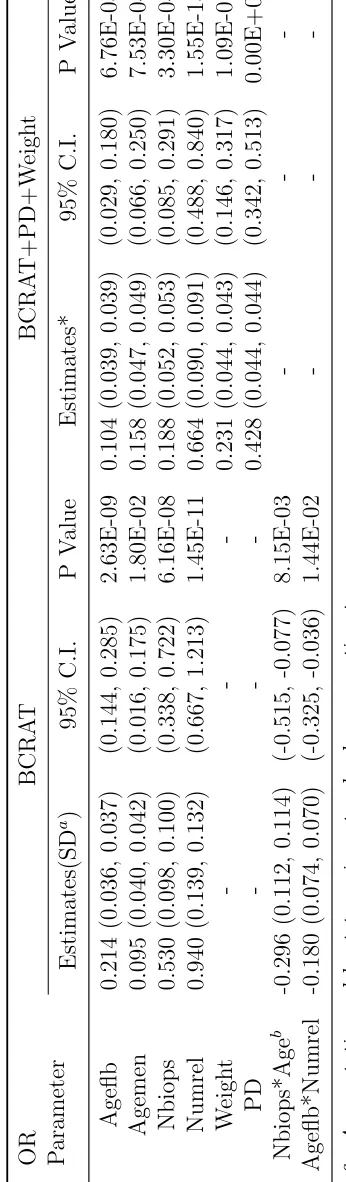
The OR parameter estimates for variables in the BCRAT and BCRAT+PD+Weight
models are provided in Table 2.1. Note that the two interaction terms that were
included in the BCRAT were not significant in the BCRAT+PD+Weight model and
therefore excluded. The OR estimates for the two strongest risk predictors, Nbiops
and Numrel, became much smaller in the latter model, which may be due to the
correlation between PD and Nbiops and Numrel as shown in Chapter 3. Our
es-timates were slightly different from those in Chen et al. (2008), because we used
coarser post-stratification strata in the PL method. This is mainly to facilitate the
bootstrapping method for obtaining asymptotic variance estimates of the predictive
accuracy statistics. The coarser strata guaranteed that the same post-stratification
can guarantee a reasonable size of each stratum in each bootstrapping sample. The
T able 2.1: Estimates of the OR P arameters for BCDDP .
OR Parameter
circumstances.
Table 2.2: Estimates of Predictive Accuracy Statistics for the BCRAT and its Vari-ants.
Statistics Model Estimates (SD)
PPV (95% risk)
BCRAT 0.008 (0.001) BCRAT+PD+Weight 0.009 (0.001) BCRAT+SNP 0.009 (0.001) BCRAT+PD+Weight +SNP 0.012 (0.002)
AUC
BCRAT 0.607 (0.011) BCRAT+PD+Weight 0.659 (0.012) BCRAT+SNP 0.674 (0.009) BCRAT+PD+Weight +SNP 0.706 (0.007)
PCF (q=0.1)
BCRAT 0.209 (0.018) BCRAT+PD+Weight 0.258 (0.015) BCRAT+SNP 0.254 (0.006) BCRAT+PD+Weight +SNP 0.299 (0.011)
PCF (q=0.2)
BCRAT 0.356 (0.029) BCRAT+PD+Weight 0.400 (0.018) BCRAT+SNP 0.413 (0.008) BCRAT+PD+Weight +SNP 0.466 (0.013)
PCF (q=0.3)
BCRAT 0.460 (0.033) BCRAT+PD+Weight 0.524 (0.019) BCRAT+SNP 0.541 (0.009) BCRAT+PD+Weight +SNP 0.592 (0.012)
PCF (q=0.4)
BCRAT 0.721 (0.067) BCRAT+PD+Weight 0.630 (0.018) BCRAT+SNP 0.647 (0.010) BCRAT+PD+Weight +SNP 0.694 (0.011)
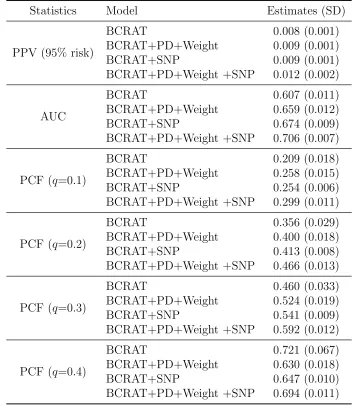
The estimates of predictive accuracy statistics for the four models are provided in
Table 2.2. The standard deviations were obtained by bootstrapping 1000 samples
from the BCDDP. We first generated 1000 samples from the original data by sampling
with replacement from each stratum defined by case-control status and age groups.
With each bootstrapping sample, we estimated (β,θ). Then we applied parametric
variance-covariance matrix from NHIS dataset. Finally, we parametrically bootstrapped 1000
sets ofβwwith the estimated log ORs and variances from literature. We then obtained
1000 sets of estimates ( ˆβ,θˆ) and ˆp(X|A). The standard errors of each statistic is then calculated from the 1000 corresponding predictive accuracy statistics. The calculation
of all predictive accuracy statistics was based on the 5-year risk for 35 year old women.
Adding SNPs and PD lead to large improvement in all predictive accuracy statistics,
and SNPs appeared to have a slightly larger incremental value. PPV was 0.54%,
0.71%, 0.70%, and 0.82% under the BCRAT, BCRAT+PD+Weight, BCRAT+SNP,
and BCRAT+PD+Weight+SNP, respectively. The PPV of the BCRAT was 0.0075,
suggesting that 0.75% of the 35 year-old women whose breast cancer absolute risk
was greater than 0.54% (top 5%, high risk) will develop breast cancer by age 40.
The PPV for the other three models were 0.93%, 0.93%, and 1.17%, respectively.
The AUC statistic under the four models were 0.607, 0.659, 0.674, and 0.706. We
computed PCF under different q values. At q = 0.2, the PCF for the four models
were 0.356, 0.400, 0.413, and 0.466, respectively. These results indicated that for the
35 year-old women who will develop breast cancer in the age interval (35, 40), 11%
more will arise among women whose absolute risk exceeds the 80% percentile in the
population as calculated by each model. PCF at the other q values showed similar
results.
2.4. Simulation Study
We then conducted extensive simulation studies to 1) assess the finite sample
perfor-mance of the asymptotic standard error estimates for predictive accuracy statistics,
and 2) assess the performance of normal approximation to the distribution of risk
in-corporated from external sources. We designed the simulation studies so that the
distribution of risk predictors was similar to that in the BCDDP. Therefore, we
ex-pect that our simulation results will also yield insights on the performance of variant
BCRAT models.
To generate two-phase stratified case-control samples, we first simulate a population
under the true model with all predictors and SNPs as follows. We first generated for
each subject data on age A, five predictors X = (X1, X2, X3, X4, Z), and external
predictors W = (W1, W2, ..., Wl). The age group indicatorIA was obtained as IA = 1
for 30 ≤ A < 40, IA = 2 for 40 ≤ A < 50, IA = 3 for 50 ≤ A < 60, IA = 4 for
60≤A <70, andIA= 5 forA≥70, whereAwas generated from a uniform
distribu-tion Uniform(30,80). X1 took values 0, 1, 2 and 3 and X2 values 0, 1 and 2 with the
frequency of each value similar to that of Ageflb and Agemen in the BCDDP,
respec-tively. X3 were generated from Poisson(0.8) and X4 from Poisson(0.2) by assigning
values 0, 1, and 2 to categories 0, 1, and ≥2, respectively. We generated the contin-uous Z measurement from Beta distribution, Beta(κφ, φ−κφ), with logit(κ) = Qγ
and log(φ) = Qω, where Q = (1, X, A), and we used for parameters θ = (γ,ω)
similar values as the corresponding estimates in the BCDDP. Then we categorized
Z to create variable Zc taking values 0, 1, 2 and 3 for Z ∈ (0,0.25), [0.25,0.50),
[0.50,0.75) and [0.75,1), respectively. We generated l independent SNPs, with the
genotype data for each SNPj generated from a multinomial distribution with values
0, 1 and 2 and corresponding probabilities (1−pj)2, 2pj(1−pj) and p2j, wherepj was
the minor allele frequency for the jth SNP and j = 1,2, ..., l. Finally, we generated
case-control status Y from a Bernoulli distribution with probability
We treated all predictors as ordinal in the analyses. We then randomly sampled n/5
cases andn/5 controls from each age stratum using variable probability sampling, so
that each case-control sample includedn cases andn controls. To create a two-phase
design sample, we randomly sampled a subset of cases and controls stratifying on A
and then deleted data Zc for the rest of case-control subjects.
The estimation of the predictor distribution p(X, Zc, W|A), as required in the esti-mation of predictive accuracy statistics, requires estimates of parameters θ in the
distributionpθ(Zc|X, A),p(X|A), andpj. For each dataset, we estimatedθ by fitting
a beta regression model to phase II controls only. Because p(X|A) and pj were
gen-erally estimated from external resources, we keep them fixed in the simulation. To
evaluate the normal approximation to the distribution of risk scoreXβx+Zcβ
z+Wβw
when the number of SNPs is large, we compared results obtained with normal
approx-imation and those with the exact distribution. For the former, we estimated (βx, βz)
for each simulated dataset by fitting model (2.2) but withoutW using the PL method,
and estimatedβw from an independent case-control sample generated from the same
population as described by model (2.2). For the latter, we jointly estimated (βx, βz)
andβw by fitting model (2.2) using the PL method, and we refer to the corresponding
estimates of predictive accuracy statistics as “gold standard”. We considered 2 SNP
predictors in W to make the computation of the exact distribution feasible in this
comparison. Below, We used “Model-XZ” to refer a the model that only used (X, Z)
as predictors, “Model-XZ-SNP” a model that includes both (X, Z) and W but with
(βX, βz) and βw estimated separately as above, and “Model-XZ-SNPgs” the “gold
standard” model.
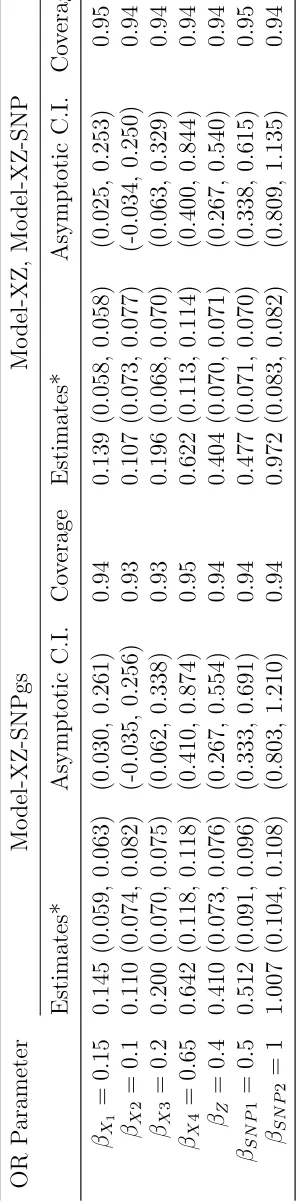
As shown in Table 2.3, even if we used intentionally large OR values for the two
regardless of whether they were estimated jointly or separately, and the asymptotic
standard error estimates were close to the empirical estimates as well. The 95%
confidence intervals provided good coverages as well. Therefore, the potential bias
resulting from fitting a mis-specified model (“Model-XZ”) due to omission of the
two SNPs is small. This observation is owing to the fact that the outcome Y was
rare and that SNPs and the rest of the predictors were independently distributed in
the population. Because we considered strong SNP effects, this same observation is
expected to be generalizable to when a larger number of SNPs with weaker SNPs are
related, as in the variant BCRAT models.
The estimates of predictive accuracy statistics and their standard errors are presented
in Table 2.4. PPV was computed at the 95% absolute risk quantile cutoff, which,
un-der Model-XZ-SNP, was quite close to that unun-der Model-XZ-SNPgs. PPV estimates
were the largest under Model-XZ-SNPgs as expected, and those under
model-XZ-SNP was similar. The average asymptotic and empirical standard errors were close.
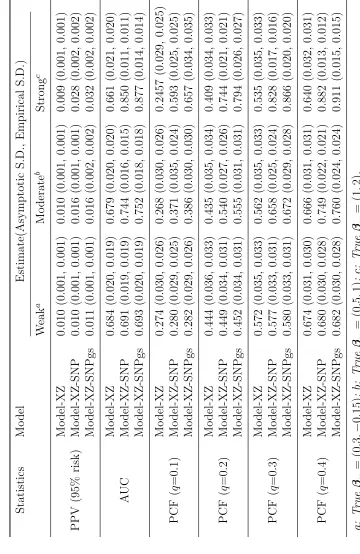
For the two SNPs, except for the OR values in Table 2.3, βw = (0.5,1), we also
considered weaker effects βw = (0.3,−0.15) and stronger effects βw = (1,2). The results were largely the same (data not shown). The AUC statistic under the three
models were 0.679, 0.744, and 0.752, respectively. We calculated PCF at different q
values, 0.1, 0.2, 0.3 and 0.4 . Model-XZ-SNP and Model-XZ-SNPgs always had
sim-ilar PCFs, which were greater than that under Model-XZ. As shown by PPV, AUC,
and PCF statistics, although Model-XZ-SNP is a composite approach to evaluating
the predictive accuracy, it performed similar as the gold standard one. In
particu-lar, Model-XZ-SNP led to a conservative assessment of the added value of Z, and
therefore is an appealing first step to assess a potential risk predictor. The average
latter was slightly smaller.
Finally, we performed simulation studies withW including 74 SNPs as in the variant
BCDDP model (Table 2.5). Due to the large number of SNPs, we adopted normal
approximation to the risk score Xβx +Zcβ
z +Wβw when computing predictive
accuracy statistics under both “Model-XZ-SNP” and “Model-XZ-SNPgs”. We used
the exact distribution for Xβx+Zcβ
z under “Model-XZ”. As observed for the
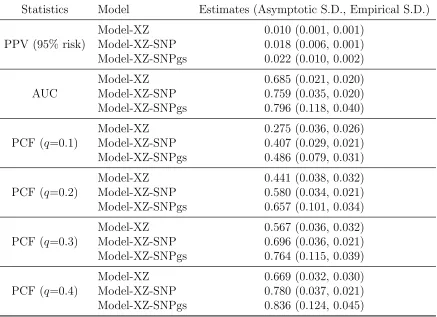
two-SNP setting, for all the predictive accuracy statistics, we observed large improvement
of Model-XZ-SNP over Model-XZ, and those under Model-XZ-SNPgs were usually
noticeably larger that those under Model-XZ-SNP. For all statistics, the asymptotic
standard error estimate was usually larger than empirical standard error, although
they were reasonably close for Model-XZ and Model-XZ-SNP. The large discrepancy
under Model-XZ-SNPgs might be due to the large dimension of variance-covariance
matrix for the large number of OR parameters. Statistics under Model-XZ-SNP, most
of the time, had smaller empirical standard errors than those under Model-XZ.This
was because Model-XZ-SNP exploited external information for SNP OR parameters
and minor allele frequencies, which were treated as known. Our results suggested
that normal approximation could lead to reasonable albeit conservative assessment
Table 2.5: Estimates of Predictive Accuracy Statistics in Simulation Studies with 74 SNPs.
Statistics Model Estimates (Asymptotic S.D., Empirical S.D.)
PPV (95% risk)
Model-XZ 0.010 (0.001, 0.001) Model-XZ-SNP 0.018 (0.006, 0.001) Model-XZ-SNPgs 0.022 (0.010, 0.002)
AUC
Model-XZ 0.685 (0.021, 0.020) Model-XZ-SNP 0.759 (0.035, 0.020) Model-XZ-SNPgs 0.796 (0.118, 0.040)
PCF (q=0.1)
Model-XZ 0.275 (0.036, 0.026) Model-XZ-SNP 0.407 (0.029, 0.021) Model-XZ-SNPgs 0.486 (0.079, 0.031)
PCF (q=0.2)
Model-XZ 0.441 (0.038, 0.032) Model-XZ-SNP 0.580 (0.034, 0.021) Model-XZ-SNPgs 0.657 (0.101, 0.034)
PCF (q=0.3)
Model-XZ 0.567 (0.036, 0.032) Model-XZ-SNP 0.696 (0.036, 0.021) Model-XZ-SNPgs 0.764 (0.115, 0.039)
PCF (q=0.4)
Model-XZ 0.669 (0.032, 0.030) Model-XZ-SNP 0.780 (0.037, 0.021) Model-XZ-SNPgs 0.836 (0.124, 0.045)
2.5. Conclusion
The estimators that we proposed for the adapted statistics were model-based,
treat-ing the absolute risk model as the correct model to relate risk predictors and the
probability of developing breast cancer. But this is rarely true in reality. The same
issue arose for predicting binary and time-to-event outcomes, where nonparametric
estimation methods were proposed that were robust to model mis-specification.
How-ever, in the setting of the widely applied composite approach to the development of
cancer absolute risk prediction models, nonparametric estimation methods are not
and events. Our method allows investigators to have at least an initial look at the
added values of candidate predictors.
The efficiency of estimating the adapted statistics depends on the efficiency of
es-timating the OR association parameters and the distribution of risk predictors. In
our current work, the PL method is not fully efficient for estimating OR association
parameters, and parameters in the conditional distribution of the new predictor was
estimated from phase II controls. It is of great interest to develop more efficient
methods for estimation. In Chapter 3, we propose a semiparametric maximum
likeli-hood approach (MLE) to estimating these two sets of parameters, which is expected
to lead to more efficient estimates of the adapted accuracy statistics. On the other
hand, the PL method is robust to the specification of the distribution of the new
predictor, but the semiparametric MLE can yield biased estimates of OR parameters
if the distribution of the new predictor is mis-specified. This bias and efficiency trade
off needs to be carefully considered for deciding which method to use in data analysis.
Our evaluation of combined values of PD and breast cancer risk SNPs relied on
multiple assumptions in order to utilize data in the literature on SNP minor allele
frequencies and OR parameter estimates. But SNPs may contribute to the variation
in the distribution of non-genetic risk predictors such as PD and family history of
breast cancer, and estimates of the OR parameters in the literature from marginal
analysis are biased for those in the logistic model that includes both genetic and
non-genetic risk predictors. Nevertheless, in the absence of data that provides information
on all predictors, this approach allows initial exploration of the combined values of all
predictors. Our simulation studies indicated that this approach provides reasonable
approximation at least for breast cancer risk prediction in the general female
in estimating the added values. Our results showed that incorporating PD and the
74 breast cancer risk SNPs improves the predictive accuracy of the BCRAT in term
CHAPTER 3
Semiparametric Maximum Likelihood Estimation with
3.1. Introduction
Cancer absolute risk is the probability that an individual will develop cancer in a
certain age period without dying from competing causes. Its computation involves
the relative hazard function, the age specific baseline hazard, and age specific
com-peting risk hazard. The relative hazard function can be approximated by the odds
ratio (OR) function of the predictors since cancer outcomes are rare. The baseline
hazard rates can be calculated from composite hazard rates available from population
databases such as the Surveillance, Epidemiology, and End Results (SEER) program
when coupled with the OR function and distribution of risk predictors. The hazard
rates of mortality can be obtained from the National Death Index. This composite
approach to cancer risk projection was first used by Gail et al. (1989) to develop the
breast cancer assessment tool (BCRAT), commonly referred to as the “Gail model”.
The BCRAT is the current National Cancer Institute (NCI) standard for predicting
breast cancer absolute risk. It has been widely used for designing clinical trials and
counseling individual woman. It has recently also been evaluated for its usefulness in
designing model-based breast cancer screening program.
The BCRAT includes four risk predictors, age at menarche (Agemen), age at first
live birth (Ageflb), number of previous breast biopsies (Bbiops), and number of
first-degree relatives (mother/sisters) (Numrel) who had breast cancer. It calibrates well
but only has a modest discriminatory accuracy with the area under the ROC curve
(AUC) ranging from 0.58 to 0.64 (Costantino et al., 1999; Freedman et al., 2005;
Rockhill et al., 2001). Therefore, it has been of great interest to increase the
pre-dictive accuracy of the BCRAT by incorporating emerging risk predictors. Percent
dense area on the mammogram image, has recently been established to be one of the
strongest risk predictors for breast cancer. Chen et al. (2006) and Chen et al. (2008)
developed an OR function and the corresponding absolute risk prediction model that
included PD as a new predictor, and found that it led to a modest increase in the
AUC statistic. Breast cancer risk associated SNPs, independently or combined with
PD, have recently been extensively evaluated for their added values in improving
breast cancer risk prediction. In Chapter 2, we adapted several statistics for
evaluat-ing the accuracy of models developed with binary or time-to-event outcome data to
accommodate the composite approach to absolute risk prediction, and assessed the
combined value of PD and the 74 breast cancer risk SNPs for improving the accuracy
of the BCRAT.
In Chapter 2, for the BCRAT and its variants, we used data for risk predictors
and PD from the Breast Cancer Detection and Demonstration Project (BCDDP).
BCDDP started from 1973 and was originally designed to assess whether
mammo-graphic screening can reduce morbidity and mortality of breast cancer. It recruited
243,221 white women in 1973 to 1975 and followed up each subject for at least 5
years. An age-stratified case-control study was conducted in 1979, and the BCRAT
risk predictors were available for all 2808 cases and 3119 controls. But only 1217
cases and 1616 controls had PD measurements available. SNP genotype data was
not available from the BCDDP. The challenge of incomplete predictor data as in the
BCDDP in the development of absolute risk prediction models is widespread. For
example, it may require up-to-date high technology to measure emerging risk factors,
which may be too expensive or technically infeasible to use on all subjects. One such
example is estrogen metabolomic measurements. It may also be possible that
are available from a stratified/frequency-matched case-control study but candidate
predictors are only collected on a subset, the data can be viewed as arising from
a two-phase stratified case-control design. In phase I, the case-control status and
standard risk predictors are collected on all cases and controls. In phase II, costly
predictor is measured on a subset selected based on case-control status and phase I
variables. The incomplete data conforms to a missing at random mechanism (Little
and Rubin, 1987) because the missingness occurred by study design. The
develop-ment of statistical methods for analysis has been focused on integrated analysis of
phase I and phase II data to achieve increased precision for estimating OR parameters
that quantify associations between the binary outcome and risk variables (Breslow
and Cain, 1988; Breslow and Chatterjee, 1999; Breslow and Holubkov, 1997; Chen
et al., 2008; Scott and Wild, 1997). In particular, Chen et. al (2006, 2008) carried
out a pseudo-likelihood approach to analyzing the two-phase stratified case-control
data and derive the OR function. This approach was applied to analyze the BCDDP
data in Chapter 2.
We are interested in developing a more efficient approach to estimating cancer
ab-solute risk and predictive accuracy statistics developed in Chapter 2, which requires
efficient estimation of both OR parameters and the joint distribution of standard and
candidate predictors given age. Usually the distribution of standard risk predictors
can be obtained from national population databases, which is preferable to assure the
applicability of the model to the general population. But candidate predictors are
often not included in these databases. Therefore, our goal involves efficient estimation
of the OR parameters and conditional distribution of the candidate predictor given
standard predictors and age. Here, we propose a semiparametric maximum