A Dose-Response Study of OROS Methylphenidate in Children With
Attention-Deficit/Hyperactivity Disorder
Mark A. Stein, PhD*; Christopher S. Sarampote, PhD‡; Irwin D. Waldman, PhD§; Adelaide S. Robb, MD‡; Charles Conlon, MD‡; Phillip L. Pearl, MD‡; David O. Black, MA‡; Karen E. Seymour, BA‡; and
Jeffrey H. Newcorn, MD储
ABSTRACT. Objective. OROS methylphenidate HCL (MPH) is a recently developed long-acting stimulant medication used to treat attention-deficit/hyperactivity disorder (ADHD). This study was conducted to examine dosage effects on ADHD symptoms and stimulant side effects and to explore potential moderating effects of ADHD subtype.
Methods. Children with ADHD combined type
CT) or predominantly inattentive type (ADHD-PI; n ⴝ 47), ages 5 to 16 years, underwent a placebo-controlled, crossover trial using forced titration with weekly switches at 3 dosage levels. Parent and teacher ratings of ADHD symptoms were used to evaluate effi-cacy. In addition, vital signs and standardized measures of stimulant side effects were obtained weekly.
Results. Parent ratings were more sensitive to treat-ment effects than teacher ratings. ADHD symptoms and Clinical Global Impressions Severity Index ratings at each dose condition differed significantly from placebo and baseline ratings, which did not differ from one an-other. For those with ADHD-CT, there was a clear linear dose-response relationship, with clinically significant re-ductions in ADHD Rating Scale-IV scores occurring in two thirds to three fourths of the subjects during either 36- or 54-mg dose conditions. Children with ADHD-PI, conversely, were more likely to respond optimally to lower doses and derived less benefit from higher doses, with 60% displaying significant improvement on the ADHD Rating Scale-IV at 36 mg or lower. Mild stimulant side effects were reported during placebo and at all dos-age levels. With the exception of insomnia and decreased appetite, which were more common at higher doses, par-ent report of side effects was not related to dose. In addition, younger and smaller children were more likely to display sleep difficulties and decreased appetite at the higher dose levels Although pulse rate increased slightly with increasing dose, there were no dose effects on blood pressure.
Conclusions. In children with ADHD-CT, the most
common subtype of ADHD, increasing doses of stimu-lant medication were associated with increased
improve-ment of inattention and hyperactivity symptoms. In chil-dren with ADHD-PI, symptom improvement occurred at lower doses and less benefit was derived from higher doses. In both ADHD subtypes, higher doses were asso-ciated with parent ratings of increased insomnia and decreased appetite. Pediatrics 2003;112:e404 –e413. URL: http://www.pediatrics.org/cgi/content/full/112/5/e404; at-tention-deficit/hyperactivity disorder, methylphenidate, pharmacologic treatment.
ABBREVIATIONS. ADHD, attention-deficit/hyperactivity disor-der; MPH, methylphenidate; DSM-IV, Diagnostic and Statistical Manual of Mental Disorders, Fourth Edition; ADHD-PI, attention-deficit/hyperactivity disorder predominantly inattentive type; ADD, attention-deficit disorder; ADHD-CT, attention-deficit/hy-peractivity disorder combined type; ODD, oppositional defiant disorder; ADHD RS-IV, ADHD Rating Scale-IV: Home Edition; CGI, Clinical Global Impressions Severity Index; SERS, Side Effect Rating Scale; ACTeRS, ADD-H Comprehensive Teachers Rating Scale; SD, standard deviation; RCI, reliable change index.
A
ttention-deficit/hyperactivity disorder (ADHD) is one of the most common neurobehavioral disorders of childhood and represents a sig-nificant public health problem because of its preva-lence, persistence, associated psychiatric comorbid-ity, and impairments in adaptive functioning.1,2Boththe American Academy of Pediatrics and the Amer-ican Academy of Child and Adolescent Psychiatry have recently developed clinical practice guidelines for this disorder.3,4 Stimulant medications, such as
methylphenidate (MPH), have been evaluated exten-sively in hundreds of empirical studies5and are the
most common medical treatment for ADHD. Ac-cording to a recent review, “Stimulants are among the most effective psychotropic medications in clini-cal use today.”4
Currently, the most commonly prescribed medica-tion for ADHD is OROS MPH, a long-acting stimu-lant designed to release gradually increasing concen-trations of methylphenidate over 10 to 12 hours.6The
effectiveness of OROS MPH is supported by 2 stud-ies conducted in laboratory settings and a multisite efficacy study.5,7,8In these studies, OROS MPH was
shown generally to mimic the efficacy and side-effect profile of three times a day (TID) MPH in treating childhood ADHD. Recently, a 1-year open follow-up study indicated that OROS MPH is well tolerated with few clinically significant adverse effects.9
Dos-age varied from 18 to 54 mg in these studies, with the most common dose being 36 mg. However, none of
From the *Department of Psychiatry, University of Chicago, Chicago, Illi-nois; ‡Departments of Psychiatry and Pediatrics, Children’s National Med-ical Center, Washington, DC; §Department of Psychology, Emory Univer-sity, Atlanta, Georgia; and 储Departments of Psychiatry and Pediatrics, Mount Sinai School of Medicine, New York, New York.
Presented in part at the American Academy of Child and Adolescent Psychiatry Annual Meeting; October 27, 2002; San Francisco, CA. Received for publication Apr 21, 2003; accepted Jul 22, 2003.
Reprint requests to (M.A.S.) University of Chicago (MC 3077), Child and Adolescent Psychiatry, 5841 S Maryland Ave, Chicago, IL 60637. E-mail: [email protected]
the aforementioned studies systematically examined the relationship between OROS MPH dose and be-havioral and cognitive symptoms of ADHD.
As defined in theDiagnostic and Statistical Manual of Mental Disorders, Fourth Edition (DSM-IV),10
ADHD is a heterogeneous disorder with consider-able variation within individuals in their degree of cognitive (ie, inattention) and behavioral (ie, hyper-activity) symptoms.11 Studying interindividual
dif-ferences within and across different domains of func-tioning can increase our understanding of the pathophysiology of the disorder and facilitate under-standing of pharmacotherapy.12 Stimulant
medica-tions are usually titrated until there is optimal symp-tom reduction or significant stimulant side effects occur. Mild side effects are commonly reported in children who take stimulant medications, and changes in timing and dosage often result in im-provement. The two most frequent untoward effects of immediate-release stimulant medications are sleep disturbance and decreased appetite; slightly less common side effects include negative mood changes (eg, irritability, sadness, anxiety), headaches, tics, and stomachaches.13Stimulant side effects are often
presumed to be dose related, with higher doses yielding more severe side effects. However, with the exception of decreased appetite, this has not been demonstrated within the mild to moderate dose ranges (ie, 0.3– 0.5 mg/kg/dose) in studies of short-acting stimulants with school-age children.14,15 The
relationship between dose and stimulant side effects has not been evaluated systematically using long-acting stimulants.
In 1937, Bradley16 first noted that children vary
significantly in their response to stimulant medica-tion and stressed the importance of identifying cor-relates of treatment response to further our under-standing and improve clinical decision making. Moderators, or subgroups defined by baseline char-acteristics, may respond differentially to stimulant treatment. For example, the landmark MTA study examined several potential moderators, such as pre-vious medication use, demographic characteristics, and comorbidity.17 However, one of the most
com-mon ADHD subgroups, individuals with ADHD pre-dominantly inattentive type (ADHD-PI), were not included in the MTA sample. Thus, it is unclear whether stimulant medication response is moder-ated by ADHD subtype. In an earlier study con-ducted before DSM-IV, Barkley et al18examined the
efficacy of 5, 10, and 15 mg of MPH administered twice per day, in children with DSM-III-defined at-tention-deficit disorder (ADD) with and without hy-peractivity. The subgroup of children with ADD without hyperactivity responded to lower dosages relative to children with ADD with hyperactivity. Extrapolating to DSM-IV, we hypothesized that ADHD subtype will moderate dose-response rela-tionships to OROS MPH
Thus, the goal of the present study was to examine the relationship between OROS MPH dose and ADHD symptoms, impairment, and side effects. A secondary goal was to evaluate the potential moder-ating effects of ADHD subtype.
METHODS Subjects
Forty-seven children who were ages 5 year 11 months to 16 and referred to the Hyperactivity, Attention and Learning Problems Clinic at Children’s National Medical Center (CNMC) served as subjects. Youths with mental retardation, severe mood disorders (requiring antidepressant or concurrent psychotropic medications medication), Tourette syndrome, seizure disorders, or other med-ical disorders associated with symptoms that may mimic ADHD (eg, thyroid disorder) were excluded, as were children who were taking systemic medications.
All subjects completed a semistructured diagnostic interview conducted with the parents and the child by a child and adoles-cent psychiatrist or psychologist. As part of the interview, parents were asked to provide information about specific DSM-IV symp-toms for common childhood psychiatric disorders (disruptive behavior, anxiety, mood, and pervasive developmental disorders) and impairment. All subjects met DSM-IV criteria for ADHD.10
Evaluation of ADHD and other psychiatric disorders was based on a “best-estimate” diagnosis, after reviewing interview and all available data, including behavioral observations during cog-nitive testing with the Wechsler Intelligence Scale for Children, Third Edition,19and Wechsler Individual Achievement Test,
Sec-ond Edition,20the Test of Variables of Attention,21Child Behavior
Check List,22 and Conner’s Teacher Rating Scale.23 These
mea-sures were part of the standard diagnostic test battery that was administered to school-aged children who were referred to the multidisciplinary Hyperactivity, Attention, and Learning Problems Clinic, which includes pediatricians, psychologists, neurologists, and child and adolescent psychiatrists. Thirty-two (68%) subjects re-ceived a diagnosis of ADHD-Combined type (ADHD-CT), 15 (32%) received a diagnosis of ADHD-PI. In addition, 17.0% met criteria for oppositional defiant disorder (ODD), 10.6% displayed encopresis/enuresis, and 2.1% displayed tic disorders. Thirty-three (70%) children were stimulant naı¨ve, and 14 (30%) had taken stimulant medications in the past. As in most clinic-ascertained studies of ADHD, there was a strong male preponderance: 70.2% (33) were male and 29.8% (14) were female. In addition, 89.4% (42) of the subjects were white, 4.3% (2) were black, 2.1% (1) were Hispanic, and 4.3% (2) reported other ethnicities.
Procedures
Once children met inclusion criteria, parents and children were given a detailed description of the project and each subject’s parent(s) or guardian(s) were required to give signed informed consent; subjects aged 7 years or older were also required to give written assent. The consent and assent forms, study protocol, and any advertisements for subjects were reviewed and approved by the Institutional Review Board of Children’s National Medical Center.
Experimental Design
The 47 subjects were evaluated in a placebo-controlled, cross-over study with 3 dose conditions of OROS MPH. Children who previously took stimulant medications completed a 2-week wash-out period before beginning the study. During the trial, patients received their usual school-based educational interventions and were not allowed to begin additional family-based or new psy-chosocial treatments until the medication trial was completed. The research pharmacist prepared weekly blister packs for each sub-ject, each containing a 7-day supply of study drug for each week. Blister packs contained either a commercially available placebo capsule slightly larger than the OROS MPH preparations1or 18
mg, 36 mg, or 54 mg (18 ⫹ 36 mg) of OROS MPH. Dosing schedules were assigned from a randomly ordered list of all dosing schedules with the exception that no child could start with the 54-mg dose. In addition, 1 child who weighed⬍40 kg did not receive the 54-mg dose to minimize potential side effects in smaller children.
Weekly Procedures and Measures
During the initial visit and each weekly visit, children and their parents met with the clinical staff to discuss medication effects and to complete rating scales and questionnaires. Each week the fol-lowing measures were completed:
• ADHD Rating Scale-IV: Home Version (ADHD RS-IV)24: The
ADHD RS-IV consists of 18 items that assess DSM-IV criteria for inattention and hyperactivity. The rating scale includes inatten-tion and hyperactivity-impulsivity subscales as well as a total symptom score.
• Clinical Global Impression-Severity (CGI25): The CGI is a
single-item clinician rating of the clinician’s assessment of the severity of ADHD symptoms. Severity of impairment is rated on a 7-point scale (1⫽not at all ill, 7⫽maximal, profound impair-ment).
• Side Effect Rating Scale (SERS)26: The SERS is a 17-item scale
composed of a variety of central nervous system stimulant side effects. The severity of each symptom is rated by parents on a 10-point (0 –9) scale ranging from absent to serious. This scale has been used to measure the prevalence and severity of stim-ulant side effects in several treatment studies.14,27
• Vital signs: Children’s weight, height, blood pressure, pulse, and temperature were obtained weekly.
In addition to parent and child ratings, teachers were queried weekly to assess medication response in school. Before medication (baseline) and during each subsequent week of the trial, teachers completed the ADD-H Comprehensive Teachers Rating Scale (ACTeRS).28The ACTeRS consists of 24 items with 5 to 7 items
assessing each of 4 categories of behavior: attention, hyperactivity, social skills, and oppositional behaviors.
Statistical Plan
Frequency data were evaluated using2. Repeated measures
analyses of variance or multivariate analyses of variance were used to evaluate treatment effectiveness. Trend analyses were conducted to test for hypothesized linear and higher-order
dose-response curves. All follow-up analyses were completed using Bonferroni correction for multiple comparisons. A pairedttest was used to evaluate differences between the ADHD subtypes at baseline and to test the significance of change from baseline to follow-up visits on vital signs. Effect sizes were calculated by dividing the difference of the mean scores by the standard devi-ation (SD) for the placebo phase or were provided by the statistical package (viz, SPSS for Windows, v.11) as the percentage of vari-ance accounted for.
Three procedures were used to determine the clinical signifi-cance of OROS MPH treatment: 1) examining rates of improve-ment through commonly used cutoffs on the ADHD RS-IV that approximate those used in the MTA optimal responder analyses,5
2) determining global changes in severity via the CGI, and 3) calculating clinically significant change using a reliable change index (RCI).29Following the guidelines established by Jacobson
and Truax,29clinically significant change was defined as when the
posttreatment level of functioning results in a subject rated closer to the mean of the functional population than to the mean of the dysfunctional population. Clinical improvement was calculated separately for inattention and hyperactivity symptoms using the ADHD RS-IV. A t score of 50, the population mean,24was used to
define the mean of the functional population. To evaluate whether the change was statistically reliable, we also calculated RCI scores.
RESULTS Diagnostic and Descriptive Information
With the exception of 1 child who tested in the borderline range for verbal and full-scale IQ, all chil-dren had scores within the average or above-average range on the Wechsler Intelligence Scale for Chil-dren, Third Edition (mean IQ: 105). However, 31.9% of the children received a diagnosis of a learning disability on the basis of a significant discrepancy between Wechsler Individual Achievement Test scores and IQ. Consistent with an ADHD diagnosis, the highest mean Child Behavior Check List scores were on the Attention Problems Scale. Similarly, on the Conner’s Teacher Rating Scale,23 the highest
mean score was on the Hyperactivity Index (Table 1). Child Behavior Check List Attention and
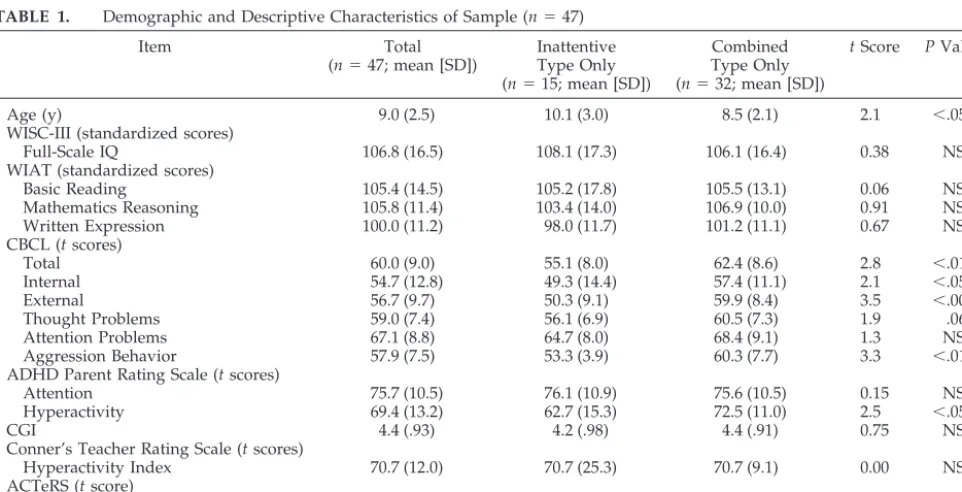
Hyperac-TABLE 1. Demographic and Descriptive Characteristics of Sample (n⫽47)
Item Total
(n⫽47; mean [SD])
Inattentive Type Only (n⫽15; mean [SD])
Combined Type Only (n⫽32; mean [SD])
tScore PValue
Age (y) 9.0 (2.5) 10.1 (3.0) 8.5 (2.1) 2.1 ⬍.05
WISC-III (standardized scores)
Full-Scale IQ 106.8 (16.5) 108.1 (17.3) 106.1 (16.4) 0.38 NS WIAT (standardized scores)
Basic Reading 105.4 (14.5) 105.2 (17.8) 105.5 (13.1) 0.06 NS Mathematics Reasoning 105.8 (11.4) 103.4 (14.0) 106.9 (10.0) 0.91 NS Written Expression 100.0 (11.2) 98.0 (11.7) 101.2 (11.1) 0.67 NS CBCL (tscores)
Total 60.0 (9.0) 55.1 (8.0) 62.4 (8.6) 2.8 ⬍.01
Internal 54.7 (12.8) 49.3 (14.4) 57.4 (11.1) 2.1 ⬍.05
External 56.7 (9.7) 50.3 (9.1) 59.9 (8.4) 3.5 ⬍.001
Thought Problems 59.0 (7.4) 56.1 (6.9) 60.5 (7.3) 1.9 .06
Attention Problems 67.1 (8.8) 64.7 (8.0) 68.4 (9.1) 1.3 NS
Aggression Behavior 57.9 (7.5) 53.3 (3.9) 60.3 (7.7) 3.3 ⬍.01 ADHD Parent Rating Scale (tscores)
Attention 75.7 (10.5) 76.1 (10.9) 75.6 (10.5) 0.15 NS
Hyperactivity 69.4 (13.2) 62.7 (15.3) 72.5 (11.0) 2.5 ⬍.05
CGI 4.4 (.93) 4.2 (.98) 4.4 (.91) 0.75 NS
Conner’s Teacher Rating Scale (tscores)
Hyperactivity Index 70.7 (12.0) 70.7 (25.3) 70.7 (9.1) 0.00 NS ACTeRS (tscore)
Attention 63.8 (8.7) 63.6 (7.2) 64.0 (9.5) 0.14 NS
Hyperactivity 56.8 (12.0) 54.4 (7.9) 58.0 (13.63) 0.93 NS
tivity Index scores both were ⬎1.5 SD above the mean for each scale, respectively. Mean impairment, as assessed with the CGI, was moderate (CGI⫽4.4). Children with ADHD-CT as a group were younger, were more hyperactive, and displayed more internalizing and externalizing symptoms on dimensional measures of psychopathology than the ADHD-PI group (Table 1). There was no significant difference between children with ADHD-CT or ADHD-PI in CGI impairment ratings, intellectual functioning, or academic achievement. However, just 22% (n ⫽ 7) of the ADHD-CT group received a diagnosis of having a learning disability, whereas 53% (n⫽8) of the ADHD-PI group received a diag-nosis of having a learning disability (2(1) ⫽ 4.65,
P⫽.05).
Changes in ADHD Symptoms and Impairment
Changes in inattentive and hyperactive ADHD symptoms as a function of OROS MPH dosage were assessed using the ADHD RS-IV and the ACTeRS. As OROS MPH dose increased from 0 to 54 mg, parent-rated ADHD symptoms decreased in a linear manner (F[1,38] ⫽ 96.71, P ⬍ .001, partial Eta2 ⫽
0.72), similarly for inattentive and hyperactive-im-pulsive symptoms (F[1,38]⫽89.55,P⬍.001, partial Eta2⫽0.70;F[1,38]⫽81.28,P⬍.001, partial Eta2⫽
0.68, respectively).
We also examined the differential sensitivity of parent and teacher ratings of ADHD symptoms to treatment. Although similar linear decreases with increased OROS MPH dosage were noted for teacher ratings of inattentive and hyperactive-impulsive symptoms, effect sizes for these decreases were more moderate in magnitude (F[1,23] ⫽ 21.87, P ⬍ .001, partial Eta2 ⫽ 0.49;F[1,23]⫽ 8.55, P ⫽ .008, partial
Eta2⫽0.27, respectively), suggesting that parent
rat-ings are slightly more sensitive than teacher ratrat-ings in detecting OROS MPH effects.
The effects of OROS MPH on impairment were examined by modeling changes in CGI as a function of dosage level. Overall impairment decreased with
increasing OROS MPH dose (F[1,38] ⫽ 57.49, P ⬍
.001, partial Eta2⫽ 0.60).
ADHD Subtype Differences in Treatment Response and the Effects of Comorbid ODD and Learning Disability
There were no subtype differences in severity of CGI measured impairment as a function of increas-ing OROS MPH dose (F[1,37]⫽0.31,P⫽.578, partial Eta2 ⬍ 0.01), and these results did not differ when
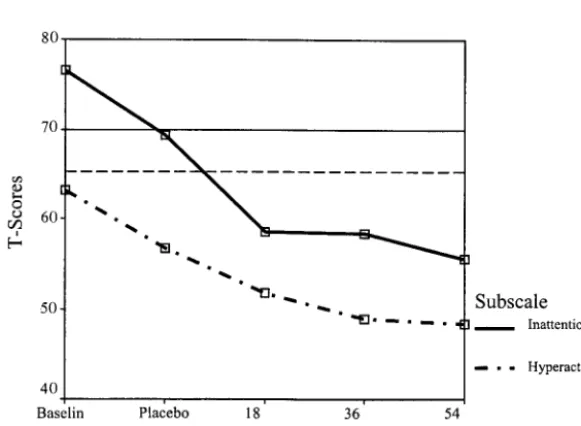
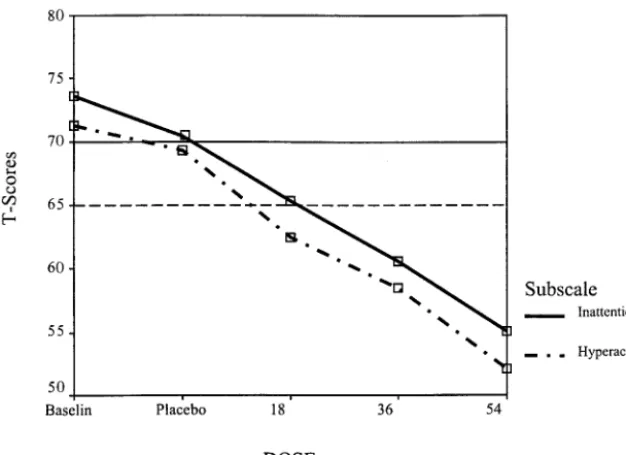
comorbid ODD and learning disability were taken into account. In contrast, there were significant dif-ferences in parent-rated hyperactive-impulsive and inattentive symptoms between the ADHD-CT and ADHD-PI subtype groups. As shown in Figs 1 and 2, there was a trend for the difference between the ADHD-CT and ADHD-PI groups in the reduction of hyperactive-impulsive symptoms with increasing OROS MPH dose (quadratic trendF[1,37]⫽3.55,P⫽
.067, partial Eta2⫽ 0.09). This subtype difference in
reduction of hyperactive-impulsive symptoms was enhanced when comorbid ODD was controlled (F[1,36] ⫽ 5.68, P ⫽ .023, partial Eta2 ⫽ 0.14) and
remained when comorbid learning disability and ODD both were controlled (F[1,34]⫽4.49,P⫽.041, partial Eta2 ⫽ 0.12). The nature of this subtype
dif-ference in the quadratic trend for reduction of hyper-active-impulsive symptoms was that the ADHD-PI showed greater treatment response at lower OROS MPH doses, whereas the ADHD-CT group showed greater treatment response at higher doses. Specifi-cally, in the ADHD-CT group, there was a greater decrease in hyperactive-impulsive symptoms from the 36-mg condition to the 54-mg condition (P ⫽
.002) than from the 18-mg to the 36-mg condition (P⫽.296) or the placebo to the 18-mg condition (P⫽
.034; Fig 2), whereas in the ADHD-PI group, there was a greater decrease from baseline and placebo to the 18-mg condition (P⫽.010 and .123, respectively) than from 18-mg to 36-mg or from 36-mg to 54-mg dose (P⫽.109 and .807, respectively).
A similar subtype difference in treatment response
was found for inattentive symptoms, which are ele-vated in both subtypes. Specifically, there was a trend for the ADHD-CT and ADHD-PI groups to differ in the reduction of inattentive symptoms with increasing OROS MPH dose (quadratic trendF[1,37]
⫽ 3.13, P⫽ .085, partial Eta2⫽ 0.08). This subtype
difference in reduction of inattentive symptoms was enhanced when comorbid ODD was controlled (F[1,36]⫽4.72,P⫽.037, partial Eta2⫽0.12) as well
as when comorbid learning disability and ODD both were controlled (F[1,34]⫽4.48,P⫽.042, partial Eta2
⫽0.12). The nature of this significant subtype differ-ence in the quadratic trend for reduction of inatten-tive symptoms was that the ADHD-PI group showed greater treatment response at lower OROS MPH doses, whereas the ADHD-CT group showed greater treatment response at higher doses. Specifically, in the ADHD-CT group, there was a greater decrease in hyperactive-impulsive symptoms from 36- to 54-mg conditions (P⫽ .003) than from the 18-mg to 36-mg dose (P⫽.141) or the placebo to the 18-mg dose (P⫽
.059), whereas in the ADHD-PI group, there was a greater decrease from baseline and placebo to the 18-mg condition (P ⫽ .005 and .085, respectively) than from the 18-mg to 36-mg or the 36-mg to the 54-mg dose (P ⫽ .973 and .107, respectively). This pattern also was borne out in the t scores for inatten-tive symptoms in that clinically significant declines were seen for the ADHD-CT group from the 36-mg to the 54-mg dose (mean t scores: 61 vs 55, respec-tively; a decrease ⬎0.5 SD), whereas for the ADHD-PI group, the most substantial decline was seen from the baseline to the 18-mg dose (mean t scores: 76 vs 59, respectively; a decrease⬎1 SD) with very slight declines from the 18-mg to the 36-mg dose and from the 36-mg to the 54-mg dose (mean t scores: 59, 58, and 56, respectively; decreases⬍0.10 and 0.25 SD, respectively). These results suggest that the subtype differences in reduction of ADHD symp-toms with increasing OROS MPH dose were similar in magnitude for the hyperactive-impulsive and in-attentive symptoms of ADHD.
Clinical Improvement/Return to Normalcy
Three procedures were used to examine the clini-cal significance of changes in ADHD symptom. First, common cutoffs for the ADHD RS-IV were used to estimate clinically significant improvement. A score of 9 or less (T⬍60) on the inattentive scale indicated “normalization” for the ADHD-PI subgroup, and a score of 18 (T⬍60) or less on the total score was used to indicate “normalization” for the ADHD-CT sub-group. Thirty-three percent of the ADHD-PI subjects met this criterion during the placebo phase: 43% at 18 mg, 60% at 36 mg, and 50% at 54 mg (Table 2). There were no dose-related differences in the proportion of subjects whose scores were “normalized” in this group (2(2) ⫽.86; not significant).
Within the ADHD-CT group, however, the pro-portion of normalized subjects was 14%, 32%, 40%, and 66% at placebo, 18 mg, 36 mg, and 54 mg of OROS MPH, respectively. Within this group, there were few placebo responders and greater improve-ment was reported at higher doses of OROS MPH (2(2)⫽ 7.2,P⬍ .05).
Clinically significant improvement was also as-sessed using the CGI. Severity of impairment for more than two thirds (ⱖ67%) of subjects in the ADHD-PI group diminished to subclinical levels (eg, CGIⱕ3) at 36 mg and 54 mg of OROS MPH (Table 2). Within this group, 43% displayed an excellent re-sponse as indicated by “no or mild impairment” (CGI ⱕ2) at 36 mg, and 58% showed “no or mild impairment” at 54 mg of OROS MPH. For the ADHD-CT group, CGI severity decreased to subclin-ical levels for 65% of subjects at 36 mg and for 72% of subjects at 54 mg of OROS MPH. Forty-five percent of ADHD-CT subjects at 36 mg and 52% of subjects at 54 mg had no or mild impairment (Table 2).
Following Jacobson and Truax’s procedures, sub-jects were classified as “normalized” when they achieved clinical improvement and a significant RCI indicating reliable symptom improvement. As shown in Table 3, the proportion of subjects in the Fig 2. ADHD-RS-IV scores for the
inattentive subgroup who met criteria for normaliza-tion of inattennormaliza-tion symptoms was approximately half at all 3 doses of OROS MPH. Thus, with the use of this method, the inattentive subtype did not seem to experience incremental treatment benefits with higher doses of OROS MPH over the 18-mg dose. Within the ADHD-CT group, the proportion of sub-jects who met criteria for normalization on attention symptoms ranged from more than one third at 18 mg of OROS MPH to more than two thirds at 54 mg. ADHD-CT subject normalization on hyperactivity symptoms increased from one fourth at 18 mg of OROS MPH to two thirds at 54 mg of OROS MPH.
Premature Discontinuation and Compliance
Any child who could not complete a treatment phase was classified as a premature discontinuation. Their data were included for all phases that were completed. One (2%) child dropped out during pla-cebo, 2 (4%) children did not complete the 36-mg condition, and 5 (10%) did not complete the 54-mg level condition. Reasons for discontinuation (not mu-tually exclusive) included irritability and negative
mood (n⫽ 4), decreased appetite (n⫽ 3), insomnia (n⫽2), staring (n⫽2), somatic complaints (n⫽ 1), tics/nervous movements (n⫽1), drowsiness (n⫽1), and euphoria (n⫽1). There was a marginally signif-icant trend indicating that premature discontinua-tion was more likely to occur during the 54-mg con-dition (2(3) ⫽7.3,P⫽ .06).
Compliance was assessed weekly by querying par-ents on missed doses. Compliance was adequate, with 92% of all study medications given.
Side Effects
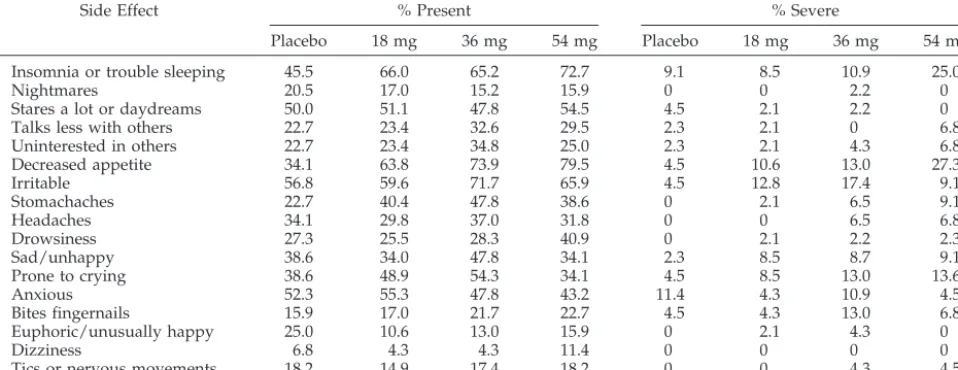
To examine effects of OROS MPH dose on percep-tions of untoward or stimulant side effects, we com-pared scores from the parent-completed SERS at pla-cebo and each dose. OROS MPH dose did not have a significant effect on SERS total score (F[3,123] 1.78; not significant. Although stimulant side effects were reported at all dose levels, these were generally mild. Following the recommendations of Barkley et al,26
ratings of 7 and higher were taken as an indication of a serious or severe side effect (Table 4). In addition, regression analyses were used to explore the rela-TABLE 2. Symptom and Impairment Improvement as Measured With ADHD Parent Rating Scale
Cutoff Scores and CGI Severity Scores
Improvement Using CGI Normalization Using Cutoffs From DuPaul Rating Scale (n[%*†]) CGIⱕ2
(n[%*])
CGIⱕ3 (n[%*]) Inattentive subtype (n⫽15)
Baseline 0 4 (31%) 1 (7%)
Placebo 2 (14%) 5 (36%) 5 (33%)
18 mg 3 (21%) 9 (64%) 6 (43%)
36 mg 6 (43%) 10 (71%) 9 (60%)
54 mg 7 (58%) 9 (75%) 7 (50%)
Combined subtype (n⫽32)
Baseline 0 4 (13%) 1 (3%)
Placebo 2 (7%) 4 (14%) 4 (14%)
18 mg 8 (25%) 14 (44%) 10 (32%)
36 mg 14 (45%) 20 (65%) 12 (40%)
54 mg 15 (52%) 21 (72%) 19 (66%)
* Note that percentages are calculated based on the availablenat each dose.
† For subjects with ADHD-PI, scores of 9 or less on the inattentive subscale of the DuPaul Parent Rating Scale indicated normalization. For Subjects with ADHD-CT, score of 18 or less on the total scale of the Parent ADHD Rating Scale IV indicated normalization.
TABLE 3. Clinically Significant Improvement and Statistically Reliable Change (RCI), and Nor-malization on the Attention and Hyperactivity Subscales of the ADHD Parent Rating Scale IV at Each Dose of OROS MPH
Threshold t Score
Clinical Improvement
% Improved
RCI* % Improved
Clinical Improvement and RCI* % Normalized Inattentive subtype (n⫽15)
Attention subscale 62.49
18 mg 57% 50% 50%
36 mg 60% 80% 53%
54 mg 57% 79% 50%
Combined subtype (n⫽32)
Attention subscale 62.49
18 mg 45% 45% 36%
36 mg 61% 55% 48%
54 mg 76% 86% 69%
Hyperactivity subscale 60.71
18 mg 52% 39% 26%
36 mg 55% 55% 42%
54 mg 76% 76% 66%
tionship between age and weight on insomnia, de-creased appetite, irritability, and tics at 36 mg and 54 mg of OROS MPH.
Insomnia
Parents reported more problems with sleep on all doses of OROS MPH relative to placebo (F[3,123]⫽ 5.7,P⬍.001, partial Eta2⫽0.12). Approximately 9%
reported severe sleep-related problems at placebo, 9% at the 18-mg OROS MPH dose, 11% at 36-mg OROS MPH dose, and 25% at the 54 mg OROS MPH dose. In addition, younger and lighter subjects re-ported more problems with sleep at 54 mg of OROS MPH (F⬎5.4,P⬍.05, R2⬎0.11). At the 36-mg dose
of OROS MPH, younger subjects reported more problems with sleep (F[46] ⫽ 6.57, P ⫽ .01, R2 ⫽
0.13), and a trend suggested that subjects who weighed less reported more problems with sleep (F[44]⫽ 3.48,P⫽.07, R2⫽ 0.08).
Appetite
Fewer than 5% of the participants reported signif-icantly decreased appetite during the placebo phase, whereas 10.6% of participants reported severe appe-tite-related side effects at 18 mg, 13.0% at 36 mg, and 27.3% at 54 mg. Thus, there was greater appetite suppression as the OROS MPH dose increased (F[3,123]⫽ 11.9, P ⬍ .001, partial Eta2⫽ 0.23).
Fol-low-up paired comparisons indicated that placebo was different from all doses of OROS MPH (P⬍.05), and the proportion of subjects who reported severe decreased appetite increased as Concerta dose in-creased (2(3)⫽10.29,P⬍.05). Younger children and
children who weighed less also reported more appe-tite-related problems at 36 mg of OROS MPH (F ⬎
7.2,P⬍.02, R2⬎0.14), but no effect was found at 54
mg of OROS MPH (F[42]⬍0.3; not significant).
Irritability
Mood symptoms and irritability are often reported in individuals with ADHD and if reported when medications are wearing off may indicate stimulant rebound.30OROS MPH dose was not related to
par-ent report of irritability (F[3,120]⫽ 0.26, partial Eta2
⫽0.01; not significant). Neither age nor weight was related to complaints of irritability on 36 mg or 54 mg of OROS MPH (F⬍ 1.26,P⬎ .2).
Tics
Another side effect that is associated with stimu-lant medications and that causes concern among par-ents and pediatricians is tics. However, tics, as as-sessed by parent ratings, were not associated with OROS MPH dose (F[3,120]⫽1.36, partial Eta2⫽0.03;
not significant). Only 2 (5%) subjects at the 36-mg and 54-mg dosages reported severe tics. Although age and weight were not related to reported tics on 36 mg of OROS MPH (F ⬍ 1.5,P ⬎.2), marginally significant trends suggested that younger children (F[42] ⫽ 2.87,P ⫽ .098) and children who weighed less (F[41] ⫽ 4.03, P ⫽ .051) were more likely to experience tics on the 54-mg dose of OROS MPH.
Effects of OROS MPH Dose on Vital Signs
To determine whether OROS MPH had an effect on blood pressure, we compared the proportion of subjects beyond the 95th percentile for their age and sex at placebo and each dose of OROS MPH with baseline values. OROS MPH dose was not related to changes in either systolic or diastolic blood pressure (2(4) ⬍ 5.3; not significant). Although a slight
in-crease in pulse rate was noted from baseline to pla-cebo and treatment doses of OROS MPH (F[4,116]⫽ 2.6, partial Eta2 ⫽ 0.08, P ⫽ .04), there were no
differences between placebo and any dose of OROS MPH (not significant).
DISCUSSION
The primary purpose of this study was to deter-mine dosage effects of OROS MPH on ADHD symp-toms, impairments, and side effects. Similar to stud-ies with short-acting stimulants, OROS MPH significantly reduced the frequency and severity of ADHD symptoms. Normalization occurred on at least 1 dose in half to two thirds of subjects. Consis-tent with previous studies with hyperactive or ADHD-CT samples, treatment response followed an inverse linear dose-response curve with ADHD TABLE 4. Frequency of Presence of Any Side Effect and Any Severe Side Effects at Each Dose of OROS MPH
Side Effect % Present % Severe
Placebo 18 mg 36 mg 54 mg Placebo 18 mg 36 mg 54 mg Insomnia or trouble sleeping 45.5 66.0 65.2 72.7 9.1 8.5 10.9 25.0
Nightmares 20.5 17.0 15.2 15.9 0 0 2.2 0
Stares a lot or daydreams 50.0 51.1 47.8 54.5 4.5 2.1 2.2 0
Talks less with others 22.7 23.4 32.6 29.5 2.3 2.1 0 6.8
Uninterested in others 22.7 23.4 34.8 25.0 2.3 2.1 4.3 6.8
Decreased appetite 34.1 63.8 73.9 79.5 4.5 10.6 13.0 27.3
Irritable 56.8 59.6 71.7 65.9 4.5 12.8 17.4 9.1
Stomachaches 22.7 40.4 47.8 38.6 0 2.1 6.5 9.1
Headaches 34.1 29.8 37.0 31.8 0 0 6.5 6.8
Drowsiness 27.3 25.5 28.3 40.9 0 2.1 2.2 2.3
Sad/unhappy 38.6 34.0 47.8 34.1 2.3 8.5 8.7 9.1
Prone to crying 38.6 48.9 54.3 34.1 4.5 8.5 13.0 13.6
Anxious 52.3 55.3 47.8 43.2 11.4 4.3 10.9 4.5
Bites fingernails 15.9 17.0 21.7 22.7 4.5 4.3 13.0 6.8
Euphoric/unusually happy 25.0 10.6 13.0 15.9 0 2.1 4.3 0
Dizziness 6.8 4.3 4.3 11.4 0 0 0 0
symptoms and impairment declining with increasing dose up to 54 mg. Although only slight improve-ments occurred relative to baseline when receiving placebo or 18 mg of OROS MPH, clinically signifi-cant improvement occurred in one half to two thirds of youths with ADHD at 36- and 54-mg dose levels. This is consistent with the intermediate-term, open-label follow-up study of OROS MPH treatment re-ported by Willens et al.9
ADHD subtype moderated the dose-response re-lationship. In contrast to children with ADHD-CT, children with ADHD-PI and receiving 18 mg of OROS MPH displayed little additional benefit at the 2 higher dosage levels. Our findings, although based on a relatively small sample of children with ADHD-PI, are consistent with the report of Barkley et al18
that children with ADD without hyperactivity are more likely to do well on lower MPH dosages,18
whereas children with ADD with hyperactivity are likely to require higher dosages for clinical manage-ment. Their findings and those in the present study both suggest improvement in inattentive symptoms at lower stimulant doses relative to doses effective for treating children with both hyperactivity and impulsivity symptoms.
The finding of differential response based on ADHD subtype are reminiscent of Sprague and Slea-tor’s widely reported study of differential dose ef-fects of immediate-release MPH in hyperactive chil-dren.34 In that study, a lower dose of MPH (0.3
mg/kg) produced the most improvement on a cog-nitive task, but performance worsened at higher doses associated with optimal improvement in rat-ings of hyperactivity. This differential dose-response pattern has not been replicated consistently. Rather, several dose-response studies using mild to moder-ate doses of immedimoder-ate-release MPH typically report a linear dose-response pattern on behavioral and cognitive measures (14,31–33). The present findings
highlight the importance of assessing, within each subtype, effects of dose on multiple domains of cog-nitive functioning and attention in children with ADHD.
In contrast to previous studies of short-acting stim-ulants (eg,35), parent ratings were more sensitive to
medication effects than teacher ratings. This may reflect the longer duration of action of OROS MPH and consequently increased opportunity for parents to observe medication effects directly. This finding has practical implications in situations in which teacher ratings are unavailable, because parent rat-ings alone were sensitive to medication effects. Nonetheless, we agree with the American Academy of Pediatrics practice guidelines that call for a mul-timodal assessment battery to monitor treatment ef-fects, including teachers and other adults in the child’s environment, as differences in perspectives are clinically important for eliciting a comprehensive profile of ADHD symptoms, associated problems, and impairments to guide treatment.36
Considerable controversy exists on defining “opti-mal’ response to stimulant medication. Studies of community treatment of ADHD, such as the MTA study, suggest that ”undertreatment“ in terms of
dose and duration of active treatment is common.37
Even in the MTA medication management condition, which set the standard for careful titration and which offered coverage of 10 to 12 hours of active treat-ment, approximately half of the subjects displayed symptoms ratings that were considered ”normal-ized.“38 We used 3 different procedures to calculate
clinical improvement, and all resulted in similar es-timates of clinical significance: normalization oc-curred on at least 1 dose in half to two thirds of subjects. It should be noted that the highest dosage used in this study was 54 mg, and some youths with ADHD may require higher dosages for optimal re-sponding.39 Given the significant morbidity
associ-ated with partially treassoci-ated ADHD as suggested by the community treatment condition in the MTA and other studies (eg, 17,40), perhaps clinicians should
pursue a higher standard of effectiveness than mere ADHD symptom reduction and titrate until there is normalization, little room for improvement, or clin-ically significant or persistent side effects.
Although stimulant side effects are often pre-sumed to be dose related, it should be noted that side effects often associated with stimulants are fre-quently reported in children with ADHD even when they are taking a placebo.26 Previous studies using
side effects rating scales and short-acting stimulants indicated few differences in side effects between chil-dren who were receiving low to moderate doses (ie, 0.3– 0.8 mg/kg dose) of MPH.14,15,26It is interesting
that Rapport and Moffitt41 found that somatic
com-plaints, which are often seen as side effects associ-ated with stimulant use, improved with increasing MPH dose in a linear manner, whereas insomnia and decreased appetite severity were associated with in-creasing dose. In the present study, mild side effects were common during all dosing conditions, and the total number of side effects did not increase signifi-cantly with increasing dose. However, when exam-ined individually, severe insomnia and decreased appetite seemed to worsen in proportion to dose. These side effects were reported for⬎20% of those who were taking 54 mg of OROS MPH. In addition, younger children and those who weighed less seemed to be more prone to these side effects, despite excluding the smallest children from the highest dose level. Consequently, clinicians should be alert to greater risk of stimulant side effects in younger children with lower body mass.
The forced titration procedure deserves some com-ment. The advantage of this procedure is the in-creased potential to determine optimal response. However, this procedure is likely to result in in-creased reports of stimulant side effects compared with a more gradual titration procedure. In addition, direct inquiry about potential side effects is more likely to elicit reports of side effects than more open-ended questioning and spontaneous reporting.
which dose condition their child was receiving each week, it is possible that some parents or patients may have assumed that the larger OROS MPH capsules or that 2 capsules represented higher dosages. We at-tempted to examine the potential impact of expect-ancy or placebo effects using analyses previously mentioned in footnote 1. In addition, we presume that expectancy or placebo effects were minimal, be-cause measures of ADHD symptoms obtained dur-ing the placebo phase, durdur-ing which the largest cap-sule was taken, were almost identical to baseline scores. Moreover, children with ADHD-PI did not display greater improvement with the larger cap-sules or higher doses. In theory, this may be attrib-utable either to the true effects of dosage level or to the different appearance of the 54-mg dose. In our opinion, the former is more plausible, given that the different appearance of the 54-mg dose did not affect dose-response effects on ADHD symptoms disre-garding ADHD subtype and that children in the ADHD-PI subtype group did not experience any additional improvement with the 54-mg dose over and above that experienced with the lower doses (18 and 36 mg). Indeed, differential response of the ADHD-CT and ADHD-PI groups to both the 54-mg and the 18-mg doses seemed to account for the ma-jority of the subtype difference in treatment response in this study. Nonetheless, the unavailability of iden-tical placebo and drug conditions for the present study tempers our conclusions.
Other limitations include the short-term nature of the study, the relatively small number of subjects with ADHD-PI, and the measures of ADHD symp-toms used that were rating scales rather than behav-ioral observations or laboratory measures of atten-tion. Additional studies that use more direct and specific measures of cognitive and behavioral symp-toms of ADHD and side effects are needed to exam-ine intermediate- and long-term dose-response ef-fects of long-acting stimulants.
The present study sample seems to have less co-morbidity overall than other clinical samples, such as the MTA, which did not include children with ADHD-PI.35 This may partially explain the higher
response rate relative to the MTA study. Differences in inclusion and exclusion criteria, ascertainment methods, and referral characteristics may have con-tributed to differences between samples. In terms of referral characteristics, almost two thirds of the sam-ple was stimulant naive. This may reflect the pdominately mid- to upper socioeconomic status re-ferral base of the clinic and that approximately one third of the sample had ADHD-PI. Consistent with previous studies of ADHD-PI, individuals with this subtype displayed lower rates of disruptive behavior disorders and increased learning difficulties and ed-ucational impairments.42– 44In the present study, the
moderating effects of ADHD subtype on stimulant response were not attributable to comorbid ODD or learning disorder. Nonetheless, additional study is needed with other clinic samples, such as samples that contain children with mood or tic disorders, who were excluded from the present study.
The present study has several clinical implications.
First, it is clear that long-acting stimulants, such as OROS MPH, are similar to short-acting stimulants in their remarkable efficacy in quickly reducing ADHD symptoms and impairment. Significant beneficial ef-fects were evident within 1 week, and parent ratings were highly sensitive medication effects. Second, for children with ADHD-CT, there is generally a linear dose-response relationship for attention and hyper-activity symptoms within the low to moderate dos-age range used in the study. Third, additional study is needed to determine whether greater efficacy oc-curs above 54 mg of OROS MPH, which is currently the upper dose limit. Fourth, for children with ADHD-PI, clinicians should expect attention prob-lems to improve at lower dosages than for youths with hyperactivity and impulsivity symptoms. A ca-veat is that there is often wide individual variation in response. Finally, for both ADHD subtypes, it is recommended that practitioners continue to titrate to obtain optimal response or normalization by system-atically monitoring ADHD symptoms throughout the child’s day, as well as key functional outcomes related to impairment, such as family and social adaptive functioning.45
ACKNOWLEDGMENTS
This study was supported by National Institute of Mental Health grants K24MHO1823, MH19833-04, and M01-RR13297 from the General Clinical Research Center Program of the Na-tional Center for Research Resources, NaNa-tional Institutes of Health, Department of Health and Human Services.
Drs Stein, Robb, Conlon, and Newcorn participate in the speak-ers bureau for McNeil Consumer and Specialty Pharmaceuticals, and Drs Stein and Newcorn are members of the Concerta National Advisory Committee.
We thank Dr Bennett L. Leventhal for reviewing an earlier version of this manuscript.
REFERENCES
1. Barkley RA. International consensus statement on ADHD.J Am Acad Child Adolesc Psychiatry. 2002;41:1389
2. Goldman L, Gemel M, Bezman R, Slanetz P. Diagnosis and treatment of attention deficit hyperactivity disorder.JAMA. 1998;279:1100 –1107 3. Swanson J. Effects of stimulant medication on hyperactive children: A
review of reviews.Except Child.1993;60:154 –162
4. American Academy of Child and Adolescent Psychiatry. Practice pa-rameter for the use of stimulant medications in the treatment of chil-dren, adolescents, and adults.J Am Acad Child Adolesc Psychiatry. 2002; 41(2 suppl):26S– 48S
5. Swanson JM, et al. Efficacy of a new pattern of delivery of methylpheni-date for the treatment of ADHD: effects on activity level in the class-room and on the playground.J Am Acad Child Adolesc Psychiatry. 2002; 41:1306 –1314
6. IMS National Prescription Audit 2002. Plymouth Meeting, PA: IMS Health, 2002
7. Pelham WE, Gnagy EM, Burrows-Maclean L, et al. Once-a-day Concerta methylphenidate versus three-times-daily methylphenidate in labora-tory and natural settings.Pediatrics. 2001;107(6). Available at: http:// www.pediatrics.org/cgi/content/full/107/6/e105
8. Wolraich ML, et al. Randomized, controlled trial of OROS methylpheni-date once a day in children with attention-deficit/hyperactivity disor-der.Pediatrics. 2001;108:883– 892
9. Wilens T, et al. ADHD treatment with once-daily OROS methylphenidate: interim 12-month results from a long-term open label study.J Am Acad Child Adolesc Psychiatry. 2003;42:424 – 433
10. American Psychiatric Association.Diagnostic and Statistical Manual of Mental Disorders. 4th ed. Washington, DC: American Psychiatric Association; 1994
11. Lahey B, Appelgate B, McBurnett K, et al. DSM-IV field trials for attention deficit hyperactivity disorder in children and adolescence.
12. Denney C, Rapport M. Cognitive pharmacology of stimulants in chil-dren with ADHD. In: Solanto E, Arnsten A, Castellanos X, eds. Stimu-lant Drugs and ADHD: Basic and Clinical Neuroscience.New York, NY: Oxford University Press; 2001:283–302
13. Klein R, Bessler A. Stimulant side effects in children. In: Lieberman J, ed.
Adverse Effects of Psychotropic Drugs. New York, NY: Guilford Press; 1992:470 – 496
14. Ahmann P, et al. Placebo-controlled evaluation of Ritalin side effects.
Pediatrics. 1993;91:1101–1106
15. Stein MA, et al. Methylphenidate dosing: twice daily versus three times daily.Pediatrics. 1996;98:748 –756
16. Bradley C. The behavior of young children receiving Benzedrine.Am J Psychiatry.1937;94:577–585
17. The MTA Cooperative Group. Moderators and mediators of treatment response for children with attention deficit hyperactivity disorder.Arch Gen Psychiatry. 1999;56:1088 –1096
18. Barkley R, DuPaul G, McMurray M. Attention deficit disorder with and without hyperactivity: clinical response to three dose levels of methyl-phenidate.Pediatrics. 1991;87:519 –531
19. Wechsler D.Wechsler Intelligence Scale for Children.3rd ed.San Antonio, TX: The Psychological Corporation; 1991
20. Wechsler D.Wechsler Individual Achievement Test.2nd ed. San Antonio, TX: The Psychological Corporation; 2001
21. Greenberg L, Waldman ID. Developmental normative data on the Test of Variables of Attention (T.O.V.A.).J Child Psychol Psychiatry. 1993;34: 1019 –1030
22. Achenbach T.Manual for the Child Behavior Checklist 4 –18 and 1991 Profile. Burlington, VY: University of Vermont Department of Psychiatry; 1991
23. Conners C.Conners’ Rating Scales-Revised (L). North Tanawanda, NY: Multi-health Systems; 1997
24. DuPaul G, et al.ADHD Rating Scale-IV: Checklists, Norms, and Clinical Interpretations.New York, NY: Guilford Press; 1998
25. Guy W, et al.ECDU Assessment manual for psychopharmacology, Revised.
Rockville, MD: US Department of Health, Education, and Welfare; 1976:217–222
26. Barkley R, et al. Side effects of MPH in children with attention deficit hyperactivity disorder: a systematic placebo controlled evaluation. Pe-diatrics. 1990;86:184 –192
27. Efron D, Jarman F, Barker M. Child and parent perceptions of stimulant medication treatment in attention deficit hyperactivity disorder.J Pae-diatr.1998;34:288 –292
28. Ullman RK, Sleator R, Sprague R. Introduction to the use of the ACTeRS.Psychopharmacol Bull.1985;21:915–920
29. Jacobson N, Truax P. Clinical significance: a statistical approach to defining meaningful change in psychotherapy research.J Consult Clin Psychol.1991;59:12–19
30. Carlson GA, Kelly KL. Stimulant rebound: how common is it and what does it mean?J Child Adolesc Psychopharmacol.2003;13:137–142 31. Douglas V, et al. Short term effects of methylphenidate on the cognitive,
learning, and academic performance of children with attention deficit disorder in the laboratory and the classroom.J Child Psychol Psychiatry. 1986;27:191–211
32. Pelham W, et al. The dose-response effects of methylphenidate on classroom academic and social behaviors in children with attention deficit disorder.Arch Gen Psychiatry. 1985;42:948 –952
33. Rapport M, et al. Attention deficit disorder and methylphenidate nor-malization rates, clinical effectiveness, and response prediction in 76 children.J Am Acad Child Adolesc Psychiatry.1994;33:882– 893 34. Sprague R, Sleator E. Methylphenidate in hyperkinetic children:
differ-ences in dose effects on learning and social behavior.Science.1977;198: 1274 –1276
35. Greenhill LL, et al. Impairment and deportment responses to different methylphenidate doses in children with ADHD: the MTA titration trial.
J Am Acad Child Adolesc Psychiatry. 2001;40:180 –187
36. American Academy of Pediatrics. Clinical Practice Guideline: Treat-ment of the School-Aged Child with Attention-Deficit/Hyperactivity Disorder.Pediatrics.2001;4:1033–1044
37. The MTA Cooperative Group. 14-Month randomized clinical trial of treatment strategies for attention deficit hyperactivity disorder.Arch Gen Psychiatry.1999;56:1073–1086
38. Swanson JM, et al. Clinical relevance of the primary findings of the MTA: success rates based on severity of ADHD and ODD symptoms at the end of treatment.J Am Acad Child Adolesc Psychiatry. 2001;40:168 –179 39. Greenhill L, et al. Efficacy and safety of OROS methylphenidate in adolescents. Poster presented at American Academy of Child and Ad-olescent Psychiatry; October 27, 2002; San Francisco, CA
40. Barkley RA, et al. The persistence of attention-deficit/hyperactivity disorder into young adulthood as a function of reporting source and definition of disorder.J Abnorm Psychol. 2002;111:279 –289
41. Rapport MD, Moffitt C. Attention deficit/hyperactivity disorder and methylphenidate. A review of height/weight, cardiovascular, and so-matic complaint side effects.Clin Psychol Rev.2002;22:1107–1131 42. Faraone S, et al. Psychiatric, neuropsychological, and psychosocial
fea-tures of DSM-IV attention-deficit hyperactivity disorder.J Am Acad Child Adolesc Psychiatry. 1998;37:185–193
43. Gaub M, Carlson C. Behavioral characteristics of DSM-IV ADHD sub-types in a school-based population.J Abnorm Child Psychol.1997;25: 103–111
44. McBurnett K, et al. Experimental cross-validation of DSM-IV types of attention deficit hyperactivity disorder.J Am Acad Child Adolesc Psychi-atry. 1999;38:17–24
DOI: 10.1542/peds.112.5.e404
2003;112;e404
Pediatrics
Newcorn
Charles Conlon, Phillip L. Pearl, David O. Black, Karen E. Seymour and Jeffrey H.
Mark A. Stein, Christopher S. Sarampote, Irwin D. Waldman, Adelaide S. Robb,
Attention-Deficit/Hyperactivity Disorder
A Dose-Response Study of OROS Methylphenidate in Children With
Services
Updated Information &
http://pediatrics.aappublications.org/content/112/5/e404
including high resolution figures, can be found at:
References
http://pediatrics.aappublications.org/content/112/5/e404#BIBL
This article cites 33 articles, 6 of which you can access for free at:
Subspecialty Collections
http://www.aappublications.org/cgi/collection/pharmacology_sub
Pharmacology
following collection(s):
This article, along with others on similar topics, appears in the
Permissions & Licensing
http://www.aappublications.org/site/misc/Permissions.xhtml
in its entirety can be found online at:
Information about reproducing this article in parts (figures, tables) or
Reprints
http://www.aappublications.org/site/misc/reprints.xhtml
DOI: 10.1542/peds.112.5.e404
2003;112;e404
Pediatrics
Newcorn
Charles Conlon, Phillip L. Pearl, David O. Black, Karen E. Seymour and Jeffrey H.
Mark A. Stein, Christopher S. Sarampote, Irwin D. Waldman, Adelaide S. Robb,
Attention-Deficit/Hyperactivity Disorder
A Dose-Response Study of OROS Methylphenidate in Children With
http://pediatrics.aappublications.org/content/112/5/e404
located on the World Wide Web at:
The online version of this article, along with updated information and services, is
by the American Academy of Pediatrics. All rights reserved. Print ISSN: 1073-0397.