Major Qualifying Projects (All Years) Major Qualifying Projects
April 2007
Building Intelligent Tutoring Systems
Candice E. Richardson
Worcester Polytechnic Institute
Felix Geller
Worcester Polytechnic Institute
Petre Rontea
Worcester Polytechnic Institute
Follow this and additional works at:https://digitalcommons.wpi.edu/mqp-all
This Unrestricted is brought to you for free and open access by the Major Qualifying Projects at Digital WPI. It has been accepted for inclusion in Major Qualifying Projects (All Years) by an authorized administrator of Digital WPI. For more information, please [email protected]. Repository Citation
Richardson, C. E., Geller, F., & Rontea, P. (2007).Building Intelligent Tutoring Systems. Retrieved from
A Major Qualifying Project Report
submitted to the faculty of
W
ORCESTER
P
OLYTECHNIC
I
NSTITUTE
in partial fulfillment of the requirements for the
Degree of Bachelor of Science
by
F
ELIXG
ELLERC
ANDICER
ICHARDSONP
ETRER
ONTEAAdvisors:
Neil T. Heffernan, G´abor S´ark¨ozy, Stanley M. Selkow
Abstract
This project’s goal was to improve the ASSISTments intelligent tutoring system’s algebraic capabilities. We worked towards three main objectives. First, we built support for parsing ex-pressions and comparing them for algebraic equality. Second, we implemented an interactive grapher capable of plotting a variety of expressions. Third, we added support for rendering ex-pressions to well formatted images. Finally, we implemented a basic tutoring system including sample problems that demonstrate our work, establishing our tools’ usability and integrability.
Acknowledgements
This project owes a great deal to many individuals, whose assistance has earned our eternal grati-tude. We would like to extend our deepest gratitude first to Professor G´abor S´ark¨ozy for his tireless assistance in every aspect of our Budapest experience, from arranging this project, to guiding our progress, to apartment maintenance. We could not have hoped for a better or more considerate advisor. Professor Neil T. Heffernan for his prompt correspondence and for his supervision and advice every step of the way, and whose enthusiasm about the ASSISTments system is highly con-tagious. Professor Stanley M. Selkow for his significant aide in various aspects of our project, and for his undeniable enthusiasm about the Budapest project center.
We would also like to thank P´eter Juh´asz of MTA SZTAKI for his crucial guidance on the development of our parser and demonstration problems. J´ozsef Patvarczki for preparing us for the project and for his advice in our selection of tools. We would like to thank everyone at MTA SZTAKI for their generous hospitality which has made our stay here a most pleasant and enjoy-able experience. Finally, we would like to express our gratitude for the help provided to us by the ASSISTments team at WPI both while preparing for this project and during the development process.
Contents
1 Introduction 7
1.1 Intelligent Tutoring Systems . . . 7
1.2 The ASSISTments Project . . . 10
1.2.1 Assistance in ASSISTments . . . 11
1.2.2 Assessment in ASSISTments . . . 14
1.2.3 Architecture of ASSISTments . . . 18
1.2.4 Content Creation in ASSISTments . . . 20
2 Problems to Solve 22 3 Methodology 26 3.1 Parsing and Comparison of Algebraic Expressions . . . 28
3.1.1 Analysis of Requirements . . . 29
3.1.2 Brief Discussion of Context-Free Grammars . . . 31
3.1.3 Analysis of Implementation . . . 33
3.1.4 The Solution’s Design . . . 39
3.2 Graph an Algebraic Expression . . . 41
3.2.1 Analysis of Requirements . . . 41
3.2.2 Development and Implementation Details . . . 42
3.2.3 The Grapher’s External Interface . . . 45
3.2.4 The Grapher’s Toolbox . . . 50
3.3 Rendering of Algebraic Expressions . . . 54
4 Implementation 57 4.1 Parsing and Comparison of Algebraic Expressions . . . 59
4.2 Graphing of Algebraic Expressions . . . 60
4.3 Rendering of Algebraic Expressions . . . 65
5 Demonstration Implementation 67 5.1 Building an ASSISTment in the Demo System . . . 67
5.2 Perpendicular Line Demo Problem . . . 68
5.3 The Biker Problem . . . 74
6 Tests and Analysis 80 6.1 Traffic Analysis . . . 80
6.2 Analysis of Server load . . . 82
6.3 Analysis of the Interface’s Re-usability . . . 84
6.4 Source Code Metrics . . . 85
7 Conclusions 87
List of Figures
1 Screen-shot of the ASSISTments system. . . 10
2 Screen-shot of the ASSISTments system: forced scaffolding. . . 12
3 Screen-shot of the ASSISTments system providing hints. . . 14
4 Screen-shot of the Student-Gradebook Interface . . . 16
5 Screen-shot of the WEKA Interface . . . 18
6 Screen-shot of the ASSISTments Builder . . . 20
7 Screen-shot of the Report Criteria . . . 22
8 Screen-shot Showing the Need for an Algebraic Parser . . . 23
9 Development Process . . . 26
10 Parse Expression Tree . . . 35
11 Normalized Expression Tree . . . 39
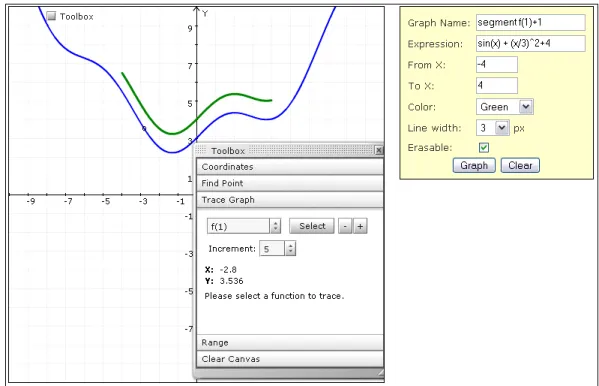
12 Plot Segments Feature . . . 48
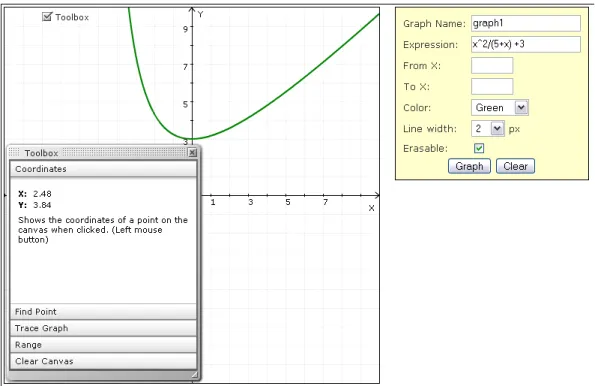
13 Show Coordinates Feature . . . 51
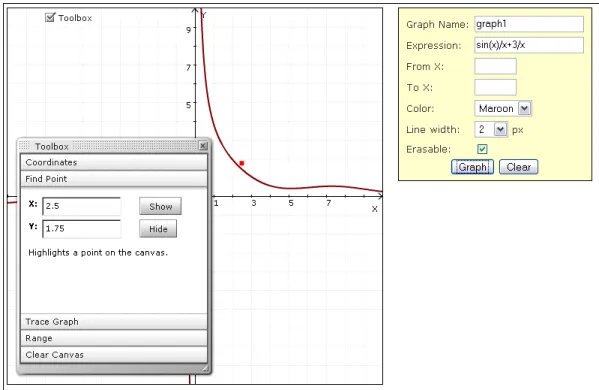
14 Find Point Feature . . . 52
15 Set Ranges Feature . . . 55
16 Screen-shot of Rendering In-lined Expressions . . . 56
17 Architecture Of Our Framework . . . 58
18 Communication Process for Parsing and Comparison of Algebraic Expressions . . 59
19 OpenLaszlo Architecture . . . 62
20 Abstract Diagram Illustrating Usage Of ExternalInterface . . . 63
21 Communication Process for Graphing Algebraic Expressions . . . 64
22 Communication Process for Rendering Algebraic Expressions . . . 66
23 Preview of Problem Statement . . . 68
24 Grapher Setup . . . 69
25 Perpendicular Line Demo Problem . . . 70
26 Perpendicular Line Problem Hint . . . 72
27 Biker Demo Problem . . . 75
28 Biker Demo Problem Hints . . . 76
29 Biker Demo Problem: Change Ranges . . . 77
30 Biker Demo Problem: Find Point . . . 78
31 Octagate Results . . . 82
32 Grapher Setup . . . 85
33 Screen-shot of the ASSISTments Grapher . . . 93
34 Enabling Shockwave in IE 6 . . . 94
35 Insert an Equation . . . 95
36 Displaying Your First Graph . . . 95
37 ASSISTments Grapher Interface . . . 96
38 Graph Name Insert Box . . . 96
39 Multiple Graphs on the Same Canvas . . . 97
40 Graph of First Degree Equation . . . 98
42 Preparing a Line Segment . . . 98
43 Drawing a Line Segment . . . 99
44 Graphing with Colors . . . 99
45 Different Stroke Sizes . . . 100
46 Using the Erasable Check Box . . . 101
47 Displaying Toolbox . . . 101
48 Displaying Toolbox from The Check Box . . . 102
49 Toolbox Can Only Be Displayed On The Canvas . . . 102
50 How to Resize the Toolbox . . . 103
51 Resizing the Toolbox . . . 103
52 Display a Coordinate . . . 104
53 Display a Different Coordinate . . . 104
54 Find Point Tab . . . 105
55 Find Point Tab Widgets . . . 105
56 Finding a Point on a Graph . . . 106
57 Trace a Graph . . . 107
58 Prepare for Tracing . . . 107
59 Tracing Steps 1-4 . . . 108
60 Tracing Steps 5-6 . . . 108
61 The Range Tab . . . 109
62 Zoom Into A Location of the Canvas . . . 109
63 The Clear Canvas Tab . . . 110
64 Clear a Graph . . . 110
65 Trigonometric Warm Up . . . 110
66 Drawing a Sine Curve . . . 111
67 Exploring the Sine Curve . . . 111
List of Tables
1 Ruby Source Code: compare degrees . . . 30
2 Input Grammar For Parser . . . 34
3 Class Representations for Algebraic Terms . . . 34
4 Class Representations for Numeric Values . . . 35
5 Ruby Source Code: collapse multiparens . . . 36
6 Single Expression Normal Form Grammar . . . 37
1
Introduction
1.1
Intelligent Tutoring Systems
In recent years computers have become increasingly common and powerful, and the tasks assigned to software programs have grown in number and complexity. They are used to automate paper-work and record keeping, to perform difficult calculations and simulate environments for research purposes, and to build and play games of impressive number and variety. It was thus inevitable that computers would make their appearance on the education front. Educational programs and games were designed and built to help teach young children and adults alike.
Beginning in the early 1970s, a challenging and innovative new form of computer-based in-struction was being developed. Researchers hoped to create a system that would imitate a personal human tutor by “[engaging] the students in sustained reasoning activity and [interacting] with the student based on a deep understanding of the student’s behavior” [5].
The benefit that one-on-one tutoring can have on a student’s learning is impressive and widely acknowledged. Studies have shown that on average tutored students perform at two standard devi-ations above students taught in a normal classroom setting. This means that “the average tutored student was above 98% of the students in the control [normal classroom] class” [3]. Tutors guide students through problems and concepts, and can personalize their teaching style to suite each child’s individual needs. Children learn in different ways, at different paces, and require different degrees of guidance when learning new concepts. A tutor can learn a child’s style, and tailor his or her methods accordingly. He or she can provide immediate and appropriate feedback if a student is confused, so students’ errors and misunderstandings are corrected effectively and more quickly than is likely in a classroom setting where a teacher has twenty to thirty students to keep track of. Many schools strive to keep classroom sizes as small as possible in order to maximize the amount of individual attention a teacher can give to each student. Computers will never be able to replace the distinctly human touch of a tutor, but when built and used properly, an educational program
can prove to be a very helpful teaching tool. Such programs can provide assistance and guidance to clarify concepts learned in class, teach new information, build simulations to illustrate in-depth concepts, provide students with the individual feedback that is so helpful for the learning process but difficult to accomplish in today’s crowded classrooms, and even help teachers in such tasks as grading homework and assessing a class’ progress. Computers provide tools that can be used by students to help them learn, and by teachers to review concepts with their class or to free up some of their valuable time [4].
Initial research for such an “Intelligent Tutoring System” (ITS) centered around deploying and improving artificial intelligence (AI) algorithms. For example, the first such program, SCHOLAR [5], used a natural language dialogue structure to communicate with students. It was capable of both asking and answering questions, as a human tutor would be. However, the parsing and compre-hension of natural language proved to be a great enough obstacle that it deterred developers from the original goal of education. Unfortunately, the early ITSs were evaluated against AI quality standards and not by any measurement of their educational effectiveness.
However, since the 1990s, ITSs are once again becoming increasingly popular as researchers try to shift their focus to a point where systems are evaluated by their success in improving stu-dents’ performance [5], not by the quality of their AI logic. There have been several successful ITS projects recently. For example, the Pittsburgh Urban Math Project’s (PUMP) Algebra Tutor (PAT) [22] was developed by the Pittsburgh Advanced Cognitive Tutor Center at Carnegie Mel-lon University to help students learn to model real-life situations using algebraic representations. Its curriculum uses activities that draw on a student’s common sense in order to help him or her develop and understand “formal mathematical strategies.” PAT aims to help students succeed in algebra and see its relevance in the real world as well as the classroom. In an experiment that com-pared the performance of students using the PAT system on standardized tests to a comparison set of students not using it, classes using PAT scored about one standard deviation better on the exams that were the target of the curriculum, and “their scores were about 100% better than or double
those of the Comparison classes. The average performance of students who used the PAT system was significantly higher than the average performance of those who didn’t. These learning gains appear to occur at no expense to basic skills objectives of standardized tests. In fact, PUMP+PAT classes scored about 15% better on these tests” [23].
The Andes Physics tutoring system [36] is designed to take over the task of grading physics homework for a teacher, and replace the traditional tools of pencil and paper to help students work through the steps and calculations of a problem. It offers hints, including bottom-out-hints that tell the student exactly what to do, and provides instant feedback for everything the student enters. If a step is incorrect because of what is likely a typo or an oversight (e.g. forgetting an entry box) the system alerts the student. Otherwise correct answers turn green, and incorrect entries are colored red. The system uses this immediate feedback and many teaching hints to keep the student working in the right direction. Using this system to replace pencil-and-paper homework may lead to shallower thinking in some cases, as the instant feedback can encourage guessing, but it is ultimately beneficial, partly because students using the system tend to do more work. Pencil-and-paper homework is often assigned for practice but not collected or graded, and thus many students will skip the work. But assignments on the Andes system are automatically graded, and thus the student cannot skip without penalty.
The web-based intelligent tutoring system Study Island [18] has shown great success in prepar-ing elementary students for standardized tests. For the 2004-2005 school year, the percentage of schools in North Carolina using Study Island that met the Annual Yearly Progress (AYP) rose by 11.4%, while the percentage of public schools not using Study Island that met AYP decreased by 13.6% [19].
The ASSISTments [15] web-based intelligent tutoring system tutors eighth and tenth grade students on concepts needed for the mathematics portion of the Massachusetts Comprehensive Assessment System exam, and estimates the score they will likely achieve on the exam. The system combines assistance (for students) with assessment(for teachers)in one comprehensive program.
Figure 1: Screen-shot of the ASSISTments system.
1.2
The ASSISTments Project
Following the Education Reform Law of 1993, the Massachusetts Comprehensive Assessment System (MCAS) [29] was implemented. MCAS tests are administered in selected grades to all public school students in the Commonwealth, and are an important basis of accountability for schools and districts as well as students.
The ASSISTments system is an effective web-based intelligent tutoring system used in several schools throughout the Worcester and Boston areas to help prepare students for the math portion of the MCAS exams. In May of 2004, the ASSISTments system was being used by approximately 200 students “in three different schools from about 13 different classrooms” [31] and has grown significantly since then.
The mission of the ASSISTment system consists of three major goals: to provide tutoring content to students, to provide teachers with useful reports on students, and to provide teachers with the tools required for creating their own tutoring content [16].
1.2.1 Assistance in ASSISTments
While the class is using the system, each student is presented with a series of questions similar to those used on the MCAS exams. If the student answers the question correctly, he or she moves on to the next question. If the answer provided is incorrect, the student is presented with a series of simpler questions, called scaffolding questions, that break the problem down into simpler sub-problems, as seen in Figure 1 [31]. The student must complete these scaffolding questions in order to move on to the next question. They guide the student through a step-by-step process of solving a given problem, but ask him or her to perform each step and apply each rule him- or herself. This follows the example of many expert human tutors, who use hints and ask questions in an attempt to guide students and remind them of existing knowledge, but still make sure it is the students who actually do the work, go through the steps, and find a solution. As seen in Figure 2, once the scaffolding questions are triggered, the solution box in the original question is de-activated, and the student must work through all of the smaller steps. The student is thus prevented from rushing through or skipping difficult problems. These scaffolding questions aim to give the student a clearer and more complete understanding of the concepts used in the question; it forces the student to work through the entire problem (an example of “learning-by-doing”) and provides a detailed view of what the question requires, thus also revealing where the student went wrong the first time [32]. A series of hints is available to the student if he or she is having trouble, and the final hint provides the correct answer to the question, as shown in Figure 3 [38]. Thus, even if students use hints to find the solution, they are still guided through the entire problem. As a result, they can benefit from the problem even if they do not reach its conclusion on their own.
This method of teaching, where the tutor or tutoring system guides a student through a problem is called “coached practice”. In such a system, the student is engaged in solving a specific problem and the ITS guides the student to its solution. The coached practice method clearly follows the idea of “learning-by-doing”, which is a recognized model of cognitive skill acquisition. The student learns a topic by doing problems and working through them to a solution. Furthermore, the guided
Figure 2: Screen-shot of the ASSISTments system: forced scaffolding.
student will always reach the solution of a problem and the system will not quit or move on to another problem prior to receiving the appropriate answers. This has been proven to be beneficial even if the student does not actively participate in the process of finding the solution and the guide provides every step. The student is at the very least watching an example of the problem being solved properly, rather than immediately moving on to another question with no attempt to understand the current problem.
Furthermore, this approach overcomes the technical problems associated with using natural language dialogues. In non-dialogue based systems, the problem solving environment is usually an abstracted version of a real situation, where steps towards the solution can only be taken from a pre-defined set of actions, or where the problem’s domain has an underlying formalism that is easier to parse than natural language (e.g. algebraic expressions). There is no need to try understanding arbitrary questions from the student; the system only needs to be able to interpret answers. With a
student’s actions thus restricted, the system development can focus on maximizing its educational value and on providing appropriate feedback at any stage of the process. Even if the tutor fails to identify a student’s action, it can still provide support; the guide is aware of the problem’s solution and the developer can prepare stages that lead to the desired end result.
In 1993, V.J. Shute analyzed two variations on the feedback provided for students by tutoring environments. The first variation is called “Rule Application”, in which the tutoring environ-ment describes both the concept behind the question and the relationships between the variables used. The second variation is called “Rule Induction”, which consists of the tutor pointing out the relevant variables but requiring students to find the relationships between them [33]. The study suggested that the student’s learning style and knowledge level should be the main factors influ-encing the content of the ITS’s provided advice. The advice should be generated based upon what each student knows, and what information he or she needs to have to properly understand the con-cepts behind each question. This imitates the ability of a human tutor to provide hints and other guidance based upon what he or she knows of the student’s existing knowledge and learning style. However, the same graduated advice technique can also be accomplished by using different lev-els of advice without the need to model a student’s progress [4]. A proposed framework [4] for generating advice content, or hints, consists of four stages:
• a reminder of the problem solving goal,
• a description of the current problem state and the desired goal state,
• a description of the rule for moving from the current state to the desired state, • a description of the concrete action to take.
Questions in the ASSISTment system contain a series of hints which were developed following similar guidelines, and are available to the student at his or her request. The final hint provides the correct answer to the question, as shown in Figure 3 [38], thus ensuring the student’s awareness of the problem’s solution.
Figure 3: Screen-shot of the ASSISTments system providing hints.
1.2.2 Assessment in ASSISTments
The ASSISTments system is not just a tutoring system. It combines assistance, or tutoring, with assessment of the student’s performance. By tracking all of a student’s actions within the system (which questions were answered correctly on the first try, which required scaffold questions, when the student asked for hints, how long it took to answer a question, etc.), it can measures a student’s, or class’, understanding of each subject. Furthermore, the gathered data is used to estimate how well each will perform on the MCAS exam. All of this information is made available to the classes’ teachers who are thus able to track their students’ progress. The MCAS puts a great deal of pressure not only on the students but also on the state’s teachers and schools to produce high scores. Therefore, it is valuable to a teacher to be able to track his or her students’ progress. Measurements provided by the ASSISTments system can be used to determine what areas need more attention,
where a student is doing well, and where the class needs help. This sort of assessment can consume vital classroom time that could otherwise be spent furthering the student’s progress.
With the ASSISTments program, the teacher can spend less time evaluating his or her class [31]; the reports from the system will provide him or her with a thorough and accurate evaluation on each student and on the class as a whole. In addition, the students are learning while being assessed. This means that the time lost on evaluating students through exams is reduced, instead they are tu-tored while their progress and knowledge is being assessed. The ASSISTments system will record if a child gets an item wrong, but will also provide assistance and teach the child by guiding them to the correct solution. Students also receive immediate feedback this way, so that questions are an-swered while they are still paramount in the students’ consciousness. This has obvious advantages over the alternative of standard pen-and-paper evaluations where students do not receive feedback on the exam until it is graded and passed back. Teachers can spend less class time evaluating progress, while students can spend more time learning.
As with the actual MCAS tests, each ASSISTment, or question in the ASSISTments system, is designed to test the student’s understanding on a few basic concepts. Each ASSISTment involves at most three specific topics from a list produced by subject-matter experts. When a question is an-swered correctly, the probability of that student understanding all of these topics increases. When a student answers incorrectly, each scaffold question presented correlates to one of the specific top-ics tested in the original question, and the student’s predicted skills are adjusted accordingly [10]. This “dynamic assessment” allows the ASSISTments program, and thus the student’s teacher, to track each student’s skill levels, as well as which topics he or she needs help on, with much more accuracy, and also provides a better estimation of the student’s likely performance on the MCAS exams.
Therefore, an important tool of the ASSISTments system for teachers to quickly assess the progress of their students is the “Student Grade Book”. Through this tool, the system reveals information on each student’s performance to the teachers [31]. The picture in Figure 4 shows the
Figure 4: Screen-shot of the Student-Gradebook Interface
Student Grade Book interface. It provides the teacher with access to information like the “elapsed-time,” how long the student has spent using the system, the number of hints requested by a student, his or her predicted MCAS score based on how well he has done on ASSISTments thus far, and his or her “Performance Level” which indicates how his or her scores compare to the expected average. From this page teachers can also access a more detailed report on a single student, which will tell them how the student performed on individual questions (how long the student took, number of hints asked for, if the student answered correctly or incorrectly, if the question was the problem’s main question or a scaffold question, etc.). The Student Grade Book helps teachers observe and keep track of their students with extensive detail. They can not only easily see a student’s or class’s levels of skill or knowledge with as much, or more accuracy as a standard written assessment or exam would provide. But it can also determine if a student is using the system properly or, for example, is using the help button excessively.
By using the Student Grade Book tool provided by the ASSISTments system, teachers can, in part, replace the traditional ”paper-and-pencil” method of evaluating a student’s progress. The tra-ditional method for estimating a student’s preparedness for standardized exams such as the MCAS
Tests is to issue practice exams during class, then grade them and possibly review them in class. This method consumes a great deal of class time that could be more effectively used. The class is not really learning while they take the practice exams, and students who already understand the material will not benefit from reviewing it later. The ASSISTment system provides the same infor-mation as the written practice exams and offers further detail, and the teacher doesn’t have to do any grading. The students are learning topics that confuse them while they do the problems, and students with a complete grasp on a topic will not be forced to read hints and do scaffolding prob-lems, but can instead continue on to the next problem without unnecessary and redundant review that would only bore the student. Thus teachers and students both benefit from the ASSISTment system’s combination of assistance and assessment.
A major problem faced by Intelligent Tutoring Systems is off-task student behavior, where students systematically exploit the system behavior to advance through a curriculum without in-tellectual participation [38]. In the ASSISTments system, this means asking for hints on every question until the final “bottom-out” hint is reached, and then simply entering the correct answer without giving any actual thought to the problem. This off-task behavior is called “gaming”. To detect if a student is gaming, the ASSISTment team developed a set of machine-learned gaming-detection models which were able to identify this sort of behavior from a student with a certain accuracy. This was accomplished by recording students’ actions while using the system. The dataset generated by this observation had 1430 attributes and a boolean target attribute called ’gaming’ [38]. Using twelve different algorithms from the WEKA machine-learning system on the generated dataset, the team was able to create a decision tree model which can detect whether or not a student is gaming with a certain probablity. Figure 5 shows the WEKA interface.
The study revealed that on average, students who have less prior knowledge of the respective topic are more likely to game or cheat the system. This suggests that students are often reading all of the questions, and are more likely to “game” only if they do not have the required background knowledge for solving the problem. To prevent gaming, the system logs the number of requested
Figure 5: Screen-shot of the WEKA Interface
hints and the time spent on a particular problem. An analysis of this information could warn the teacher of that students are possibly gaming, allowing them to take action in attempt to prevent further gaming. In addition, a feature was added to the ASSISTments system that shows each student a record of their activities. Also, if students ask for too many consecutive hints and the system determines that they are likely to be gaming, an alert pops up that querying the student whether he or she requires the requested hint in an attempt to prevent the student simply contiously asking for hints. It was observed that students are less likely to game when they can see that the system is tracking their actions [38].
1.2.3 Architecture of ASSISTments
“In 2001, the ratio of students to instructional computers with Internet access in public schools was 5.4 to 1, an improvement from the 12.1 to 1 ratio in 1998,” [21] that indicates the increased Internet
availability for students. This means that more students and teachers will be able to use, and contribute to, educational programs and tutoring systems that are developed as web applications, such as the ASSISTments system, in order to facilitate accessibility and usage [35].
Because the ASSISTments system is a web application, it allows for much greater flexibility than traditional desktop ITS programs. Content can be added by teachers and researchers, not just highly experienced programmers. The system can be scaled up with relative ease to include more material and servers for better performance. Teachers have easier, more convenient and complete access via the “Portal” to the various aspects of the system. Researchers and programmers can extend the system and add functionality in a central place, without the need to deploy the changes to each client individually. In addition, its content can be incorporated into other systems with web access to reach a much broader audience [30].
Currently, the ASSISTments system is a web-based “install-free”application which means that accessing all of its functionality is possible from any machine with access to the Internet. This pro-vides for convenient usage and content creation for students and teachers [35], as they can utilize the system from any computer of their choice that is capable of connecting to the Internet. This also means that that students or teachers can use the system on a school’s network without needing to obtain any special access privileges that would be required to install programs on a school’s network given the basic setup of an Internet node. Also, because the system is “install-free”, net-work administrators at the schools using this system do not have the additional responsibility of continously upgrading the application. Moreover, building the ASSISTments system as a web application not only provided greater flexibility than desktop programs, but also offers more pro-tection against unforeseen technical or external complications. For example, if a school’s network crashes, or a computer at the school is stolen or destroyed, students’ records will remain intact on the ASSISTments team’s servers. This also facilitates the recovery process because it will not force network administrators to look through different backup versions of their records. Finally, if the system becomes so widely used that the load on the servers requires upgraded resources, the
Figure 6: Screen-shot of the ASSISTments Builder system can be enhanced centrally.
1.2.4 Content Creation in ASSISTments
Adding content to the system is a reasonably effortless process that does not require programming experience. Content developers, both teachers and researchers, are provided with the ASSISTment Builder, the intuitive interface of which is presented in Figure 6. The ASSISTment Builder pro-vides teachers with the means for constructing questions, or ASSISTments, which they can then add to a “curriculum” and assign to the students in their class. It contains the interface needed to build a tree of scaffolding questions, branching from a main question and dependent upon the user’s input [31]. Each of the scaffolding questions could in turn contain further branches of scaffold-ing questions and hints, and each could have different widgets for processscaffold-ing the student’s input, such as radio-buttons, pull-down menus, check-boxes and text-fields. For developers to verify that their content is being constructed correctly, the Builder also provides users with a ”live preview” which is updated whenever the content of the ASSISTment is modified. This feature allows the
author to see how the ASSISTment will appear to a student using the system and working through a problem. The first scaffolding question is triggered automatically when a user answers the initial question incorrectly or when when a user presses the ”Hint” button.
To test the efficiency of the ASSISTment Builder a different system was built to log the actions of the authors. The data obtained by the system suggests that the average time needed to build an entirely new ASSISTment, not including time spent planning the question and creating any necessary graphics before entering the builder, is approximately 25 minutes [31]. With the use of the ASSISTment Builder, content can be added simultaneously by several teachers and researchers, from various locations, provided they all have an Internet connection. Thus the Builder enables intuitive and rapid content development, allowing the system to grow as needed.
The ASSISTment system also provides teachers and researchers with easy access to a broad range of features via the “Portal.” The Portal grants access to various capabilities of the system like online reports, and administration and authoring tools [9]. For example, teachers have the option of creating a report based on several criteria. A screen-shot displaying this process is shown in Figure 7. In it we see that teachers can choose a specific class or student for which to generate a report. Moreover, they can select a time period for the report and various sorting methods for displaying its content.
Figure 7: Screen-shot of the Report Criteria
2
Problems to Solve
Currently, the ASSISTments system’s support for dealing with algebra is minimal. Expressions cannot be evaluated for algebraic equality, making it difficult to fairly judge a student’s input, and nearly impossible to provide specialized and useful feedback on it. Student text input currently is evaluated via simple string comparison. This leads most content developers to make any prob-lems that require an answer more complicated than a simple number be a multiple-choice question. While this is true to the style of MCAS exams, it means that students can often derive their answer (at least in part) from the options provided, rather than entirely working it out from the information in the question. This speaks to the student’s cleverness, but defeats the system’s goal of assessing his or her understanding of the topics. The system needs a way to evaluate and compare alge-braic expressions based upon their mathematical value, not just the string’s ASCII content. If the system had a way to parse strings and determine their simplified value, it would be able to show more flexibility when dealing with students’ input (i.e. 3x+3x is mathematically equivalent to 6x, but a string comparator will not recognize this and could unjustly conclude that the student was incorrect). In the picture below we show a similar situation that clearly illustrates the need for
Figure 8: Screen-shot Showing the Need for an Algebraic Parser
evaluating and comparing algebraic expression based on their value instead of their ASCII repre-sentation. In Figure 8, we can see that even though the student entered the correct solution for the problem, the system evaluated the result as “incorrect” because it cannot “understand” the input. Such errors could lead to an inaccurate evaluation of a student’s progress and thus send the teacher in the wrong direction when it comes to class time allocation. The ASSISTments system needs a tool to parse and compare algebraic expressions in order to maximize its educational potential and to ensure that students and teachers are receiving accurate feedback and results.
A problem inherent to comparison of ASCII strings is the fact that there are no common stan-dards about the usage of white-spaces. Consider the following strings that represent intuitively equivalent statements, namely the value of the variable x: “x = 1.25” and “x=1.25”. Clearly, these two strings are not equal when compared. However, we might use regular expressions or similar techniques to ignore the use of white-spaces. Another possible cause for misinterpreting expressions is illustrated in the following situation: x = 1 1/4. Most students and educators would quickly recognize this statement as being equivalent to the two previous ones, but no or-dinary string comparison would. While white-spaces seem to be a simple obstacle when parsing algebraic expressions, both the nature of algebra and the various possible interpretations of ASCII representations provide for endless ways of writing similar expressions. Consider the following four strings that a student might enter:
1. 2x = 3 2. 2∗x = 3
3. x + x = 3
4. x = 3/2, x = 1 1/2, x = 1.5
Clearly the first three equations are equivalent. Only (4) is slightly different, in that it contains the result of simplifying the previous equations to identify the numeric value of x. These examples illustrate a further requirement for improving the tutoring capabilities of the current ASSISTments system: manipulation of algebraic expression according to the associative, commutative, and dis-tributive laws.
Also, the current ASSISTments system shows input simply as plain text, not as in the intu-itive format they would take if the student were to write them, or as they would appear in a math textbook. It is up to the student to convert a formula between proper equation appearance and the ASCII string required by the system. Enhancing the system with the ability to display formulas and equations as the student would write them on paper (i.e. with exponents indicated via super-script instead of carrots, and fraction denominators being displayed actually under the numerators), would not only be more aesthetically pleasing, but would also aid the student’s progress, i.e. by making it easier to determine if he or she has entered the formula as intended. Visualization is an important learning tool, and equation formatting is a part of that. “Representing functions in multiple ways is critical in student understanding of functions and success in mathematics” [7].
A vital part of learning algebra is understanding graphs. In academia, graphs have become an indispensable tool for helping students to better understand the relationship between two functions or curves, by offering them a visual representation of a function. Graphs are also indispensable for students when exploring the mathematical patterns of first, second and third degree equations. Unfortunately, graphing mathematical expressions can be a difficult skill to acquire especially when teachers are forced to allocate class time to help students become comfortable with various graphing tools. Pilot studies with PAT revealed an unexpected difficulty in graphing; it emerged
that students did not have good heuristics for setting the axes’ scales and bounds dependent on the size of the values being plotted in each problem [4]. Students must learn to graph formulas, read graphs, and estimate the formula for a line or curve based upon how it is graphed.
Despite the importance of these skills, the ASSISTments system lacks sufficient support for graph-related ASSISTments. If a content developer wishes to refer to a graph within a question, he or she must include an image by uploading it. The system provides no feature for helping the developer build this graph. He or she must create the graph in an external program, save the image, and load it into the system while building the ASSISTment. Thus a developer’s ability to include graphs is dependent upon his or her having access to, and knowing how to use, an external program capable of producing the graph he or she needs. This is undoubtedly a time-consuming and tiresome process. Including graphs in ASSISTments would be significantly more efficient and desirable from the content creator’s end if the system provided an internal feature to assist in the creation of these images. Even when developers do include images in their questions, there is no way for a student to manipulate or interact with a graph. The abilities to graphically visualize a formula, and manipulate or interact with a graph, could be powerful educational tools. However, the current ASSISTments system has no sufficient support for such features. Extending the algebraic capabilities of the ASSISTments system by allowing questions to include well-drawn, interactive graphs that students can manipulate and use to draw their own graphs could have a major positive impact on the educational value of the student’s experience with the system.
Analysis & Test Cases Initial Planning Requirements Prototyping Implementation Testing Evaluation Release
Figure 9: Development Process
3
Methodology
The three main objectives of our development were the following: 1. Parsing and comparison of algebraic expressions
2. Graphing of algebraic expressions 3. Rendering of algebraic expressions
Before approaching these main goals of our project, our team agreed on a development process, which is discussed below.
Our development style generally followed the Test-Driven Model for software development, which required us to develop test cases before writing actual code. Our main reason for choosing this style of software development was the short time frame for our project. The Test-Driven development model allowed us to ensure that all code written served and worked properly. We believe that the design of our implementation is mainly based on the feature requirements and that the chosen development process allowed us to cut down possible coding overhead caused by implementation of unnecessary features. On the other hand, the design is Object-Oriented, making it extensible and modular.
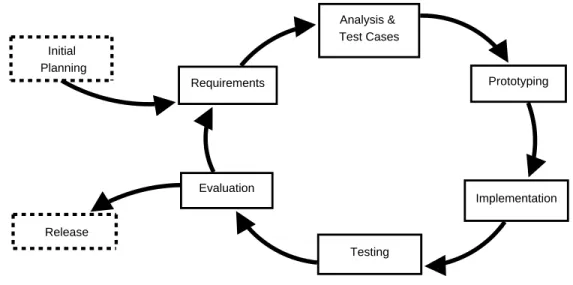
Our development process consisted of eight phases. Figure 9 shows an abstracted diagram of this process. In the remainder of this section we will explain each stage of our development process in detail. Our development process was iterative and circular at the same time. We first approached subproblems of our main objectives and followed a common procedure that is represented by the circular section of the diagram for solving the problem.
The first step of the process, the “Initial Planning”, represents the Pre-Qualifying Project phase of our project which preceded our work in Budapest. In this stage, we conducted preliminary research on ITS systems and agreed on the general project methodology. Also during this step, we also wrote an initial project proposal and created our first prototypes to test possible tools. This part of the development process ensured that all team members understood the requirements of the project and agreed with the choice of tools. With our background research and our project proposal completed, we were able to move to the second step of our development process, the “Requirements.”
A major part of our Requirements phase consisted of identifying the features that our system should support and figuring out under what constraints they would have to operate. This phase also helped us ensure that our team was well synchronized and that dependencies between features were handled correctly. By analyzing the the main requirements and identifying what subproblem they consisted of we created our own set of requirements that helped us accomplish the main goals of the project. We were thus able to assign tasks to different team members so that each of us could work individually, increasing the efficiency and synchronization of our team.
The next step of our development process, “Analysis and Test Cases”, consisted of confirm-ing that the requirements built in the previous stage were helpful for accomplishconfirm-ing the main re-quirements of the project. Additionally, we created test cases that identified our rere-quirements for features. The test cases were designed to target specific features.
The “Prototyping” step of our development process was aimed at illustrating whether our choice for tools was appropriate and was sufficient for implementing the previously identified
requirements. The use of prototypes in our project enforced an incremental software development approach. To facilitate the release of our prototypes and gather feedback, we created a website where we posted our prototypes, making them accessible to others. These frequent updates and releases enabled us to constantly verify the status of our project.
The “Implementation” stage centered around the realization of chosen feature requirements. In this phase we also used pair-programming in order to ensure the quality of our code and similarly maintain a common level of understanding of the code base. The new features were then verified in the “Testing” phase.
During the Testing phase we ran our implementations against the previously designed test cases. Additionally, we looked for potential integration problems that could hinder the incorpo-ration of our system into the current ASSISTments system. To ensure the compatibility of our implementation with the current tutoring system, we used a Ruby on Rails [14] server to test our server-side applications not only locally but also on a different setup that was in use by the AS-SISTments system’s team. The testing phase served as the preparation for the “Evaluation” phase. To enable remote evaluation of our software we made use of our website by providing pro-totypes online. We also used web-conferencing tools such as Skype and WebDialog’s Unyte to communicate with Professor Heffernan who was at WPI while we worked at Sztaki in Budapest. This step was usually performed once a week and its main purpose was to gather feedback on the current status of our project. Once a prototype made it to the Evaluation phase, we made sure that it had complete and comprehensive documentation and that it could easily be integrated into the ASSISTments system.
3.1
Parsing and Comparison of Algebraic Expressions
The first objective of our project was to remedy a major lack of functionality in the current AS-SISTments system: comparison of student answers and teachers’ solutions based on their algebraic equality instead of their string equality. Adding the capability of comparing algebraic expressions
has obvious advantages and leads to improved tutoring abilities of the system. It also provides for a more convenient problem creation process, as a teacher need not try to anticipate what possible answers a student might submit but can simply rely on the system to recognize equality. This renders the requirement of anticipating multiple solution strings unneccessary.
3.1.1 Analysis of Requirements
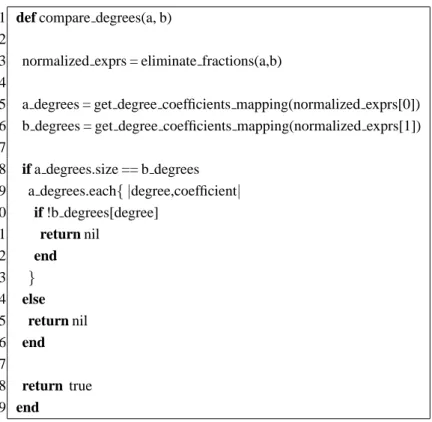
In addition to fulfilling the main objective, we decided to provide an extensible framework that one could use to implement functionality for transforming or comparing algebraic expressions for custom needs. To this end, we decomposed the functionality of our product into modular functions that can be reused by any application that supports calls to Ruby methods. For example, in a tutor-ing environment the need for appropriate feedback is obvious. For this one might require enhanced features for the analysis of a possibly wrong answer in order to offer the student helpful advice. Our system allows not only the use of the equality testing functionality, but can also be extended to compare expressions based on other factors, such as the occurrences of terms with equal degrees. This type of comparison might help to indicate that a student misunderstood the use of a coefficient and the tutor could provide fitting feedback to the wrong answer, therewith improving the student’s experience with the system. An implementation of a function that compares expressions based on their degrees is part of our framework and can be taken as an example for extending the original requirements to our system. One can observer that adding such functionality is relatively effortless from the function’s implementation (Table 1).
In order to properly fulfill the requirements for features involved in comparing algebraic ex-pressions for equality, we determined three main steps to take for processing the ASCII represen-tations of an answer and solution expression. These were used for making design decisions for our implementation, and can be summarized as follows:
1. Parsing of algebraic expressions
1 def compare degrees(a, b) 2
3 normalized exprs = eliminate fractions(a,b) 4
5 a degrees = get degree coefficients mapping(normalized exprs[0]) 6 b degrees = get degree coefficients mapping(normalized exprs[1]) 7 8 if a degrees.size == b degrees 9 a degrees.each{ |degree,coefficient| 10 if !b degrees[degree] 11 return nil 12 end 13 } 14 else 15 return nil 16 end 17 18 return true 19 end
Table 1: Ruby Source Code: compare degrees 3. Comparison of two expressions based on their normal forms
We decided to approach these three phases as a whole, but iteratively. This means that we advanced by completing prototypes that would support a limited input grammar, but would be able to parse, transform and compare a supported expression appropriately. After running our previously devised test-suite and making sure that the process was implemented correctly, we planned on extending the input grammar and devised appropriate test cases. After deciding upon the next extension to the accepted input, we planned the required changes to the system. After implementing this additional support, we ran the new set of test cases we had designed when planning the extension, as well as the test-suite from the previous stage in order to fully ensure the correctness of our additions.
We used a set of context-free grammars to define the set of algebraic expressions that our parser supports as input. Similarly, we also defined the normal form that would be the basis for
compar-ison of algebraic expressions as a context-free grammar. Using well-defined grammars to define the capabilities of our framework helped us to write test cases before implementing functionality, following the test-driven software development paradigm. More importantly however, grammars allow for a universal definition of required input and output and therewith provide for reusability to individual features of our framework.
3.1.2 Brief Discussion of Context-Free Grammars
We chose a formal grammar for documentation purposes, in order to clearly define the required input to our framework’s tools and document their output for future reuse. The structure of an algebraic expression lead us to use a context-free grammar, a well understood tool for defining a set of strings that are accepted or produced by an application. A formal context-free grammar G is commonly denoted as a four-tuple, G=hVn,Vt,S,Pi, where:
• Vnis a finite set of non-terminal symbols,
• Vt is a finite set of terminal symbols,
• S∈Vnis a unique start symbol ,
• P is a finite set of production rules,
such that every p ∈ P is of the form N →w where N ∈ Vn and w=a0a1a2. . .ai for 0≤i
and aj ∈ Vn∪Vt for 0≤ j≤i. Furthermore, the language of the grammar,
L
=L
(G) is theset of strings that can be derived from S by applying rules in P such that for all α∈
L
we have α=b0b1b2. . .bkfor 0≤k and bm∈Vt for 0≤m≤k. We chose to denote the respective grammarsby listing the production rules in P.
Context-free grammars (CFGs) are “Type-2” grammars within the Chomsky containment hi-erarchy for formal grammars and their respective languages. This means the languages that can
be expressed by context-free grammars are equivalent to those that can be recognized by non-deterministic pushdown automata. A non-non-deterministic pushdown automata, or NDPA, has a stack for storing a potentially infinite amount of information in a last-in-first-out fashion. At each step a NDPA pops a symbol off the stack and can push a symbols onto the stack, read the next symbol in the input string, and change state. CFG languages are contained in the set of languages that are produced by “Type-1” (equivalent to the languages expressible by context-sensitive grammars) and “Type-0” grammars (equivalent in expressibility to unrestricted grammars). The set of languages that can be derived from regular grammars (“Type-3”) is contained within the set of languages that are expressible through context-free grammars.
Context-free grammars provide a formal technique to clearly define the requirements for the input to our framework as well as the output, the normalized form of an expression. More specif-ically, the language of the given context-free grammar is precisely the set of input or output ex-pressions that are taken in or produced by our framework. The set of terminals consists of the supported variable string, algebraic operations and representations of numerical values.
Using a context-free grammar improves our system’s expand-ability, as it is widely understood by computer scientists and, and is a common and accepted way to document the capabilities of a parsing application. Furthermore, it is worth noting that as context-free grammars are an estab-lished tool in the field of computer science, there exists a variety of optimized tools that use them. For example, tools called parser generators have been created that can be used to produce a parser from a given context-free grammar. For example, the application “Coco/R(uby)” generates “LL” parsers in Ruby. The “LL” denotes a top-down parser that proceeds from the left to the right end of the string (similar to the parser that is a part of our implementation), constructing what is called the “left-most” derivation of the given word. One produces a left-most derivation by continuously replacing the non-terminal that is closest to the left end of the string until only terminals remain. The existence and popularity of these applications further emphasizes the usefulness of employing such formal tools to describe our system’s capabilities.
3.1.3 Analysis of Implementation
Before implementing the parser that would process the ASCII representation of an algebraic ex-pression, we devised the grammar for the desired input. As mentioned in the previous section, we approached the problem by iteratively adding to the supported grammar; the grammar that the cur-rent implementation supports can be found in Table 2. The grammar contains the basic algebraic operations of addition, subtraction, multiplication and division. Furthermore, we included support for exponentiation where the exponents are limited to non-negative integers, and for grouping ex-pressions by a set of parentheses. The supported exex-pressions are limited to one variable (according to the grammar in Table [?] this variable is called x, however, the implementation is modular and allows for choosing a custom string for the used variable). The parser supports three main numer-ical formats: integers, decimal numbers and improper fractions. Additionally, the parser ignores white-spaces by removing them from the input string, except for the use of improper fractions, which are delimited for internal recognition. Furthermore, we process the string before the parsing starts in order to insert missing multiplication operators. This allows for the ASCII representation to be more intuitive to the student and eliminates a possible source of confusion. For example, the following string contains terms that are commonly recognized as products and also supported by our parser: “(23x−3x3)(−x)”
Our implementation of the parser proceeds by pattern matching for algebraic terms in the given string recursively in order of algebraic precedence. This means that the string is processed sim-ilarly to a possible production using the given “Input Grammar”in Table 2. For example, the expression 3x+x2is first split into the summands 3x and x2. Then the first summand is split into the multiplicands 3 and x while the second is identified as base and exponent and split up accord-ingly. Following this procedure, the parser pattern matches a string until it identifies a “leaf” (or terminal), in our case either a numerical value or the used variable.
After defining the desired input grammar, we designed the elements required for its internal representation. We decided to use an object-based tree that would facilitate a convenient traversal
hExpi→+hSndihExpi|-hSndihExpi|+hSndi|-hSndi|hSndi hSndi→*hMultihSndi|hMultihSndi|hMulti
hMulti→hBaseiˆhInti|hMultiˆhInti|hBasei
hBasei→x|(hExpi)|hNumerici|hInti hNumericihNumerici hNumerici→hInti|hInti.hInti|.hInti
hInti→hIntihInti|1|2|3|4|5|6|7|8|9|0
Table 2: Input Grammar For Parser
and transformation of the expression tree produced. Therefore, the created structure is an object-based tree, where there is an internally defined class for each operation, the variable or numerical values. This allows for immediate and clear identification of the nodes, and also isolates the func-tionality that applies to certain operations by containing it inside the class definition. Therefore, our internal representation reflects the mathematical structure of the expression, grouping nodes by their corresponding algebraic operations or isolating them as the number or variable that they represent. The names of the current set of class definitions with their corresponding algebraic equivalent terms are listed in Table 3. Additionally, Table 4 contains the set of class names for rep-resenting numerical values. The API for our implementation, which can be found on the project’s website [12], contains a comprehensive documentation of the classes and their member methods.
Internal Object Name Algebraic Term
SummandNode Sum
MultiplicantNode Product
FractionNode Divisor
ParenNode Expression grouped by parentheses
NegatedNode Negation of an expression
ExpNode Exponentiation
NumericNode Numeric values
VarLeaf The variable
Class Name Numerical Type
IntLeaf Integer
FloatLeaf Decimal Number
NumericFractionLeaf Rational Number
TripleFractionLeaf Improper Fractions Table 4: Class Representations for Numeric Values
For each iteration of pattern matching, after the parser identifies an operation or terminal ex-pression (number or variable), it instantiates and populates a class representing the identified term. Thus, the expression tree is generated recursively, according to the precedence of the algebraic op-erations. The corresponding tree is intuitive with respect to the algebraic expression and therewith should be reasonably integrable and adaptable to custom requirements for the tree’s nodes’ pur-pose. Figure 10 shows the object tree that the parser would generate for the algebraic expression “x5−(2x+23)/x”. SummandNode hhh hhhhhh h ( ( ( ( ( ( ( ( ( ( ExpNode H HH © © © VarLeaf x IntLeaf 5 NegatedNode MultiplicantNode XX XXX X » » » » » » SummandNode P P PP ³ ³ ³ ³ MultiplicantNode H HH © © © IntLeaf 2 VarLeaf x IntLeaf 23 FractionNode H HH © © © IntLeaf 1 VarLeaf x
Figure 10: Parse Expression Tree
By arranging the nodes in order of precedence and grouping them by operations such as ad-dition and multiplication, we achieve an expression tree that facilitates manipulation according to algebraic laws. The structure is advantageous when compared to other representations such
as a binary tree structure that at first glance seem reasonable considering that the subset of alge-braic expression supported by our framework contains only unary and binary algealge-braic operations. Grouping terms of the same level of precedence in the algebraic hierarchy considerably simplifies the traversal of tree and transformation to the desired normal form.
Our framework provides methods that allow for a depth-first traversal of the object tree, visiting only desired nodes and modifying them based on given predicates. These functions provide easy extensibility of our framework’s capabilities. For example, eliminating redundant grouping of parentheses (i.e. “((2∗x))”) in the expression tree can be achieved via this feature. The internal solution is given in Table 5. The API provided with the implementation of our framework provides an extensive explanation of the methods used.
1 def collapse multiparens(node) 2
3 p = Proc.new{ |paren node|
4 if paren node.child.class == ParenNode 5 paren node.child 6 else 7 paren node 8 end 9 } 10
11 return tree walker(node,ParenNode,p) 12 end
Table 5: Ruby Source Code: collapse multiparens
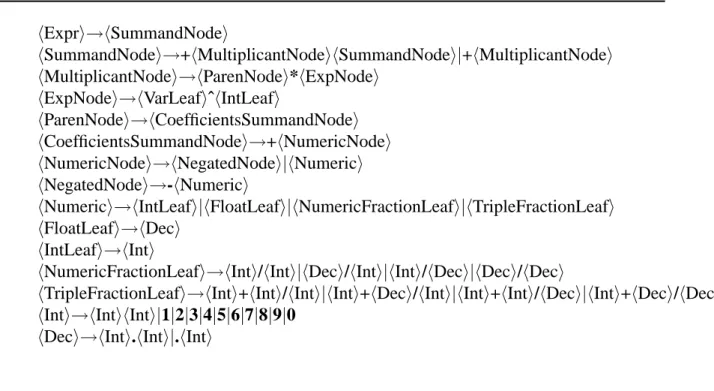
After the expression was successfully parsed and the internal object-tree representing the al-gebraic terms is constructed, the tree is transformed to conform the “Single Expression Normal Form” that is given in Table 6. The underlying principle of this normal form is the grouping of terms by their polynomial degree. This facilitates the comparison process, as it allows terms to be compared according to their degrees and the corresponding coefficients. However, the coefficients possibly contain divisors (FractionNode) that also contain polynomial expressions. Each of the
FractionNodes (their denominator) is reduced into the single expression normal form in order to facilitate later transformation into the normal form that is used to test two expressions for equality.
hExpri→hSummandNodei
hSummandNodei→+hMultiplicantNodeihSummandNodei|+hMultiplicantNodei hMultiplicantNodei→hParenNodei*hExpNodei
hExpNodei→hVarLeafiˆhIntLeafi
hParenNodei→hCoefficientsSummandNodei
hCoefficientsSummandNodei→+hNumericNodei|+hCoefficientMultiplicantNodei hCoefficientMultiplicantNodei→hNumericNodei*hFractionNodei
hFractionNodei→1/hExpri
hNumericNodei→hNegatedNodei|hNumerici hNegatedNodei→-hNumerici
hNumerici→hIntLeafi|hFloatLeafi|hNumericFractionLeafi|hTripleFractionLeafi hFloatLeafi→hDeci
hIntLeafi→hInti
hNumericFractionLeafi→hInti/hInti|hDeci/hInti|hInti/hDeci|hDeci/hDeci
hTripleFractionLeafi→hInti+hInti/hInti|hInti+hDeci/hInti|hInti+hInti/hDeci|hInti+hDeci/hDeci hInti→hIntihInti|1|2|3|4|5|6|7|8|9|0
hDeci→hInti.hInti|.hInti
Table 6: Single Expression Normal Form Grammar
For the manipulation process, our framework contains a collection of methods that implement singular operations on the expression tree. This follows the practice of decomposing functionality into modules, isolating responsibility for certain operations. This isolation reduces the impact of changes to these modules and therewith lowers the framework’s vulnerability to modifications. Furthermore, it also allows for the partial reuse of our functionality when extending our framework. The main steps of the transformation process can be summarized in the following list of operations:
1. Eliminating exponentiation with base other than the variable “x” by expanding to a product or collapsing in case of a numeric base.
2. Eliminate parentheses from expression according via the algebraic distributive law. 3. Transform negation into product, if negated expression is not numerical.
4. Combine multiple divisors in one product, by substituting them with a divisor that consists of their product.
5. Group terms by polynomial degree
6. Combine numerical coefficients of all terms
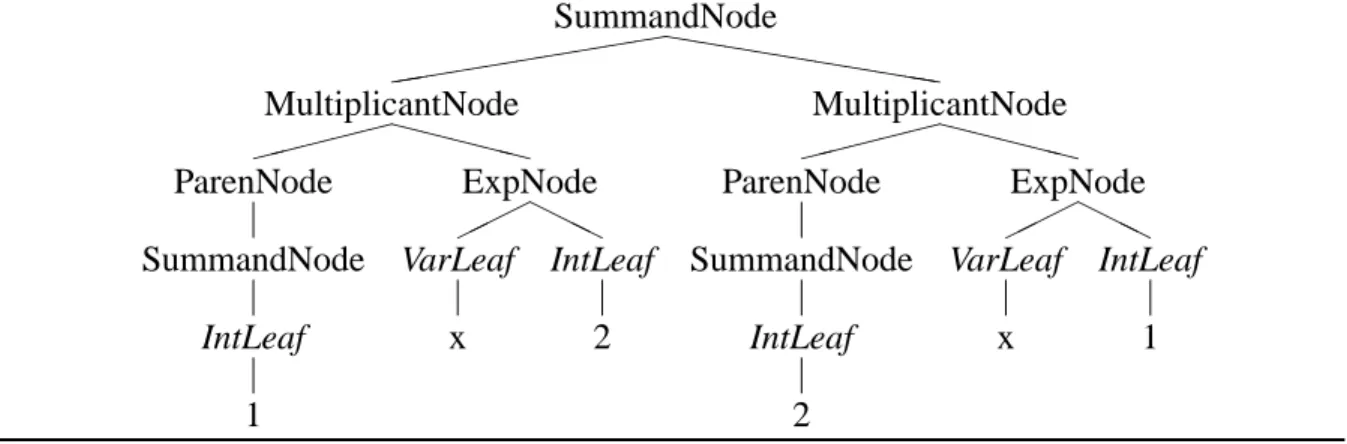
It is worth noting that the implemented operations aim to maintain the form closest to the normal form when manipulating an expression, for example when expanding expressions that are grouped by parentheses. This means, for example, that at no point would an operation add an exponentiation with a base other than a variable (VarLeaf) after the corresponding “expanding” operation has been performed. For this reason, the framework distinguishes between parsed ex-pressions and already processed exex-pressions. This means that transforming a parsed expression into a normal form is more expensive than transforming already processed expressions. This as-sumption is formalized in the API by the requirement that the input has been passed through a subset of operations. The framework’s implementation “protects” such assumptions by condition-als which raise anAssertionErrorthat is specific to our framework if they are violated. Figure 11 illustrates an example for the single expression normal form of the expression “(x+1)2−1” as the framework would produce it. The normal form can be seen as a sum of products, where the products contain as one multiplicand the variable exponentiated to the degree of the term, and the other multiplicand the sum of coefficients of the polynomial term.
However, the single expression normal form is inappropriate for the comparison of two ex-pressions. In order to support the correct comparison of polynomial fractions, the expressions are considered as a pair and their fractions are eliminated by multiplication. This means that each side is multiplied with the greatest common denominator of the other side until all fractions have been
SummandNode hhhhhh hhhh ( ( ( ( ( ( ( ( ( ( MultiplicantNode XX XXX » » » » » ParenNode SummandNode IntLeaf 1 ExpNode H HH © © © VarLeaf x IntLeaf 2 MultiplicantNode XX XXX » » » » » ParenNode SummandNode IntLeaf 2 ExpNode H HH © © © VarLeaf x IntLeaf 1
Figure 11: Normalized Expression Tree
eliminated. The greatest common denominator is simply the product of the fractions that occur as coefficients. It is worth noting that the polynomial expression’s degree, and possibly the num-ber of summands, will increase after this procedure, as only non-numeric divisors will remain as a FractionNodein the single expression normal form. This might lead to expensive operations when a divisor contains a considerable amount of summands. After the fractions are cancelled out, both expressions conform to the “Comparison Normal Form” given in Table 7. The two expres-sions can now be compared based on the degrees of the occurring terms and their corresponding numerical coefficients.
3.1.4 The Solution’s Design
The nature of the programming language used, Ruby, allowed us to take advantage of both object oriented and functional programming styles. We decided to use an object-based structure to rep-resent the expression tree, because the reprep-resentation is subject to frequent changes and traversals. By using classes to represent operations as part of the structure, we can isolate the specific node functionality in a class definition. Using objects to represent algebraic operations allows us to im-plement functionality specific to a certain operation in an isolated location and similarly facilitates the identification of an algebraic operation while traversing the expression tree.
hExpri→hSummandNodei
hSummandNodei→+hMultiplicantNodeihSummandNodei|+hMultiplicantNodei hMultiplicantNodei→hParenNodei*hExpNodei
hExpNodei→hVarLeafiˆhIntLeafi
hParenNodei→hCoefficientsSummandNodei hCoefficientsSummandNodei→+hNumericNodei hNumericNodei→hNegatedNodei|hNumerici hNegatedNodei→-hNumerici
hNumerici→hIntLeafi|hFloatLeafi|hNumericFractionLeafi|hTripleFractionLeafi hFloatLeafi→hDeci
hIntLeafi→hInti
hNumericFractionLeafi→hInti/hInti|hDeci/hInti|hInti/hDeci|hDeci/hDeci
hTripleFractionLeafi→hInti+hInti/hInti|hInti+hDeci/hInti|hInti+hInti/hDeci|hInti+hDeci/hDeci hInti→hIntihInti|1|2|3|4|5|6|7|8|9|0
hDeci→hInti.hInti|.hInti
Table 7: Comparison Normal Form Grammar
Furthermore, our implementation follows commonly accepted coding practices such as “De-sign Patterns” to improve modularity and extensibility. For example, the “Factory Pattern” was used to hide the internal representation of numerical values. This is achieved by a common inter-face to a numeric value object and a central “factory” that returns the correct object for a given numeric input. This allows us to support a variety of numerical notations (i.e. integers, decimals, triple fractions, rationals, etc) and change their internal representation without impact on the other parts of the framework.
The operations that are performed on the expression tree in order to transform it, were decom-posed into individual functions in order to be able to use them in custom order and reuse them from other Ruby compliant code. Therewith we tried to facilitate the use of our functionality in the future version of the ASSISTments system, which will be based on the Ruby on Rails framework. Furthermore, to improve the integrability of our framework, the provided methods and class
defi-nitions are well documented in the framework’s API. The API is available online, on the project’s website. It was produced with the commonly used RDoc [34] tool that produces documentation based on comments in the source code in HTML format.
3.2
Graph an Algebraic Expression
3.2.1 Analysis of RequirementsOur project’s second objective was to build a grapher that could be incorporated into the ASSIST-ments system. The grapher would allow content developers to include graphs in their questions without needing to create and save images using some external program and then load them into the ASSISTments system. The system would have an internal feature that allows developers to generate and customize a graph for inclusion in a question. This would save a great deal of time and effort for the developers, and in many cases speed up the process of generating ASSISTments by eliminating the need for an outside tool. The grapher would not just be a tool for the devel-opers, however. It would be a powerful interactive tool for students as well. If an ASSISTment includes a grapher, the student will be able to use it to graph his or her own functions and to gain detailed information about all the lines plotted on the grapher. With this feature the ASSISTments system will be able to offer students a much more powerful and educationally valuable tool than the stand