Physical Activity in Youth Dance
Classes
Kelli L. Cain, MAa,b, Kavita A. Gavand, MSb, Terry L. Conway, PhDb,c, Emma Peck, BAa, Nicole L. Bracy, PhDa,b, Edith Bonilla, BAa,b, Patricia Rincon, MFAd, James F. Sallis, PhDa,b
abstract
BACKGROUND AND OBJECTIVES:The majority of youth are not meeting the US Department of Healthand Human Services physical activity guidelines. Dance is a popular activity, particularly for girls, and has the potential to increase physical activity for many youth. This study investigated physical activity of children and adolescents in 7 dance types: ballet, hip-hop, jazz,
Latin-flamenco, Latin-salsa/ballet folklorico, partnered, and tap.
METHODS:Data were collected in 17 private studios and 4 community centers in San Diego, California. A total of 264 girls from 66 classes participated (n=154 children;n= 110 adolescents). Physical activity was measured with accelerometers, and activity levels during class were calculated.
RESULTS:Participants recorded an average of 17.26 8.9 minutes of moderate-to-vigorous
physical activity (36% of class), but this varied by age and dance type. For children, dance type differences were observed with percent of class in moderate-to-vigorous physical activity ranging from 13.6% (Latin-flamenco) to 57% (hip-hop). For adolescents, there were no differences across dance types. Children were more active than adolescents in all types except ballet. Children and adolescents were more active in private compared with community center classes.
CONCLUSIONS:Overall, physical activity in youth dance classes was low; 8% of children and 6% of
adolescents met the Centers for Disease Control and Prevention 30-minute guideline for after-school physical activity during dance. To increase physical activity in dance classes, teaching methods could be employed to increase activity in all types, or emphasis could be placed on greater participation in more active dance types.
WHAT’S KNOWN ON THIS SUBJECT:The majority of youth are not meeting the recommended physical activity guidelines. Dance classes are popular for girls and have potential to provide physical activity for many youth. Little is known about how active youth are in different dance types.
WHAT THIS STUDY ADDS:Objectively measured physical activity in dance classes are low and generally provide less physical activity than youth sports. There is a public health imperative to engage the dance profession in efforts to improve the health impact of youth dance classes.
Department ofaPsychology andcGraduate School of Public Health, San Diego State University Research
Foundation, San Diego, California; and Departments ofbFamily and Preventive Medicine anddTheatre and Dance, University California San Diego, La Jolla, California
Ms Cain conceptualized and designed the study, participated in data management and analyses, and drafted parts of the manuscript; Ms Gavand carried out thefinal analyses and drafted parts of the manuscript; Dr Conway participated in study design, consulted on analyses and interpretation, and critically reviewed and revised the manuscript; Ms Peck participated in study design, data collection, initial analyses and interpretation, and drafted parts of the manuscript; Dr Bracy participated in study design, data management, initial analyses and interpretation, and critically reviewed and revised the manuscript; Ms Bonilla participated in study design, coordinated data collection, participated in data management and results interpretation, and critically reviewed and revised the manuscript; Ms Rincon participated in study design, results interpretation and critically reviewed and revised the manuscript; Dr Sallis conceptualized the study, participated in study design, and critically reviewed and revised the manuscript; and all authors approved thefinal manuscript as submitted.
www.pediatrics.org/cgi/doi/10.1542/peds.2014-2415
Children and adolescents are recommended to accumulate at least 60 minutes of moderate-to-vigorous physical activity (MVPA) most days,1
because of its multiple physical and mental health benefits.2However,
data based on objective measures with accelerometers reveal 42% of children and 8% of adolescents are meeting these guidelines.3The
Centers for Disease Control and Prevention recommends that schools provide 30 minutes of MVPA per day, with after-school activities providing the remaining 30 minutes.4
Most physical activity among adolescents occurs after school in organized and structured programs such as sports teams and dance lessons.5Dance is particularly
popular among girls,6,7which means
it has the potential to reduce the well-documented gender differential in youth physical activity.8Dance has
many health benefits such as muscle and bone strengthening, increased
flexibility, improvements in balance and spatial awareness, and enhanced cognitive functioning. Dance can contribute to an overall healthy lifestyle and can also provide an opportunity for social interaction.9,10
Dance is commonly taught in schools and community-based dance studios. The National Dance Education Association estimates that∼43% of youth in the United States obtain dance instruction at schools, most often during physical education. An unknown number of US youth take classes in more than 30 000 dance studios.11Dance has the potential to
contribute to a healthy lifestyle and overall MVPA. Among female youth who reported dancing, almost 40% of their total MVPA was attributable to dance.7Another study revealed that
girls obtained 70% more MVPA and 8% less sedentary time on days they attended dance classes.12
There are numerous dance styles that vary in amount and intensity of physical activity. O’Neill et al13found
that adolescent jazz/tap classes
provided more MVPA compared with ballet (19.6% vs 12.5% of class time, respectively). Nelson et al14found
that swing, fun dance, and merengue generated higher heart rates
compared with foxtrot, waltz, and tango in afifth grade school-based dance program. Huang et al15found
that ballroom/partnered dances such as swing, merengue, tango, and foxtrot promoted MVPA during at least 50% of the class time in 9- to 11-year-old children. However, several popular dance types such as hip-hop,flamenco, and salsa have not been evaluated. If it is confirmed that specific dance types are found to be particularly good sources of physical activity for children and adolescents, more active dance types can be recommended for school and community programs as a means of increasing youth physical activity, particularly among girls.
The current study aimed to investigate the physical activity of children and adolescents in 7 general types of studio dance classes
including: ballet, jazz, hip-hop,
Latin-flamenco (Latin-F), Latin-salsa and ballet folklorico (Latin-SBF), tap, and partnered dance (which included ballroom, merengue, and swing). Because fees can be a barrier to participation among youth from low-income families, dance classes in full-fee private and reduced-full-fee or free community center studios were contrasted to assess whether the setting was associated with physical activity during dance classes.
METHODS
Recruitment
Five hundredfifty-one private and public dance studios in San Diego County, California, were identified from online business directories. Eligible studios offered group classes in at least 1 of the dance types of interest. Dance types were selected to represent a broad range of commonly taught styles. Two hundred eighty-seven studios did not meet these
criteria, and 54 were closed. From the list of 210 eligible studios, contacts were made in a random order until 4 community centers and 17 private studios agreed to participate. Ten studios declined to participate in the study. Community centers were recruited to assess dance classes available to lower income youth.
After obtaining permission from the dance studios, research staff visited individual dance instructors to explain the study and get permission to collect data in their classes, which included both the teacher and students wearing an accelerometer for the length of the class and completing a brief survey. Only beginner and intermediate level classes were eligible. Research assistants then visited classes to solicit interest among students to participate. Students had to be girls between 5 and 18 years old, willing to wear an accelerometer during the entire dance lesson, and be
participating in the study for thefirst time (ie, have not participated in the study during a different dance class). Although data were collected from girls and boys, few participants were boys. Thus, only girls were included in analyses. Parental consent and child assent were obtained, and the study protocol was approved by the San Diego State University
Institutional Review Board.
Dance Class Characteristics Research staff observed each dance lesson and recorded the number of girls present for the class (ie, class size, which included both study participants and nonparticipants), and the start and end time of each lesson to compute class length (minutes).
Student Characteristics
were calculated by using age- and gender-specific guidelines.16
Dance Instructor Characteristics Dance instructors reported their age, gender, race/ethnicity (coded as white non-Hispanic versus other), and years of experience teaching dance.
Physical Activity
Each participant and dance instructor wasfitted with a waist-worn
Actigraph GT33accelerometer before the dance lesson.
Accelerometers have been validated for objectively assessing physical activity in youth and are widely used.3,17,18Accelerometer data were
collected at 15-second epochs by using the normalfilter and scored using Freedson 3 Metabolic
Equivalent of Task (MET) age-specific cut points for youth and Freedson Adult cut points for instructors.19,20
Sedentary behavior was defined as
#100 cpm.21,22The exact start and
end times of class that were recorded by research assistants were used to eliminate all nonclass time from the accelerometer data. MeterPlus version 4.3 (www.meterplussoftware. com) was used to summarize minutes of sedentary, light, moderate,
vigorous, and MVPA (moderate + vigorous) during dance classes. Total time (minutes) and percent of class time (minutes divided by class
length) spent in each intensity level were calculated.
Statistical Analysis
SPSS version 21.0 (IBM SPSS
Statistics, IBM Corporation) was used for analyses. Descriptives for
participant, class, and instructor characteristics were summarized for each dance type by 2 age groups: children (5–10 years old) and adolescents (11–18 years old). Mixed linear regression analyses were performed to assess the effect of dance types on the various physical activity outcomes for children and adolescents separately, adjusting for covariates asfixed effects and instructor and dance class as random effects to account for participant clustering of students within classes and classes within instructors. Hip-hop was set as the reference group. To identify covariates to include in the models, Spearman’s correlations were performed with each of the student and teacher variables and physical activity outcomes. Variables with significant correlations (P,.05) with at least 1 physical activity outcome were included as covariates in all models. Covariates included in the models were student’s age, race/ ethnicity (non-Hispanic/white or other), class length (for“total time” outcomes), BMI percentile,
instructors’MVPA (minutes), and whether the class was private or
community based. All dance types were represented in both private and community-based settings, with the exception of partnered and Latin-SBF, which were only found in private studios.
RESULTS
A total of 264 girls participated in the study (n= 154 children andn= 110 adolescents). Descriptive
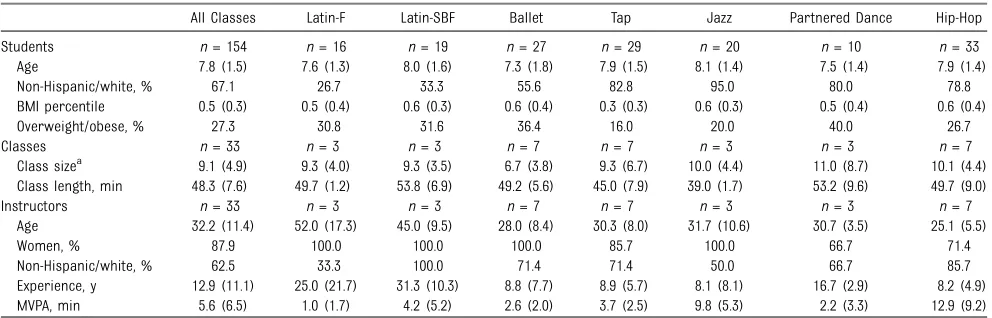
characteristics are presented in Tables 1 and 2. Mean age was 7.86 1.5 and 13.161.9 for children and adolescents, respectively. The majority of participants were non-Hispanic/white (67.1% and 71.6% of children and adolescents,
respectively). The highest percent of overweight/obese children were found in partnered dance (40%) with the lowest in tap (16%). The highest percent of overweight/obese adolescents were found in Latin-SBF classes (50%) with the lowest in ballet (0%).
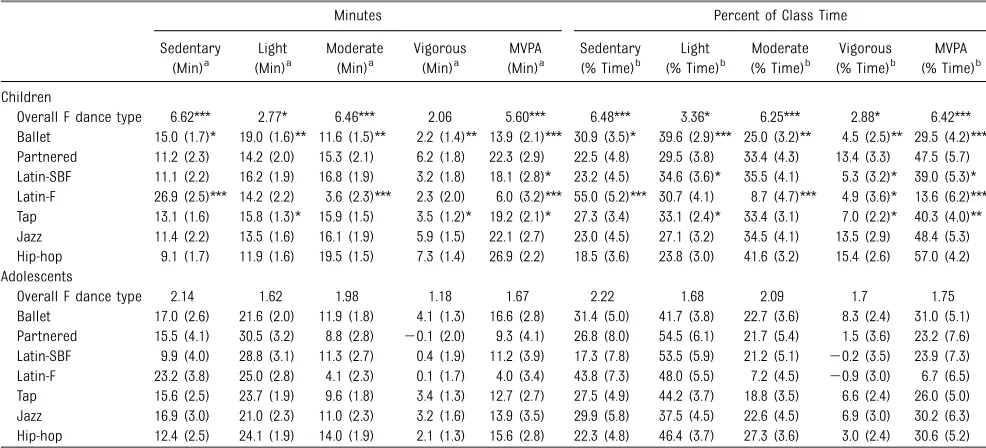
Covariate-adjusted means for activity outcomes are presented in Table 3, along with results from the mixed model linear regressions investigating the statistical significance of
differences between dance types for sedentary, light, moderate, vigorous, and MVPA. For children, significant differences were observed by dance type in all activity categories with the strongest differences found with
TABLE 1 Student, Class, and Instructor Characteristics by Dance Class Type in Children
All Classes Latin-F Latin-SBF Ballet Tap Jazz Partnered Dance Hip-Hop
Students n= 154 n= 16 n= 19 n= 27 n= 29 n= 20 n= 10 n= 33
Age 7.8 (1.5) 7.6 (1.3) 8.0 (1.6) 7.3 (1.8) 7.9 (1.5) 8.1 (1.4) 7.5 (1.4) 7.9 (1.4)
Non-Hispanic/white, % 67.1 26.7 33.3 55.6 82.8 95.0 80.0 78.8
BMI percentile 0.5 (0.3) 0.5 (0.4) 0.6 (0.3) 0.6 (0.4) 0.3 (0.3) 0.6 (0.3) 0.5 (0.4) 0.6 (0.4)
Overweight/obese, % 27.3 30.8 31.6 36.4 16.0 20.0 40.0 26.7
Classes n= 33 n= 3 n= 3 n= 7 n= 7 n= 3 n= 3 n= 7
Class sizea 9.1 (4.9) 9.3 (4.0) 9.3 (3.5) 6.7 (3.8) 9.3 (6.7) 10.0 (4.4) 11.0 (8.7) 10.1 (4.4) Class length, min 48.3 (7.6) 49.7 (1.2) 53.8 (6.9) 49.2 (5.6) 45.0 (7.9) 39.0 (1.7) 53.2 (9.6) 49.7 (9.0)
Instructors n= 33 n= 3 n= 3 n= 7 n= 7 n= 3 n= 3 n= 7
Age 32.2 (11.4) 52.0 (17.3) 45.0 (9.5) 28.0 (8.4) 30.3 (8.0) 31.7 (10.6) 30.7 (3.5) 25.1 (5.5)
Women, % 87.9 100.0 100.0 100.0 85.7 100.0 66.7 71.4
Non-Hispanic/white, % 62.5 33.3 100.0 71.4 71.4 50.0 66.7 85.7
Experience, y 12.9 (11.1) 25.0 (21.7) 31.3 (10.3) 8.8 (7.7) 8.9 (5.7) 8.1 (8.1) 16.7 (2.9) 8.2 (4.9) MVPA, min 5.6 (6.5) 1.0 (1.7) 4.2 (5.2) 2.6 (2.0) 3.7 (2.5) 9.8 (5.3) 2.2 (3.3) 12.9 (9.2)
Data are presented as mean (SD) or percent unless noted otherwise.
percent of class time spent in MVPA (F= 6.4,P,.001), which ranged from 13.6% in Latin-F to 57% in hip-hop classes. For adolescents, there were no significant overall differences across dance types in any activity category. As can be seen in Table 3, the ranges of means across dance types for all activity categories were much narrower for adolescents than for children.
Hip-hop classes provided the least amount of sedentary time
(9.1 minutes; 18.5% of class time) and the most MVPA (26.9 minutes; 57% of class time) for children, whereas ballet provided the most MVPA for adolescents (16.6 minutes; 31% of class time). Latin-SBF classes were the least sedentary for
adolescents (9.9 minutes; 17.3% of class time). Latin-F classes were the most sedentary for children and adolescents (26.9 minutes; 55% of class time and 23.2 minutes; 43.8% of class time, respectively) and provided
the least amount of MVPA (6 minutes; 13.6% of class time and 4 minutes; 6.7% of class time, respectively) compared with other dance types.
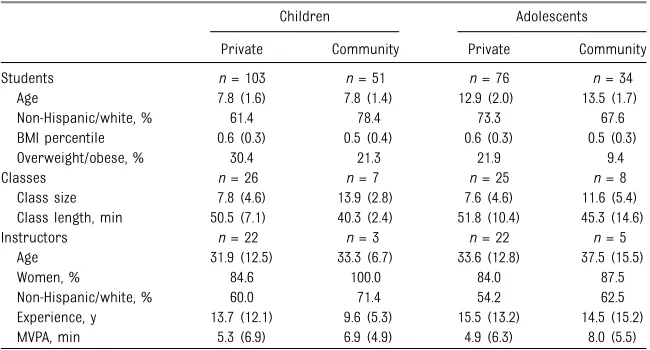
Descriptive characteristics of the sample for private and community center classes are presented in Table 4. Private classes had a higher percent of overweight/obese children and adolescents (30.4% and 21.9%, respectively) compared with community centers (21.3% and 9.4%).
TABLE 2 Student, Class, and Instructor Characteristics by Dance Class Type in Adolescents
All Classes Latin-F Latin-SBF Ballet Tap Jazz Partnered Dance Hip-Hop
Students n= 110 n= 12 n= 6 n= 23 n= 19 n= 18 n= 9 n= 23
Age 13.1 (1.9) 11.7 (0.9) 12.0 (2.0) 14.0 (1.7) 13.6 (2.3) 12.8 (1.9) 13.1 (1.7) 13.0 (1.8)
Non-Hispanic/white, % 71.6 41.7 83.3 78.3 68.4 88.9 77.8 63.6
BMI percentile 0.5 (0.3) 0.6 (0.3) 0.6 (0.5) 0.4 (0.3) 0.5 (0.3) 0.6 (0.3) 0.5 (0.3) 0.5 (0.3)
Overweight/obese, % 18.1 33.3 50.0 0.0 16.7 20.0 11.1 22.7
Classes n= 33 n= 4 n= 3 n= 5 n= 6 n= 3 n= 4 n= 8
Class sizea 8.5 (5.0) 5.3 (2.9) 9.7 (3.1) 7.2 (3.9) 9.0 (6.6) 9.8 (3.3) 11.3 (6.9) 8.3 (6.1) Class length, min 50.2 (11.6) 43.8 (6.4) 52.7 (6.5) 55.2 (15.0) 46.2 (8.7) 43.5 (11.3) 61.5 (16.4) 50.2 (9.5)
Instructors n= 33 n= 4 n= 3 n= 5 n= 6 n= 3 n= 4 n= 8
Age 34.5 (13.4) 46.0 (18.6) 45.0 (9.5) 35.4 (11.4) 36.5 (19.5) 31.0 (8.8) 32.5 (4.7) 24.4 (5.0)
Women, % 84.8 100.0 100.0 80.0 100.0 100.0 50.0 71.4
Non-Hispanic/white, % 56.3 25.0 100.0 60.0 83.3 66.7 75.0 57.1
Experience, y 15.2 (13.5) 20.0 (20.3) 31.3 (10.3) 14.8 (9.4) 17.9 (20.3) 9.9 (7.5) 16.3 (2.5) 6.1 (4.8) MVPA, min 5.6 (6.2) 0.0 (0.0) 3.7 (5.5) 5.6 (5.9) 3.5 (3.4) 10.0 (4.1) 2.0 (2.7) 11.1 (8.0)
Data are presented as mean (SD) or percent unless noted otherwise.
aTotal number of students attending class; includes study participants plus nonparticipants.
TABLE 3 Relationship of Sedentary, Light, Moderate, Vigorous, and Moderate-to-Vigorous Intensity Physical Activity With Dance Class Type
Minutes Percent of Class Time
Sedentary (Min)a
Light (Min)a
Moderate (Min)a
Vigorous (Min)a
MVPA (Min)a
Sedentary (% Time)b
Light (% Time)b
Moderate (% Time)b
Vigorous (% Time)b
MVPA (% Time)b Children
Overall F dance type 6.62*** 2.77* 6.46*** 2.06 5.60*** 6.48*** 3.36* 6.25*** 2.88* 6.42*** Ballet 15.0 (1.7)* 19.0 (1.6)** 11.6 (1.5)** 2.2 (1.4)** 13.9 (2.1)*** 30.9 (3.5)* 39.6 (2.9)*** 25.0 (3.2)** 4.5 (2.5)** 29.5 (4.2)*** Partnered 11.2 (2.3) 14.2 (2.0) 15.3 (2.1) 6.2 (1.8) 22.3 (2.9) 22.5 (4.8) 29.5 (3.8) 33.4 (4.3) 13.4 (3.3) 47.5 (5.7) Latin-SBF 11.1 (2.2) 16.2 (1.9) 16.8 (1.9) 3.2 (1.8) 18.1 (2.8)* 23.2 (4.5) 34.6 (3.6)* 35.5 (4.1) 5.3 (3.2)* 39.0 (5.3)* Latin-F 26.9 (2.5)*** 14.2 (2.2) 3.6 (2.3)*** 2.3 (2.0) 6.0 (3.2)*** 55.0 (5.2)*** 30.7 (4.1) 8.7 (4.7)*** 4.9 (3.6)* 13.6 (6.2)*** Tap 13.1 (1.6) 15.8 (1.3)* 15.9 (1.5) 3.5 (1.2)* 19.2 (2.1)* 27.3 (3.4) 33.1 (2.4)* 33.4 (3.1) 7.0 (2.2)* 40.3 (4.0)** Jazz 11.4 (2.2) 13.5 (1.6) 16.1 (1.9) 5.9 (1.5) 22.1 (2.7) 23.0 (4.5) 27.1 (3.2) 34.5 (4.1) 13.5 (2.9) 48.4 (5.3) Hip-hop 9.1 (1.7) 11.9 (1.6) 19.5 (1.5) 7.3 (1.4) 26.9 (2.2) 18.5 (3.6) 23.8 (3.0) 41.6 (3.2) 15.4 (2.6) 57.0 (4.2) Adolescents
Overall F dance type 2.14 1.62 1.98 1.18 1.67 2.22 1.68 2.09 1.7 1.75
Ballet 17.0 (2.6) 21.6 (2.0) 11.9 (1.8) 4.1 (1.3) 16.6 (2.8) 31.4 (5.0) 41.7 (3.8) 22.7 (3.6) 8.3 (2.4) 31.0 (5.1) Partnered 15.5 (4.1) 30.5 (3.2) 8.8 (2.8) 20.1 (2.0) 9.3 (4.1) 26.8 (8.0) 54.5 (6.1) 21.7 (5.4) 1.5 (3.6) 23.2 (7.6) Latin-SBF 9.9 (4.0) 28.8 (3.1) 11.3 (2.7) 0.4 (1.9) 11.2 (3.9) 17.3 (7.8) 53.5 (5.9) 21.2 (5.1) 20.2 (3.5) 23.9 (7.3) Latin-F 23.2 (3.8) 25.0 (2.8) 4.1 (2.3) 0.1 (1.7) 4.0 (3.4) 43.8 (7.3) 48.0 (5.5) 7.2 (4.5) 20.9 (3.0) 6.7 (6.5) Tap 15.6 (2.5) 23.7 (1.9) 9.6 (1.8) 3.4 (1.3) 12.7 (2.7) 27.5 (4.9) 44.2 (3.7) 18.8 (3.5) 6.6 (2.4) 26.0 (5.0) Jazz 16.9 (3.0) 21.0 (2.3) 11.0 (2.3) 3.2 (1.6) 13.9 (3.5) 29.9 (5.8) 37.5 (4.5) 22.6 (4.5) 6.9 (3.0) 30.2 (6.3) Hip-hop 12.4 (2.5) 24.1 (1.9) 14.0 (1.9) 2.1 (1.3) 15.6 (2.8) 22.3 (4.8) 46.4 (3.7) 27.3 (3.6) 3.0 (2.4) 30.6 (5.2)
*P#.05; **P#.01; ***P#.001.
aAnalyses adjusted for age, race, class length, BMI percentile, instructor MVPA, community versus private, and clustering within dance classes and instructors. bAnalyses adjusted for age, race, BMI percentile, instructor MVPA, community versus private, and clustering within dance classes and instructors.
Table 5 presents the covariate-adjusted means for activity outcomes along with the results from the mixed model linear regressions investigating the differences between private studio classes and community center classes in activity categories. Children in private dance studios were more active with 20.6 minutes spent in MVPA (44.1% of class time) compared with children in community center classes who had 16 minutes MVPA (34.5% of class time). Adolescents in private dance studios spent more time in vigorous activity (6.4% of class time) compared with adolescents in community center classes (0.8% of class time).
Figure 1 reveals covariate-adjusted means for minutes of MVPA during dance classes by dance type and age group. Children were more active than adolescents in all dance types except ballet, with a 20.3-minute difference between the least and most active dance type (Latin-F and hip-hop, respectively). There were smaller differences among dance types for adolescents with a 12.6-minute MVPA difference between the least and most active dance type (Latin-F and ballet, respectively). The biggest within-dance type difference between age groups was found with partnered dance with children getting 13 more minutes of MVPA compared
with adolescents. Within-dance type differences for most other types ranged from 2.4 to 11.1 minutes between children and adolescents.
DISCUSSION
Objectively measured physical activity during youth dance classes varied dramatically, from 4 to 27 minutes, depending on dance type and age of student. The Centers for Disease Control and Prevention recommends that schools provide 30 of the total 60 minutes of MVPA per day, with after-school activities providing the remaining 30 minutes.3
Only 8% of children and 6% of adolescents in the current study met these 30-minute guidelines in dance classes. A study using similar methods revealed that from 50% to 100% of participants in youth sports practices achieved 30 minutes of MVPA.23Though dance classes have
the potential to reduce gender-based disparities in physical activity by appealing mainly to girls, the public health promise of dance classes is not being delivered.
Dance as physical activity in youth is not well studied. Studies to date had small sample sizes, limited age ranges, limited types of dance, and short dance sessions.12–15The
current study revealed over twice as much class time in MVPA in ballet TABLE 4 Student, Class, and Instructor Characteristics by Private and Public Dance Classes in
Children and Adolescents
Children Adolescents
Private Community Private Community
Students n= 103 n= 51 n= 76 n= 34
Age 7.8 (1.6) 7.8 (1.4) 12.9 (2.0) 13.5 (1.7)
Non-Hispanic/white, % 61.4 78.4 73.3 67.6
BMI percentile 0.6 (0.3) 0.5 (0.4) 0.6 (0.3) 0.5 (0.3)
Overweight/obese, % 30.4 21.3 21.9 9.4
Classes n= 26 n= 7 n= 25 n= 8
Class size 7.8 (4.6) 13.9 (2.8) 7.6 (4.6) 11.6 (5.4) Class length, min 50.5 (7.1) 40.3 (2.4) 51.8 (10.4) 45.3 (14.6)
Instructors n= 22 n= 3 n= 22 n= 5
Age 31.9 (12.5) 33.3 (6.7) 33.6 (12.8) 37.5 (15.5)
Women, % 84.6 100.0 84.0 87.5
Non-Hispanic/white, % 60.0 71.4 54.2 62.5
Experience, y 13.7 (12.1) 9.6 (5.3) 15.5 (13.2) 14.5 (15.2) MVPA, min 5.3 (6.9) 6.9 (4.9) 4.9 (6.3) 8.0 (5.5)
Data are presented as mean (SD) or percent unless noted otherwise.
TABLE 5 Relationship of Sedentary, Light, Moderate, Vigorous, and Moderate-to-Vigorous Intensity Physical Activity With Private and Public Dance Classes
Minutes Percent of Class Time
Sedentary (Min)a
Light (Min)a
Moderate (Min)a
Vigorous (Min)a
MVPA (Min)a
Sedentary (% Time)b
Light (% Time)b
Moderate (% Time)b
Vigorous (% Time)b
MVPA (% Time)b Children
Overall F class typec 1.85 0.05 2.10 1.07 4.29* 1.95 0.18 1.73 2.52 5.05* Private 12.8 (0.9) 14.7 (0.8) 15.2 (0.8) 5.4 (0.7) 20.6 (1.1)* 26.1 (1.8) 30.4 (1.5) 32.4 (1.6) 11.6 (1.3) 44.1 (2.1)* Community 15.2 (1.5) 15.2 (1.9) 13.0 (1.3) 3.4 (1.7) 16.1 (1.9) 31.1 (3.0) 32.0 (3.4) 28.1 (2.7) 6.6 (2.7) 34.5 (3.6) Adolescents
Overall F class typed 0.25 0.65 0.38 2.78 0.38 0.43 0.67 0.75 5.30* 0.06 Private 16.7 (1.5) 23.9 (1.2) 9.5 (0.9) 3.1 (0.7) 12.7 (1.4) 30.7 (3.0) 44.4 (2.3) 18.6 (1.8) 6.4 (1.2)* 25.2 (2.6) Community 14.9 (3.2) 26.0 (2.4) 10.7 (1.7) 0.7 (1.3) 11.0 (2.4) 26.2 (6.2) 48.6 (4.7) 21.8 (3.2) 0.8 (2.2) 23.8 (5.0)
P,.05.
aAnalyses adjusted for age, race, class length, BMI percentile, instructor MVPA, community versus private, and clustering within dance classes and instructors. bAnalyses adjusted for age, race, BMI percentile, instructor MVPA, community versus private, and clustering within dance classes and instructors.
compared with a previous study using accelerometers,11but
differences in epoch length,
accelerometer model, and particularly the use of a 3-MET vs 4-MET cut point could explain this
difference.17,24
Children were more active than adolescents in all types of dance classes, except for ballet. This could be because children are more active in general or because dance classes for adolescents may spend more time teaching routines rather than providing opportunities for active dancing. Lower activity levels for adolescents might also reflect adolescent girls’fear of embarrassment and body
consciousness, particularly because dance classes are almost always held in rooms with mirrored walls whereby students are often comparing their movements (and bodies) to one another.25,26
Variation by type of dance, specifically in children, was more
dramatic than age differences. Latin-F was the least active for both children and adolescents, whereas hip-hop classes were the most active for children and ballet for adolescents, although the differences across dance types were not significant in
adolescents. Partnered dancing was an active dance type for children, but not for adolescents, likely reflecting differences in the type of partnered dance. Common partnered dance styles for children were swing and merengue, whereas the common styles for adolescents were traditional ballroom dances. Ballet was a lighter intensity dance type for children but the most active dance for adolescents. This likely reflects more advanced and active jumps and running for the higher-skilled adolescents. The reasons for the large differences in MVPA across dance types among children but not adolescents should be explored in subsequent studies that assess the nature of the dance moves and instructional practices.
It is useful to compare the profile of physical activity of youth dance classes and sports practices, because these are 2 common after-school activity programs. Compared with activity levels in youth soccer and baseball/ softball practices,23dancing was much
less active. Though sedentary time was comparable (30% of class/practice time), children and adolescents had less vigorous intensity activity in dance compared with soccer (mean 7.2% vs 28% of class/practice time, respectively). Some dance types such as jazz, partnered, and hip-hop in children had comparable amounts of vigorous activity compared with baseball/softball (11% of practice time).23Vigorous intensity activity is
important because it is particularly protective from youth obesity.27
Children’s dance classes in private studios provided more MVPA (44% of class time) compared with girls’ baseball/softball practices, which spent∼35% of practice time being active, but less MVPA than girls’soccer (over 50% of practice time).23
FIGURE 1
The current study included some lower-cost dance classes
(approximately $5/class) to allow comparisons with higher-cost private classes (approximately $17/class). For children, community center classes had less MVPA compared with private classes, whereas for
adolescents, community center classes had less vigorous compared with private classes, even after controlling for the higher activity of instructors. It was also notable that community center classes tended to be shorter in duration, have larger class sizes, and have fewer overweight/obese students. It was unexpected that public classes were serving a lower proportion of overweight/obese girls. Thisfinding should be explored in other locations.
Strengths of the study included an objective measure of physical activity, a large sample size from a variety of dance types, age-specific analyses, and multiple classes for each dance type. Limitations included studying dance in only 1 geographic area. Another limitation was height and weight were reported by parents and not objectively measured. Some dance types might not be measured well with accelerometry, particularly styles with extensive upper body movement, such asflamenco. A study of Latin dancing also revealed that accelerometers were not as sensitive as heart rate monitors for measuring physical activity in overweight and obese women.28The current study
used 3 METs as the lower limit of moderate-intensity physical activity, though other studies used 4 METs or higher3,29,30reflecting a lack of
consensus on definitions.17A 3-MET
cut point will result in higher
estimates of MVPA compared with higher MET values. However, the US physical activity guidelines are based on 3 METs for all age groups,1which
was the rationale for methods used in the current study. The difference in cut points could explain different MVPA levels between the current study and the O’Neill et al13study,
which used a 4-MET cut point.
CONCLUSIONS
The current study confirmedfindings from the few previous studies that physical activity levels are low in youth dance classes. It appears that most dance classes are substantially less active than youth sports practices, so 1 of the most common types of after-school activity programs is providing youth participants with limited amounts of physical activity. Thus, there is a public health imperative to engage the dance profession in efforts to improve the public health impact of youth dance classes. A fruitful place to begin would be to work with leading dance organizations to adopt public health and physical activity goals. Though there are important social, developmental, cultural, and aesthetics benefits of dance that should be maintained and
strengthened, it should be possible to simultaneously increase physical activity. It should be possible to implement more active dance classes in the estimated 32 000 private dance studios,11as well as school physical
education classes and after-school programs.
Two strategies for increasing physical activity in youth dance classes are suggested by currentfindings. One
strategy is to alter teaching methods to increase physical activity in all dance types. This could be done by using dynamic rather than static warm up periods, having more frequent and longer practice of dance moves, and including a segment of vigorous exercise in each class to improvefitness. A second strategy is to emphasize greater participation in dance class types with higher levels of physical activity. Present results implied that lower-cost dance classes delivered in community centers attracted more adolescents of color who may experiencefinancial barriers to dance classes in private studios. However, public classes tended to be less active. Closer collaboration between public health and dance instruction professionals could lead to changes in dance class practices that could benefit millions of young people, especially girls who are attracted to dance but are much less likely to meet physical activity guidelines.3
There are several steps pediatricians and pediatric organizations could take to maximize the health benefits of dance classes. Pediatricians could recommend more active dance types for children interested in dance, such as jazz, hip hop, and partnered types. Local pediatric organizations could compile lists of public and private dance studios and indicate which studios have made commitments or taken steps to ensure relatively high levels of physical activity during dance classes. National pediatric organizations could collaborate with dance instructor organizations to develop guidelines and training opportunities designed to increase physical activity during dance classes.
Address correspondence to Kelli L. Cain, MA, University California San Diego, 3900 5th Ave, Suite 310, San Diego, CA 92103. E-mail: [email protected]
PEDIATRICS (ISSN Numbers: Print, 0031-4005; Online, 1098-4275).
Copyright © 2015 by the American Academy of Pediatrics
FINANCIAL DISCLOSURE:The authors have indicated they have nofinancial relationships relevant to this article to disclose.
FUNDING:No external funding.
REFERENCES
1. US Department of Health and Human Services. Physical activity guidelines for Americans. Washington, DC: US Department of Health and Human Services. Available at: www.health.gov/ paguidelines/guidelines/chapter3.aspx. Accessed April 1, 2015
2. US Department of Health and Human Services. Physical activity guidelines advisory committee report. Available at: www.health.gov/paguidelines/
guidelines/chapter2.aspx. Accessed April 1, 2015
3. Troiano RP, Berrigan D, Dodd KW, Mâsse LC, Tilert T, McDowell M. Physical activity in the United States measured by accelerometer.Med Sci Sports Exerc. 2008;40(1):181–188
4. Centers for Disease Control and Prevention (CDC). School health guidelines to promote healthy eating and physical activity.MMWR Recomm Rep. 2011;60(RR-5):1–76
5. Vilhjalmsson R, Kristjansdottir G. Gender differences in physical activity in older children and adolescents: the central role of organized sport.Soc Sci Med. 2003;56(2):363–374
6. Grieser M, Vu MB, Bedimo-Rung AL, et al. Physical activity attitudes, preferences, and practices in African American, Hispanic, and Caucasian girls.Health Educ Behav. 2006;33(1):40–51
7. O’Neill JR, Pate RR, Liese AD. Descriptive epidemiology of dance participation in adolescents.Res Q Exerc Sport. 2011; 82(3):373–380
8. Whitt-Glover MC, Taylor WC, Floyd MF, Yore MM, Yancey AK, Matthews CE. Disparities in physical activity and sedentary behaviors among US children and adolescents: prevalence, correlates, and intervention implications.J Public Health Policy. 2009;30(suppl 1): S309–S334
9. Zhang JG, Ishikawa-Takata K, Yamazaki H, Morita T, Ohta T. Postural stability and
physical performance in social dancers.
Gait Posture. 2008;27(4):697–701
10. Alpert PT. The Health Benefits of Dance.
Home Health Care Manage Pract. 2011; 23(2):155–157
11. National Dance Education Organization. Statistics on general education in the United States. National Dance Education Organization. Available at: www.ndeo. org/content.aspx?page_id=22&club_id= 893257&module_id=55774. Accessed June 24, 2014
12. O’Neill JR, Pate RR, Hooker SP. The contribution of dance to daily physical activity among adolescent girls.Int J Behav Nutr Phys Act. 2011;8:87
13. O’Neill JR, Pate RR, Beets MW. Physical activity levels of adolescent girls during dance classes.J Phys Act Health. 2012; 9(3):382–388
14. Nelson L, Evans M, Guess W, Morris M, Olson T, Buckwalter J. Heart rates of elementary physical education students during the dancing classrooms program.
Res Q Exerc Sport. 2011;82(2):256–263
15. Huang SY, Hogg J, Zandieh S, Bostwick SB. A ballroom dance classroom program promotes moderate to vigorous physical activity in elementary school children.Am J Health Promot. 2012; 26(3):160–165
16. Kuczmarski RJ, Ogden CL, Grummer-Strawn LM, et al. CDC growth charts: United States.Adv Data. 2000;314(314):1–27
17. Cain KL, Sallis JF, Conway TL, Van Dyck D, Calhoon L. Using accelerometers in youth physical activity studies: a review of methods.J Phys Act Health. 2013; 10(3):437–450
18. Welk GJ.Physical Activity Assessments for Health-Related Research. Champaign, IL: Human Kinetics; 2002
19. Freedson P, Pober D, Janz KF. Calibration of accelerometer output for children.
Med Sci Sports Exerc. 2005;37(suppl 11): S523–S530
20. Freedson PS, Melanson E, Sirard J. Calibration of the Computer Science and Applications, Inc. accelerometer.Med Sci Sports Exerc. 1998;30(5):777–781
21. Evenson KR, Catellier DJ, Gill K, Ondrak KS, McMurray RG. Calibration of two objective measures of physical activity for children.J Sports Sci. 2008;26(14): 1557–1565
22. Treuth MS, Schmitz K, Catellier DJ, et al. Defining accelerometer thresholds for activity intensities in adolescent girls.
Med Sci Sports Exerc. 2004;36(7): 1259–1266
23. Leek D, Carlson JA, Cain KL, et al. Physical activity during youth sports practices.Arch Pediatr Adolesc Med. 2011;165(4):294–299
24. Vale S, Santos R, Silva P, Soares-Miranda L, Mota J. Preschool children physical activity measurement: importance of epoch length choice.Pediatr Exerc Sci. 2009;21(4):413–420
25. Oliver W. Body Image in the Dance Class.
J Phys Educ, Recreat Dance. 2008;79(5): 18–41
26. Green J. Somatic authority and the myth of the ideal body in dance education.
Dance Res J. 1999;31(2):80–100
27. Gutin B. Child obesity can be reduced with vigorous activity rather than restriction of energy intake.Obesity (Silver Spring). 2008;16(10):2193–2196
28. Lee RE, Mama SK, Medina A, Orlando Edwards R, McNeill L. SALSA: Saving Lives Staying Active to Promote Physical Activity and Healthy Eating.J Obes. 2011; 2011:436509
29. Pate RR, Stevens J, Webber LS, et al. Age-related change in physical activity in adolescent girls.J Adolesc Health. 2009; 44(3):275–282
DOI: 10.1542/peds.2014-2415 originally published online May 18, 2015;
2015;135;1066
Pediatrics
Edith Bonilla, Patricia Rincon and James F. Sallis
Kelli L. Cain, Kavita A. Gavand, Terry L. Conway, Emma Peck, Nicole L. Bracy,
Physical Activity in Youth Dance Classes
Services
Updated Information &
http://pediatrics.aappublications.org/content/135/6/1066
including high resolution figures, can be found at:
References
http://pediatrics.aappublications.org/content/135/6/1066#BIBL
This article cites 26 articles, 1 of which you can access for free at:
Subspecialty Collections
cal_fitness_sub
http://www.aappublications.org/cgi/collection/sports_medicine:physi Sports Medicine/Physical Fitness
following collection(s):
This article, along with others on similar topics, appears in the
Permissions & Licensing
http://www.aappublications.org/site/misc/Permissions.xhtml
in its entirety can be found online at:
Information about reproducing this article in parts (figures, tables) or
Reprints
http://www.aappublications.org/site/misc/reprints.xhtml
DOI: 10.1542/peds.2014-2415 originally published online May 18, 2015;
2015;135;1066
Pediatrics
Edith Bonilla, Patricia Rincon and James F. Sallis
Kelli L. Cain, Kavita A. Gavand, Terry L. Conway, Emma Peck, Nicole L. Bracy,
Physical Activity in Youth Dance Classes
http://pediatrics.aappublications.org/content/135/6/1066
located on the World Wide Web at:
The online version of this article, along with updated information and services, is
by the American Academy of Pediatrics. All rights reserved. Print ISSN: 1073-0397.