Jndian
i.
Plant
Physloi., Vol. xxxiirNo.2,
PI'.10s;.td
(tune, 1m)INFLUENCE OF PLANT HORMONES ON AGED SEEDS OF MAIZE·
NEETA CHANDAKBotany Department, University School of Sciences, Gujarat University,
Ahmedabad·380 009
Received on 16 June, 1989
SUMMARY
Seeds of maize (Zea mays L. cv. African Tall) were stored at 7.5% moisture content (m.c.) in 100 and 300 gauge sealed polythene bags at room-temperature (ambient: 35±5°C), in B.O.D. incubator (moderate: 25±1"C) and low temperature-(4-6°C). When seeds lost viability by 50% (after 12 months, at ambient and moderate temperatures), . seeds were presoaked for 6 h in the aqueous solutions of GAa. Kinetin (lo-'~ M) and dis
tilled water. A remarkable increase in germination (50 to 70-90 %) was observed. Seedl ing growth in terms of length, fresh weight and dry weight was also enhanced. Untreated seeds lost viability after 16 months, whereas pretreated seeds took 20-22 months to lose its full viability.
INTRODUCTION
Preservation of vigour and viability of stored maize seeds, especially of carry
over stocks poses serious problem. The lower temperature and lower moisture con
tent are effective in prolonging the longevity and maintaining the quality of the
agriculturally valuable seeds (Agrawal, 1980). Packing of seeds in moisture-vapour
proof containers and placing them at relatively lower temperatures maintained the
viability for comparatively longer periods (Bhattacharya et
01,
1983).
The treatment with PGRs (Plant growth regulators) need careful investigations
as different researches have given conflicting results (Heydecker, 1973). Thus present
study was conducted to obtain information on the response elicited by PGRs treat
ment to seeds during storage.
MATERIALS AND METHODS
PLANT HOR.MONES ON MAIZE SEEDS
109
seedling length, fresh weight and dry weight of the seedling and moisture content of
seeds. Stored seeds were germinated in petridishes lined with filter paper, moistened
with distilled water for 120 hours, in the B.O.D. incubator under continuous white
light and temperature (25± 1°C).
Seed treatment:
When seeds lost viability by 50 percent at 12.3 percent mois
ture content they were soaked in double the volume of aqueous solutions (v/w) of
gibberellic acid (GAl), kinetin (KN)
(10~5M) and distilled water (DW) for 6 h,
dried back to their original weights and stored again under the same conditions.
Again the data (germination performance and moisture content) were recorded at
regular intervals from the different conditions and treatments. The untreated seeds
served as control.
RESULTS AND DISCUSSION
The seedling performance initially was low but became very pronounced
after storage for 4 to 6 mOilths. The same decreased with the advancement of storage
period. The germination per cent was 100 in the beginning with moisture content- of
7.5 percent (Fig.
1).In selected treatments, OW appeared to be equal to GAl (Figs. 1,2). Both the
treatments enhanced the per cent germination (30-50) and retained viability for 24-28
months under ambient (100 gauge stored seeds) and moderate (300 gauge po]ythene
bags) conditions (Figs. 1-4), whereas they lost viability in 300 ambient and 100
moderate treatments (Figs. 2 and 3). Kinetin too improved germination. percent
of 300 gauge stored seeds under moderate temperature (Fig 4). However it was
interesting to note that all the treatments significantly increased seedling length,
fresh weight and dry weight.
There was little difference in moisture percent between the control and
variously treated seeds during the course of ageing. In untreated seeds moisture was
more than 16 percent after 24 months (Fig. 1). Treatments were efficient in prevent
ing moisture gain.
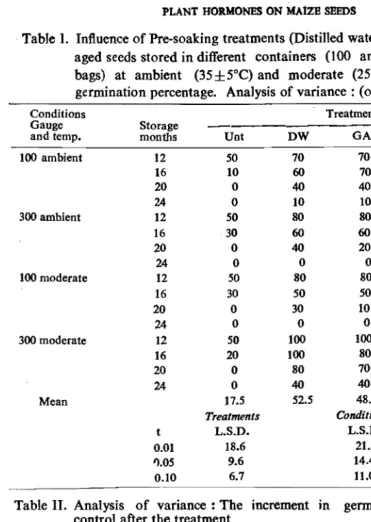
All the three treatments (OW, GAl, KN) were significantly superior over the
untreated seeds (P>O.OI) (Table
I).300 gauge moderate was found to be superior
over other storage conditions (100 and 300 ambient, 100 moderate) (Table
J).The values observed (in the increase) just after the treatment in germination
have shown significantly higher values compared to untreated seed (OW and GA
3,P>O.OI. KN P>0.10).
110
NEETA CRANDAI:Fi9. 1 Fig. 2
aged seeds is now possible, (Saxena and Maheshwari, 1980; Saxena and Pakeeraiah,
1986). Tilden (1985) observed that slow hydration followed by dehydration with
PGRs produced better seedlings and higher germination' than untreated seeds.
According to Basu and Dhar (1979) the presoaking of seeds during storage gave
better seedling performance and establishment and also increased yield in several
crops. Further it has an advantage 'of enhancing the storage life of
seeds
(Savino
et al., 1979).
The pretreated seeds generally perform better and the advantages persist till
the last phase of the life cycle, however, this all depends on many factors such as
,j:
p¥'"
PLANT HOllMONES ON MAIZE SEEDS
111
Table
1.
Influence of Pre-soaking treatments (Disti1led water, GAl. KN (10-
5M) on
aged seeds stored in different containers (100 and 300 gauge polythene
bags) at ambient (35
±
5°C) and moderate (25
±
1 "C) temperatures on
germination percentage. Analysis of variance: (original values)
Conditions Treatments
Gauge Storage
and temp. months Unt DW GAs
KN
Mean100 ambient 12 50 70 70 80 65.0
16 10 60 70 60 50.0
20 0 40 40 20 25.0,
24 0 10 10 0 5.0
300 ambient 12 50 80 80 70 70.0
16 30 60 60 50 50.0
20 0 40 20 10 17.5
24 0 0 0 0 0
100 moderate 12 50 80 80 80 12.5
16 30 50 50 50 45.0
20 0 30 10 20 15.0
24 0 0 0 0 0
300 moderate 12 50 100 100 90 85.0
16 20
tOO
80 80 70.020 0 80 70 70 52.5
24 0 40 40 30 27.5
Mean 17.5 52.5 48.8 43.8
Treatments Conditions
t L.S.D. L.S.D.
0.01 18.6 21.3
1).05 9.6 14.4
0.10 6.7 11.0
Table II. Analysis of variance: The increment in germination percentage over
control after the treatment
Conditions Container Treatments
(polythene
bags) Unto DW GAs
KN
MeanAmbient 100 gauge 40 70 70 80 65
Ambient 300 gauge
SO
80 80 70 70Moderate' 100 gauge 50 80 80 80 12.5
Moderate 300 gauge ,50 100 100 90 85
Mean 47.5 82.5 82.5 80.0
Treatments
t L.S.D.
0.01 20.2
0.05 10.5
112
NEETA CHANDAKhormone with proper concentration and the type of seeds (Saxena, 1979; Saxena
and Pakeeraiah, 1986).
Seeds stored in sealed po1ythene bags gave higher percent germination
(Bhattacharya et 01.,
1983). According to Kaur and Srivastava (1982) low tempera
ture helps in lowering some biochemical parameters associated with the loss of seed
vigour.
In general all the presoaking treatments increased the viability of aged seeds,
and can
be
further explored.
ACKNOWLEDGEMENT
Thanks are due to Gujarat Government for the award of Research Scholar
ship and to Head, Botany and Dr. O.P. Saxena for providing facilities and guidance.
REFERENCES
Agrawal, P.K. (1980). Relative storability of seeds of ten species under ambient conditions. Seed
Res., 8(2): 94-99.
Basu, R.N. and Dhar, N. (1979). Seed treatment for maintaining vigour, viability and producti vity of sugar beet. (Beta vulgaris) Seed Sci. and Technol., 7 (2) : 225-233.
Bhattacharya, P., Samul, R.C. and Sen, S. (1983). Studies on the germination and viability of stored sunliower seeds. Seed Res., 11 (2) : 162-171.
Heydecker, W. (1973). Panel discussion. Presowing treatments. In: Seed Ecology. (Ed.) W. Heydecker. "Butterworths, London. pp. 521-531.
Kaur, J., Srivastava, A.K. (1982). Effect of different storage conditions on some biochemical parameters associated with the loss of seed viability in soybean. Jour. Res., PAU: 19(4) : 368-373.
Roherts, E.H. (1972). Storage environment and the control of viability 2. In: Viability of seeds (Ed) E.H. Roberts. Chapman and Hall Ltd. London, pp. 14-58.
Savino, G.P.M., Haigh and P. De Leo. (1979). Effect of presoaking upon seed vigour and viability during storage. Seed Sci. and Technol., 7 (1) : 57-64.
Saxena, O.P. (1979). Physiological aspects of seed deterioration. In: Current Advances Plant Reproductive Biology (Ed.) C.P. Malik. Kalyani Publishers, New Delhi. pp. 328-348. Saxena, O.P. an::! Maheshwari, D.C. (1986). Influence of growth hormones and accelerated ageing
on growth and yield in soyabean, 19th ISTA, Vienna, June 6-12, Preprint No. S-I : 1-5. Saxena, O.P. and Pakeeraiah, T. (1985). Seed deterioration studies. Indian Rev. Life Sci., 6:
180-214.