Original Research Article
A study to assess knowledge and skill among doctors about hand
hygiene, WHO five moments, personal protective equipment’s and
assess the impact of educational intervention, in tertiary care hospital,
Al Qassim provenance of Saudi Arabia
Sanjay Kumar Gupta
1*, Fahd Khaleefah Al Khaleefah
2, Ibrahim Saifi Al Harbi
1,
Sinimol Jabar
1, Marilou A. Torre
1, Sunitha Lorin Mathias
1INTRODUCTION
Hand hygiene (HH) is now to be considered as one of the most important effective measure of infection control activities. This is because enough scientific evidence suggested the observation that if properly implemented, hand hygiene alone can significantly reduce the risk of cross-transmission of infection in healthcare facilities (HCFs).1-3 Semmelweis worked in the Great hospital in
Vienna in the 1840s, there were two maternity clinics in the hospital, with alternate day admission policy,the first clinic was attended by medical students, who moved straight from autopsy rooms to the delivery suite and had an average maternal mortality rate due to puerperal fever of about 10 per cent. The second clinic, attended by midwives had a maternal mortality of only 2 per cent. The puzzled Semmelweis got a breakthrough in 1847, following the death of colleague Jokob Kolletschka, who
ABSTRACT
Background: Hand hygiene (HH) is now to be considered as one of the most important effective measure of infection control activities. This is because enough scientific evidence suggested the observation that if properly implemented, hand hygiene alone can significantly reduce the risk of cross-transmission of infection in healthcare facilities.
Methods: Hospital based educational intervention.
Results: The study results showed the overall improvement pre and post educational intervention regarding hand hygiene skills, five moments and donning and doffing of PPE was significantly improved from 56.50% to 94.51%. If we see the knowledge and skills among doctors between department than we found significantly low knowledge and skills among (pre-interventional) doctors of radiology 23.33% followed by orthopedics 42.50%. The post educational interventions improvement in intensive care unit, laboratory, ENT and dental department were near 100% and lowest observed in departments in pediatrics (84%).
Conclusions: The study shows that need for the doctors to increase their knowledge and skill related to infection prevention and control practice by assessing their existing knowledge and skills in small groups and according to observations intervention also plan and its improved knowledge and skill significantly.
Keywords: Knowledge and skill, Doctors, Hand hygiene and five moments, Personal protective equipment, Educational intervention
1
Department of Infection, Prevention and control, 2Director Medical Education and Research Department, AlRass General Hospital, AlRass Qassim, Saudi Arabia
Received: 24 June 2018 Revised: 30 July 2018 Accepted: 31 July 2018
*Correspondence: Dr. Sanjay Kumar Gupta,
E-mail: [email protected]
Copyright: © the author(s), publisher and licensee Medip Academy. This is an open-access article distributed under the terms of the Creative Commons Attribution Non-Commercial License, which permits unrestricted non-commercial use, distribution, and reproduction in any medium, provided the original work is properly cited.
had been accidentally got a cut by a student's scalpel while performing an autopsy, his autopsy showed a pathological condition similar to that of women drying from puerperal sepsis/fever, Semmelweis concluded that some “unknown cadaverous material” caused or responsible for puerperal fever.He instituted a policy of washing hands with chlorinated lime for those leaving the autopsy room, following which maternal mortality fall down sharply around 10 times, comparable to the second clinic. Thus, he almost conducted a controlled trial, in an era when microbes were yet to be discovered and the germ theory of disease was not defined.4,5 In 1975 and 1985, the CDC published guidelines on hand washing practices in hospitals, primarily advocating hand washing with non-antimicrobial soaps; washing with antimicrobial soap was advised before and after performing invasive procedures or during care for high risk patients. Alcohol-based solutions were recommended only in situations where sinks were not available. Personal Protective Equipment (PPE) is specific equipment worn by an employee for protection against infectious materials or infection. PPE prevents contact with an infectious agents or body fluid that may contain an infectious agent, by creating a barrier between the potential infectious material and the healthcare worker to prevent infection. PPE Includes gloves, gowns, head covers, masks, respirators, eye protection, face shields, and goggles. For maximum prevention of infection among health care workers CDC recommended proper donning (wearing of PPE) and Doffing (Removal of PPE), if you will not follow the proper guideline of donning and doffing than you still have risk to get infection even after use of PPE, so in this regard CDC recommended following sequence.6,7
Donning
Before donning hand hygiene followed by gown than face mask or respirator than face shield or goggle and last gloves.
Doffing
After finishing procedure, first you have to remove gloves followed by hand hygiene than face shield or respirator than gown and last face mask or respirator, CDC recommend if you are wearing surgical mask remove near the door of the room. If you are wearing N95 mask than remove after closing the door of isolation room or in ante-room.
Objectives
To assess correct knowledge and skill among doctors about hand hygiene, five moments and personal protective equipment’s (PPE).
To find out the impact of educational intervention on the same.
METHODS
The present educational intervention was carried out by infection Prevention and Control department at AlRass General Hospital (AGH) among doctors of all departments from February to June 2017. No sampling method was applied, all doctors available in the concern department during study period were taken as a sample, the sample size collected during study period 125 out of total strength of 160 doctors (around 78%). The present study was conducted in two phases, in first phase we assessed knowledge and skills among all doctors from various department about proper steps of hand hygiene, WHO five moments and donning and doffing of the PPE. The respondents were assessed and given score for each parts, WHO hand hygiene steps 2 points, WHO five moments 5 points and CDC donning and doffing sequence 3 points, the maximum score is 10. Each department score was collected individually in the predesigned and pretested proforma. After the competitions of all departments in the hospital, in second phase educational intervention was done in small groups (In each department) about correct knowledge and skills improvements for hand hygiene, WHO five moments and donning and doffing of PPE, after completitions of the intervention in all department post assessments scoring was recorded and compared with pre-intervention score for any change in knowledge and skills.
Inclusion criteria
Those who present and willing to participate and present during the study were included in the study.
Exclusion criteria
Those who on vacation and not willing to participate were excluded
Ethical consideration: Informed consent were taken from all participants and given free choice to participate or refuse as a part of study.
The collected data was entered in excel sheet and presented in the form of tables, graphs and analyzed using SPSS version 21 and required statistical test is also applied like mean, standard deviation, chi-square test etc. The p value of less than or equal to 0.05 was considered significant.
RESULTS
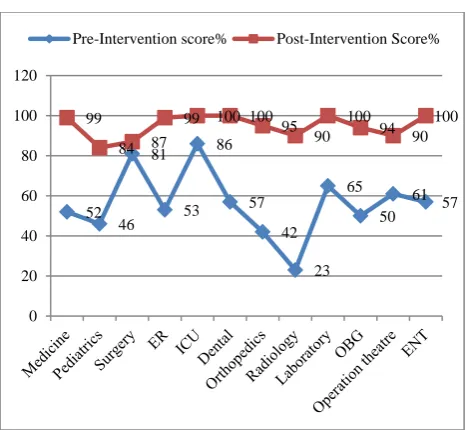
ICU doctors followed by surgery doctors and minimum among radiology doctors. Figure 3 shows that maximum improvement of interventions occurred in ICU, dental, laboratory and ENT, minimum in pediatrics. Figure 4 shows comparative improvement of knowledge and skill among various department.
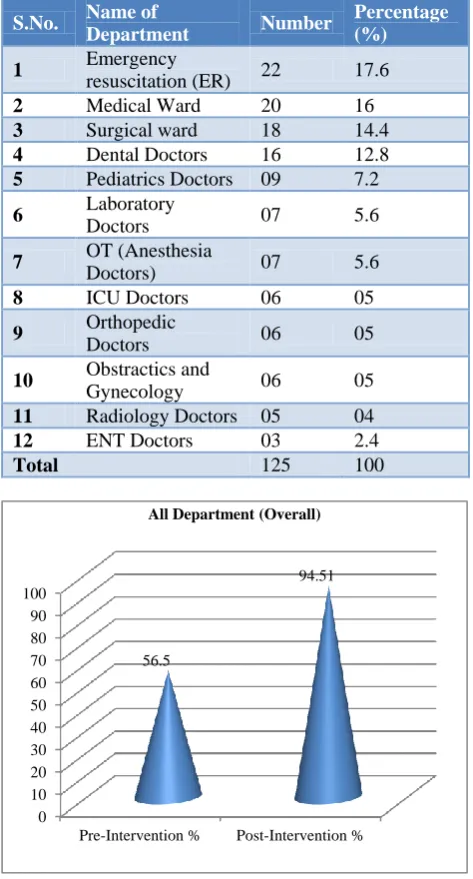
Table 1: Distribution of respondent participated in the study according to their individual department.
S.No. Name of
Department Number
Percentage (%) 1 Emergency
resuscitation (ER) 22 17.6
2 Medical Ward 20 16
3 Surgical ward 18 14.4
4 Dental Doctors 16 12.8
5 Pediatrics Doctors 09 7.2
6 Laboratory
Doctors 07 5.6
7 OT (Anesthesia
Doctors) 07 5.6
8 ICU Doctors 06 05
9 Orthopedic
Doctors 06 05
10 Obstractics and
Gynecology 06 05
11 Radiology Doctors 05 04
12 ENT Doctors 03 2.4
Total 125 100
Figure 1: Showing comparison according to overall pre and post-interventional difference in knowledge and skills among Doctors about hand hygiene, 5
moments and donning and doffing of PPE.
The present study results showed the overall improvement in knowledge and skills regarding hand hygiene, five moments and donning and doffing of PPE, the difference to be found significant (56.50% to 94.51%). If we were compared the existing knowledge and skills among doctors between department than we
found significantly low knowledge and skills among (Pre-interventional) doctors of Radiology 23.33% followed by orthopedics 42.50%. The existing knowledge and skills regarding hand hygiene, five moments and PPE with in department significantly higher observed among ICU Doctors 86% followed by Surgery department doctors 80.60%. The impact of post educational interventions improvement were observed maximum in Intensive Care Unit, Laboratory, ENT and Dental department near 100% and lowest among all departments in Pediatrics 84%.
Figure 2: Showing various department Doctors knowledge and skills about hand hygiene, 5 moments
and donning and doffing of PPE before intervention (pre-interventions).
Figure 3: Showing various department Doctors knowledge and skills about hand hygiene, 5 moments
and donning and doffing of PPE according to post– interventional improvement.
0 10 20 30 40 50 60 70 80 90 100
Pre-Intervention % Post-Intervention % 56.5
94.51
All Department (Overall)
0 10 20 30 40 50 60 70 80 90
52 46
81
53 86
57
42
23 65
50 61
57
Pre-Intervention Score%
75 80 85 90 95 100 99
84 87
99 100 100
95
90 100
94
90 100
Figure 4: Showing comparison between department Doctors according to pre and post –interventional
difference in knowledge and skills about hand hygiene, 5 moments and donning and doffing of PPE.
DISCUSSION
Present study was done to find out the knowledge and skills among doctors about hand hygiene, WHO five moments and PPE, the study done by Kampf et al regarding Epidemiologic background of hand hygiene and evaluation of the most important agents for scrubs and rub they observed the best antimicrobial efficacy can be achieved with ethanol (60 to 85%), isopropanol (60 to 80%), and n-propanol (60 to 80%). The present study was not evaluated the efficacy of scrubs and hand rub.8 The another study conducted by Daniels about hand washing simple but effective they observed out of 239 patient events, which are defined as a clinician reviewing a patient in order to assess their treatment, a total of 88 involved an examination (37%) and, of these, 41 had postoperative wounds (47%). The number of times clinicians washed their hands between examinations was 36 (41%). Between the two groups of clinicians, the consultants washed their hands 30 times in 55 examinations (55%), while the registrars washed their hands six times in 23 examinations (26%), in the present study we try to assessed hindrance and obstacles in the hand hygiene practice and how to improve but we were not studied hand hygiene compliance.9 The study finding observed by Rotter in a seminal intervention study 150 years ago and Semmelweis insisted that doctors performing necropsies washed their hands before delivering babies, so reducing mortality due to streptococcal puerperal sepsis from 22% to 3%.10 The study done by Pittet et al regarding improving adherence to hand hygiene practice: A Multidisciplinary Approach, they were also observed same kind of finding like present study regarding non-compliance and perceived barriers about hand hygiene.11 The study conducted by Stone et al
about hand hygiene the case for evidence based education they observed cording to recent figures hospital acquired infection affects 1 in 11 inpatients, carries a 13% mortality and lengthens stay by a factor of. The extra cost to the NHS is nearly £3000 per patient, and the total annual cost is nearly £1 billion. Between 15% and 30% of hospital-acquired infection is considered preventable, but even a 10% reduction would improve bed management to the tune of 47000 extra finished consultant episodes per year, in the present study also planned to find out obstacles or perceived barriers so we can increase the compliance in health care workers by tackling these obstacles.12 Another study done by Smith et al regarding a review of hand-washing techniques in primary care and community settings they observed lack of evidence for hand-washing techniques being undertaken in practice today. Findings from hand-washing technique studies were inconclusive and methodological issues exist resulting in sparse reliable evidence. There is an urgent need to undertake methodologically sound studies of hand-washing techniques for use in the ever expanding scope of primary care practice, but present study was conducted in tertiary care hospital.13 Study conducted by Aluko et al regarding Knowledge, attitudes and perceptions of occupational hazards and safety practices in Nigerian healthcare workers they found most of the respondent know the importance of hand hygiene, only half complied with standard procedures.14
Another study conducted by Tenna and others in Ethopia regarding knowledge attitude and practice among health care workers they also observed similar type of findings.15
CONCLUSION
The study shows that need for the Doctors to increase their knowledge and skill related to infection prevention and control practice by assessing their existing knowledge and skills in small groups and according to observations intervention also plan and its improved knowledge and skill significantly, because these measures very important for prevention and control the health care associated infection, hospital outbreak, antibiotic’s resistance, multi drug resistant organism (MDRO) and for better patient outcome.
Limitation
Impact of educational intervention accessed on the basis of improvement in knowledge and skills of the participants, not on the basis of actual implementation or compliance.
Funding: No funding sources Conflict of interest: None declared
Ethical approval: The study was approved by the Institutional Ethics Committee
52 46
81
53 86
57
42
23 65
50 61 57 99
84 87
99 100 100 95 90
100
94 90 100
0 20 40 60 80 100 120
REFERENCES
1. Guide to implementation of the WHO multimodal hand hygiene improvement strategy. Available at: http://www.who.int/patientsafety/en. Accessed 24 August 2010.
2. WHO Guidelines on Hand Hygiene in Health Care. First Global Patient Safety Challenge. Clean Care is Safer Care. Accessed 24 August 2010.
3. Boyce JM, Pittet D. Guideline for Hand Hygiene in Health-Care Settings, recommendations of the Healthcare Infection Control Practices Advisory Committee and the HICPAC/SHEA/ APIC/IDSA, hand Hygiene Task Force. Morb Mortal Wkly Rep. 2002;51:1–44.
4. Labarraque AG. Instructions and observations regarding the use of the chlorides of soda and lime. In: Porter J, editor. New Haven, CT: Baldwin and Tread way; 1829.
5. Semmelweis I. Etiology, concept, and prophylaxis of childbed fever. In: Carter KC, editor. 1st ed. Madison, WI: The University of Wisconsin Press; 1983.
6. Steere AC, Mallison GF. Hand washing practices for the prevention of nosocomial infections. Ann Intern Med. 1975;83:683–90.
7. Garner JS, Favero MS. CDC guideline for hand washing and hospital environmental control, 1985. Infect Control. 1986;7.
8. Kampf G, Kramer A. Epidemiologic background of Hand Hygiene and evaluation of the most important
agents for scrubs and rubs. Clin Microbial Rev. 2004;17:863–93.
9. Daniels IR, Rees BI. Hand washing: simple, but effective. Ann R Coll Surg Engl. 1999;81:117–8. 10. Rotter ML. 150 years of hand
disinfection-Semmelweis’ heritage. Hyg Med. 1997;22:332–9. 11. Pittet D. Improving Adherence to Hand Hygiene
Practice: A Multidisciplinary Approach. Emerg Infect Dis. 2001;7:234-40.
12. Stone SP. Hand hygiene: the case for evidence-based education. J R Soc Med. 2001;94:278–81. 13. Smith SMS. A review of hand-washing techniques
in primary care and community settings. J Clin Nurs. 2009;18:786–90.
14. Aluko AO, Adebayo AE, Adebisi TF, Ewegbemi MK, Abidoye AT, Popool BF. Knowledge, attitudes and perceptions of occupational hazards and safety practices in Nigerian healthcare workers. BMC research note. 2016;9:3-14.
15. Tenna A, Stenehjem EV, Margoles L, Kacha E. Infection Control Knowledge, Attitudes, and Practices among Healthcare Workers in Addis Ababa, Ethiopia. 2013;34:1289-96.