RESEARCH ARTICLE
FABRICATION OF NEW MODIFIED CROSS LINKED POLYIMERIC RESINS COMPOSITE WITH NANO
TiO
2& NANO Fe
2O
3FOR THE REMOVAL OF SELECTIVE
METAL IONS
Beaulah Angelin, K., Baishnisha, A., Siva, S.
and
*Sayee Kannan, R.
PG Research and Department of chemistry, Thiagarajar College, Madurai-625 009, India
ARTICLE INFO
ABSTRACT
Phenol-Formaldehyde resin (PFR) grafted Nano-Fe2O3 & Nano-TiO2 (nFe2O3 & nTiO2) was fabricated
for Cd(II), Zn(II) & Hg(II) removal using a novel polycondensation method. The present resources were carefully examined by FT-IR spectra (FT-IR), Scanning electron microscope (SEM), Energy-dispersive microanalysis (EDX), and Thermo gravimetric analysis (TGA). PFR/nFe2O3 & nTiO2
showed excellent uptake effects for Cd(II), Zn(II) and Hg(II) removal with a pseudo-second order model. The D-R isotherm models well described the equilibrium isotherm than the Langmuir’s model. Thermodynamic parameters showed that adsorptions were feasible, spontaneous and endothermic. These suggested that both electrostatic adsorption and chemisorptions were involved. The results indicated that PFR/nFe2O3 & nTiO2 could well be used as a high concert sorbent for the heavy metal
ions removal from aqueous solution with a list of Cd(II), Zn(II) & Hg(II).
Copyright © 2016,Beaulah Angelin et al.This is an open access article distributed under the Creative Commons Attribution License, which permits unrestricted
use, distribution, and reproduction in any medium, provided the original work is properly cited.
INTRODUCTION
Water contamination with heavy metals is a very significant problem all over the world. Nickel, lead and cadmium are three distinctive extensive heavy metal pollutants in the natural water environment. The main anthropogenic pathway which nickel, lead and cadmium entering environment is via wastes from industrial processes such as electroplating, alloy manufacturing, pigments, batteries and textile operations. Nickel entering body could cause cancers of the lungs, nose
and bone (Baraka et al., 2007; Duran et al., 2008). Cadmium
entering body could cause serious damages of the kidneys,
lungs, bones and hypertension (Beatty, 1999; Kołodynˇıska et
al., 2008). Lead could cause brain damage in children even at
extremely low concentration (Shukla et al., 2006; Pramanik et
al., 2004; Li et al., 2002; Dakova et al., 2007). The
conservative methods for heavy metal removal from water and wastewater include oxidation, reduction, precipitation, membrane filtration, ion exchange and adsorption. Among these methods, adsorption is highly effective and economical.
Many adsorbents such as various activated carbon (Liu et al.,
2005; Atia et al., 2005; Donia et al., 2006; Navarro et al.,
2001; Kantipuly et al., 1990), agricultural waste including
*Corresponding author: Sayee Kannan, R.,
PG Research and Department of Chemistry, Thiagarajar College, Madurai-625 009, India.
chitosan, orange peel and various hell, barley straw and grape bagasse (Mathew, 1994)); industrial products including lignin,
waste slurry, silica gel (Lezzi et al., 1994; Roy et al., 2003),
polymeric ion exchange resins (Juang and Wang, 2003) and
polymeric chelating resins (Atzei et al., 2001; Chen et al.,
2007; Denizi, 2004; Gode, 2003; Reddy, 2003; Chen, 2007; Eloueara and Bouzida, 2008); natural materials including zeolites, clay and lignite, (Pehlivan, 2006) have been used for the heavy metals removal. Among these materials, the low-cost adsorbents such as agricultural waste, industrial waste slurry and natural materials are unquestionable interesting compared to expensive commercial activated carbon due to higher the quality.
While polymeric chelating resins such as chemically modified melamine chelate resins with functional groups of sulfur and nitrogen donor atoms are very efficient for heavy removal of Fe(II), Fe(III), Cr(III), Cr(VI), Cu(II), Ag(I) and Ni(II) with a
high selectivity (Lin et al., 2000; Leinonen 2000). The
importance of chelating resins are usually greater than carbonaceous adsorbents with good selectivity to metal ions, make them very attractive candidates for heavy metal removal, but the expensive costs at capital and operation limit the application in industrial scale. To decrease capital expense, various cheaper activated carbons derived from agricultural waste such as coconut shell charcoal, pecan shells, hazelnut shell, rice husk and almond husk was utilized to the heavy metal removal in decades (Chen, 2005; Chen, 2003).
ISSN: 0976-3376
Asian Journal of Science and Technology Vol. 07, Issue, 05, pp.2936-2943, May,2016Available Online at http://www.journalajst.com
ASIAN JOURNAL OF
SCIENCE AND TECHNOLOGY
Article History:
Received xxxxxx, 2015 Received in revised form xxxxxxxxxxxxx, 2015
Accepted xxxxxxxxxxxxxxx, 2015 Published online xxxxxxxxxxx, 2016
Article History:
Received 19th February, 2016
Received in revised form
27th March, 2016
Accepted 19th April, 2016
Published online 30th May, 2016
Key words:
Phenol-Formaldehyde Resin,
Nano-Fe2O3 & Nano-TiO2,
Adsorption,
For example, the adsorption capacities of Ni
and 62.5 mg g_1 at hazelnut shell and coir
carbon. Moreover, rice husk and hazelnut shell activated carbon could be used to other heavy metal removal including Cr(VI), Cu(II), Hg(II) and Zn(II). Further these activated carbons have been treated by various methods to enhance sorption capacity or selectivity. They were respectively treated by inorganic acid for Cr(III), Cu(II), Ni(II) and Cd(II) removal, ethylenediamine and triethylenetetramine for Cd(II), Cr(III), Fe(III) and Pb(II) adsorption, amine for Cu(
sulfurized steam for Pb(II) and Hg(II) removal. From above facts, it always is significant to develop low
effective activated carbon materials in terms of the heavy metal ions removal. In this work, PFR resin grafted nFe
(PFR/nFe2O3 & nTiO2) was fabricated using a novel
polycondensation method. The adsorption behaviors of Cd(II), Zn(II) and Hg(II) were investigated at PFR/ nFe
using batch methods in detail. To perform this study the experimental tests carried out were SEM, nitrogen adsorption isotherms, FT-IR, XRD, E-dax and TGA and aqueous solutions adsorption isotherms of the heavy metals.
MATERIALS
Phenol and formaldehyde used were Fischer reagents (India).
LR grade of Conc. H2SO4 was used. The other chemicals and
reagents were of chemically pure grade (AnalaR) procured from SD Fine Chemicals, India.
METHODS
Phenol (10 mL) and Conc. H2SO4 (11.5 mL) were blended
gradually with continuous stirring and cooling, heated to about
70 OC on a hot water bath for 6 h, cooled directly in the ice
cold water and set aside overnight (Sarkar et al
and 0 % nFe2O3 & nTiO2 was mixed to phenol sulphonic acid
and these constitute samples labeled as PFR/ nFe
and PFR. This mixture was polymerized with formaldehyde
(12.5 mL) at 70 OC and treated at this temperature for 3 hrs to
yield a dark brown chunky mass. It was subsequently ground, cleaned with distilled water and finally with double distilled (DD) water to remove excess free acid, dried, sieved (250 300 μm) using Jayant sieves (India) and preserved for
characterization (Siva et al., 2014).
Characterization of the samples
FT-IR (SHIMADZU MODEL FT-IR spectrometer)
was used to the study the before and after heavy metal ions adsorption on resins using the IR-grade KBr pellets in the ratio of 1:200 at the wave number ranging from 400 to 4000 cm The morphology of free and heavy metal ions
were studied by SEM (Vega3 Tescan SEM instrument studying the elemental constitute of free and
loaded of adsorbent, X’Pert Pro Materials Research diffractometer system and EDX (Bruker machine) were used. The thermal degradation of the free and
treated resins were found out using TGA (SII MODEL 6000 thermal analyzer).
Batch studies
Batch adsorption experiments were carrying out by introducing a preferred amount of PFR and PFR/nFe
2937 Asian Journal of Science and Technology
For example, the adsorption capacities of Ni (II) were 10.11 at hazelnut shell and coir-pith activated carbon. Moreover, rice husk and hazelnut shell activated carbon could be used to other heavy metal removal including Cr(VI), Cu(II), Hg(II) and Zn(II). Further these activated methods to enhance sorption capacity or selectivity. They were respectively treated by inorganic acid for Cr(III), Cu(II), Ni(II) and Cd(II) removal, ethylenediamine and triethylenetetramine for Cd(II), Cr(III), Fe(III) and Pb(II) adsorption, amine for Cu(II) uptake, sulfurized steam for Pb(II) and Hg(II) removal. From above facts, it always is significant to develop low-cost and high effective activated carbon materials in terms of the heavy
metal ions removal. In this work, PFR resin grafted nFe2O3
) was fabricated using a novel polycondensation method. The adsorption behaviors of Cd(II),
Zn(II) and Hg(II) were investigated at PFR/ nFe2O3 & nTiO2
using batch methods in detail. To perform this study the experimental tests carried out were SEM, nitrogen adsorption dax and TGA and aqueous solutions adsorption isotherms of the heavy metals.
used were Fischer reagents (India). was used. The other chemicals and reagents were of chemically pure grade (AnalaR) procured
(11.5 mL) were blended gradually with continuous stirring and cooling, heated to about on a hot water bath for 6 h, cooled directly in the
ice-et al., 2010). 2 % was mixed to phenol sulphonic acid
and these constitute samples labeled as PFR/ nFe2O3 & nTiO2
and PFR. This mixture was polymerized with formaldehyde C and treated at this temperature for 3 hrs to subsequently ground, cleaned with distilled water and finally with double distilled (DD) water to remove excess free acid, dried, sieved (250– 300 μm) using Jayant sieves (India) and preserved for
IR spectrometer) spectra was used to the study the before and after heavy metal ions grade KBr pellets in the ratio
at the wave number ranging from 400 to 4000 cm1.
heavy metal ions loaded resins Vega3 Tescan SEM instrument). For studying the elemental constitute of free and heavy metal ions X’Pert Pro Materials Research r machine) were used. The thermal degradation of the free and heavy metal ions treated resins were found out using TGA (SII MODEL 6000
Batch adsorption experiments were carrying out by
PFR and PFR/nFe2O3 &
nTiO2 resin in 250 mL glass bottles separately containing
heavy metal ion solutions of various concentrations (0.01 0.05M). The mixtures were stirring at 200 rpm using a Remi rotator water bath shaking machine at 303 K to attain the equilibrium. The agitation time was varied from 10 to 60 min in the succeeding periods like 10, 20, 30, 40, 50 and 60 min at 303 K to find the equilibrium.
the heavy metal ions in the aqueous medium was determined by using standard titration techniques as per the literature (Vasudevan and Sharma, 1979
capacity (qe) of the adsorbents was estimated with the help of
following equation:
qe = (Co-Ce) × V / M
---Where qe is the equilibrium adsorption capacity (mg g
the concentration of metal ion (mg L
volume of solution (L) and M is the weight (g) of adsorbent.
Specific surface area and pore properties of Activated Carbon
The specific surface area and pore structure of the carbon samples were determined by N
isotherms at 77 K (Micrometrics ASAP 2020 system) after
being vacuum-dried at 100OC overnight. The specific surface
areas were calculated by the convention
Emmett–Teller) method. The pore size distribution (PSD) plots were recorded from the adsorption branch of the isotherm based on the Barrett– Joyner–Halenda (BJH) model.
RESULTS AND DISCUSSION
Characterization of PFR and PFR/nFe
Figure 1. N2 adsorption–desorption isotherms of
PFR/nFe2O
Figure 2. FTIR spectra of (a) PFR/nFe PFR/nFe2O3 nTiO2Cd (II) (c) PFR/nFe
PFR/nFe2O3&
Asian Journal of Science and Technology Vol.07, Issue, 05, pp.2936-2943, May,2016
resin in 250 mL glass bottles separately containing heavy metal ion solutions of various concentrations (0.01-0.05M). The mixtures were stirring at 200 rpm using a Remi rotator water bath shaking machine at 303 K to attain the The agitation time was varied from 10 to 60 min in the succeeding periods like 10, 20, 30, 40, 50 and 60 min at 303 K to find the equilibrium. The residual concentration of the heavy metal ions in the aqueous medium was determined ard titration techniques as per the literature 1979). The equilibrium adsorption ) of the adsorbents was estimated with the help of
--- (1)
is the equilibrium adsorption capacity (mg g-1), Ce is
the concentration of metal ion (mg L-1) at equilibrium, V is the
volume of solution (L) and M is the weight (g) of adsorbent.
Specific surface area and pore properties of Activated
ic surface area and pore structure of the carbon
samples were determined by N2 adsorption-desorption
isotherms at 77 K (Micrometrics ASAP 2020 system) after C overnight. The specific surface areas were calculated by the conventional BET (Brunauer–
Teller) method. The pore size distribution (PSD) plots were recorded from the adsorption branch of the isotherm
Halenda (BJH) model.
RESULTS AND DISCUSSION
Characterization of PFR and PFR/nFe2O3 & nTiO2
desorption isotherms of PFR and O3 & nTiO2
2. FTIR spectra of (a) PFR/nFe2O3 & nTiO2 (b)
(c) PFR/nFe2O3 & nTiO2- Hg (II) &(d)
&nTiO2 Zn(II)
Figure 3. The SEM images of (a) PFR/nFe (II) (c) PFR/nFe
Figure 4. Energy dispersive spectra of a) n
2938 Asian Journal of Science and Technology
The SEM images of (a) PFR/nFe2O3 & nTiO2 (b) PFR/nFe2O3 & nTiO
PFR/nFe2O3& nTiO2 -Zn(II) (d) PFR/nFe2O3 & nTiO2 Hg(II)
4. Energy dispersive spectra of a) n-TiO2 b) CR-Cd (II) c) CR-Hg (II) d) CR
Asian Journal of Science and Technology Vol.07, Issue, 05, pp.2936-2943, May,2016
& nTiO2 Cd
An abrupt increase in nitrogen volume adsorbed at higher P/P0
suggested a quite large contribution in mesopore and macropore range in the both resins. Micropore surface area is extremely small and tends to zero which is preferred from the metal ion adsorption point of view. In the entire region of relative pressure, the nitrogen volume adsorbed by PFR was
smaller than that by PFR/ nFe2O3 & nTiO2, testifying a lower
porosity for PFR. Both the isotherms have the characteristic feature of the type IV isotherm with almost the same inflection
points around P/P0 = 0.9 and hysteresis loops, indicating that
the pore shape of the resins was similar, that is, the pores had not been destroyed significantly during the reaction.
The FT-IR spectra of the PFR/nFe2O3 & nTiO2, Zn(II) –
PFR/nFe2O3 & nTiO2, Hg (II) – PFR/nFe2O3& nTiO2 and Cd
(II) – PFR/nFe2O3 & nTiO2 were shown in Fig.2. These
showed a shift in wave number of dominant peaks related with the loaded metal and confirmed the metal binding process occurring at the exterior of resin (Natarajan and Krishnamoorthy, 1993). This information gives confirmation
that the functional groups of SO3 are implied in binding the
heavy metal ions onto the ion exchange resins (IERs). SEM images of the free and heavy metal ions loaded adsorbents are shown in Fig 3a, 3b, 3c and 3d respectively. As observed from Figures, a visible change of the surface morphology in the
heavy metals loaded PFR and PFR / nFe2O3 & nTiO2 exhibited
that the adsorption of heavy metal ions has happened on the resin.
TEM
The morphology and size of nanoparticles were studied by (TEM). The image revealed that the particle size of the composite was 20 nm (Fig 5a and 5b).
Figure 6. XRD Pattern of free (a) and Hg (II) loaded (b) PFR/nFe2O3 & nTiO2
The XRD spectrum of free and Hg (II) loaded adsorbent are shown in Fig 6a and b. These showed that disappear (or) change of peaks in the spectrum after adsorption confirms the
adsorption of Hg (II) onto PFR/nFe2O3 & nTiO2.
Figure 7. TGA curve of n-FTPFR
TGA
The TGA thermo grams for the n-FTPFR samples were shown in figure 7. The weight loss of nFTPFR during the heating process was investigated in figure7. The TGA curve of nFTPFR revealed weight loss at two regions corresponding to the loss of water (8% by weight) at temperature around 100 Cand the loss of organic binder (50% by weight) at the
temperature range of 200- 500oC. No further significant weight
loss peak was observed in the temperature range above 500oC.
It can be concluded that nFTPFR exhibited thermal stability
during the heating process at the temperature range 750oC
Figure 7. Effect of concentration on the removal of Zn(II), Cd(II) and Hg(II) from aqueous solution
Figure 5. TEM image of free a) and Hg(II) loaded n-FTPFR
Adsorption isotherm study
Fig.7 indicated that the Co increases from 30 to 150 mg L-1 as
well as the adsorption capacity of IER at 30OC for Cd(II),
Zn(II) and Hg(II) ions raises in the cycle as the initial concentration creates essential driving force to rout the dispute to the mass transfer of metal ions between the adsorbate and the adsorbent. The relation between Cd(II), Zn(II) and Hg(II) and IER can be found out with the various adsorption isotherm
representations like D-R isotherm (Bassett et al., 1989) and
Langmuir isotherm (Sosa et al., 2003) models. The limits were
determined from fig.8a and b and are tabulated in Table 1:
Freundlich isotherm: log qe = log KF + (1 / n) log Ce --- (2)
Langmuir isotherm : (Ce/ qe) = (1 / Qob) + (Ce/ Qo) --- (3)
Fig. 8. (a) Langmuir plots (b)D-R isotherm for Cd(II), Zn(II) and Hg(II) removal
Where KL (mg g-1) is the Langmuir constant and ‘n’ the
Langmuir exponent. Where qe (mg g-1) is the adsorbed amount
of Hg (II) at equilibrium, Ce (mg L-1) is the equilibrium
concentration of Cd(II), Zn(II) and Hg(II), Q0 (mg g
-1
) and b
(L mg-1) are Langmuir constants related to adsorption capacity
and energy of adsorption. As depicted in Table.1, the trial data
could be well fitted with D-R Isotherm (R2=0.909, 0.984 &
0.991) as compared to the Langmuir isotherm models
(R2=0.962, 0.975 & 0.942). The value of the exponent 1/n
consisting between 0 and 1 and then the value of n greater than
1 indicated sympathetic atmospheres for adsorption
(Srivastava et al., 2006).
Table 1. Adsorption isotherm factors for Cd(II), Zn(II) and Hg(II) removal from aqueous solution onto the PFR/nFe2O3 &
nTiO2
Mathematical models Parameters Cd(II) Zn(II) Hg(II)
Langmuir isotherm
D-R isotherm
R2
KL
qm (mg/g)
R2
Β E kJ/mol
0.962 79.70 0.0097 0.984 21.96 10.980
0.975 70.03 0.0108 0.994 114.5 57.250
0.942 60.35 0.0112 0.991 91.98 45.910
Adsorption Kinetics and Intraparticle diffusion rate
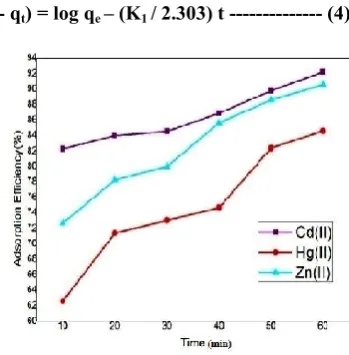
Fig.9 obviously showed that the adsorption process was prompt at the starting of reaction and over within 20 min. Consequently a prolonged next stage for the heavy metal ions
removal adsorption on PFR/nFe2O3 & nTiO2 was ceased
within 60 min. Hence the equilibrium time was 20 min for this adsorption. Further, no major change was detected owing to the occurrence of more active sites at begin of the reaction
and more active sites were not available on PFR / nFe2O3 &
nTiO2 after 20 min. The efficiency of the IERs was valued
through analyzing adsorption kinetics. The rate constant was calculated from Lagergren Pseudo - first order equation which
is commonly expressed as (Aroua et al., 2008).
Log (qe - qt) = log qe – (K1 / 2.303) t --- (4)
Figure. 9. Effect of contact time on the removal of Cd(II) ,Zn(II) & Hg(II) from aqueous solution
Fig. 10. Pseudo first order plot for the removal of Cd (II), Zn (II) and Hg(II) from aqueous solution
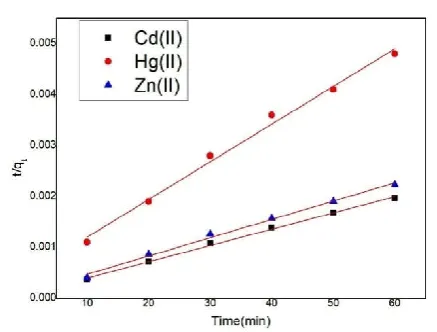
Fig. 11. Pseudo second order plot for the removal of Cd (II), Hg (II) and Zn(II) from aqueous solution
Where K1 is the pseudo-first-order rate constant (min-1) and qe
(mg g-1) is the adsorption capacity at equilibrium and qt (mg g
-1
) is the adsorbed amount of metal ion after time t (min). The all values are calculated from Fig.10 and are presented in
Table.2. The linear form of pseudo - second order kinetic
model can be expressed as (Shubha et al., 2001):
t / qt = 1/ K2 qe2 + t/qe --- (5)
Where K2 is the rate constant of second order adsorption
(g/mg/min). K2 and qe were determined from the Fig.11 and
are tabulated in Table.2. The R2 values for pseudo
second-order kinetic model are relatively higher than pseudo-first order kinetic model. The correlation between predicted and
experimental qe values pointed out that the adsorption system
studied goes to pseudo second-order kinetic model. This model was to the highlight the rate-limiting step of the adsorption process and recommended by Weber and Morris
(Freundlich, 1906). If the plot qt versus t1/2 makes a straight
line and exceed throughout the origin, intra-particle diffusion is the source of rate-limiting step. This equation can be expressed as
qt = Kid t1/2 + C --- (6)
Where qt is the adsorption capacity at any time t and Kid is the
intra particle diffusion rate constant and C is the film
thickness. The calculated Kid, C and correlation coefficient (R2)
values are tabulated in Table.2.Larger the value of C greater is the effect of boundary layer on adsorption process. The deviation of the plot from the linearity indicates the rate-limiting step have to be controlled boundary layer diffusion. These two straight lines describe the points, the sharp first linear portion is because of the film diffusion and the second linear portion is because of the pore diffusion. Non-linearity of the plots had revealed the multi stage adsorption for adsorbing
Cd (II), Hg (II) and Zn(II)ions through PFR/nFe2O3 &nTiO2.
Effect of temperature
The effect of temperature on the adsorption of heavy metal
ions by PFR/nFe2O3 & nTiO2 was studied form 303 K to 323
K. Thermodynamic parameters tell feasibility and the spontaneous nature of the adsorption process. The thermodynamic parameters, specifically free energy change
(ΔGO), entropy change (ΔSO) and enthalpy change (ΔHO),
were studied using the equilibrium constants at different
temperatures. The adsorption equilibrium constant (KC) was
calculated by the following equation:
KC = Cad (solid) / Ce (solution) --- (7)
Cad is the amount of metal (mg) adsorbed on the adsorbent per
liter (L) of the solution at equilibrium, and Ce is the
equilibrium concentration (mg L-1) of the metal in the solution.
The free energy change (ΔGO) of the adsorption was calculated
by the following equation:
ΔGO = -2.303 RT log KC --- (8)
Table 2. Kinetic parameters for the adsorption of Cd(II) ion , Zn(II) ion and Hg(II ) on PFR/nFe2O3 & nTiO2
Mathematical models Parameters Cd(II) Zn(II) Hg(II)
First-order kinetics Second-order kinetics
Intra-particle diffusion
R2
k1 (min-1)
qe (mg/g)
R2
k2 g/mg/min
qe (mg/g)
R2
kid g/mg/min1/2
C (mg/g)
0.962 79.70 1.5776 0.992 80.00 0.0125 0.962 79.70 0.198
0.975 70.03 2.2908 0.995 70.422 0.0142 0.975 70.03 0.360
0.942 60.35
2.5882 0.994 60.606 0.0165 0.942 60.35 0.413
The correlation between equilibrium constant (KC) and
temperature (T) is indicated using the van’t Hoff equation:
Log KC = - (ΔH
O
/ 2.303 RT) + (ΔSO / 2.303R) --- (9)
The enthalpy change (ΔHO) and entropy change (ΔSO) values
were calculated from the slope and intercept of the linear plot
log KC versus 1/T (Fig.12). The calculated all values were
tabulated in Table.3. The negative values of ΔHO show the
exothermic nature of the ion exchange process between heavy
metals and PFR/nFe2O3, nTiO2 as the negative value of ΔGO
indicates the spontaneous nature of heavy metals sorption
(Lagergren et al., 1898). The negative entropy change (ΔSO)
value represents to a decrease in the degree of freedom of the adsorbed metal ions.
Figure 12. Van’t Hoff plots of ln Kversus 1/T for the adsorption of Cd(II) ion, Hg(II) and Zn(II) onto PFR/nFe2O3 & nTiO2
Table 3.Thermodynamic Parameters
Metal Ions Thermodynamics parameters
R2 ΔH˚
J/mol ΔS˚ J/mol K
-ΔG˚(kJ/mol) ×102
Cd(II) 0.909 21.96 0.211 308K 318K 328K
-86.92 -89.83 -90.79
Zn(II) 0.984 91.82 0.522 -69.23 -73.62 -79.67
Hg(II) 0.991 114.5 0.554 -55.67 -62.43 -66.75
Conclusion
nFe2O3 & nTiO2 were tightly impregnated within a polymeric
matrix PFR through a polycondensation process, using formaldehyde as the cross-linking agent and a novel composite
nano porous cation exchanger (20nm) PFR/nFe2O3 & nTiO2
was obtainable for selective heavy metals removal. As
Compared to PFR, PFR/nFe2O3 & nTiO2 displayed more
preferable heavy metals confiscation from aqueous medium. The kinetic studies show that the adsorption of heavy metals
onto PFR/nFe2O3 & nTiO2 followed the pseudo-second order
rate expression. The adsorption isotherm studies confirmed a good fit with the D-R isotherm model. The exchanges between
heavy metals and PFR/nFe2O3 & nTiO2 are
thermodynamically feasible, spontaneous and endothermic in nature. The current study concludes that nano porous cation
exchange resin PFR/nFe2O3 & nTiO2 could be applied for the
removal of heavy metal ions from aqueous solution as well as waste water.
REFERENCES
Aroua, M.K., Leong, S.P.P., Teo, L.Y., Yin, C.Y. and Daud, W.M.A.W. 2008. Real-time determination of kinetics of adsorption of lead (II) onto palm shell - based activated
carbon using ion selective electrode, Bioresour. Technol.
99 5786-5792.
Atia, A.A., Donia, A.M., Elwakeel, K.Z. 2005. Selective separation of mercury(II) using a synthetic resin containing amine and mercaptan as chelating groups, Sep. Purif. Technol. 65 267–275.
Atzei, D. et al. 2001. Structural characterization ofcomplexes
between iminodiacetate blocked on styrene-divinylbenzene matrix (Chelex 100 Resin) and Fe(iii), Cr(iii), Zn(iii) in solid phase by energy-dispersive X-ray diffraction, J. Am. Chem. Soc. 123 2552–2558.
Baraka, A., Hall, P.J. and Heslop, M.J. 2007. Melamine–
formaldehyde–NTA chelating gel resin: synthesis,
characterization and application for copper (II) ion removal
from synthetic wastewater, J. Hazard. Mater. 140 86–94.
Bassett, G.H., Jeffery, J., Mendham, J. and Denney, R.C. 1989. Vogel’s Text Book of Quantitative Chemical Analysis, fifth Ed, Longman, London.
Beatty, S.T., Fischer, R.J. 1999. A comparative study of the removal of heavy metal ions from water using a silica–
polyamine composite and a polystyrene chelator resin, Ind.
Eng. Chem. Res. 38 4402–4408.
Chen, C.Y. 2003. Stability constants ofwater-soluble and latex types of chelating polymers containing iminodiacetic acid
with some transitionmetal ions, Eur. Polym. J. 39 991–
1000.
Chen, C.Y. 2005. Formation of silver nanoparticles on a chelating copolymer film containing iminodiacetic acid, Thin Solid Films 484 68–72.
Chen, C.Y. et al. 2007. Recovery of Cu(II) and Cd(II) by a
chelating resin containing aspartate groups, J. Hazard.
Mater. 45 154–160.
Chen, C.Y., Chiang, C.L., Chen, C.R. 2007. Removal of heavy metal ions by a chelating resin containing glycine as chelating groups, Sep. Purif. Technol. 54 396–403.
Dakova, I., Karadjova, I., Ivanov, I., Georgieva, V., Evtimova, B., Georgier, G. 2007. Solid phase selective separation and preconcentration of Cu(II)-imprinted polymethacrylic
microbeads, Anal. Chim. Acta 584 146–203.
Deepatona, A., Valix, M. 2006. Recovery of nickel and cobalt from organic acid complexes: adsorption mechanisms of
metal–organic complexes onto aminophosphanate
chelating resin, J. Hazard. Mater., B 137 925– 933.
Denizi, A. et al. 2004. Methacryloylamidoglutamic acid
incorporated porous poly (methylmethacrylate) beads for
heavy-metal removal, Ind. Eng. Chem. Res. 43 6095–6101.
Donia, A.M., Atia, A.A., EL-Boraey, H.A. and Mabrouk, D.H. 2006. Uptake studies of copper (II) on glycidyl methacrylate chelating resin containing Fe2O3 particles, Sep. Purif. Technol. 49 64–70.
Duran, A., Soylakb, M., Ali Tuncel, S. Poly 2008. (vinyl pyridine-poly ethylene glycol methacrylate-ethylene glycol
dimethacrylate) beads for heavy metal removal, J. Hazard.
Mater. 155 114–120.
Eloueara, Z., Bouzida, J. et al. 2008. Heavy metal removal
from aqueous solutions by activated phosphate rock, J.
Hazard. Mater. 156 412–420.
Freundlich, H.M.F. 1906. Uber die adsorption in Losungen, Z. Phys. Chem. 57 385–470.
Gode, F., Pehlivan, E. 2003. A comparative study of two chelating ion-exchange resins for the removal of chromium
(II) from aqueous solution, J. Hazard. Mater. B100 231–
243.
Juang, R.S. and Wang, Y.C. 2003. Ligand-enhanced separation of divalent heavy metals from aqueous solutions
using a strong-acid ion-exchange resin, Ind. Eng. Chem.
Res. 42 1948–1954.
Kantipuly, G., Katragadda, S., Chow, A., Gesser, H.D. 1990. Chelating polymers and related supports for separation and preconcentration of trace metals, Talanta 37 491–498. Kołodynˇıska, D., Hubicki, Z., Geca, M. 2008. Polyaspartic
acid as a new complexing agent in removal of heavy metal ions on polystyrene anion exchangers, Ind. Eng. Chem. Res. 47 6221–6227.
Lagergren, S. 1898. Zur theorie der sogenannten adsorption geloster stoffe. Kungliga Svenska Vetenskapsakademiens, Handlingar. 24 1–39.
Leinonen, H., Lehto, J. 2000. Ion-exchange of nickel by iminodiacetic acid chelating resin chelex 100, React. Funct. Polym. 43 1–6.
Lezzi, A. and Cobianco, S. 1994. Chelating resins supporting dithiocarbamate and methylthiourea groups in adsorption of heavy metal ions, J. Appl. Polym. Sci. 54 889–897. Li, W., Zhao, H., Teasdale, P.R., John, R., Zhang, S. 2002.
Synthesis and characterization of a polyacrylamide– polyacrylic acid copolymer hydrogel for environmental analysis of Cu and Cd, React. Funt. Polym. 52 31–41. Lin, S.H., Lai, S.L., Leu, H.G. 2000. Removal of heavy metals
from aqueous solution by chelating resin in amultistage adsorption process, J. Hazard. Mater. B76 139–153. Liu, Y., Chang, X., Yong, D., Guo, Y., Meng, S. 2005. Highly
selective determination of inorganic mercury (II) after
preconcentration with Hg(II)-imprinted diazo amino
benzene–vinylpyridine copolymers, Anal. Chim. Acta 538
85–91.
Mathew, B., Rajasekharan Pillai, V.N. 1994. N,N_-2-methylene bisacrylamide cross linked polyacrylamides as supports for dithiocarbamate ligands for metal ion
Complexation, Polym. Int. 28 201–208.
Natarajan, M. and Krishnamoorthy, S. 1993. Studies on p-cresol-formaldehyde cationic resins substituted by coconut
shell carbon, Res. Ind. 38 278-282.
Navarro, R.R., Tatsumi, K., Sumi, K. and Matsumura, M. 2001. Role of anions on heavy metal sorption of a cellulose
modified with poly (glycidyl methacrylate) and
polyethyleimine, Water Res. 35 2724–2730.
Pehlivan, E., Altun, T. 2006. The study of various parameters
affecting the ion exchange of Cu2+, Zn2+, Ni2+, Cd2+ and
Pb2+ from aqueous solution on Doewex 50w synthetic
resin, J. Hazard. Mater. B134 149–156.
Pramanik, S., Dhara, P.K., Chatto padhyay, P. 2004. A chelating resin containing bis(2-benzimidazolymethyl) amine: synthesis andmetal-ion uptake properties suitable for analytical application, Talant 63 485–490.
Reddy, K.H. and Reddy, A.R. 2003. Removal of heavy metal ions using the chelating polymers derived by the
condensation of poly (3-hydroxy-4-acrtylphenl
methacrylate) with different diamine, J. Appl. Polym. Sci.
88 414–421.
Roy, P.K., Rawat, A.S. and Rai, P.K. 2003. Synthesis, characterisation and evaluation of polydithiocarbamate resin supported on macroreticular styrene–divinylbenzene copolymer for the removal of trace and heavy metal ions, Talanta 59 239–246.
Sarkar, S., Sengupta, A.K., Prakash, P. 2010. The Donnan membrane principle: opportunities for sustainable
engineered processes and materials, Environ. Sci. Technol.
44 1161–1166.
Shubha, K., Raji, C. and Anirudhan, T.S. 2001.
Immobilization of heavy metals from aqueous solutions using polyacrylamide grafted hydrous Tin (IV) oxide gel
having carboxylate functional groups, Water Res.35
300-310.
Shukla, S.R., Pai, R.S., Shendarkar, A.D. 2006. Adsorption of Ni(II), Zn(II) and Fe(II) on modified coir fibres, Sep. Purif. Technol. 47 141–147.
Siva, S., Sameem, S.M., Sudharsan, S., Sayeekannan, R. 2014. Green, effective biological route for the synthesis of silver nanoparticles using Cyperus rotundus grass extracts, IJCR. 6 4532-4538.
Sosa, I.O., Noguez, C., Barrera, R.G. 2003. Optical properties
of metal nanoparticles with arbitrary shapes, J. Phys.
Chem., 107 6269–6275.
Srivastava, V.C., Mall, I.D. and Mishra, I.M. 2006. Characterization of mesoporous rice husk ash (RHA) and adsorption kinetics of metal ions from aqueous solution
onto RHA, J.Hazard.Mater.314 257-267.
Vasudevan, P. and Sharma, N.L.N. 1979. Composite cation
exchangers, J. Appl. Poly. Sci., 23 1443-1448.