Application of PID Controller for Load Frequency Control of a
Hybrid Power System
Jag Pravesh*1, Pardeep Nain2
1Electrical Engg., OITM Hisar, Haryana, India 2Electrical Engg., OITM Hisar, Haryana, India ABSTRACT
In this paper, the Load Frequency Control issue in a Hybrid Power System (HPS) by implementing a novel Flower Pollination Algorithm (FPA) based Proportional-Integral-Derivative (PID) controller. LFC aims at constraining the system frequency and tie-line power deviations within prescribed limits thereby maintaining the system reliability and stability. An HPS consists of a Micro-Grid (MG) connected to the conventional power grid. An FPA based PID controller has been proposed to regulate the frequency and tie-line power dynamics. To demonstrate the effectiveness of the proposed controller its performance has been compared with the PI and I controllers. Simulation has been carried out using the MATLAB and SIMULINK environment. The simulation results clearly reveal the potential of the proposed controller over the other controllers. Also, the proposed controller has been tested subject to a Random Load Perturbation (RLP) and its simulation results when compared to the PI and I controllers are found to be superior.
Keywords: Hybrid power system model, Load frequency control, Renewable energy sources, Flower Pollination Algorithm
I.
INTRODUCTIONAvailability and consumption of electrical energy plays a crucial role in enhancing overall gross development products of any country in the world. However, high percentage of electrical energy requirement is met from fossil-fuel fired generating units. The reserves of fossil fuels are depleting at fast rate. The gap between power generation and demand is widening day-by-day which has forced electric power utilities to supply power to the customers erratically. Not only this, there are many places in the world which are yet to be electrified due to energy shortage issue. Moreover, growing concern on deteriorating environmental conditions has led the electrical power utilities round the world to search for renewable energy sources (RESs) based power generation technologies. RES based power generation
micro-turbine generator (MTG) and diesel engine generator (DEG), non-traditional power generators like fuel cell (FC) with aqua-electrolyser (AE), RES based generators like wind turbine generator (WTG), solar photovoltaic (PV) generator and energy storage units (ESUs) like battery energy storage system (BESS), flywheel energy storage system (FESS), ultra-capacitor (UC) and superconducting magnetic energy storage (SMES) system. The power generated from WTGs and SPVGs are sporadic in nature. Therefore, while designing HPS, power generators such as MTGs and DEGs must be used as standby generators to meet the load requirement. Apart from this, ESUs are also inevitable components of such autonomous HPS which ensure its stable operation by quickly alleviating short-term power fluctuations by the way of storing and releasing adequate amount of power as and when required [4–12].
II.
MATHEMATICAL MODEL OF THEHYBRID POWER SYSTEM
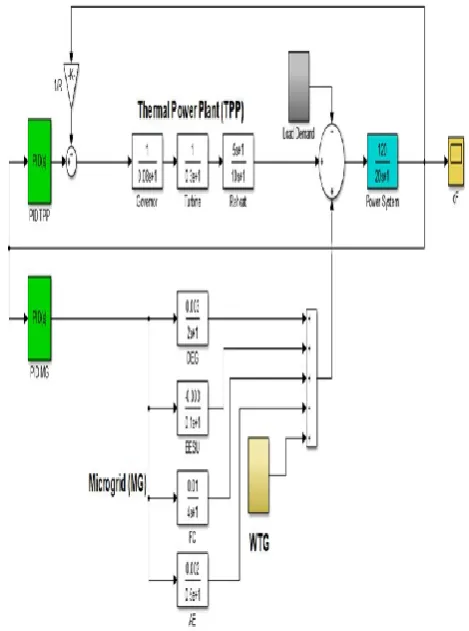
The Figure.1 shows the mathematical model of a hybrid power system (HPS). HPS has two main components: MG and TPP. MG consists of a diesel engine generator (DEG), wind turbine generator (WTG), battery energy storage system (BESS), aqua-electrolyser (AE) and fuel cell (FC). TPP consists of reheat thermal power generation. PID controllers are provided for both the MG and the TPP to regulate the frequency dynamics of the system. Modelling of HPS components presents modelling of different components of the studied HPS. In Section Proposed HPS and adopted control strategy investigated HPS and adopted PID optimization technique like flower pollination algorithm. PID controller is one of the most commonly used conventional controllers used by the process industries. It is, easily, realizable and it offers superior performance in eliminating steady state errors and improving overall system dynamic response.
Figure 1. MATLAB Simulation model of a hybrid power system
III.
FLOWER POLLINATION ALGORITHMfishes and birds,. All of these proposed theories have been applied on different applications. In the field of engineering and industry, we are to try to find out the optimal solution of a given problem under highly complex constraints. These type of constrained in optimization problems are mainly highly nonlinear, to find out the optimal solutions is very challenging task if it is not impossible. Most of conventional optimization does not work well for problems with nonlinearity and multimodality. In today scenario we use nature-inspired metaheuristic algorithms to solve such difficult problems, and it has been finding that metaheuristics are surprisingly very efficient. Due to this reason, the literature of nature-inspired algorithms has expanded tremendously in the last two decades. In this paper, we are going to propose a new algorithm that is based on the flower pollination process of flowering plants. As from the biological evolution theory, the aim of the flower pollination is the survival of the fittest and the optimal reproduction of plants in the terms of numbers as well as fittest. This is in fact an optimization process of plant species. All the above points and factors of flower pollination interact so as to get optimal reproduction of the flowering plants. Hence, this may inspire to design a new optimization algorithm. The basic idea of flower pollination in the context of bees and clustering was investigated before but in this paper, we can design a completely new optimization solely based on the flower pollination characteristics.
Flower Pollination Algorithm Step
Now from the above characteristics we can idealize of pollination process, flower constancy and pollinator behaviour as the following steps:
1. Biotic and cross-pollination is considered as global pollination process with pollen-carrying pollinators performing L´evy flights.
2. Abiotic and self-pollination are considered as local pollination.
3. Flower constancy can be considered as the reproduction probability is proportional to the similarity of two flowers involved.
4. Local pollination and global pollination is controlled by a switch probability p ∈ [0, 1].
Due to the physical proximity and other factors such as wind, local pollination can have a significant fraction p in the overall pollination activities. Obviously, in reality, each plant can have multiple flowers, and each flower patch often release millions and even billions of pollen gametes. However, for simplicity, we also assume that each plant only has one flower, and each flower only produce one pollen gamete. Thus, there is no need to distinguish a pollen gamete, a flower, a plant or solution to a problem. This simplicity means a solution xi is equivalent to a flower and/or a pollen gamete. In future studies, we can easily extend to multiple pollen gametes for each flower and multiple flowers for multi-objective optimization problems. From the above discussions and the idealized characteristics, we can design a flower-based on algorithm, namely, flower pollination algorithm (FPA). There are two key steps in this algorithm, they are global pollination and local pollination. In the global pollination step, flower pollens are carried by pollinators such as insects, and pollens can travel over a long distance because insects can often fly and move in a much longer range. This ensures the pollination and reproduction of the most fittest, and thus we represent the most fittest as g.
IV.
RESULTS AND DISCUSSIONNominal Loading Curves:
Curve (a) shows the output power of the WTG which is assumed to be constant at 0.005 pu. Curve (b) shows the output power of the TPP.
Curve (c) shows the output power of the MG.
(a)
(b)
(c)
(d) RLP curves:
Curve (e) shows Random load perturbation (i.e. load variation) during 100 sec interval. Curve (f) shows the Output power of MG during the RLP. Curve (g) shows the Output power of TPP during the RLP. Curve (h) shows the Output of WTG assumed to be constant during the RLP scenario. Figure (i) shows the frequency dynamics comparison between the PID, PI and I controllers with the power subjected to RLP.
(f)
(g)
(h)
(i) Convergence Curve:
J =
Convergence curve for the performance index J corresponding to the PID controller.
J = ∫ is calculated using the integral square error (ISE). Tsim is the simulation time in seconds.
Table 1 Optimi zed parame ters Controllers
TPP MG
PID PI I PID PI I
Kp
-10.37 32 -0.79 53 -0.60 52 15.81 71 -20.23 65 -12.39 84
Ki
-10.12 04
-1.34 77
- 20.02
29 -12.80 36
-
Kd
-18.05 48
- - 31.95
24
- -
V.
CONCLUSIONIn this paper, the application of an FPA based PID controller to resolve the LFC issue in an HPS. An HPS consists of an MG connected to a TPP. Performance comparison of the proposed controller with the PI and I controllers has been carried out in the MATLAB and SIMULINK environment. Simulation results show that the proposed controller performs better than the other two controllers in terms of the system frequency dynamics.
The FPA based PID controller can further be used in applications involving multi-area HPS and for solving other complex power system problems.
VI.
REFERENCES[1]. Doolla S, Bahtti TS. Automatic generation control of an isolated small-hydro power plant. Electr Power Syst Res 2006;76(1):889–96. [2]. Banerjee A, Mukherjee V, Ghoshal SP.
Intelligent fuzzy-based reactive power compensation of an isolated hybrid power
system. Int J Electr Power Energy Syst 2014;57(1):164–77.
[3]. Singh B, Mukherjee V, Tiwari P. A survey on impact assessment of DG and FACTS controllers in power system. Renew Sust Energy Rev 2015;42 (1):846–82.
[4]. El-Khattam W, Salama MMA. Distributed generation technologies, definitions and benefits. Electr Power Syst Res 2004;71(1):119– 28.
[5]. Zhao JH, Foster J, Dong ZY, Wong KP. Flexible transmission network planning considering distributed generation impacts. IEEE Trans Power Syst 2011;26 (3):1434–43.
[6]. Aghamohammadi MR, Abdolahinia H. A new approach for optimal sizing of battery energy storage system for primary frequency control of islanded microgrid. Int J Electr Power Energy Syst 2014;54(1):325–33.
[7]. Barsali S, Ceraolo M, Giglioli R, Poli D. Storage applications for smartgrids. Electr Power Syst Res 2015;120(1):109–17.
[8]. Chatterjee A, Ghoshal SP, Mukherjee V. Artificial bee colony algorithm for transient performance augmentation of grid connected distributed generation. In: Proc international conference on swarm evolutionary memetic computation, vol. 6466; 2010. p. 559–66.
[9]. Hien NC, Mithulananthan N, Bansal RC. Location and sizing of distribution generation units for loadability enhancement in primary feeder. IEEE Syst J 2013;7(4):797–806.
[10]. Lopes JA Pecas, Hatziargyriou N, Mutale J, Djapic P, Jenkins N. Integrating distributed generations into electric power system: a review of drivers, challenges and opportunities. Electr Power Syst Res 2007;77(1):1189–203.
[11]. Sebastian R, Pena-Alzola R. Control and simulation of a flywheel energy storage for a wind diesel power system. Int J Electr Power Energy Syst 2015;64 (1):1049–56.
islanded and grid connected operation. Int J Electr Power Energy Syst 2014;55(1):704–13. [13]. Hatziargyriou N, Asano H, Iravani R, Marnay C.
Microgrids. IEEE Power Energy Mag 2007;5(4):78–94.
[14]. Lee D, Wang L. Small-signal stability analysis of an autonomous hybrid renewable energy power generation/energy storage system – Part I: Timedomain simulations. IEEE Trans Energy Convers 2008;23(1):311–20.
[15]. Das DC, Roy AK, Sinha N. GA based frequency controller for solar thermal diesel- wind hybrid energy generation/energy storage system. Int J Electr Power Energy Syst 2012;43(1):262–79. [16]. Wang L, Lee DJ, Lee WJ, Chen Z. Analysis of a
novel autonomous marine hybrid power generation/energy storage system with a high-voltage direct current link. J Power Sources 2008;185(1):1284–92.
[17]. Senjyu T, Nakaji T, Uezato K, Funabashi T. A hybrid power system using alternative energy facilities in isolated island. IEEE Trans Energy Convers 2005;20(2):406–14.
[18]. Kamwa I. Dynamic modelling and robust regulation of a no-storage wind–diesel hybrid power system. Electr Power Syst Res 1990;18(3):219–33.
[19]. Gampa SR, Das D. Real power and frequency control of a small isolated power system. Int J Electr Power Energy Syst 2015;64(1):221–32. [20]. Gao L, Dougal RA, Liu S. Power enhancement
of an actively controlled battery/utracapacitor hybrid. IEEE Trans Power Electron 2005;20(1):236–43.
[21]. Aditya SK, Das D. Application of battery energy storage system to load frequency control of an isolated power system. Int J Energy Res 1999;23(3):247–58.
[22]. Kottick D, Blau M, Edelstein D. Battery energy storage for frequency regulation in a island power system. IEEE Trans Energy Convers 1993;8(3):455–9.
[23]. Ray PK, Mohanty SR, Kishor N. Small-signal analysis of autonomous hybrid distributed generation systems in presence of ultracapacitor and the tie-line operation. J Electr Eng 2010;61(4):205–14.
[24]. Das DC, Roy AK, Sinha N. PSO optimized for wind–solar thermal-diesel hybrid energy generation system: a study. Int J Wisdom Based Comput 2011;1 (3):128–33.
[25]. Al-Saedi W, Lachowicz SW, Habibi D, Bass O. Voltage and frequency regulation based DG unit in an autonomous microgrid operation using particle swarm optimization. Int J Electr Power Energy Syst 2013;53(1):742–51.
[26]. Mukherjee V, Ghoshal SP. Application of capacitive energy storage for transient performance improvement of power system. Electr Power Syst Res 2009;79(2):282–94. [27]. Mukhtaruddin RNSR, Rahman HA, Hassan MY,
Jamian JJ. Optimal hybrid renewable energy design in autonomous system using iterative-pareto-fuzzy technique. Int J Electr Power Energy Syst 2015;64(1):242–9.