Original Research Article
A comparative study to assess the knowledge, attitude and
practice regarding tuberculosis among the male and female
TB patients in district Amritsar
Pooja Sadana
1*, Vishal Verma
2, Tejbir Singh
3, S. S. Deepti
3INTRODUCTION
Tuberculosis (TB) remains a major health burden and it is one of the top 10 causes of death, and the leading cause from a single infectious agent ranking above HIV/AIDS. Millions of people continue to fall sick with the disease each year. In 2017, TB caused an estimated 1.3 million deaths among HIV-negative people, and there were an additional 3 lakh deaths from TB among HIV-positive people. Globally, there were an estimated 10.0 million
new cases of TB equivalent to 133 cases per 100 000 population in 2017 this includes 5.8 million men, 3.2 million women and 1.0 million children.1 About 1.7 billion people, 23% of the world’s population, are estimated to have a latent TB infection, and are thus at risk of developing active TB disease during their lifetime.2
Poverty and lack of awareness about TB are considered the most important factors that increase the risk of
ABSTRACT
Background: Lack of knowledge about tuberculosis could have an effect on the patients who seek health care services and continue the disease transmission within the public. Hence, the study was conducted in Amritsar district to assess knowledge, attitude and practice towards transmission and prevention of Tuberculosis.
Methods: The study was conducted on 326 patients registered with district tuberculosis centre, Amritsar. Information was collected with reference to knowledge, attitude, and practice regarding TB.
Results: A total of 228 patients participated in the study. 72.4% had heard of tuberculosis before being diagnosed, with significant gender difference (p=0.016). 19.3% were afraid to disclose the disease to others. The relation between fear of disclosing the disease and gender was found to be statistically significant (p=0.011). 23.5% male vs 8.3% females were worried about finances, which was found to be statistically significant (p=0.002). Regarding the practices, 72.4% of the patients used separate utensils. In response to stigma 9.2% patients had isolated themselves from other members and 34.6% had discontinued their work and there was significant gender difference seen with both these practices (p=0.0001).
Conclusions: There were lot of unfavourable attitude and practices regarding TB. More male patients had heard of tuberculosis. Due to social stigma more males had isolated themselves and discontinued their work as compared to females. Females were worried that other family members may not get the disease.
Keywords: Knowledge, Attitude, Practice, Tuberculosis
Department of Community Medicine, 1Sri Guru Ramdas Institute of Medical Sciences and Research, 3Govt Medical College, Amritsar, Punjab, India
2
Office of Civil Surgeon, Tarn Taran, Punjab, India
Received: 19 March 2019
Revised: 09 May2019
Accepted: 10 May 2019
*Correspondence:
Dr. Pooja Sadana,
E-mail: [email protected]
Copyright: © the author(s), publisher and licensee Medip Academy. This is an open-access article distributed under the terms of the Creative Commons Attribution Non-Commercial License, which permits unrestricted non-commercial use, distribution, and reproduction in any medium, provided the original work is properly cited.
exposure to TB. In addition, poor access to health facilities, lack of finances and lack of knowledge about the cause, mode of transmission, and symptoms, can act as barriers to TB diagnosis.3 Furthermore, it has been seen that the disease has a significant impact on social relations. This occurs when there is stigma, discrimination, and several misconceptions that could contribute to poor adherence and treatment compliance which pose a formidable challenge to control the disease.4 A high level of awareness on TB is essential for the prevention and control of TB in the community. Little is known about the knowledge, attitude and practices of communities towards TB in the current study area. Therefore, the study was conducted in Amritsar city to assess patient’s knowledge, attitude and practice towards TB.
Objective of the study
To assess the knowledge in patients regarding the tuberculosis.
To compare the knowledge, attitude and practice of male and female patients regarding tuberculosis.
METHODS
The study was conducted in the field practice area of department of Community Medicine, Government Medical College, Amritsar. It falls under the Primary Health Centre (PHC) Verka.
All the patients belonging to the study area and registered with District Tuberculosis Centre, Amritsar from 1st April 2010 to 31st March 2011 were included in the study.
Inclusion criteria
Patients on directly observed treatment therapy were only included for the study. Patients of all three categories (i.e I, II& III) were included because at time of registration (2010) there were three categories.
List of patients suffering from tuberculosis with their complete address and treatment record was obtained from the tuberculosis register at District Tuberculosis center. Patients once started on treatment were included in the study. Houses of all the patients were located using address mentioned in the tuberculosis register, DOT provider or staff who knew the patients. If the patient was not available in the first visit, then every effort was made to contact the patient by subsequent visits as per convenience and suitability to the patient. In the event a patient no longer lived at a specific address, help of local neighbours and guides was taken to trace the patients. Patients who had migrated to another district were excluded from the study. The patients who were below 14 years of age, the adult family member who accompanied the patient to the DOT centre were interviewed and the consent of the parent/ guardian was taken. Informed
consent was taken from each study subject in their own vernacular language.
The information regarding name, age, sex, occupation, socio economic status, knowledge and practices regarding the disease was obtained personally by interviewing the patient. Modified Kuppuswami’s socio-economic status scale, 2012, was used to determine the socioeconomic status of the participants. The information was recorded on a pretested and preformed questionnaire evolved for the study. Approval of college ethical committee was granted at the time of submission of the plan of the study.
Statistics
The data collected was compiled and analyzed statistically with help of Epi info version 3.5.3. Chi square test was applied to find the difference of knowledge about TB among male and female patients. The level of statistical significance was defined as p<0.05 and valid conclusions were drawn.
RESULTS
Following observations were made:
Out of the total 326 patients, only 228 (69.94%) patients were interviewed. 59 (18.10%) patients could not be traced as most of them had migrated to new place and some of them could not be traced due to their incomplete or wrong addresses. 36 (11.04%) had died by the time of interview. 3 (0.92%) patients did not give consent for interview.
Table 1: Distribution of patients according to socio demographic variables (n=228).
Socio-demographic
factor Total
Percentage (%)
Age group (years)
1-14 21 9.2
15-29 99 43.4
30-44 55 24.2
45-59 40 17.5
60-74 13 5.7
Sex
Male 132 57.90
Female 96 42.10
Literacy status
Illiterate 84 36.84
Below matric and matric 125 54.82
Above matric 19 8.34
Socio economic status*
Upper 2 0.90
Upper middle 11 4.80
Upper lower 180 78.90
Lower middle 23 10.10
Lower 12 5.30
The socio-demographic profile of the patients is summarized in Table 1. Among the 228 patients studied, majority 99 (43.40%) patients were in the age group
15-29 years. 67.6% of the patients belonged to
economically productive age group i.e. 15-44 years.
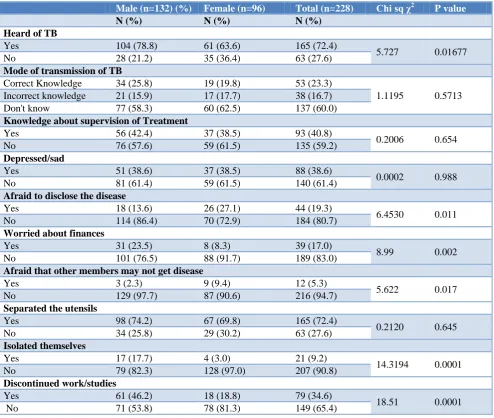
Table 2: Distribution of patients according to knowledge, attitude and practice regarding TB.
Male (n=132) (%) Female (n=96) Total (n=228) Chi sq χ2 P value
N (%) N (%) N (%)
Heard of TB
Yes 104 (78.8) 61 (63.6) 165 (72.4)
5.727 0.01677
No 28 (21.2) 35 (36.4) 63 (27.6)
Mode of transmission of TB
Correct Knowledge 34 (25.8) 19 (19.8) 53 (23.3)
1.1195 0.5713
Incorrect knowledge 21 (15.9) 17 (17.7) 38 (16.7)
Don't know 77 (58.3) 60 (62.5) 137 (60.0)
Knowledge about supervision of Treatment
Yes 56 (42.4) 37 (38.5) 93 (40.8)
0.2006 0.654
No 76 (57.6) 59 (61.5) 135 (59.2)
Depressed/sad
Yes 51 (38.6) 37 (38.5) 88 (38.6)
0.0002 0.988
No 81 (61.4) 59 (61.5) 140 (61.4)
Afraid to disclose the disease
Yes 18 (13.6) 26 (27.1) 44 (19.3)
6.4530 0.011
No 114 (86.4) 70 (72.9) 184 (80.7)
Worried about finances
Yes 31 (23.5) 8 (8.3) 39 (17.0)
8.99 0.002
No 101 (76.5) 88 (91.7) 189 (83.0)
Afraid that other members may not get disease
Yes 3 (2.3) 9 (9.4) 12 (5.3)
5.622 0.017
No 129 (97.7) 87 (90.6) 216 (94.7)
Separated the utensils
Yes 98 (74.2) 67 (69.8) 165 (72.4)
0.2120 0.645
No 34 (25.8) 29 (30.2) 63 (27.6)
Isolated themselves
Yes 17 (17.7) 4 (3.0) 21 (9.2)
14.3194 0.0001
No 79 (82.3) 128 (97.0) 207 (90.8)
Discontinued work/studies
Yes 61 (46.2) 18 (18.8) 79 (34.6)
18.51 0.0001
No 71 (53.8) 78 (81.3) 149 (65.4)
Table 2 shows that majority i.e. 165 (72.4%) had, at least heard of Tuberculosis before being diagnosed, with significant gender difference (p=0.016). Out of 63 patients who had not heard of TB, 21.2% and 36.4% were males and females respectively. 53 (23.3%) had correct knowledge regarding mode of transmission of TB. Majority i.e. 137 (60.0%) of the study participants had absolutely no knowledge regarding the mode of spread of tuberculosis. Only 93 (40.8%) patients knew that DOTS is a supervised treatment. Knowledge about mode of transmission and about supervision of treatment showed no association with gender.
On being diagnosed, depression/sadness was equally found among both males (38.6%) and females (38.5%) participants. 44 (19.3%) were afraid to disclose the disease to others. The relation between fear of disclosing the disease and sex of patient was found to be statistically
significant (p=0.011). 23.5% male vs 8.3% females were worried about finances, which was found to be statistically significant (p=0.002). 12 (5.3%) respondents were worried that the disease may be transmitted to their family members. When asked about the practices for the prevention of TB, 165 (72.4%) of the patients replied that they used separate utensils, 21 (9.2%) had isolated themselves from other members and 79 (34.6%) had discontinued work/studies so that others may not get the disease and that society may stigmatize them.
DISCUSSION
In the present study, 154 (67.6%) of the patients belonged to economically productive age group i.e. 15-44 years. According to TB India 2012 report, tuberculosis primarily affects people in their most productive years of life. Almost 70% of TB patients are between 15-54 years of age.5 In our study 194 (85%) patients belonged to 15-59 years, similar findings are seen in a study conducted by Mohrana et al showed that 91.4% cases belonged to economically productive age group 15-59 years.6
In the present study male to female ratio was 1.37:1 approximately. This is in accordance with WHO global TB report 2014, the male: female ratio was 1.6 globally, ranging from 0.7 to 2.9 among high burden countries.7 More prevalence of Tuberculosis among males may be because of the fact that males have more exposure because of outgoing habits or health of males is given more preference. In some societies social stigma may preclude women from attending tuberculosis clinics.
When we considered the educational status about 36.84% respondents were illiterate, and 215 (76.7%) persons belonged to lower socioeconomic class. High rate of illiteracy and poverty are common findings amongst tuberculosis patients.8 The social conditions which arise from poverty have been known to provide a favorable environment for TB disease.
A perusal of Table 2 shows that 165 (72.4%) patients had heard of TB before being diagnosed with significant gender difference (p=0.016). A cross-sectional study by Kar and Logaraj in rural Tamil Nadu showed that 56% had heard of TB.9 Another study by Mukhtar et al in Libya showed 96.5% respondents had heard of disease.10
Majority, 137 (60.1%) of the study participants were ignorant about the mode of transmission of TB. Out of 38 (16.7%) incorrect respondents, 10.5% mentioned that TB occurs as a complication of typhoid or some other fever of long duration. Some mentioned poor diet, water, and alcohol, as cause of TB. Rest stated that tuberculosis is a curse. The respondents who answered 'air' as mode of transmission were considered to have correct knowledge. Male participants were more likely to know TB as an airborne disease compared to female participants (25.8% males vs. 19.8% females) but the difference is not significant. The implication of such misconceptions regarding the cause of TB is that it may have a negative impact on patients’ attitude toward health-seeking behavior as people with such misconceptions may not visit health facilities or consider self-treatment, both of which delay case detection and treatment of patients with TB in the community. The results also showed that there was a significant difference in the knowledge about the mode of transmission of the TB between illiterate and literate tuberculosis patients. Poor knowledge about mode of transmission was significantly associated with less education (p=0.0007).
With regard to the attitudes towards TB, most of them 88 (38.6%) responded that they experienced sadness and/or hopelessness after being diagnosed with TB. Observations in our study are in line with the study by Thakker and Upadhyay which showed a feeling of worry and depression among 40.8% patients.11
Out of 132 males, 18 (13.6%) were afraid to disclose their disease to others. In contrast, out of 96 females, 26 (27.1%) were reluctant to disclose their disease. The relation between fear of disclosing the disease and sex of patient was found to be statistically significant (p=0.011). Female participants were more likely to be afraid to disclose their disease status compared to male participants. In order to get rid from discriminations and ill behavior from other people patients hide their disease. Balasubramanian et al showed that overall, 21% of women and 14% of men felt inhibited discussing their illness with their families or friends.12 A significantly higher proportion of women than men faced social stigmatisation or rejection because of their illness, felt inhibited discussing their illness with family and friends. This difference can be attributed due to the fact that they have to face more severe consequences. K Jaggarajamma et al showed that among those who disclosed the disease, 10% of the patients were kept isolated and 9% faced rejection due to their disease.13
In the present study, 39 (17.0%) patients were worried about finances, 23.5% male vs. 8.3% females were worried about finances, which was found to be statistically significant (p=0.002). 12 (5.3%) respondents were afraid that the disease may be transmitted to their family members.
A study to assess the psychological problems among TB patients by Thakker and Upadhyay also revealed that 66.6% of patients feared of spreading TB to other family members.11 Separating the dishes or early separating was the most common preventive measure adopted by the patients and their families to prevent the transmission of disease to other family members. Our study also revealed that, 165 (72.4%) of the patients used separate utensils. Study by Khan et al and by Bhattacharyya et al showed that 57% and 78.3% patients use separate utensils for the prevention of TB in family respectively.14,15
In present study 21 (9.2%) patients had isolated themselves from other family members. Relatively, a higher proportion of male TB patients were in favor of using separate room, as a preventive method of the disease, than female individuals (17.7% versus 3.0%, p=0.0001). Similar findings were observed in a study by Jangid et al where 47% patients kept themselves isolated (52.2% males vs 37.1% females).16 A study by Ritu et al, showed that spouses were found to sleep separately and avoided sexual contact.17
the disease and that society may stigmatize them. 46.2% males vs 18.8% females discontinued their work and there was significant gender difference (p=0.0001). Similar results were noted in a study done in turkey where 43.2% patients mentioned that they had to leave their job because of their illness.18
CONCLUSION
The study findings demonstrate that more males had heard of TB than females. There was also a significant difference in attitude and practice regarding TB among male and female patients. To improve the case detection rate, correct knowledge, attitude, and practices regarding tuberculosis are essential in the community. There is a need for a robust Information Education and Communication activities to remove the social stigma attached with the disease.
Funding: No funding sources Conflict of interest: None declared
Ethical approval: The study was approved by the Institutional Ethics Committee
REFERENCES
1. World Health Organisation. Global Tuberculosis Report. WHO Report. 2018: 27.
2. World Health Organisation. Global Tuberculosis Report. WHO Report. 2018: 2.
3. Tolossa D, Medhin G, Legesse M. Community knowledge, attitude, and practices towards tuberculosis in Shinile town, Somali regional state,eastern Ethiopia: a cross-sectional study. BMC Public Health. 2014;14:804.
4. Rathore MS, Jain J, Dixit M. A cross sectional study to assess the knowledge, attitude and practice regarding tuberculosis among the patients at GMCH, Udaipur (Rajasthan). Int J Community Med Public Health. 2017;4:4272-6.
5. TB India. RNTCP Annual status report. Central TB Division. Directorate General Of Health Services, Ministry of Health and Family Welfare, New Delhi. 2012 :11.
6. Mohrana PR, statapathy DM, Sahani NC, Behera TR, Jena D, Tripathi RM. An analysis of treatment outcome among tuberculosis patients put under DOTS at tertiary level health facility of Orrisa. J Community Med. 2009;5(2):4.
7. World Health Organisation. Global Tuberculosis Report. WHO Report. 2014: ch4.
8. Jangid VK, Agrawal NK, Yadav GS, Pandey S, Mathur BB. Knowledge and Awareness of the Tuberculosis in Tuberculosis Patients at a Tertiary Care Centre in North West Rajasthan, India. Ntl J Community Med. 2016;7(4):262- 8.
9. Kar M, Logaraj M. Awareness, attitude and treatment seeking behaviour regarding tuberculosis in a rural area of Tamil Nadu. Indian J Tuberc. 2010;57: 226-9.
10. Mukhtar A, Mohamed AH, Al-HaddadnM, Mukhtar
MH, Fahad S, Muhammad A, et al. Assessment of Knowledge towards Tuberculosis among general Population in North East Libya. J Applied Pharm Sci. 2012;2(4):24-30.
11. Thakker RM, Upadhyay GP. Psychosocial reaction of diagnosing tuberculosis – An experience of tertiary care center of rural Gujarat. Int J Med Sci Public Health. 2014;3:1498-500.
12. Balasubramanian R, Garg R, Santha T, Gopi PG, Subramani R, Chandrasekaran V, et al. Gender disparities in tuberculosis: report from a rural DOTS programme in South India. Int J Tuberc Lung Dis. 2004;8(3):323–32.
13. Jaggarajamma K, Ramachandran R, Charles N, Chandrasekaran V, Muniyandi M and Sudha. psycho-social dysfunction: perceived and enacted stigma among tuberculosis patients registered under revised national tuberculosis control programme. Indian J Tuberc. 2008;55:179-87.
14. Khan JA, Irfan M, Zaki A, Beg M, Rizvi N. Knowledge, Attitude and Misconceptions regarding Tuberculosis in Pakistani Patients. JPMA. 2006;56:211.
15. Bhattacharyya K, Ram R, Mitra SP, Bhattacharyya SK, Sarkar TK, Dasgupta U, et al. Perceptions and practices of sputum positive pulmonary tuberculosis patients regarding their disease and its management. NTI Bulletin 2005;41(1&2):11–7.
16. Jangid VK, Agrawal NK, Yadav GS, Pandey S, Mathur BB. Health-seeking behavior and social stigma for tuberculosis in tuberculosis patients at a tertiary-care center in North West India. Int J Med Sci Public Health. 2016;5:1893-9.
17. Ritu K.C., Anup K.C., Sharma I. Stigma among tuberculosis patients under directly observed treatment, short course at urban setting of western Nepal. Int J Health Sci Res. 2015;5(5):357-63. 18. Aslana D, Altıntasa H, Emrib S, Cesuroglu T,
Kotanc O, Koyuncuc S, et al. Self-evaluations of tuberculosis patients about their illnesses at Ankara Ataturk Sanatorium. Training and Research Hospital, Turkey. Resp Med. 2004;98:626–31.
Cite this article as: Sadana P, Verma V, Singh T, Deepti SS.A comparative study to assess the knowledge, attitude and practice regarding