A Prototype Rule-based Expert System with an
Object-Oriented Database for University
Undergraduate Major Selection
M. Ayman Al Ahmar
Associate Professor and Deputy Dean, College of Information Technology Ajman University of Science & Technology (AUST)
United Arab Emirates (UAE)
ABSTRACT
In this research, a prototype rule-based expert system for guiding high school students in selecting suitable undergraduate university majors is designed and developed. The system can also be used in the presence of academic advisors and teachers while advising their students to select the proper majors from the available options. The system is supported with an object-oriented database, and the interactions with the system are performed through a friendly graphical user interface. An overview of the system’s model and a description of its structure are presented. The outcomes obtained by the current prototype show that the used expert system architecture resulted in successful computerized intelligent decision support software that is easy to maintain, modify, and extend.
General Terms
Artificial Intelligence, Rule-Based Expert System, Object-Oriented Software Development, University Major Selection.
Keywords
Artificial Intelligence, Expert System, Rule-Based Expert System, Object-Oriented Database, Academic Advising, University Major Selection, Undergraduate Major.
1.
INTRODUCTION
In this research, a prototype rule-based Expert System (ES) with Object-Oriented (OO) modeling techniques for guiding high school students in selecting suitable undergraduate university majors is designed and developed. Hence, the research has the following two objectives: (1) Providing an intelligent decision support software system that assists students in selecting suitable university majors, and (2) Investigating the appropriateness of a software model composed of an ES supported with an Object-Oriented database for the domain of this study (i.e., university major selection). The proposed expert system is called "Major-Selection" and is supported with a user friendly graphical user interface.
Literature survey reveals that few expert systems were reported in this important field [1]-[4] and this research is an additional contribution in this domain that presents an ES enhanced with the Object-Oriented architecture of its database as will be addressed in subsequent sections.
The remainder of this paper is organized as follows: Section 2 presents considerations related to university major selection.
Section 3 discusses artificial intelligence, expert systems, and OO modeling. The major components of the proposed expert system and a sample system consultation are addressed in Section 4. Finally, Section 5 contains the conclusion and future work.
2.
UNIVERSITY MAJOR SELECTION
Selecting a proper undergraduate major is an important decision. Every year thousands of high school students in every country (and their families) face the challenge of choosing their most suitable university/college major. The selection of correct majors for university students has great advantages for every society and country as it results in an optimal usage of human resources which are the most valuable resources for every nation. Selecting a suitable major is a difficult and time consuming task because many factors contribute towards taking the accurate decision. In addition, due to the ‘knowledge explosion’ that we observe in all fields, more and more majors are designed and introduced based on the society and business needs. The will of the students or the ‘feeling’ that a student likes a specific major is not enough to give the result that the targeted major is suitable. Even achieving the requested high school score (or grade) for a specific major is not enough to assure that the student will be really successful in that major. Even for ‘smart’ students (with high scores in secondary schools) it is a difficult task to choose the correct and most suitable major. A suitable major for a particular student is the major that fits the student’s grades, personality, aptitudes, skills, preferences, subjects that he/she likes, and the career type that he/she loves. Unfortunately many universities apply a fixed ‘traditional’ admission requirements model for accepting students in their offered majors (e.g., to study engineering your high school type should be ‘science’ and score should be at least 70%). With today’s large number of majors the mentioned model is not enough alone to judge whether a student has actually the abilities and skills to study a specific major. Artificial intelligence methods like Expert Systems can help and save time in this domain because an ES can provide a fast expert advice based on the captured and modeled knowledge in its knowledge base component as addressed in the next section.
3.
ARTIFICIAL INTELLIGENCE,
EXPERT SYSTEMS & OO MODELING
attempt to emulate the behavior of human experts, usually confined to a specific field" [6]. The main three components of ES are [7]-[8]:
Knowledge base: Contains the relevant knowledge necessary for understanding, formulating, and solving problems. In rule-based ES the domain’s knowledge is represented in the format of If-then rules (or production rules) that combines the condition (If) and the conclusion (Then) for handling a specific situation.
Inference engine: It is the ‘brain’ of the ES. This component provides directions about how to use the system’s knowledge by developing the agenda that organizes and controls the steps taken to solve problems whenever consultation takes place.
User interface: This component consists of all the computer screens through which the user interacts with the ES.Rule-based mode of knowledge representation is used in this research for a number of reasons, including: (1) Its widespread use, (2) Rule bases can be relatively easily modified because additions, deletions, and revisions to rule bases are straightforward tasks, and (3) The majority of the reasoning related to the domain of university major selection is a symbolic reasoning that can be conveniently modeled using If-Then format. The relevant knowledge can be conveniently captured in the knowledge base component of the expert system, and the related reasoning can be successfully automated by the reasoning power of ES. Expert systems are practically developed using specialized ES development software packages known as ES development environments or ES shells. ES shells support all major expert system’s components. The proposed system in this research (Major-Selection) is modeled as an ES supported with an object-oriented database, and therefore the OO database is a major component of the developed system. The OO model for developing software systems is a software development methodology that finds increasing areas of applications. The basic construction block of the OO software is the object which models actual world objects in the application domain (e.g., a university major). A significant contribution of this research is the OO modeling used to enhance the developed system. The OO architecture of the system simplifies its continuing enlargement without affecting the efficiency or integrity of the whole system. More details on object-oriented software development can be found, among others, in [9]-[11]. The system is developed using Kappa-PC expert system development environment which supports rule-based reasoning, OO modeling, list processing, and graphical user interface construction components [12]. The ES knowledge and database data were compiled from various sources including academic advisors, university major admission requirements, and specialized websites [4], [13]-[15]. The following section explains the details of the developed ES by addressing its major components which are: The OO database, the rule-based knowledge base, the inference engine, and the user interface.
4.
THE DEVELOPED EXPERT SYSTEM
4.1
The OO Database (OODB)
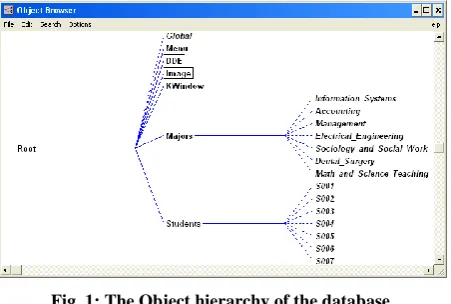
Developing an efficient database structure is an important objective in database design. Much of the work in creating a successful database is in the modeling. The database of the developed system is modeled as an OODB in which university majors are objects (or instances) from the main class ‘Majors’ as shown in the object hierarchy window which is the Kappa-PC's graphical representation of the OO database structure (Figure 1). The OO structure allows each major to be modeled as an object, and the database to be constructed as a collection of these objects. This structure gives more flexibility to each major to have whatever attributes and behaviors required for identifying it while maintaining the integrity of the system as a whole. In addition, adding more majors or major attributes (or fields) is a straightforward process. The current prototype system contains the following majors in its database (which are part of the available majors in Ajman University of Science & Technology - AUST): Information Systems (IS), Accounting, Management, Electrical Engineering, Sociology & Social Work, Dental Surgery, and Math & Science Teaching. Besides common traditional data associated with majors (major title, requested high school type (science section or literary section), minimum requested high school score, requested English proficiency test score, etc.), each major in the database is also described by its own list of attributes and skills values required by students who are willing to study that major. The database also contains another class for ‘Students’ and the data of students consulting the system are saved under students’ objects. Note that students’ data (e.g., first name, last name, e-mail address, high school type and score, year of high school certificate, grades in specific courses, etc.) are saved in the database because one of the recommended future works on the system is to make it an online Internet-based system, thus saving students’ data can help in retrieving past consultations for registered users.
Fig. 1: The Object hierarchy of the database
4.2
The Rule-Based Knowledge Base
(RBKB)
grades in specific courses, the high school graduation year, score of English proficiency test, etc. As an example of this rule category, consider the following illustrative rule written in English:
Rule1:
If: The student’s high school certificate type is Literary and grade is greater than or equal to 60% and less than 65% Then: Add the following majors to the student's allowable majors list: Accounting, Management, and Sociology & Social Work
As noticed from the example rule above University Major Admission Requirements Rules represent the ‘traditional’ method of accepting students in various majors (without detailed considerations of the specific skills required by the majors). In Major-Selection the above mentioned traditional rules do not work alone in giving the ES consultation results on suitable majors; they are supported with the second category of rules which are Students Preferences and Skills Rules. These rules -as the name suggests- consider the preferences and skills values of students and attempt to match them with the skills and attributes values required for studying the majors that were added to the allowable majors list. For example the main skills required for Math & Science Teachers include (among others) the following [4]:
Speaking - Talking to others to convey information effectively.
Reading Comprehension - Understanding written sentences and paragraphs in work related documents. Learning Strategies - Selecting and using training/
instructional methods and procedures appropriate for the situation when learning or teaching new things.
Writing - Communicating effectively in writing as appropriate for the needs of the audience.
Science - Using scientific rules and methods to solve problems.
Instructing - Teaching others how to do something. As another example, the skills of students who are suitable to major in IS (or MIS) can be summarized as following: "In order to succeed in this major, a student should be interested in organizations and how they function, as well as in computing. This student also needs a strong grasp of oral and written communication skills. Working with computers in general requires the student to be able to concentrate, to deal with frustrations, to be a self-starter and to be motivated to learn on their own" [4].
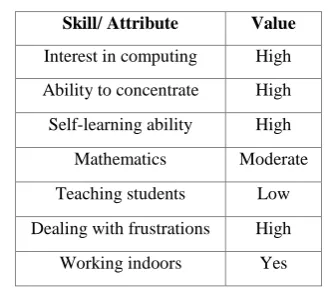
University majors' skills similar to the skills mentioned above are listed in the database objects with assigned values as: High, Moderate, or Low. All other attributes (i.e., preferences) are listed in the database objects with yes/no values. By ‘other attributes’ we mean university major’s attributes that are not High-Moderate-Low ‘skills’ in nature (i.e., they are mainly preferences and are not ‘skills’). For example, if the university major leads to an indoors job, then the value of the associated attribute (or preference) ‘working indoors’ is ‘Yes’. To illustrate the above discussion, part of the skills/attributes values associated with the undergraduate major Information Systems is shown in Table 1 below. Note that names of the
skills and attributes are unified in the system in order to keep its consistency and simplify the inference process (various literature resources give different names; however, the database of the developed system uses unified names for skills and preferences (or majors’ attributes)).
Table 1. Part of the skills/ attributes and their values associated with the major Information Systems
Skill/ Attribute Value
Interest in computing High Ability to concentrate High Self-learning ability High
Mathematics Moderate Teaching students Low Dealing with frustrations High Working indoors Yes
From the above discussion it is clear that the objective of Students Preferences and Skills Rules is to attempt to understand the preferences and skills of the student who is consulting the expert system and match them with the skills and attributes required by the majors within the allowable majors list (the list resulting from applying the first category of If-Then rules) in order to filter out the list and produce the list of ‘suggested majors’ for the student.
As an example rule from this second category of rules consider the following rule:
Rule2:
If: Response to ‘method of learning’ is ‘learn by my own’ Then: Assign the value 'High' to the student’s skill named 'Self-learning ability' (See Figure 4).
The list of student’s skills and preferences is a list that is populated with values after applying Students Preferences and Skills Rules based on the answers supplied by the student consulting the system (see Figures 4 and 5). At the end of every ES consultation the values assigned for the skills and preferences in this list are compared with the database values of skills and attributes required by allowable majors to match the appropriate majors and form the ‘ranked’ list of suggested majors as will be explained below.
4.3
The Inference Engine
Kappa-PC expert system development environment supports rule-based reasoning as well as the micro-managing of the reasoning process using classical programming techniques and list processing through Kappa-PC Application Language (KAL). Major-Selection’s inference engine uses both If-Then rules processing and list processing techniques. List processing is an important feature of Kappa-PC that is used in the developed system because a large portion of system reasoning depends on forming and processing lists as explained in the previous subsection.
form the list of allowable majors (majors in which the student can be accepted without violating university ‘traditional’ major admission requirements). Step 2 applies Students Preferences and Skills Rules (based on user's answers to system questions) in order to assign the inferred values of student’s skills and preferences. Step 3 is the matching and filtering step that generates the list of suggested majors based on comparing the values of student’s skills and preferences with the values of the skills and attributes required by each allowable major. A skill is considered satisfied if its value for the user is equal to or greater than its value for the major, otherwise the skill is considered unsatisfied. Other yes/no attributes are considered satisfied if they match the user’s preferences. For example if the student's value associated with the skill "Teaching students" is Moderate, then all majors having the values Moderate or Low for "Teaching students" will be assigned the value Satisfactory for the field "Teaching students test", whereas all majors having the value High for "Teaching students" will be assigned the value Unsatisfactory for the field "Teaching students test". Note that each skill or attribute in the database has an associated "test" field that gets its value as a result of comparing major’s values with student’s values. Test fields can have the values Satisfactory, Unsatisfactory, or Unknown (the Unknown value is assigned to a test field in case the student's skill or preference value is not determined; which is the case if the student skips some ES questions without answering them (see Figures 4 and 5)). The user is always encouraged to answer as much questions as possible in order to reduce the Unknown test values. At the end of this step, all majors having some (one or more) "Unsatisfactory" test values are excluded from entering the suggested majors list, and majors that have either all Satisfactory tests or combination of Satisfactory and Unknown tests enter the suggested majors list with majors having more Satisfactory values ranked higher in the list. The process of looping over the generated lists, comparing, and filtering them is achieved using KAL codes containing the powerful Kappa-PC's function ‘EnumList’ which is able to loop over all the elements of its argument list using a dummy variable (X for example) to perform an expression for each element in the list (X is matched with each element in the list in turn and is used in the action expression of EnumList).
4.4
The User Interface and Sample
Consultation
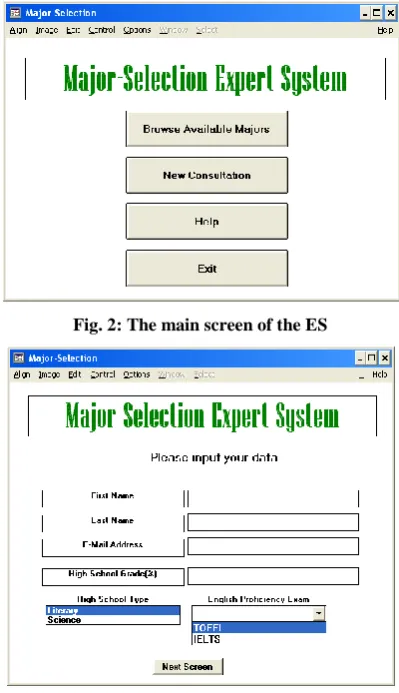
The Interaction between the users and the expert system is supported through a friendly graphical user interface running under Windows environment. Figure 2 shows the current main screen of the system where various options (or buttons) are displayed. The option "Browse Available Majors" enables the users to view all currently available majors and all their data (i.e., library of available majors). The user can see the user manual and get more help on using the system by clicking the "Help" button, or exit the system by selecting the "Exit" button. The main option here is "New Consultation" from which the user is directed to several successive screens asking for the student’s data requested by the system (Figure 3).
Fig. 2: The main screen of the ES
Fig. 3: Sample user data input screen
After all user data input screens, the user is prompted to answer several successive questions through which user's skills and preferences are extracted as shown in Figure 4 and Figure 5.
Fig. 5: Sample question screen for determining the user’s preferences
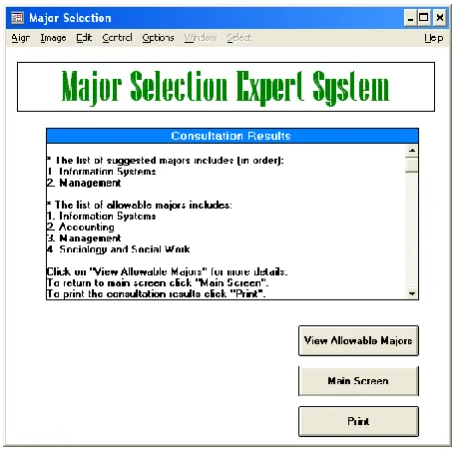
At the end of the consultation the ES presents the list of suggested majors (a ranked list) and the list of allowable majors as shown in Figure 6. Presenting both lists on one screen gives some sort of ‘explanation’ to the user since the user can easily recognize the majors that were excluded from the list of allowable majors based on his/her skills and preferences (detected from user’s answers). The user can get more details on the consultation results by clicking on "View Allowable Majors" to see all their data and required skills and preferences values (i.e., further explanation to the user to understand the presented ranked list of suggested majors).
Fig. 6: Sample consultation result screen
5.
CONCLUSION AND FUTURE WORK
In this paper a prototype expert system supported with an object-oriented database for university undergraduate major selection has been designed and developed. The system provides the students (and academic advisors) with a useful decision support tool for quick and easy major search and selection. The system has a graphical user interface and simple menus. The architecture used in the design of the system resulted in a successful software system that is easy to maintain, modify, and extend. The present state of the system was discussed and illustrated. Many parts of the system can be
improved further and some issues deserve future work, among them:
1. Being a prototype system only seven majors are currently included, therefore more majors (and of course more skills and preferences) can be added in the future developments of the system.
2. The system can be improved by making it an Internet-based system so users can access it online and register in the system and be able to save and retrieve their past consultations results.
6.
REFERENCES
[1] Deorah, S. 2010. SAES- Expert system for advising academic major, IEEE 2nd International Advance Computing Conference, Patiala, India.
[2] Abu Naser S., Baraka M., and Baraka A. 2008. A proposed expert system for guiding freshman students in selecting a major in Al-Azhar University, Gaza, Journal of Theoretical and Applied Information Technology, Vol. 4, No. 9, pp. 889-893.
[3] Zhou. Q, Yu. F. 2008. Knowledge-based major choosing decision making for remote students, Proceedings of International Conference on Computer Science and Software Engineering.
[4] Grupe F. 2002. An Internet-based expert system for selecting an academic major: www.mymajors.com, The Internet and Higher Education, Vol. 5, No. 4, pp. 333-344.
[5] Shi, Zhongzhi. 2011. Advanced Artificial Intelligence. World Scientific Publishing Co. Pte. Ltd.
[6] Schalkoff R. J. 2009. Intelligent Systems: Principles, Paradigms and Pragmatics. Jones & Bartlett Publishers. [7] Giarratano, J. and Riley, G. 1998. Expert Systems:
Principles and Programming, 3rd Edition. PWS Publishing Company.
[8] Turban, E., Aronson, J. E., and Liang, T. 2005. Decision Support Systems and Intelligent Systems, 7th Edition. Pearson Education, Inc.
[9] Booch, Grady, 2007. Object-Oriented Analysis and Design with Applications. Addison-Wesley.
[10]Rainer, Kelly. 2007. Object Oriented Concepts. Pearson Education.
[11]Schach, Stephen R. 2007. Object-Oriented Software Engineering. McGraw-Hill.
[12]Intellicorp. 1997. Kappa-PC 2.4 Manuals, Intellicorp, Inc., USA.
[13]AUST Undergraduate Admission Requirements, www.ajman.ac.ae.
[14]Georgia State University website, Choosing your major (www.gsu.edu/success/choosing_your_major.html). [15]Quintessential Careers, Choosing major,