Madura island has high potential for producing tropical fruits, but it still not being well managed especially concerning with the value added. Fruit leather is a product created by using various fruits and simple technology application. Fruit leather is categorized as new product on the market, therefore it is important to know consumer preference towards fruit leather attributes so that producer can design an acceptable product in the market. The research investigated attributes within the levels that become consumer preference in purchasing fruit leather product. There were 60 samples respondents taken accidentally at Bangkalan Plaza Shopping area. Method being used was conjoint analysis. Result showed that fruit leather being chosen by consumers as preference are gummy, mixed fruit taste, yellow color, small roll shape, at 100 grams and in a plastic tube package.
Pulau Madura memiliki potensi yang cukup besar dalam menghasilkan buah-buahan tropika, namun belum terkelola dengan baik, terutama dalam hal pemanfaatan nilai tambahnya. Fruit leather merupakan produk yang diciptakan dengan memanfaatkan bahan baku aneka buah dengan teknologi pembuatan yang sederhana. Namun perlu diketahui preferensi konsumen terhadap atribut fruit leather supaya produsen dapat mendesain produk yang dapat diterima oleh pasar. Penelitian ini bertujuan untuk mengetahui atribut dan level atribut yang menjadi preferensi konsumen dalam pembelian fruit leather. Sample penelitian berjumlah 60 orang yang diambil secara accidental di kawasan perbelanjaan Bangkalan Plaza. Tujuan penelitian dianalisis dengan menggunakan metode konjoin. Hasil yang diperoleh menunjukkan bahwa atribut fruit leather yang dipilih konsumen adalah fruit leather yang bertekstur kenyal, memiliki rasa mixfriut, berwarna kuning, berbentuk rol pendek, ditaruh dalam kemasan 100 gram, dan dikemas dengan menggunakan tabung plastik.
© 2017 IRJBS, All rights reserved. Keywords:
Preference, attributes, fruit leather, conjoint
Corresponding author: [email protected]
Elys Fauziyah
Jurusan Agribisnis, Fakultas Pertanian, Universitas Trunojoyo Madura Jl. Raya Telang, Kamal, Bangkalan, Madura 69162, Indonesia
A R T I C L E I N F O A B S T R A C T
Consumer Preference Towards Fruit Leather
Attributes of Madurese Exotic Tropical Fruits
S A R I P A T I
INTRODUCTION
Indonesia that geographically located in tropical area is being known as mega-biodiversity country for having huge biological diversity, including high potential of exotic tropical fruit production such as avocado, banana, mango, starfruit, duku, durian, pineaple, cempedak, langsat, markisa, sapodilla, etc. According to Directorate General of Horticulture (2016), there have been an increase of tropical fruits harvesting area during 5 years (2010-2015) as much as 22.06 % and an increase of Indonesian tropical fruit production as much as 66.25 %. However, the increase has not corresponded with increase of fruit consumption in Indonesia that reached 12-15 % in average per year in the form of fresh and processing fruit (Krisnamurthi, 2016).
Madura island which is known as salt island actually have the potential of diverse exoctic tropical fruits production. As further description, Bangkalan Re-gency is known as bark producer with soft texture, crispy and sweet fruit. Bark production reaches 25,013.12 tonnes per year (BPS Bangkalan, 2015). Next, Saronggih Sub district of Sumenep Regency is known as custard apples producer by production reaches 75-100 fruits per tree for each harvesting
moment. In addition, jackfruit, manggo, juwet (Madurese grape), sapodilla, cashew nuts can be seen at any area in Madura island. Potential of tropi-cal fruits in Madura can be seen at following table 1. Farmer household at dry land like Madura has lower income level compared to those who live in productive area (Fauziyah et al. 2014). One of effort in order to increase is by enhancing economic potential using local base raw material. In this case, it may utilize exotic tropical fruit value added with Madurese special characteristic through processing into various products such as fruit leather.
Fruit leather is one of fruit processing product in the form of sheet with sweet taste, soft, gummy texture, water content ranged between 15 up to 25%, storage capacity up to 9 months, and being favorite of consumer in international market (FAO 2016). This product is judged as health supports, practical in consumption and give pleasure due to gummy texture, transparent and strong fruit taste (Diamante et al. 2014).
Fruits leather by using Madurese potential exotic fruit is categorized as new product and not much being known by consumer. In regarding with
No. Fruits Production (Tonne)
1 Avocado 329
2 Star fruit 484
3 Guava 19 005
4 Palm 406.47
5 Pineaple 2 178
6 Papaya 7 803
7 Manggo 54 005
8 Banana 103 346
9 Bark 34 001
10 Jackfruit 47 041
11 Orange 4 680
12 Big size Orange 6 750
Source : Bangkalan Dalam Angka (2016)
this, producer should find out the attributes of product that suppose to be consumer preference. Thus, success of marketing activity has been becoming necessity so that product industrial will be developed more into expected direction (Kotler, 2000). According to assauri (1992), product creation should pay attention on factors contained in the product namely quality, features, options, brand names, packaging, sizes, product lines, product items, warranties, services. Meanwhile based on Roesipah (2013), Mohebalion (2013) and Andriyani (2014), the attributes mostly being considered by consumer in purchasing food products are price, color, texture and packaging. Understanding consumer preference and their judgment about the products may help the company in determining strategy to increase customer satisfaction and loyalty to be further being used in reinforcing the position among competitors (Pullman, Moore, and Wardell 2002). The research aimed to analyze attributes within the levels on Madurese exotic tropical fruit leather to determine most preferred product by consumers.
Literature Review
Recently, business environment is close to tight competition and rapid change. Therefore, in order to achieve the objective, the company should conduct consumer behavior observation as well as consumer preferences. Consumer preference is defined as consumer’s taste or choice towards the product being consumed. According to Dwiastutik (2012), consumer perception is resulted from consumer knowledge that gained from various informations about the product. These are 1) awareness on product category and brand, 2) product terminology, 3) product attributes or features such as class, shape, brand, model, benefit, and value that will be achieved by consuming the product, 4) trust on the general product category and specific brand.
Consumer perception towards the product quality can be affected by intrinsic or extrinsic attributes (Caswell et al. 2002). Food is as a product that
can be categorized as search product, experience product and credence product. It is resulted based on the attributes that can be found by consumer at various different stages. A thing can be categorized as search product when consumer can evaluate information of relevant product attributes before purchasing the product such as price, dimension, size, color. Meanwhile, things can be classified as experience product when the information of relevant attributes can be determined after consuming the product such as quality and taste. Things is categorized as credence product when the attributes is difficult to be determined by the consumers either before or after the consumption such as healthiness, free pesticide, organic product, certified product, etc. These attributes are usually determined by authorized institution (Moser et al, 2011).
The research is conducted to understand consumer preferences towards product attributes that have been done by various analysis methods. One of analysis tool oftentimes being used to identify consumer preferences is conjoint. Conjoint Analysis is multivariate technique that can be used to understand the choice taken by individuals. In specific, the technique is used to gain signals how the consumer judge various attributes based on their evaluation (Green dan Srinivasan, 1978). According to Reddy et al (1995) product characteristic is described as attributes. Variation of attributes is drawn as attributes level. Next, Ryan (1999) assumed that conjoint analysis enables product attributes to be considered simultaneously, and enable consumers to put options on the attributes. Relatives interest of each attribute is counted by using range utility (Green dan Krieger, 1996). Biggest attributes level value shows that the attribute level is most preferred by consumer, and conversely smallest value means that the level is un preferred by consumer (Myung, 2003).
preference rank meanwhile independent variables consist of dummy variable for each attributes level. Conjoint analysis model mathematically can be shown as follows (Haaijer, Kamakura, and Wedel 2000; Carroll and Green 1995;):
m ki
u(x) =
S
S
αijXijt=1 j=1
In which U(x) is level of attributes interest, αij is
utility coefficient, Xij is valued 1 if there is level j
from attribute i, and valued 0 if others. There are stages to arrange conjoint analysis namely:
1. Identify attribute and attributes level
2. Design combination of attributes or stimulant
3. Determine method of data collection.
4. Determine analysis method
5. Data Analysis within interpretation.
Conjoint analysis has been widely used in various researches. It is used in marketing studies to evaluate
consumer preference to the product, services or price (Kuzmanovic, 2010; Kuzmanovic 2012). The method has been applied in order to understand preference in various markets such as retail (Wilson 2006; Kuzmanovic 2011), transportation (Hensher 2001), education (Sohn, 2010), labor in the context
of decision election, telecommunication (Popović
et al., 2012; Nakamura, 2010; Head 2010), tourism (Triphati, 2010) and food industrial (Ozayan, 1998;; Munandar et al., 2012; Oyatoye, 2013; Cheng, 2014; Ashraf, 2015; Imami et al., 2016).
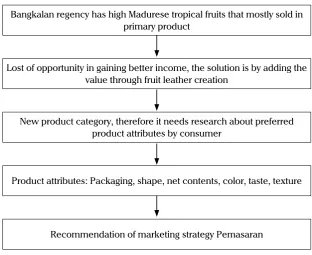
The research scheme of consumer preference towards Madurese exoctic tropical fruit leather attributes can be seen in figure 1.
METHODS
The research was held at Bangkalan Plaza. Location determination was by purpose based on consideration that fruit leather is included as expensive product and targeted on both middle and upper economic class that use to be found in surrounded area of supermarket.
Bangkalan regency has high Madurese tropical fruits that mostly sold in primary product
New product category, therefore it needs research about preferred product attributes by consumer
Lost of opportunity in gaining better income, the solution is by adding the value through fruit leather creation
Product attributes: Packaging, shape, net contents, color, taste, texture
Recommendation of marketing strategy Pemasaran
Type of data being used in the research is primary data collected from interview process combined with questionnaire filled by respondents. The data to be gained is respondent’s judgement towards stimulants (combination of several attributes level). Sample determination was by purposive using accidental sampling. There were 60 respondents taken as samples.
Research purpose was analyzed by using following conjoint method stages:
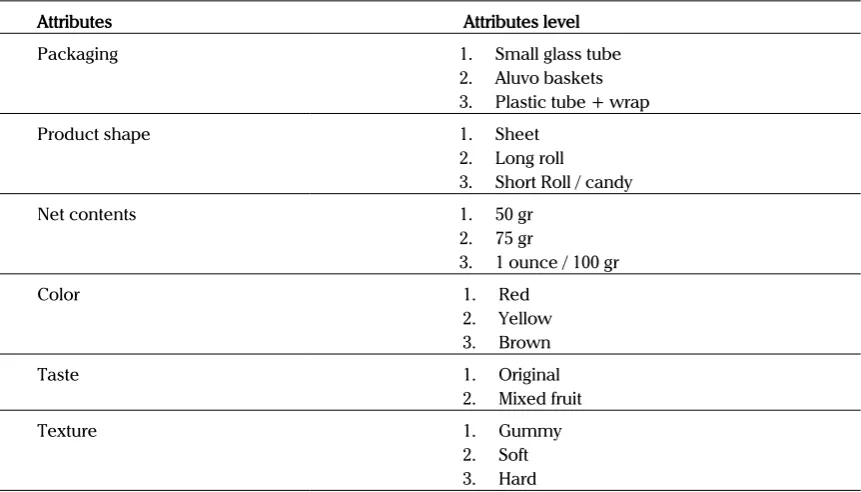
a. Determining attributes and attributes level Attributes and attributes level in the research can be seen in table 2.
b. Determining stimulant
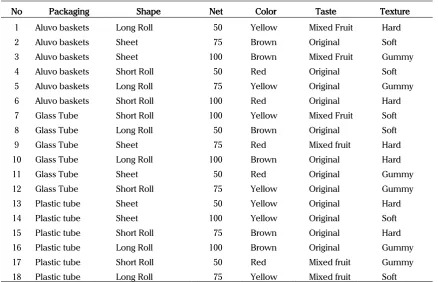
There are 18 stimulants served in table 3
C. Respondents judged 18 stimulants by using Lickert scale on the following criteria
1. : showing very non preferred stimulants 2. : showing non preferred stimulants
3. : showing preferred stimulants 4. : showing very preferred stimulants
d. Analyzing data by using conjoint model
through SPSS 16 software.
Testing of result precision in conjoint analysis can be done by seeing Kendall’s value correlation or between conjoint analysis result and actual respondent’s opinion (using qualitative scale namely nominal and ordinal). High correlation result reflects the results of conjoint analysis that can describe real expectation.
RESULTS AND DISCUSSION
Process of decision making in purchasing of product is affected by various factors, including attributes attached on the product. Product attributes oftentimes considered to be identically with the characteristic attached on the product such as packaging, shape, net contents (weight of product in each package), color, taste and texture. According to several researches, attributes in
Attributes Attributes level
Packaging 1. Small glass tube
2. Aluvo baskets 3. Plastic tube + wrap
Product shape 1. Sheet
2. Long roll 3. Short Roll / candy
Net contents 1. 50 gr
2. 75 gr
3. 1 ounce / 100 gr
Color 1. Red
2. Yellow 3. Brown
Taste 1. Original
2. Mixed fruit
Texture 1. Gummy
2. Soft 3. Hard Source : Primary Data Processed, 2017
Table 3. Combination of Fruit Leather Product Attributes (Stimulants)
No Packaging Shape Net Color Taste Texture
1 Aluvo baskets Long Roll 50 Yellow Mixed Fruit Hard
2 Aluvo baskets Sheet 75 Brown Original Soft
3 Aluvo baskets Sheet 100 Brown Mixed Fruit Gummy
4 Aluvo baskets Short Roll 50 Red Original Soft
5 Aluvo baskets Long Roll 75 Yellow Original Gummy
6 Aluvo baskets Short Roll 100 Red Original Hard
7 Glass Tube Short Roll 100 Yellow Mixed Fruit Soft
8 Glass Tube Long Roll 50 Brown Original Soft
9 Glass Tube Sheet 75 Red Mixed fruit Hard
10 Glass Tube Long Roll 100 Brown Original Hard
11 Glass Tube Sheet 50 Red Original Gummy
12 Glass Tube Short Roll 75 Yellow Original Gummy
13 Plastic tube Sheet 50 Yellow Original Hard
14 Plastic tube Sheet 100 Yellow Original Soft
15 Plastic tube Short Roll 75 Brown Original Hard
16 Plastic tube Long Roll 100 Brown Original Gummy
17 Plastic tube Short Roll 50 Red Mixed fruit Gummy
18 Plastic tube Long Roll 75 Yellow Mixed fruit Soft
Source : Primary Data Processed, 2017
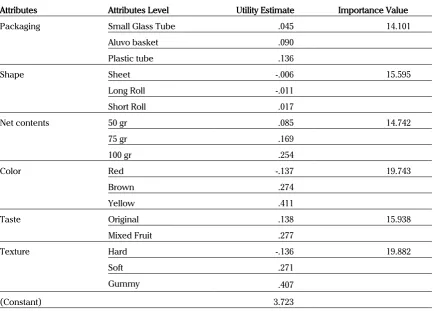
the product will affect consumer preference in selecting product. Result of consumer preference analysis to the fruit leather product of Madurese exotic tropical fruits is shown in table 4.
1. Packaging attribute
Based on Kotler and Amstrong (2012), packaging has function as product cover to maintain the quality. Meanwhile, Wijayanti (2012) says that packaging has several functions such as product cover during distribution process, beautify the product, and also can be used as information media concerning with the product. Fruit leather that produced in Madura is packed by using 3 packaging materials, namely; small glass tube, aluvo basket and plastic tube. Each packaging material has an advantage and weaknesses. Small glass tube gives more exclusive impression, but it takes high price and fragile during distribution process. Aluvo basket packaging is made of siwalan tree woven that has an exotic shape but perishable. Meanwhile, plastic tube is long
lasting material and not easily broken. The price is relatively cheap as well. Based on the analysis, consumers put preference on fruit leather packed by plastic tube. This packaging adds higher utility to the consumer compared to two other packaging materials. This condition describes that producer suppose to choose plastic tube as packaging material. Nevertheless, product that packed by using both aluvo basket or glass tube is still being interested by consumers. This can be seen at the positive sign of utility estimation value although it is not as much as utility value of plastic tube. The result is similar to the research of Kalsum et al. (2013), on Rengginang product in Madura.
2. Product Shape Attribute
Fruit leather is type of food made from juicing
other shape such as long roll, short roll or other as preference. There are three shapes of fruit leather namely sheets, long roll and short roll. Analysis result has shown that consumer prefer fruit leather attributes in a short roll shape. According to consumer opinion, this shape increased their satisfaction meanwhile two others are not being chosen as preference. Short roll of fruit leather has an advantage in practical of consumption. Consumer can enjoy the product like candy. Based on the research, there is drawing of 45 peoples or about 75% respondents choosing short roll fruit leather.
3. Net Contents/Weight of Packaging Attributes
Net contents or weight of packaging is one of most considerable attributes in purchasing product by consumer. Similar attributes were considered in the research of Mulyadi (2014). Generally, preference level of consumer about the net
contents is based on financial capacity, practical in carrying the product and estimation of consuming sufficiency. Fruit leather is categorized as snack. Consumer needs in product consumption usually only takes small portion and enjoy it during break moment of lunch or dinner. Based on this, attribute level included in the research were 50, 75, and 100 grams. The result had shown that most of consumer prefers fruit leather by 100 grams package. As the matter of fact, there were 52 respondents choose to buy fruit leather by 100 grams package.
4. Color Attribute
Next attribute oftentimes to be consideration in purchasing product is color. Rahayu (2012) also put color as one of attributes in the research of consumer preference towards imported apple product. There are red, yellow and brown used as color attributes in this research. It is based on
Table 4. Result of Conjoint Analysis of Consumer Preference Towards Madurese Exoctic Tropical Fruit Leather Product
Attributes Attributes Level Utility Estimate Importance Value
Packaging Small Glass Tube .045 14.101
Aluvo basket .090
Plastic tube .136
Shape Sheet -.006 15.595
Long Roll -.011
Short Roll .017
Net contents 50 gr .085 14.742
75 gr .169
100 gr .254
Color Red -.137 19.743
Brown .274
Yellow .411
Taste Original .138 15.938
Mixed Fruit .277
Texture Hard -.136 19.882
Soft .271
Gummy .407
(Constant) 3.723
color of tropical fruits in Madura that dominated by those three colors.
Research analysis result had drawn that yellow fruit leather is most preferable by consumers, besides brown color. Red color is not taken as an option of preference by consumers. Spread of
consumer preference level for color data is shown in above diagram. Implication of the research can be used by producer in selecting yellow local fruits and brown as well to be used as material of fruit leather. Field identification in Bangkalan Regency had shown that there are huge productions of yellow fruits such as mangoes and jackfruit (Table
1), therefore an opportunity to fulfill consumer preference towards color attributes is highly possible to be done.
5. Taste Attribute
Generally, taste attribute is being prioritized in producing food product. Fruit leather brings out taste as the material being used. Sweet, sour or mixed of both tastes inside the fruit that being used to determine fruit leather taste. This can be made by mixing various materials to bring out sensation of kind taste. The research served an original and mixed fruit taste. Result of analysis showed that mixed fruit is preferred to be taken by consumers and increase their utilities. Original taste had also increase their utilities although not as much as the mixed fruit. This is shown by field fact that there were 87 % consumers chose mixed fruit product. Based on this, producer may consider to produces fruits combination as fruit leather material.
6. Texture Attribute
Texture attribute in consumer preference towards food product had also conducted by Rosipah (2013). Fruit leather product has various textures namely hard, soft and gummy.
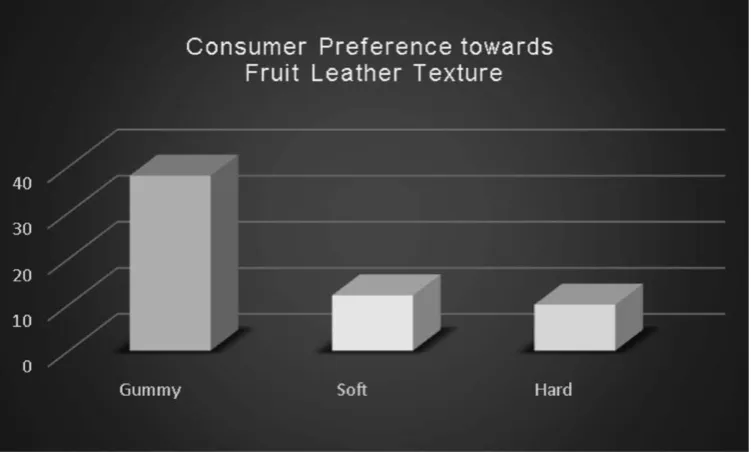
Material composition and pectin inside the fruits affects texture of fruit leather. According to Valenzuela and Aguilera (2015), fruit leather has sticky characteristic. This is caused by material, humidity, compression, and fineness. Research result had shown that consumer prefers gummy texture better than hard texture. This is supported by data spread of respondents in regarding with texture attributes, shown in Figure 5.
MANAGERIAL IMPLICATIONS
Based on several attributes within the levels judged by consumers, there are three most considered attributes in making decision to purchase fruit leather in respectively texture, color and taste. Meanwhile combination of attributes level chosen by consumer are gummy, mixed fruit, yellow, 100 grams and plastic tube package. This can be used as consideration of producer in designing the product.
CONCLUSION
Fruit leather attributes to be taken as preference by consumer in purchasing decisions in respectively are texture, color, shape, net contents, and package. Meanwhile attributes level of fruit
Figure 5. Consumer Preference Level towards Fruit Leather Texture
R E F E R E N C E S
Andriyani, F., Astuti, R., & Effendi, M. (2014). Preferensi Konsumen Terhadap Produk Kripik Buah So Kressh Menggunakan Analisis Konjoin. Tesis. Program Pasca Sarjana Universitas Brawijaya. Malang.
Assauri S. (1992). Manajemen Pemasaran Dasar, Konsep dan Strategi. Rajawali. Jakarta.
Ashraf , S. & Zaheer Abbas, (2015). Conjoint Analysis: A Study on Gourmet Bakery Items and Services. International Journal
of Multidisciplinary Consortium, 2, 9-15.
Badan Pusat Statistik. 2016. Bangkalan Dalam Angka.
Carroll, J. D. & Green, P. E. (1995). Psychometric Methods in Marketing Research: Part I, Conjoint Analysis. Journal of Marketing
Research, 32, 385-391.
Cheng, C.-H., Lin, S.-Y., & Tsai, C.-C. (2014). Investigating Consumer Preferences in Choosing Vegetarian Restaurants Using Conjoint Analysis. Current Urban Studies, 2, 279-290.
Diamante, L.D.M., Li, S., Xu, Q., & Busch, J. (2013). Effects of apple juice concentrate, black currant concentrate and pectin levels on selected wualities of apple-black currant fruit leather. Foods 2, 430-440.
FAO. Fruit Leather. www.fao.org. Accessed March 1, 2016.
Fauziyah, E., Umi Purwandari, Iffan Maflahah, & Eko Murniyanto. (2014). Agribisnis Mie Sehat Berbahan Baku Umbi Lahan Kering. UTM Press. Bangkalan.
Fox, J. (1997). Applied Regression Analysis, Linear Models, and Related Methods. Thousand Oaks, CA: Sage
Green, P. E., & Srinivasan, V. (1978). Conjoint Analysis in Consumer Research: Issues and Outlook. Journal of Consumer
Research, 5, 103-123.
Green, P. E., & Krieger, A.M. (1996). Individualized Hybrid Models for Conjoint Analysis. Management Science, 42, 850- 867. Haaijer, R., Kamakura, W. & Wedel, M. (2000). Response Latencies in the Analysis of Conjoint Choice Experiment. Journal of
Marketing Research, Vol. 37, No.3, pp. 376-382.
Head, M., & Ziolkowski, N. (2010). Understanding Student Attitudes of Mobile Phone Applications and Tools: A Study Using Conjoint, Cluster and SEM Analyses. Proceedings of the 18th European Conference on Information Systems (ECIS 2010) Pretoria, South Africa, 2010
Hensher, D. (2001) The Valuation of Commuter Travel Time Savings for Car Drivers: Evaluating Alternative Model Specifications.
Transportation, 28, 101 -118.
Imami, D., Engjell, S., Edvin, Z., Maurizio C., Catherine C., & Alban C. (2016). Analysis of consumers’ preferences for typical local cheese in Albania applying conjoint analysis. New Medit, 15, 49-55.
Kalsum, U., Elys F., & Taufik R. (2013). Preferensi Konsumen dalam Membeli Rengginang Lorjuk di Kecamatan Kamal Bangkalan. Agriekonomika, 2, 153-162.
Kuzmanovic, M., & Martic, M. An Approach to Competitive Product Line Design Using Conjoint Data. (2012). Expert Systems with Application, 39, 7262-7269.
Kuzmanovic, M., & Martic, M. (2010). Using Conjoint Analysis to Create Superior Value to Customers. Metalurgia International, 17, 93-99.
Kuzmanović, M., & Obradović, T. (2010). The Role of Conjoint Analysis in the New Product Price Sensibility Research.
Management Journal for Theory and Practice Management, 15, 51 -58.
Kotler P. 2000. Marketing Management. Prentice Hall. New Jersey.
Mohebalian, P. M. & Aguilar, F. X., (2013). Conjoint Analysis of U.S. Consumers’ Preference for Elderberry Jelly and Juice Products. HortScience 48, 338-346.
Mulyadi, A., & Elys F., (2014). Preferensi Konsumen dalam Pembelian Mi Instan di Kabupaten Bangkalan, Agriekonomika, 3, 65-80.
Munandar, J. M. Udin, F., & Amelia, M. (2012). Analisis Faktor yang Mempengaruhi Preferensi Konsumen Produk Air Minum dalam Kemasan di Bogor. Jurnal Teknologi Industri Pertanian IPB, 13, 97-107.
Myung, R. (2003). Conjoint Analysis as a New Methodology for Korean Typography Guideline in Web Environment. International
Journal of Industrial Ergonomics, 32, 341-348.
Nakamura, A. (2010). Estimating Switching Costs Involved in Changing Mobile Phone Carriers in Japan: Evaluation of Lock-In Factors Related to Japan’s SIM Card Locks. Telecommunications Policy, 34, 736-746.
Oyatoye, E.O., Adebiyi, S.O., & Amole, B.B. (2013). An Aplication Of Conjoint Analysis to Consumer Preference For Beverage Products in Nigeria. AUDCE 9, 43-46.
Ozayan, A., Harrison, R.W., & Meyers, S.P., (1998). An Analysis of Buyer Preferences for New Food Products Derived From Louisiana’s Crawfish. Luoisiana Agricultural Experiment Station, Juni 1998
Popović M., Kuzmanović M., & Martić, M. (2012). Using Conjoint Analysis to Elicit Employers’ Preferences toward Key Competencies for a Business Manager Position. Management–Journal for Theory and Practice Management, 17, 17-26.
Rahayu, JM., Elys F., & Aminah HM. (2012). Preferensi Konsumen Terhadap Buah Apel Impor di Toko Buah Hokky dan Pasar Tradisional Ampel Surabaya. Agriekonomika, 1, 52-66.
Reddy, V. S., Bush, R. J., & Rudik, R. (1995). A Market-Oriented Approach to Maximizing Product Benefits: Cases in U.S. Forest Products Industries. US Forest Service, 4, 19-38.
Rosipah, s., Burhan, & Purwandari, U. (2013) . Preferensi Konsumen Terhadap Pancake Dari Tepung Sukun. Jurnal Agrointek, 7, 53-57.
Ryan, M. (1999). Using Conjoint Analysis to Take Account of Patient Preferences and Go Beyond Health Outcomes: An Application to in Vitro Fertilization. Social Science and Medicine, 48, 535-546.
Sohn, S. Y., & Ju, Y. H. (2010). Conjoint Analysis for Recruiting High Quality Students for College Education. Expert Systems
with Applications, 37 3777-3783.
Tripathi Shalini N. (2010). An empirical study of tourist preferences using conjoint analysis Int. Journal of Business Science and
Applied Management, 5, 2-16.
Valenzuela, C., & Aguilera, J.M. (2015). Effects of different factors on stickiness of apple leather. Journal of Food Engineering
149, 51-60