The Influence of Word of Mouth on Brand Imange and
Purchase Intention (A study on the potential customers of
Kakiang Garden Cafe Ubud)
Gede Agni Temaja 1 and Ni Nyoman Kerti Yasa2 1,2
Faculty of Economics and Business Udayana University, Bali, Indonesia
Abstract
The purpose of this study is to determine the influence of word of mouth on purchase intention mediated by the brand image of Kakiang Garden Cafe Ubud. The sample used is 90 respondents which are determined using the purposive sampling method. The data collection technique utilized is by questionnaires with the Likert scale measurement method, while the data are analyzed using the path analysis technique. The research results show that the word of mouth and brand image variable have a positive and significant influence on purchase intention. Likewise, brand image is able to mediate the influence of word of mouth on purchase intention. The management of Kakiang Garden Cafe should be able to make their customers feel comfortable when they make purchases so that the customers can share positive information regarding Kakiang Garden Cafe to other people. This is to enhance the role of brand image by improving the product image of Kakiang Garden Cafe so that there are increases in the purchase intention.
Keywords: word of mouth, brand image, purchase intention
1. INTRODUCTION
The development of the business world in this modern era has been increasingly fast and dynamic. Consequently, the competition between producers of certain goods or services have also been intensifying. This demands the business practitioners to be able to utilize all potentials, opportunities and resources that they have optimally. Among the popular businesses in this modern era is the food and beverage business.
Food is a primary need for human which must be fulfilled in order to stay alive. Among the types of food nowadays is cake, and one of the popular cake sellers in Ubud is Kakiang Garden Cafe. In Kakiang Garden Cafe, there are various menus of food and beverages. This information has been forwarded by the customers of Kakiang Garden Cafe to their friends and family, which can be seen as a promotion media for the offered products. Information regarding Kakiang Garden Cafe’s products eventually form their brand image. The brand image and information received by potential consumers are the bases which could make people want to buy the products and spend their time there. In other words, this causes purchase intention to rise among the people who visit Kakiang Garden Cafe.
The intention to purchase is a situation which reflects the plan to purchase the product or service of a certain brand (Aditya and Wardana, 2017). Before any purchases are made by an individual, it certainly begins with a purchase intention. This purchase intention is usually caused by several reasons which may be from within the individual or external factors.
The intention to purchase Kakiang Garden Cafe’s products still exist even though there are many bakeries. This may be caused by the strong brand image of the Cafe in the consumers’ mind. Brand image represents the associations that are activated by the memory when it remembers certain brands. This association appears in the form of thoughts or images that are related to a certain brand (Shimp, 2014: 40). The brand image of a good product will attract potential customers to purchase the product instead of purchasing the same product from another brand (Seno and Lukas, 2007).
Other than a strong brand image, the phenomena in social medias also caused the products of Kakiang Garden Cafe to become famous among the people. The many photos and videos uploaded in social medias can be seen as a word of mouth promotion phenomena. Word of mouth (WOM) is a type of communication in the form of conversations and testimonies that are conducted by people that talk about a certain product or service (Basalamah, 2010). Consumers will share their experience of using the product or service of certain companies, or even recommend the product or service to other people (Permadi et al., 2014). Recommending food products through WOM will stimulate curiosity, which indirectly causes purchase intention to arise.
Based on the pre-survey results conducted on 15 respondents, it was found that most consumers have the intention to make purchases because of the effect of word of mouth and brand image. To prove this matter, there is a need to conduct further studies by using the variables to examine the role of brand image in mediating the influence of word of mouth on purchase intention.
2. LITERATURE REVIEW AND HYPOTHESIS DEVELOPMENT
Hasan (2010:32) defined word of mouth as an action that is conducted by consumers in providing personal information to other consumers related to certain products or services. According to Dzian et al. (2015) word of mouth is an informal communication with other consumers where they share information regarding the attributes of various products and services, about the usage or the producer. Word of mouth can be identified as a marketing method which maximizes the interaction of consumers with potential consumers who have never known or used the product before (Aditya and Wardana, 2017).
A better method of communicating the brand to consumers will consequently make the interest of consumers towards the brand to be stronger. Brand image can be defined to be an association form which arise in the mind of consumers when they remember certain brands. According to Darmawan and Djati (2018) brand image is a collection of brand associations that are formed in the consumer’s mind. Association occurs in the form of thoughts or images related to certain brands, similar to when we think of other people (Hidayati et al., 2013). Rizan et al. (2012) argued that brand image is the assumption regarding a brand reflected by the consumer which depends on the consumer’s memory. Through brand image, consumers are able to identify certain products, evaluate that product, reduce the purchase risk of a product and receive experience and satisfaction from the product differentiation. The experience felt by consumers regarding the product purchased forms the brand image in consumers and afterwards, the brand image may be able to increase the repurchase intention or even the purchase intention of potential customers.
Purchase intention is the stage in which respondents tend to act before actually purchasing a product or service (Martinez and Soyong Kim, 2012). According to Setiawan and Ihwan in Ambarwati et al. (2015), purchase intention is the process of directing individuals that have the intention to purchase. Purchase intention is also a measure of a person’s intention to make a purchase, and purchase intention is related to the purchase behaviour of a person. Moksaoka and Rahyuda (2016) stated that the purchase intention that arise in the purchase process will create a motivation which will continuously be recorded in people’s mind and become a very strong activity, and when consumers must fulfil their needs, they will actuate what is in their mind.
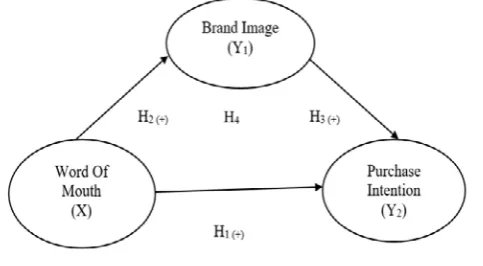
Figure 1. Conceptual Framework
Source: Khan (2015), Aditya and Wardana (2017), Akbar and Rosita (2017), Febriana and Rumyeni (2016), Ruhamak and Rahayu (2016), Pertiwi and Sukawati (2017), Cretu and Brodieb (2007), Aberdeen et al. (2016), Prakoso dkk. (2016), and Hidayati et al. (2013).
The research conducted by Khan (2015) stated that word of mouth has a positive and significant influence on purchase intention. With the correct word of mouth method, the products will have a good brand image which will increase the purchase intention of consumers. This is supported by the research conducted by Aditya and Wardana (2017) which states that word of mouth entails an increase in purchase intention and this proves that these two variables have a positive and significant relationship. In another study, Akbar and Rosita (2017) stated that electronic word of mouth has a positive and significant influence on the intention to purchase music in the JOOX music streaming application. Based on the empirical review, the research hypothesis is formulated as follows:
H1 : Word of Mouth has a positive and significant influence on purchase intention
H2 : Word of Mouth has a positive and significant influence on brand image.
The better the brand image of a firm, the higher the purchase intention of consumers (Cretu and Brodieb, 2007). Akbar and Rosita (2017) stated in their study that brand image has a positive and significant influence on the intention to purchase products from the JOOX music streaming application. Aberdeen et al. (2016) stated in their study that brand image has a positive influence on the purchase intention of Xiaomi mobile phone consumers in Malang. Based on this empirical review, the research hypothesis formulated is as follows:
H3 : Brand image has a positive and significant influence on purchase intention
The influence of word of mouth on purchase intention mediated by brand image. Prakoso et al. (2016) found that word of mouth has a significant influence on purchase decision. This result means that product information, recommendation, and encouragement by others can influence the decision of others. Hidayati et al. (2013) stated that brand image has a positive influence on purchase intention and purchase decision. This is supported by the research conducted by Pertiwi and Sukawati (2017) which found that brand image is able to significantly mediate the relationship between word of mouth and purchase intention. Based on this explanation, the hypothesis formulated is as follows:
H4 : Brand image is able to significantly mediate the influence of word of mouth on purchase intention
3. RESEARCH METHOD
This research utilize the associative research method, in which it is to determine the causal effect of the independent on the dependent variable. This study discusses the role brand image has in mediating the influence of word of mouth on purchase intention. The research location selected is in Kakiang Garden Cafe, Jalan Raya Andong, Ubud, Bali. The research objects in this research are brand image, word of mouth, and purchase intention. The population in this research are the potential customers of Kakiang Garden Cafe.
The data collection method used in this study is by questionnaire, in which a number of questions are given to respondents to be answered in accordance to the respondents’ perception regarding the research objects. The questionnaires are distributed to the potential consumers of Kakiang Garden Cafe. The answers of the respondents are measured using the Likert scale. The data analysis technique utilized in this study are the classical assumption test and the path analysis.
4. RESULTS AND DISCUSSION
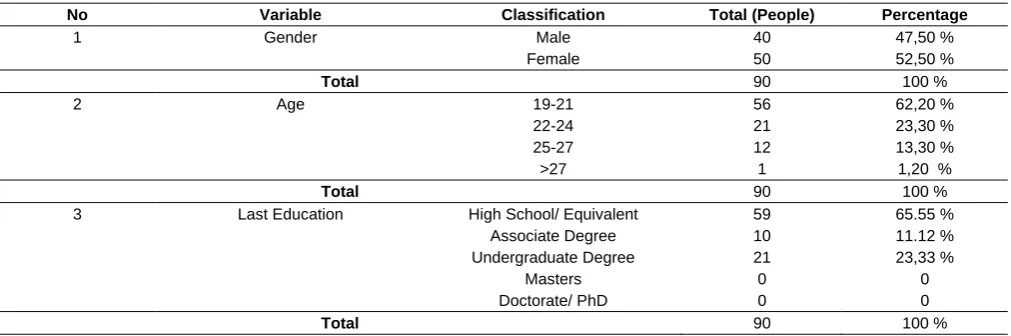
The characteristics of respondents in this research are the profiles of 90 respondents who participated in filling in the questionnaires. The profile of respondents displays the gender, age, last education, and occupation. Table 1. explains that there are less male respondents than female respondents in which 47,5 percent are male and 52,5 percent are female. Viewed from the age range, a majority of the respondents, or 62,2 percent are between 19 – 21 years old, while 23,3 percent are between 22 – 24 years old, 12,2 percent are aged between 25 – 27 years old, and 2,3 percent are at an age above 27 years old. Based on the last education level of respondents, 65,55 percent, or in other words most have an education level of High School/ equivalent, 11,12 percent have an associate degree, while 23,3 percent have an undergraduate degree. Viewed from their occupation, a majority of the respondents or 62,2 percent are students, while 24,4 percent are private employees, 10 percent are entrepreneurs, followed by other occupations, the National Army of Indonesia/ Police, and government employees, there are 2,3 percent, 1,1 percent and 0 percent respectively.
Table 1. Characteristics of Respondents
No Variable Classification Total (People) Percentage
1 Gender Male 40 47,50 %
Female 50 52,50 %
Total 90 100 %
2 Age 19-21 56 62,20 %
22-24 21 23,30 % 25-27 12 13,30 % >27 1 1,20 %
Total 90 100 %
3 Last Education High School/ Equivalent 59 65.55 % Associate Degree 10 11.12 % Undergraduate Degree 21 23,33 %
Masters 0 0
Doctorate/ PhD 0 0
No Variable Classification Total (People) Percentage
4 Occupation Student 56 62,2 %
Government Employee 0 0 Private Employee 22 24,4 %
Entrepreneur 9 10 % National Army of Indonesia/
Police 1 1,1 %
Others 2 2,3 %
Total 90 100 %
Source: Computed Primary Data, 2018
The validity test has a purpose to examine whether the questionnaires as the research instrument are accurate in measuring what the are meant to measure. The correlation value between the item scores with the total items are afterwards compared with the r-critical. If the item correlation is greater than the r-critical (0,30), the instrument is deemed as valid (Sugiyono, 2014: 177).
Table 2. The Instrument Validity Test Results for the Word of Mouth Variable
No Indicator rcalculated Description
1 X1 0.852 Valid
2 X2 0.871 Valid
3 X3 0.893 Valid
Source: Computed Primary Data, 2018
Table 3. The Instrument Validity Test Results for the Brand Image Variable
No Indicator rcalculated Description
1 Y1.1 0.867 Valid
2 Y1.2 0.911 Valid
3 Y1.3 0.895 Valid
Source: Computed Primary Data, 2018
Table 4. The Instrument Validity Test Results for the Purchase Intention Variable
No Indicator rcalculated Description
1 Y2.1 0.900 Valid
2 Y2.2 0.964 Valid
3 Y2.3 0.917 Valid
Source: Computed Primary Data, 2018
The reliability test has a purpose to determine the consistency of the utilized measurement tool. Reliability is measured using Cronbach’s Alpha method. The instrument is deemed as reliable if the value for the variable measurement is greater than 0,60 (Sugiyono, 2014: 183). The reliability test result is shown in Table 5.
Table 5. Research Instrument Reliability Test Results
Variable Alpha Cronbach Description
Word of Mouth 0.854 Reliable
Brand Image 0.859 Reliable
Purchase Intention 0.870 Reliable
Source: Computed Primary Data, 2018
In the following data description, the perception of respondents regarding the variable of word of mouth, purchase intention and brand image, which were attained through questionnaire, are discussed. The quantitative valuation is conducted by utilizing the interval scale and integrating the average score according to the evaluation category. To describe the respondent’s evaluation regarding the variables in this study, the frequency distribution needs to be determined based on the interval value (Wirawan, 2014: 33).
Table 6. Description of Respondents’ Answers Regarding Their Evaluation on the Word of Mouth Variable
No. Statements for Word of Mouth (X1) Respondents’ Answers
Ttl. Res.
Ave-rage Desc.
1 2 3 4 5
1 I received positive information regarding Kakiang
Garden Cafe (X1.1) 0 9 12 60 9 90 3.77 Good 2 Others recommend me to try Kakiang Garden Cafe
(X1.2) 0 5 17 50 18 90 3.90 Good 3 I was invited to purchase products from Kakiang
Garden Cafe (X1.3) 2 4 25 32 10 90 3.87 Good
Average 3.83 Good
Source: Computed Primary Data, 2018
Based on the data in Table 6, the 3 questions regarding word of mouth attained an average value of 3.83 and is categorized as within the criteria of 3.40 – 4.19, which means good. This means that the potential customers of Kakiang Garden Cafe, who are the respondents in this research, agree that the word of mouth regarding Kakiang Garden Cafe is good.
Table 7. Description of Respondents’ Answers Regarding Their Evaluation on the Brand Image Variable
No. Statements for Brand Image (Y1) Respondents’ Answers Ttl. Res.
Ave-rage Desc. 1 2 3 4 5
1 The product image of Kakiang Garden Cafe is attractive to
me (Y1.1) 0 6 13 39 32 90 4.08 Good 2 To me, Kakiang Garden Cafe’s product is unique (Y1.2) 0 3 23 35 39 90 4.00 Good 3 I can easily remember Kakiang Garden Cafe’s products
(Y1.3) 0 1 27 32 30 90 4.01 Good
Average 4.03 Good
Source: Computed Primary Data, 2018
Based on the data in Table 7, the 3 questions regarding brand image has an average value of 4,03 and is categorized as in the criteria of 3.40 – 4.19, meaning that the respondents agree. This means that the potential customers of Kakiang Garden Cafe who became respondents in this research agree that the brand image of Kakiang Garden Cafe is good.
Table 8. Description of Respondents’ Answers Regarding Their Evaluation on the Purchase Intention Variable
No. Statements for Purchase Intention (Y2) Respondents’ Answers
Ttl. Res.
Ave-rage Desc.
1 2 3 4 5
1 I’m attracted to the products of Kakiang Garden
Cafe (Y2.1) 0 0 5 47 38 90 4.37 Very High
2 I intend to try the products of Kakiang Garden
Cafe (Y2.2) 0 0 9 39 42 90 4.37 Very High
3 I intend to purchase the products of Kakiang
Garden Cafe (Y2.3) 0 1 4 33 52 90 4.51 Very High
Average 4.42 Very High
Source: Computed Primary Data, 2018
Based on the data in Table 8, it can be seen that the 3 statements regarding brand image has an average value of 4,42 and are categorized as in the criteria of 4.20 – 5.00, or very high. This means that the potential consumers of Kakiang Garden Cafe who became the respondents in this study agree that they have a high intention to purchase the products of Kakiang Garden Cafe.
Based on Table 9, it can be seen that the Kolmogorov-Smirnov Asymp. Sig. (2-tailed) value is 0,111. This result indicates that the regression equation model is normally distributed because the Asymp. Sig. value (2-tailed) is greater than 0,05.
Table 9. Structure 1 Normality Test Result
Unstandardized Residual
N 90
Kolmogorov-Smirnov Asymp. Sig. (2-tailed) 0.111
Source: Computed Primary Data, 2018
Table 10. Structure 2 Normality Test Result
Unstandardized Residual
N 90
Kolmogorov-Smirnov Asymp. Sig. (2-tailed) 0.200
Based on Table 10, it can be seen that the Kolmogorov-Smirnov Asymp. Sig value is 0,200. This result indicates that the regression equation model is normally distributed because the Asymp. Sig. (2-tailed) value is greater than 0,05.
Table 11. Multicollinearity Test Result
Structural Equation Variable Tolerance VIF
Y1= β2X1 ++e1 Word of Mouth(X1) 1.000 1.000
Y2= β3Y1 + β1X1 + e2
Word of Mouth(X1) 0.610 1.640
Brand Image (Y1) 0.610 1.640 Source: Computed Primary Data, 2018
In Table 11. the tolerance and VIF value of the word of mouth and brand image variables are displayed. The tolerance value of each variable is greater than 10% and the VIF value is less than 10 which means that the regression equation model is free from multicollinearity.
Table 12. Structure 1 Heteroscedasticity Test Result
Source: Computed Primary Data, 2018
In Table 12., the significance value of the word of mouth variable is found to be 0,073. This value is greater than 0,05 which means that there is no significant influence by the independent variable on the absolute residual. Thus, the model does not show any signs of heteroscedasticity.
Table 13. Structure 2 Heteroscedasticity Test Result
Source: Computed Primary Data, 2018
Table 13 shows that the significance value of the word of mouth variable is 0,105 and the brand image variable is 0,470. This value is greater than 0,05 which means that the independent variable does not have any influence on the absolute residual. Thus, the model formulated does not show any signs of heteroscedasticity.
Based on the results in Table 14 and 15, the structural equation is as follows.
Structural Equation 1 Y1= β2X1 ++e1
Y1= 0,625 X1 + e1
ε1 (error1) =
= = 0,781
Table 14. Structure 1 Path Analysis Result
Variable Standardized Coefficients Std. Error t-calculated t-test Sig.
(Constant) 0.893 6.170 0.000
Word of mouth (X1) 0.625 0.076 7.504 0.000
R Square 0.390 F-Statistics 56.305
F-test Sig. 0.000
Source: Computed Primary Data, 2018
Structural Equation 2 Y1 = β3M1 + β1X1 + e2
Y2= 0,447Y1 + 0,259 X1 + e2 e2 (error2) =
= = 0,767
Model Unstandardized Coefficients Standardized Coefficients t Sig. B Std. Error Beta
1 (Constant) 2.105 0.458 4.598 0.000 Word of mouth -0.071 0.039 -0.190 -1.817 0.073
Model Unstandardized Coefficients Standardized Coefficients t Sig. B Std. Error Beta
Table 15. Structure 2 Path Analysis Result
Variable Standardized Coefficients Std. Error t-calculated t-test Sig.
(Constant) 0.741 10.189 0.000
Word of Mouth (X1) 0.259 0.068 2.460 0.016
Brand Image (Y1) 0.447 0.074 4.242 0.000
R Square 0.411
F Statistics 52.887 F-test Sig. 0.000
Source: Computed Primary Data, 2018
Based on the results of analyzing the ε1 and ε2, the total coefficient of determination can be calculated as follows.
R²m = 1 – (ε1) 2 (ε
2) 2
= 1 – (0,781)2 (0,767)2 = 1 – (0,609) (0,588) = 0,642
The total coefficient of determination is 0,642 which means that 64,2 percent of the variance in purchase intention is influenced by the variances in the word of mouth and brand image, while the remaining 35,8 percent is explained by other factors that are not included in the model.
To test the mediating variable which mediates the relationship between the dependent variable and the independent variable, the following steps are conducted.
To calculate the value: Sab =
Sab = Sab = 0,057
To calculate the ab value: ab = 0,574 0,314 ab = 0,180
To calculate the Z value:
Z =
Z = 3,17
From the calculation results in Table 15, the significance level of the word of mouth is 0,000 < 0,05 with a beta value of 0,259. Thus, research hypothesis H1 is accepted. This means that word of mouth has a positive
and significant influence on the purchase intention of Kakiang Garden Cafe’s potential consumers. The calculation results in Table 14 show that the significance level of the word of mouth is 0,000 < 0,05 with a beta value of 0,625. Thus, research hypothesis H2 is accepted. This means that word of mouth has a positive and
significant influence on the brand image of Kakiang Garden Cafe. The calculation results in Table 15 show that the significance level of brand image is 0,000 < 0,05 with a beta value of 0,447. Thus, hypothesis test H3 is
accepted. This means that brand image has a positive and significant influence on the purchase intention of Kakiang Garden Cafe’s potential consumers. From the calculation results, the Z-calculated value was found to be 3,17 which is > the Z-table value 1,96. Thus, research hypothesis H4 is accepted. This means that brand
image is able to significantly mediate the influence of word of mouth on purchase intention. This shows that with the creation of good word of mouth, along with the improvement in brand image, this will indirectly increase the purchase intention of Kakiang Garden Cafe’s potential consumers.
5. DISCUSSION The Influence of Word of Mouth on Purchase Intention
The calculation results in Table 15 shows that the level of significance of word of mouth is 0,000 < 0,05 with a beta value of 0,259. Thus, research hypothesis H1 is accepted. This means that word of mouth has a positive
and significant influence on the purchase intention of Kakiang Garden Cafe’s potential consumers. Word of mouth, which is measured based on several indicators, namely, hearing positive information, receive recommendations, and receive invitations to make purchases, is proven to be able to increase the purchase intention of Kakiang Garden Cafe’s potential customers.
The Influence of Word of Mouth on Brand Image
The calculation results in Table 14 show that the significance level of word of mouth is 0,000 < 0,05 with a beta value of 0,625. Thus, research hypothesis H2 is accepted. This means that word of mouth has a positive
and significant influence on the brand image of Kakiang Garden Cafe. Word of mouth, which is measured based on the indicators, namely, hearing positive information, receive recommendation, and receive invitation to purchase, has been proven to be able to improve the brand image of Kakiang Garden Cafe.
This research result is in line with the formulated hypothesis which states that word of mouth has a positive and significant influence on the brand image of Kakiang Garden Cafe. This means that with a better conveyance of the word of mouth, there will be an improvement in the brand image. This research result supports the research conducted by Febriana and Rumyeni (2016), Pertiwi and Sukawati (2017), Ruhamak and Rahayu (2016) and Aditya and Wardana (2017).
The Influence of Brand Image on Purchase Intention
The calculation results in Table 15 show that the significance level of brand image is 0,000 < 0,05 with a beta value of 0,447. Thus, research hypothesis H3 is accepted. This means that brand image has a positive and
significant influence on the purchase intention of Kakiang Garden Cafe’s potential customers. Brand image, which was measured using several indicators, namely strength, uniqueness, and favorable, has been proven to be capable of improving the purchase intention of Kakiang Garden Cafe’s potential customers.
This research result is in line with the formulated hypothesis which states that brand image has a positive and significant influence on the purchase intention of Kakiang Garden Cafe’s potential customers. This means that the better the brand image of Kakiang Garden Cafe, the higher the purchase intention stimulated in its potential customers. This research result supports the studies conducted by Cretu and Brodieb (2007), Akbar and Rosita (2017) and Aberdeen et al. (2016).
The Role of Brand Image in Mediating The Influence of Word of Mouth on Purchase Intention
The calculation result shows that the Z-calculated value is 3,17 > the Z-table 1,96. Thus, research hypothesis H4 is accepted. This means that brand image is able to significantly mediate the influence of word of
mouth on purchase intention. This shows that if brand image is improved, the influence of word of mouth on purchase intention will also increase.
This research result is in line with the formulated hypothesis which states that brand image medates the influence of word of mouth on the purchase intention of Kakiang Garden Cafe’s potential customers. This research result supports the studies conducted by Prakoso et al. (2016), Hidayati et al. (2013), Ruhamak and Rahayu (2016) and Pertiwi and Sukawati (2017).
6. CONCLUSION
The conclusion of this study based on the analysis results and results discussion are: first, word of mouth has a positive and significant influence on the purchase intention of Kakiang Garden Cafe’s potential customers. This shows that with a better word of mouth circulating, there will be a higher level of purchase intention among Kakiang Garden Cafe’s potential consumers. Second, word of mouth has a positive and significant influence on the brand image of Kakiang Garden Cafe. This shows that a better conveyance of the word of mouth will result in a better brand image. Third, brand image has a positive and significant influence on the purchase intention of Kakiang Garden Cafe’s potential consumers. this shows that with a better brand image, the purchase intention of consumers will also be higher. Fourth, brand image significantly mediates the influence of word of mouth on purchase intention. This shows that with a better word of mouth, brand image will be enhanced, and this improvement in brand image will indirectly increase the purchase intention of Kakiang Garden Cafe’s customers.
Based on the research analysis results, discussion and conclusion, there are several recommendations that can be considered in determining the right policy to maintain and improve the purchase intention of Kakiang Garden Cafe’s consumers. First, the management of Kakiang Garden Cafe should enhance the role of word of mouth by improving the conveyance of positive information regarding Kakiang Garden Cafe such as through promotions in social media. Second, the management of Kakiang Garden Cafe should improve the role of brand image by improving the image of Kakiang Garden Cafe’s products.
REFERENCE
Aberdeen, N. I., Muhammad S., and Mukhamad N. (2016). The Effect of Brand Awareness and Image on Cusumer Perceived Quality and Purchase Intention – A Study of Carbonated Drink Brand at Bogor City. International Journalof Scientific and Research Publication, 6(8), pp: 441–446.
Aditya, Kadek Yoga dan I Made Wardana. (2017). Peran Brand Equity Dalam Memediasi Pengaruh Word Of Mouth Terhadap Purchase intention. E-Jurnal Manajemen Unud, 6 (2), hal.830-856.
Ambarwati, M. (2015). Pengaruh Citra Merek Terhadap Minat Beli (Survei Pada Mahasiswa Universitas Brawijaya Yang Menggunakan Pasta Gigi Pepsodent). Jurnal Administrasi Bisnis, 25(1).
Basalamah, Fauzan M., (2010). Pengaruh Komunitas Merek Terhadap Word of Mouth. Jurnal Ilmu Administrasi dan Organisasi, 17 (1), hal.79-89.
Cretu, A. E., & Brodie, R. J. (2007). The influence of brand image and company reputation where manufacturers market to small firms: A customer value perspective. Industrial marketing management, 36 (2), 230-240.
Darmawan, D., & Djati, P. (2018). Pengaruh Citra Merek dan Citra Pengecer Terhadap Respon Merek dan Respon Pengecer Melalui Kepuasan Merek dan Kepuasan Pengecer. EKUITAS: Jurnal Ekonomi dan Keuangan, 9(1), 126-143.
Dzian, Michal., Miroslava Triznova., Vladislav Kaputa., and Mikulas Supin. (2015). The analysis of WOM in Slovak Republic and impact of WOM on consumers' purchasing decision. Procedia Economics and Finance, 26, pp: 975-981.
Febriana, L., and Rumyeni. (2016). The Influence of Word Of Mouth Communication towards Brand Imageof Iphone on Student of Political Science and Social Science Faculty University of Riau. Jurnal Online Mahasiswa Fakultas Ilmu Sosial dan Ilmu Politik. 3(2), pp: 1-15. Hasan, Ali. (2010). Marketing dari Mulut ke Mulut. Yogyakarta: Media Pressindo
Hidayati, T.A., Suharyono, dan Dahlan, F. (2013). Pengaruh Citra Merek Terhadap Minat Beli DanKeputusan Pembelian Konsumen (Survei Pada Mahasiswa Penghuni Ma’had Sunan Ampel Al-Aly UINMalang Tahun Angkatan 2012/2013 Yang Mengkonsumsi Mie Instan Merek Indomie). Jurnal Administrasi Bisnis (JAB). 2(1), pp: 162-171.
Khan, S. A., Ramzan, N., Shoaib, M., and Mohyuddin, A. (2015). Impact of Word of Mouth on consumer purchase intention. Journal of Business and Management University of Engineering and Technology, 18(21), pp: 78.
Martinez, B. and S. Kim, (2012). Predicting purchase intention for privatesale sites. Emeraldinsight. 2(4), pp: 1361-2026.
Moksaoka, I M. W. dan Rahayuda, K. (2016). Peran Brand Image dalam memediasi Country of Origin terhadap Purchase Intention. E-Jurnal Manajemen Unud. 5 (3). Hal. 1690-1716
Permadi, Prima C., Srikandi K., dan Andriani K. (2014). Pengaruh Citra Merek Terhadap Word Of Mouth dan Keputusan Pembelian (Survei pada Konsumen Dapoer Mie Galau Jalan Selorejo 83 Malang). Jurnal Administrasi Bisnis (JAB), 10(1), hal.2-7.
Pertiwi, K. Y., & Sukawati, T. G. R. (2017). Brand Image Memediasi Wom Terhadap Niat Menggunakan Wedding Service Di Cahya Dewi Beauty Salon Denpasar. E-Jurnal Manajemen Unud, 6(5), pp: 2609-2641.
Prakoso, A., Zainul, A., Sunarti. (2016). Pengaruh Social Media Advertising Terhadap Word OfMouth DanDampaknya Pada Keputusan Pembelian (Survei Pada Konsumen Cafe Mochimaco Malang Yang Menggunakan Instagram). Jurnal Administrasi Bisnis (JAB), 41(1), pp: 25-31.
Rizan, M., Saidani, B., & Sari, Y. (2012). Pengaruh Brand Image Dan Brand Trust Terhadap Brand Loyalty Teh Botol Sosro Survei Konsumen Teh Botol Sosro Di Food Court Itc Cempaka Mas, Jakarta Timur. JRMSI - Jurnal Riset Manajemen Sains Indonesia, 3(1), 1-17.
Ruhamak, M.D., dan Rahayu, B. (2016). Pengaruh Word Of Mouth terhadap Purchase Intention melaluiBrand Image pada Lembaga Kursus Bahasa Inggris Dynamic English Course Pare. Jurnal Ekonomi Universitas Kadiri,1(2), pp: 188-204.
Seno, Diana and Lukas Bryan A. (2007). The Equity of Product endorsement by Celebrities A conceptual Framework from a co branding perspective. European Journal of Marketing, 41(1/2), pp: 121 – 134
Shimp, Terence A. (2014). Intergrated Marketing Communication in Advertising and Promotion. Jakarta: Salemba Empat. Sugiyono. (2014). Metode Penelitian Bisnis (Pendekatan Kuantitatif, Kualitatif dan R&D). Bandung: Alfabeta.