VOLUME 10 | ISSUE 2 | 2015 | 615
The effects of exercise and two pre-exercise fluid
amounts on cognition
TODD PATRICK BACKES 1 , PETER J. HORVATH 2, KARRY ANN KAZIAL 3
1 Professor of Biology Exercise Science Program, Director Biology Department, State University of New York at
Fredonia, United States
2 Department of Exercise and Nutrition Sciences, State University of New York at Buffalo, United States 3 Department of Biology, State University of New York at Fredonia, United States
ABSTRACT
Backes, T., Horvath, P.J., & Kazial, K. (2015). Effects of the exercise in the cerebral blood flow and metabolism. J. Hum. Sport Exerc., 10(2), pp.615-622. Exercise is associated with elevated mood states and arousal. Observational studies support the claim that exercise can help individuals think more “clearly’ with reports of improved mood and feelings of psychological well-being following exercise. However, laboratory studies have produced equivocal results. The purpose of this study is to examine the effect of exercise intensity and two likely pre-exercise fluid amounts consumed by euhydrated athletes on cognitive performance. Fifteen college age students were randomly assigned to either a 150 ml or a 500 ml fluid condition on the first test day and received the other fluid condition on the second test day. Prior to exercise subjects completed baseline computerized cognitive tests then began a treadmill protocol of three 6 min stages at increasing intensity after which subjects completed cognitive tests. A second treadmill portion started at 7.5 mph for 2 min then speed was increased 0.5 mph every 30 s until voluntary exhaustion and final cognitive testing was completed. Our results demonstrate a facilitation of cognitive function in response to exercise with the exception of the match to sample cognitive test which showed lack of facilitation of cognition in the 500 ml condition at moderate exercise. Our research contributes to the growing field of exercise and its effects on cognition. Specifically working memory cognitive tests showed facilitation with exercise. These results may be applicable to a typical exercising population since our study included a common exercise mode (treadmill) at moderate and high intensities and likely fluid amounts.
Key words: EXERCISE, COGNITIVE TEST, TREADMILL, MEMORY COGNITIVE.
1 Corresponding author. Professor of Biology Exercise Science Program, Director Biology Department, State University of New
York at Fredonia, United States. E-mail: [email protected]
Submitted for publication January 2015 Accepted for publication September 2015
JOURNAL OF HUMAN SPORT & EXERCISEISSN 1988-5202 © Faculty of Education. University of Alicante
616 | 2015 | ISSUE 2 | VOLUME 10 © 2015 University of Alicante INTRODUCTION
Physiological research has proposed that the level of arousal of an individual is associated with cognitive performance (Eysenck, 1982). A classic example of this relationship is the Yerkes-Dodson Law (Yerkes & Dodson, 1908). This law is illustrated as an inverted U-shaped function between the conditions of physiological arousal and cognitive performance. The ascending limb of the inverted U represents increased attention as physiological stress increases from baseline to moderate levels. As physiological stress reaches a moderate level, attention reaches its peak then decreases along the descending limb of the inverted U at high physiological stress levels. Yerkes-Dodson Law has influenced early learning theory (Hull, 1943) as well as modern theories of human performance (Easterbrook, 1959; Oxendine, 1984). Exercise is associated with elevated mood states and arousal (Berger, 1996). It is therefore not surprising that the Yerkes-Dodson Law would be examined from the context of exercise or physical activity being the source of physiological arousal (Chmura, Krysztofiak, Ziemba, Nazar, & Kaciuba-Uscilko, 1998). Thus, determination of the benefits of exercise has expanded into cognition research.
Observational studies support the claim that exercise can help individuals think more “clearly’. Individuals report improved mood and feelings of psychological well-being following exercise. These results typically come from individuals engaging in mild to moderate bouts of exercise (Cotman, Berchtold, & Christie, 2007; Hillman, Erickson, & Kramer, 2008; Morgan & O’Connor, 1988; Raglin, 1997). However, laboratory studies investigating the affect of physiological stress using acute bouts of exercise have met with equivocal results. Some studies have demonstrated cognitive facilitation with exercise; whereas others have found a lack of facilitation or impairment (Kamijo, Nishihira, Hatta, Kaneda, Wasaka, Kida, & Kuroiwa 2004). In a comprehensive review of the literature, Tomporowski & Ellis (1986) found little empirical support for improved cognition related to physical activity or exercise. A review by McMorris & Graydon (2000), reached the same conclusion.
The mixed results have been attributed to the broad definition of cognition, the nature of the cognitive task (e.g., targeting different brain areas), exercise mode, exercise intensity, as well as fitness level, nutritional status, and intake of varied fluid amounts of the subjects. The purpose of this study is to examine the effect of exercise intensity and two likely pre-exercise fluid amounts consumed by euhydrated athletes on cognitive performance. The fluid amounts used are a commercially available bottle of water (500ml) and an amount equal to two squeezes of a cycling water bottle (150ml). We used a treadmill protocol of moderate intensity for 18 min, then high intensity exercise to voluntary exhaustion. Our cognitive tasks focus on working memory, an aspect of cognition that can have real world consequences, using sophisticated automated computer software.
METHODS
Participants
VOLUME 10 | ISSUE 2 | 2015 | 617
12:00 pm. The day before each lab visit subjects were instructed to refrain from strenuous exercise, not drink alcoholic beverages, and not eat after midnight.
Procedures & Measures
Subjects were required to complete an Automated Neuropsychological Assessment Metrics (ANAM) test battery. The ANAM software is a windows/PC based program that has strong correlations to traditional neuropsychological tests (Jones, Loe, Krach, Rager, & Jones, 2008). ANAM tests cognitive function by including modules assessing information processing, visual spatial memory, attention, code substitution, and working memory. Cognitive function performance is measured by throughput (a ratio of accuracy and speed) with higher values indicating better performance (Short, Cernich, Wilken, & Kane, 2007). Prior to the start of each module; written instructions are given to explain the specifics of the following cognitive test.
Three ANAM modules were used in this study. These included code substitution, match to sample, and match to grid. Code substitution (CDS) is an association test that involves nine pairings of symbols and numbers continuously presented on the screen. Novel pairings are then presented and the subjects are directed to decide if the novel pairing is correct or incorrect; response is given by mouse button click. Match to sample (M2S) consists of a two-color 4 by 4 block pattern. Patterns are presented side by side, with the right pattern graph rotated 90º relative to the left pattern. The subject is instructed to determine if the patterns are identical irrespective of orientation. Response is given by a right mouse click if not identical or left if identical. Match to grid (Mtg) is similar to match to sample in which subjects are presented two color patterns on the screen. The screen goes blank and two separate block patterns are presented side by side. The subject must correctly choose the identical pattern with respect to both pattern and orientation. Response is given by left or right mouse button clicks respectively.
1st Lab Visit (Screening)
All subjects read and signed the approved informed consent. Subjects met the criteria for the American College of Sports Medicine (ACSM) low risk stratification for coronary artery disease (Thomson, Gordon, & Pescatello, 2010). Exclusionary criteria included: diagnosed learning disability, diagnosed concussion in the preceding six months, and the use painkillers or antidepressants. Female subjects were screened for pregnancy. Females actively taking birth control were not excluded; menstrual cycle has been reported to have a minimal effect on cognition (Epting & Overman, 2008; LoBue –Estes, Horvath, Burton, & Leddy, 2008).
2nd and 3rd Lab Visits
Prior to arrival on the 2nd visit, subjects were randomly assigned to a 150 ml or a 500 ml fluid condition and assigned the alternative condition on the 3rd visit. Water was prepared in opaque bottles prior to the subject arriving and out of view of the principal investigator. The principal investigator was not allowed to handle the bottle and subjects were instructed to drink the entire fluid amount before beginning the exercise. Practice ANAM tests were administered before the recording of cognitive data. Urine samples were collected for specific gravity measurement. Subjects with specific gravity 1.020 or higher were excluded from continuing that day. Subjects were administrated a baseline ANAM test.
618 | 2015 | ISSUE 2 | VOLUME 10 © 2015 University of Alicante
recorded at midpoint and end of the 2 min stage and during each 30 s interval. Upon reaching voluntary exhaustion, the subject completed another ANAM test. Additionally, the subject supplied a second urine sample and was weighed dry and naked.
Statistics
Three repeated measures general linear models were performed on change in mean throughput from baseline (pre-exercise) for the cognitive tests administered by ANAM software (CDS, M2S, Mtg). The within-subject factors were exercise (pre, moderate intensity, and high intensity) and fluid condition (500 ml and 150 ml). All interaction effects were evaluated by the models. If significant in the repeated measures general linear model, post-hoc tests were completed for exercise and fluid condition and adjusted for multiple testing. Values are expressed as mean ± SE, except for subject demographics which are mean ± SD. Significance of tests was compared with a significance level of 0.05 except for correction for multiple testing.
RESULTS
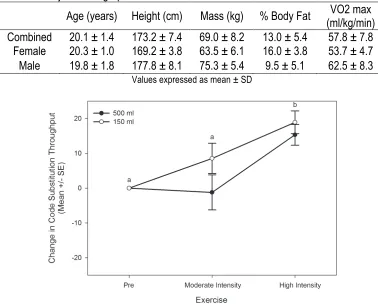
Subject demographic data includes age, height, mass, percent body fat, and an average VO2max (Table 1). Exercise was significant for the CDS cognitive test (Table 2). Post hoc tests revealed pre-exercise and high intensity as well as moderate intensity and high intensity were significantly different for CDS data (Fig. 1). At moderate intensity the mean value was 3.7 ± 3.4 and at high intensity the mean value was 17.1 ± 2.2.
Table 1. Subject Demographic Data
Age (years) Height (cm) Mass (kg) % Body Fat (ml/kg/min) VO2 max Combined 20.1 ± 1.4 173.2 ± 7.4 69.0 ± 8.2 13.0 ± 5.4 57.8 ± 7.8
Female 20.3 ± 1.0 169.2 ± 3.8 63.5 ± 6.1 16.0 ± 3.8 53.7 ± 4.7 Male 19.8 ± 1.8 177.8 ± 8.1 75.3 ± 5.4 9.5 ± 5.1 62.5 ± 8.3
Values expressed as mean ± SD
VOLUME 10 | ISSUE 2 | 2015 | 619
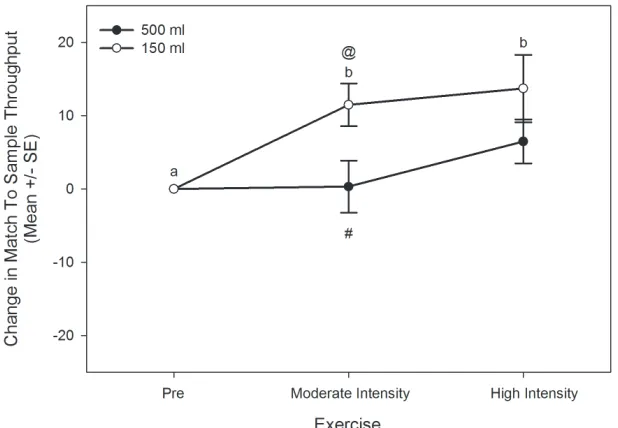
Values are expressed as a change from pre (baseline) throughput. Exercise intensities not sharing a common letter are significantly different. Fluid conditions not sharing a common symbol are significantly different
Exercise was significant for the M2S cognitive test (Table 2).Post hoc tests revealed pre-exercise significantly differed from both moderate intensity and high intensity exercise for M2S data. Fluid condition was significant for the M2S cognitive test and was different at moderate intensity exercise (Table 2, Fig. 2). The fluid condition*exercise interaction was also significant (Table 2). At moderate intensity exercise the mean value was 5.9 ± 2.5 and the high intensity exercise mean value was 10.0 ± 2.8. For the 500 ml condition, the moderate intensity exercise mean value was 0.3 ± 3.5 and the mean value at high intensity exercise was 6.5 ± 3.0. For the 150 ml condition, the moderate intensity exercise mean value was 11.6 ± 2.9 and the mean value at high intensity exercise was 13.6 ± 4.6.
Table 2. Cognitive test results from repeated measures general lineal models
Cognitive Test F Df Significance
CDS
Exercise 27.02 2 P < 0.0005
M2S
Exercise 7.20 2 P = 0.004
Fluid Condition 5.20 1 P = 0.044
Fluid Condition*Exercise 4.09 2 P = 0.031
Mtg
Exercise 8.16 2 P = 0.002
Within-subjects factors were exercise (pre, moderate intensity, and high intensity) and fluid condition (500 ml and 150 ml water). All interaction effects were evaluated by the models.
620 | 2015 | ISSUE 2 | VOLUME 10 © 2015 University of Alicante
Values are expressed as a change from pre (baseline) throughput. Exercise intensities not sharing a common letter are significantly different. Fluid conditions not sharing a common symbol are significantly different
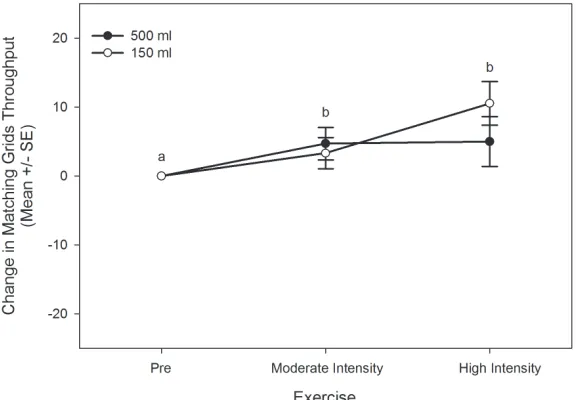
Exercise was a significant factor for the Mtg cognitive test (Table 2). Post hoc tests revealed pre-exercise significantly differed from both moderate intensity and high intensity exercise for Mtg data (Fig. 3). At moderate intensity exercise the mean value was 4.9 ± 2.1 and at high intensity exercise the mean value was 7.8 ± 2.4.
Figure 3. Change in matching grids throughput mean values at pre-exercise, moderate intensity exercise, and high intensity exercise between fluid conditions.
Values are expressed as a change from pre (baseline) throughput. Exercise intensities not sharing a common letter are significantly different. Fluid conditions not sharing a common symbol are significantly different
DISCUSION
Our results demonstrate a facilitation of cognitive function in response to exercise which supports the findings of other studies (Hiroki, Ippeita, Daisuke, Morimasa, Masako, Yasushi, & Hideaki, 2010). While the exact mechanism of cognitive facilitation is not known, previous researchers who have reported cognitive facilitation with exercise have speculated that an increase in blood flow to the brain may be the cause (McMorris & Graydon, 2000; Tomporowski, 2003).
VOLUME 10 | ISSUE 2 | 2015 | 621
throughput which takes into account both speed of response and accuracy, whereas the Dietrich & Sparling (2004) study used errors as the measure of cognitive performance.
The match to sample cognitive test showed lack of facilitation of cognition in the 500 ml condition at moderate exercise, conversely the 150 ml condition showed facilitation in reference to baseline performance. This cognitive test is the only test in the set that requires the subjects to “hold” the pattern/image in working memory since the screen goes blank before choices are presented. This test differs from other ANAM tests because it relies more on working memory and not solely on visual- spatial processing. The lack of facilitation in this test could imply transient impairment to working memory, visual-spatial processing, or poor information processing. Interestingly, the code substitution cognitive test showed a non-significant trend influenced by fluid condition in a similar pattern to the match to sample test. This test requires the subject to visually scan pairings of symbols and numbers. The code substitution test does not require the subject to memorize the pairings, however, learning or “holding” the pattern in working memory would reduce the time spent needed for visual scanning.
While the exact mechanism for a lack of facilitation of cognition in the 500 ml condition in the match to sample cognitive test is unknown, the 500 ml of fluid may have initiated a stress response not initiated in the 150 ml condition. Additional data gathered on our subjects includes salivary measures of stress. Salivary cortisol and salivary alpha–amylase (an accepted bio-marker of sympathetic nervous system activity) demonstrated a significant inverse relationship (salivary cortisol levels were significantly lower) to each other at moderate exercise in the 500 ml fluid condition. It is possible the 500 ml of fluid diminished a physiological response, potentially upstream or downstream to cortisol. This diminished response “placed” the subjects farther down on the ascending limb of the Yerkes-Dodson model resulting not in impairment, but in a lack of cognitive facilitation.
Our research contributes to the growing field of exercise and its effects on cognition. Specifically working memory cognitive tests showed facilitation with exercise. These results may be applicable to a typical exercising population since our study included a common exercise mode (treadmill) at moderate and high intensities. Our study points out the importance of pre-exercise fluid consumption as a possible confounding variable in exercise and cognition research. Because our fluid intervention occurred prior to the exercise, it is possible that in other research, subjects could have ingested fluid similar in amount to our study having an effect as an extraneous variable or even as a confounding variable.
ACKNOWLEDGEMENTS
The authors would like to thank the following SUNY Fredonia Exercise Science students for their research efforts: Timothy Carrow, Lauren Fial, Robert Newton and Amanda Richards.
REFERENCES
1. Berger, B.G. (1996). Psychological benefits of an active lifestyle: What we know and what we need to know. Quest, 48(3), pp.330-353.
2. Chmura, J., Krysztofiak, H., Ziemba, A.W., Nazar, K., & Kaciuba-Uscilko, H. (1998). Psychomotor performance during prolonged exercise above and below the blood lactate threshold. Eur J Appl Physiol O., 77(1-2), pp.77-80.
622 | 2015 | ISSUE 2 | VOLUME 10 © 2015 University of Alicante
4. Dietrich, A. (2005). Transient hypofrontality as a mechanism for the psychological effects of exercise. Psychiat Res., 145(1), pp.79-83.
5. Dietrich, A., & Sparling, P.B. (2004). Endurance exercise selectively impairs prefrontal dependant cognition. Brain Cognition, 55(3), pp.516-524.
6. Easterbrook, J.A. (1959). The effect of emotion on cue utilization and the organization of behavior.
Psychol Rev., 66(3), pp.183-201.
7. Epting, L.K., & Overman, W.H. (2008). Sex-sensitive tasks in men and women: a search for performance fluctuations across the menstrual cycle. Behav Neurosci., 112(6), pp.1304-1317. 8. Eysenck, M.W. (1982). Attention and arousal, cognition and performance. Berlin: Springer-Verlag. 9. Hillman, C.H., Erickson, K.I., & Kramer, A.F. (2008). Be smart, exercise your heart: exercise effects
on brain and cognition. Nat Rev Neurosci., 9(1), pp.58-65.
10. Hiroki, Y., Ippeita, D., Daisuke, T., Morimasa, K., Masako, O., Yasushi, K., & Hideaki, S. (2010). Acute moderate exercise elicits dorsolateral prefrontal activation and improves cognitive performance with Stroop test. NeuroImage, 50(4), pp.1702-1710.
11. Hull, C.L. (1943). Principles of Behavior: An Introduction to Behavior Theory. England: D. Appleton-Century Company, Incorporated.
12. Jones, W.P., Loe, S.A., Krach, S.K., Rager, R.Y., & Jones, H.M. (2008). Automated Neurophysiological Assessment Metrics and Woodcock-Johnson III tests of cognitive ability: a concurrent validity study. Clin Neurophysiol., 22(2), pp.305-320.
13. Kamijo, K., Nishihira, Y., Hatta, A., Kaneda, T., Wasaka, T., Kida, T., & Kuroiwa, K. (2004). Differential influences of exercise intensity on information processing in the central nervous system.
Eur J Appl Physiol., 92(3), pp.305-311.
14. LoBue-Estes, C., Horvath, P.J., Burton, H., & Leddy, J. (2008). Exhaustive exercise affects cognitive function in trained and untrained women. Percept Motor Skill, 107, pp.933-945.
15. McMorris, T., & Graydon, J. (2000). The effect of incremental exercise on cognitive performance.
Int J Sport Psychol., 31(1), pp.66-81.
16. Morgan, W.P., & O’Connor, P.J. (1988). Exercise and mental health. Exercise adherence: Its impact on public health, pp.91-121.
17. Oxendine, J.B. (1984). Psychology of motor learning. Englewood Cliffs: Prentice Hall. 18. Raglin, J.S., & Hanin, Y.L. (2000). Competitive anxiety. Emotions in sport, pp.93-111.
19. Short, P., Cernich, A., Wilken, J.A., & Kane, R.L. (2007). Initial construct validation of frequently employed ANAM measures through structural equation modelling. Arch Clin Neuropsych., 22(1), pp.63-77.
20. Thomson, W.R., Gordon, N.F., & Pescatello, L.S. (2010). ACSM's Guidelines for Exercise Testing and Prescription. Philadelphia: Lippincott Williams & Wilkins.
21. Tomporowski, P.D. (2003). Effects of acute bouts of exercise on cognition. Acta Psychol., 112(3), pp.297-324.
22. Tomporowski, P.D., & Ellis, N.R. (1986). Effects of Exercise on Cognitive – Processes – A Review.
Psychol Bull., 99(3), pp.338-346.