Original Research Article
Emergency contraception amongst medical college students:
knowledge, attitude, practice
MohamedAnas M. Patni, Sukesha Gamit*, Rahul Damor
INTRODUCTION
Emergency contraceptive pills (ECPs)—sometimes simply referred to as emergency contraceptives (ECs) or the "morning-after pill"—are medications intended to disrupt or delay ovulation or fertilization, which are necessary for pregnancy.1,2 Emergency contraceptive pills (ECPs) may contain higher doses of the same hormones (estrogens, progestins, or both) found in regular combined oral contraceptive pills. Taken after unprotected sexual intercourse or contraceptive failure, such higher doses may prevent pregnancy from occurring.3 Related literary sources suggest that, for most of the youth, tertiary education represents a shift toward
greater independence from home – an opportunity to form new friendships and, for some, an opportunity to experience romantic and/or sexual relationships. Higher education students’ unwanted pregnancies pose a major public health problem globally.4 Teenage sexual activity is increasing globally with a trend towards early onset. As many as 20-50% of adolescents have initiated sexual activity with age at first sexual intercourse ranging from fourteen to eighteen years.5 Unintended pregnancy therefore poses a major challenge to the reproductive health of these young adults. EC is appropriate for adolescents who engage in sporadic and occasional sexual intercourse, and especially among those who find regular contraceptives intolerable or who use them ABSTRACT
Background: Emergency contraception has the potential to greatly reduce the number of unintended pregnancies. The level of knowledge among the medical student population about EC has not been adequately investigated. This study aims to assess the knowledge, attitude and practice of EC (Emergency Contraception) amongst the medical under graduate students in Government college of Surat.
Methods: This study was carried out among 339 medical under graduate students during the month of October, 2016. A predesigned self-administered questionnaire was used to collect the data.
Results: Majority of students knew about some form of contraception. Only quarter of students knew about EC pill. Varied responses were observed regarding various knowledge aspects of EC. Internet and books were the most common source of knowledge. As far as their attitudes are concerned, almost 40% believed that EC would lead more irresponsible behaviour and more STD/HIV cases, while 30% believed that it would lead to promiscuity, and be inexpensive, if they are readily available. More than half number of students opined that EC should be made available for women aged only 18 years and above. As far as practice is concerned, only one student reported using EC. However, more than 40% were willing to use it, if required and would also encourage friends and relatives to use it. Conclusions: Awareness of EC was low among students. Attitude was favorable towards EC. Study also document very low level of practice of EC among the students.
Keywords: Knowledge, Attitude, Practice, Emergency contraception
Department ofCommunity Medicine, Government Medical College, Surat, Gujarat, India
Received: 31 May 2018 Revised: 19 July 2018 Accepted: 06 August 2018
*Correspondence: Dr. Sukesha Gamit,
E-mail: [email protected]
Copyright: © the author(s), publisher and licensee Medip Academy. This is an open-access article distributed under the terms of the Creative Commons Attribution Non-Commercial License, which permits unrestricted non-commercial use, distribution, and reproduction in any medium, provided the original work is properly cited.
sparingly.6 Despite the fact that different modern contraceptives exist worldwide, the problem of unintended pregnancy still exists, which could be due to gap in awareness, negative attitudes towards contraception, low accessibility or as a result of sexual assault.7
Emergency contraception has the potential to greatly reduce the number of unintended pregnancies. Many women do not know of emergency contraception. Even if they are aware, accurate and detailed knowledge is lacking. Therefore availability must be accompanied by education and motivation.8
In India, studies on EC have been done among adult married women. However, the level of knowledge among the medical student population about EC has not been adequately investigated. The medical students/interns are the doctors in making, who hold the promise of providing health-care services to the community in near future.
Aims and objectives
The study aims to assess knowledge, attitude & practice of Emergency Contraception among medical students in Government college of Surat, Gujarat.
METHODS
It was a cross sectional study which was carried out in the month of October 2016. Medical students of the Government college of Surat were selected as study participants. All selected participants were in the age groups of 17 to 21 years. Necessary prior permissions were taken from the appropriate authorities before commencing the study. Participants were approached for the study after their classes. A predesigned, pre-tested. self-administered semi structured multiple response questionnaire was provided to the students, who were willing to participate in the study. Data was collected on demographic information, knowledge and attitude regarding emergency contraceptives and practice of Emergency Contraception. Confidentiality of information provided was assured and maintained. A total of 339 students participated in the study. Data was entered in MS office Excel 2007, and was analyzed using Epi Info 7 and relevant frequencies, proportions and percentages were calculated.
Inclusion criteria
All medical students of Government Medical College, Surat, willing to participate were included in our study.
Exclusion criteria
Medical students who were not willing to participate in the study and those who were absent on the day of data collection were excluded from our study.
RESULTS
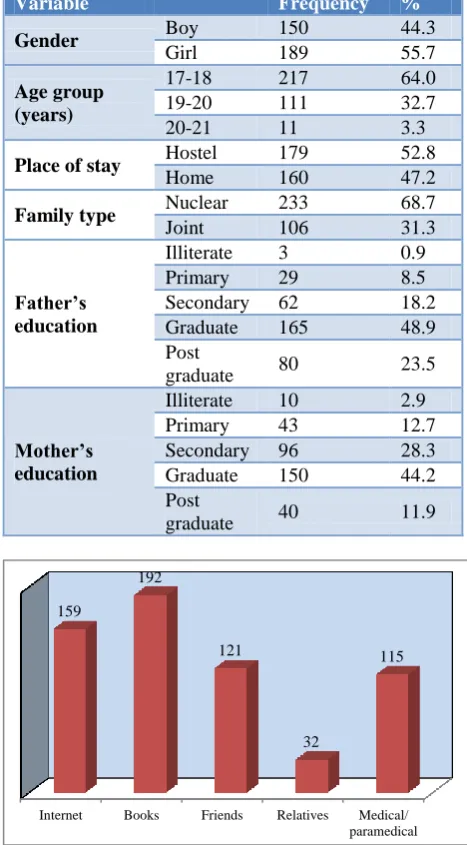
Out of the total participants enrolled, more than half of them were girls. Majority (64%) of them belonged to age group of 17 to 18 years. More than half of them stayed in hostel. Parents (both mother and father) of more than half of study participants were either graduate or post graduate. Majority of them belonged to nuclear families.
Table 1: Socio-demographic profile of study participants (N=339).
Variable Frequency %
Gender Boy 150 44.3
Girl 189 55.7
Age group (years)
17-18 217 64.0
19-20 111 32.7
20-21 11 3.3
Place of stay Hostel 179 52.8
Home 160 47.2
Family type Nuclear 233 68.7
Joint 106 31.3
Father’s education
Illiterate 3 0.9
Primary 29 8.5
Secondary 62 18.2 Graduate 165 48.9 Post
graduate 80 23.5
Mother’s education
Illiterate 10 2.9
Primary 43 12.7
Secondary 96 28.3 Graduate 150 44.2 Post
graduate 40 11.9
Figure 1: Source of knowledge of contraception.
Study participants were asked about their source of knowledge of contraception and multiple responses were taken. It was observed that books followed by internet were the most common source of knowledge regarding contraception. Medical/paramedical personnel were the source of information of contraception in about 34% of the participants.
Internet Books Friends Relatives Medical/
paramedical
159
192
121
32
Table 2: Gender wise distribution of participants about knowledge of emergency contraception.
Gender P value
Is EC Pill available only after prescription?
Yes No Do not know
Girl 32 71 86
>0.05
Boy 30 53 67
What is the drug composition of ECP as compared to regular pills?
Same Higher dose Completely different Do not know
Girl 1 92 6 90
>0.05
Boy 4 71 3 72
When should EC pill be taken?
Any time Within 24 hrs Within 48 hrs Within 72 hrs Do not know
Girl 2 49 28 42 68
>0.05
Boy 2 26 27 31 64
How many times can the EC pills be used in a year?
Once Twice Thrice No limit Do not know
Girl 3 5 3 10 168
>0.05
Boy 4 8 7 15 116
Can the EC pills be used if a woman is already taking the regular pills?
Yes No Do not know
Girl 38 65 86
>0.05
Boy 28 53 69
Does the EC pill also protect against some sexually transmitted diseases?
Yes No Do not know
Girl 41 82 66
>0.05
Boy 25 72 53
Can it terminate pregnancy if woman already pregnant?
Yes No Do not know
Girl 57 56 76
>0.05
Boy 38 54 58
Effectiveness of EC pill in preventing pregnancy
Highly effective (99%) 75% 50% < 50% Do not know
Girl 40 48 18 9 74
>0.05
Boy 35 32 14 8 61
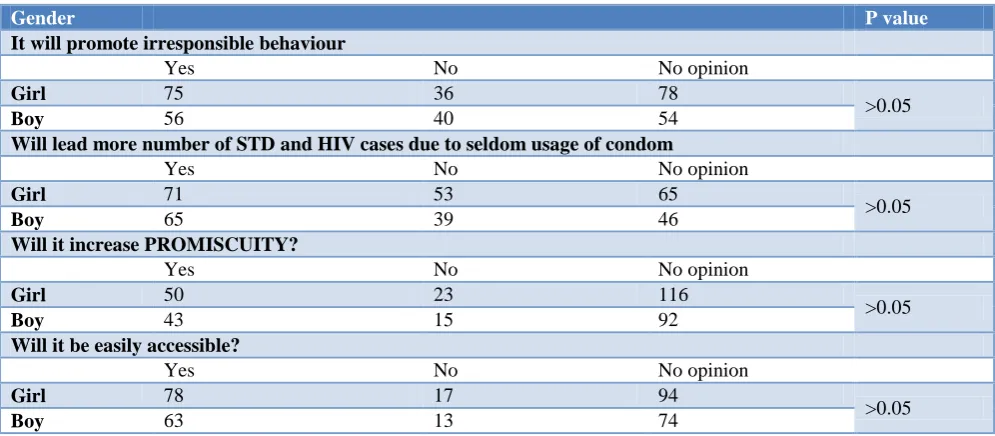
Table 3: Gender wise distribution of attitude of students regarding EC, if they are easily available.
Gender P value
It will promote irresponsible behaviour
Yes No No opinion
Girl 75 36 78
>0.05
Boy 56 40 54
Will lead more number of STD and HIV cases due to seldom usage of condom
Yes No No opinion
Girl 71 53 65
>0.05
Boy 65 39 46
Will it increase PROMISCUITY?
Yes No No opinion
Girl 50 23 116
>0.05
Boy 43 15 92
Will it be easily accessible?
Yes No No opinion
Girl 78 17 94
>0.05
Gender P value Will it be inexpensive?
Yes No No opinion
Girl 67 41 81
>0.05
Boy 55 38 68
Should it be available to women over 18 yrs only?
Yes No No opinion
Girl 107 32 50
>0.05
Boy 70 24 56
Should it be available to victims of rape only?
Yes No No opinion
Girl 13 111 65
>0.05
Boy 18 74 58
Various knowledge questions were asked to study participants regarding EC. Only quarter of students knew about EC pill. It was observed that many students were unaware about many aspects of knowledge regarding contraception. Gender wise comparison was also made between boys and girls regarding various aspects of knowledge related to Emergency Contraception. It was noted that there was no significant difference between boys and girls about knowledge of various aspects of Emergency contraception.
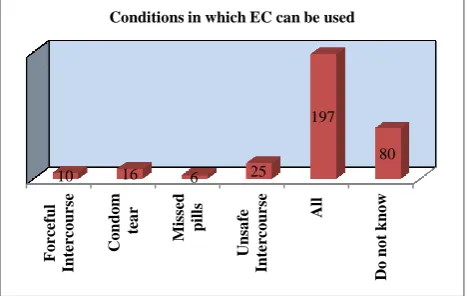
Figure 2: Student’s perception regarding conditions in which EC pill can be used.
Various questions related to attitude of students regarding different aspects of Emergency contraception were asked. Many students did not put forward opinion on them as can be noted from the table above. Almost 40% believed that EC would lead more irresponsible behaviour and more STD/HIV cases, while 30% believed that it would lead to promiscuity, and be inexpensive, if they are readily available. More than half number of students opined that EC should be made available for women aged only 18 years and above. Majority of the students did not agree with the question that EC pills should be available to vistims of rape only. Also, no significant difference was observed among boys and girls regarding their attitude towards Emergency Contraception.
The study participants were also asked regarding their perception about the conditions in which Emergency contraception can be used. Majority of the students were of the opinion that emergency contraception can be used in all the given conditions like Forceful intercourse, condom tear, missed pills and unsafe intercourse. 80 participants responded negatively to this question, while 5 participants did not respond to this question.
Practices of emergency contraception among study participants
Only 1 student reported to have used emergency contraception. He purchased it from medical store. There were 26 participants, who refused to answer this question, while rest of them reported not to have used EC. Among students who did not use EC, 40% reported their willingness to use EC, if needed. Also, 40% of them reported that, they would encourage their friends and relatives to use emergency contraception.
DISCUSSION
Emergency contraception pill (ECP) is an effective reproductive health intervention, which could protect millions of women from unwanted pregnancy. In India, ECP was introduced in 2002 by the Ministry of Health and Family Welfare (MoHFW) and was made an over the counter (OTC) drug in 2005. Less than one-third women are aware of ECP and less than one percent has ever used it.9 When ECP was introduced, no sustained efforts were made to educate about ECP at any level of providers – doctors, ANMs, and ASHA. Some senior officials of the MoHFW believed that there is no need to train healthcare providers in ECP, as the leaflet provided with the pill is self-explanatory.9 As per NFHS-4 report, knowledge of Emergency contraception was present in 38.5% of women and 44% of men, who were interviewed. The report also says that percentage of women who have ever used emergency contraceptive pills was just 0.4% and percentage of women who have used emergency contraceptive pills in the last 12 months was just 0.2%.10
Fo rc ef u l In te rc o u rse C o n d o m t ea r M
issed pills
U n sa fe In te rc o u
rse All
D o no t k n o w
10 16 6 25
197
It is expected that medical students, being future health care providers, must have sufficient knowledge regarding all forms of contraception along with Emergency contraception. Worldwide there is variation of knowledge, attitude and practice of EC amongst health care providers. In our study, books, internet and friends were most common source of knowledge of Emergency contraception. In a study done by Parey et al. in Trinidad among tertiary level students, it was observed that media, internet and books were the most common source of knowledge regarding EC.11 Similarly, in the study done by Nasir Tajure in Ethiopia on graduating female students, friends, radio and television were most common source of knowledge of EC.12
In the present study, various knowledge questions regarding EC were asked to the students. It was observed that, students were unaware regarding many aspects of EC. The percentage of unawareness ranged from 40% to 70% regarding various questions asked regarding knowledge of EC. In a similar study done by Giri et al on Post graduate students, Interns and medical undergraduate students in a medical college in Maharashtra, it was observed that overall good level of knowledge about EC was highest (47.6%) among postgraduates in comparison to interns (43.3%) and undergraduate students (41.6%).13
The current study also assessed attitudes of Medical students regarding EC. 30 to 50% of medical students did not put forward any opinion regarding their attitudes to different aspects of EC. The general attitude of students towards EC was positive. In a study done by Giri et al, overall positive attitude towards EC was observed among 73.8% of the respondents.13 Similarly, positive attitude to EC was found in tertiary level students in the study done by Parey et al in Trinidad.11
In our study, only one student reported to have used EC, while 26 respondents did not respond to this question. Similar findings were observed by Lakshmi et al in a study done on female medical students in Andhra Pradesh, where it was observed that no medical students had ever used EC pills.14 Similarly, in a study done by Rahaman et al on nursing staff in Sikkim, India, it was observed that almost 25% of nursing staff have ever practiced EC.15 In our study, among students who did not use EC, 40% reported their willingness to use EC, if needed. Also, 40% of them reported that, they would encourage their friends and relatives to use EC.
CONCLUSION
The great potential of EC to prevent unintended pregnancies and their complications is far from being realized. There is a lack of complete awareness about EC among studied population. As they are the health care providers in future, their knowledge regarding EC will be useful in educating public especially youth. Attitude was favorable towards EC in the studied population. Study
also document very low level of practice of EC among the students.
Funding: No funding sources Conflict of interest: None declared
Ethical approval: The study was approved by the Institutional Ethics Committee
REFERENCES
1. Leung VW, Levine M, Soon JA. Mechanisms of action of hormonal emergency contraceptives. Pharmacotherapy. 2010;30(2):158-68.
2. Gemzell-Danielsson K. Mechanism of action of emergency contraception. Contraception. 2010;82(5):404-9.
3. Food and Drug Administration (FDA). "Certain combined oral contraceptives for use as postcoital emergency contraception" (PDF). Federal Register. 1997;62 (37):8610–2.
4. Nibabe WT, Mgutshini T. Emergency contraception amongst female college students – knowledge, attitude and practice. Afr J Prm Health Care Fam Med. 2014;6(1):538.
5. Babatunde OA, Ibirongbe DO, Omede O, et al. Knowledge and use of emergency contraception among students of public secondary schools in Ilorin, Nigeria. The Pan African Med J. 2016;23:74. 6. Arowojolu AO, Adeyemi OA. Perception and
practice of emergency contraception by post-secondary school students in southwest Nigeria. Afr Reprod Health. 2000;4(1):56-65.
7. Fatuma A Ahmed, Kontie M Moussa, Karen O Petterson, Benedict O Asamoah. Assessing knowledge, attitude, and practice of emergency contraception: a cross- sectional study among Ethiopian undergraduate female students BMC Public Health, 2012;12:1.
8. Chandna A, Nath J, Dhingra D. Awareness of Emergency Contraception among 1st Year Medical Students. Int J Contemporary Med Res. 2016;3(6):1568-70.
9. Dixit A, Khan ME, Bhatnagar I. Mainstreaming of Emergency Contraception Pill in India: Challenges and Opportunities. Indian J Community Med: Official Publication of Indian Association Preventive Social Med. 2015;40(1):49-55.
10. International Institute for Population Sciences (IIPS) and ICF. 2017. National Family Health Survey (NFHS-4), 2015-16: India. Mumbai: IIPS.
11. Parey B, Addison L, Mark JK, Maurice B, Tripathi V, Wahid S, et al. A Sahai Knowledge, Attitude and Practice of Emergency Contraceptive Pills among Tertiary level students in Trinidad: A Cross-sectional Survey. West Indian Med J. 2010;59(6):650.
Southwest Ethiopia. Ethiopian J Health Sci. 2010;20(2):91-7.
13. Giri PA, Bangal VB, Phalke DB. Knowledge and attitude of medical undergraduate, interns and postgraduate students in India towards emergency contraception. North Am J Med Sci. 2013;5:37-40. 14. Lakshmi GV, Radha PK, Naidu SA. Knowledge,
attitude and practices of emergency contraception among female medical students of Andhra Medical College, Visakhapatnam. Int J Res Health Sci. 2014;2(2):507-10.
15. Rahaman H, Renjhen P, Kumar A, Pattanshetty S, Sagir A, Dubey H. A study on Emergency Contraceptive practice among nursing staff in Sikkim, India- A cross sectional study. AMJ. 2010;3(10):667-71.