Original Research Article
Knowledge and vaccination status on hepatitis B among the students of
Patuakhali Science and Technology University, Bangladesh
M. Sabbir Ahmed*, M. Wahidur Rahman, Fahmida Fayeza, Tarana Sharmin
INTRODUCTION
Hepatitis B virus (HBV) infection is a serious global public health problem as well as in Bangladesh. It is estimated that nearly two billion people have been acutely infected with HBV in the world in which about 350 million people are chronically infected.1 The most common liver disease in Bangladesh is viral hepatitis. Research shows that about 10 million people in Bangladesh have been suffering from hepatitis B.2
HBV is the prototype member of the Hepadnaviridae
member family having a strong preference for infecting the liver cells. It is an acute inflammatory disease of the liver or a form of viral hepatitis is caused by the HBV.3 Hepatitis B virus may lead to chronic hepatitis, cirrhosis of liver and hepatocellular carcinoma.4 It is estimated that globally about 0.6 million people are die to the acute or chronic consequences of hepatitis B infection. About 25% of adults who become chronically infected during childhood later die from liver cancer or cirrhosis (scarring of the liver) caused by the chronic infection.5 Bangladesh
ABSTRACT
Background: Hepatitis B virus (HBV) infection is a serious global public health problem as well as in Bangladesh. The most common liver disease in Bangladesh is viral hepatitis. Bangladesh is an intermediate endemic zone for hepatitis B virus infection. Research shows that about 10 million people in Bangladesh have been suffering from hepatitis B.
Methods: The research was a cross-sectional survey and appropriate statistical formula was used to select 341 respondents randomly. The data were collected through a pre-designed, pre-structured questionnaire, which was distributed among the students. All the data was analysed using Microsoft Excel 2013.
Results: Most of the respondent 95% knew about hepatitis B and about 87% knew that it is a viral infection. About 69% students respond that hepatitis B can increase liver cancer. Among the respondents, 76% supported that hepatitis B can be transmitted by blood transfusion. Most of the students 82% supported blood transfusion as a causative factor and 67% informed that jaundice is the major sign and symptoms of hepatitis B. More than half of the students 53% reported that they were vaccinated for hepatitis B. The major reasons for not taking vaccination were lack of free time and lack of feeling of necessity for vaccination.
Conclusions: The overall knowledge and vaccination status on hepatitis B virus was not satisfactory. Different types of seminars and campaigns on hepatitis B, arranged by university will help to increase the student’s level of knowledge on hepatitis B.
Keywords: Hepatitis B, Knowledge, Vaccination, University students, Bangladesh
Faculty of Nutrition and Food Science, Patuakhali Science and Technology University, Dumki, Patuakhali, Bangladesh
Received: 09 September 2018
Accepted: 05 October 2018
*Correspondence:
Mr. M. Sabbir Ahmed, E-mail: [email protected]
Copyright: © the author(s), publisher and licensee Medip Academy. This is an open-access article distributed under the terms of the Creative Commons Attribution Non-Commercial License, which permits unrestricted non-commercial use, distribution, and reproduction in any medium, provided the original work is properly cited.
is an intermediate endemic zone for Hepatitis B virus infection.6
Although hepatitis B is an ancient disease, most of the knowledge of its epidemiology, prevention, pathogenesis, natural history and treatment were made in the past few years. Certain groups are at particularly high risk of HBV infection. These includes: healthcare workers, men who have sex with other men, people who use IV drugs, people with multiple sex partners, people with chronic liver disease, people with kidney disease, people over the age of 60 with diabetes, those traveling to countries with a high incidence of HBV infection.7 Vertical transmission, transmission through unsafe sex, unsafe injections and body fluid like blood, saliva etc. are the most common route of infection for HBV.7
There is no specific treatment for acute hepatitis B. Vaccination against HBV and safety measures are the only way to avoid this hepatitis B infection. The vaccine against hepatitis B is available since 1982 and is 95% successful preventing infection and its grave consequences like liver cancer and cirrhosis of liver.8 In Bangladesh hepatitis B vaccination has been integrated into the national EPI program since 2005.9 After completing the graduation university students might go for professional or married life. So, it is very important for them to have the basic knowledge about the hepatitis B and make sure that he/she is HBV positive or negative. If it is found positive it can be very dangerous for him as well as for the family and society. So the university students are expected to have a sound knowledge regarding hepatitis B and safety precautions to prevent its acquisition and spreading.
However, a few study have been conducted to assess the knowledge and vaccination status on hepatitis B among the university students in Bangladesh. This study is therefore helpful to evaluate the vaccination status and knowledge regarding hepatitis B. The objectives of this study was to assess the knowledge and vaccination status on hepatitis B among the students of Patuakhali Science and Technology University in Bangladesh.
METHODS
Type of study
A cross sectional study was carried out among the students of Patuakhali Science and Technology University, Bangladesh during the time period between July to August 2018.
Sample size
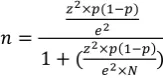
A total of 341 students were randomly selected from all the students of the university. The sample size was statistically calculated by using following formula:
Where, n= sample size, z = the value of association with 95% confidence interval= 1.96, p= Level of variability = 0.5, e=margin of error (percentage in decimal form) = 0.05, N =population size= 3000.
Data collection
The data were collected through a designed, pre-structured questionnaire, which was distributed among the students. A pilot survey was done to check the validity of the questionnaire. The questionnaire was in English and consisted of questions related to knowledge of hepatitis B infection as regards to basic information, mode of transmission, risk factors, sign and symptoms, vaccination information and reasons for not taking vaccination. All the questions were objective in nature with ‘Yes’, ‘No’ and ‘Not sure’ as the options, although a few questions were of multiple-choice type. The oral consent was obtained from each participant before data collection.
Data analysis
After finishing of all data collection informations were re-checked and entered into the computer very carefully. The data was edited if there was any discrepancy (doubt entry, wrong entry). All the data was analyzed using Microsoft Excel 2013. For tabular charts and graphical representation Microsoft Word 2013 was used.
RESULTS
Table 1: Demographic characteristics of the students (N=341).
Variables Frequency Percentage (%)
Age (in years)
18-21 216 63.34
22-25 125 36.66
Mean (± SD)=20.98 (± 1.58)
Gender
Male 207 60.7
Female 134 39.3
Religious status
Muslim 271 79.47
Hindu 68 19.95
Others 2 0.58
Educational level
Undergraduate 298 87.39
Graduate 43 12.61
Muslim 79%. Majority of the subjects 87% were the undergraduate students (Table 1).
Table 2 shows the basic knowledge of the respondents regarding the hepatitis B. Most of the respondent 95% knew about hepatitis B and about 87% knew that it is a viral infection. About 69% students respond that Hepatitis B can increase liver cancer. More than half of the respondents 60% tested their blood for hepatitis B.
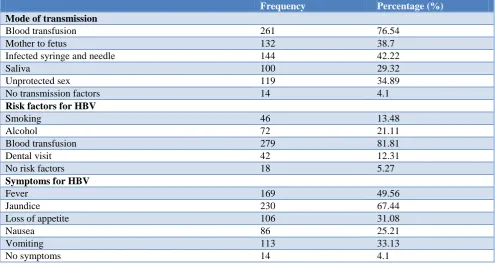
Table 3 illustrates the knowledge of the respondents about the mode of transmission, risk factors and symptoms of hepatitis B infection. Among the respondents, 76% supported that hepatitis B can be transmitted by blood transfusion. About 35% marked unprotected sex as a way of mode of transmission. 29% of the respondents informed that the virus can be transmitted through saliva whereas only 4% said that they had never heard of these factors before.
Table 2: Basic knowledge of the respondents regarding hepatitis B (N=341).
Yes
N (%)
No N (%)
Not sure N (%)
Do you know about hepatitis B? 326 (95.60) 10 (2.94) 5 (1.46)
Do you know hepatitis B is a viral infection? 296 (86.81) 31 (9.09) 14 (4.10)
Do you think hepatitis B can impair liver function? 246 (72.15) 45 (13.19) 50 (14.66)
Do you think hepatitis B can increase liver cancer? 235 (68.91) 37 (10.85) 69 (20.24)
Do you think hepatitis B can be completely cured? 107 (31.38) 150 (43.98) 84 (24.64)
Do you ever test your blood for hepatitis B? 203 (59.53) 126 (36.95) 12 (3.52)
Table 3: Knowledge about mode of transmission, risk factors and symptoms about hepatitis of the respondents (N=341).
Frequency Percentage (%)
Mode of transmission
Blood transfusion 261 76.54
Mother to fetus 132 38.7
Infected syringe and needle 144 42.22
Saliva 100 29.32
Unprotected sex 119 34.89
No transmission factors 14 4.1
Risk factors for HBV
Smoking 46 13.48
Alcohol 72 21.11
Blood transfusion 279 81.81
Dental visit 42 12.31
No risk factors 18 5.27
Symptoms for HBV
Fever 169 49.56
Jaundice 230 67.44
Loss of appetite 106 31.08
Nausea 86 25.21
Vomiting 113 33.13
No symptoms 14 4.1
Table 4: Vaccination status of the respondents.
Frequency Percentage (%)
Vaccinated for HBV 180 52.78
Not vaccinated for HBV 136 39.88
Not sure about the vaccination 25 7.34
Total 341 100
It was found that most of the students 82% supported blood transfusion as a causative factor of Hepatitis B.
Among the study population, maximum respondents 67% informed that jaundice is the major sign and symptoms of hepatitis B. Only few population about 4% confirmed that they had no knowledge regarding that information. (N.B. all the responses were multiple in nature)
More than half of the students 53% reported that they were vaccinated for hepatitis B infection and about 7% respondents was not sure about the vaccination (Table 4).
Figure 1: Reasons behind not taking vaccine.
The population who did not take vaccine specify some reasons for that. Most of them 25% and 24% did not take vaccine due to lack of free time and lack of feeling of necessity respectively. 4% of the respondents reported that they never heard about vaccination (Figure 1).
DISCUSSION
Hepatitis B is a serious global public health problem which occurs due to hepatitis B virus affecting the liver. In our study most of our study population were in the age range 18-21 years 63% and majority of the subjects 87% were the undergraduate students of the university. Our current study found that Most of the respondent 95% knew about hepatitis B and about 87% knew that it is a viral infection which is greater than the another study done in Bangladesh among the university students.10 About 69% students respond that hepatitis B can increase liver cancer which is similar with the study done among Vietnamese American college students.11 About 37% respondents reported that hepatitis B cannot be cured which is higher than the previous study.11
This study reveals that, among the study population about 76% supported that hepatitis B can be transmitted through blood transfusion which is lower than the previous study done among the nurses in Bangladesh.12 About 35% marked unprotected sex as a way of mode of transmission which is lower than the previous study.11,12 Our study also found that most of the students 82% supported blood transfusion as a causative factor of hepatitis B which is higher than the previous done in Bangladesh.10 Among the study population, maximum
respondents 67% informed that jaundice is the major sign and symptoms of hepatitis B which is higher than the study reported from Bangladesh.10
This study also found that, more than half of the students 53% reported that they were vaccinated for hepatitis B infection which is lower than the study done in India.13 The population who did not take vaccine specify some reasons for that. Most of them 25% and 24% did not take vaccine due to lack of free time and lack of feeling of necessity respectively which is relatively similar with the previous study done among the Bangladeshi University students.10
CONCLUSION
The overall knowledge of hepatitis B virus is not satisfactory. Nearly half of the respondents did not take vaccine. The students do not have adequate knowledge about the mode of transmission, risk factors and symptoms of viral hepatitis B. There were certain amount of population which was not so small thought that it is unnecessary for them to take vaccine. Different types of seminar and campaigns on hepatitis B, arranged by university can increase the student’s level of knowledge on hepatitis B. Government and different health related organization should take necessary steps to increase knowledge and awareness about hepatitis B virus and its vaccination.
ACKNOWLEDGEMENTS
The author wishes to acknowledge Liton Chandra Sen, Jasmin Ara Farhana and all the participants for their help and assistance.
Funding: No funding sources Conflict of interest: None declared Ethical approval: Not required
REFERENCES
1. Lee WM. Hepatitis B virus infection. New England J Med. 1997;337(24):1733-45.
2. Lin C-L, Kao J-H. Hepatitis B viral factors and clinical outcomes of chronic hepatitis B. J Biomed Sci. 2008;15(2):137-45.
3. Al-Hussami M. Knowledge and acceptance of hepatitis B vaccine. Int J Healthcare Admin. 2004;2(1).
4. Malik AH, Lee WM. Chronic hepatitis B virus infection: treatment strategies for the next millennium. Ann Internal Med. 2000;132(9):723-31. 5. Huq S, Hossain SM, Haque SMT, Akter S. Knowledge, attitude and practice on hepatitis-B infection among infected patients in a Homoeopathy Medical Center in Dhaka City, Bangladesh. South East Asia J Public Health. 2016;6(1):27-31.
6. Alam S, Azam G, Mustafa G, Alam M, Ahmad N. Past, present, and future of hepatitis B and fatty
25%
24% 20%
14% 13% 4%
Reasons for not taking vaccination
Lack of Time
Need was not Felt
Never thought of Vaccination Financial Problem
Fear of Injection
liver in Bangladesh. Gastroenterol Hepatol Open Access. 2017;6(3):197.
7. Healthline. Hepatitis B. Available at: https://www. healthline.com/health/hepatitis-b. Accessed on 4 September 2018.
8. World Health Organization (WHO). Hepatitis B- Fact Sheet. Available at: http://www.who.int/ mediacentre/factsheets/fs204_Jul2014/en/. Accessed 4 September 2018.
9. Ahad MA, Guho A, Alim MA. Antibody Titer and Sex Difference After Recombinant Hepatitis B Vaccination. Medicine Today. 2011;23(2):91-6. 10. Afrin N. Survey on Hepatitis B Knowledge and
Awareness among the university students of Bangladesh. 2017.
11. Hwang JP, Huang C-H, Yi JK. Knowledge about hepatitis B and predictors of hepatitis B vaccination
among Vietnamese American college students. J Am Coll Health. 2008;56(4):377-82.
12. Mehriban N, Ahsan GU, Islam T. Knowledge and preventive practices regarding Hepatitis B among nurses in some selected hospitals of Dhaka city, Bangladesh. South East Asia Journal of Public Health. 2015;4(1):48-52.
13. Giri PA, Phalke DB. Knowledge and vaccination status of hepatitis B amongst medical interns of Rural Medical College, Loni, Maharashtra, India. South East Asia J Public Health. 2014;3(2):19-22.