Original Research Article
Knowledge attitude and practice on dengue among university students
Mohamad Afhzan Amanah, Hasmah Abdullah, Noraini Abdul Ghafar*
INTRODUCTION
Dengue fever is a vital public health problem which is epidemiologically and ecologically related to human lifestyle and activities.1 Nowadays, dengue is the ordinary and quickly spreading mosquito-borne viral disease in several parts of the world. Dengue can be divided into two main forms which are dengue fever and the worse; dengue haemorrhagic fever. Infection from dengue virus also can cause wide range of clinical problem such as asymptomatic infection and mild flu-like symptoms.2 Outbreaks of vector-borne diseases such as dengue can devastate health systems especially in resource-poor countries.3
Dengue fever is a problem that is continuously occurring. Internationally, dengue fever is widespread in 112 countries around the world and the approximate yearly
incidences are 50 million dengue fever cases and 500,000 dengue haemorrhagic fever cases led to 22,000 deaths that occurred mainly among children.4 Dengue fever becomes worst over the time. Three quarters of all cases of dengue fever worldwide occur in Southeast Asia and Western Pacific regions.5 Recently, it is estimated that 390 million dengue infections happen each year, with about 100 million manifesting clinically with varying degrees of severity of the disease and small quantity progress to severe dengue.3
Good knowledge, attitude and practice regarding dengue fever are important especially to those exposed to this deadliest disease. Knowledge on vector of the disease, the mode of transmission, the symptoms of the disease, and the correct prevention method are vital to help the public act toward the disease accordingly. On the other hand, good attitude and practice of dengue prevention and
ABSTRACT
Background: Knowledge, awareness, and practice regarding dengue are important to be cultivated especially among the young generation. This study was commenced to assess the level of knowledge, attitude and practice of dengue fever among undergraduate health science students of University of Science Malaysia, beside to determine the relationship between knowledge regarding dengue and practice of dengue prevention.
Methods: Cross sectional survey among 250 undergraduate students was conducted to assess the level of knowledge, attitude, and practice toward dengue using a standardized questionnaire. Data was analysed using SPSS through a few statistical analyses.
Results: Majority of the students had moderate level of knowledge, attitude, and practice toward dengue fever. There was a significant, positive, weak correlation between knowledge and practice regarding dengue fever (p<0.05).
Conclusions: Level of knowledge, attitude and practice regarding dengue fever among the students could be increased. Social media could be used as an important medium in delivering information on dengue especially among the youths. Effort must be put to translate the components of knowledge into good practice of dengue prevention.
Keywords: Knowledge, Attitude, Practice, Dengue, Students
School of Health Science, University of Science Malaysia, Health Campus, Kubang Kerian Kelantan, Malaysia
Received: 28 August 2018
Revised: 04 October 2018
Accepted: 05 October 2018
*Correspondence:
Dr. Noraini Abdul Ghafar, E-mail: [email protected]
Copyright: © the author(s), publisher and licensee Medip Academy. This is an open-access article distributed under the terms of the Creative Commons Attribution Non-Commercial License, which permits unrestricted non-commercial use, distribution, and reproduction in any medium, provided the original work is properly cited.
control should be cultivated. Practise of covering water, avoiding from being bitten by Aedes mosquito, and ensuring that there are no possible breeding sites around the living area are important to be practiced. Knowledge, attitude and practice are related to each other. Good knowledge on dengue would be translated into good practice of prevention studies.6-9
Many studies on knowledge, attitude, and practice on dengue have been done including in Malaysia. However, very few had focused on university or college student. It is important to cultivate good attitude and practice besides providing knowledge regarding dengue among younger generation, especially teenagers and young adult so that they could educate other people especially those who are close to them beside applying good practice of dengue prevention when they are in the campus or at home. Besides, it is hoped that this younger generation can spread the important information to a wider community. This study therefore was commenced to assess the level of knowledge, attitude and practice of dengue fever among undergraduate health science students of University of Science Malaysia, beside aiming to see the relationship between the three components..
METHODS
This cross-sectional study was conducted among 250 under graduate health sciences students of University of Science Malaysia from January 2017 until June 2018. The sample size was calculated based on the formula of two proportion; (Zα/2+Zβ)2 * (p1(1-p1)+p2(1-p2)) / (p1-p2)2
by considering the confidence interval, CI of 95%, level of significance, α of 0.05, the power of 0.80 and the dropout rate of 10%. Purposive sampling method was used to recruit students. The students were approached and briefed about the study. Those students who were interested in participating in this study were asked for consent prior to the distribution of the questionnaire.
Research tools
Structured questionnaire was used to collect the data for this study. The questionnaire consisted of 38 questions which were divided into four parts; socio demographics, knowledge, attitude, and practice. Response for the questions were in the form of ‘Yes’ or ‘No’ and in the form of agreement.
Data analysis
Data were analysed using Statistical Package for the Social Science (SPSS) version 22.0. Descriptive analysis was performed to describe the total score of knowledge, attitude and practice towards dengue fever beside to describe the socio-demographic information of the students. Pearson’s correlation test was performed to determine correlation between knowledge and attitude, attitude and practice, knowledge and practice of dengue fever among students. Results were considered significant at p<0.05.
Ethical consideration
This study had gained human ethical approval from the committee of Human Research Ethics, University of Science Malaysia. Participatory of the students in this study were based on voluntary and supported by written consent form from each student.
RESULTS
Socio demographic characteristics of the respondents
A total of 250 students participated in this study (n=250); 59 males and 191 females. Students were of multiracial; 52 percent were Malays, 36 percent were Chinese, 11 percent were Indians, and 1 percent was from other races. Majority of the students aged between 19-23 years old and pursuing their studies in Health Science Programs.
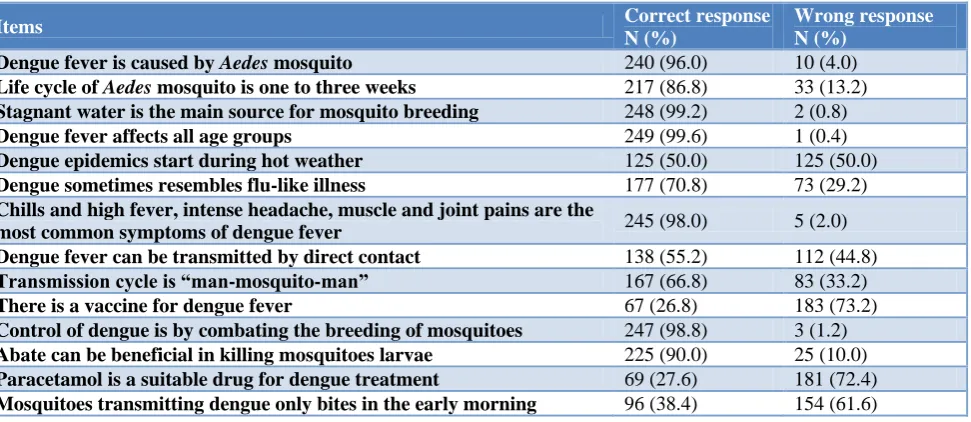
Table 1: Knowledge regarding dengue among the students (N=250).
Items Correct response
N (%)
Wrong response N (%)
Dengue fever is caused by Aedes mosquito 240 (96.0) 10 (4.0)
Life cycle of Aedes mosquito is one to three weeks 217 (86.8) 33 (13.2)
Stagnant water is the main source for mosquito breeding 248 (99.2) 2 (0.8)
Dengue fever affects all age groups 249 (99.6) 1 (0.4)
Dengue epidemics start during hot weather 125 (50.0) 125 (50.0)
Dengue sometimes resembles flu-like illness 177 (70.8) 73 (29.2)
Chills and high fever, intense headache, muscle and joint pains are the
most common symptoms of dengue fever 245 (98.0) 5 (2.0)
Dengue fever can be transmitted by direct contact 138 (55.2) 112 (44.8)
Transmission cycle is “man-mosquito-man” 167 (66.8) 83 (33.2)
There is a vaccine for dengue fever 67 (26.8) 183 (73.2)
Control of dengue is by combating the breeding of mosquitoes 247 (98.8) 3 (1.2)
Abate can be beneficial in killing mosquitoes larvae 225 (90.0) 25 (10.0)
Paracetamol is a suitable drug for dengue treatment 69 (27.6) 181 (72.4)
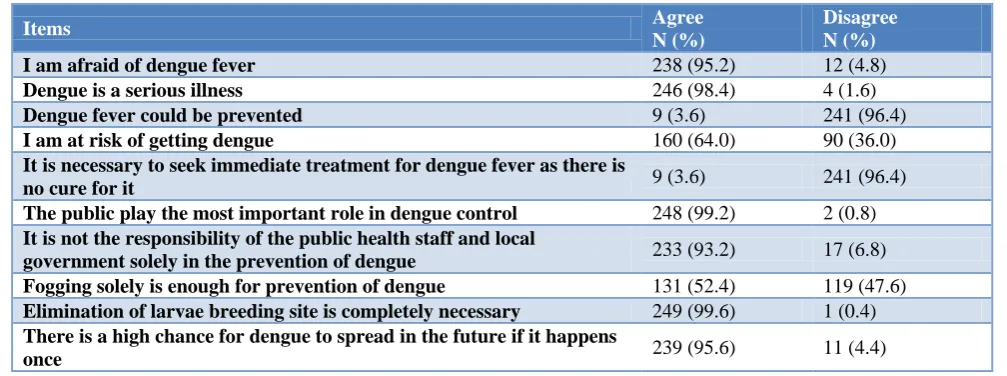
Table 2: Attitude towards dengue among the students (N=250).
Items Agree
N (%)
Disagree N (%)
I am afraid of dengue fever 238 (95.2) 12 (4.8)
Dengue is a serious illness 246 (98.4) 4 (1.6)
Dengue fever could be prevented 9 (3.6) 241 (96.4)
I am at risk of getting dengue 160 (64.0) 90 (36.0)
It is necessary to seek immediate treatment for dengue fever as there is
no cure for it 9 (3.6) 241 (96.4)
The public play the most important role in dengue control 248 (99.2) 2 (0.8)
It is not the responsibility of the public health staff and local
government solely in the prevention of dengue 233 (93.2) 17 (6.8)
Fogging solely is enough for prevention of dengue 131 (52.4) 119 (47.6)
Elimination of larvae breeding site is completely necessary 249 (99.6) 1 (0.4)
There is a high chance for dengue to spread in the future if it happens
once 239 (95.6) 11 (4.4)
Table 3: Practice of dengue prevention among the students (N=250).
Items Agree
N (%)
Disagree N (%)
I often practice covering water jars at hostel 180 (72.0) 70 (28.0)
I dispose material that may hold water (examples: tyres, empty bottles)
properly 139 (55.6) 111 (44.4)
I often use mosquito net at the hostel 28 (11.2) 222 (88.8)
I often use mosquito repellent 134 (53.6) 116 (46.4)
I often participate in community cleanliness activities 158 (63.2) 92 (36.8)
Table 4: Level of knowledge, attitude, and practice of dengue fever and prevention among the students (N=250).
Level, N (%)
Components Poor Moderate Good
Knowledge 30 (12.0) 155 (62.0) 65 (26.0)
Attitude 8 (3.2) 235 (94.0) 7 (2.8)
Practice 83 (33.2) 153 (61.2) 14 (2.8)
Table 5: Relationship between knowledge on dengue and practice of dengue prevention.
Knowledge Practice
Knowledge Pearson correlation 1 0.137**
Sig. (2-tailed) 0.035
n 250 250
Practice Pearson correlation 0.137** 1
Sig. (2-tailed) 0.035
n 250 250
** Correlation is significant at the 0.05 level (2-tailed).
Knowledge regarding dengue
Table 1 summarizes knowledge regarding dengue. There were 14 questions under this component. Based on descriptive analysis, majority of the students managed to answer correctly on most of the questions. However, a few questions were answered wrongly by them. Question regarding availability of vaccine for dengue recorded
only 26.8 percent of correct answers. Meanwhile, more than 70 percent of the students answered that
Attitude toward dengue
A total of ten statements regarding attitude toward dengue were asked in the questionnaire. Majority of the students shown agreement on most of them except for the third and the fifth statement. Only 3.6 percent of the students agreed that dengue could be prevented while the rest assumed that it could not be. This number is similar with the percentage of agreement and disagreement for the necessity to seek immediate treatment. As for fogging, more than half of the students agreed that fogging solely is enough for preventing dengue (Table 2).
Practice of dengue prevention
Table 3 summarizes the items under the component of practice of dengue prevention. Based on the table, majority of the students practiced covering water jars. Besides, they practice disposing material holding water properly, use mosquito repellent, and participate in cleanliness activities moderately. However, only 11.2 percent of them practice using mosquito net at the hostel.
Level of knowledge, attitude, and practice of dengue fever and prevention
Total score of knowledge, attitude, and practice were calculated and each of them were categorized into three level; poor, moderate, and good. The results were summarized in Table 4. Based on the table, majority of the students had moderate level of knowledge, attitude, and practice.
Correlation between knowledge and practice of dengue fever among students
Pearson’s correlation analysis was performed to see if there is a relationship between knowledge and practice. Result found that there was a significant, weak, positive correlation between those two components; r=0.137, p<0.05 (Table 5).
DISCUSSION
This study assessed the level of knowledge, attitude and practice of dengue fever among the under graduate health sciences students from the Health Campus of University of Science Malaysia. Total score of knowledge, attitude, and practice of the students were analysed to determine the level of those three components. Correlation between knowledge and practice was also included in this study.
For general knowledge on dengue, a few key questions were answered wrongly by the students. Regarding availability of vaccine for dengue, only 26.8 percent of the students manage to answer correctly that there is no vaccine available on the shelf for this disease. The importance of answering correctly for this question is undeniable since it will determine the way the students act toward dengue. By assuming that there is vaccine
available for dengue, the students might not take this disease seriously. Meanwhile, more than 70 percent of the students answered that Paracetamol is a suitable drug for treating dengue. As for now, there is no treatment for dengue except fluid management and thorough monitoring.10 Besides, 61.8 percent of the students regard that dengue vector only active in the early mornings. This misunderstanding need to be corrected because apart from early morning, the vector is also active a few hours before sunset.11 It is important to know the active biting time of Aedes mosquito to avoid being bitten.
For attitude toward dengue, majority of the students assumed that dengue could not be prevented. This assumption must be corrected since dengue could be prevented. Correct prevention method such as elimination of the potential larval breeding sites, beside avoidance from being bitten by Aedes mosquito must be taught to the students. The importance of immediate treatment for dengue must be emphasized to the students so that they will seek early treatment when getting symptoms of dengue fever.12
For practice of dengue prevention, majority of the students practiced covering water jars beside practicing disposing material holding water properly, using mosquito repellent, and participating in cleanliness activities moderately. These practices of dengue prevention are important to prevent from mosquito bites apart from controlling mosquito breeding in campus. For practise of using mosquito net, only 11.2 percent of the students practiced using it at the hostel. This may be due to the hostel environment and hot weather in Malaysia that made the usage of mosquito net quite uncomfortable. This finding is coherent with a study in Kuala Lumpur.7 From the correlation analysis, students with high score of knowledge frequently have high score of practice. This finding was in concordance with several studies. 6-9 Theoretically, good knowledge would be translated into good practice, while poor knowledge will lead to poor practice. A study by Alyousefi et al proved that poor knowledge of the vector mosquitoes was the independent factor significantly associated with poor practices of the respondents.13 However, there are contrasting findings whereby good knowledge has no association.14-16
CONCLUSION
fast through this medium. Younger generation is very much exposed to the social media. Therefore, using the social media as a medium to deliver information on dengue could promote awareness on dengue fever beside helping the students to improve knowledge, attitude and practice on dengue prevention.
Study limitation
Our findings must be interpreted in the light of a few potential limitations. Firstly, cross sectional design which does not allow causation to be implied. Besides, the study location which was a campus may limit the findings to be extrapolated to other settings.
ACKNOWLEDGEMENTS
Authors would like to acknowledge the University of Science Malaysia for supporting this study. We would also like to acknowledge all the professionals, health personnel, and all the respondents participated in this study.
Funding: This work was financially supported by the University of Science Malaysia
Conflict of interest: None declared
Ethical approval: The study was approved by the Human Research Ethical Committee of University of Science Malaysia
REFERENCES
1. Gul SN, Ghafoor F, Jajja MA. knowledge, attitude and practices regarding dengue fever in Lahore, Pakistan. Pakistan J Med Res. 2014;53(2):34-8. 2. Taksande A, Lakhkar B. Knowledge, attitude and
practice (KAP) of dengue fever in the rural area of central India. Shiraz E-Med J. 2012;13(4):146-57. 3. Alobuia WM, Missikpode C, Aung M, Jolly PE.
knowledge, attitude, and practices regarding vector-borne diseases in Western Jamaica. Ann Glob Health. 2015;81(5):654-63.
4. Sayavong C, Chompikul J, Wongsawass S, Rattanapan C. Knowledge, attitudes and preventive behaviors related to dengue vector breeding control measures among adults in communities of Vientiane, capital of the Lao PDR. J Inf Pub Health. 2015;8(5):466-73.
5. WHO. Comprehensive guidelines for prevention and control of dengue and dengue haemorrhagic fever. 2011:55-60
6. Dhimal M, Aryal KK, Dhimal ML, Gautam I, Singh SP, Bhusal CL, et al. Knowledge, attitude and
practice regarding dengue fever among the healthy population of highland and lowland communities in central Nepal. PLoS One. 2014;9(7):e102028. 7. Abdo Radman S, Ganasegeran K, Alwan MR,
Ahmed M, Saif-Ali R. Factors affecting dengue fever: knowledge, attitudes and practices among selected urban, semi-urban and rural communities in Malaysia. SEA J Trop Med Pub Health. 2013;44(1):37-49.
8. Cho N, Wong YR, Chan YM, Koh PF, Chua Q, Choo NN, et al. Awareness of dengue and practice of dengue control among the semi-urban community: a cross sectional survey. J Comm Health. 2011;36:1044-9.
9. Hafeez F, Akram W, Suhail A, Arshad M. Knowledge and attitude of the public towards dengue control in urban and rural areas of Punjab. Pakistan J Zool. 2012;44(1):15-21.
10. Ministry of Health Malaysia. Clinical Practice Guidelines. Management of dengue infection in adults. Third Edition. 2015: 21-24.
11. Center for Disease Control. Dengue and Aedes aegypti mosquito. 2012:1-2.
12. Wong LP, Sazaly AB. Health beliefs and practices related to dengue fever: a focus group study. PLOS Neglected Tropical Dis. 2013;7(7):1-9.
13. Alyousefi TAA, Abdul-Ghani R, Mahdy MAK, Al-Eryani SMA, Al-Mekhlafi AM, Raja YA, Shah SA, Beier JC. A household-based survey of knowledge, attitudes and practices towards dengue fever among local urban communities in Taiz Governorate, Yemen. BMC Inf Dis. 2016;16(1):543.
14. Chinnakali P, Gurnani N, Upadhyay RP, Parmar K, Suri TM, Yadav K. high level of awareness but poor practices regarding dengue fever control: a cross-sectional study from North India. North Am J Med Sc. 2012;4(6):278-82.
15. Mayxay M, Cui W, Thammavong S, Khensakhou K, Vongxay V, Inthasoum L, Sychareun V, Armstrong G. Dengue in peri-urban Pak-Ngum district, Vientiane capital of Laos:a community survey on knowledge, attitudes and practices. BioMed Central Pub Health 2013;13(434):1-8. 16. Thompson F, Caltabiano ML. The Health Belief
Model and dengue fever preventative behaviors:A pilot program. Int J Health Promo and Edu. 2010;48(1):9-19.