Original Research Article
A cross sectional study to find out the prevalence of type D personality
and its associated factors among undergraduate students of a dental
college in western Uttar Pradesh
Deepak Kumar*, Gurpreet Kaur, Rahul Bansal, Chetna Tuteja,
Ankur Kumar, Anuj Farswal
INTRODUCTION
Mental health is an essential component of health. There is an important role of psychological and behavior factors in etiology and pathogenesis of various disorders.1 These factors play a very dominating role in determining personality of an individual.
An individual personality is reflected in their thoughts,
emotion and behaviour.2 The personality type
classification of individuals refers to psychological classifications of different types of individuals. The most well-known of these personalities is type A personality
which includes competitiveness, aggressiveness,
impatience, alertness, irritation, ambitiousness, hostility and increased potential for anger. Type A individuals are at increased risk for developing coronary heart disease. The other personalities are type B and type C. Type B personality are procrastinators and type C are assertive.
Recently, a new personality construct, Type D personality has been proposed in which D stands for distress as reflected by the mood status of an individual. Type D personality is defined as joint tendency towards negative affect and social inhibition. The persons with negative affect have characteristic features of negative
ABSTRACT
Background: An individual personality is reflected in their thoughts, emotion and behavior. Type D personality is defined as joint tendency towards negative emotions and social inhibition. Type D personality is associated with anxiety, depression and psychological stress. The present study is conducted to assess the incidence of Type D personality in the under graduate dental students as they are prone to excessive stress in their education. To study the prevalence Type D personality in first year dental students and to study the various variables associated with type D personality.
Methods: The personality of students was analyzed by using DS 14 questionnaire. Likert scale was used to calculate the personality score. The students scoring high on either or both subscales taking cut off value as 10 was considered as type D.
Results: 15% students had only social inhibition and 7% students had only negative affectivity. 5% students had both social inhibition and negative affectivity. Overall, the prevalence type D personality was found to be 27% among the students of dental college. The type D personality students were significantly associated with habits like alcoholism.
Conclusions: The early identification of Type D personality can be helpful both for physical and mental wellbeing and we can minimize its impact on health by adopting healthier life style, yoga and meditation, mentorship in early college days, emotional support etc.
Keywords: Type D personality, Alcoholism, Dental students, DS14 questionnaire Department of Community Medicine, Subharti Medical College, Meerut, India
Received: 16 May 2019
Accepted: 06 July 2019
*Correspondence:
Dr. Deepak Kumar,
E-mail: [email protected]
Copyright: © the author(s), publisher and licensee Medip Academy. This is an open-access article distributed under the terms of the Creative Commons Attribution Non-Commercial License, which permits unrestricted non-commercial use, distribution, and reproduction in any medium, provided the original work is properly cited.
emotions towards themselves and others. Such persons have the tendency to experience negative emotions like depression, low mood, anger, anxiety, stress and hopelessness, etc. Those people scoring high on negative affect are not only dysphoric, but also have negative views about self, future, world, and present many somatic symptoms.3
In contrast, the social inhibition is an avoidance of potential dangers involved in social interacting situations. They fell uncomfortable, shy, tense, and inhibited while interacting with people.3 They tend to experience difficulty in expressing themselves in social situations and result in social inhibition.4 Hence, people with Type D personality are unable to express the emotions which lead them feeling tense, insecure, and socially uncomfortable.5
Type D personality is vulnerability factor for general psychosocial distress that affects physical health status and people are at high risk of developing psychiatric disorders like depression, anxiety, PTSD, panic or phobic disorder. Type D individuals are associated with greater cortisol reactivity to stress. Elevated cortisol may be mediating factor in the association between type D personality and the increased risk for coronary heart disease and possibly other medical disorders. Type D personality has been linked to a wide range of adverse health outcome like cardiovascular disease and stroke.4,6,7 Type D is further associated with occupational problems such as an increasedrate of sick leave, job stress and burn out.8,9
The medical and dental students are confronted with significant academic, psychological or existential stress. They face difficulties like long study hours, language related problems, home sickness while living in hostel, feeling of loneliness etc. The prevalence of type D personality in Indian medical students is found to be in range of 30-70% in various studies.10-13 But, very few studied have found out prevalence and associated factors of type D personality among dental students. Therefore, the current study aims to find our prevalence of type D personality among dental students in a private dental college of western Uttar Pradesh.
Objectives
To find out the prevalence of type D personality among dental students of a dental college of western Uttar Pradesh.
To find out the associated factors along type D personality among dental students of a dental college of western Uttar Pradesh.
METHODS
A cross sectional study was conducted among 1st year dental students of a private dental college in western Uttar Pradesh. All students of 1st year i.e., 100 students
were enrolled in the study. The study was conducted during October-November 2018 after taking permission of institutional ethical committee. Each eligible subject was well explained about the purpose of the study by the investigator and an informed consent was obtained, prior to inclusion. Students known to hypothyroidism or diabetes were excluded from the study. Students who were on antihypertensive drugs, anticonvulsants or corticosteroids were excluded from this
The study used DS 14 questionnaire to find out personality type of students. This tool was developed by Denollet (2005) and established as valid and reliable instrument both in clinical sample and general population. Questions 2,4,5,7,9,12,13 measured negative affectivity and questions 1,3,6,8,10,11,14 measured social inhibition (Table 1). The scoring of the questions was done by using Likert scale (five point scale; where 0=false, 1=mostly false, 2=neutral, 3=mostly true, 4=true). Those scoring high on either or both subscales taking cut off value as 10 was considered as Type D (Table 1).4
The data was entered into Microsoft-Excel 2007 and after cleaning it was subsequently analyzed using SPSS 19.0. Results were expressed as percentages and proportions. Chi-square test was applied to test gender difference in perceived quality and satisfaction among study subjects. P value less than 0.05 was considered statistically significant.
RESULTS
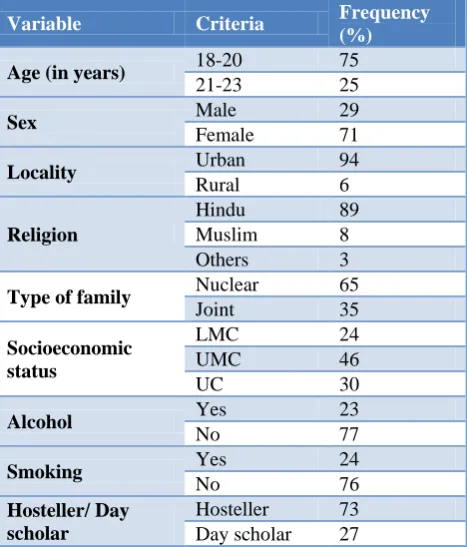
Out of total 100 students, 71 students were female and 29 students were male. The age of 75 students were between 18-20 years whereas age of 25 students was in the range of 21-23 years. Most of the students (94) were resident of urban areas. 24 students belonged to lower middle class, 46 students belonged to upper middle class and 30 students belonged to upper class. Out of total students, 23 students were drinkers and 24 were smokers. The various sociodemographic details of students are described in Table 2 in detail.
Figure 1: prevalence of type D personality among the dental students.
Non type D personality=73%
Type D personality =27% 4th Qtr
Social inhibition = 15%
Negative inhibition =7%
Both=5%
Table 1: DS 14 questionnaire.
Negative affectivity questionnaire
Social inhibition questionnaire
Q2 I often make a fuss about unimportant things
Q1 I may contact easily when I meet people
Q4 I often feel unhappy Q3 I often talk to
strangers
Q5 I often get irritated Q6 I often feel inhibited in social interactions Q7 I have a gloomy view
of things
Q8 I find it hard to start a conversation
Q9 I am often in a bad mood
Q10 I am a closed kind of person
Q12 I often found myself worrying about something
Q11 I would rather keep other people at a distance
Q13 I am often down in the dumps
Q14 When socializing I do not find the right things to talk
Table 2: Socio-demographic variables of study subjects.
Variable Criteria Frequency
(%)
Age (in years) 18-20 75
21-23 25
Sex Male 29
Female 71
Locality Urban 94
Rural 6
Religion
Hindu 89
Muslim 8
Others 3
Type of family Nuclear 65
Joint 35
Socioeconomic status
LMC 24
UMC 46
UC 30
Alcohol Yes 23
No 77
Smoking Yes 24
No 76
Hosteller/ Day scholar
Hosteller 73
Day scholar 27
15% students had only social inhibition and 7% students had only negative affectivity. 5% students had both social inhibition and negative affectivity. Since, students scoring high on either or both subscales were considered as Type D therefore the prevalence type D personality was found to be 27% among the study subjects (Figure 1).
There was a statistically significant association between drinking status of students and type D personality (Table 3) which indicated that the students with typed personality are more prone to drinking alcohol. The
association of type D personality and other variables like age, sex, socioeconomic status, religion, family type, residential status and smoking habits were not found significant.
Table 3: Association of Type D personality with alcohol consumption of students.
Alcohol Type D Non
type D
Chi
Square P value
Yes 12 11
9.604 0.001942
No 15 62
DISCUSSION
In the present study, 15% students had only social inhibition and 7% students had only negative affectivity. 5% students had both social inhibition and negative affectivity. Since, students scoring high on either or both subscales were considered as Type D therefore the prevalence type D personality was found to be 27% among the study subjects. Khan et al (2017) also reported that prevalence of type D was 39.6% among college going students of Delhi.10
In addition of this, Williams l et al (2008) reported that the prevalence of type-D was found to be 38.5%, significantly higher in UK and Ireland than that reported in other European countries.11 In addition, type-D individuals reported performing significantly fewer health-related behaviors and lower levels of social support than non-type-D individuals. In a study conducted by Lapyte et al (2015) the prevalence of type D personality was 31.57% among medical students of Lithuania and Belgium.14
On the contrary, Gupta et al in under graduate medical students from Midnapore medical college, West Bengal Type D personality was present in 70% students.12 15.3% students had only negative affectivity, 23.3% students had only social inhibition and 31% students had both the components of Type D personality. The reason for higher prevalence in their study as compared to our study could be because of lesser stress in dental students as compared to medical students.
Similarly, Rishi et al conducted a study in women in Jalandhar city, Punjab, in their study, social inhibition was observed in 72% of participants, negative affectivity in 71% and type D personality was found in 72%.13 The reason for higher prevalence of personality D in their study as compared to ours could be because of the fact that their study was done only in women population and depression is more prevalent in women.
important factors which are associated with type D personality students across the various studies.
It has been observed that type D personality individuals are at high risk of developing psychiatric disorders like
depression, anxiety, panic or phobic disorder,
cardiovascular disorders.10,12,14 Therefore, instead of studying the association of type D personality and variables like depression, the present study had focused on studying the association of type D personality and variables like smoking, drinking among students.
The present study has identified a statistically significant association between Type D personality and alcohol consumption in the students. Bruce et al showed that Type D individuals were motivated to drink alcohol in order to cope with their negative emotions.15 Williams et al reported Type D individuals exhibited significantly higher levels of desire for alcohol during the acute stress and recovery phases, compared to non-type D individuals.16 Williams et al suggested that type D individuals might be motivated to consume alcohol in order to cope with stressful situations.16 Therefore, type D dental students should be provided more emotional and psychological supports to prevent depression and alcoholism among them.
The various factors like smoking, residential status, socioeconomic status of students were not found to be significantly associated with type D personality. Khan et al also observed that there was no significant association between type D personality and whether students stayed at home with parents or in hostels or paying guest accommodation.10 Khan et al also observed no significant association between type D personality and type of courses perused by students.10
CONCLUSION
The personality cannot be changed but if these traits are recognized we can not only minimize risk on health aspect, but also cam improve their quality of life significantly type D personalities are emotional labile and they face difficulty in social relationships. Type D personalities are more likely to experience anxiety and depression type D personality had shown association with drinking alcohol. Therefore, type D personality students require good counselling and mentorship during college period. Type D personalities students are required to adopt healthier lifestyle such as better diet and regular exercise. They need counselling to conquer addictions such as smoking or alcohol abuse. These students should try techniques such as guided imagery, breathing exercises, tai chi, yoga and meditation to help relieve stress and mood and can learn to control anger and hostility. This may help the young students to overcome their difficulties and lead healthier life and are required to adopt healthier lifestyle such as better diet and regular exercise. They need counselling to conquer addictions such as smoking or alcohol abuse. These students should
try techniques such as guided imagery, breathing exercises, tai chi, yoga and meditation to help relieve stress and mood and can learn to control anger and hostility. This may help the young students to overcome their difficulties and lead healthier life.
ACKNOWLEDGEMENTS
We acknowledge all the undergraduate students who participated in the study.
Funding: No funding sources Conflict of interest: None declared
Ethical approval: The study was approved by the Institutional Ethics Committee
REFERENCES
1. Sher L. Effects of psychological factors on the development of cardiovascular pathology: role of immune system and infection. Med Hypotheses. 1999;53(2):112-3.
2. Denollet J. Type D personality A potential risk factor defined. J Psychosom Res. 2000;49(4):225-66.
3. Denollet J. Type D personality and vulnerability to chronic disease, impaired quality of life and
depressive symptoms. Psychosom Med.
2002;64(1):101.
4. Denollet J. DS14: Standard assessment of negative affectivity, social inhibition and type D personality. Psychosomatic Med. 2005;67(1): 89-97.
5. Sher L. Type D personality: The heart, stress and cortisol. QJM. 2005;98(5):323-9.
6. Denollet J, Rombouts H, Gillebert T, Brutsaert D, Sys S, Brusaert DL et al. (1996) Personality as independent predictor of long-term mortality in patients with coronary heart disease. The Lancet. 1996; 347(8999):417–21.
7. Mols F, Denollet J. Type D personality in the general population: a systematic review of health status, mechanisms of disease, and work-related problems. Health Qual Life Outcomes. 2010;8: 9.
8. Mommersteeg PM, Denollet J, Martens EJ. Type D
personality, depressive symptoms and work-related
health outcomes. Scand J Public Health.
2012;40(1):35–42.
9. Oginska-Bulik N. Occupational stress and its
consequences in healthcare professionals: the role of type D personality. Int J Occup Med Environ Health. 2006;19(2):113-22.
10. Khan, ZH, Khokhar A. Prevalence of type D personality, depression and their association
amongst college going students of Delhi.
International Journal of Current Research.
2017;9(7):53186-9.
11. Williams L, O’Connor RC, Howard S, Hughes BM,
behavior and social support. J Psychosom Res. 2008;64(1):63-9.
12. Gupta S, Basak P. Depression and type D
personality among undergraduate medical students. Indian J Psychiatry. 2013;55(3):287-9.
13. Rishi J. A study of distressed personality in relation to somatic complaints among women in India. IJELLH. 2015;3(8):359-69.
14. Lapyte A, Lussier A, Danileviciute V, Loas G. 2015. Type D Personality among Undergraduate Medical Students and Physicians. Ann Psychiatry Ment Health. 2015;3(8):1053.
15. Bruce G, Curren C, Williams L. Type D personality, alcohol dependence, and drinking motives in the
general population. J Stud Alcohol Drugs. 2013;74(1):120-4.
16. Williams L, Bruce G, Knapton C. Type D
personality is associated with increased desire for alcohol in response to acute stress. Stress and Health. 2018;34(3):411-5.