www.ijatca.com 92
International Journal of Advanced Trends in
Computer Applications
www.ijatca.com
An Optimize Clustering Protocol Using Genetic
Approach
1
Salony Handa, 2Vishal Walia, 3Dr.Rahul Malhotra
1
M.Tech Student- ECE RIEIT, Ropar
2
Associate Professor (Dean Academic) RIEIT, Ropar
3
Director GTBKIET Malout
1
[email protected], [email protected], [email protected]
Abstract:
The key principle of this paper is to evaluate the performance of the network based on performance metrics such as throughput optimization, end to end delay, packet delivery ratio using GA algorithm. In this research, objective and fitness function are applied in genetic algorithm to calculate the average energy of the arrangement and to make sure which block has lesser energy than average energy. Afterwards that block has been added in the result of the objective function and then the movement in the fitness function is checked for the improvements in the LEACH protocol. This whole simulation is taken place in the MATLAB environment.Keywords:
LEACH protocol, Genetic algorithm, neural, Throughput, Optimization..
I.
Introduction
Wireless sensor networks (WSNs), which consist of a number of small battery-powered devices, are frequently to obtain various sorts of useful data from surroundings [1-5]. These devices sense physical properties, such as sound, humidity, pressure, luminosity, temperature, or chemical concentration, and transmit the gathered data to a base station (BS) for further analysis and processing. WSNs have been effective deployed in tactical combat situations, habitat monitoring, home security, and so on [11, 12]. Since WSNs consist of many sensors with limited energy, an energy-efficient network protocol is an important consideration in WSN applications. Many routing protocols for WSNs have appeared in the literature. But none of any algorithm is providing good optimization of energy. So our work will use Genetic Algorithm (GA) for optimization process. Also in the simulation it will be shown that how our technique is performing better than other techniques [6].
The remaining paper is organized as Section II will describe basic LEACH protocol, then Section III will give review of genetic algorithm working , In section IV proposed work model will be shown, Then In section V genetic algorithm based pseudo code has been
described, Section VI will contain simulation results. Finally Section VII will discuss conclusion and future scope.
II. LEACH PROTOCOL
LEACH stands for Low-Energy Adaptive Clustering Hierarchy [1, 13]. The LEACH Network is through up of nodes, some of which are called cluster-heads. The trade of the cluster-head is to get together data from their instantaneous nodes and exceed it on to the base position [4]. LEACH is vibrant since the job of cluster-head rotates. The LEACH network has two phases:
A. Set-up phase
Cluster-heads can be preferred stochastically (at random based) on this algorithm:
T(n)= P/1-P* (r modp
-1),ⱴ n €G
T(n)=0
Where n is a random number between 0 and 1.P is the cluster head odds. G is the set of node.
www.ijatca.com 93
rotates between the assorted sensors in regulate to not to exhaust the string of a single sensor. Each node takes the judgment independent of the
additional nodes to become cluster head. It is based on the proportion determined a priori and round digit.
B. Steady phase
Nodes transmit information based on TDMA schedule. Later than information has been recognized cluster head implement signal processing /compression and send to base location. Later than a definite moment a novel turn begins [7]. Major power reduction is owing to combine lossy compression with the information direction-finding and deal among excellence of production and quantity of density ensuing in considerable decrease of overall power indulgence.
III.
GENETIC ALGORITHM
OPTIMIZATION IN WSN
A genetic algorithm is used to figure out true or rough solutions and explore the problems for optimization [3] and use methods motivated by evolutionary biology such as inheritance, mutation, selection, and crossover. Genetic algorithms are executed as a workstation recreation in which an inhabitant of indefinable representations of aspirant solutions to an optimization trouble for improved solutions represented in binary as strings of 0s and 1s, further encodings are also achievable. Genetic algorithm is defined as [8]:
An illustration of the solution domain,
A Fitness function to estimate the solution domain.
The fitness function is defined more by the genetic demonstration and measures the value of the result. The fitness of the solution is the sum of values of all items in the knapsack if the representation is suitable or 0. In many cases, it is difficult to explain the fitness expression. In these cases, interactive genetic algorithms are used. The choice is too analogous the continued existence of the fittest in the usual world. Individuals are selected for “breeding” (or cross-over) based upon their fitness values – the fitter the individual, the more likely that individual will be able to reproduce [9]. The cross-over obtained by combining the two solutions jointly to create two new individuals. By every generation, there is a small possibility for every entity to transform, results in the change in the entity in a few diminutive technique [10].
A Genetic Algorithm can be described as:
1. Create inhabitants of casual aspirant solutions as pop.
2. Following the process till the algorithm execution circumstances meet, called generations.
I.Generate an empty population called new-pop. II.While new-pops is not occupied do the subsequent:
a) Select two individuals at arbitrary from pop to select the individuals.
b) Cross-over the two individuals to generate the two new individuals.
c) Let every individual in new pop contains arbitrary possibility to mutate.
d) Swap pop with new pop
3. Choose the individual from pop with the highest fitness as the result to the difficulty.
IV.
PROPOSED MODEL
The proposed methodology of the proposed work is described as follows in the flowchart.
V.
PSEUDO CODE LEACH-GA
BASED
BEGIN
Specify number of nodes (n); Initialize
www.ijatca.com 94
node s be a candidate CH else
CCH{s}=FALSE; //node s not be a candidate CH
end if end if
SendToBS: All nodes send messages to BS; BS broadcasts a message back to all nodes;
SET-UP PHASE
do { //repeat for r rounds
CH{s}=TRUE; //node s be a CH Else
CH{s}=FALSE; //node s not be a CH end if
end if
if (CH{s}=TRUE) then
BC (ADV) ← broadcast an advertisement message;
Cluster(c); //form a cluster c; end if
STEADY-STATE PHASE If (CH(s)=TRUE) then receive data from members; aggregate received data; transmit received data; else
If (My Timeslot=TRUE) then transmit sensed data;
else
node i at a sleep state end if
end if
one round is completed
END
VI.
RESULTS AND DISCUSSION
The performance simulation is taken place in MATLAB environment, in which initially No. of nodes that were taken are --- and no.of heads are ……… The performance evaluation will be done on the basis of following parameters.
a. Throughput. b. End to end delay c. Packet delivery Ratio
Figure no 5.1 Show a number of nodes
The above figure shows the LEACH network in which nodes are deployed in the network and divided into the number of clusters which act as a LEACH network and shows the cluster heads in blue color .
Figure no 5.2 Nodes Representation complete
The above figure shows the message box that the nodes should not be more than 300 nodes. Total nodes that are taken in network is 300 which are sufficient for the realization of the WSN network
Figure no 5.3 Calling Genetic algorithm
www.ijatca.com 95 Figure no: 5.4 Dynamic Path
The above figure shows the dynamic path after applying objective function using genetic algorithm
Figure no: 5.5 Finalized path
The above figure shows the finalized path which is obtained by the fitness function of genetic algorithm
Figure no: 5.6 Destination Blocks
The above figure shows the destination block which is included in the finalized path as a destination node
Figure no: 5.7 Throughput graph
The above figure shows the throughput graph which shows the performance between speed with genetic
algorithm and speed with energy of the cluster head using genetic algorithm
Figure no: 5.8 End-to- End delay
The above figure shows the end to end delay which shows that at how much delay the packets are received by the destination to reduce the congestion in the network and having less energy consumption. This measure should be low as much as possible for the efficient network.
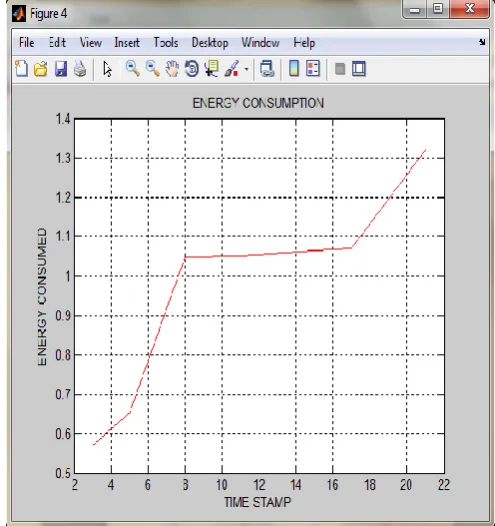
Figure no: 5.9 Energy Consumption
www.ijatca.com 96
energy consumption and shows that the energy consume is very less after applying genetic approach
Figure no: 5.10 Packet Delivery
The above figure shows the packet delivery percentage which is an important parameter which shows that the packets are successfully sent from source to the destination and shows that 99.6 percent packets are delivered from source to the destination which increases the lifetime of the network and enhances the LEACH protocol.
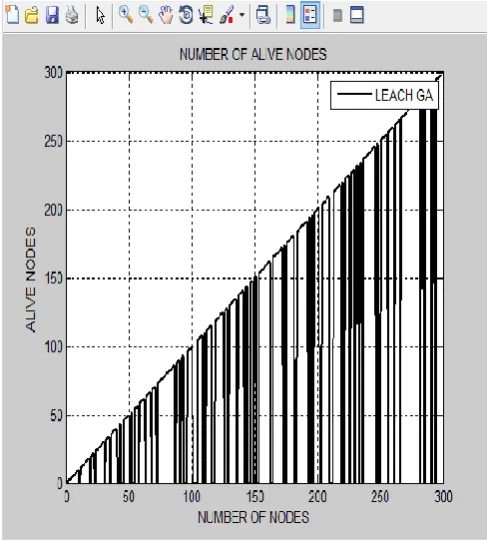
Figure no: 5.10 Alive Nodes
The above figure shows the number of alive nodes which is near about 290 nodes out of 300 which shows the network life time is more with more number of alive nodes and less number of dead nodes and this performance metric should be high as much as possible for the efficient network.
VII.
CONCLUSION AND FUTURE
SCOPE
In this paper, an original Genetic Algorithm based Energy Efficient adaptive clustering hierarchy Protocol has been offered to powerfully maximize the lifetime and immovability period of wireless sensor networks. Genetic Algorithm energy efficient uses genetic algorithm to advance the network life span and stability period of the wireless sensor networks by finding the most favourable number of cluster heads and their locations based on minimizing the energy consumption of the sensor nodes. Mat lab simulation marks showed that the planned GENETIC ALGORITHM ENERGY EFFICIENT protocol is more energy efficient and more reliable in cluster process as compared to LEACH, LEACH-GA protocols in low or high dense networks and in homogeneous or heterogeneous networks. Also, GENETIC ALGORITHM ENERGY EFFICIENT protocol increases the dependability of clustering process because it expands the stability period and compresses the unsteadiness period.
In prospect, the cross layer optimization using uncertainty and routing strategy can be investigated moreover, the work can be complete by including
multi-hop communication between cluster heads.
Additionally, other knowledge techniques could be included to decide energy efficient clusters.
REFERENCES
[1]. Ravneet Kaur, Deepika Sharma, “Comparative Analysis Of Leach And Its Descendant Protocols In Wireless Sensor Network,” International Journal of P2P Network Trends and Technology- Volume3Issue1- 2013.
[2]. Anjali Bharti, Kanika Sharma, “Enhancing the lifetime of LEACH Protocol using NNA for Wireless Sensor Network,” International Journal of Computer Trends and Technology (IJCTT) - volume4Issue4 –April 2013.
[3]. Jenn-Long Liu and Chinya V. Ravishankar, “LEACH-GA: Genetic Algorithm-Based Energy-Efficient Adaptive Clustering Protocol for Wireless Sensor Networks,” International Journal of Machine Learning and Computing, Vol.1, No. 1, April 2011.
www.ijatca.com 97 Journal of Emerging Technology and Advanced
Engineering Website: www.ijetae.com (ISSN 2250-2459, ISO 9001:2008 Certified Journal, Volume 3, Issue 12, December 2013).
[4] C. Intanagonwiwat., R. Govindan, D. Estrin, J. Heidemann, and F. Silva, “Directed diffusion for wireless sensor networking,” IEEE/ACM Transactions on Networking, vol. 11, issue 1, Feb. 2003, pp. 2-16.
[5] T. Shepard, “A Channel Access Scheme for Large Dense Packet Radio Networks,” ACM SIGCOMM Computer Communication Review, vol. 26, issue 4, Oct. 1996, pp. 219–230.
[6] B. Krishnamachari, D. Estrin, and S. Wicker, “Modeling data-centric routing in wireless sensor networks,” Wireless Communications, vol. 1, issue 4, , Oct. 2002, pp. 660-670.
[7] W. B. Heinzelman, A. P. Chandrakasan, and H. Balakrishnan, “Energy-efficient communication protocol for wireless microsensor networks,” in Proceedings of the 33rd Annual Hawaii International Conference on System Science, Maui, Hawaii, Jan. 2000, pp. 1-10.
[8] W. B . Heinzelman, A. P. Chandrakasan, and H. Balakrishnan, “An application-specific protocol architecture for wireless microsensor networks,” IEEE Transactions on Wireless Communications, vol. 1, issue 4, Oct. 2002, pp. 660-670.
[9] P.T.V. Bhuvaneswari and V. Vaidehi, “Enhancement techniques incorporated in LEACH- a survey,” Indian Journal of Science and Technology, vol. 2, no. 5, May 2009, pp. 36-44.
[10] S. Bandyopadhyay and E.J. Coyle, “An energy efficient hierarchical clustering algorithm for wireless sensor network,” in INFOCOM 2003, vol. 3, San Fancisco, CA, Mar. 2003, pp. 1713-1723.
[11] K. Yang, Y. Wu, and H. Zhou, “Research of optimal energy
consumption model in wirelss sensor network,” in 2010 2nd International Conference on Computer Engineering and Technology, Chengdu, China, Apr. 2010, pp. 421 - V7-424.
[12] WONGSATHAN , “CLUSTER-BASED ROUTING USING
BACTERIOLOGIC ALGORITHM IN WIRELESS SENSOR
NETWORK”,IEEE,PP.V1-51 TO V1-9,2012.
[13] RAHMANIAN , “A NOVEL GENETIC ALGORITHM IN
LEACH-C ROUTING PROTOCOL FOR SENSOR NETWORKS”,