http://www.ijcmph.com pISSN 2394-6032 | eISSN 2394-6040
Original Research Article
Relationship between levels of nutrients and habitual coffee
consumption and the incidence of anemia in former leprosy patients
Sadar Ginting*, Sondang Sidabutar, Eka Saudur Renaldi Sihombing
INTRODUCTION
Iron deficiency anemia (IDA) is a medical problem that is often encountered, especially in developing countries. This disorder is a cause of chronic disease that has a major impact on social and economic wellbeing, as well as physical health.1
Anemia is directly affected by daily consumption of less iron-containing foods, in addition to infection factors as a trigger.2 In general, food consumption is closely related to nutritional status. When the food consumed less
nutritional value, it will cause malnutrition and can cause anemia.3
The consumption pattern of anemic patients is generally a menu pattern with low bioavailability of iron, because it consists only of rice or tubers with nuts and little (rarely) meat, chicken or fish, and little foods containing vitamin A and vitamin C.4 In accordance with the analysis performed by Heidari et al, blood albumin is associated with the occurrence of anemia in hospital patients.5 Anemia as a complication of hospitalized patients could
ABSTRACT
Background: Former leprosy patients are a group of people that are at risk of anemia. Anemia in the former leprosy can be caused by daily food consumption and coffee drinking behavior. This study aimed is to determine the relationship between the levels of nutrients and habitual coffee consumption and the incidence of anemia in the former leprosy patients.
Methods: Design of this study is cross sectional. There were 115 former leprosy patients, all of whom were selected as subjects for this study. The nutrient consumption data were obtained through filling out 24-hour food recall forms; the coffee drinking habit was obtained through questionnaire; and the incidence of anemia were obtained through Hb level examination by using Digital Acute Check. The data obtained were analyzed with Chi-Square statistical test and binary logistic regression.
Results: Protein intake (p value 0.003), iron intake (p value 0.001), and habitual coffee consumption (p value 0.035) have significant relationship with the incidence of anemia. While energy intake (p value 0.833) and Vit. C intake (p value 0.516) have no significant relationship with the incidence of anemia in former leprosy patients. Iron intake is a dominant factor affecting the occurrence of anemia in former leprosy patients.
Conclusions: Nutrient consumption is lower than the recommended dietary allowance, especially iron. The daily coffee consuption can inhibit iron absorption. Thus, it appears that insufficient levels of protein and iron, and the consumption of coffee are the factors that affect the occurrence of anemia in the former leprosy patients.
Keywords: Nutrient consumption, Coffee drinking, Anemia, Former leprosy patient Department of Public Health, Faculty of Health, Efarina University, Indonesia
Received: 11 March 2018 Revised: 05 April 2018 Accepted: 14 April 2018
*Correspondence: Sadar Ginting,
E-mail: [email protected]
Copyright: © the author(s), publisher and licensee Medip Academy. This is an open-access article distributed under the terms of the Creative Commons Attribution Non-Commercial License, which permits unrestricted non-commercial use, distribution, and reproduction in any medium, provided the original work is properly cited.
be caused by several factors, and one of them is a condition of malnutrition that is often overlooked.
Former leprosy patients are a group of people that are at risk of anemia. One reason is because of the consumption of drugs as long as they suffer from leprosy.6
Based on the results of preliminary survey in the Technical Implementation Unit of Lau Simomo Leprosy Hospital, Tanah Karo district known that the incidence of anemia (the hemoglobin count is lower than normal) in former leprosy patients was very high 79.4% in 2016.7 While the description of the pattern of former leprosy patients in the Technical Implementation Unit of Lau Simomo Leprosy Hospital, Tanah Karo District through 24-hour food recall results obtained that the level of sufficiency of former leprosy patients in general is still below the number of nutritional adequacy.
In addition to the above problems, from the results of the initial survey was also known that the former leprosy patients also used to drink coffee or tea at the main meal. Even though the majority of studies have found no relationship between coffee and tea intake and also, a review by Temme et al, concluded tea consumption does not appear to affect iron status in populations who mostly have adequate iron status.8-11 However, in populations with marginal iron status, there appears to be a negative association between tea consumption and iron status.
Arisman also said that although there has been a lot of research proving the various benefits of drinking coffee, but the way improper coffee consumption will have a negative impact, especially the occurrence of anemia.12 This is because coffee contains tannins that can bind minerals (including iron). Coffee also contains polyphenol compounds that act as antioxidants, but it has undergone oxidation which can bind minerals such as Fe, Zn, and Ca, so that iron absorption is reduced.11,13-15
Based on the data of percentage of former leprosy patients with anemia in the Technical Implementation Unit of Lau Simomo Leprosy Hospital, Tanah Karo Distric, the researchers were interested in doing research entitled relationship between levels of nutrients and habitual coffee consumption and the incidence of anemia in former leprosy patients.
METHODS
Study design and sampling techniques
The method used in the research is descriptive analysis with cross sectional design. There were 115 former leprosy patients, all of whom were selected as subjects for this study.
Study period
Data collection
The nutrient consumption data were obtained through filling out 24-hour food recall forms; the coffee drinking habit was obtained through questionnaire; and the incidence of anemia were obtained through Hb level examination by using Digital Acute Check.
Data analysis
All collected data were fed into the computer. For data analysis, SPSS 22 for Windows were used. The data were analyzed with Chi-Square statistical test and binary logistic regression.
Research ethics
Prior to this research, respondents were given information about the purpose of the study and the procedure that will be done, namely interview in answer the questionnaire, and food recall 24 hours, and Hb level examination by using Digital Acute Check. Each respondent was given full rights to be willing/not to be a respondent. Respondents are willing to put a signature on the informed consent. The researcher ensures the confidentiality of identity and information provided by the respondent during and after the study.
Respondents were given comfort and safety and applied the same. To minimize the side effects of the blood-taking process for Hb examination, the blood blood-taking is sterile. However, if there are abnormalities of wounds in the area of blood collection, it will be wound care or referred to the health center or hospital at a cost borne by the researcher.
RESULTS
Description of food consumption of former leprosy
Based on the results of 24-hour food recall obtained a description of food consumption of former leprosy patients in the Technical Implementation Unit of Lau Simomo Leprosy Hospital, Tanah Karo distric. In addition to eating rice as a staple food, former lepers also eat bread and noodles. However, in terms of side dishes, most former leprosy consumed protein sources from vegetable foods, namely temphe and tofu that they consume almost every day.
vegetables. Similarly, in consuming fruits, most former leprosy rarely eat fruit.
Figure 1: Average nutrients intake (% RDA).
From the research results obtained the description of energy sufficiency level 2030 kcal, protein 50 g, iron 10 mg, and vitamin C 65 mg. When compared with Recommended Dietary Allowances (energy, protein, iron, vitamin c) by age group (National Food and Nutrition Summit 10th, 2012), then obtained briefly the average nutrients intake (% RDA) of the former leprosy patients (Figure 1).
In general, the nutrient consumption is lower than the recommended dietary allowance, especially iron. The
daily coffee consumption can inhibit iron absorption. Thus, it appears that insufficient levels of protein and iron, and the consumption of coffee are the factors that affect the occurrence of anemia in the former leprosy patients.
From the research results also obtained a description of the habit of respondents in drinking tea or coffee every day. In general, respondents have a habit of tea or coffee consumption, but as many as 53.9% of respondents say consumption of tea or coffee every day.
Factors associated with incidence of anemia
Results showed that the incidence of anemia in the former leprosy patients at the Technical Implementation Unit of Lau Simomo Leprosy Hospital, Tanah Karo District is 73.0%.
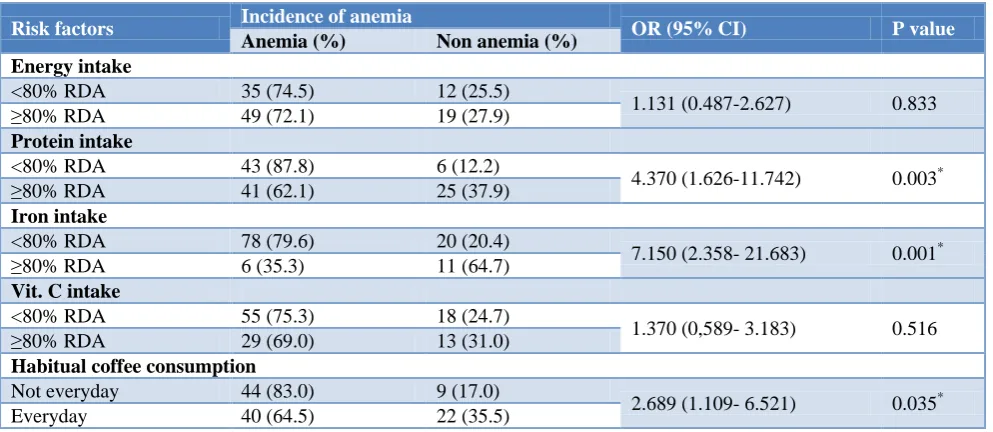
The result of analysis using Chi-Square test obtained that protein intake (p value 0.003), iron intake (p value 0.001), and habitual coffee consumption (p value 0.035) have significant relationship with the incidence of anemia. While energy intake (p value 0.833) and Vit. C intake (p value 0.516) have no significant relationship with the incidence of anemia in former leprosy patients (Table 1). Iron intake is a dominant factor affecting the occurrence of anemia in former leprosy patients (Table 2).
Table 1: Bivariate analysis on factors associated with incidence of anemia.
Risk factors Incidence of anemia OR (95% CI) P value
Anemia (%) Non anemia (%) Energy intake
<80% RDA 35 (74.5) 12 (25.5)
1.131 (0.487-2.627) 0.833
≥80% RDA 49 (72.1) 19 (27.9)
Protein intake
<80% RDA 43 (87.8) 6 (12.2)
4.370 (1.626-11.742) 0.003*
≥80% RDA 41 (62.1) 25 (37.9)
Iron intake
<80% RDA 78 (79.6) 20 (20.4)
7.150 (2.358- 21.683) 0.001*
≥80% RDA 6 (35.3) 11 (64.7)
Vit. C intake
<80% RDA 55 (75.3) 18 (24.7)
1.370 (0,589- 3.183) 0.516
≥80% RDA 29 (69.0) 13 (31.0)
Habitual coffee consumption
Not everyday 44 (83.0) 9 (17.0)
2.689 (1.109- 6.521) 0.035*
Everyday 40 (64.5) 22 (35.5)
Table 2: Multivariate analysis on factors associated with incidence of anemia.
Variables Coefficient OR (95% CI) P value
Protein intake 1.325 3.761 (1.312-10.784) 0.014*
Iron intake 1.788 5.980 (1.825-19.593) 0.003*
Habitual coffee consumption 1.122 3.070 (1.144-8.235) 0.026*
*Significant, p<0.05 (binary logistic regression).
0 20 40 60 80 100
Energi (Kcal)
Protein (g/d)
Iron (mg/d) Vitamin C (mg/d)
84 81
64
DISCUSSION
Energy intake and occurrence of anemia
There is no significant relationship between the level of energy sufficiency with the incidence of anemia in former leprosy patients. It can be caused due to intake of energy derived mostly from food sources of carbohydrates, so it does not contribute iron in large amounts. As it was known that food that contributes more in relation to anemia status is iron. The iron nutrient is a necessary group of minerals, as the core of hemoglobin, the main element of red blood cells. Based on the results of 24-hour food recall obtained a description of the level of nutritional adequacy that can be explained that the average level of energy adequacy of 2030 kcal. Where most (44.7%) have moderate energy sufficiency level, and only 11.6% of the good category energy adequacy level. The low level of energy sufficiency is due to the low number and quality of energy sources consumed, especially rice. This is because the rice they get or bought has a low quality or classified as poor rice (called raskin). Besides rice, the energy sources that can consume are corn and yams, which they should be able to grow on their own.
Protein intake and occurrence of anemia
From this result of the study found that there was a relationship between protein intake and the incidence of anemia. It meant that the better the protein consumption, the less likely to be anemia. Desalegn et al in their study also mentioned that people who do not consume protein source foods are 2.3 times more likely to be anemic than those who consume protein source foods.16 According to Almatsier, the level of protein consumption needs to be considered because the lower the level of protein consumption the more likely to suffer from anemia.17 Proteins function in the formation of essential bodily bonds. Hemoglobin, a red blood pigment that functions as a carrier of oxygen and carbon dioxide, is a protein bond.18
Proteins also play a role in the process of transporting nutrients including iron from the gastrointestinal tract into the blood, from the blood to the tissues, and through the cell membrane into the cells.19 So that if the lack of protein will cause disruption in the absorption and transport of nutrients. Lack of protein intake from food can also cause protein synthesis in the blood will be disrupted. In blood or other body fluids iron is transported by a protein called transferrin. Transferrin will carry the iron in the blood to be used in the synthesis of hemoglobin. If the levels of transferrin in the blood decrease then the transport of iron cannot run properly and ultimately hemoglobin levels in the blood also decreases.18
Protein is a compound that can increase the absorption of iron in the body. Foodstuffs that have good protein quality are food derived from animal; this is because the protein content of animal food is higher when compared with plant foods. In addition, animal food is a food ingredient with good iron absorption.18 However, food sources of protein that are often consumed by former leprosy patients are vegetable foods that have low iron absorption such as tofu and tempeh.12
Iron intake and occurrence of anemia
In the former group of leprosy patients who are not anemic but the consumption of iron is included in the category less likely former leprosy still have iron reserves in their bodies.
Sharp also showed that there was a correlation between protein consumption level, iron consumption level, and vitamin C consumption level and hemoglobin level.19 The low level of iron sufficiency is due to less consumption of food sources of iron such as red meat, and former patients also often consume tea (inhibits the absorption of iron), and green vegetables which is non heme iron and has a high fiber content. If the amount of iron deposits is reduced and the amount of iron obtained from food is also low, there will be an iron imbalance in the body, resulting in hemoglobin levels falling below the normal limit called iron nutritional anemia.4 According Müller et al the main factor that causes iron anemia is the lack of iron intake derived from food so that insufficient body needs.3 Diet that is less diverse as a menu that consists of only rice alone also support the lack of iron intake for the body.
According to Sharp, blood levels of Hb are commonly associated with protein, Fe and vitamin C intake.19 But the most important is Fe because Fe is the major factor forming hemoglobin (Hb). While the role of vitamin C and protein is to help the absorption and transport of iron in the intestine. The form of iron in the diet depends on the food ingredients consumed. Iron heme is present in foods derived from animal sources such as in animal flesh. Iron heme can be absorbed by the body twice than in non-heme iron. While non-heme iron is present in many plant-based foods. In menus a day foods containing heme iron and non heme together will increase the absorption of non-heme iron. Foodstuffs such as meat, chicken and fish contain factors that help the absorption of non-heme iron. Other factors that help the absorption of iron are organic acids, such as vitamin C. Vitamin C greatly helps the absorption of non-heme iron by functioning as a reducer to convert ferric to ferro.20
are citric acid.4,12,20 Factors that inhibit the absorption of iron are phytic acid, oxalic acid, tannin, calcium, phospitin and fiber. Phytic acid is widely present in cereals, oxalic acid is found in vegetables, phospitin is found in egg yolks. The compound will bind iron so that iron becomes difficult to be absorbed. Soy protein sources lowered iron absorption. This is because the content of phytate is very high.4,19 In addition to phytate and oxalate, tannin also inhibits iron absorption. This tannin is present in tea and coffee.11,15,18
Vit C intake and occurrence of anemia
The result of analysis using Chi-Square test obtained p value 0.516 (p>0.05), which means that there is no significant relationship between the vitamin C sufficiency level on the incidence of anemia in former leprosy patients. It can be due to intake of former leprosy who rarely consumes vegetables and fruits that contain lots of vitamin C.
It is known that vitamin C can help the absorption of iron in the prevention of anemia, but if the iron is consumed in limited quantities, the function of vitamin C as an enhancer (increase absorption) of iron will not work. Likewise Sharp said that vitamin C is a substance that can increase the absorption of iron in the body.19 Heath et al in their study proved that the consumption of non-hem diet sources with vitamin C supplementation can increase hemoglobin levels.9
Habitual coffee consumption and the incidence of anemia
Consumption habits of tea or coffee have significant relationship to the occurrence of anemia in former leprosy patients. The effects of the interaction of tea with iron depend on iron consumption status and individual characteristics. This study proved that in addition to the lack of side dish, other factors that play a role in the incidence of anemia in former leprosy is the behavior of drinking tea or coffee every day.
Although there have been many studies that prove the various benefits of drinking tea or coffee.21-24,but the inappropriate way of consuming tea or coffee will have a negative impact, especially the occurrence of anemia. This can be caused by several things, among others, because tea and coffee contain tannins that can bind minerals (including iron) and in some teas (especially black tea) polyphenol compounds that act as antioxidants have been oxidized, so it can bind minerals such as Fe, Zn, and Ca so the absorption of iron decreases.11,13-15 Hurrell et al reported that black tea can inhibit the absorption of non-heme iron by 79-94% when taken together.18
Nelson et al stated that in groups at risk of iron deficiency the advice should be to drink tea between meals and to wait at least 1 h after eating before drinking tea.23
CONCLUSION
Based on the result of the current study, it can be concluded that the nutrient consumption is lower than the recommended dietary allowance, especially iron. The daily coffee consumption can inhibit iron absorption. Thus, it appears that insufficient levels of protein and iron, and the consumption of coffee are the factors that affect the occurrence of anemia in the former leprosy patients.
Protein intake, iron intake, and habitual coffee consumption have significant relationship with the incidence of anemia. While energy intake and Vit. C intake have no significant relationship with the incidence of anemia in former leprosy patients. Iron intake is a dominant factor affecting the occurrence of anemia in former leprosy patients.
Nutrition counseling is needed with regard to the inexpensive food sources of iron and vitamin C that can meet the nutritional adequacy of the former leprosy patients. Counselling should also be given on the coffee drinking habit and its effect on the occurrence of anemia.
ACKNOWLEDGEMENTS
The researchers would like to thank all the participated former leprosy patients who were willing to be enrolled in this study.
Funding: No funding sources Conflict of interest: None declared
Ethical approval: The study was approved by the Institutional Ethics Committee
REFERENCES
1. Baltussen R, Knai C, Sharan M. Iron Fortification and Iron Supplementation are Cost-Effective Interventions to Reduce Iron Deficiency in Four Subregions of the World. J Nutr. 2004;134:2678-84. 2. James EC, Eric PS. Iron in Infection and Immunity.
Science Direct. 2013;13:509-519.
3. Müller O, Krawinkel M. Malnutrition and health in developing countries. CMAJ : Canadian Med Association J. 2005;173(3):279-86.
4. Cade JE, Moreton JA, O’Hara B, Greenwood DC, Moor J, Burley VJ, Kukalizch K, Bishop DT, Worword M. Diet and genetic factors associated with iron status in middle-aged women. Am J Clin Nutr. 2005;82:813-20.
6. Guragain S, Upadhayay N, Bhattarai BM. Adverse reactions in leprosy patients who underwent dapsone multidrug therapy: a retrospective study. Clin Pharmacol. 2007;9:73-8.
7. Technical Implementation Unit of Lau Simomo Leprosy Hospital, Tanah Karo District. Data on the state of morbidity of hospital patients yearly, 2016. RSUK: Karo District; 2017.
8. Brussard JH, Brants HAM, Bouman M, Lowik MRH. Iron intake and iron status among adults in the Netherlands. Eur J Clin Nutr. 1997;51:51-8. 9. Heath ALM, Skeaff CM, Williams S, Gibson RS.
The role of blood loss and diet in the aetiology of mild iron deficiency in premenopausal adult New Zealand women. Public Health Nutr. 2001;4:197-206.
10. Rigas AS, Sorensen CJ, Pedersen OB, Petersen MS, Thorner LW, Kotze S, et al. Predictors of iron levels in 14,737 Danish blood donors: Results from the Danish Blood Donor Study. Transfusion. 2014;54:789-96.
11. Temme EH, Van Hoydonck PG. Tea consumption and iron status. Eur J Clin Nutr. 2002;56:379-86. 12. Arisman MB. Gizi Dalam Daur Kehidupan Edisi 2:
Buku Ajar Ilmu Gizi, Jakarta: Penerbit Buku Kedokteran EGC; 2009: 76-87.
13. Disler PB, Lynch SR, Charlton RW, Torrance JD, Bothwell TH, Walker RB. The effect of tea on iron absorption. Gut. 1975;16:193-200.
14. Hallberg L, Rossander L. Effect of different drinks on the absorption of non‐heme iron from composite meals. Hum. Nutr. Appl. Nutr. 1982;36:116-23. 15. Zijp IM, Korver O, Tijburg LB. Effect of tea and
other dietary factors on iron absorption. Crit Rev Food Sci Nutr. 2017;40:371-98.
16. Desalegn A, Mossie A, Gedefaw L. Nutritional Iron Deficiency Anemia: Magnitude and Its Predictors among School Age Children, Southwest Ethiopia: A Community Based Cross-Sectional Study. PLoS ONE. 2014;9(12):e114059.
17. Almatsier S. Prinsip Dasar Ilmu Gizi. Jakarta: Gramedia Pustaka; 2009: 190-267.
18. Hurrell R, Egli I. Iron bioavailability and dietary reference values. Am J Clin Nutr. 2010;91:1461-7. 19. Sharp PA. Intestinal iron absorption: Regulation by
dietary and systemic factors. Int J Vitam Nutr. 2010;80:231-42.
20. Ganz T. Cellular iron: ferroportin is the only way out. Cell Metab. 2005;1:155-67.
21. Gabrielli GB, De Sandre G. Excessive tea consumption can inhibit the efficacy of oral iron treatment in iron‐deficiency anemia. Haematologica. 1995;80:518-20.
22. Mahlknecht U, Weidmann E, Seipelt G. The irreplaceable image: black tea delays recovery from iron‐deficiency anemia. Haematologica. 2001;86:559.
23. Nelson M, Poulter J. Impact of tea drinking on iron status in the UK: a review. J Hum Nutr Diet. 2004;17:43-54.
24. Wierzejska R. Tea and health-a review of the current state of knowledge. Przegl Epidemiol. 2014;68:501-6,595-9.