67
Contextual-Based ISBD Learning Model To
Develop Honesty And Responsibility
Desri Nora, Azwar Ananda, MudjiranAbstract: The contextual model is designed for the development of the students’ character as a form of achievement of the objectives of the target
domain in the ISBD course by combining the mission and general purpose of Islamic religious education at State University of Padang by paying attention and integrating the values of religious characters that include honesty and responsibility. These values are the main character of the ISBD course which can be more meaningful to the development of students' character for both men and women based on Islamic religious values.This education design research needs to be done to obtain a valid, practical, and efficient, contextual-based ISBD learning model in character development or students morality. So that the ISBD course can contribute optimally in realizing the State University of Padang vision and mission to be one of the superior university in southeast Asia in the field of education, science, technology, sports, and art in 2020 based on the devotion to the God Almighty. Thus, the ISBD course is expected to highly contribute to achieving Indonesia's national education objectives.
Index Terms: Contextual-based ISBD, Learning Model,Honesty and Responsibility.
————————————————————
1.
BACKGROUND
In general, the basic socio-cultural sciences aims to develop human personality as a social creature (Zoon Politicon) and as a cultural creature (Homo humanus), so that it is able to face and solve a critical and insightful problem on socio-cultural and social-cultural issues. There are some general purposes of basic social sciences; first, the development of human personality as social creatures and cultured creatures; second, human’s ability in responding critics and acknowledging socio-cultural issues and environmental problems of socio-cultural; third, ability to address problems in society wisely and objectively. It is common sense to see a human as a socio-cultural being capable of thinking critically and having extensive knowledge of social and environmental problems. The product of this context-based ISBD learning model using a storytelling method is a model book, lecturers teaching syllabus, and teaching materials. The products are designed to meet the standardized education for university students, meaning, they will help the students to have good integrity and responsibility. One of the purposes of the ISBD learning model is to facilitate the students to apply the cultural values in their life. These products are intended to push the students developing their integrity and responsibility based on social and cultural norms in the story. Therefore, they will embrace social norms-based characters. These products will have the students to explore more learning materials from different sources since constructivism is all about finding new learning communities and the real test. The importance of developing a contextual-based ISBD learning model with storytelling to build honesty and responsibility students include 1. ISBD is a general course focused on the development of a compulsory students personality that is attended by all diploma and undergraduate students. This means that all students of any majors in the State University of Padang are the subjects and objects of ISBD learning. Hence, it is needed as an effort to increase the contribution of ISBD course in realizing the vision and mission of the State University of Padang. 2. The need for meaningful learning (meaningful learning is given to give good marks in the students’ spirit and to motivate the students in learning social and cultural values.
2.
METHODOLOGY
This research is educational design research subsequently abbreviated EDR, particularly in development study. According to Plomp (2013:16) development study is a systematic analysis in designing and evaluating interventions in education to build research-based on solutions towards complex problems in the practice of Education. Moreover, this study is also aimed at improving knowledge about the characteristics of such interventions and the process of designing and developing them. Thus, this research aims to develop a model of contextual-based (ISBD) learning model ISBDBeKo for the development of characters in University especially religious, honesty, and responsible character.
3.
RESULTS
AND
DISCUSSIONS
3.1 The Need Analysis and Implementation of Current Contextual-based ISBD learning
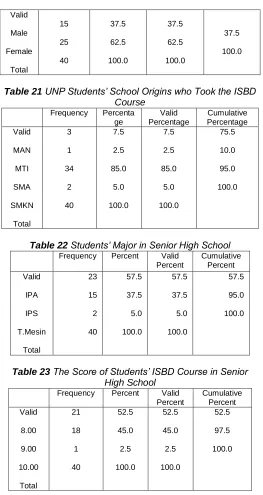
In the need analysis, the perception of the stakeholder about the current situation (existing situation) is acquired. The process of the need analysis consists of two activities, namely analysis students ' characteristics, and instructional characteristics. The analysis of learners (raw inputs) aims to know the current activity about the condition of learners or students. The aspects of this matter are gender, age, origin, school, major in Senior High School and the value of the ISBD at the high school level. Meanwhile, the instructional characteristic analysis aims to identify the curriculum of the ISBD course such as course objectives, key competencies, and supporting competencies as well as materials, methods and learning evaluation. A questionnaire is randomly disseminated to 40 students of the ISBD alumni. The following data in the table below is the result of the students who took the ISBD course from the previous semester.
Table 20 Students’ Gender who Took the ISBD Course
Frequency Percentage Valid Percentage
Valid Male Female Total 15 25 40 37.5 62.5 100.0 37.5 62.5 100.0 37.5 100.0
Table 21 UNP Students’ School Origins who Took the ISBD
Course Frequency Percenta
ge Valid Percentage Cumulative Percentage Valid MAN MTI SMA SMKN Total 3 1 34 2 40 7.5 2.5 85.0 5.0 100.0 7.5 2.5 85.0 5.0 100.0 75.5 10.0 95.0 100.0
Table 22 Students’ Major in Senior High School
Frequency Percent Valid Percent Cumulative Percent Valid IPA IPS T.Mesin Total 23 15 2 40 57.5 37.5 5.0 100.0 57.5 37.5 5.0 100.0 57.5 95.0 100.0
Table 23 The Score of Students’ ISBD Course in Senior
High School Frequency Percent Valid
Percent Cumulative Percent Valid 8.00 9.00 10.00 Total 21 18 1 40 52.5 45.0 2.5 100.0 52.5 45.0 2.5 100.0 52.5 97.5 100.0
Table 20 above shows the students’ gender characteristics that take ISBD course is 37.5% of female gender students. This means that ISBD learning should better accommodate the needs and issues which are related to female students issues in ISBD classes. Table 21 above shows the characteristics of students from their school origins. It was found that most of the students; 85% of UNP students come from Senior High School while 7.5% were from Madrasah Aliyah (MA), 5% were from SMKN and 2.5% were Madrasah Tarbiyah Islamiyah (MTI). This means that most of UNP students come from SMA of 85% plus SMK plus 2,5% of SMK equals to 87.5% that study religion in
students come from science majors of 57.5% and 37.5% from mechanical engineering majors. This means that UNP is derived from non-religious majors. Such characteristics need to be considered in selecting the ISBD materials, approaches, methods and learning strategies. Table 23 above shows that more than half of the 52.5% of the students have a score of 8 and 45% have a score of 9 and 2.5% have a score of 10 on their certificate of graduation. This means that the religious score of the students who enter the UNP is above 8. This proves that the results of students’religious learning in Senior High School is very good. In general, all of the data above show that the UNP students who take ISBD course generally come from public schools, science major, and social major. They were accepted in the UNP with a good and excellent score of ISBD which was between 8 and 9. Most genders are women. The next characteristic is instructional analysis. The ISBD Learning at UNP currently includes three things: planning, implementation, and evaluation of ISBD learning. From the results of observations and interview analysis with the lecturers of the ISBD course in UNP, coordinator of ISBD, head of UPT MKU and Vice-Rector 1 UNP related to the three learning scopes can be described as follows.
3.2 The Interaction of Learning Model with Students’ Gender towards ISBD Learning Outcome
69 The work was then reported in front of the class and
discussed extensively. Students are encouraged to argue, deny and defend their opinions. With such activities, students have learned to take the initiative, practice how to solve problems and draw conclusions. In the learning process, students have used their ability to think and apply concepts, principles, and techniques to investigate problems. In addition, in ISBDBeKo learning, students can integrate various disciplines. All this corresponds to the theory proposed by Schmidt et al in Rusman (2011:231) in which a study theory
based on Constructivism. There is no interaction between the learning model and the students’ gender which influence the outcomes of the learning potential due to the lack of motivation from the students themselves. As it is known that most students still consider the course of ISBD only to complete their semester credit. In the theory of motivational process (Process theory) particularly the theory of hope developed by Victor Vroom (1964). It is seen that there was an internal need in everyone that cause a person being motivated when he believed that: 1) If certain attitudes would have
a certain outcome; 2) Each result has a certain value or attraction to it; 3) Those results can be achieved by doing efforts. If the learning process of ISBD is still considered as complementary courses of credit semester, it can be said that the students lack motivation so that it does not show a real effort in the learning process. They just simply complete the semester credit.
1) Normality Test
The hypothesis test was subsequently conducted using the Mann-Whitney U test because the requirements of parametric tests were not met. The following table shows the test results of the normality test of students increase in their learning outcomes for aspects of knowledge by using SPSS 19.
Tabel 54. The Result of Normality Test for the Improvement
of Character
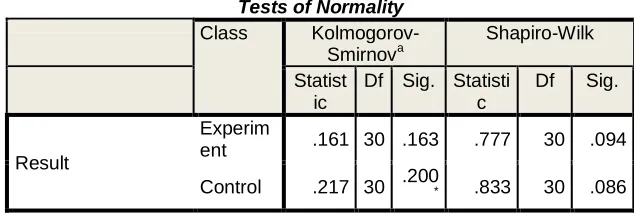
The distributed data criteria are normal when the significance is > α. The data processing results show a signification in the experiment class is 0.003 < 0.05 and for the control class is 0.002 < 0.05. It means that the data for both classes are not distributed normally. From table 55,
the result of variance homogeneity is displayed. The test of data normality uses the Kolmogorov-Smirnov test. From the summary of the results of the analysis of normality test, it can be known that the significance value of pre-test in the experiment class is 0.625 while the result of post-test in the experiment class is 0.212. Moreover, the pre-test result of the control class is 0.602 while the post-test result of the control class is 0.725. This means that the score of each variable is greater than the significance of 0.05. Based on this score, it can be said that the spread of data from the
sample is normally distributed. 2) Homogeneity Test
The test of homogeneity from the population group data is conducted to see whether the data obtained comes from a homogeneous sample group. The test of homogeneity data is given to the sample groups (i.e. the results of learning by using the test of homogeneity of variances). The summary of the results of the test analysis of the population groups’ variance is significant with the value of 0,193. The Significance value (Sig.) is > 0.05. This means that the data variance of population groups is homogeneous.
Test of Homogeneity of Variances
Levene Statistic df1 df2 Sig.
2.163 1 78 .294
3) Hypotheses Testing
After the normality and homogeneity tests, it turns out that the results of the data and the student's gender data in the sample class is normally distributed. Moreover, it also has a homogeneous variances. Thereby, the requirements of variance analysis can be fulfilled for the use of hypothesis testing. Four hypotheses will be tested. Three of the hypotheses use the F test and one of it uses the T-test. Hypotheses test results can be seen in table 35.
Tests of Normality Class
Kolmogorov-Smirnova
Shapiro-Wilk
Statist ic
Df Sig. Statisti c
Df Sig.
Result
Experim
ent .161 30 .163 .777 30 .094
Control .217 30 .200* .833 30 .086
Table 35. The Two-Way Anova Calculation
The test of hypotheses 1, 2 and 3 was conducted with the analysis of two-line variances. The research hypothesis has been formulated as a statistic tested hypothesis first. a) The First Hypothesis Testing
The first hypothesis proposed was "The learning outcomes of the ISBD of the students’ group taught with the ISBDBeKo learning Model are more highly compared with the outcomes of learning of the ISBD of the students taught with conventional learning". Based on table 35, the average score of learning outcomes of ISBD of the student groups taught using ISBDBeKo learning models is higher than the learning outcomes of ISBD of the student groups taught using Conventional learning. In the column of score Sig. 0.000 < Alpha 0.05 on the 95% trust level. This means that the ISBD learning outcomes by using the ISBDBeKo learning Model are higher than the ISBD learning outcomes by using conventional learning. Thus, the first zero hypotheses were rejected which states "The learning outcomes of the ISBD of the students’ group taught with the ISBDBeKo learning Model were not higher than the outcomes of the ISBD of the students group with conventional learning". Thus, the learning outcomes of the ISBD of the students who are taught with the learning Model ISBDBeKo higher than the results of learning ISBD of the students with conventional learning and this truth has been tested.
b) The Second Hypothesis Testing
The second hypothesis to be proposed is "the learning outcomes of female students is higher than the male students". From table 35 above, it can be seen the average score of learning outcomes of ISBD of the students’ group with the male and female gender. In score column of Sig. 0.001 < Alpha 0.05 on the 95% trust level. This differentiates the learning outcomes of male and female students. Thus, the second zero hypothesis was rejected "there is no difference in learning outcomes between male
greater than the alpha of 0.05. This indicates that the third zero hypotheses were accepted. It proves that there is no interaction between the ISBDBeKo learning model and the gender of students towards their learning outcomes. d)The Fourth Hypothesis Testing
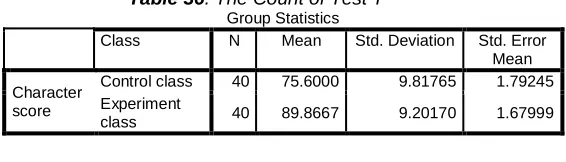
The fourth hypothesis proposed is "the character of students who studied with the ISBDBeKo model was better than those who studied with the conventional model". Based on table 36, it can be seen the average value of students who studied with the model ISBDBeKo with the average character of students who studied with the conventional model. In the Levene’s column, the score of sig is 0.919 which means the variances are homogeneous. In the score column of the Sig value. 0.001 < Alpha 0.05 on a 95% trust level. This means that there are differences between the students who studied with the ISBDBeKo model with conventional group. Thus, the fourth zero hypotheses were rejected "there is no difference of character between students with ISBDBeKo model and conventional model". Furthermore, an alternate hypothesis states that "there is a difference of character between students with ISBDBeKo model and conventional model" in which the truth is tested and acceptable. By seeing the mean of that two groups, it is proven that students character with ISBDBeKo model is better than the one with the conventional model.
Table 36. The Count of Test T
Group Statistics
Class N Mean Std. Deviation Std. Error Mean Character
score
Control class 40 75.6000 9.81765 1.79245 Experiment
class 40 89.8667 9.20170 1.67999
4.
CONCLUSIONS
Based on the results of the research in the development of the contextual-based learning model of Islamic education for character formation in this University, it can be concluded:
1. The study of religious education at Padang State University was carried out. However, some important aspects need to be improved i.e. the affective aspect (character) and the meaning of the students’ lessons that are expected to move the students to practice their religion as they should.
2. In line with that, an effort is necessary to improve the quality of the ISBD learning particularly in the development of learning model to achieve the learning outcomes especially from the point of religious characters, honesty, and responsibility. It is approved and expected by stakeholders.
3. Based on the analysis conducted, it is known that the effort is needed for the development of a contextual-based ISBD learning model to develop ISBD learning in UNP effectively which is strengthening the religious character, honesty, and responsibility.
Tests of Between-Subjects Effects Dependent Variable: Nilai
Source Type III Sum of Squares
Df Mean Square
F Sig.
Corrected
Model 4636.991 a
3 1545.664 17.971 .000
I
ntercept 789499.737 1
789499.7 37
9179.54 2 .000 Model 192.624 1 192.624 52.240 .000 School 4291.286 1 4291.286 49.895 .000 Model *
school 171.270 1 171.270 .759 .420 Error 9890.740 115 86.006
Total 805200.000 119 Corrected
Total 14527.731 118
71 [1] The model which is developed, ISBDBeKo., is
proven valid and practice by experts and practitioners.
[2] Hurlock., Elizabeth B. 2012. Psikologi Perekmbangan Suatu Pendekatan Sepanjang Rentang Kehidupan. Jakarta: Penerbit Airlangga Dahar, Ratna Wilis. 1988. Teori – Teori Belajar. Jakarta: Departemen Pendidikan dan Kebudayaan.
[3] Fosnot, Catherine Twomey. 2005. Constructivism: Theory Perspectives and Practice.
[4] Bern R.G and Erickson, P.M., 2001. ―Contexual Teaching and Learning: Preparing Student for New Economy‖ The Highlight Zone No. 5 www.Nccte.com.New York: Columbia.
[5] Fry, Heather, et.al. 2013. Hand Book Teaching and Learning, Strategi Peningkatan Mutu Pendidikan di Perguruan Tinggi. Pekanbaru: Zanafa publishing. [6] Gagnon, George W and Collay, Michelle. 2001.
Designing For Learning: Six Elemen In Constructivist Classroom. California:Corwin Press. Inc
[7] Graham, SE. And Diez, M.E. 2015. ―The Complexety og Character an Ability-Based Model for Higher Education― Journal of Character Eduation. Volume 11 2015 pp51-65
[8] Iriyanto, H.D., 2012. Learning Methamorposis Hebat Gurunya Dasyat Murinya. Jakarta: Esensi divisi Penerbit Airlangga
[9] Johnson, B. Elaine. 2012. Contexual Teaching and Learning.Terj. Bandung: MLC
[10]Jonassen, David. 1999. Designing Constructivist Learning Environtment. Instructional-Design Theories And Models Volume II, Editied By Charles M. Reigeluth. New Jersey: Lawrence Erlbraum Associates,Inc
[11]Joyce, Bruce. Marsha Weil. Emily Calhoun. 2011. Models of Teaching. Terj. Yogyakarta: Pustaka Pelajar
[12]Joyce, Bruce., Weil, Marsha. 1992. Model of Teaching. Boston: Allyn & Bacon. Kementerian Agama RI. 2010. Syamil Alqur’an Miracle the Reference. Bandung: Sygma Publishing
[13]Marlowe, Bruce A and Page, Marilyn. 1998. Creatingand Sustaining the Constructivist Classroom. California: Corwin Press, InsMulyasa, E.2011. Managemen Pendidikan Karakter. Jakarta: Bumi Aksara
[14]Sagala, Syaiful. 2010. Konsep dan makna Pembelajaran. Jakarta: Alfa Beta
[15]Sanjaya, Wina. 2006. Pembelajaran Dalam Implementasi Kurikulum Berbasis Konpetensi, Jakarta: Kencana