U C L
Eclipsed Conformations For
Simple Saturated Bonds
by
Anthony Ibhakhomon Ijeh (Jnr)
A thesis presented to the University of London in the
partial fulfilment of the requirements for the degree of
Doctor of Philosophy.
Department of Chemistry
ProQuest Number: U643729
All rights reserved
INFORMATION TO ALL USERS
The quality of this reproduction is dependent upon the quality of the copy submitted.
In the unlikely event that the author did not send a complete manuscript and there are missing pages, these will be noted. Also, if material had to be removed,
a note will indicate the deletion.
uest.
ProQuest U643729
Published by ProQuest LLC(2016). Copyright of the Dissertation is held by the Author.
All rights reserved.
This work is protected against unauthorized copying under Title 17, United States Code. Microform Edition © ProQuest LLC.
ProQuest LLC
789 East Eisenhower Parkway P.O. Box 1346
______________________________Abstract____________________________ 2
Abstract
This thesis is primarily concerned with demonstrating bond eclipsing and its consequences in simple saturated compounds using dynamic nuclear magnetic resonance spectroscopy and molecular mechanics calculations. I report the three-fold equilibria in cyclic aza/poly-aza compounds and two-fold rotational equilibria in trialkylamines.
The dynamic stereochemistry of a range of N-neopentyl piperidines with eclipsed N-CH2Bu^ bonds is compared with that of the corresponding N- ethylpiperidines, with gauche N-CH2Me bonds. The relative importance of ring inversion, exocyclic bond rotation and nitrogen inversion is elucidated, barriers of these processes are discussed and reported with the help of Molecular Mechanics calculations.
The effect of including cis equatorial methyl groups at the 2 and 6 positions of the piperidine ring was investigated, and examples of bonds which can adopt either eclipsed or staggered conformation are demonstrated. Dynamic studies are reported for poly-aza compounds i.e. N,N’-dineopentyl- hexahydropyrimidine and Tris(neopentyl)-1,3,5-triazane which has been shown by X-ray diffraction study to have one axial and two equatorial neopentyl groups with eclipsing in both axial and equatorial exocyclic N-CH2 bonds.
A dynamic NMR study of a range of acyclic N,N-dialkylneopentylamines supported by Molecular Mechanics calculations, showed that eclipsed conformations are encountered for N-CH2Bu^ bond which has a high one-fold
rotational barrier, with more branched alkyl groups it was shown that the bond adopts an intermediate between staggered and eclipsed.
D ed ication
Dedication
To the Father Almighty To whom all things are possible
Acknow ledgem ents
Acknowledgements
I would like to express my sincere appreciation to my supervisor Dr J.E.Anderson (The Boss) for his help and guidance during the course of this work.
I am grateful to members of the Anderson group also known as “The NMR people” , both past and present for all their help, especially Saheen, Samuel, Tomaz, Nanthini and Rima. I would also like to thank all the technical staff for their assistance with this research in particular Mrs Gillian Maxwell and Mr Steve Corker in the analytical department. Also I would like to thank Professor Vico Lunazzi for providing me with the compound 40i and Dr Derek Tocher for the X-Ray analysis of compound 18.
My thanks also extends to members of the Garrat group both past and present for the “European Community spirit” forged between both groups which involved a free flow of glassware between us and for my numerous friends at UCL who made my stay an enjoyable experience.
Abbreviations and Acronyms Ad  ax b.p. br But
C D C I3 C D 2 C I2 C3D6O C IC H F 2 C H C i2F
c m °C 1 3 c d DNMR d of d d of cm Et eq FAB-MS 1H Hz AH° AG AG" agK 3J Keg exp
Abberviations and Acronyms
Adamantyl Angstrom Axial
Boiling point Broad
Tert-butyl
Deuteriated chloroform
Deuteriated methylene chloride. Deuteriated acetone
Chlorodifluoromethane Dichorofluoromethane Complex multiplet Celcius
Carbon 13 NMR Doublet
Dynamic Nuclear Magnetic Resonance Doublet of doublets
Doublet of complex multiplets Ethyl
Equatorial
Fast atom bombardment mass spectroscopy Proton NMR
Hertz
Change in Enthalpy
Change in Experimental free energy Change in Gibb's free energy
Change in Barrier at coalescing temperature Vicinal coupling
Abbreviations and Acronyms
Np Neopentyl
NMR Nuclear Magnetic Resonance
•N Nitrogen inversion
M e4Si Tetramethylsilane
Me Methyl
m.p. Melting point
MHz Megahertz
iPr iso propyl
Ph Phenyl
ppm Parts per million
° Degrees
q of cm Quartet of complex multiplets
q Quartet
'R Ring inversion
rot Bond rotation
R Gas constant
s Singlet
sep Septet
s br Broad singlet
AS° Change in Entropy
T Temperature in Kelvin
t br Broad triplet
Table of Contents
Table of Contents
Page
Title Page 1
Abstract 2
D ed ication 3
Acknow ledgem ents 4
Abberviations and Acronyms 5
Table of Contents 7
Chapter 1 Introduction
1.1 Eclipsing in General 11
1.2 Conformational Analysis of Saturated Six-membered N-Heterocyclic
Compounds 13
1.3 Techniques 19
1.3.1 Nuclear Magnetic Resonance Methods
a) Dynamic NMR 19
b) Coupling Constants 20
1.3.2 Molecular Mechanics Calculations 23
1.3.3 Crystal Structure Determination 24
1.4 Stereodynamics of Cyclic Poly-aza Compounds 24
1.5 Stereodynamics of Trialkylamines Compounds 29
1.6 Aims of the Present Work 31
Chapter 2 Stereodynamics of N-Heterocyclic Compounds
2.1 Introduction 33
2.2 Molecular Mechanics Calculations 35
2.3 Rate Processes 44
2.4 Dynamic Nuclear Magnetic Resonance Results 45
2.5 Discussion 53
Table of Contents 8
Chapter 3 Stereodynamics of Cyclic Poly-aza Compounds
3.1 Introduction 63
3.2 Molecular Mechanics Calculations 65
3.3 Rate Processes 68
3.4 Dynamic Nuclear Magnetic Resonance results 69
3.5 Discussion 73
3.6 Experimental 77
Chapter 4 Stereodynamics of 2.6-Dim ethyl-piperidine Derivatives
4.1 Introduction 81
4.2 Molecular Mechanics Calculations 83
4.3 Rate Processes 87
4.4 Dynamic Nuclear Magnetic Resonance Results 88
4.5 Discussion 98
4.6 Experimental 101
Chapter 5 Stereodynamics of Acyclic Neopentyldialkylamines
5.1 Introduction 105
5.2 Molecular Mechanics Calculations 107
5.3 Rate Processes 111
5.4 Dynamic Nuclear Magnetic Resonance Results 112
5.5 Discussion 116
5.6 Experimental 118
Chapter 6 Stereodynam ics of Protonated Cyclic and A cyclic Am ines
6.1 Introduction 122
6.2 Molecular Mechanics Calculations 124
6.3 Dynamic Nuclear Magnetic Resonance Results and Rate Processes 136
Table of Contents
6.5 Vicinal Coupling and One Bond a Carbon-Proton Coupling 144
6.6 Experimental 146
Chapter 7 Stereodynamics of 2.6-Dim ethyl-piperldinium Salts
7.1 Introduction 152
7.2 Molecular Mechanics Calculations 153
7.3 Dynamic Nuclear Magnetic Resonance Results and Rate Processes 157
7.4 Discussion 162
7.5 Experimental 164
Chapter 8 Conclusion
8.1 Conclusion 167
8.2 General Experimental Considerations 167
Chapter 1
Chapter 1 Introduction 11
1.1 Eclipsing in General
The ground-state conformation for saturated bonds which minimises the steric energy of most simple organic molecules, is the standard staggered conformation e.g. ethane 1 with the H-C-C-H dihedral angle of 60° and 180°. As bulky substituents groups replace hydrogen bonded to the carbons, the above conditions may no longer be obeyed due to the bond rotating away from being perfectly staggered to minimise its energy. Thus if two bulky substituents are added to the molecule, so as to make them gauche to one another 2, then their dihedral angle will become greater than 60° as they rotate away from each other.
Staggered 1
3-dimensional image o f ethane 1
R
R
H
G auche 2 S kew ed 3
Chapter 1 Introduction 12
This argument can be said to be purely academic, since the two bulky substituents will continue to move from each other until an anti conformation 5 is achieved, however if another bulky group is added then the logical reasoning applied in the previous cases becomes more critical, and the plausibility of the eclipsed ground-state conformation increases. As the groups , r2 and r3 of
a 1,1,2-trisubstituted ethane R"! CH^Hb—-CHCr2r3 become increasingly
demanding of space, conformations 6 and 7 are unlikely to be highly populated due to the gauche interactions between substituents, whereas, conformation 8 in which the only disadvantage is the 3 eclipsing interactions with the hydrogen atoms, might be the low energy point.
N ear E clipsed 4 A n ti 5
A known trisubstituted compound"! 1,1,2-tri-fe/t-butyl ethane has on the basis of molecular mechanics calculations and coupling constant measurements been shown to prefer a nearly eclipsed ground state conformation 9. Perfect eclipsing with three torsion angles each of 0° is not to be expected due to other distortions in the molecule. Thus the H-C-H and Bu^-C-Bu^ projections in 9 will be less than and greater than 120° respectively.
Chapter 1 Introduction 13
for a preferred eclipsed conformation of saturated carbon-X bonds (X=CH2, NH, O) is an equatorial or axial X-R substituent on a six membered ring with equatorial substitution in the 2- and 6- position 10. The Newman projections 11 and 12 respectively show how the equatorial substituents A and B drive the group R to eclipse the hydrogen.
H ,X R
While eclipsing has also been reported in totally different situations'»^ model 1 0 is a special case of a more general s te r e o t y p e ^ "G,8 f o r eclipsing for
the X-Y bond in R'^X-—Y R 2 r3 (Y=CH, N, O etc.) where groups R are sterically demanding.
1.2 Conformational Analysis of Saturated Six-membered N-Heterocyclic Compounds
Saturated six-membered N-heterocyclic rings of which piperidine is the parent are commonly encountered in various branches of chemistry. This includes piperidine derivatives and polyheterocyclic systems in which the ring methylene groups can be substituted by alkyl or functional groups or replaced by an additional heteroatom (mainly nitrogen, oxygen or sulphur)
Cyclohexane-like rings adopt various non-planar conformations, mainly chair, but occasionally boat and twist c o n f o r m a t io n s ^ and interconversion between chair conformations takes place rapidly at room temperature. Conformational analysis based mainly on nuclear magnetic resonance (NMR) spectroscopy is therefore necessary for any full understanding of the structure of six-membered rings.
Chapter 1___________________ Introduction_________________________ 14
interconversion by passing through a planar transition state in which the central nitrogen atom is apparently sp2 hybridised (figurel.1). N-heterocyclic six- membered rings are thus both conformationally and configurationally mobile. In most cases, fast interconversion processes change one molecule into its companion structure at equilibrium.
Figure 1.1
Pyramidal Nitrogen Inversion
Pyramidal atomic inversion is a well-documented topic^O-12 but there are some particularly interesting aspects when the nitrogen is incorporated in a ring with its geometric constraints, and the possibility of two inversion processes: 1 nitrogen inversion ('N) and 2, ring inversion or reversal ('R ). In five-membered
Chapter 1 Introduction 15
scheme 1.1
Ring and N itrogen inversion in piperidine derivatives
It should be noted that, when the set of equatorial and axial substituents are not identical, then starting from a given conformation (A), the two processes •n or 'r, result in two different conformers, (B) and (0) respectively. If we
perform a sequence of two non-identical processes (i.e. 'n then 'r, or 'r then 'n) then we obtain a fourth different conformer (D).
Conformational kinetic data may be derived by consideration of the scheme(1.2)9
scheme 1.2
CN)
Ki2 : (1)
(* R ) Ki3
(2)
1
K31
K21
K34
K42 K2 4---(’ R )
^43 •
('N )
Chapter 1___________________ Introduction__________________________16
Barriers to ring reversal are about 10-12 kcal/mol for six-membered rings'! 3, while nitrogen inversion barriers for trialkylamines are 5-8 kcal/mol 14. This means that the rate constants using NMR line shape methods are usually obtained for ring reversal at moderately low temperature (typically between -20 and -60“C) and individual nitrogen inversion rates at lower temperature (typically between -100 and -150°C).
The stereodynamics of a wide range of six-membered A/-heterocyclic compounds has been studied over the last few years^^'^O largely by observing the temperature dependence of NMR spectra, which helps in the understanding of the interconversion of specific conformations. It has to be noted that interconversions involve a combination of ring inversion or reversal, nitrogen inversion and importantly for this work, rotation about exocyclic bonds. This last point arises because on nitrogen inversion, with no rotation, a staggered bond with torsion angles of 60° and 180° becomes a bond with torsion angles of 120° and 0° i.e. eclipsed. NMR methods may allow study of these processes and measurement of their barriers.
A/-neopentyl-4-ferf-butylpiperidine 13 was shown by F o rs y th 3 1 to exist predominantly eclipsed at the exocyclic N-CH2 bond, based on evidence obtained from molecular mechanics calculations and coupling constant measurements, this structure is redolent of structure 10 above, but here the equatorial substituents flanking the eclipsed bonds are hydrogen atoms. The conformation of 13 is analogous to that we obtained for fe/t-butoxycyclohexane 14 in which the ferf-butyl finds that the two flanking equatorial hydrogens are once again sufficient to produce e c lip s in g 1 6 of the exocyclic C-0 bond.
Bu'
Chapter 1 Introduction 17
We had been considering m e t h o x y c y c lo h e x a n e s ^ ^ with none to four
adjacent methyl substituents (see table 1.1) and some simple acyclic methyl secondary alkyl ethers and had shown a correlation between the three-bond coupling constant of the methine proton with the methoxy carbon and the conformation of the HC O bond defined by 0 , the torsion angle as suggested by molecular mechanics calculations MM333,34 see figure 1.2.
R^
'h
R'^
( )
OMe ring - ^ r i n g
Chapter 1 Introduction 18
Table 1.1
Experimental vicinal ‘•^q-O -Q -Ih coupling constants (J/Hz) and MM3-calculated optimum carbon-oxygen bond conformation for methoxycyclohexanes and other
Compound and Substituents 0 ^ n J/Hz
Equatorial methoxycyclohexane
none 46.0 3.7b
eq 2-Me 40.4 4.7a
ax 2-Me 44.6 4.ia,b
2,2-Me2 37.3 5.5
eq,ax 2,6-Me2 41.2 4.3a.b
eq,eq 2,6-Me2 0.0 7.3a
eq 2,2,6-Me3 0.7 7.3
2,2,6,6-Me4 0.4 7.5
eq 4-But-2,2,6,6-Me4 0.3 7.7
Axial methoxycyclohexanes
none 41.9 3.7b
eq 2-Me 40.7 4.ia,b
eq 4-Bu^ 41.5 3.9
eq,eq 2,6-Me2 0.2 7.3a,b
Acyclic methyl ethers
(Me)2CH- 46.6 3.9
(Et)2CH- 46.6 4.6a
'Pr2CH- 1.8 7.6a
3 ref^2. ^ The coupling for a mixture of two chair conformations with the methoxy-group equatorial or axial.
Chapter 1 Introduction 19
namely Nuclear Magnetic Resonance Methods, M olecular M echanics Calculations and Crystal Struture Determination.
1.3.1 Nuclear Magnetic Resonance Methods a)Dynamic NMR (DNMR)
Very broadly, simple averaged spectra are seen when the interconversion of two conformations is fast on the NMR time scale whereas more complex individual spectra are seen when the process is slow on the NMR time scale.
________________ Figure 1.3_______________
AG BA
I
AG'
A
Reaction co-ordinate
The above figure 1.3 depicts the energy profile to be expected for a molecule interconverting between two states A and B (of unequal energy) via a single transition state. The position of the equilibrium at a particular temperature T is determined by AG°, the free energy difference for the process:
[ b ]
AG =-RTIn"
[A ]
Chapter 1____________________Introduction__________________________ 20
corresponding to A and B. The rate of the interconversion of A to B is given by k which is related to AG* in accordance with the Eyring equation^G
e x p (-A G *^ ^ )
Kb = Boltzmann’s constant h = Planck’s constant f = Transmission coefficient R= Gas constant
T= Absolute temperature or AG*c=RT{23.76 + In Tc - In Kc} kcal/mol
The rate constant kc of a chemical exchange process at the coalescence temperature Tc for two exchanging NMR signals Va and Vb is given by37
kc =
'2
AT)=difference in frequency
enabling AG*c to be readily determined by observation of the lineshape of two coalescing signals. A complete theory of NMR lineshapes allows the calculation of signal appearance for any rate constant for exchange, and so by matching exchange-modified spectra to calculated spectra, rate constants can be obtained at a series of temperatures.
b)Coupling Constants
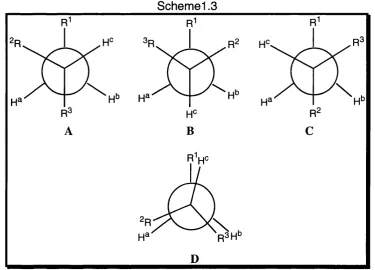
In confirming the calculated conformation of a simple 1,1,2-trisubstituted ethane, (see scheme 1.3) the NMR spectrum of the compound is useful. It should be possible to measure two coupling constants Ja-c and Jb-c, which are
equal if R2 = R3. The sum of these coupling constants gives an indication of the degree of eclipsing. When the conformation is near staggered as in scheme 3, the sum of the coupling should be about 14.2Hz. However, in tri-ferf-butyl e th a n e w h ic h is a good model for an eclipsed conformation the sum of the coupling constant is only 7.2Hz ( Ja-c= Jb-c= 3 . 6 Hz). Table 1.2 shows the value
Chapter 1 Introduction 21
The instability of the staggered conformations of R‘*CH2CHR2r3 is due
to parallel-1,3-interactions, so for most marked eclipsing, a fair degree of branching in R \ R2 and R3 is desirable. If R2 and R^ are only moderately space- demanding, but are inflexible, a sizeable group R^ may prefer to eclipse a hydrogen atom, as a means of distancing itself from R2 and R^- If R2 and R3 are part of a ring system eclipsing is more likely because there is less scope for distortion than in an acyclic system.
Schemel .3
Table 1.2 vicinal proton-proton coupling constants (Hz) in acyclic alkanes R1CAHB-CHCR2R3
R1 R2 R3 jA -C JB-c I J
f-Bu f-Bu t-Bu 3.6 3.6 7.2
Me f-Bu f-Bu 3.7 3.7 7.4
Me Et f-Bu 3.3 6.5 9.8
f-Pentyl Me Me 5.1 5.1 10.2
Me /-Pr /-Pr 5.1 5.1 10.2
f-Bu Me /-Pr 8.8 1.7 10.5
f-Bu Me Me 5.3 5.3 10.6
Chapter 1 Introduction 22
Me /-Pr t-Bu 4.2 7.0 11.2
Me Et /-Pr 4.8 6.6 11.4
/-Pr Me Me 7.1 7.1 14.2
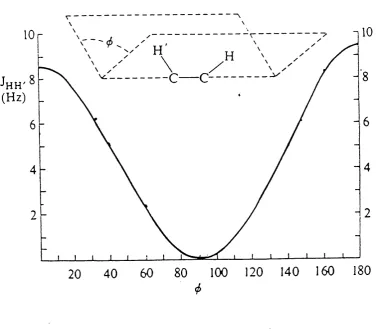
Karplus derived theoretically^Q the relationship between three-bond vicinal coupling constants (3J) and the dihedral angle (0), and for various kinds of bonds and substituents A,B and 0 vary.
Karplus equations
Jvic=Acos20+Bcos0+C Figure 1.4
lOr
(Hz)
20 40 60 80 100 120 140 160 180
<!>
Chapter 1____________________ Introduction__________________________ 23
60'(staggered) and 120°(eclipsed) so some care in interpretation is necessary. The same kind of torsion angle dependence is to be expected for a ^H-C-C-^^Q
and for a system 39,40
1.3.2 Molecular Mechanics Calculations
Chapter 1____________________Introduction__________________________ M
Clearly, calculated bond lengths, bond angles and dihedral angles should match well, when these are known. Allinger and c o - w o r k e r s ^ 7 ,1 8 ^ whose molecular
program MM3 we use have placed emphasis on matching calculated and experimental heat of formation, and infra red vibrational frequencies. Allinger’s MM2 program which is the basis of the M MX^I calculations we sometimes report places more emphasis on matching experimental heats of formations than infra-red vibrations.
1.3.3 Crystal Structure Determination
T h e diffraction pattern of X-rays after passing through a single crystal gives static structural information on the conformation, in addition to details such as bond lengths, bond an g les and interatom ic d istances, and also the intermolecular disposition of the molecules. A fundamental limitation of the X-ray m ethod is that it is only app licable to the crystalline state, and that the geometrical results obtained from it m ay be distorted by specific interactions in the crystal lattice. Thus the conformation of a molecule in the crystal may not be the sam e as the dominant one in solution or in the gas phase. O ne exam ple is 3 ,3 :6 ,6 -b is (p e n ta -m e th y le n e )-s -te tra th ia n e 1 5 4 2 ^ which has the central ring a chair conformation in the crystal, but exists as a 1:4 mixture of chair and twist conformation in solution. M ore than one conformation m ay be populated in solution while only one, not always the most favoured is normally found in the crystal.
s —s
s —s
1.4 Stereodynamics of Cyclic Poly-aza Compounds
Chapter 1 Introduction 25
may exist under two sets of conformers 1 and 2 which are equivalent but with axial and equatorial hydrogen interconverted.
Scheme 1.4
The relative proportion of each conformer may vary widely within each set, for example 1,3 diaxial conformer (aa) is expected to have a very low contribution. Nitrogen inversion barriers refer to one conformational equilibrium ee=ea.
Much work has been done on hexahydropyrimidines and hexahydro- 1,3,5-triazines by Riddell et aK^ which reached its culmination when Katritzky et al^4 carried out variable temperature NMR studies to elucidate the conformational equilibria and energies of 1,3 dimethyl hexahydropyrimidine 16.
1,3 dimethyl hexahydropyrimidine
Chapter 1____________________Introduction__________________________ 26
minor set of six lines was assigned to (ae). The diaxial conformers are expected to be of high energy and therefore the low temperature spectrum can only
reasonably be attributed to (1ee) and (1ea/ae). It is worth noting that signal splitting on 1 NIVIR does not occur until both ring inversion and nitrogen inversion are slow on the NMR timescale, so the barrier measured AG*c= 7.2 kcal/mol is due to nitrogen inversion. A dynamic process with a higher barrier
AG*c=11.3 kcal/mol is observed in the proton NMR and is assigned to ring inversion.
Symmetrical hexahydro-1,3,5-triazines can be divided along the same lines into two enantiomeric sets separated by ring inversion see scheme 1.5. Each set contains eight conformers separated by ring inversion, namely one triequatorial (eee) one triaxial (aaa) conformation, three monoaxial-diequatorial (eea, eae, aee) c o n f o r m a t i o n s 4 5 , 4 6 and three diaxial monoequatorial
conformations. Seven of the eight conformers have axial repulsions involving substituents and/or lone pair electrons on the nitrogen atoms..
scheme 1.5
GGG ( e e a ) ^ — (eaa)^ . (e a e )^ r (aae)^T' " (aee)=F^ ( a e a ) ^ ^ (aaa)
In In In ^n In ^n In
1r
(a a a )t= ^ (a a e )*^ = ^ (a e e )1 ^ ^ ^ (a e a )*::;i^ (e e a )* ^ (eaa)tp±^(eae)=!^(eee)'
^N ^N ^N ^N In ^N In
conformational processes in symmetrical hexahydro-1,3,5-triazines
Chapter 1 Introduction 27
Riddell, Price & Sutherland^O), the eea conformer (Bushweller, Lourandos & Brunelle^G, Baker, Ferguson, Katritzky, Patel & Rahimi-Rastgoo^S) and varying amounts of the eee, eea and eaa conformers (Duke, Jones, Katritzky, Scattergood & Riddell^l). No evidence (apart from not totally convincing dipole moments measurements) exist for conformations other than the eee or eea in solution.
I will report through X-ray diffraction s t u d i e s ^ Z that N , N ' , N
”-tris(neopentyl)-1,3,5-triazane 18 in the crystal has one axial and two equatorial neopentyl groups with eclipsing of both axial and equatorial exocyclic N-CH2
bonds. In solution at about -130°C both ring inversion and nitrogen inversion are slow on the NMR time scale and 91% of the molecules adopt that structure (aee) while 9% adopt the all-equatorial arrangement (eee). This will be fully reported in chapter 3, but we will now look a little more closely at earlier work on triazane stereodynamics.
Bu^-HoC CHo-Bu
As with hexahydropyrimidines a complete study of such systems emerged only with the advent of dynamic NMR spectroscopy. Katritzky et
a |4 5 were able (using variable temperature proton and carbon 13 dynamic NMR
spectroscopy) to show the inversion barriers and preferred conformations of hexahydro-1,3,5-triazane derivatives (where R = methyl , ethyl and isopropyl) and some closely related compounds. This work also looked at the effect of increasing the size of the alkyl substituent on the hexahydro-1,3,5-triazane system.
Chapter 1 Introduction 28
signals were observed for each N-substituent. Reduction in temperature resulted initially in the formation of an AB quartet for the ring methylene protons in each case.
Table 1.3
1H NMR coalescence data and energies for ring inversion the N-alkyl triaza-series
Ring inversion Av/Hz J/Hz Tc/K AG^/kcal mol"1
methyl 90.0 9.9 264 12.8
ethyl 108 251 11.4
isopropyl 92 232 11.0
f-butyl- 120 219 10.2
At this stage the lack of change in the signal of the substituent group R was thought to be due to the slowing of ring inversion while nitrogen inversion remained fast. On lowering the temperature further, only the trimethyl compound displayed prominent decoalescence behaviour, the other compounds showed peaks broadening at temperatures approaching -150°C, but this could be attributed to the freezing out or relaxation effects rather than coalescence.
Ring inversion barriers determined for each compound using the Eyring equation (table 1.3) were in good agreement with previously quoted results^G that increasing substituent size resulted in lowered nitrogen inversion barriers. The NMR studies on the series of hexahydro-1,3,5-triazane, in which N,N’,N” -tris(methyl)-1,3,5-triazane 19 was included, confirmed that the findings of Bushweller et a|46 were consistent with this. At room temperature single peaks for the ring carbon atoms were observed, together with expected signals for the substituent group. NMR spectroscopy does not reveal changes as ring inversion is slowed because the carbon atom remained magnetically equivalent owing to nitrogen inversion.
Chapter 1 Introduction 29
doublet. The trimethyl compound confirmed the ^ H NMR results and the methyl and methylene carbon atom peaks both split into two peaks of relative intensity 2:1 peaks. It was f o u n d ^ S that the barrier for the f-butyl compound so low as to
be inaccessible even by nMR. The Eyring equation was applied and showed the correlation between increase in substituent size and lowering of the barrier to nitrogen inversion (table 1.4).
table 1.4
Cyclohexane Av/Hz Tc/K AG^c/kcalmol""*
methyl 37.7 148 7.15
130.8 157 7.21
ethyl 1 1 2 .2 143 6.80
isopropyl 171.1 133 5.99
1.5 Stereodynamics of Triaikylamine Compounds
The stereodynamics of a wide range of trialkylamines has been studied over the last thirty year^6-30 largely by observing the temperature dependence of NMR spectra. While it is advisable to discuss changes in the NMR in terms of the interconversion of specific conformations, this interconversion involves a combination of inversion of the configuration at the nitrogen centre and rotation about the carbon-nitrogen bonds and in favourable conditions the NMR method may allow a separate study of both these processes and a measurement of two (or more than two) distinct barriers.
Chapter 1 Introduction 30
C H C H
In a triaikylamine of the type RCHgNR'R", the N-methylene protons are diastereotopic in any nonplanar conformer but become equivalent via nitrogen inversion and accompanying rotation. Forsyth et a|54^ established that the NMR invisible processes in the more symmetrical RCH2N(R)2 amine can be revealed
through NMR isotope shifts, if the methylene is monodeuteriated to create a chiral centre that makes the R^ groups diastereotopic when N-inversion is slow, while Lunazzi et a|25 showed that the same process could become NMR visible in the presence of a chiral shift reagent
A barrier of 8.2 kcal/mol for inversion in N,N-dimethyl-1 -pentanamine- 7-dy
2 4 5 2 was found through complete DNMR line-shape analysis of the /V-methyl
Chapter 1 Introduction 31
C H D
Me*
n-Bu n-Bu n-Bu
in v -rg t
s lo w e r Me
Me Me* Me
C H D
t-Bu t-Bu f-Bu
Et* ro ta tio n in v e rs io n
Et* faster slo w e r |-
Et*
1.6 Aim of the Present Work
Chapter 2
Stereodynamics o f
Chapter 2 Stereodynamics of N-Heterocyclic Compounds_______ ^
2.1 Introduction
Much interest has been shown in saturated bonds which prefer to adopt eclipsed conformations^-8,32,52,55 jp particular
A/,A/’,A/'-tris(neopentyl)-1,3,5-triazane50 18 and tert-butoxycyclohexane^^ 14 where the exocyclic
C-N and 0 -0 bonds are eclipsed. This work endeavours to investigate what effect an eclipsed exocyclic N-C bond would have on the 3 fold equilibria i.e. nitrogen inversion, ring inversion and rotation about the exocyclic bond.
Eclipsed bonds are generally to be associated with a relatively high rotational b a r r ie r 5 ,5 4 and if other conformations of the bonds are not populated,
this barrier cannot be measured by usual dynamic NMR methods, this limitation is not subjected to amines with eclipsed N-C bonds since they exist in two equivalent conformations. Scheme 2.1 shows the ground state conformation I of 25 neopentylpiperidine with the substituent equatorial and the exocyclic CH2R bond eclipsed. Interconversion involves a combination of ring inversion, nitrogen inversion and more importantly rotation of exocyclic bonds with an equivalent form V which can take place in any order.
Scheme 2.1 I I I
Rot Rot
V I I I
. - j I ^
I V
Rot
Rot
Chapter 2 Stereodynamics of N-Heterocyclic Compounds_______ 34
Dynamic NMR is suitable for studying these processes (for II, I II and IV) if the barriers and populations are high enough to be measured. In keeping with this eclipsing postulate, Forsyth et a|31 reported an eclipsed geometry for the side chain in 1-neopentyl-4-ferf-butyl piperidine 13, their calculations for 13 suggested a 3.5 kcal/mol preference for the eclipsed conformation over the syn form, a point which we will demonstrate by direct experimental measurement.
In the gauche conformation two enantiomeric structures would exist, and interconversion between the three possible conformers should be a rapid process with an energy barrier low enough (<5 kcal/mol) to be under the limit of detection by usual dynamic NMR methods^G as shown in scheme 2.2. For the purposes of the present work the compounds (25-34) in table 2.1 were synthesized and studied by Nuclear Magnetic Resonance Spectroscopy and Molecular Mechanics Calculations. Substituents CFI2R are either neopentyl
25-28 and 33, which should produce an eclipsed exocyclic N-CHg bond, or ethyl 29-32 and 34, to give compounds with normal staggered exocyclic N- CFI2 bonds for comparison. NAIkyl pyrrolidines 33,34 are included in this work due to low barrier to pseudorotation^ which means that the ring can be considered as planar on the NMR timescale and the difference between axial and equatorial disappears, so the only processes which are NMR visible are nitrogen inversion and N-CFI2 bond rotation. Likewise, the piperidones 26,30
are expected to have much lower ring inversion barriers than the piperidines 25,29 in the same way that cyclohexanone ring inversion barrier57 of 4.0 kcal/mol is much less than that of cyclohexane 10.3 k c a l/m o |5 8 ,5 9 and the 3,3 dimethyl piperidine 28,32 should have insignificant population of conformation
with the N-alkyl group axial Scheme 2.2
2Ç
Chapter 2 Stereodynamics of N-Heterocyclic Compounds 35
table 2.1
Compound
2 5 , 2 9
2 6 , 3 0
2 7 , 3 1
2 8 , 3 2
3 3 , 3 4
25.26.27.28.33 CH2R=neopentyl 29.30.31.32.34 CH2R=ethyl
2.2 Molecular Mechanics Calculations
Molecular mechanics calculations for compounds 25-34 will now be reported in detail in the following sections 1 to 6, with all possible conformations explored. In all cases rotations about the exocyclic bond through 360“ were performed in order to find potential minima. Stable conformations within 2.7 kcal/mol of the most stable will normally be considered as they correspond to at least 1% population at room temperature ( and much less at lower temperatures), as a signal from 1% population is an optimistic minimum for what is observable in the NMR at low temperature.
Molecular mechanics calculations gives us enthalpy differences ARo, but since we have no way of knowing the entropy differences AS° we assume it is equal to zero and this reduces the equation
Chapter 2 Stereodynamics of N-Heterocyclic Compounds_______36
For each compound the absolute value of the computed Final steric energy is reported for the most stable conformation for reference purposes.
1) Neopentyl piperidine 25. Neopentyl piperidone 26 and its ketal 27
Molecular mechanics calculations of 25, 26 and 27 are discussed here, the rotational conformation of the exocyclic bond is defined by the torsion angle 0Lp=(Lp-N-C-C) which gives the dihedral angle of the lone pair with respect to the exocyclic bond
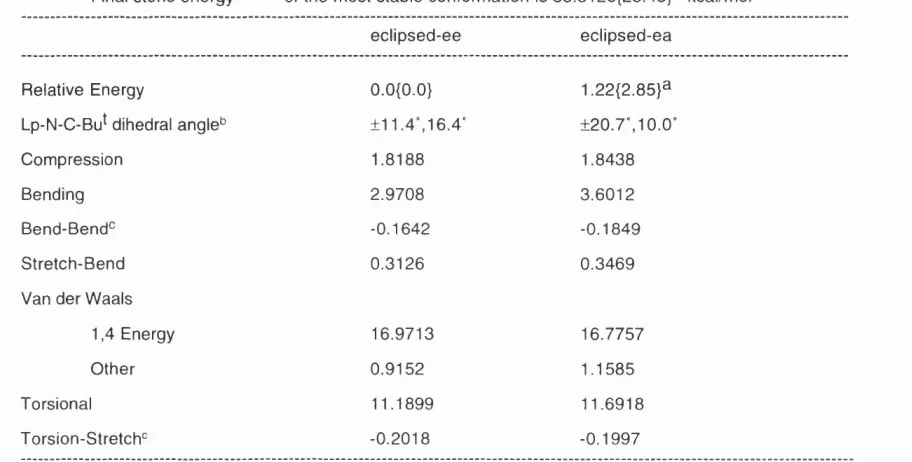
Table 2.2 M olecular m echanics calculation (M M 3 )3 3 ,3 4 Qf N eopentyl piperidine Final steric ene rg y of the most stable conform ation is 2 1 .9 1 6 5 {1 8 .1 1 ) kcal/m ol
e c lip s e d -e q u a to ria l 2 5 A e c lip s e d -a x ia l 2 5 8 a n ti-e q u a to ria l 2 5 C
Relative Energy 0 .0 (0 .0 }3 2 .1 2 (2 .2 4 } 3 .5 7 (3 .0 5 } Lp-N-C-Bu^ dihedral angle^ ± 1 .7 “ ±9 .3" ± 1 7 0 .9 “ Com pression 1 .0 1 3 0 1 .0 4 1 9 1 .0 5 2 5 Bending 1 .5 5 7 0 2 .4 9 8 6 6 .2 1 4 9 Bend-Bend^ -0 .1 1 4 8 -0 .1 6 0 2 -0 .2 0 8 1 S tre tc h -B e n d 0 .1 6 6 2 0 .2 1 5 2 0 .2 9 0 8 Van der W a a ls
1,4 Energy 1 1 .6 6 3 6 1 1 .1 7 8 7 1 0 .3 6 8 2 O th e r 0 .1 1 8 7 0 .6 1 7 8 1.5731 Torsional 7 .6 3 0 8 8 .7 5 8 5 6 .2 8 4 3 Torsion-Stretch'^ -0 .1 1 8 3 -0 .1 1 7 3 -0 .0 5 5 2
Note:
M M X ^^ values in parenthesis
Angles in deg rees. For eclipsed-equatorial and eclipsed-axial neopentyl groups dihedral angles reported from the quaternary carbon nearly eclipsing the lone pair and for anti-equatorial antiperiplanar to the lone pair.
T h e n egative sign indicates stabilisation rather than strain
r
Bu'eclipsed-equatorial eclipsed-axial anti-equatorial
Bu'
25A 25B 25C
Chapter 2 Stereodynamics of N-Heterocyclic Compounds_______ 37
minimum was located. There are two conformations likely to be populated, the eclipsed-equatorial 25A ( 0 L p = ± 1 .7°) and the eclipsed-axial 25B (0 L p = ± 9 .3 ° a double minimum), the former is calculated to be more stable by about 2 .1 2
kcal/mol. The other plausible conformation, anti-equatorial 25C is 3 .5 7 ( 3 .0 5 }
kcal/mol less stable.
Table 2.2 shows the calculated enthalpies for neopentyl piperidine, which includes the contribution to the total enthalpy of the three isomers. It is worth noting that no minima for the anti-axial position nor for the gauche equatorial or axial positions were located. The latter might be attributed to the gauche minima being displaced to coincide at the eclipsed position. Populations at room temperature may therefore be calculated (via AG° = -RTInKeq) to be 97.3% of eclipsed-equatorial 25A, and 2.7% of eclipsed-axial 25B by MM3, while MMX values suggest 97.8% of 25A and 2.2% of 25B.
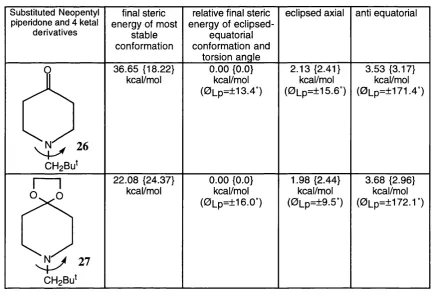
Table 2.3 shows the conformational minima for the neopentyl piperidone 26 and its ketal 27. The various contributions to the final steric energy such as shown for 25 in table 2.2 have not been included.
Table 2.3
Substituted Neopentyl piperidone and 4 ketal
derivatives
final steric energy of most
stable conformation
relative final steric energy of eclipsed-
equatorial conformation and
torsion angle
eclipsed axial anti equatorial
O
CH2Bu^
36.65 {18.22}
kcal/mol
0.00 {0.0}
kcal/mol
(0Lp=±13.4°)
2.13 {2.41}
kcal/mol
(0Lp=±15.6°)
3.53 {3.17}
kcal/mol
(0Lp=±171.4“)
I---1
^ 27
CH2Bu^
22.08 {24.37}
kcal/mol 0.00
{0.0}
kcal/mol
(0Lp=±16.O“)
1.98 {2.44}
kcal/mol
(0Lp=±9.5“)
3.68 {2.96}
kcal/mol
Chapter 2 Stereodynamics of N-Heterocyclic Compounds_______ 38
Molecular mechanics calculations for these compounds show that the most stable conformation is the eclipsed-equatorial. The anti-equatorial conformations for 26 and 27 were calculated to be least stable by 3.53(3.17} and 3.68(2.98} respectively and the calculated enthalpies by MM3 for 26 suggest 97.3% of eclipsed-equatorial 26A and 2.7% of eclipsed-axial 26B at room temperature, for 27, 96.6% of eclipsed-equatorial 27A, and 3.4% of eclipsed-axial 278 would exist at room temperature. MMX values predict at room temperature that 26 will be composed of 98.3% of 26A and 1.7% 268 and that 27 will be composed of 96.6% of 27A and 3.4% 278 respectively.
Table 2.4 M o lecu lar m echanics calculation of N eo p e n ty l-3 ,3 -d im eth yl piperidine
Final steric en erg y (M M 3 )^ ^ -^ ^ of the most stable conform ation is 2 5 .4 1 3 2 (1 8 .9 2 } kcal/m ol e c lip s e d -e q u a to ria l 28A
Lp-N-C-Bu^ dihedral angle ± 1 5 .8 " Com pression 1 .4 3 6 0
Bending 1.7 65 1
Bend -B end -0 .0 9 1 1 S tre tc h -B e n d 0 .2 1 7 3 V an der W aals
1,4 Energy 1 3 .4 2 2 0 O th e r 1 .0 0 8 9
Torsional 7 .7 6 6 2
T orsio n -S tre tc h -0 .1 0 8 1 R elative Energy 0 .0 0
eclipsed-equatorial
28A
Chapter 2 Stereodynamics of N-Heterocyclic Compounds_______ ^
The difference in enthalpy by MM3 and MMX suggests that more than 99% of the molecules would prefer the eclipsed-equatorial conformation at room temperature. No minimum was located for the axial anti conformation.
3) Ethyl piperidine 29. EthvI piperidone 30 and its ketal 31 Table 2.5 M olecular m echanics calculation A/-ethyl piperidine
Final steric energy of the most stable conformation is 1 4 .8 1 5 5 {1 1 .6 5 } kcal/m ol
g au c h e -e q u a to ria l 2 9 A anti-eq uatorial 2 9 B g au che-axial 2 9 C
Relative Energy 0 .0 0 {0 .0 0 }3 0 .7 6 (0 .8 6 } 2 .2 5 (2 .4 3 } Lp-N -C -C H g dihedral angle‘s ±5 1 .3 " ± 1 7 9 .2 ° ± 5 3 .0 " Com pression 0 .5 5 2 9 0 .4 7 2 3 0 .5 6 0 6 Bending 1 .2 2 9 6 2 .2 3 1 1 2 .2 2 4 6 Bend-B end -0 .0 5 9 7 -0 .1 3 1 9 -0 .1 1 6 6 S tre tc h -B e n d 0 .1 2 1 8 0 .1 3 9 9 0 .1 6 5 2 Van d er W a a ls
1,4 Energy 8 .7 2 5 7 8 .2 2 3 3 8 .2 5 3 5 O th e r 0 .5 3 1 4 0 .4 1 2 9 0 .9 3 4 5 Torsional 3 .7 2 6 4 4 .2 4 3 2 5 .0 6 6 4 T o rsio n -S tretch -0 .0 1 2 6 -0 .0 1 1 7 -0 .0 2 2 5
Note:
MMX"^^ values in parenthesis
Angles in d egrees. For gauche-equatorial and g auche-axial ethyl groups dihedral angles reported from the exocyclic C H g group g auche to the lone pair and for anti-equatorial and anti-axial antiperiplanar to the lone pair.
9 , ( r “
-gauche-equatorial anti-equatorial
C H 3
gauche-axial
29A 29B 29C
Six relevant conform ational m inim a for N -ethyl piperidine w ere located,
of four types. T h e se include two gauche-equatorial e.g. 29A (0 L p = + 5 1 .3 ° and its enantiom er) and an anti-equatorial 29B (0 L p = ± 1 7 9 .2 ° ) which is calculated to be less stab le by 0 .7 6 (0 .8 6 } kcal/m ol. For th e a xial-co n fig u ratio n , two
g a u ch e-a x ial e.g . 29C (0 L p = + 5 3 .O ° and its en an tio m er) and anti-axial 29D (0 L p = ± 1 7 9 .8 ° ) not shown, w ere located and th ese w ere calculated to be less
Chapter 2 Stereodynamics of N-Heterocyclic Compounds_______ ^
No minima were detected for the eclipsed-equatorial and eclipsed-axial conformation, in contrast to neopentyl piperidine where no gauche minima were located. /V-ethylpiperidine can therefore be calculated (via AG° = -RTInKeq) to be composed of 86.9% of gauche-equatorial 29A, 12.0% of anti- equatorial 29B and 1.1% of gauche-axial 29C at room temperature by MM3 calculations while MMX values predict 8 8.6% of 29A, 9.9% of 29B and 1.5%
29C at the same temperature.
Table 2.6 shows the minimum energy for the N-ethyl piperidone 30 and its ketal derivative 31.
Table 2.6
substituted Ethyl piperidone and
4-ketal derivatives
O
^ 30 CH2CH3
A X
X
N
^ 31 CH2CH3
final steric energy of most stable
conformation
14.99 {12.1} kcal/mol
29.51 {26.43} kcal/mol
relative final steric energy of gauche-equatorial conformation and
torsion angle
0.00 {0.00}
0.00{0.00}
anti-equatorial
0.765 {0.80} kcal/mol (0Lp=±178.9-)
0.765 {0.81} kcal/mol (0Lp=±178.9”) gauche-axial 1.954 {2.67} kcal/mol (0Lp=±51.9°)
2.292 {2.35} kcal/mol (0Lp=±51.5")
Here molecular mechanics calculations suggest the gauche-equatorial conformation is the most stable and the differences in the calculated enthalpies by MM3 calculations for 30 indicate 85.6% of gauche-equatorial 30A, 1 1.2% of anti-equatorial 3GB and 3.2% of gauche-axial 30C at room temperature, for 31 8 6.8% of gauche-equatorial 31 A, 11.3% of anti-equatorial 31B and 1.9% of gauche-axial 31C would exist at room temperature. While MMX predicts at room temperature that 30 will be composed of 88.1% of 30A, 10.8% of 30B and 1.0% 30C and 31 will be composed of 87.5% of 31 A, 10.6% of 31B and
Chapter 2 Stereodynamics of N-Heterocyclic Compounds_______ 41
4) 1-ethyl-3.3-dimethvl piperidine 32
Table 2.7 M olecular m echanics calculation (M M 3 )^ ^ ’^^ of 1-eth yl-3,3-d im ethyl piperidine in kcal/m ol
Final steric energy of the most stable conform ation is 1 8 .4 3 5 0 (1 3 .8 9 } kcal/m ol g au c h e -e q u a to ria l 3 2 A anti-eq u a to ria l 3 2 B
R elative Energy 0 .0 0 (0 .0 0 ) 0 .7 9 (0 .8 5 } L p-N -C -C H g dihedral angle® ±5 1 .0 " ± 1 7 8 .8 " Com pression 0 .9 0 2 3 0 .8 3 0 3 Bending 1 .4 1 0 0 2 .3 7 7 9 B end-B end -0 .0 6 7 3 -0 .1 3 5 8 S tre tc h -B e n d 0 .1 5 9 1 0 .1 7 8 5 Van d er W a a ls
1,4 Energy 1 0 .4 6 9 0 9 .9 7 2 5 O th e r 1.0931 0 .9 8 4 9 Torsional 4 .4 8 8 5 5 .0 3 7 2 T o rsio n -S tretch -0 .0 1 9 7 -0 .0 1 9 2
M e Me
M e'
anti-equatorial gauche-equatorial
32A 32B
Five conformational minima were located. For the equatorial conformations two gauche-equatorial 32A (0 L p = + 5 1 .O ° and its diastereomer) and anti-equatorial 32B ( 0 L p = ± 1 7 8 .8 °) were identified, with the gauche conformation being more stable by 0 .7 9 (0 .8 5 } kcal/mol. For the axial
conformations two diastereomeric conformations were calculated, locating the methyl of the ethyl group on either side of the lone pair, i.e. the gauche-axial conformation 32C not shown (0 L p = -4 1 .7 ° and -1-56.8°), and this was calculated to be less stable by 5 .0 4 (6 .7 0 } kcal/mol. No eclipsed minima were perceived in either set of conformations, the difference in enthalpy by MM3 suggests that
8 8 .4 % of the molecules would prefer conformation 32A and 1 1 . 6 %
Chapter 2 Stereodynamics of N-Heterocyclic Compounds_______^
5) 1-neopentvl pyrrolidine 33
Table 2.8 M olecular m echanics calculation (M M 3 )^ ^ ’^^ of 1-neopentyl pyrrolidine in kcal/m ol Final steric en erg y of the most stable conformation is 3 1 .5 4 8 7 (2 0 .6 } kcal/m ol
ec lip s e d -(eq u a to ria l/a x ia l) 3 3 A
Lp-N-C-Bu^ dihedral angle® ± 0 .0 ° Com pression 1 .2 1 2 3 Bending 6 .5 3 9 9 Bend-B end 0 .1 8 8 1 S tre tc h -B e n d -0 .1 2 5 8 Van d er W a a ls
1,4 Energy 8 .5 3 3 8 O th e r 0 .0 6 4 9 Torsional 1 5 .5 9 9 5 T o rsio n-S tretch -0 .4 6 3 9
Note:
Angles in d egrees. For eclipsed neopentyl groups dihedral angles reported from the quaternary carbon eclipses the lone pair and for anti-equatorial antiperiplanar to the lone pair.
7L^C(CH3)3
eclipsed-(equatorial/axial)
33A
Rotation through 360° about the exocyclic bond led to two conformational minima eclipsed and anti with the eclipsed 33A (0Lp=±O.O°) being more stable by 3.13(8.15} kcal/mol. The difference in enthalpy by MM3 and MMX programs indicates that 99.99% of the molecule would prefer conformation 33A at room temperature.
6) 1-ethyl pyrrolidine 34
Table 2.9 M olecular m echanics calculation (M M 3 )^ ^ ’^^ of 1-ethyl pyrrolidine in kcal/m ol
Final steric energy of the most stable conformation is 2 3 .8 4 8 6 {9 .5 8 } kcal/m ol
g a u c h e -(e q u a to ria l/a x ia l) 3 4 A
0.00(0.00}
± 5 3 .5 5 ° 0 .7 2 1 8 5 .8 4 8 2
a nti-eq u a to ria l 3 4 B
1 .4 8 (0 .7 5 } ± 1 7 9 .7 5 ° 0 .7 2 6 2 7 .3 0 1 3 Relative Energy
L p-N -C -C H g dihedral angle® Com pression
Chapter 2 Stereodynamics of N-Heterocyclic Compounds 43
B end -B end 0 .2 0 1 5 0 .1 7 8 1 S tre tc h -B e n d -0 .1 8 4 3 -0 .1 4 9 0 V an d er W aals
1,4 Energy 5 .6 5 2 0 5 .0 7 7 0 O th e r 0 .0 8 7 5 0 .3 1 2 2 Torsional 1 1 .8 9 1 9 1 2 .2 6 5 7 T o rsio n -S tre tc h -0 .3 7 0 0 -0 .3 8 7 7
^ ^ 0
r \ Q
eclipsed-(equatorial/axial) anti-equatorial
34A 34B
Three conformational minima, two gauche e.g. 34A (0 L p = + 5 3 .5 ° and its enantiomer) and anti 34B (0Lp=±179.7°) were identified by rotation of the exocyclic N-CH2-R bond with the gauche being more stable by 1.47(0.75}
kcal/mol, here no minimum was located for an eclipsed conformation. The difference in enthalpy by MM3 suggests that 96.0% of the molecules would prefer the 3 4 A and 4.0% the 3 4 B at room temperature, while the corresponding MMX values predict 87.7% of 34A and 12.3% of 34B at room temperature.
Final note on Molecular Mechanics Calculations
Chapter 2 Stereodynamics of N-Heterocyclic Compounds_______ ^
The barrier to rotation about the exocyclic A/-CH2 bonds were calculated using the dihedral drive option in the MM3 program for the A/-CH2But bond in 25-28 and 33, barriers of about 10.0 kcal/mol are suggested for rotation from the tert-butyl eclipsing the lone pair conformation to the anti-conformation by way of the tert-butyl eclipsing the ring conformation. In contrast for the N- C H2Me bond in 29-32 and 34, smaller barriers of about 2.5kcal/mol were calculated for methyl groups rotating from +gauche through to the lone pair to -guache and about 5.0 kcal/mol for methyl groups rotating from gauche to anti.
2.3 Rate Processes
Reference barriers for the three processes are of important significance when discussing the results of the set of compounds 25-34, which divides in two, the /V-neopentyl series in which the N-CH2-R bonds are eclipsed and the /V-ethyl series in which these bonds are staggered. The ring inversion barrier has been measured for /V-methyl piperidine®"! as 11.8 kcal/mol and the axial conformation is less stable than the equatorial by 2.7 kcal/mol®^ using enriched "!®C for the /V-Me group and this represented less than 1% for the
axial conformation. Nothing is known of the axial/equatorial equilibrium for
N-ethyl or /V-neopentylpiperidine, nitrogen inversion barriers for /V-mN-ethyl piperidine®® and /V-methyl pyrrolidine®^ have been reported to be 6.0 and 8.0 kcal/mol respectively. Studies®®»®® on /V-methyl-4-piperidone suggest that the barrier to nitrogen inversion is between 8.0 and 8 .6 kcal/mol. Lower barriers for straightforward nitrogen inversion are expected for bulkier alkyl groups4®,49
Chapter 2 Stereodynamics of N-Heterocyclic Compounds_______ ^
of the cube in scheme 2.1. If two of these processes combine into a single process as suggested for /V-ferf-butyldimethylamine"! ^ a pathway diagonally across one face of the cube results. This does not exclude a small measure of one process like nitrogen inversion flattening thus making another process i.e. rotation about the exocyclic bond more accessible, this would be represented by inwardly curved rather than straight lines for the sides of the cube.
2.4 Dynamic Nuclear Magnetic Resonance Results
The H and spectra of each of the compounds 2 5 -3 4 are temperature-dependent, showing splitting of signals as the temperature is lowered. Two sets of changes are observed in the NMR spectra of 25-27, while for 28-34 only one change is observed, but some of the changes are clearer and more directly usable than others. These NMR spectral changes for each compound are summarised in tables 2.10 H) and 2.11 O ^ C )
respectively.
Table 2.10 Chemical shifts (400M Hz) of compounds 25-34 at various temperature (ppm from IVIe^Si
in CCI2D2/CHF2CI/CHCIF2)_________________________________________________________________________
Compound T /'C _________________________________ Observed Signals
N C H 2Bu^ C (CHs)3 C H2(2,6) C H 2(3,5) C H2(4)
2 5 +25 1.89 0.76 2.34 1.42 1.28
-130 1.88 0.74 2.67;2.01 1.41 1.55:0.98
N C H 2Bu^ C(CH3)3 C H2(2,6) C H 2(3,5)
2 6 +25 2.11 0.82 2.28 2.75
-120 2.09 0.80 2.40;2.22 2.91:2.61
NCH2Bu^ C(CHa)3 C H2(2,6) C H 2(3,5) ^CH2(3,4)
2 7 +25 2.08 0.89 2.61 1.68 3.82
-120 2.06 0.87 2.69:2.39 1.68:1.51 3.80
N CH2BU* C(CHa)3 C (CH a)2 C H2(2) C H2(4) C H 2(5) C H2(6)
2 8 +25 1.85 0.75 0.84 2.14 2.27 1.45 1.04
-120 1.83 0.72 0.99:0.72 2.25:2.47 2.65:1.92 1.62:1.27 1.19:0.89
NCH2CH3 CHa C H2(2,6) C H 2(3,5) C H2(4)
2 9 +25 2.22 0.93 2.24 1.46 1.33
-120 2.21 0.91 2.84:1.54 140:1.38 1.06:1.63
NCH2CH3 C Ha C H2(2,6) C H 2(3,5)
3 0 +25 2.42 1.03 2.32 2.62
-120 2.45 1.08 2.40,2.02 3.06,2.16
NCH2CH3 CHa C H2(2,6) C H 2(3,5) '"CH2(3,4)
3 1 +25 2.45 1.10 2.52 1.75 3.94
-120 2.30 1.09 2.81:1.94 1.75,1.60 3.85
NCH2CH3 CHa C (CH a)2 C H2(2) C H2(4) C H2(5) C H2(6)
3 2 +25 2.20 0.93 0.84 2.21 1.91 1.49 1.13
-120 2.22 0.91 0.82:0.71 2.75:1.55 2 .41,1.24 1.47 1.39,0.91
N C H 2Bu^ C (C H a)3 C H 2(2,5) C H 2(3,4)
3 3 +25 2.30 0.89 2.64 1.78
Chapter 2 Stereodynamics of N-Heterocyclic Compounds 46
NCH2CH3 C H3 C H 2(2,5) C H 2(3,4)
3 4 +25 2.48 0.98 2.40 1.65
-120 2.28 0.98 2.8 8;1.68 1.60
Table 2.11 Chemical shifts (100.6M H z) of compounds 25-34 at various temperature (ppm from
Me^Si in CCI2D2/CHF2CI/CHCIF2)
Compound T/°C Observed Signals
NCH2Bu^ C(CH3)3 C(CH3)3 C (2,6) C (3,5) C(4)
2 5 +25 72.0 34.1 28.2 58.2 27.4 25.0
97% -120 70.5 32.1 27.0 57.0 25.5 22.8
3% -120 63.0 33.0 a 53.4 19.9 24.1
NCH2But C(CH3)3 C(CH3)3 C (2,6) C (3.5) C(4)
2 6 +25 69.4 34.0 28.0 56.8 42.2 212
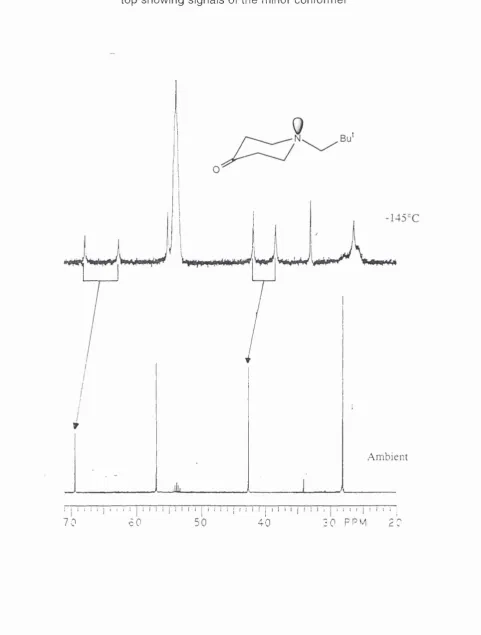
53% -145 67.8 33.0^ 27.5 55.2 42.0 213.8
47% -145 62.5 33.0^ 27.0 53.1 38.5 213.3
NCH2Bu^ C(CH3)3 C(CH3)3 C (2,6) C (3,5) ^ (4 ) ^C(3,4)
2 7 +20 69.5 32.4 27.1 53.9 35.1 107 64.0
91.7% -120 72.0 33.2 26.8 56.0 35.5 106.5 6 6.8:66.6
8.3% -120 65.2 33.4 c 53.0 29.6 c c
NCH2Bu^ C(CH3)3 C(Ch3)3 C(CH3)2 C(CH3)2 C2 C4 C5 Ce
2 8 +25 71.5 34.5 28.7 32.9 28.0 70.3 24.5 38.4 58.6
-80 71.0 34.2 28.1 32.3 32.4:25.0 70.1 24.2 38.2 58.6
NCH2CH3 CH3 C (2.6) C (3,5) C(4)
2 9 +25 53.8 12.5 55.0 27.0 25.5
-130 52.8 12.0 53.7 25.2 24.0
NCH2CH3 CH3 C(2,6) C (3,5) C(4)
3 0 +25 52.0 13.0 53.4 41.9 210.5
-120 51.8 13.0 53.8 41.5 212.0
NCH2CH3 CH3 C(2,6) C (3,5) C(4) ^C(3,4)
31 +25 52.8 12.9 52.0 35.9 108.2 64.5
-120 51.9 12.4 50.9 34.4 107.2 64.4:64.2
NCH2CH3 CH3 C(CH3)2 C(CH3)2 C2 C4 C5 Ce
3 2 +25 53.8 12.8 28.2 31.8 66.9 23.5 38.7 55.5
-120 52.7 12.0 30.1 30.5 64.5 22.1 36.8 55.0
NCH2NP C(CH3)3 C(CH3)3 C (2,5) C (3,4)
3 3 +25 69.0 32.0 28.3 56.7 23.0
-120 69.2 32.1 28.5 56.8 23.0
NCH2CH3 CH3 C(2,5) C (3,4)
3 4 +25 50.1 13.2 53.5 23.0
-120 50.0 14.0 54.0 23.0
^ Signal for the tert butyl methyl group of the minor isomer could not be distinguished and are presumably
overlapped by the major isomer signal. ^ The ^ NMR at -140° C this signal is unusually broad at the lowest
temperature observed in a manner quite in keeping with rotation about the tert-butyl-CH2N bond becoming
slow on the NMR time scale. ^ Signals for tert-butyl methyl group, C4 and ^ C(3_4)for the minor isomer couid
not be distinguished and are presumably overlapped by the major isomer signal.
The ^ H NMR spectra of 25, 27 and 28 show broadening of signals from the protons on the rings below ca -20°C and eventually splitting below ca -60°C to give two equal multiplets. On decoupling at the frequency of the protons at the 3 and 5 positions, the signal of the protons at the 2 and 6 positions
Chapter 2 Stereodynamics of N-Heterocyclic Compounds_______ £7
singlet for 28 and the methylenedioxy singlet in 27. Very similar pattern can be observed for the corresponding /V-ethyl analogues 29, 31 and 32. In each case interconversion of structures like I and V has become slow on the NMR timescale, full lineshape analysis of fitting calculated and experimental spectra suggest a barrier ranging from 10.8 kcal/mol for this process. The size of the barrier is similar to that observed for N-methyl piperidine ring inversion.
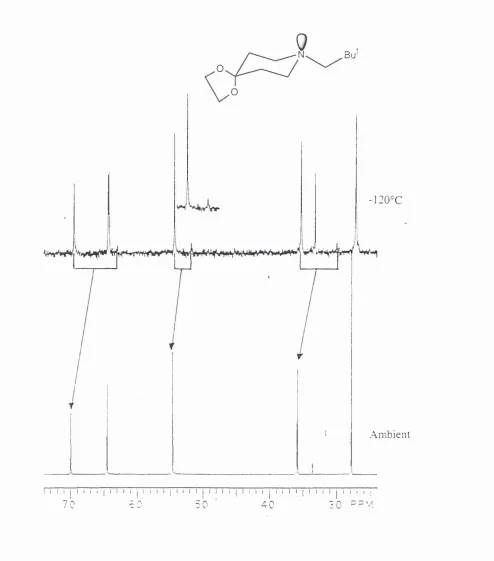
Compounds 25 and 27 but not 28, show additional broadening in the proton NMR as the temperature is further lowered. Apart from lines sharpening, the precise nature of the changes cannot be assigned with any degree of certainty due to multiple overlap of signals, however the corresponding changes in the n m r are apparent. The signals broaden and split below ~-110°C and then resharpen at ca -130°C with a major and a minor set of signals, see figures 2.1 and 2.2 respectively. The spectrum for 25 by integration of signals corresponds to 97% and 3% indicating that the minor structure is less stable at -120°C by 1.04 kcal/mol, while for 27 the populations are 92% and 8% establishing that the minor structure is 0.72 kcal/mol less stable at -120°C.
Chapter 2 Stereodynamics of N-Heterocyclic Compounds_______ ^
different in the two series. The similar nitrogen inversion barriers for both the N- alkyl pyrrolidines supports this argument. Since the interconversion requires both nitrogen inversion and bond rotation, the latter explanations for high bond rotation barriers for neopentylamines fits well. Axial substituents cause upfield shifts68 for the ring carbons and since the minor signals for the ring carbons are upfield from the major signals, this agrees with the assumption that minor conformation is axial.
The reported axial/equatorial energy difference for N-methyl piperidine favours the first explanation which suggests that the relative instability of the N- ethyl series compared with that of N-neopentyl series may be responsible for the conformational differences. It has been s h o w n 4 5 ,4 9 that increasing the substituent size increases the tendency to planarity of the nitrogen atom and hence reduces the axial/equatorial difference. This therefore means that for
N-neopentyl piperidine 25 the axial/equatorial energy difference would be lower than for A/-ethyl piperidine 29. Calculations, however, suggest that these compounds should have similar axial/equatorial difference see table 2.1 2.
table 2 .1 2
... compound... observedScat/moi) r« X (l(c a i? m o l)
2 5 - ' 1 . 0 4 ^ 2.29
0.075 : ■ 2.13 2.41
2 7 0.72 ' 1.98 3 .0 0
3 0 a S l i 2.25 , 2.43
N-methyl piperidine - 2:7 : ' - ' 1 2 .3 0 : : 2 .5 2
^ m inor signal not observable