Effect Of Work Compensation, Supervision And
Discipline On Work Performance
Yeni Widya Saputri, Nurul Qomariah, Toni Herlambang
Abstract: This study aimed to examine and determine the effect of compensation, supervision and discipline on the work performance of Banyuwangi District Civil Servants. The population of this study were 10,300 civil servants in the Banyuwangi Regency Government. The total sample of 375 employees were selected using the systematic sampling technique , where each member of the population has an equal opportunity to be selected as a research sample. The data were analyzed using Smart PLS software application version 3.0. The results showed that compensation, supervision, and employee discipline, in isolation, has a positive and significant effect on work performance.
Keywords: compensation; supervision; work discipline; work performance.
————————————————————
1
INTRODUCTION
ivil Servants are part of the State Civil Apparatus, hereinafter abbreviated as ASN. In addition to Civil Servants, government employees with employment agreements who work for government agencies also include the State Civil Apparatus. In accordance with Press Release Number: 058 / RILIS / BKN / IV / 2019, the State Personnel Agency (BKN) released statistics on civil servants in Indonesia as of December 31, 2018. Based on these data the number of civil servants as of December 31, 2018 was 4,185,503 with 939,236 PNS details served in Central Institutions (22.44%) and 3,246,267 civil servants served in Regional Agencies (77.56%). From that data, the distribution of civil servants with the highest number was in Java with a percentage of 20.64% or equivalent to 1,209,036. Conversely, the lowest number of civil servants was in Papua and Maluku with a percentage of 5.83% totaling 248,020 civil servants. With the enactment of Law of the Republic of Indonesia Number 5 of 2014 concerning State Civil Apparatus, the government wants to realize the state civil apparatus as part of bureaucratic reform, become a profession that has the obligation to manage and develop itself and is obliged to account for its performance and apply the principle of merit in the implementation of civil apparatus management country. One of the policies and management of ASN regulated in this law is based on the principle of professionalism, which prioritizes expertise based on a code of ethics and the provisions of the legislation. Regulation of the Minister of Administrative Reforms and Bureaucratic Reform of the Republic of Indonesia Number 38 Year 2018 concerning Measurement of the Index of the Professionals of the State Civil Apparatus clearly regulates the measurement of the ASN professionalism level index correctly. ASN Professionalism Index is a statistical measure that describes ASN quality based on the suitability of qualifications, competencies, performance and discipline of ASN in carrying out their duties. One of the dimensions of the professionalism index measurement is performance which is measured on
indicators of civil servant performance appraisal which include Employee Work Targets (SKP) and Work behavior. Work performance is a form of work carried out by employees usually used as a basis for evaluating the company. It is the result achieved by someone according to the applicable measurement for the work in question [1]. Real companies only expect the best performance from their employees. However, to make it optimal and beneficial for the company, a performance report is recorded [2]. Work performance is the level of implementation of tasks that can be achieved by a person, unit, or division using existing capabilities and boundaries that have been set to achieve the goals of the organization/company [3].Work performance / achievement is the quality and quantity of work achieved by an employee in carrying out his duties in accordance with the responsibilities given to him [4]. Work performance is something that is done or a product/service produced or given by someone or a group of people [5]. Work performance is a result of work achieved by a person in carrying out the tasks assigned to him based on the tasks of skill, experience and sincerity and time [2]. Various factors may affect the performance or work performance of employees in an organization, both government and private organizations. Among the factors that can improve work performance include compensation, supervision and work discipline.
Compensation is all income in the form of money, direct or indirect goods to employees in return for services provided to the company. The size of the compensation reflects the status, recognition, and level of fulfillment of needs enjoyed by employees and their families. As rewards get higher, status rises, and the fulfillment of the needs the employee enjoys increases, his achievements or work can be indicated better [6]. Compensation is the overall arrangement for providing rewards to employers and employees, whether directly in the form of money (financially) or not (non-financial). One way to improve performance or work performance, job satisfaction and motivation of employees is through compensation [7]. How much compensation given, must be such that it is able to bind the employees. This is very important, because if the compensation given to employees is too small compared to other business entities, employees might move to other business entities. Therefore, organizational attention to compensation arrangements correctly and fairly is very important [8]. Much research has been done on the relationship between compensation and work performance / employee performance. Among them is done by [9], Syah (2013), [11], [12], [13]. The next factor that C
————————————————
Yeni Widya Saputri :Universitas Muhammadiyah Jember, Email: [email protected]
Nurul Qomariah: Universitas Muhammadiyah Jember(Coresponding Author); Email: [email protected]
can improve employee work performance is supervision carried out by superiors or leaders. Supervision is the process of observing the overall implementation happening in the organization to ensure that all work carried out is according to a predetermined plan [14]. Supervision is a process of monitoring employee performance based on applicable standards to measure performance, ensuring quality of performance appraisal and retrieval of information that can be used as feedback on the achievement of results communicated to employees [15]. Research on supervision that is associated with employee performance is carried out by several researchers such as[16], [17], [18], [19], and [20]. Finally, the other factor that may influence performance is work discipline. Work discipline is a management action to encourage members of the organization to meet the demands of various provisions that must be obeyed [14]. Discipline is also a person's awareness and willingness to obey all organizational rules and social norms that apply. It is further explained when employees regularly arrive and leave the office on time, complete their work, and comply with all company regulations and applicable social norms [21]. Therefore, it is an attitude of willingness to obey the norms of regulations that apply in the surroundings. Good employee discipline will speed up company goals, while declining discipline will become a barrier and slow down the achievement of company goals [3]. Based on the Government Regulation Number 53 of 2010 concerning Civil Servants Discipline, it is stated that Civil Servants Discipline is the ability of Civil Servants to fulfill obligations and avoid the prohibitions set forth in legislation and/or official regulations which if not adhered to or violated was disciplined. Research on work discipline that has an impact on employee performance has often been carried out by several researchers, among others Suwondo & Sutanto (2015), [23], [24], [25], [26]. Among the agenda of the bureaucratic reform agenda is to realize a government apparatus that is clean and free of corruption, collusion and nepotism. The government of Banyuwangi Regency is constantly trying to improve the work performance of female officers in various ways. The methods used include changing the provision of additional income. This additional income is stipulated in Banyuwangi Regent Regulation number 74 of 2016 concerning Additional Income for Civil Servants in the Banyuwangi Regency Government Environment. The next way is to increase internal supervision within the district government. Supervision has important meaning for every organization. It aims to get the results of the work carried out in an efficient and effective manner, in accordance with a predetermined plan. Efforts to improve work performance continue to be pursued by the government. The following data shows the average value of civil servant work performance in Banyuwangi Regency in 2015 to 2018.
TABLE1
AVERAGE WORK PERFORMANCE SCORES OF BANYUWANGI
REGENCY
Source: Agency of Civil Service, Education, and Training of Banyuwangi
From Table 1, it can be explained that the average work performance value of Banyuwangi Regency civil servants during 2015 to 2018 did not always increase; in 2017 it declined so it was not as expected. Therefore, it seems to be a problem faced by the Banyuwangi Regency government on how to improve ASN work performance as it is associated with compensation, internal supervision and work discipline.
2 RESEARCH
METHODOLOGY
This study used quantitative method to test and prove hypotheses that have been made through various tests and data processing. The quantitative approach emphasizes the existence of variables as research objects, and these variables must be defined in the form of operationalization of each variable [27]. Reliability and validity are absolute conditions that must be met in using this approach, because both elements will determine the quality of research results and the ability to replicate and generalize the use of similar research models [28]. The variables in this study consisted of two variables namely the independent variable and the dependent variable. The independent variables include compensation, internal supervision and work discipline, whereas the dependent variable is employee performance. The population in this study were 10,300 civil servants in the Banyuwangi District Government Environment. Determination of the size of the sample based on the Slovin formula with an error rate of 5% was obtained until 385 respondents. Partial Least Squares (PLS) analysis was used to determine the effect of independent variables on the dependent variable [27]. PLS is one of the variant-based SEM statistical methods that is designed to solve multiple regression when specific problems occur in the data.
3 RESULTS
AND
DISCUSSION
3.1 Descriptive Statistics Results
Statistically, of 375 respondents, 52.58% or 52.58 people are male and the other 47.42% or 178 people were female, therefore the male employees outnumber the female. Moreover, based on the education level of the respondents are known that of 375 respondents, amounting to 1.87% or as many as 7 people are elementary school (SD) and junior high school (SMP) graduates, while 31.47% or 118 respondents are graduated from high school (SMA) and Diploma, 64.27% or 241 respondents are graduates of Undergraduate (S1) and Diploma IV (D-IV), and amounting to 2.4% or as many as 9 people consisted of respondents with a graduate education background. In other words, the No. Year
SKP Value (60%)
Value of Work Behavior
(40%)
Work Achievement
Value
1. 2015 79.82 82.2 80,77
2. 2016 85.33 81.4 83,76
3. 2017 84.39 81.6 83,27
majority of respondents are graduated from undergraduate and diploma IV programs. Based on the age of respondents it is known that of 375 respondents, 3.2% (12 respondents) are aged below 30 years old, 13.87% or 52 respondents age between 30-39 years old, 24,57% or 92 respondents age from 40 to 49 years old, and the majority 58.4% or as many as 219 people age over 49 years. Therefore, the largest number of respondents are youth or from an age range above 49 years. Based on employee rank and class, it is known that out of 375 respondents, 0.8% or three respondents are within the class I/a - I/d, 18.93% or 71 people are in the class II/a - II/d, while 44.27% or 166 people are in the class III/a - III/d and by 36% or 135 people are in the class IV/a - IV/d. The description concludes that the highest number of respondents are within the class - a/III/d.
3.2 Hypothesis Test Results
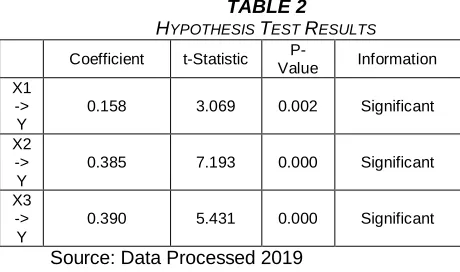
The results of this hypothesis test used as a basis for decision making are t-statistic ≥ 1.96 and p-value ≤ 0.05, then the hypothesis is accepted and if t-statistic <1.96 and p-value> 0.05, the hypothesis rejected. The results of correlation between constructs are measured by looking at the path coefficients and their level of significance which are then compared with the research hypothesis.
TABLE 2 HYPOTHESIS TEST RESULTS
Coefficient t-Statistic
P-Value Information X1
-> Y
0.158 3.069 0.002 Significant
X2 ->
Y
0.385 7.193 0.000 Significant
X3 ->
Y
0.390 5.431 0.000 Significant
Source: Data Processed 2019
First hypothesis is stated that compensation (X1) can influence work performance (Y). From the results of statistical calculations, the t-statistic is 3.069 and P-value is 0.002. Because t-static ≥ 1.96 and P-value ≤ 0.05 indicate that there is a significant influence of compensation (X1) on work performance (Y). This means that high and low compensation (X1), will result in high or low work performance (Y). Second hypothesis is stated that there is an influence of supervision (X2) on work performance (Y). The results show that the t-statistic is 7,193 and the P-value is 0,000. Because t-static ≥ 1.96 and P-value ≤ 0.05, there is a significant influence of supervision (X2) on work performance (Y). This means that the level of supervision (X2) will result in high or low work performance (Y). Third hypothesis is stated that there is an influence of work discipline (X3) on work performance (Y). The results of statistical calculations show that the t-statistic is 5,431 and the P-value is 0,000. Because t-static ≥ 1.96 and P-value ≤ 0.05 indicate that there is a significant influence of work discipline (X3) on work performance (Y). This means that the level of work discipline (X3), will result in high and low work performance (Y).
4 DISCUSSION
4.1 Effect of Compensation on Work Performance
Based on the results of the study, it was found that compensation significantly affected work performance. In this study it can be seen from the path coefficient that is 0.158 which indicates that a large compensation will improve the work performance of the Civil Servants of the Banyuwangi Regency Government. Compensation is all forms of wages or rewards that apply to employees as result of their work. It has two components, namely direct financial payments in the form of wages, salaries, incentives, commissions, and bonuses, and indirect payments in the form of financial benefits such as insurance money and vacation money paid by employers or superiors (Mangkunegara, 2009). This shows that compensation can affect employee work performance. The results of this study have similarities with results of previous studies [9]; Syah, 2013; [11]; [12]; [13].
4.2 Effect of Supervision on Work Performance
Based on the results of the study, it was found that supervision had a positive effect on work performance. In this study, it can be seen from the path coefficient value of 0.385 which shows that good supervision has a significant influence in improving the work performance of Banyuwangi Regency Government Civil Servants. Supervision is a process of monitoring employee performance based on standards to measure performance, ensuring quality of performance appraisals and retrieval of information that can be used as feedback on the achievement of results that are communicated to employees [15]. It is the process of observing the implementation of all organizational activities to ensure that all work carried out goes according to a predetermined plan [14]. Supervision is a real and most effective action in realizing employee discipline, because with this supervision superiors must be active and directly supervise the behavior, morals, attitudes, work enthusiasm, and work performance of their subordinates [21]. With careful supervision by superiors, it is expected that employees can work well and in accordance with their main tasks and functions. This shows that supervision affects employee work performance. This means that good supervision will have a positive effect on work performance. This study has similarities with previous research [16], [17], [18], [19], [20].
4.3 Effect of Work Discipline on Work Performance
performance. This means that if an employee is truly disciplined it will positively influence the employee's work performance. This study has similarities with results of previous research [22]; [23]; [24]; [25]; [26].
5 CONCLUSIONS
AND
SUGGESTIONS
Compensation has a positive and significant effect on work performance. So, the greater the compensation received by the Civil Servants, the more it will influence the employee's good work performance. Supervision has a positive and significant effect on work performance, therefore the better the supervision of the Civil Servants, the more influential it will be on the high work performance of these employees. Finally, work discipline has a positive and significant effect on work performance, therefore the better and higher discipline of Civil Servants, the more it will influence the high work performance of these employees. Based on the results of this research, the government of Banyuwangi should continue to maintain or improve the provision of compensation and supervision of employees to make their employees more motivated to get more achievement and enthusiasm in working in accordance with their respective duties. In this research there are still many shortcomings, therefore it is highly recommended for prospective researchers to add other research variables in addition to service quality and service innovation, and increase the number of research samples to improve data accuracy.
REFERENCES
[1] A. A. A. P. Mangkunegara, Manajemen Sumber Daya Manusia, Cetakan Kedua. Bandung: PT Remaja Rosdakarya., 2010.
[2] S. Samsudin, Manajemen Sumber Daya Manusia. Bandung: Pustaka Setia., 2006.
[3] M. N. Azhad, Anwar, and N. Qomariah, Manajemen Sumber Daya Manusia. Jember: Cahaya Ilmu, 2015.
[4] A. A. A. P. Mangkunegara, Manajemen Sumber Daya Manusia Perusahaan. Bandung: PT. Remaja Rosdakarya, 2009.
[5] A. S. Ruky, Sistem Manajemen Kinerja. Jakarta: Gramedia Pustaka Utama., 2006.
[6] M. S. P. Hasibuan, Manajemen Sumber Daya Manusia. Jakarta: PT. Bumi Aksara, 2013.
[7] M. Nasution, Manajemen Personalia. Jakarta: Djambatan, 2012.
[8] S. Martoyo, Manajemen Sumber Daya Manusia: Edisi Kelima. Yogyakarta: PT. BPFE, 2007.
[9] M. B. Winanti, ―Pengaruh Kompetensi Terhadap Kinerja Karyawan (Survei Pada Pt. Frisian Flag Indonesia Wilayah Jawa Barat),‖ Maj. Ilm. UNIKOM, vol. 7, no. 2, pp. 249–267, 2011.
[10] H. Syah, ―PENGARUH KOMPENSASI FINANSIAL TERHADAP KEPUASAN KERJA DAN MOTIVASI KERJA KARYAWAN PADA PT . GRAHA RAJA EMPAT HARITS SYAH Jurusan Manajemen , Fakultas Ekonomi , Universitas Negeri Surabaya Kampus Ketintang Surabaya 60231,‖ vol. 1, 2013. [11] H. Hermawan, ―PENGARUH MOTIVASI KERJA,
KOMPENSASI FINANSIAL DAN KOMPENSASI NON FINANSIAL TERHADAP PRESTASI KERJA KARYAWAN PADA PERUSAHAAN BINTANG MULIA HOTEL & RESTO JEMBER,‖ J. Manaj. dan
Bisnis Indones., vol. 1, no. 2, pp. 143–161, 2015. [12] E. W. Kosdewata, N. Qomariah, and B. WIjayanti,
―KAJIAN KOMPENSASI FINANSIAL LANGSUNG DAN TIDAK LANGSUNG TERHADAP KINERJA
KARYAWAN PADA PT . BPR
ANUGERAHDHARMA Wahyu Kosdewata , 2 Nurul Qmariah , 3 Bayu WIjayanti PENDAHULUAN Dalam era persaingan global , keberadaan sumber daya manusia yang handal memili,‖ J. Sains Manaj. Bisnis Indones., vol. 7, no. 2, pp. 194–207, 2017. [13] Pujiarti, ―Pengaruh Kompetensi Dan Kompensasi
Terhadap Kinerja Karyawan Dengan Kepuasan Kerja Sebagai Variabel Intervening Pada PT . Pilar Guna Usahatama,‖ PRIMANOMICS J. Ekon. DAN BISNIS -, vol. 1, pp. 1–14, 2019.
[14] S. P. Siagian, Manajemen Sumber Daya Manusia. Edisi pertama Cetakan Keduapuluh Tiga. Jakarta: Bumi Aksara, 2015.
[15] R. R. & J. H. J. Mathis, Manajemen Sumber Daya Manusia Jilid I dan II. Jakarta: Salemba Empat, 2006.
[16] S. P. Dewi, F. Ekonomi, and U. Negeri, ―Pengaruh Pengendalian Internal dan Gaya Kepemimpinan Terhadap Kinerja Karyawan SPBU Yogyakarta (Studi Kasus Pada SPBU Anak Cabang Perusahaan RB Group),‖ J. Nominal, vol. I, no. 1, 2012.
[17] R. Marpaung and T. D. Agustin, ―PENGARUH PENGAWASAN DAN DISIPLIN KERJA TERHADAP KINERJA PEGAWAI KEJAKSAAN TINGGI RIAU,‖ J. Sos. Ekon. Pembang., vol. 3, no. 8, pp. 141–164, 2013.
[18] H. E. Setiyawan and M. Safri, ―Analisis Pengaruh Akuntabilitas Publik , Transparansi Publik dan Pengawasan Terhadap Kinerja Satuan Kerja Perangkat Daerah di Kabupaten Bungo,‖ vol. 4, no. 1, pp. 51–72, 2016.
[19] P. Arianzah, Nuryanti, and A. Rifqi, ―Pengaruh Pengawasan, Kesehatan dan Keselamatan Kerja Terhadap Motivasi dan Kinerja Karyawan Pada PT. Sawit Inti Raya Kec. Batang Gansal Kabupaten Indragiri Hulu,‖ JOM Fekon, vol. 4, no. 1, pp. 535– 546, 2017.
[20] R. R. Situmeang, ―TERHADAP KINERJA KARYAWAN PADA,‖ Asian J. Innov. Entrep., vol. 02, no. 02, 2017.
[21] A. Fathoni, Organisasi dan Manajemen Sumber Daya Manusia. Jakarta: Rineka Cipta, 2014.
[22] D. I. Suwondo and E. M. Sutanto, ―HUBUNGAN LINGKUNGAN KERJA, DISIPLIN KERJA, DAN KINERJA KARYAWAN,‖ J. Manaj. dan Kewirausahaan, vol. 17, no. 2, pp. 41–59, 2015. [23] A. Bentar, M. Purbangkoro, and D. Prihartini,
―ANALISIS PENGARUH KEPEMIMPINAN, MOTIVASI, DISIPLIN KERJA DAN LINGKUNGAN KERJA TERHADAP KINERJA KARYAWAN TAMAN BOTANI SUKORAMBI ( TBS ) JEMBER,‖ J. Manaj. dan Bisnis Indones., vol. 3, no. 1, pp. 1– 17, 2017.
Ekonomi Universitas Muhammadiyah Jember Email : [email protected] PENDAHULUAN Di dalam kehidupan seha,‖ J. Penelit. IPTEKS, no. 2, pp. 49–60, 2017.
[25] N. H. Feel, T. Herlambang, and Y. Rozzaid, ―Pengaruh Disiplin Kerja, Budaya Organisasi Dan Lingkungan Kerja Terhadap Kinerja Pegawai,‖ Penelit. Ipteks, vol. 3, no. 2, pp. 176–185, 2018. [26] Herawati and Mahfudnurnajamuddin, ―Pengaruh
kompetensi, disiplin dan iklim organisasi terhadap kinerja pegawai pada balai besar pelaksanaan jalan nasional vi kementrian pekerjaan umum makassar,‖ Parad. J. Ilmu Ekon., vol. 1, no. 1, 2018.
[27] Sugiyono, Statistika Untuk Penelitian. Bandung: CV. Alfabeta, 2010.