The Impact Of Cognitive Intervention Training
Module To Develop Teaching Competence
Among Student - Teachers Of B.Ed In Salem
District
D. Lakshmi Rekha, Dr. K. Dhanalakshmi
Abstract: Educational technology is used to improve the teaching learning process. The present study aimed to develop teaching competen cies of Student-teachers in Salem District. For this study module has been formulated to perform training programme. In this stud y, the pre-test and post-test had been conducted for both control and Experimental group. In this research random sampling technique was adopted and sample of 50 student - teachers had been taken from Sri Saradha college of Education in Salem district. In that 25 student -teachers had considered as Control group and 25 student - teachers were considered as Experimental group. The research performed to the control group, Intervention has been given thro ugh the conventional method and for the experimental group, Intervention explained through the training module. The research conducted through training phrase. The development in teaching competence measured by the Cognitive strategy tool had been used. Independent t-test had conducted to find the difference between the mean scores. In the interpretation had found that there is a significant means score difference between pre-test and post- test of experimental group among the student – teachers. In the results shown that the module had effective than the conventional methods. In the light of research findings, it has been proved the module well supported teaching tool is one of the appropriate and effectiv e methodologies to develop teaching competence among student – teachers of B.Ed. The Cognitive Intervention training module will enhance the teaching competence of B.Ed trainees by that making a difference, which may produce in student‘s long-term memories and knowledge.
Index Terms: Educational Technology, Training module, Post - test, Teaching competence, Conventional method, Independent t-Test, Standard Deviation.
—————————— ——————————
1 INTRODUCTION
Instruction is the way towards encouraging, learning or explains of information, abilities, qualities, convictions, and behavior. Instructive techniques incorporate narrating, talk, educating, preparing, and coordinated research. Training often happens under the direction of instructors, anyway, students may likewise teach themselves. In this 21st Century Education having more advancement in the curriculum as well as in methodologies and incorporating the aspects of Educational Technology. Preparation of teacher‘s education directly related to the strategies, methodology, doing arrangement which intense to prepare imminent instructors with the learning, mentalities, practices, and aptitudes. They require to play out their undertakings adequately in the classroom, school, and more extensive network. It is notable that the quality and effect of student-teacher accomplishments have resolved fundamentally by teaching skill, affectability and educator inspiration. Educator training incorporates showing abilities, well educational capacity and expert aptitudes
. Instructor Education = Teaching Skills + Pedagogical skill + Proficient abilities.
Instructing aptitudes would incorporate by preparing and practicing in the various procedures, methodologies and techniques that would help the educators.
To design and bestow guidance, give proper support with lead viable evaluation. It incorporates viable classroom abilities, readiness, utilization of instructional materials and relational abilities. In 21st century is characterized with the emergence of knowledge based society wherein ICT plays a pivotal role. The National curriculum framework 2005 (NCF 2005) has also highlighted the importance of ICT in education.Educational technology allows the student‘s self regulated learning. It allows for self-pacing and inventive. Students can takes the time the need and choose the path of learning, making learning interesting and enjoyable. Training Module will be help in better understanding of concepts and teaching with cognitive strategies will be most helpful to the students who learning problems. The training module proves many advantages to the student- teachers, especially in the training will improve their abilities on teaching and so they can make their class room more effectively by the students will achieve their goal.
2 COGNITIVE INTERVENTION TRAINING
Cognitive interventions had a type of psychological intervention, a set of techniques and therapies practiced in counselling. This form of counselling had practiced in cognitive psychology. Most of these intervention studies combine multiple strategies within the intervention program.3 TEACHING COMPETENCIES
A competence has best described as ‗a complex combination of knowledge, skills, understanding, values, attitudes and desire which lead to effective, embodied human action in the world in a particular domain‘.
4 REVIEW OF LITERATURE
Arun Kumar Gupta et al., (2019) had been studied about the training and clinical Impact of Cognitive Behaviour
_______________________________________
Mrs. D Lakshmi Rekha, Part-time research Scholar, Department of Education, Periyar University, Salem-11, 9994510820,
1868
therapy works in a teaching hospital in north India. In this current study cognitive behaviour therapy has given theory the workshop. Non pharmacological Interventions have given. The results had shown that 60 out of 85 have benefited from this therapeutic workshop. Chakraborly et al., (2019) studied the cognitive teaching for sub clinical attention problem. A case study method followed. The study observation 11 year old male child has taken as sample, the child has Gallatin & academic problems. To examine the defects wrestler intelligence sale for children has used as tool. Multiple sessions have shown the increase in memory in post test. Amarda W.G Vanloon, et al (2019) Studied the effectiveness of the school based skills training programmes promoting metal health in adolescents a study protocol for a randomized controlled study. Experiments method has followed in mixed approach way like questionnaire & physiological measurements have been used to measure the mental health which means students performance in Anxiety (or) social skills. Control Group will be waitlisted. Control group students have got their Intervention 7 weeks later. The result has shown that training intervention has very much useful to improve mental health of students. Ferdinand Stebner. et. al, (2019) studied on the effects of self – regulations training on self Regulated learning competencies & Cognitive load experimental method used for 15 weeks 90 minutes per day has taken for experiement. The result of this study has shown improvement and fruitful contribution.
5 RATIONALE FOR THE STUDY
Generally, when teachers taught their students by applying appropriate techniques and strategies in their routine teaching, that to with the help of their instructional supports, assist students rightly to enhance their knowledge, interest to study and ability to understand the concepts more easily. In addition to that, the use of cognitive strategies could increase the student's efficiency, if the learner‘s approach their learning task with the help of the learnt and acquired cognitive strategies. Statement of the problem Enhancing teaching competence through cognitive intervention strategies will give better understanding skill and analyzing skill to the students. Thus, the investigator suspected those have a need for more information about various strategies that works most effectively for specific everyday tasks. Cognitive psychology components have helped make an understanding of language use and thinking process. In this 21st century, students are multi-tasking and more efficient. Teachers have to fulfill their needs and lead to achieve their goals. For that, the teacher must be a competent person. So that the present study conducted to the student-teachers. The future teacher would get clarity about the methodology and human nature. If student-teachers utilize the cognitive strategies then the class will be an effective manner. Teachers are competent than the future generation also enriches with knowledge and skills. So the present study has entitled ―The Impact of Cognitive Intervention Training Module to develop teaching competence Among Student - teachers of B.Ed in Salem District‖.
Objectives of the study
To develop and validate a module on Cognitive Intervention Training programme for B.Ed student – teachers in Salem District of Tamil Nadu.
To develop and validate the model of cognitive intervention strategies to enhance teaching competence of B.Ed trainees
To find out the effect of the module on Cognitive Intervention Strategies and Teaching Competence of B.Ed trainees
To ascertain the effectiveness of orientation on Cognitive Intervention Strategies, Teaching Competence, Cognitive Skills and Use of cognitive Instructional Strategies
Hypotheses of the study
There is significant difference in pre- test scores of cognitive intervention strategies of student- teachers in experimental and control groups.
There is significant difference in post - test scores of cognitive intervention strategies of student- teachers in experimental and control groups.
There is significant difference in the pre and Post - test mean scores of cognitive intervention strategy
based on demographic variables such as
Locality of the student-teachers [urban/rural]
Medium of instructions [Tamil / English]
Sample
In this study, Student- teachers studying B.Ed courses in colleges of education in Salem district has been considered as the sample. In this study 50 B.Ed student-teachers had been taken as a sample from Sri Saradha college of Education.
6
METHOD OF THE STUDY
The investigator has adopted quasi-experimental method with parallel group design which consisted of control and experimental group was employed.
7 INSTRUMENTATION FOR THE STUDY
COGNITIVE INTERVENTION STRATEGIES SCALE:
Cognitive strategies in teaching directly and enhances learning. Based on the aspects of cognitive psychology cognitive intervention strategies scale was constructed by the investigator in order to measure the utilization of strategies. Five point rating scale was constructed.
COGNITIVE INTERVENTION TRAINING PROGRAM:
Cognitive intervention training program for student-teachers had been conducted about 30 days based on the module. Intervention program has focused mainly to stimulate some cognitive processes and cognitive teaching strategies.
8 RELIABILITY
The investigator has found the internal consistency of the tool as 0.87 by using cronbach alpha and split method showed 0.82 coefficient value which showed that the cognitive intervention Strategy scale had internal consistency over items.
STATISTICAL TECHNIQUES
Mean and standard deviation is used to find out the level.
ANALYSIS AND INTERPRETATION Hypothesis
1. There is significant difference in pre- test scores of cognitive intervention strategies of student- teachers in experimental and control groups.
TABLE.1
Cognitive Intervention Strategy
Experimental (N1=25)
control
(N2=25) T P
M SD M SD
Chunking 11.30 3.76 10.85 2.97 0.84 NS Attention &
Memory 8.71 2.68 8.39 2.31 0.82 NS
Mnemonic device 6.45 2.19 6.21 1.73 0.76 NS
Creativity 6.84 2.21 6.50 1.85 1.05 NS Mind mapping 6.66 2.20 6.28 1.85 1.21 NS Problem solving 6.88 2.10 6.54 2.02 1.04 NS
Contextualization 6.89 2.34 6.50 1.96 1.13 NS
Reasoning 6.46 2.07 6.43 2.05 0.11 NS
Heuristic method 6.85 2.23 6.53 1.66 1.04 NS
Intelligence 6.91 2.26 6.40 2.11 1.48 NS ICT tool & project
based learning 6.51 2.26 6.66 2.00 0.45 NS Perception 6.58 2.30 6.00 1.68 1.80 NS
Imagery 6.85 2.30 6.71 1.84 0.42 NS
Total 93.89 28.65 89.99 23.39 0.94 NS
*NS- Not Significant at 0.05 level
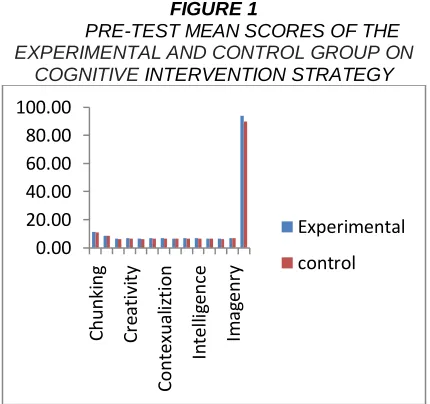
FIGURE 1
PRE-TEST MEAN SCORES OF THE EXPERIMENTAL AND CONTROL GROUP ON
COGNITIVE INTERVENTION STRATEGY
Independent sample ‗t‘ test had been conducted to find the difference between mean scores of the experimental and control group on Cognitive Intervention Strategy of student-teachers in total and its dimension in pre-test. The results indicated that the calculated 't' values of Cognitive
Intervention Strategy of Student-teachers in total and its dimensions.Thus, it was evident that the alternate hypothesis had been rejected and null hypothesis was accepted.
2. There is significant difference in post - test scores of cognitive intervention strategies of student- teachers in experimental and control groups.
TABLE.2
Cognitive Intervention Strategy
Experimental
(N1=25) control (N2=25) t p
M SD M SD
Chunking 21.18 3.65 9.90 3.56 19.77 S
Attention &
Memory 16.95 2.89 8.04 2.90 19.48 S
Mnemonic device 12.81 2.27 6.15 2.30 18.47 S
Creativity 12.79 2.16 5.86 2.29 19.68 S
Mind mapping 12.90 2.04 6.11 2.13 20.58 S
Problem solving 12.83 2.04 5.99 2.24 20.22 S
Contextualization 12.99 2.07 6.11 2.04 21.19 S
Reasoning 12.81 2.21 5.94 2.21 19.66 S
Heuristic method 12.86 2.01 6.15 2.04 20.94 S
Intelligence 12.69 2.08 5.84 2.16 20.44 S
ICT tool & project
based learning 12.90 2.16 6.06 2.04 20.58 S
Perception 12.79 2.23 5.83 2.19 19.93 S
Imagery 12.90 2.08 6.31 2.20 19.46 S
Total 179.39 27.58 84.29 28.26 21.54 S
*S- Significant at 0.05 level
FIGURE 2
POST-TEST MEAN SCORES OF THE EXPERIMENTAL AND CONTROL GROUP ON
COGNITIVE INTERVENTION STRATEGY
Independent sample t test has been conducted to find the difference between mean scores of the
experimental and control group on Cognitive
Intervention Strategy of student-teachers in total and its dimensions in post-test. The results indicated that the calculated ‘t‘ values of Cognitive
Intervention Strategy of Student-teachers were greater than that of the critical table ‘t‘ value at 0.05 significance level. Thus, it was evident that the null hypothesis was rejected and alternate hypothesis had been accepted. Mean scores of Cognitive
Intervention Strategy of student-teachers belong to experimental group were approximately greater than the mean scores of Control group student-teachers.
0.00 20.00 40.00 60.00 80.00 100.00
C
hun
ki
ng
C
re
at
ivi
ty
C
o
ntex
ua
liz
ti
o
n
In
tel
lig
enc
e
Im
ag
enr
y
Experimental
control 0.00
20.00 40.00 60.00 80.00 100.00 120.00 140.00 160.00
Experimental
1870
3. There is significant difference in the pre and Post - test mean scores of cognitive intervention strategy
based on demographic variables such as
Locality of the student-teachers [urban/rural] TABLE.3
Cognitive Intervention Strategy
Urban (N1=36) Rural (N2=14)
t p
M SD M SD
Chunking 15.58 6.84 15.50 6.61 0.07 NS
Attention &
Memory 12.67 5.40 12.33 5.26 0.40 NS
Mnemonic
device 9.62 4.04 9.36 4.06 0.40 NS
Creativity 9.32 4.16 9.33 4.10 0.02 NS
Mind mapping 9.55 4.01 9.46 3.99 0.13 NS
Problem solving 9.53 4.06 9.30 4.03 0.35 NS
Contextualization 9.61 4.02 9.50 4.02 0.16 NS
Reasoning 9.47 4.11 9.29 4.09 0.28 NS
Heuristic method 9.51 3.96 9.50 3.91 0.02 NS
Intelligence 9.26 4.12 9.26 3.97 0.00 NS
ICT tool & project based learning
9.46 4.08 9.50 3.98 0.06 NS
Perception 9.38 4.22 9.24 4.06 0.21 NS
Imagery 9.55 3.91 9.65 3.97 0.16 NS
Total 132.51 56.09 131.23 54.80 0.14 NS
*NS- Not Significant at 0.05 levels
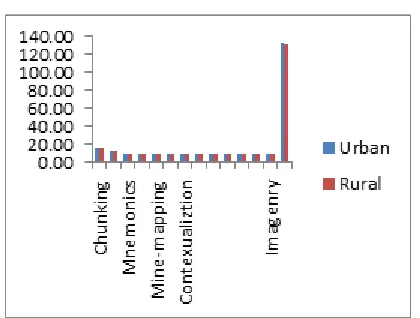
FIGURE 3
MEAN SCORES OF STUDENT – TEACHERS ON
COGNITIVE INTERVENTION STRATEGY BASED ON THE LOCALITY
Independent sample t test has conducted to find the difference between mean scores of student – teachers with regard to Cognitive Intervention Strategy in total and its
dimensions based on the locality. The results indicated that the calculated‘t‘ values were lesser than that of the critical table‘t‘ value at 0.05 significance level. Thus the alternative hypothesis had been rejected and null hypothesis was accepted.
Medium of instructions [Tamil / English]
TABLE .4
Cognitive Intervention Strategy
Tamil (N1=36) English (N2=14)
t p
M SD M SD
Chunking 21.18 3.65 9.9 3.56 19.77 S
Attention &
Memory 10.12 2.2 7.35 1.95 24.67 S
Mnemonic device 7.63 3.1 7.54 2.93 7.93 S
Creativity 8.76 4.69 8.62 4.57 3.33 S
Mind mapping 7.53 3.06 7.58 2.95 7.9 S
Problem solving 12.83 2.04 5.99 2.24 20.22 S
Contextualization 12.99 2.07 6.11 2.04 21.19 S
Reasoning 12.81 2.21 5.94 2.21 19.66 S
Heuristic method 12.9 2.08 6.31 2.2 19.46 S
Intelligence 12.31 2.63 7.72 0.93 100.81 S
ICT tool & project
based learning 7.71 3.1 7.5 3.01 10.79 S
Contextualization 8.61 4.64 8.72 4.49 3.43 S
Imagery 5.96 1.65 6.38 2.1 14.53 S
Total 179.4 27.58 84.29 28.26 21.54 S
*S- Significant at 0.05 level
Independent sample t test has conducted to find the difference between mean scores of Tamil and English Medium student - teachers with regarding to Cognitive
Intervention Strategy in total and its dimensions in post- test. The results indicated that the calculated 't' values of
Cognitive Intervention Strategy in total and in dimension
namely Chunking, Mnemonic Technique, Mnemonic device, Creativity, Mind mapping, Problem solving, Contextualization, Reasoning, Heuristic method, Intelligence, ICT tool & project based learning, Perception and Imagery were greater than that of the critical table 't' value at 0.05 significance level. Thus the alternative hypothesis was accepted.
Findings of the study
student-teachers. From the above findings it can be infer that student-teachers of Experimental Group trained through cognitive intervention module have shown enhancement in teaching when compare with Control Group.
2. A significant difference was not found based the locality Rural and Urban of post-test mean scores of student –teachers.
3. A Significant difference found based on the demographic variable medium Instruction.
9 CONCLUSION
From the above findings of the study, it concluded that the student-teachers of experimental group who were taught through the cognitive intervention module have shown development in their teaching competence when compare with control group. A teacher had been considered as the best teacher, would able to memorize the subject matter, delivering it more skill fully, relate the perceived concepts more easily to the real life situation and form new concepts by organizing information from various sources, etc. Hence, in order to develop teaching competence an intervention program focusing more on cognitive strategies based on some mental processes such as memory, attention, thinking power, concept formation and perception related to teaching has been introduced for the student-teachers to improvise their teaching competence in the form of knowledge, attitudes and skills.
10 REFERENCE
[1] Ali, M. , Ahmad, A., & Seman, A., (2017). Teachers‘ Competencies in Teaching and Learning History. Open Journal of Social Sciences, 5, 220-228. doi: 10.4236/jss.2017.58018
[2] Atmaca, Ç., (2017). A Comparison of Pre-Service and In-Service English Teachers' TEACHING COMPETENCE Levels. Journal of Higher Education & Science/ Bilim Dergisi, 7(2).
[3] Berliner, D. C., (2014). Exogenous Variables and Value-Added Assessments: A Fatal Flaw. Teachers College Record, 116(1), n1. [4] Blickenstaff, S. M., Wolf, K. J., Falk, J. M., & Foltz,
J. C., (2015). College of agriculture faculty perceptions of student skills, faculty competence in teaching areas and barriers to improving teaching. NACTA Journal, 59(3), 219.
[5] Cheng, E. C., (2014). Learning study: nurturing the instructional design and TEACHING COMPETENCE of pre-service teachers. Asia-Pacific Journal of Teacher Education, 42(1), 51-66. [6] Cortese, S., Ferrin, M., Brandeis, D., Buitelaar, J., Daley, D., Dittmann, R. W., ... & Zuddas, A., (2015). Cognitive training for attention-deficit/hyperactivity disorder: meta-analysis of clinical and neuropsychological outcomes from randomized controlled. Retrived from Springer database.
[7] David Hessl, et al., (2019). Cognitive training for children and adolescents with fragile X syndrome: a randomized controlled trial of Cogmed. Journal Neuro developmental Disorders volume 11, Article number: 4 (2019)
[8] De Hullu, E., Sportel, B. E., Nauta, M. H., & de Jong, P. J., (2017). Cognitive bias modification and CBT as early interventions for adolescent social and test anxiety: two-year follow-up of a randomized controlled trial. Journal of behavior therapy and experimental psychiatry, 55, 81-89.