Two-Phase Iridum-Based Refractory
Sup
eralloy
s
THEIR DEVELOPMENT AND POSSIBILITIES AS HIGH TEMPERATURE STRUCTURAL MATERIALS
By Y. Yamabe-Mitarai, Y. F.
Gu
and H. HaradaHigh-Temperature Materials Group, NIMS, Sengen 1-2-1, Tsukuba. lbaraki 305-0047, Japan
A new class of alloys based on platinum group metals. which are called rejractoty superallo.vs, is proposed. These refractory superalloys have aJc.c. and L 1 2 coherent two-phase structure (similar to that of nickel-based superalloys). high melting temperatures, and good potential as structural materials f o r use at temperatures up to 1800°C. In this paper. we report our results on the strength behaviour. creep property, ductility and,fracture mode of iridium-based refractory superalloys.
Iridium has a high melting temperature
(2447"C), the highest room temperature elastic modulus (570 GPa) (1) and is one of the most sta- ble elements against corrosion (2). Its main use is for crucibles for growing single crystals of h h melting temperature oxides, but it is also used in catalysts and in ignition devices (spark plugs).
Over the last few decades, the possibility of using iridium Q as a h g h temperature structural material has been evaluated. Several Ir-based inter- metallics have been noted as having melting temperatures above 2000"C, such as IrNb with a Llo structure (3), IrAl with a B2 structure (4), and Ir,Nb or Ir3Zr with a L12 structure (5-6). However, Ir is an anomalous metal with a face cen- tred cubic (f.c.c.) lattice that fails due to cleavage
Iridium single crystals fail in a brittle manner under tensile tests after an elongation of about 80
per cent at room temperature (9). However, poly- crystalline Ir and its alloys normally exhibit intergranular or mixed intergranular and transgran- ular cleavage with limited ductility over a wide temperature range (10-1 2). Some researchers believe that intergranular fracture in polycrystalline Ir is caused by non-metallic impurities, such as car- bon (C) and oxygen, or that it is environmentally induced (13). Other reports have proposed that the intergranular brittleness in polycrystalline Ir is intrinsic and not due to impurities at the grain boundary (14).
(7,s).
Much work has been done over the past three decades in attempts to prevent brittle fracture of Ir and its alloys and to improve their mechanical properties. Alloying (by macro-addition or micro- d o p a is believed to be one of the most effective ways to achieve this. Liu and colleagues found that adding a trace amount (below 60 ppm) of thorium (Th) to an Ir-0.3W alloy (the alloy currently used as a fuel-clad- material in radioisotope thermo- electric generators) could improve its strength and ductility, and change the fracture mode from inter- granular to transgranular (15). A cerium-doped Ir alloy has also shown several similarities to
Th-
doped alloys (16). Wolff and coworkers reported that the addition of 0.5 at.% boron (B) to an Ir- 16Nb alloy could raise its strength and ductility at lower temperatures but caused a rapid fall in strength above 1100°C (17). Recently, Heatherly and colleagues investgated the effects of impuri-ties in Ir and found that iron, nickel pi), chromium or aluminium (Al) at levels ranging from 50 to 5000 ppm do not embrittle Ir, whereas high levels of silicon cause severe embrittlement
While these research projects concentrated on single-phase alloys based on Ir (which may be less resistant to creep deformation than two-phase alloys) we focused on two-phase Ir-based alloys consisting of f.c.c. and
L12
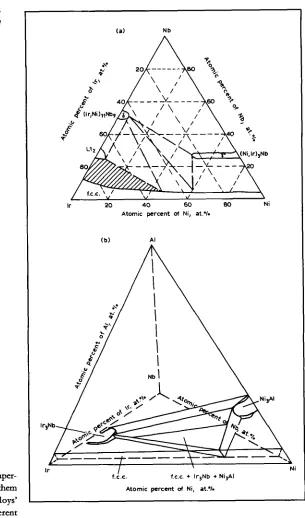
phases (19). We have proposed a new class of alloys based on Ir with a f.c.c. and Llz coherent two-phase structure similar (18).Fig. 1 Phase diagrams of iridium alloys, determined experimentally:
(a) the tertiary system Ir-Nb-Ni at 1300°C
(b) the quaternary system Ir-Nb-Ni-A1 at 1300°C
to that of Ni-based super-
(a) Nb
I
Atomic percent of Ni, at.%
I f.&. f.c.c. + Ir3Nb + Ni3Al
Atomic percent d Ni, at.%
I
alloys, and named them‘refractory superalloys’ (20, 21). The coherent
interface in the alloys appears to play an important role in strengthening alloys by preventing disloca- tion movements. We considered that if the Ir-based alloys (with melting temperature above 2000°C) have a f.c.c. and L12 two-phase coherent structure, then the alloys should show high
strength at h g h temperature. Such an alloy could then be used at h g h temperawe in situations where Ni-based superalloys cannot be used. A brief introduction to our primary work was given in this Journal by Wolff and
W
(22). Here, our recent results on the strength behaviour, creepFig. 2 Precipitate shape of (u) lr-I5 ut.% Nb und (h) I r - I 5 at.% Zr alloys. These durk+eid images were takeii.jrom sirperlattice rejlectionsfrom the L12 phase. (c) Bright$eld image qf'un Ir-15 at. % ZI- ulloy
property, ductility and fracture mode of Ir-based alloys developed under the High-Temperature Materials 21 Project are reported.
Design Concept of Ir-Based
Refractory Superalloys
According to the Ir binary phase diagrams given in Massalski (23), the f.c.c. and LlZ two- phase region exists, for example, in the Ir-V, Ir-Ti, Ir-Nb, Ir-Ta, Ir-Hf and Ir-Zr systems. We investi- gated the strength behaviour and deformation structure in these alloys (24,25), and Ir-Nb and Ir-
Zr were found to be the most promising alloys for study with regard to their strength and microstruc- ture up to 1200°C. However, the strength of these two binary alloys dropped off drastically above 1200°C. In attempts to improve the high-tempera- ture strength, additions of molybdenum (Mo), tantalum p a ) and tungsten (W) with h g h melting temperatures (261 7,2977 and 3380"C, respectively) were added to the Ir-Nb alloy.
Another problem is that Ir-based alloys are very brittle and break by the intergranular fracture mode (26). In attempts to improve their ductility and change the fracture mode, different elements were added as the third element to the Ir-Nb alloy. In Ni-based superalloys, B is the element added to improve grain boundary strength and C is added
to stabilise the grain boundary. Therefore B and C
were expected to improve grain boundary strength in Ir-based alloys. In addition to these trials, plat- inum (Pt), Ni and rhodium @) were also added
to Ir-Nb alloys to characterise the structural con- nection and to find a suitable quantity of each to replace some of the Ir. These added elements may help to improve ductility.
Another trial involved combining the two- phase Ir-Nb and Ni-Al alloys and also the two-phase Ir-Nb-Ni and Rh-Nb-Ni alloys in order
to check the two-phase regions in the combined systems. These two quaternary alloys can be expected to have the advantages of both systems -
Q h strength at high temperature from the Ir-Nb and Ir-Nb-Ni alloys, and good ductility and low density from the Ni-Al and Rh-Nb-Ni alloys. These quaternary alloys could be described, respectively, as an Ir-Ni-based alloy or as an Ir-Rh- based alloy, containing some f.c.c. or L1, phase- forming elements.
Experimentally determined phase diagrams of Ir-Nb-Ni and Ir-Nb-Ni-Al at 1300°C are shown in Figure 1 (27,28). In the Ir-Nb-Ni system, the f.c.c. and L12 two-phase region expanded on addition of Ni. However, when too much Ni was added a third phase, Qr, Ni),,Nb,, was formed. In the Ir- Nb-Ni-Al system, contrary to our expectations,
Fig. 3 Comparisons of Ihe temperature dependence of the compressive strengths of four iridium-based alloys: Ir-12Zc Ir-l7Nb,
Ir-ISNb-5Ni and Ir-13.5Nb-8Ni-2AI; with the nickel-based alloy (CMSX-10) (29), a
niobium-based alloy (Nh-Si-Mo- W) (30). and a tungsten-based alloy (31)
2000
1500
a
4
v)- 1000 v)LL c
v)
3
s
s
z
LL
500 lo00 1500 2000
TEMPERATURE, * C the f.c.c. and Llz two-phase region
was not connected from the Ni-Al side to the Ir-Nb side. Instead, a three- phase region, the f.c.c. and Llz-Ir3Nb
and L12-Ni& appeared. However, there was no other phase of different structure in addition to the f.c.c. and Llz phase in the alloys that were tested. The quaternary Ir-Nb-Ni-Al alloy is very promis- ing from the point of view of phase structure. Although exact phase diagrams for the Ir-Nb-Mo, Ir-Nb-Ta, Ir-Nb-W, Ir-Nb-Pt, Ir-Nb-B and Ir-Nb- C systems cannot be provided yet, the f.c.c. and Llz two-phase structure was confirmed in the following alloys: Ir-15Nb-5M0, Ir-l5Nb-Ta, Ir-lSNb-lOW, Ir-15Nb-30Pt (all measured in at.%) and in Ir-15 at.% Nb-500 ppm B, and Ir-15 at.% Nb-500 ppm C, by observation of their microstructure. For the Ir-Rh-Nb-Ni system, the f.c.c. and L11 two-phase region was observed over a wide area.
High-Temperature Strength
Precipitate Morphology Effect
Precipitate morphology depends on the lattice misfit between the f.c.c. matrix and the Llz precip- itates (21). Typical microstructures are shown in Figure 2. In the Ir-Nb alloy with a small lattice mis- fit of 0.4%, cuboidal Llz precipitates formed, see
Figure 2a. However, plate-like precipitates formed in the Ir-Zr alloys where there was a large lattice misfit of 2% ( F i i e 2b), and a sern-coherent structure with many misfit dislocations also formed (Figure 2c). Plots of the temperature dependence of the strength showed that the strengths of the Ir-Nb and Ir-Zr alloys were very hgh (> 1000 MPa) below 1200"C, although the strengths decreased dramatically above 1200°C (Figure 3). (Figure 3 also shows the strengths of a typical commercial Ni-based superalloy, CMSX-10 (29), a Nb alloy (30) and a W alloy (31) plotted for comparison as other hgh-temperature materials.) In both the
Ir
alloys the volume fraction of the L11precipitates was 50%. Below 1200"C, the strength of the Ir-Zr alloy was higher than that of the Ir-Nb alloy. In these two alloys, solid-solution hardening and precipitation-hardening effects were both observed (32), with precipitation hardening being larger in the Ir-Zr alloy.
The deformation mode in the Ir-Zr alloy was by she- (25); on the other hand, shearing did not occur in the Ir-Nb alloy (33). In the Ir-Zr alloy, when a dislocation moves in the f.c.c. matrix, it
140
120
0
‘E, 100
.-
tm 2
=
80 I‘GJ
60u
+ u)
U
IT 4 0
U
W
a u)
-
20
500 1000 1500 201
TEMPERATURE, *C
meets numerous interfaces in the maze structure. The coherent interface has high-coherency strain energy in the maze structure, and a large number of misfit dislocations will prevent the movement of dislocations in a semi-coherent structure. This could be attributed to the high precipitation hardening of the Ir-Zr alloy.
The Effect of Element Addition
In attempts to improve the high-temperature strength of Ir-based alloys above 1200”C, we added Mo, Ta and W to a two-phase 11-15Nb alloy. Only Ta, at concentrations C 20 at.%, was found to be effective at improving the high-tem- perature strength. Additions of Ta > 20 at.% made the Ir-15Nb lose the f.c.c. and
L12
two-phase structure, causing the alloy strength to drop great- ly at 1200°C. Ad* W and Mo to the Ir-15Nb alloy only slightly improved its high-temperature strength even though W has a higher melting tem- perature and larger atomic size than Ta. Similar behaviour was also observed in the Ir-Nb-Ni and Ir-Nb-Ni-Al alloys (Figure 3). These results showed that a third element is not very effective at improving the strength at temperatures over 1200°C.One of the biggest obstacles to using a two-
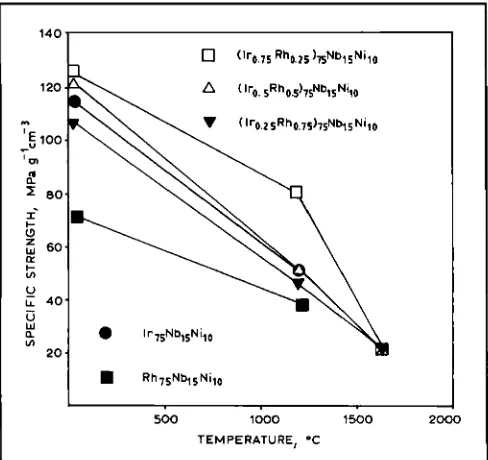
Fig. 4 The temperature dependence
of the speciJk strength of
(I6 Rh)rsNblsNiIn allo.vs. Small udditions of rhodium produce the strongest alloy
phase Ir-based alloy as a structural material at ultra-high temperatures may come from its lower specific strength (normalised strength to density), which is mainly caused by its higher density. To reduce the density, we med replacing Ir by Rh in an Ir-15Nb-1ONi alloy, which has higher strength at both room and high temperature. The effects of the replacement on the strength and ductility are shown in Figure 4. The quaternary (Ir75Rh25)75Nb15Nilo two-phase alloy had the high- est specific strength of all the tested Qr, Rh)7sNb15Nilo alloys: 126 MPa g-’ cm-’ at room temperature, 81 MPa g-’ cm-’ at 1200°C, and 24 MPa g-’ cm-3 at 1600°C.
In the trial described previously, after the Ir-Nb alloy had been combined with the Ni-Al alloy, the density decreased; for example, the density of the Ir-lONb-42Ni-8Al alloy with three phases was 14.8 g cm-’. However, the strength and melting temperature also decreased drastically.
Creep Properties
Compressive creep curves of the Ir binary and ternary alloys at 1500 and 1650°C are shown in Figure 5. Although the strength of the Ir-based binary alloys above 1500°C was not very high, the creep strain was below 2% and tertiary creep was
Fig. 5 Creep curves
(a) for the binary iridium alloys Ir-12.3 and Ir-17Nb at 1500°C under I3 7 MPa
(b) f o r Ir-17Nb alloy and nickel- containing iridium-niobium alloys at 1650%, also under 137 MPa. The alloy containing the least amount ( I at.%) of nickel shows
the best creep property
not observed until 300 hours. The creep resistance was %her in the It-Nb alloy than in the Ir- Zr alloy because discontinuous coarsening occurred from the grain boundary in the Ir-Zr alloy and its microstructure changed to a coarse structure during creep (34). This was due to the large lat- tice misfit in the h-Zr alloy. In the Ir-Zr alloys, the coherency
( a )
1 M O *C
-?
. 3 1
5 2.
L i . Ir-12Zr
LL
Ir-17Nb
100 2 0 0 3bO
TIME, HOURS
1650.C ( b )
Ir-15Nb-1ONi
3-
z z-
a 1
I-
v)
1 -
\
1650.C ( b )
I I
1 0 0 2 0 0 300
TIME, HOURS
strain energy of the interface was very hgh and coarsening of the maze structure was difficult to achieve. Discontinous coarsening was also observed in the lamellar structure of the Ti-Al alloy, for example (35). When the lamellae are very fine, coarsening often occurs by migration of the grain boundary (36).
At 1650°C, a tertiary creep was observed dear- ly in the binary Ir-Nb alloy after 20 hours, but ad- Ni to this alloy improved its creep resis- tance dramatically. As long as the Ni content is below 5 at.%, tertiary creep is not observed. The creep strains were below 2% after 300 hours for Ir- 15Nb-xNi alloys (x e 5). The steady-state creep rate for the Ir-15Nb-ZNi was 1.2 x 10" s-I, about three orders of magnitude lower than that of the
binary Ir-17Nb alloy
d).
The values of the steady-state creep rates for the Ir-15Nb-5Ni and Ir-15Nb-1ONi alloys were 2.1 Xlo4
sd and 1.2 xlo-' s-', respectively. The great improvement in creep resistance of the Ir-15Nb alloy on adding Ni might be due to the effect of Ni on improving the grain-boundary strength and reducing the coarsening process.
Ductility
and Fracture Mode
Our previous investigation showed that poly- crystalline binary Ir-based two-phase alloys normally exhibit intergranular fracture with limited ductility even in compression tests, as does pure Ir and its single-phase alloys (26). This result implies that the grain boundary in binary Ir-based two-
Phtinnm Me& &., 2002,46, (2) 79
phase alloys is still a weak point. The large differ- ence between the cohesion of the grain boundary and of the bulk is likely to cause the grain bound- ary to break before any dislocations form, as discussed by Hack et ul. (37).
An interpretation of the enhanced ductility in alloys prone to intergranular fracture (which hap- pens in many intermetallic alloys and other alloy systems) based on improved grain-boundary cohe- sion caused by B segregation has been at least partially successful. The fracture behaviour and compression properties of the 11-15Nb alloy doped with 80 to 2000 wppm B were investigated. The results showed that doping with B can change the fracture mode from intergranular (for the bina- ry Ir-l5Nb alloy) to transgranular (for the B-doped alloys). However, we found that doping with B only shghtly improves the ductility of the alloy. We also found that even though the fracture mode for Ir-15Nb can be changed from intergranular to transgranular by adding Ni, W,
Ta,
Pt or Ni-Al, there is no obvious improvement in compression ductility by this change. The main reason is that the Ir-15Nb alloy, despite having additions of various elements, stiU fractures by transgranular cleavage at room temperature. This is due to apparently very strong and directed atomic bin- forces.To stabilise the structure of polycrystalline Ni- based superalloys against high-temperature deformation, carbide formation is required. However, C is reported to be the main impurity causing polycrystalline
Ir
to crack in intergranular fracture (13). Our research has found no harmful effects due to C additions on the properties of the two-phase Ir-Nb refractory superalloy, even when the C additions were up to 2000 wppm. The com- pression ductility for C-free and C-doped alloys had almost the same value.Possibilities for Ir-Based
Refractory Superalloys
The high-temperature strength of Ir-based refractory superalloys above 1200°C did not improve on addition of a third element. Compared with the Nb-Si-Mo-W d o y in Figure 3, the strength of the Ir-based alloys above 1200°C is not remarkable considering their high melang temper-
ature. On the other hand, the creep property of the Ir-based alloys is remarkable. We tested a Ni- based superalloy,
TMS-75,
which has a rupture life of 196 hours under 98 MPa in a tensile condition at 1150°C (38). Under compressive stress at 1200”C, the sample buckled, and the strain could not be measured accurately. Another comparativetest indicated that the compressive creep strain rates of an IrAl single-phase alloy with a B2 struc- ture at 1100°C were between lo4 and s-’
under 100 to 220 MPa (39). The strain rate of
ItAl
at 1100°C was one or two orders of magnitude larger than that of our alloys (lo-’ s-’) at 1500°C.This shows that our alloys, with the f.c.c. and
L12 two-phase structure are more promising materials because of their high creep resistance. We also found that the creep life of Ir-Nb increased dramatically at 1650°C by addition of a third element, such as Ni. This shows that the
Ir-
based refractory superalloys may possibly be regarded as ultra-high temperature materials. Furthermore, the change in fracture mode on addition of Ni showed that there is a potential for designing high-temperature Ir-based alloys with both htgh-temperature strength and good ductility by addition of a suitable element.Acknowledgement
This work was conducted as part of the High-Temperature Materials 21 Project. We thank Dr X. H. Y u from Manitoba University, who did part of this work during her stay at NIMS. We also thank Mr S. Nishikawa and Mr T. Maruko of Furuya Metal Co., Ltd. for the iridium.
References
1 “International Tables of Selected Constants”, Vol. 16, ‘Metals: Thermal, and Mechanical Data’, ed. S. Allatd, Pergamon, Oxford, 1969
2 “Metals Handbook”, 9th Edn., ASM, Metals Park, OH, 1979, Vol. 2
3 R. L. Fleisher, R D. Field, K. K. Denke and R J.
Zabala, Metal Truns. A, 1990,2lA, 3063
4 P. J. W, L. A. Cornish and M. J. Witcomb,]. A/&s
5 M. Bruemmer, J. Brimhall and C. H. Heneger, Mater. Res. SOC. Symp. Proc., 1990,194, pp. 257-262
6 A. M. Gyurko and J. M. Sanches, M&. Sci Eng.,
1993, A170, 169
7 C. Gandhi and M. F. Ashby, Ada Metal., 1979,27, 1565
8 P. Pantilov and A. Yermakov, Platinum Metalr h.,
2001, 45, (4), 179
co,.qd, i99a,280,240
Phtinum Metalj Rev., 2002, 46, (2) 80
9 10 11 12 13 14 15 16 17 18 19 20 21 22 23 24 25 26 27 28
C. A. Brooks, J. H. Greenwood and J. L. Routbort, J.
Appl
Ply.., 1968,39,2391C. A. Brooks, J. H. Greenwood and J. L. Routbort, J. IM. Met., 1970, 98,27
R W. Douglass and R I. Jaffee, Proc. ASTM, 1962, 62,627
D. L. Rohr, L. E. Mutr and S. S. Hecker, Metall
Tmns., 1979, 1 0 4 399
J. R Handley, PkdnumMetOLr Rev., 1986,30, (l), 12 S. P. Chen, Phil Mag. A, 1992,66, 1
C. T. Liu, H. Inouye and A. C. Schaffhauser, Met&
Trans. A, 1981,12A, 993
A. N. Gubbi, E. P. George, E. K. Ohriner and R H. Zee, Metdl M ah. Tmns. A, 1997,28,2049 I. M. Wolff and G. Sauthoff, Metal Trans. A, 1996, 27,2642
L. Heatherly and E. P. George, A& Muter., 2001,49,
289
Y. Ro, Y. Koizumi and H. Harada, Muter. Sci Eng.,
1997, A223,59
Y. Yamabe, Y. Koizumi, H. Murakarm, Y. Ro, T.
Maruko and H. Harada, Sm Muter., 1996,35, (2), 211 Y. Yamabe-Mtarai, Y. Ro, T. Maruko and H. Harada, Metdl Ma&. Trans. A, 1998,294 537
I. M. Wolff and P. J. W, Phtnum Metals Rm, 2000, 44, (4), 158
“Binary Alloy Phase Diagrams”, 2nd Edn. Suppl., ed. T. B. Massalski, ASM, Materials Park, OH, 1992
Y. Yamabe-Mitarai, Y. Ro, T. Maruko, T. Yokokawa, and H. Harada, “Structural Intermetallics 1 9 9 7 ,
TMS, Seven Springs, 1997, pp. 805-814
Y. Yamabe-Mitarai, Y. Ro, S. Nakazawa, T. Maruko
and H. Harada, Dcf.ct D&. Foam, 2001, 188-190,
171
Yuefeng Gu, Y. Yamabe-Mtarai, Y. Ro and H. Harada, Sm Muter., 1999,40, (ll), 1313
Yuefeng Gu, Y. Yamabe-Mtarai, Y. Ro, T. Yokokawa and H. Harada, Sm Matm., 1998,39, (6),
723
X H. Yu, Y. Yamabe-Mitarai and H. Harada, Scr Muter., 1999,41, (ll), 1153
29 G. L. Elickson, “Superalloys 1996”, TMS, Warrendale, PA, 1996, pp. 35-44
30 C. L. Ma, A. Kasama, Y. Tan, H. Tankaka, R Tanaka, Y. Mishima and S. Hanada, Report of the
123rd Committee on Heat-Resisting Materials and Alloys, JSPS, Tokyo, 1999,40, (3), pp. 349-360 31 W. F. Brown, H. Mindin and N. C. Ho, “Aerospace
Structural Metals Handbook”, CIDAS/Purdue University, Weat Lafayette, IN, 1992, Vol. 5, p. 5502 32 Y. Yamabe-Mitarai, Y. Ro, T, Maruko and H.
Harada, Intmetaficf, 1999, 7, 49
33 Y. Yamabe-Mitarai, Yuefeng Gu, Y. Ro, S. Nakazawa, T. Maruko and H. Harada, Sm Mafm.,
1999, 41, (3), 305
34 Y. Yamabe-Mitarai, S. Nakazawa and H. Harada, Sm Mater., 2000,43,1059
35 Y. Yamabe, N. Honjo and M. Kikuch~, JIMIS-6, Proc. Int. Symp. on Intermetallic Compounds, ed. 0. Izumi, Japan Inst. Metals, Sen& 1991, p. 821 36 J. D. Livingston and J. W. Cahn, A d a Metau., 1974,
22,495
37 J. E. Hack, S. P. Chen and D. J. Srolovitz, A d a Me&’., 1989,37,1957
38 Y. Koizumi, T. Kobayashi, T. Kimwa, M. Osawa
and H. Harada, ‘Waterials for Advanced Power Engineering 1998”, Forschungszentrum, Jiilich, pp.
1089-1098
39 A. Chiba, T. Ono, X. G. Li and S. Takahashi, Intemehakcs, 1998, 6, 35
Authors
Dr Yoko Yamabe-Mitarai is a Senior Researcher at the National Institute for Materials Science in Tsukuba. Her main professional interests are in high temperature materials, applications of the platinum group metals and intermetallics.
Dr Y. Gu is a Senior Researcher at the National Institute for Materials Science in Tsukuba. His main professional interests are in high temperature materials, applications of the platinum group metals and in intermetallics.
Professor H. Harada is Project Director at the National Institute for Materials Science in Tsukuba. His main professional interests are in high temperature materials, especially nickel-based superalloys.
The Chemistry of the
Platinum Group Metals: PGM8
The eighth conference in t h i s series takes place at Southampton University, U.K, from 7th to 12th July. Internationally-recognised speakers from the chemistry community will present their work on a wide range of platinum group metals chemistry. The
[email protected], Tel: +44 (0)20 7440 3322; Fax: +44 (0)20 7734 1227; or from the website: http://www.rsc.org/lap/confs/PGM8.hm.
Invitation to Students
-~
~~
main themes include: organometallic chemistry; coordination and supramolecular chemistry; biolog- ical and medicinal chemistry; surfaces, materials and crystal enginee-, photochemistty and electro- chemistry; catalysis and organic synthesis; and theoretical chemistry and physical methods.
More information may be obtained from Ms P. Mohamed, Royal Society of Chemistry, E-mail:
Students attending the conference are invited to write an article of 300 words for Pkzfinum Metah
Reyien, on one of the following a presentation, a series of presentations or an interview with a respect- ed academic attending the conference. The winning
article will be published in Ph’iinum Mehah lZeview. Further details will be available later and at the Ph’inum Metah Review desk at the conference.