Patient Preference and Adherence
Patterns and predictors of antihypertensive
medication used 1 year after ischemic stroke
or TIA in urban China
Jie Xu* Yi Ju*
Chunjuan Wang Yilong Wang Liping Liu Xingquan Zhao Chunxue Wang Anxin Wang Yongjun Wang
Department of Neurology, Beijing Tiantan Hospital, Capital Medical University, Beijing, People’s Republic of China
*These authors contributed equally to this work
Correspondence: Yongjun Wang Department of Neurology, Beijing Tiantan Hospital, Capital Medical University, No 6 Tiantanxili, Dongcheng District, Beijing, People’s Republic of China, 100050 Tel +86 10 6709 8350
Fax +86 10 6701 3383
Email [email protected]
Background: Antihypertensive treatment is recommended for secondary prevention in
patients with ischemic stroke or transient ischemic attack. Prescription of and persistence with antihypertensives for secondary prevention is high in developed countries; whether this is true in China is unclear. The aim of this study was to describe the patterns of antihypertensive medication use, and factors associated with its use, 1 year after stroke in China.
Methods: A total of 7880 hypertensive patients diagnosed with ischemic stroke or transient
ischemic attack in the China National Stroke Registry were analyzed. Multivariate logistic regression was used to identify factors associated with antihypertensive medication use at discharge and 12 months.
Results: Antihypertensive medication was used by 4458 (56.6%) participants at discharge
and 2927 (37.1%) at 12 months. Calcium channel blockers were the most common among five classes of antihypertensive medication prescribed at discharge, and participants prescribed this class had the highest 1-year persistence. In-hospital health education was the strongest predictor of antihypertensive medication use at discharge; age and stroke severity were the strongest negative predictors of use at 12 months.
Conclusion: Use of antihypertensive medication 1 year after stroke is extremely low in China.
Intervention is needed to improve adherence to antihypertensive medication, especially for the elderly and severe stroke patients.
Keywords: antihypertensive agents, secondary stroke prevention, stroke
Introduction
Hypertension is the strongest modifiable risk factor for recurrent stroke, and the efficacy of antihypertensive medication to prevent stroke recurrence has been established in several clinical trials.1 Current American Heart Association/American
Stroke Association guidelines advocate blood pressure reduction as a class 1A recommendation in patients who have had an ischemic stroke (IS) or transient ischemic attack (TIA).2 Previous studies conducted in Germany,3 Canada,4 the USA,5
and Sweden6 have suggested that persistence with antihypertensive medication
1 year after initial stroke is high (.85% of patients). In China, however, few data are available on the prescription of and persistence with antihypertensive medication in patients with hypertension who have had an IS or TIA. Using the China National Stroke Registry (CNSR), the patterns of antihypertensive medication use at discharge from hospital and up to 1 year after stroke were investigated. In addition, the factors associated with antihypertensive medication use at discharge and at 1 year were determined.
Dove
press
O R I g I N A L R E s E A R C H open access to scientific and medical research
Open Access Full Text Article
Patient Preference and Adherence downloaded from https://www.dovepress.com/ by 118.70.13.36 on 26-Aug-2020
For personal use only.
Number of times this article has been viewed
This article was published in the following Dove Press journal: Patient Preference and Adherence
Methods
The CNsR
The CNSR is a nationwide, hospital-based registry, as described in detail elsewhere.7 Briefly, the CNSR
prospectively collected data on consecutive patients aged 18 years or older with stroke who were admitted to one of 132 participating hospitals in urban China within 14 days after the onset of symptoms. A total of 22,216 participants were recruited between September 2007 and August 2008. The ethics committees at all participating hospitals approved the protocol, and all patients or their designated relatives provided informed consent.
Clinical data
IS and TIA were diagnosed according to World Health Organization criteria.8 Participants were classified as having
hypertension when any of the following criteria were met: a self-reported physician diagnosis of hypertension, use of antihypertensive drug(s) before the onset of stroke, or a final diagnosis of hypertension at discharge. Patient baseline information included gender, age, and level of education. Medical history included history of stroke, coronary heart disease, atrial fibrillation (confirmed by at least one electrocardiogram), diabetes mellitus, dyslipidemia, previous antihypertensive medication use, current or previous smoking, and moderate or heavy alcohol use (more than two standard alcoholic beverages consumed per day). Stroke severity was measured using the National Institutes of Health Stroke Scale on admission. In-hospital health education included information about physical exercise, quitting smoking, refraining from drinking alcohol, and medication advice.
Collection of antihypertensive
medication information
Information about the use of antihypertensive medication at discharge was extracted from medical records, whereas information about the use of antihypertensive medication at 3, 6, and 12 months was obtained by telephone interview with patients or their designated relatives. Classes of antihypertensive medication included angiotensin-converting enzyme inhibitors, angiotensin receptor blockers, calcium channel blockers (CCBs), diuretics, β-blockers, and “other” antihypertensives (including centrally acting adrenergics, peripherally acting antiadrenergics, and vasodilators), as recommended by Liu.9
statistical analysis
Multivariate logistic regression models were used to identify factors associated with antihypertensive medication use at
discharge or at 1 year among participants with IS or TIA and hypertension. Effect sizes are expressed as odds ratios and 95% confidence intervals. Statistical significance was defined as a two-tailed P , 0.05. All statistical analyses were performed using SAS 9.1.3 (SAS Institute Inc, Cary, NC, USA).
Results
Participant information
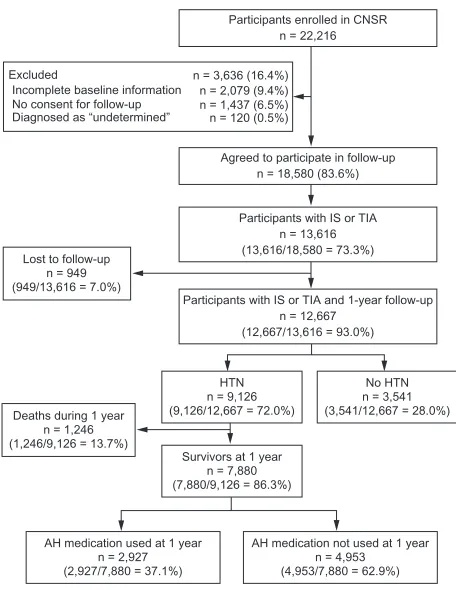
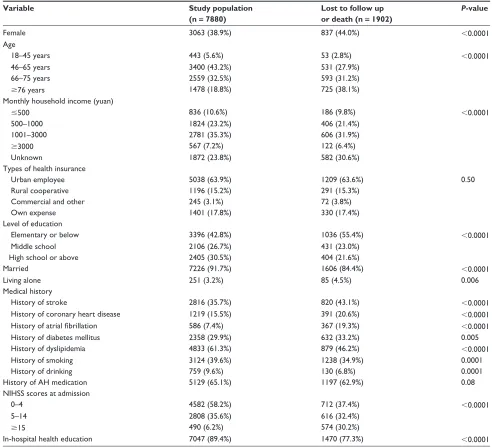
A total of 7880 participants (4817 men, 3063 women; mean age 64.9 ± 11.4 years) with hypertension who have had an IS or TIA were analyzed in this study (Figure 1). Baseline charac-teristics of patients who did or did not have 1-year follow-up data are shown as supplementary data (Table S1). Baseline characteristics of the study population are shown in Table 1.
Patterns of antihypertensive
medication use during 1 year
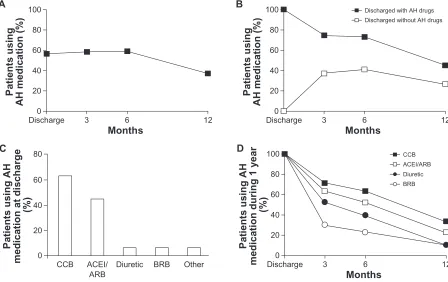
Among the 7880 participants, 4458 (56.6%) were discharged with antihypertensive medication, 4607 (58.5%) used antihypertensive medication at 3 months, 4660 (59.1%) at 6 months, and 2927 (37.1%) at 12 months (Figure 2A). Of the 4458 participants who were discharged with antihypertensive
Participants enrolled in CNSR n = 22,216
Agreed to participate in follow-up n = 18,580 (83.6%)
Participants with IS or TIA n = 13,616 (13,616/18,580 = 73.3%)
Participants with IS or TIA and 1-year follow-up n = 12,667
(12,667/13,616 = 93.0%)
HTN n = 9,126 (9,126/12,667 = 72.0%)
Survivors at 1 year n = 7,880 (7,880/9,126 = 86.3%)
AH medication used at 1 year n = 2,927 (2,927/7,880 = 37.1%)
AH medication not used at 1 year n = 4,953 (4,953/7,880 = 62.9%) Deaths during 1 year
n = 1,246 (1,246/9,126 = 13.7%)
Lost to follow-up n = 949 (949/13,616 = 7.0%)
No HTN n = 3,541 (3,541/12,667 = 28.0%) Excluded
Incomplete baseline information No consent for follow-up Diagnosed as “undetermined”
n = 3,636 (16.4%) n = 2,079 (9.4%) n = 1,437 (6.5%) n = 120 (0.5%)
Figure 1 Participant flow diagram.
Abbreviations: AH, antihypertensive; CNsR, China National stroke Registry; HTN, hypertension; Is, ischemic stroke; TIA, transient ischemic attack.
Dovepress
Xu et al
Patient Preference and Adherence downloaded from https://www.dovepress.com/ by 118.70.13.36 on 26-Aug-2020
medication, 2012 (45.1%) used antihypertensive medication at 12 months (Figure 2B), and only 1619 (36.3%) remained on antihypertensive medication at all three follow-up time points (3, 6, and 12 months). Of the 3422 participants who were discharged without antihypertensive medication, 1652 (48.3%) never started treatment with antihypertensive
medication by the end of the 1-year follow-up period. Discontinuation of antihypertensive drugs at 3, 6, and 12 months among patients who received the medication at discharge is shown as supplementary data (Figure S1).
Moreover, CCBs were the most common antihypertensive drugs prescribed at discharge, followed by the combination
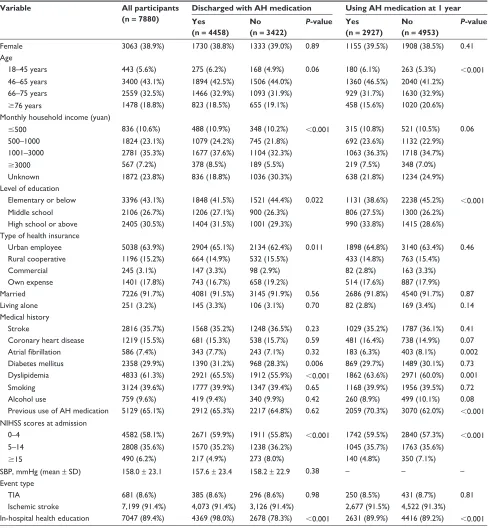
Table 1 Baseline characteristics of participants with ischemic stroke or transient ischemic attack and hypertension
Variable All participants (n = 7880)
Discharged with AH medication Using AH medication at 1 year Yes
(n = 4458)
No (n = 3422)
P-value Yes (n = 2927)
No (n = 4953)
P-value
Female 3063 (38.9%) 1730 (38.8%) 1333 (39.0%) 0.89 1155 (39.5%) 1908 (38.5%) 0.41 Age
18–45 years 443 (5.6%) 275 (6.2%) 168 (4.9%) 0.06 180 (6.1%) 263 (5.3%) ,0.001 46–65 years 3400 (43.1%) 1894 (42.5%) 1506 (44.0%) 1360 (46.5%) 2040 (41.2%)
66–75 years 2559 (32.5%) 1466 (32.9%) 1093 (31.9%) 929 (31.7%) 1630 (32.9%)
$76 years 1478 (18.8%) 823 (18.5%) 655 (19.1%) 458 (15.6%) 1020 (20.6%) Monthly household income (yuan)
#500 836 (10.6%) 488 (10.9%) 348 (10.2%) ,0.001 315 (10.8%) 521 (10.5%) 0.06 500–1000 1824 (23.1%) 1079 (24.2%) 745 (21.8%) 692 (23.6%) 1132 (22.9%) 1001–3000 2781 (35.3%) 1677 (37.6%) 1104 (32.3%) 1063 (36.3%) 1718 (34.7%)
$3000 567 (7.2%) 378 (8.5%) 189 (5.5%) 219 (7.5%) 348 (7.0%)
Unknown 1872 (23.8%) 836 (18.8%) 1036 (30.3%) 638 (21.8%) 1234 (24.9%)
Level of education
Elementary or below 3396 (43.1%) 1848 (41.5%) 1521 (44.4%) 0.022 1131 (38.6%) 2238 (45.2%) ,0.001 Middle school 2106 (26.7%) 1206 (27.1%) 900 (26.3%) 806 (27.5%) 1300 (26.2%)
High school or above 2405 (30.5%) 1404 (31.5%) 1001 (29.3%) 990 (33.8%) 1415 (28.6%) Type of health insurance
Urban employee 5038 (63.9%) 2904 (65.1%) 2134 (62.4%) 0.011 1898 (64.8%) 3140 (63.4%) 0.46 Rural cooperative 1196 (15.2%) 664 (14.9%) 532 (15.5%) 433 (14.8%) 763 (15.4%)
Commercial 245 (3.1%) 147 (3.3%) 98 (2.9%) 82 (2.8%) 163 (3.3%)
Own expense 1401 (17.8%) 743 (16.7%) 658 (19.2%) 514 (17.6%) 887 (17.9%)
Married 7226 (91.7%) 4081 (91.5%) 3145 (91.9%) 0.56 2686 (91.8%) 4540 (91.7%) 0.87
Living alone 251 (3.2%) 145 (3.3%) 106 (3.1%) 0.70 82 (2.8%) 169 (3.4%) 0.14
Medical history
stroke 2816 (35.7%) 1568 (35.2%) 1248 (36.5%) 0.23 1029 (35.2%) 1787 (36.1%) 0.41 Coronary heart disease 1219 (15.5%) 681 (15.3%) 538 (15.7%) 0.59 481 (16.4%) 738 (14.9%) 0.07
Atrial fibrillation 586 (7.4%) 343 (7.7%) 243 (7.1%) 0.32 183 (6.3%) 403 (8.1%) 0.002
Diabetes mellitus 2358 (29.9%) 1390 (31.2%) 968 (28.3%) 0.006 869 (29.7%) 1489 (30.1%) 0.73 Dyslipidemia 4833 (61.3%) 2921 (65.5%) 1912 (55.9%) ,0.001 1862 (63.6%) 2971 (60.0%) 0.001 smoking 3124 (39.6%) 1777 (39.9%) 1347 (39.4%) 0.65 1168 (39.9%) 1956 (39.5%) 0.72 Alcohol use 759 (9.6%) 419 (9.4%) 340 (9.9%) 0.42 260 (8.9%) 499 (10.1%) 0.08 Previous use of AH medication 5129 (65.1%) 2912 (65.3%) 2217 (64.8%) 0.62 2059 (70.3%) 3070 (62.0%) ,0.001 NIHss scores at admission
0–4 4582 (58.1%) 2671 (59.9%) 1911 (55.8%) ,0.001 1742 (59.5%) 2840 (57.3%) ,0.001
5–14 2808 (35.6%) 1570 (35.2%) 1238 (36.2%) 1045 (35.7%) 1763 (35.6%)
$15 490 (6.2%) 217 (4.9%) 273 (8.0%) 140 (4.8%) 350 (7.1%)
sBP, mmHg (mean ± sD) 158.0 ± 23.1 157.6 ± 23.4 158.2 ± 22.9 0.38 – – – Event type
TIA 681 (8.6%) 385 (8.6%) 296 (8.6%) 0.98 250 (8.5%) 431 (8.7%) 0.81
Ischemic stroke 7,199 (91.4%) 4,073 (91.4%) 3,126 (91.4%) 2,677 (91.5%) 4,522 (91.3%)
In-hospital health education 7047 (89.4%) 4369 (98.0%) 2678 (78.3%) ,0.001 2631 (89.9%) 4416 (89.2%) ,0.001
Note: Data are shown as n (%).
Abbreviations: AH, antihypertensive; NIHss, National Institutes of Health stroke scale; sBP, systolic blood pressure; sD, standard deviation; TIA, transient ischemic attack.
Dovepress Antihypertensives after stroke in China
Patient Preference and Adherence downloaded from https://www.dovepress.com/ by 118.70.13.36 on 26-Aug-2020
of angiotensin-converting enzyme inhibitors and angiotensin receptor blockers (Figure 2C). There were differences in persistence among the classes of antihypertensive medications during 1 year, with the lowest persistence observed with diuretics and β-blockers and the highest with CCBs (Figure 2D).
Among the 4458 participants discharged with antihypertensive medication, 14 (0.3%) were discharged on at least four antihypertensive agents, 266 (6.0%) on three agents, 949 (21.3%) on two agents, and 3229 (72.4%) on one agent.
Predictors of discharge with
antihypertensive medication
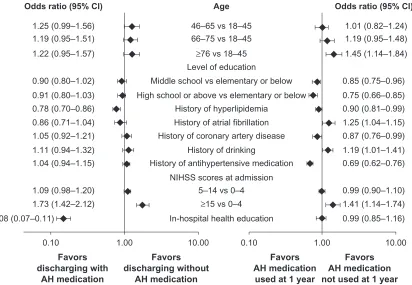
Multivariate analyses showed that among participants who had an IS or TIA and hypertension, those who received health education in hospital, and those who had a history of hyperlipidemia were more likely to be discharged with antihypertensive medication (Figure 3). In contrast, participants admitted with a severe stroke (National Institutes of Health Stroke Scale score $ 15) were less likely to be discharged with antihypertensive medication (Figure 3).
Predictors of antihypertensive
medication use at 1 year
Among the total study population, age and stroke severity were the strongest negative predictors of antihypertensive medication use at 1 year (Figure 3). Among patients who received the medication at discharge, age, level of education, history of dyslipidemia, history of antihypertensive medication, and stroke severity were determinants of new onset discontinuation at 12 months.
Discussion
In this study of data from the CNSR, it was found that the use of antihypertensive medication for secondary prevention at 1 year after stroke is extremely low in China. Previous studies conducted in other, developed countries have reported rates of antihypertensive medication use at 1 year after stroke of 86%–90%.3–6 The Swedish registry study found that of the
15,809 stroke patients discharged with antihypertensive medication, 86% used antihypertensive medication at 1 year after stroke and 74% at 2 years.6 In the AVAIL (Adherence
Evaluation After Ischemic Stroke Longitudinal) study, 88% of the 1884 stroke patients discharged with antihypertensive 12 6 Months 3 Discharge 100 80 60 40 Patients using
AH medication (%)
20 0 A 12 6 Months 3 Discharge
100 Discharged with AH drugs
Discharged without AH drugs 80
60
40
Patients using
AH medication (%)
20 0 B 12 6 Months 3 Discharge 100 80 60 40
Patients using AH
medication during 1 year
(%) 20 0 D Other 80 60 40
Patients using AH
medication at discharge
(%) 20 0 C BRB Diuretic ACEI/ ARB CCB CCB ACEI/ARB Diuretic BRB
Figure 2 Patterns of AH medication use. (A) Proportion of all participants with hypertension who used AH medication (n = 7880) during the 1-year follow-up. (B) Proportion of participants who used AH medication during the 1-year follow-up among participants discharged with (n = 4458) or without (n = 3422) AH medication. (C) Proportion of participants who were discharged with AH medication, stratified by medication class. Percentages do not total 100% because some patients received more than one AH medication. (D) Persistence with each specific class of AH medication during the 1-year follow-up among participants who were discharged with AH medication. Abbreviations: ACEI, angiotensin-converting enzyme inhibitors; AH, antihypertensive; ARB, angiotensin receptor blockers; BRB, β-blockers; CCB, calcium channel blockers.
Dovepress
Xu et al
Patient Preference and Adherence downloaded from https://www.dovepress.com/ by 118.70.13.36 on 26-Aug-2020
medication reported using these medications at 1 year.5
In contrast, only 45% of the 4458 patients discharged with antihypertensive medication in the current study reported using these medications at 1 year, ie, half the rate of the above studies.
This large discrepancy between China and other, more developed countries in persistence with antihypertensive medication after stroke has not been reported previously. Previous studies of secondary stroke prevention in China have been conducted in urban areas and tertiary care centers,10,11 which may have overestimated persistence with
antihypertensive medication.
The ChinaQUEST (Quality Evaluation of Stroke Care and Treatment) study, a multicenter, prospective, hospital registry study conducted in China, found that the rate of antihypertensive medication use at 1 year after IS in patients with hypertension was 73%,12 almost twice the rate found in
the current study (37%). There are several possible explana-tions for this discrepancy. First and most importantly, only the five classes of antihypertensive medication recommended by the American Heart Association/American Stroke Asso-ciation guidelines were included,2 and not other types of
antihypertensives such as traditional Chinese medicines. Second, ChinaQUEST was conducted in 62 hospitals located
in major cities,12 where patients are likely to receive higher
standards of care than patients in other locations in China. In contrast, the CNSR was conducted in 132 hospitals from each of the 27 provinces and four municipalities in mainland China, including the less developed, western region of the country.7 Thus, the current study is more likely than the
ChinaQUEST study to reflect the overall, nationwide use of antihypertensive medication as secondary prevention after stroke in China.
The current study also found that the use of antihyper-tensive medication was relatively well maintained during the first 6 months after stroke, but rapidly declined between 6 months and 1 year. To maintain blood pressure reduction and minimize the risk of recurrent stroke or death, patients with hypertension should persist with antihypertensive medication. The decline of antihypertensive medication between 6 months and 1 year highlights the importance of repeated intervention to improve long-term antihypertensive medication use.
Previous studies suggest that there may be important differences in persistence among the classes of antihypertensives, with angiotensin receptor blockers and angiotensin-converting enzyme inhibitors having the highest levels of adherence in Western countries.13 However, in the current study in China,
Odds ratio (95% Cl) Age Odds ratio (95% Cl)
1.25 (0.99–1.56) 1.19 (0.95–1.51) 1.22 (0.95–1.57)
0.90 (0.80–1.02) 0.91 (0.80–1.03) 0.78 (0.70–0.86) 0.86 (0.71–1.04) 1.05 (0.92–1.21) 1.11 (0.94–1.32) 1.04 (0.94–1.15)
1.09 (0.98–1.20) 1.73 (1.42–2.12) 0.08 (0.07–0.11)
46–65 vs 18–45 66–75 vs 18–45
≥76 vs 18–45
Middle school vs elementary or below Level of education
High school or above vs elementary or below History of hyperlipidemia
History of atrial fibrillation History of coronary artery disease
History of drinking
History of antihypertensive medication
5–14 vs 0–4 NIHSS scores at admission
≥15 vs 0–4 In-hospital health education
1.01 (0.82–1.24) 1.19 (0.95–1.48) 1.45 (1.14–1.84)
0.85 (0.75–0.96) 0.75 (0.66–0.85) 0.90 (0.81–0.99) 1.25 (1.04–1.15) 0.87 (0.76–0.99) 1.19 (1.01–1.41) 0.69 (0.62–0.76)
0.99 (0.90–1.10) 1.41 (1.14–1.74) 0.99 (0.85–1.16)
0.10 1.00 10.00 0.10 1.00 10.00
Favors discharging with
AH medication
Favors discharging without
AH medication
Favors AH medication
used at 1 year
Favors AH medication not used at 1 year
Figure 3 Multiple regression analysis model identifying factors associated with discharge from hospital with AH medication (left panel) and use of AH medication at 1 year (right panel).
Abbreviations: AH, antihypertensive; CI, confidence interval; NIHSS, National Institute of Health Stroke Severity; vs, versus.
Dovepress Antihypertensives after stroke in China
Patient Preference and Adherence downloaded from https://www.dovepress.com/ by 118.70.13.36 on 26-Aug-2020
CCBs were the most common antihypertensive drugs prescribed at discharge and had the highest persistence during 1 year among the five classes of antihypertensive drugs. This may be because CCB-based antihypertensive regimens were the first to be recommended by Chinese guidelines for the management of hypertension,9 which has influenced the
medication choice of doctors and patients.
Identifying predictors of antihypertensive medication use, particularly long-term use, is critical for improving the low persistence rate of patients in China. In this study, it was found that participants with a severe stroke were less likely to be discharged with antihypertensive medication and less likely to use antihypertensive medication at 1 year. Patients who have experienced a severe stroke are at high risk of death, and persistent use of antihypertensive medication could reduce mortality after stroke. For these reasons, it is especially important to prompt patients in China who have had a severe stroke to take antihypertensive medication for secondary prevention. It was also found that participants who were older, less educated, or had a history of alcohol use were less likely to use antihypertensive medication at 1 year. In contrast, participants with comorbidities, including hyperlipidemia and coronary artery disease, were more likely to use antihypertensive medication at 1 year. The finding that participants with atrial fibrillation were less likely to use antihypertensive medication at 1 year was unexpected. This observation may be related to age, as patients with atrial fibrillation are usually older.14 Notably, it was found that
in-hospital health education was a strong predictor for being discharged with antihypertensive medication, but not for antihypertensive medication use at 1 year. This phenomenon emphasizes that ongoing health education is needed for patients after being discharged from hospital.
This study does have several limitations. First, there were no hospitals from rural areas, where patients are less likely to receive standard treatment for secondary prevention. Hence, the true rate of antihypertensive medication use after stroke in China may be even lower than this study suggests. Second, data on the potential contraindications or adverse reactions that might have prevented the use of certain antihypertensive drugs were not collected. Finally, information about medication use at 3, 6, and 12 months was based on self-report via telephone interview, which may be subject to social desirability and recall bias.
Conclusion
In summary, this study of the CNSR suggests that persistence with antihypertensive medication as secondary prevention
after stroke in China is low, particularly in comparison with persistence in developed countries. Ongoing intervention is needed to improve long-term antihypertensive medication use and help reduce the risk of stroke recurrence and death in patients, particularly those at high risk of low persistence.
Acknowledgments
The authors acknowledge the independent medical writing assistance provided by Janelle Keys and Karen Woolley of ProScribe Medical Communications, funded from an unrestricted financial grant from Beijing Novartis Pharma Co, Ltd. ProScribe’s services complied with international guidelines for Good Publication Practice (GPP2).
The China National Stroke Registry was funded by the Ministry of Sciences and Technology and the Minis-try of Health of the People’s Republic of China (Grant no 2006BA101A11, 2009CB521905, and 200902004) and the National Natural Science Foundation (Grant no 81071115). The current analysis of the China National Stroke Registry data was supported by Beijing Novartis Pharma Co, Ltd. In compliance with the Uniform Requirements for Manuscripts, established by the International Committee of Medical Journal Editors, Novartis did not impose any impediment, directly or indirectly, on the publication of the study’s results.
Disclosure
The authors report no conflicts of interest in this work.
References
1. Rashid P, Leonardi-Bee J, Bath P. Blood pressure reduction and secondary prevention of stroke and other vascular events: a systematic review. Stroke. 2003;34(11):2741–2748.
2. Furie KL, Kasner SE, Adams RJ, et al. Guidelines for the prevention of stroke in patients with stroke or transient ischemic attack: a guideline for healthcare professionals from the American Heart Association/American Stroke Association. Stroke. 2011;42(1):227–276.
3. Sappok T, Faulstich A, Stuckert E, Kruck H, Marx P, Koennecke HC. Compliance with secondary prevention of ischemic stroke: a prospective evaluation. Stroke. 2001;32(8):1884–1889.
4. Lummis HL, Sketris IS, Gubitz GJ, Joffres MR, Flowerdew GJ. Medication persistence rates and factors associated with persistence in patients following stroke: a cohort study. BMC Neurol. 2008;8:25. 5. Bushnell CD, Olson DM, Zhao X, et al. Secondary preventive medication
persistence and adherence 1 year after stroke. Neurology. 2011;77(12): 1182–1190.
6. Glader EL, Sjolander M, Eriksson M, Lundberg M. Persistent use of secondary preventive drugs declines rapidly during the first 2 years after stroke. Stroke. 2010;41(2):397–401.
7. Wang Y, Cui L, Ji X, et al. The China National Stroke Registry for patients with acute cerebrovascular events: design, rationale, and baseline patient characteristics. Int J Stroke. 2011;6(4):355–361.
8. Stroke – 1989. Recommendations on stroke prevention, diagnosis, and therapy. Report of the WHO Task Force on Stroke and other Cerebrovascular Disorders. Stroke. 1989;20(10):1407–1431.
9. Liu LS. 2010 Chinese guidelines for the management of hypertension.
Zhonghua Xin Xue Guan Bing Za Zhi. 2011;39(7):579–615. Chinese. Dovepress
Xu et al
Patient Preference and Adherence downloaded from https://www.dovepress.com/ by 118.70.13.36 on 26-Aug-2020
10. Wang Y, Wu D, Ma R, Wang C, Zhao W. A survey on adherence to secondary ischemic stroke prevention. Neurol Res. 2006;28(1):16–20. 11. Wang Y, Wu D, Zhou Y, et al. Survey of blood pressure control status
in patients with ischemic stroke or transient ischemic attack in China.
Neurol Res. 2008;30(4):348–355.
12. Wei JW, Wang JG, Huang Y, et al. Secondary prevention of ischemic stroke in urban China. Stroke. 2010;41(5):967–974.
13. Kronish IM, Woodward M, Sergie Z, Ogedegbe G, Falzon L, Mann DM. Meta-analysis: impact of drug class on adherence to antihypertensives.
Circulation. 2011;123(15):1611–1621.
14. Benjamin EJ, Levy D, Vaziri SM, D’Agostino RB, Belanger AJ, Wolf PA. Independent risk factors for atrial f ibrillation in a population-based cohort. The Framingham Heart Study. JAMA. 1994;271(11):840–844.
Dovepress Antihypertensives after stroke in China
Patient Preference and Adherence downloaded from https://www.dovepress.com/ by 118.70.13.36 on 26-Aug-2020
Supplementary data
Table S1 Baseline characteristics of patients who did or did not have 1-year follow-up data
Variable Study population
(n = 7880)
Lost to follow up or death (n = 1902)
P-value
Female 3063 (38.9%) 837 (44.0%) ,0.0001
Age
18–45 years 443 (5.6%) 53 (2.8%) ,0.0001
46–65 years 3400 (43.2%) 531 (27.9%)
66–75 years 2559 (32.5%) 593 (31.2%)
$76 years 1478 (18.8%) 725 (38.1%)
Monthly household income (yuan)
#500 836 (10.6%) 186 (9.8%) ,0.0001
500–1000 1824 (23.2%) 406 (21.4%)
1001–3000 2781 (35.3%) 606 (31.9%)
$3000 567 (7.2%) 122 (6.4%)
Unknown 1872 (23.8%) 582 (30.6%)
Types of health insurance
Urban employee 5038 (63.9%) 1209 (63.6%) 0.50
Rural cooperative 1196 (15.2%) 291 (15.3%)
Commercial and other 245 (3.1%) 72 (3.8%)
Own expense 1401 (17.8%) 330 (17.4%)
Level of education
Elementary or below 3396 (42.8%) 1036 (55.4%) ,0.0001
Middle school 2106 (26.7%) 431 (23.0%)
High school or above 2405 (30.5%) 404 (21.6%)
Married 7226 (91.7%) 1606 (84.4%) ,0.0001
Living alone 251 (3.2%) 85 (4.5%) 0.006
Medical history
History of stroke 2816 (35.7%) 820 (43.1%) ,0.0001
History of coronary heart disease 1219 (15.5%) 391 (20.6%) ,0.0001
History of atrial fibrillation 586 (7.4%) 367 (19.3%) ,0.0001
History of diabetes mellitus 2358 (29.9%) 632 (33.2%) 0.005
History of dyslipidemia 4833 (61.3%) 879 (46.2%) ,0.0001
History of smoking 3124 (39.6%) 1238 (34.9%) 0.0001
History of drinking 759 (9.6%) 130 (6.8%) 0.0001
History of AH medication 5129 (65.1%) 1197 (62.9%) 0.08
NIHss scores at admission
0–4 4582 (58.2%) 712 (37.4%) ,0.0001
5–14 2808 (35.6%) 616 (32.4%)
$15 490 (6.2%) 574 (30.2%)
In-hospital health education 7047 (89.4%) 1470 (77.3%) ,0.0001
Abbreviations: AH, antihypertensive; NIHss, National Institutes of Health stroke scale.
Dovepress
Xu et al
Patient Preference and Adherence downloaded from https://www.dovepress.com/ by 118.70.13.36 on 26-Aug-2020
Patient Preference and Adherence
Publish your work in this journal
Submit your manuscript here: http://www.dovepress.com/patient-preference-and-adherence-journal Patient Preference and Adherence is an international, peer-reviewed, open access journal focusing on the growing importance of patient preference and adherence throughout the therapeutic continuum. Patient satisfaction, acceptability, quality of life, compliance, persistence and their role in developing new therapeutic modalities and compounds to
optimize clinical outcomes for existing disease states are major areas of interest. This journal has been accepted for indexing on PubMed Central. The manuscript management system is completely online and includes a very quick and fair peer-review system. Visit http://www.dovepress.com/ testimonials.php to read real quotes from published authors.
Discharged with AH drugs n = 4458
AH drugs used at 3 months n = 3332 (74.7%) Taken off AH drugs at 3 months
n = 1126
AH drugs used at 6 months n = 2959 (66.4%)
AH drugs used at 1 year n = 1619 (36.3%) Taken off AH drugs at 6 months
n = 373
Taken off AH drugs at 1 year n = 1340
Figure S1 Discontinuation of AH drugs at 3, 6, and 12 months among patients who received the medication at discharge.
Abbreviation: AH, antihypertensive. Dovepress
Dove
press
Antihypertensives after stroke in China
Patient Preference and Adherence downloaded from https://www.dovepress.com/ by 118.70.13.36 on 26-Aug-2020