University of Pennsylvania
ScholarlyCommons
Publicly Accessible Penn Dissertations
1-1-2015
Characterizing the Role of Contextualized
Problems in a Written and Enacted Algebra Unit
Luke Thomas ReinkeUniversity of Pennsylvania, [email protected]
Follow this and additional works at:http://repository.upenn.edu/edissertations Part of theScience and Mathematics Education Commons
This paper is posted at ScholarlyCommons.http://repository.upenn.edu/edissertations/1123
For more information, please [email protected].
Recommended Citation
Reinke, Luke Thomas, "Characterizing the Role of Contextualized Problems in a Written and Enacted Algebra Unit" (2015).Publicly
Accessible Penn Dissertations. 1123.
Characterizing the Role of Contextualized Problems in a Written and
Enacted Algebra Unit
Abstract
Numerous scholars propose that students can develop deep understandings of mathematical concepts through contextualized problem solving (e.g. Freudenthal, 1991), but little is known about how teachers view contextualized problems [CPs] and whether they implement CPs in ways that align with researchers'
recommendations (Chapman, 2006). The limited research available on the topic suggests that teacher beliefs may lead to practices that fail to realize CPs' potential for building conceptual understanding (Gainsburg, 2008, 2009; Pierce & Stacey, 2006) and that teachers may lack a firm understanding of how CPs can support learning (Lee, 2012). This case study sought to characterize the role of contextualized problems in one algebra unit to provide insight into how CPs can support and constrain the learning of mathematics and to provide a better understanding of how teacher beliefs and practices mediate students' experiences with a CP-based curriculum.
Qualitative methods were used to characterize the role of CPs in the written curriculum, the teacher's plans, and the classroom enactment of the curriculum. Teacher interviews provided data on teacher beliefs and factors that influenced her decisions.
The role of CPs changed as the curriculum was transformed from the written page to classroom enactment. The teacher re-sequenced tasks in response to legitimate concerns; this adaptation compromised the
progression from CPs to non-contextualized problems present in the written curriculum. As a result, students had fewer opportunities to leverage their experiences with CPs to make sense of analogous
non-contextualized tasks, as intended by the curriculum developers. The teacher highlighted the intended
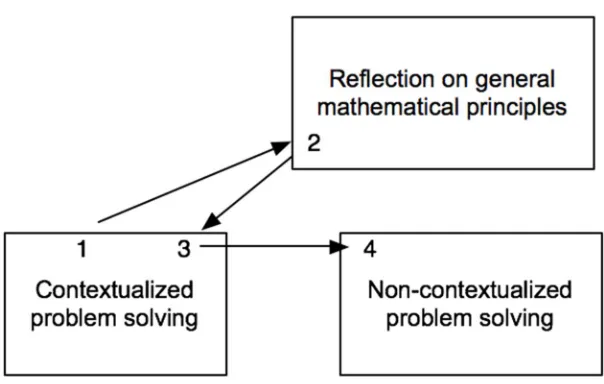
mathematics during discussions of CPs by prompting students to reflect across contexts; this type of task was not present in the written curriculum. When the progression from CPs to non-contextualized problems was preserved, students' experiences with CPs were rarely referenced during later work on non-contextualized tasks or during discussions of summative, generalizing tasks.
The analytical framework created to characterize the role of contextualized problems in the curriculum has the potential to guide research, curriculum development, and instruction. Findings around teacher adaptations and recommendations for leveraging the affordances of CPs in instruction have implications for teachers and curriculum developers.
Degree Type
Dissertation
Degree Name
Doctor of Philosophy (PhD)
Graduate Group
First Advisor
Janine T. Remillard
Keywords
algebra education, contextualized problems, mathematical modeling, mathematics curriculum
Subject Categories
CHARACTERIZING THE ROLE OF CONTEXTUALIZED PROBLEMS IN A
WRITTEN AND ENACTED ALGEBRA UNIT
Luke Reinke
A DISSERTATION
in
Education
Presented to the Faculties of the University of Pennsylvania
in
Partial Fulfillment of the Requirements for the
Degree of Doctor of Philosophy
2015
Supervisor of Dissertation:
_______________________________________
Janine Remillard, Associate Professor of Education
Graduate Group Chairperson:
______________________________________
Stanton E.F. Wortham, Judy & Howard Berkowitz Professor of Education
Dissertation Committee:
Janine Remillard, Associate Professor of Education Betsy Rymes, Associate Professor of Education
CHARACTERIZING THE ROLE OF CONTEXTUALIZED PROBLEMS IN A WRITTEN AND ENACTED ALGEBRA UNIT
COPYRIGHT 2015
ACKNOWLEDGMENT
The opportunity to enroll in graduate school and to write this dissertation has been a true privilege. How many people have the opportunity to think so hard about a topic they are curious about? I have many people to thank, and many more who deserve it; this dissertation is certainly not something I accomplished on my own.
First, I owe a great deal to “Ms. Spence.” Her love for her students continues to inspire me and I cannot thank her enough for the countless hours we spent developing the ideas in this dissertation together.
I am also greatly indebted to students who volunteered to participate in the study. As one student put it, privacy “went out the window” when that recorder was around; I hope that the final product merits the intrusion.
A number of scholars lit a passion for mathematics education inside of me. Thank you to Maggie Lampert for writing the book about “teaching with problems” and to Rico Gutstein, for encouraging me to question which problems are important.
The members of my committee helped me turn this dissertation into something I am proud of. Betsy Rymes’ perspective from outside the math education community was valuable. Andrew Brantlinger’s critical eye helped me clean up sloppy writing and thinking. And most of all, I would like to thank my advisor, Janine Remillard, for wading through drafts that were undoubtedly rough. Janine, you have supported me in countless ways over the years and I am truly grateful.
Meg Meyer, although not on my committee, was kind enough to provide feedback on an early draft of my description of the analytical framework. Several members of my Research Apprenticeship Course read early drafts of that chapter and provided valuable feedback. Susan Yoon and Joyce Lin in particular worked hard to help me clarify my thinking.
A number of friends at Amplify helped me get across the finish line; Shirley Varela and Lisa Neal were not shy in holding me accountable to their deadlines, and Drew Corley knew how to inquire as to how things were going in just the right way.
Vivian Lim helped this dissertation come about in so many ways. Vivian, thank for getting excited with me when I was excited, for commiserating with me when I was not, and for assuring me that these are ideas worth sharing. I treasure the memories I have of hashing this thing out with you and the many times you said something like, “I don’t think I understood what you were talking about before, but now I think I get it.”
While I was writing this dissertation, I lost a dear friend. Niko Harlan taught me about what is truly important in life. Learning that lesson slowed me down a bit on this particular project, and I wouldn’t trade it for anything. Thank you to Eleni, Kosta, Tamara and Eleni Jr. for accepting me into the family during it all.
My sister, Emily, provided feedback on the application and essays that got me to grad school in the first place. Emily, thank you for helping me get here and for the moral support along the way.
The birth of my son Thomas added a delightful complication along this journey. Thank you, thank you, thank you to Leigh, Paula and Mr. Edwards for the many weekends you watched the little guy when both Caroline and I had to work.
My parents also did their fair share of babysitting and so much more. Mom and Dad, I have no way to put in words all that you’ve done. Thank you for everything over the years… here’s another lanyard.
ABSTRACT
CHARACTERIZING THE ROLE OF CONTEXTUALIZED PROBLEMS IN A
WRITTEN AND ENACTED ALGEBRA UNIT
Luke Reinke
Janine Remillard
Qualitative methods were used to characterize the role of CPs in the written curriculum, the teacher’s plans, and the classroom enactment of the curriculum. Teacher interviews provided data on teacher beliefs and factors that influenced her decisions.
The role of CPs changed as the curriculum was transformed from the written page to classroom enactment. The teacher re-sequenced tasks in response to legitimate
concerns; this adaptation compromised the progression from CPs to non-contextualized problems present in the written curriculum. As a result, students had fewer opportunities to leverage their experiences with CPs to make sense of analogous non-contextualized tasks, as intended by the curriculum developers. The teacher highlighted the intended mathematics during discussions of CPs by prompting students to reflect across contexts; this type of task was not present in the written curriculum. When the progression from CPs to non-contextualized problems was preserved, students’ experiences with CPs were rarely referenced during later work on non-contextualized tasks or during discussions of summative, generalizing tasks.
The analytical framework created to characterize the role of contextualized problems in the curriculum has the potential to guide research, curriculum development, and instruction. Findings around teacher adaptations and recommendations for
TABLE OF CONTENTS
ACKNOWLEDGMENT ... III
ABSTRACT ... V
LIST OF TABLES ... X
LIST OF FIGURES ... XI
CHAPTER 1: INTRODUCTION ...1
1. Theoretical Framework ...4
1.1 Transformation of Curriculum ... 4
1.2 Contextualized Problem solving as a Basis for Learning Mathematics ... 5
2. Research Questions ...8
3. Setting ... 10
3.1 Core-Plus Mathematics: Contemporary Mathematics in Context ... 10
3.2 Participating Teacher ... 11
3.3 School Setting ... 11
4. Data Set ... 12
4.1 Document Analysis ... 12
4.2 Observations and transcripts ... 13
4.3 Interviews ... 14
5. Summary ... 14
CHAPTER 2: TOWARDS A FRAMEWORK FOR ANALYZING THE ROLE OF CONTEXTUALIZED PROBLEMS IN MATHEMATICS INSTRUCTION ... 15
1. Introduction ... 17
2. Theoretical Perspectives ... 21
2.1 Perspectives on Conceptual Model Building ... 21
2.2 Perspectives on the Use of Contextualized Problems in Mathematics Instruction ... 22
3. Empirical Testing ... 35
3.1 Setting and Participants... 35
3.2 Data Sources... 37
3.3 Data Analysis ... 37
4. A Framework for Analyzing the Role of Contextualized Problems in Mathematics Instruction ... 40
4.1 Activity Types in the CPMI Framework ... 41
4.2 Activity Types within the Contextualized Problem solving Category... 47
5. Application of the CPMI Framework ... 52
6. Conclusions ... 57
CHAPTER 3: THE ROLE OF CONTEXTUALIZED PROBLEMS IN INSTRUCTION: ONE TEACHERS’ TRANSFORMATION OF THE WRITTEN CURRICULUM ... 61
1. Introduction ... 62
2. Theoretical Framework ... 67
2.1 Teacher Intended Curriculum ... 67
2.2 Studying Teacher Practice... 70
3. Method ... 71
3.1 Curriculum, Instructional Context, and Study Participant ... 71
3.2 Data sources ... 73
3.3 Analysis ... 74
4. Findings ... 84
4.1 Modifications to the Progression from Contextualized Examples to Non-Contextualized Examples ... 85
4.2 Modifications to the Placement of Reflection on General Mathematical Principles Relative to Contextualized Examples ... 92
4.3 Supplementing with Connecting Activities... 98
4.4 Summary of Findings... 103
5. Discussion ... 105
CHAPTER 4: “I WANTED THEM TO GET THE CONNECTION”: THE ROLE OF INSTRUCTIONAL COHERENCE IN PROMOTING GENERALIZATION
FROM CONTEXTUALIZED PROBLEMS ... 114
1. Introduction ... 115
2. Review of Relevant Literature ... 117
2.1 Rationale for Contextualized Problem Based Instruction ... 118
2.2 Potential Obstacles to Student Learning from CP-based Instruction ... 120
2.3 Conceptual Framework ... 124
3. Research Design ... 126
3.1 Setting and Participants... 128
3.2 Data ... 129
3.3 Data Analysis ... 132
4. Results ... 137
4.1 Episode 1: Illustrating Connections Between Problems Set in Different Contexts .. 137
4.2 Episode 2: Attending to General Mathematical Principles during Contextualized Problem solving ... 146
4.3 Episode 3: Illustrating the Absence of Explicit Connections Between Contextualized and Non-contextualized Problems... 152
4.4 Episode 4: Illustrating Inconsistent Reference to Previous Contextualized Work While Summarizing Generalizing Mathematical Principles ... 161
4.5 Summary of the Findings ... 164
5. Instructional Coherence Across Task Sequences ... 167
6. Conclusions and Implications ... 172
CHAPTER 5: CONCLUSION ... 176
1. Summarizing the Findings ... 177
2. Implications for Further Research ... 179
2.1 Profiling CP-based instructional approaches using the CPMI ... 179
2.2 Digging Deeper into Student Responses to CP-based Instruction ... 181
2.3 Teachers’ Use of CP-based Curriculum... 185
3. Conclusion ... 186
LIST OF TABLES
The composition of Core-Plus Course 1, Unit 2: Patterns in Data ... 13
The composition of Core-Plus Course 1, Unit 3: Linear Functions ... 13
Frequency of Explicit References to Previously Worked Examples ... 142
LIST OF FIGURES
Figure 1. A common graphical representation of the act of modeling (adapted from Lesh &
Zawojewski, 2007; Niss, Blum, & Galbraith, 2007) ... 23
Figure 2. A graphical representation of Gravemeijer’s (1997) distinction between translating and organizing approaches to modeling ... 30
Figure 3. RME and MMP activity types ... 31
Figure 4. Opportunities for abstraction in the various RME and MMP activity types ... 34
Figure 5. The overall structure of the CPMI framework ... 41
Figure 6. Sub-categories within contextualized problem solving ... 48
Figure 7. The Contextualized Problems in Mathematics Instruction (CPMI) framework ... 51
Figure 8. The traditional role of contextualized problems in mathematics instruction ... 54
Figure 9. RME and MMP-aligned instruction emphasizing problem solving in “real-world” settings ... 55
Figure 10. Map of Unit 3, Lesson 1, Investigation 1 in the Core-Plus written curriculum ... 78
Figure 11. An excerpt from Core-Plus, Course 1, Unit 3, Lesson 1, Investigation 1 and the corresponding codes that were assigned to each TCT (p. 151) ... 79
Figure 12. Map of Ms. Spence’s Intended Curriculum Unit 3, Lesson 1 ... 83
Figure 13. Ms. Spence’s intended curriculum for Course 1, Unit 3, Lesson 1, Investigation 1 and the corresponding codes that were assigned to each TCT ... 83
Figure 14. Comparison of the Written and Teacher’s Intended Curriculum of Core-Plus Course 1, Unit 3, Lesson 2 ... 88
Figure 15. Three types of instructional activity framing the study... 125
Figure 16. A record of which groups were recorded during each class session ... 131
Figure 17: Examples of generalization statements and questions ... 134
Figure 18: Examples of references to prior contextualized examples and the codes that were assigned. ... 136
Figure 21. Non-contextualized examples in Investigation 1 ... 153
CHAPTER 1: INTRODUCTION
Mathematics teachers and curriculum designers are frequently urged to connect instruction to students’ interests and to real-world applications that exist outside of the classroom. Recent policy documents in the US (Common Core State Standards Initiative, 2010; National Council of Teachers of Mathematics, 2014), for instance, highlight the need for students to be able to solve real-world problems. Numerous curriculum
programs have been created to leverage the use of contextualized problems, or problems that refer to contexts that exist outside the realm of mathematics, including Core-Plus Mathematics: Contemporary Mathematics in Context (Hirsch, Fey, Hart, Schoen, & Watkins, 2008), Mathematics in Context (National Center for Research in Mathematical Sciences Education & Freudenthal Institute, 1998), and Everyday Mathematics
(University of Chicago School Mathematics Project, 2004). Unlike curricula which position traditional word problems as application problems at the end of instructional sequences, these curricula tend to place contextualized problems at the beginning of instructional sequences, in hopes that students will invent various ways to solve problems for which solution strategies have not been provided. Despite recommendations for the use of contextualized problems in mathematics instruction and the development of curricula which emphasize contextualized problem solving, evidence suggests that many teachers do not frequently make connections to the real-world in the classroom
significant foothold in the market in middle and high school classrooms (Banilower et al., 2013).
The potential affordances of contextualized problems [CPs] are numerous. CPs are thought to aid in the transfer of mathematical knowledge to situations outside of the mathematics classroom (Boaler, 1993) and highlight the relevance of the mathematics being learned (Boaler, 1993; NCTM, 2000). Advocates argue that these problems also provide the opportunity to leverage students’ non-mathematical knowledge as a bridge towards mathematics understanding (Freudenthal, 1973; Moses & Cobb, 2001). Socially, culturally, and politically relevant contexts have been used to connect mathematics instruction to students’ out-of-school expertise and promote engagement (Civil, 2007; Gutstein, 2006; Moses & Cobb, 2001; Tate, 1995).
real-world must be suspended and only the information given is relevant. In response, many teachers view non-mathematical contexts as wrappers that students needed to strip away to solve problems (Chapman, 2006).
A better understanding of how the potential affordances and complications inherent to contextualized problems play out in mathematics classroom would provide important insight into how to maximize the benefits of CP-based curricula. Research into the use of CPs in actual classrooms would provide possible reasons why curriculum programs that emphasize CPs might not be implemented as intended, explanations for why these curricula are not used in more classrooms, and insight into how CP-based curricula could be improved.
In this study, I examine the implementation of curriculum program called Core-Plus Mathematics (Hirsch et al., 2008), which is a high school curriculum that
emphasizes mathematical modeling and contextualized problem solving. By examining the written curriculum, a teacher’s plans for implementing Core-Plus lessons, and the resulting classroom instruction, I describe how the demands, complications and supports inherent to instruction based in contextualized problems play out in a high school
1. Theoretical Framework
1.1 Transformation of Curriculum
This study was designed on the assumption that the effect of a curriculum cannot be understood by simply examining student learning outcomes. To fully understand the impact of a curriculum, one must examine the process through which the written curriculum is transformed into actions. Stein, Remillard and Smith (2007) provide a framework for describing the temporal phases of curriculum as it is transformed from the written page (the written curriculum), to the teachers’ plans (the intended curriculum), and finally to the events that take place in the classroom (the enacted curriculum).
Through a detailed review, Stein et al. conclude that the written curriculum is only one of many components that influence what occurs in mathematics classrooms. To support this claim, the authors cite research demonstrating that written curriculum materials are implemented very differently by different teachers in terms of the amount of the
Martin, 2006). In this study, I aim to characterize the transformation that occurs as the curriculum is implemented and to provide insights into the factors that mediate this transformation. To achieve these aims, I follow one unit of the curriculum as it is transformed from the written page, to the teachers plans, and finally to enactment in the classroom.
1.2 Contextualized Problem solving as a Basis for Learning Mathematics
Three primary assumptions guided my examination of the Core-Plus curriculum. The first is that students can learn new mathematics as they solve novel problems, whether they are contextualized in an extra-mathematical setting or not. The second assumption complicates that notion, and introduces the need for students to be familiarized with mathematical conventions that are arbitrary and socially constructed. The third principle bridges the two, stating that the use of concrete, real-world contexts can provide support for developing students’ understanding of formal mathematical concepts, but also that these problem solving experiences must be supplemented by other types of mathematical activity for adequate learning to occur. In this subsection, I outline the theoretical basis for all of these assumptions.
the process as follows: “(1) problems are identified [by students]; (2) problems are studied through active engagement; (3) conclusions are reached as problems are (at least partially) resolved” (Hiebert et al., 1996, p. 14). Hiebert et al. support Dewey’s claim by citing empirical research, much of which is focused at the elementary level, showing that students who learn mathematics through problem solving develop richer understandings of the number system than peers taught in a skills-based manner (Cobb et al., 1991; Hiebert & Wearne, 1993) and are able to flexibly solve new problems (Fennema, Franke, Carpenter, & Carey, 1993; Fuson & Briars, 1990; Hiebert & Wearne, 1993; Kamii & Joseph, 2004; Wearne & Hiebert, 1989).
The developers of Core-Plus also cite the work of Schoenfeld (1992), who offers a complementary view of ideal mathematics instruction. He argues that “students develop their sense of mathematics- and thus how they use mathematics- from their experiences with mathematics (largely in the classroom)” and proposes that “classroom mathematics must mirror this sense of mathematics as a sense-making activity, if students are to come to understand and use mathematics in meaningful ways” (p. 339). Schoenfelds’ literature review cites numerous examples at various educational levels of instruction that focus on developing students’ ability to solve novel problems, and he argues that the traditional textbook structure (the introduction of a mathematical technique, followed by an illustrative example then repetitive practice) does not offer students the opportunity to develop a mathematical, sense-making disposition. In light of the research cited by Schoenfeld (1992) and Hiebert et al. (1996), the proposed study, like the Core-Plus
The second principle the study was designed upon provides a complicating notion. Dowling (1998) contends that from a socio-cultural viewpoint, mathematics education must apprentice students into the formal practices and conventional language and understandings of the mathematically elite. He critiques instruction aligned with the reform movement, arguing that too narrow of a focus on student discovery and
contextualization in “real-world” situations deemphasizes disciplinary conventions, many of which are arbitrary, socially-constructed, and not accessible by intuitive construction. In recognition of this critique, this study will consider the degree to which problem-based discovery leads to, or is balanced by the formalization of conventional mathematical practices.
The third principle involves the relationship between formal mathematics and the use of real-world problems. In their description of the design of the Core-Plus curricula, Schoen et al. (2010) explain that many Core-Plus instructional sequences begin with verbally presented problem settings set in concrete, familiar settings and that the use of formal mathematical language and symbols is intentionally delayed. This design characteristic is connected to a third assumption significant to the proposed study: students’ understanding of formal mathematics concepts can be anchored to their common sense understanding of real-world phenomena. This idea, popularized by
investigations (Hirsch, personal communication, 6/15/11; Fey, personal communication, 7/25/11).
2. Research Questions
To compare the role of contexts across the written, intended, and enacted
curriculum, I first needed a consistent analytical lens that could be used in each of these three phases. In the first manuscript (Chapter 2), entitled Towards a framework for analyzing the role of contextualized problems in mathematics instruction, I describe the development of an analytical framework used to describe the role of contextualized problems in the Core-Plus curriculum. The development of the framework was guided by the following questions:
1. What are the critical problems of practice in instruction that emphasizes learning through contextualized problem solving, as identified in the literature and/or from the study of practice?
2. What sorts of tasks, questions and statements are possible (from teachers, students, and curriculum materials) within contextualized mathematics instruction?
3. How can these tasks, questions and statements be organized so as to clarify significant problems of practice and suggest potential ways to navigate effective solutions?
In the second manuscript (Chapter 3), entitled The role of contextualized problems in instruction: one teachers’ transformation of the written curriculum, I use the
framework to analyze how the role of CPs was transformed as the curriculum
transformed from the written page to the teachers’ plan for enactment. This portion of the study was guided by the following questions:
1. What are the patterns in the way the teacher selected, sequenced, adapted, and supplemented the tasks offered by the textbook? How did her intended
curriculum compare to the written curriculum, especially in regard to problems referring to extra-mathematical contexts?
2. What are the factors that influenced how the teacher transformed the CP-based curricula from the written curriculum to plans for enactment? What influenced how she selected, sequenced, adapted, and supplemented tasks?
Finally, to understand the role of extra-mathematical contexts in the resulting enactment of the curriculum, I performed a third study, described in the third manuscript, ‘I wanted them to get the connection:’ the role of instructional coherence in promoting
generalization from contextualized problems. This portion of the study was guided by the following questions:
1. To what extent and in what manner are generalizations made explicit during work on CPs?
2. To what extent and in what manner are CPs referenced during work on other CPs?
3. To what extent and in what manner are CPs explicitly referenced during non-contextualized work?
3. Setting
In this section, I describe the Core-Plus curriculum, the participating teacher, and the school setting in which the study took place.
3.1 Core-Plus Mathematics: Contemporary Mathematics in Context
Fey and Hirsch (2007) describe the Core-Plus lesson sequence as a modified “ launch-explore-summarize model”. In this model, a problem situation provides the stimulus for whole-class discussions during which the teacher can informally assess students’ prior understandings. Then, students are to work in small groups to solve a series of problems. The findings from these problem sessions are to be summarized in a final whole-class discussion. Schoen and Hirsch (2003) describe the “summarize” stage as a “teacher-moderated class discussion in which students share mathematical ideas developed by their groups and together construct a common understanding of important mathematical concepts, methods, and approaches” (p. 315).
In their description of a longitudinal study of the curriculum Schoen et al. (2010) briefly describe the curriculum level instructional sequence:
In order to accommodate the learning needs of all students, especially in Courses 1 through 3, most investigations and sequences of investigations are constructed so that the entry point is familiar and concrete to students – usually more verbal than symbolic. Development of robust concept images (Tall, 1991) precede formal definitions that often appear at the end of an investigation or lesson. Similarly, use of symbols is delayed and developed gradually, with the symbols and symbolic operations drawing meaning from the earlier, more concrete settings. (p. 9)
The student text reads like a series of tasks and questions that the students are intended to engage with, either as a whole class, in small group, or individually.
3.2 Participating Teacher
The teacher I partnered with on this project, whom I refer to with the pseudonym Brenda Spence, was a veteran teacher who enrolled in a course that I assisted with at the
university. Through her participation in the course, the two of us came to know each other and began to discuss our mutual interest in researching the Core-Plus curriculum. She was an ideal participant in this study for a number of reasons. First, she was an experienced curriculum user. She had over 20 years of teaching experience, with 13 years of experience implementing Core-Plus. Furthermore, she had participated in a great deal of professional development specifically targeting Core-Plus implementation. Most importantly, she was excited about participating in this research because of the potential the project had to help her understand how her students experience the curriculum.
3.3 School Setting
The school in which the study took place was a comprehensive high school in a small school district on the east coast. The school was composed of approximately 2000 students; about half of the students were eligible for free or reduced lunch.
implemented the Core-Plus curriculum in two different settings. The first section was a general admission 9th grade Integrated Math I class with no admittance restrictions. The other section, a 9th/10th grade Integrated Mathematics 1-2 split class, was available only to young men of color. This section was originally created to provide students who had not passed Integrated Mathematics 1 a chance to cover Integrated Mathematics 1 and 2 in one year. The purpose of the class had shifted, though, and during the year of the study, some of the students in the class were first time ninth graders who, upon completion of the class, would be on track to take AP math classes during their senior year. Although I observed both classes, the transcripts analyzed here are of the general admission class because I was unable to obtain consent from a sufficient number of students in the Integrated Math 1-2 split class.
4. Data Set
Data collection took place over the course of four months and consisted of document collection, teacher interviews, class observations and recordings of class sessions.
4.1 Document Analysis
Table I
The composition of Core-Plus Course 1, Unit 2: Patterns in Data
Lesson Number of Investigations Recommended Pacing Lesson 1 2 investigations 7 days
Lesson 2 5 investigations 11 days Lesson 3 1 investigation 1 day
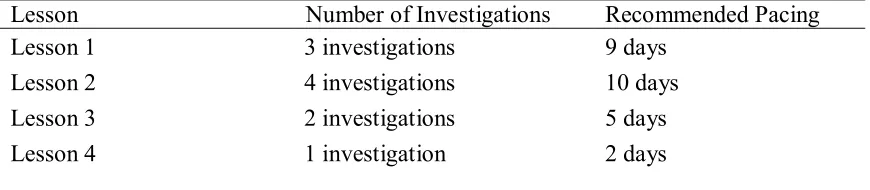
The algebra unit, focused on linear functions contained four lessons and was intended to span 26 instructional days, as shown in Table II.
Table II
The composition of Core-Plus Course 1, Unit 3: Linear Functions
Lesson Number of Investigations Recommended Pacing Lesson 1 3 investigations 9 days
Lesson 2 4 investigations 10 days Lesson 3 2 investigations 5 days Lesson 4 1 investigation 2 days
4.2 Observations and transcripts
4.3 Interviews
I interviewed Ms. Spence once at the beginning of the study to gain an understanding of her conceptions about the use of contextualized problems in mathematics instruction and the Core-Plus curriculum. I also conducted twenty post-observation interviews to gain insight into her design decisions and her perception of how students responded to the lessons.
5. Summary
The aim of this study was to characterize the role of extra-mathematical contexts in the written, intended, and enacted Core-Plus curriculum. I analyzed curriculum materials to gain insight into the way these contexts were employed in the curriculum. I interviewed Ms. Spence, an experienced user of Core-Plus, in order to characterize her conceptions of the role of extra-mathematical contexts and the way these conceptions influenced her participation with the curriculum materials. And finally, I observed as Ms. Spence taught 78 lessons. I analyzed transcriptions of classroom audio recordings, field notes, and student interview data to gain insight into the way Ms. Spence and her students responded to CPs and the factors that mediated these responses. The three chapters that follow, written in the form of stand-alone papers, represent three different analytical
approaches I took to characterize the role of contextualized problems in the written,
CHAPTER 2: TOWARDS A FRAMEWORK FOR ANALYZING THE ROLE OF
CONTEXTUALIZED PROBLEMS IN MATHEMATICS INSTRUCTION
Abstract
Mathematics teachers are frequently urged to connect mathematics instruction to real-world problem settings, but research suggests that teachers do not consistently incorporate problems that refer to real-world contexts into instruction (Banilower et al., 2013; Hiebert et al., 2003). One potential explanation for this tendency is that teachers focus on the affective benefits of contextualized problems rather than the potential for these problems to help students construct an understanding of mathematical ideas (Pierce & Stacey, 2006); and, because of these beliefs, teachers might omit these problems when pressed for time (Gainsburg, 2008). Another is that teachers may lack a nuanced
understanding of how contextualized problems can be used to develop new mathematical knowledge (Lee, 2012). To assist teachers, teacher educators, and the research
community in developing a shared language for describing instruction that leverages real-world contexts, this article proposes an analytical framework, developed through
synthesis of existing theory and analysis of the implementation of a Standards-based high school mathematics curriculum. The framework, which I call the Contextualized
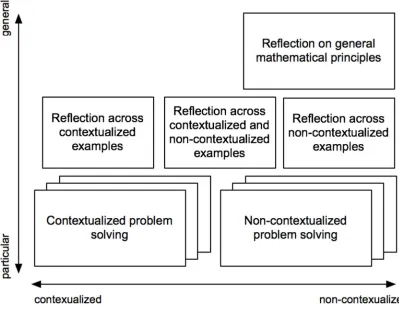
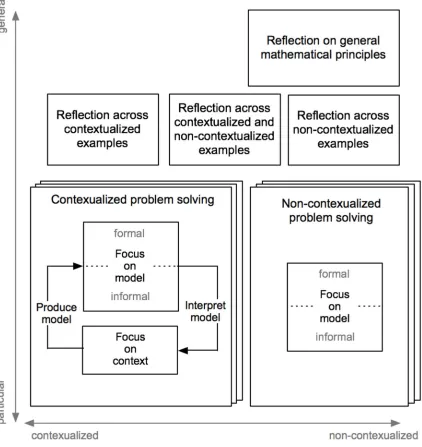
particular/general and contextualized/non-contextualized. Grounded in theoretical and empirical research, the framework has the potential for use across the mathematics
1. Introduction
Mathematics teachers and curriculum designers are frequently urged to connect instruction to students’ interests and to real-world applications that exist outside of the classroom. This idea is not new (Dewey, 1902; Whitehead, 1929), but it plays a prominent role in reform efforts in a number of countries, as evidenced by published standards and curriculum documents (e.g. Common Core State Standards Initiative, 2010; Ministerie van Onderwijs, Cultuur en Wetenschappen (OCenW), 2004; Ministry of Education, 2007). One way of connecting to the world outside the mathematics classroom is through the use of contextualized problems (CPs), or problems that reference contexts that exist outside the mathematical domain. Research has shown that certain types of CP can be used to bring out students’ intuitions and informal strategies, and this informal work can then be leveraged to facilitate students’ learning of more conventional or formal mathematics (Carpenter, Fennema, & Franke, 1996; Gravemeijer, 1994; Greeno & The Middle-School Mathematics through Applications Project, 1997; Technology Group at Cognition and Technology Group at Vanderbilt, 1997). In light of this research,
curriculum designers have developed numerous curriculum programs that emphasize CPs and position these problems at the beginning of instructional sequences. In the US, the development of these programs was funded by the National Science Foundation [NSF] (Senk & Thompson, 2003); the titles of many of these programs demonstrate an emphasis on context (e.g. Everyday Mathematics and Core-Plus: Contemporary Math in Context).
so. In the 1999 TIMSS Video Study, investigators found that, with the exception of the Netherlands, the percentage of problems that were set up with the use of a real-life connection ranged from 9 to 27% (Hiebert et al., 2003). More recently, in a 2012 US survey, only 45% of elementary, 42% of middle school, and 29% of high school math teachers surveyed report heavily emphasizing real-life applications of mathematics through the use of CPs or otherwise (Banilower et al., 2013). The survey also showed that, of those who responded, only 25% of elementary, 11% of middle and less than 1% of high school classes use NSF-supported curricula.
Researchers have identified a number of factors that explain why teachers might infrequently use CPs or otherwise make connections between mathematics instruction and real-world contexts. Teachers have difficulty identifying or finding ideas that are relevant (Gainsburg, 2008, 2009; Nicol, 2002; Schmidt, 2011) and, once these contexts are identified, teachers have trouble maintaining the contextual link when attempting to bring these ideas to the classroom (Nicol, 2002). Teachers also feel constrained by the class time needed to make these connections and a lack of material resources to support this type of teaching (Gainsburg, 2008, 2009; Schmidt, 2011).
problem according to the procedures practiced during the lesson (Gerofsky, 2004, p. 34). The belief that contextual settings are “extras” is a reasonable response to this traditional positioning of word problems.
Another reason that teachers would tend to not make connections to the world outside of mathematics is that some teachers tend to think of real-world connections primarily as tools to demonstrate the relevance of mathematics or to motivate students (Gainsburg, 2008, 2009; Pierce & Stacey, 2006). It is likely that teachers who do not see real-world contexts as potential scaffolds for the development of students’ mathematical understanding tend to sacrifice the use of contextualized problems when constrained by time (Gainsburg, 2008).
In other cases within the field where disparities have been observed between researchers recommendations and classroom practices, analytical frameworks have been developed to help teachers understand and enact recommendations from the research community. Specifically, researchers have developed analytical frameworks that provide a system of describing and categorizing various aspects of instruction, including the cognitive demand of tasks (Stein, Smith, Henningsen, & Silver, 2000), problem types within a particular mathematical domain (Carpenter et al., 1996), teacher question types (Boaler & Brodie, 2004), and student solution strategies (Carpenter et al.). These frameworks provide a common language to facilitate communication between teachers, teacher educators, researchers, and curriculum developers. Professional development around these frameworks has been shown to improve instruction (Boston & Smith, 2009; Carpenter et al.). In sum, frameworks are local theories that provide a technical
bridge the significant divide (Heid et al., 2006) between research and practice (Smith, 2012).
In this article, I offer an analytical framework called the Contextualized Problems in Mathematics Instruction framework [CPMI], which is designed to classify
instructional activity according to how that activity references extra-mathematical contexts,1 or contexts that exist outside the realm of mathematics. My intent is for this
framework to be used by teachers, curriculum designers and researchers to analyze, understand, and communicate about instruction featuring CPswwww. The framework was developed through iterative cycles of theoretical and empirical research: ideas from the literature were tested as analytical categories for describing empirical observations; when these ideas were insufficient, further literature was consulted. For the sake of organization and readability, this article represents the process in a simplified, linear manner. In section two, I outline theoretical perspectives that significantly informed the resulting analytical framework. In the third section I explain the role of the empirical research in the development of the framework. The framework is presented in the fourth section. In the fifth section, I describe examples of applications of the framework; and, I conclude by discussing the implications and limitations for research and practice.
1The term ‘real-world’ is often used to describe any statement, question or task that refers
to a phenomenon existing outside the realm of mathematics. Researchers frequently critique the authenticity with which these phenomena and the related tasks are presented within mathematics instruction (e.g. Palm, 2006; Vos, 2011). I use the term
2. Theoretical Perspectives
2.1 Perspectives on Conceptual Model Building
Sloane and Gorard (2003) identify three stages in the process of building conceptual models like the analytical framework proposed here: formulation, estimation, and validation. This article reports on the first stage. My approach to formulating a
conceptual model for analyzing instruction aligns strongly with the models and modeling perspective (MMP) described by Lesh and Zawojewski (2007). MMP theorists use the term model in multiple ways. Students build conceptual, mathematical models in response to problems; teachers and researchers create models for interpreting classroom activity. Lesh, English and Fennewald (2008) suggest that the latter type of conceptual models, like the one proposed here, are often developed first to understand local
instructional contexts with the goal of producing powerful, generalizable analytical tools: We do not expect realistic solutions to realistically complex problems to be solved by single research studies, nor even by single theories. Instead, what are most needed are models which are embodied in artifacts and tools that are designed to be powerful, sharable, and reusable. Such models also need to integrate ways of thinking drawn from a variety of practical and theoretical perspectives. (Lesh et al., 2008, p. 3)
The categories that compose the CPMI framework did not originate from a single theoretical source; instead, they were derived from a number of perspectives.
could not be described using the set of categories I had developed, I searched for literature that described the activity I observed. The framework was organized and re-organized through multiple iterations of this process; along the way, I identified, tested and ultimately discarded numerous ideas from the literature. The categories that make-up the CPMI framework were the most helpful for making sense of the classroom activity. As a consequence of this process, the resulting framework is grounded both in theory and empirical observation.
2.2 Perspectives on the Use of Contextualized Problems in Mathematics Instruction
A number of established theoretical perspectives informed the development of the framework; I describe these perspectives below. Because a primary goal for the CPMI framework is to provide a language for describing how CPs can be leveraged to help students learn new mathematical ideas, I first review two perspectives on mathematical modeling that specifically aim to develop students’ understanding of new mathematical concepts. Then, to provide additional insight into how students develop mathematical understanding through the types of activity recommended by those modeling theorists, I review multiple perspectives on how learners construct mathematical abstractions.
2.2.1 Mathematical Modeling
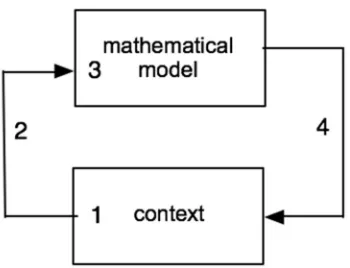
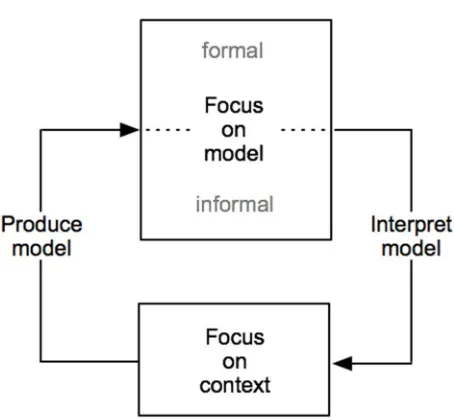
representation frequently used to describe an idealized, simplified version of the mathematical modeling process is shown in Figure 1. In this description, the process of modeling consists of (1) developing a model of the context or situation in the physical world by identifying the aspects of the situation relevant to the question at hand, (2) representing this model in the mathematical realm by creating one or more mathematical models (represented by the upward arrow), (3) working with the mathematical model or models to obtain a mathematical result or solution, and (4) interpreting this result in terms of the extra-mathematical context or situation (represented by the downward arrow). The process is typically described as a cycle; if, during step four, the solution is not deemed viable, the four steps are repeated.
Figure 1. A common graphical representation of the act of modeling (adapted from Lesh & Zawojewski, 2007; Niss, Blum, & Galbraith, 2007)
Within the field of modeling, a number of perspectives have emerged, each with different aims and philosophical foundations (Kaiser & Sriraman, 2006). In particular, two goals for integrating modeling tasks within mathematics instruction are identified (Niss et al., 2007). One approach is for students to engage in modeling tasks once they have already been exposed to mathematical tools that could be used to solve the task. The primary goal for these sorts of tasks is for students to gain competency in the act of mathematical modeling. Another goal is for the act of modeling to serve development of new mathematical ideas; in this approach, modeling tasks are often positioned at the beginning of instructional sequences. Because the purpose of this paper is to develop a framework for describing how CPs can serve as a scaffold for the development of new mathematical understanding, I focused on the latter approach in my review of the literature.
Within the category of approaches that aim to develop students’ mathematical understanding, two perspectives are particularly prominent: the Models and Modeling Perspective (MMP) and the Dutch theory of Realistic Mathematics Education (RME). MMP and RME have different philosophical roots and their aims specific aims are
2.2.2 Models and Modeling Perspective
The MMP perspective described by Lesh and Doerr (2003a) is a theoretical perspective grounded in constructivism and American pragmatism. MMP theory is used to describe instructional activities, the ways teachers make sense of instruction, and an approach to educational research designed to solve complex problems (Lesh & Doerr, 2003c). Classroom instruction designed from the MMP often centers on a certain type of CP called model-eliciting activities: problems that allow for multiple strategies and prompt students to use informal knowledge to build models that help them solve
problems. According to MMP advocates, cycles of modeling activities prompt students to develop powerful conceptual systems to describe foundational, elementary
mathematical topics (e.g. ratio, linear relationships). For instance, one problem in the MMP literature requires students to create a kit that would help the user determine the height of a person from a footprint (Lesh & Doerr, 2003b). These model-eliciting
situations are designed so that students can develop models of fundamental mathematical concepts that can later be used to understand a wide range of situations (e.g., models for proportional reasoning in the footprint example).
Model-eliciting activities differ from traditional word problems in two significant ways. Whereas traditional word problems are usually presented completely through text or mathematical symbols, model-eliciting activities are often presented through a variety of representational media including pictures or concrete models. Second, and more importantly, model-eliciting activities are meant to prompt students to construct
traditionally placed at the end of an instructional sequence and students are intended apply mathematical procedures they have already learned (Gerofsky, 2004).
Model-eliciting activities represent one stage within larger instructional sequences called model development sequences (Lesh, Cramer, Doerr, Post, & Zawojeski, 2003).
Each sequence begins with a warm-up often centered on the real-world (e.g., a newspaper clipping) setting. The warm-up is used to familiarize students with the real-world context and provide space for the teacher to assess students’ understandings of the prerequisite concepts. Next, a model-eliciting activity is posed to the students, wherein they are
expected to answer a question by developing models that describe their thinking. In these activities, students are meant to evaluate the appropriateness of their models and refine the models through iterative cycles of development and evaluation. In a subsequent
2.2.3 Realistic Mathematics Education: modeling and reflection
The modeling approach described above shares a number of key characteristics with the Dutch theory of Realistic Mathematics Education [RME], although the historical origins and primary aims of RME and MMP are different. The theory of RME is
founded in the work of Freudenthal (1973, 1991), who believed that students’
understanding of formal mathematics should be deeply connected to their common sense. Like MMP model development sequences, RME instructional sequences aim to develop students’ understanding of foundational mathematical ideas like proportional reasoning or linear relationships. The two perspectives differ, though, in that RME provides more detailed descriptions of how this activity can lead students to develop an understanding of formal conventions and procedures, which are less of a focus in MMP instructional sequences. By working with models that become increasingly formal, students are prompted to reinvent formal mathematical conventions, such as the long-division algorithm or fractional notation (Gravemeijer, 1994). The developers of RME refer to four distinct levels of activity, described below.
Instructional sequences based on RME typically begin with a CP based in a setting that is imaginable to the students (Gravemeijer, 1994).2 For instance, in one
frequently cited example, students are required to divide pizzas among a group
2
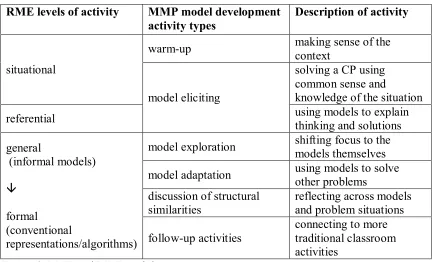
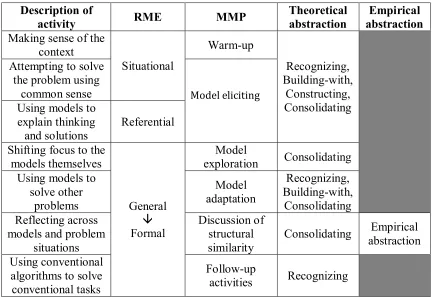
(Streefland, 1991). In this first situational level of the process, students work within the task setting, using only their common sense to solve the problem. The second level is called the referential level. Here, students’ activity in the task setting becomes the subject of their reflection. Students reflect on and discuss their own solutions to the problem. During this process, students are encouraged to draw or build various types of models to help them communicate and organize their thinking. The term model, in RME, refers to visual representations or descriptions of strategies—any way of describing activity in the situational level; in the pizza example, for instance, students might draw and divide circles to represent the act of dividing pizzas. Together, the first two stages of the RME levels align to a certain degree with the model-eliciting activities described by Lesh et al (2003). In the first stages of both perspectives, students create informal models in response to problems set in real-world contexts. (Figure 3 summarizes how the levels of RME and stages of the MMP model-development sequences align.)
In the third level of RME, the general level, students’ informal models are no longer tied to a specific situation; instead they function as entities that stand alone and represent mathematical relationships. In the pizza example, the act of drawing and dividing of circles, a “model of” the act of dividing the pizzas, becomes a “model for”
At the final stage of RME instructional sequences, students operate at the formal
level where they reason with formal algorithms without the need for models. These formal algorithms are either developed by students or shared by teachers who connect them to the less formal strategies students developed in earlier stages. In the pizza example, students at the formal level would perform computations with fractions without drawing pictures. The process of building from common sense activity in a task setting to the re-invention of formal mathematics is, in its entirety, called “progressive
mathematization” (Gravemeijer, 1994).
To further clarify the way contextualized problem solving leads to the abstraction of formal mathematics, Treffers (1987) describes processes of mathematizing both horizontally and vertically. Horizontal mathematization is the act of cropping and organizing the information one understands about the world into models that allow this information to be worked with; horizontal mathematization is most prominent at the first two levels described above: the situational and referential levels. Vertical
mathematization involves reflecting on informal models and organizing the relationships present in these models to develop an understanding of formal mathematics; vertical mathematization is the emphasis of the general and formal levels.
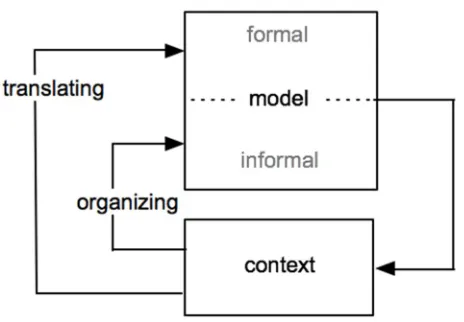
Gravemeijer (1997) provides a nuanced explanation of how the RME approach to modeling relates to the common description of modeling represented in Figure 1. He describes two approaches to modeling, which I have represented visually in Figure 2. In a translating approach, students translate the elements of a problem situation to some known, formal mathematical model. RME, on the other hand, takes an organizing
informal models. These informal models become the basis for making sense of more formal models, consisting of conventional mathematical language, algorithms, and principles. The RME approach to modeling aligns significantly with the type of activity described in MMP; in both instructional design theories students are meant to develop their own informal models to solve contextual problems.
Figure 2. A graphical representation of Gravemeijer’s (1997) distinction between translating and organizing approaches to modeling
Figure 3 shows how the levels of RME and the stages of the model-development sequences from MMP align. Most significantly, in both approaches, the instructor guides students to reflect on their self-produced, informal models, and this leads to an
processes. The RME levels distinguish between the types of models that are being used, and the MMP labels focus more on what students do with the models.
RME levels of activity MMP model development activity types
Description of activity
situational
warm-up making sense of the context
model eliciting
solving a CP using common sense and
knowledge of the situation referential using models to explain
thinking and solutions general (informal models) formal (conventional representations/algorithms)
model exploration shifting focus to the models themselves model adaptation using models to solve
other problems discussion of structural
similarities
reflecting across models and problem situations follow-up activities
connecting to more traditional classroom activities
Figure 3. RME and MMP activity types
2.3 Perspectives on Abstraction
provide a different, more general kind of lens compared to the RME and MMP literature. I review two perspectives on abstraction in this section: empirical and theoretical.
According to the classical, or Aristotelian view of abstraction, a learner begins the process of constructing a new concept by first identifying commonalities across a number of particulars; this process is often referred to as generalization (Dörfler, 1991; Ohlsson & Lehtinen, 1997). When an individual focuses on these commonalities while ignoring other properties or the particulars themselves, these common properties have been
abstracted (Skemp, 1987). The product of this process, an understanding of the property at hand, is termed an abstraction. Skemp defines an abstraction as “some kind of lasting mental change, the result of abstracting, which enables us to recognize new experiences as having the similarities of an already formed class” (1987, p. 11). This view of
abstraction is called empirical abstraction.
Some contemporary views on abstraction offer the perspective that empirical abstraction theories are insufficient for explaining how individuals develop scientific knowledge, including mathematics (Davydov, 1990; Ohlsson & Lehtinen, 1997). Such scholars prefer a more constructive characterization of abstraction that attends to the activity (often social) in which the abstraction is built. This form of abstraction, detailed by Davydov (1990), is often referred to as theoretical abstraction.
Hershkowitz, Schwartz and Dreyfus (2001), adopt Davydov’s theoretical abstraction perspective to construct a model of “abstraction in context.” They use this model, called the RBC+C model, to represent how students refine and crystallize
recognizing involves perceiving conditions related to a previously constructed abstraction and bringing the previous abstraction to mind. Building-with involves connecting two previously constructed abstractions. Both of these types of actions are nested within the larger action of constructing a new abstraction by assembling and organizing previously constructed abstractions into a new mental structure. At first, the stability of a students’ understanding of a concept might be fragile, demonstrated if they are easily talked out of an idea or slow to use the idea in another situation. Consolidation is said to have occurred if students can verbalize an idea or recognize and build-with a concept in subsequent situations. Hershkowitz et al. (2007) use the RBC+C model to characterize observed instances of vertical mathematization.
A number of scholars have used the RBC+C model to understand actions that bring about consolidation. Dreyfus and Tsamir (2004) propose that consolidation of a concept is prompted by three types of activity: building-with the concept in a different, yet structurally similar context (along the lines of MMP model-adapting activities); explicit reflection on building-with activity; and reflection on broader mathematicalideas related to the mathematics in the problem. Monaghan and Ozmantar (2006) highlight the importance of language and vocabulary for precipitating consolidation, concluding that instructors need to create opportunities for students to develop or learn precise language for the new ideas they construct. Both of these studies highlight the role that reflective discourse plays consolidation of mathematical ideas.
to provide opportunities for students to recognize and build-with previously constructed abstractions in order to construct and begin to consolidate new ideas. At the general level of RME, attention shifts to the models themselves, providing the opportunity to reflect on building-with and to develop precise language around any newly constructed concepts, both of which are thought to thought to foster consolidation (Dreyfus & Tsamir, 2004; Monaghan & Ozmantar, 2006). Applying the model to new situations provides a space for recognizing, and building-with to further promote consolidation. Discussions of structural similarity provide the opportunity for reflection on building-with and,
subsequently, consolidation. These discussions also provide opportunity for identifying similarities between problem situations necessary for empirical abstraction.
Description of
activity RME MMP
Theoretical abstraction
Empirical abstraction
Making sense of the context Situational Warm-up Recognizing, Building-with, Constructing, Consolidating Attempting to solve
the problem using
common sense Model eliciting
Using models to explain thinking and solutions
Referential Shifting focus to the
models themselves
General
Formal
Model
exploration Consolidating Using models to
solve other problems Model adaptation Recognizing, Building-with, Consolidating Reflecting across
models and problem situations
Discussion of structural similarity
Consolidating Empirical abstraction Using conventional
algorithms to solve conventional tasks
Follow-up
activities Recognizing
The mapping of key ideas from RME and MMP literature resulted in seven distinct categories describing the types of activity that are recommended by advocates of these approaches. Theories of empirical and theoretical abstraction provide a language for describing how these activities might prompt the learner to abstract mathematical ideas. After synthesizing the literature in this way, the question remains: do these categories provide an effective lens for understanding non-RME or MMP instruction based on contextualized problem solving? Are these categories sufficient for understanding significant problems of practice faced in the design and implementation of CP-based instruction?
3. Empirical Testing
Armed with theoretical sensitivity towards significant terms, categories of activity, and the potential relationships between them described in the literature, I set out to determine how these distinctions might help me make sense of classroom instruction emphasizing CPs. My goal was not to determine whether the instructional theories outlined above were effective; rather, I set out to determine whether this a priori set of categories I developed from the literature were empirically viable. In the next section, I describe in the role of empirical observation in the development of the framework.
3.1 Setting and Participants
instruction but was not familiar with MMP or RME as theoretical models. I observed two different sections, two to three times per week over the course of twelve weeks, for a total of 78 observations. In addition to these observations, I conducted 20 post-instruction interviews with the teacher, to gain insight into the critical implementation issues that arise from practice (Heid et al., 2006). Ms. Spence taught from a curriculum called Core-Plus Mathematics: Contemporary Mathematics in Context [commonly called Core-Plus] (Hirsch et al., 2008), developed by an academic center in the US with funds provided by the National Science Foundation.
This setting was appropriate for the development of the framework for a number of reasons. First, Ms. Spence was an ideal partner in the research because she had 13 years of experience implementing Core-Plus and had participated in a great deal of professional development specifically targeting Core-Plus implementation. Because of this significant experience with the curriculum, she was able to consciously reflect on what she perceived as the strengths and weaknesses of the curriculum as well as the ways in which she adapted, supplemented, and selected from the curricular offerings to address critical issues of practice. Second, high school instruction is under-represented in the theoretical literature around the use of CPs for developing new mathematical
understanding and in RME and MMP literature specifically, so a framework that can be used to describe CP-based instruction at this level would be valuable to the field. Finally,
instructional theory like RME or MMP model-development sequences (Fey, personal communication, July 25, 2011; Hirsch, personal communication, June 15, 2011). A framework that is grounded in these particular instructional theories and developed to make sense of a curriculum that was not designed from these theories has significant potential to be generalizable.
3.2 Data Sources
The primary dataset used for the development of the framework consisted of written Core-Plus lessons and transcriptions of a subset of the observed lessons. Two full units of Core-Plus textbook were analyzed: 26 instructional days of an algebra unit focused on linear relationships and 20 instructional days of a statistics unit focused on distribution and descriptions of center for one-dimensional data sets. I recorded,
transcribed, and coded eight sessions of the algebra unit; each session was 1.5 hours long. During observations, I took field notes. I also engaged the teacher in 15 post-observation interviews. From the field notes and interviews, I identified types of tasks that were particularly meaningful to the teacher or to me as an observer.
3.3 Data Analysis
The framework was developed through an iterative data analysis process. First, I consulted relevant literature to develop theoretical sensitivity and an initial set of
curriculum and transcripts of classroom observations. I use the term activity as an umbrella term that includes tasks, questions and statements. In order to assign codes to sections of the textbook and class transcripts, I segmented the written curriculum and enacted curriculum into topically contained turns [TCT], a variation on Mehan’s (1979)
topically related sets. In discourse analysis, a turn is the speech unit that begins when one person speaks and ends when another person speaks. Mehan defines a topically related set as a group of these turns focused on a single subject (e.g. the spelling of a word, the solution to a particular instructional exercise). To adapt this idea for the
purposes of coding the text, I decided that, in a textbook, a “turn” ends when the reader is signaled to perform some sort of task or to answer a question. A transition to a new topic or section also indicates a new turn. Each problem or task denoted by a letter or number is its own topically contained turn. Similarly, teacher utterances in the transcriptions of the enacted lessons were segmented into topically contained turns. A new TCT was indicated when a student was expected to perform some sort of task or respond in some way. A single utterance was segmented into multiple TCTs if a new topic was clearly indicated.
practice identified in my observation field notes and teacher interviews. This categorization was guided by the following questions: what are the dimensions or organizing concepts that connect these categories? How do they relate to each other? What types of activity are contained inside each category?
When ideas from the literature were not sufficient for describing or organizing the empirical data, I performed another round of literature review targeting any activity types that did not fit into my existing codes. Existing categories were adjusted or new
categories were established; existing codes were re-categorized. In the end, a set of 105 activity-type codes were identified and categorized into the ten categories found in the resulting framework. For example, the code “answer a context question given a mathematical representation” was placed into a broader category called “interpret
model”; the code “explain the connection between two different types of representations” was placed into a category called “focus on model”.
After the framework was established, a coding manual was developed that described the ten categories, including the various types of activity within the categories. The ten categories were validated through a test of inter-rater reliability. I trained an advanced mathematics education graduate student on the use of the coding manual, and she coded two of the Core-Plus lessons, assigning one of the ten category codes to each TCT. Comparing her codes to my own, I found the joint probability of agreement to be 85%. The resulting framework is grounded in empirical data, connected to prior theory and empirical research, and also empirically validated.
4. A Framework for Analyzing the Role of Contextualized Problems in Mathematics
Instruction
Because my aim was to define, organize, and integrate the ideas from the literature and empirical observation into a cohesive framework, I looked for properties that could be used to characterize the various types of activity I encountered in my literature review and field observations. I identified two dimensions that were particularly salient: contextualized/non-contextualized and particular/general. I
organized the categories around these two dimensions; the result was the overall structure of the resulting framework as displayed in Figure 5. The
Figure 5. The overall structure of the CPMI framework
4.1 Activity Types in the CPMI Framework
Beginning in the lower left corner, activity in the contextualized problem solving