University of Pennsylvania
ScholarlyCommons
Publicly Accessible Penn Dissertations
1-1-2013
Models for Improved Tractability and Accuracy in
Dependency Parsing
Emily Pitler
University of Pennsylvania, [email protected]
Follow this and additional works at:http://repository.upenn.edu/edissertations Part of theComputer Sciences Commons
This paper is posted at ScholarlyCommons.http://repository.upenn.edu/edissertations/912
For more information, please [email protected]. Recommended Citation
Pitler, Emily, "Models for Improved Tractability and Accuracy in Dependency Parsing" (2013).Publicly Accessible Penn Dissertations. 912.
Models for Improved Tractability and Accuracy in Dependency Parsing
Abstract
Automatic syntactic analysis of natural language is one of the fundamental problems in natural language processing. Dependency parses (directed trees in which edges represent the syntactic relationships between the words in a sentence) have been found to be particularly useful for machine translation, question answering, and other practical applications.
For English dependency parsing, we show that models and features compatible with how conjunctions are represented in treebanks yield a parser with state-of-the-art overall accuracy and substantial improvements in the accuracy of conjunctions.
For languages other than English, dependency parsing has often been formulated as either searching over trees without any crossing dependencies (projective trees) or searching over all directed spanning trees. The former sacrifices the ability to produce many natural language structures; the latter is NP-hard in the presence of features with scopes over siblings or grandparents in the tree.
This thesis explores alternative ways to simultaneously produce crossing dependencies in the output and use models that parametrize over multiple edges. Gap inheritance is introduced in this thesis and quantifies the nesting of subtrees over intervals. The thesis provides O(n6) and O(n5) edge-factored parsing algorithms for two new classes of trees based on this property, and extends the latter to include grandparent factors. This thesis then defines 1-Endpoint-Crossing trees, in which for any edge that is crossed, all other edges that cross that edge share an endpoint. This property covers 95.8% or more of dependency parses across a variety of languages. A crossing-sensitive factorization introduced in this thesis generalizes a commonly used third-order factorization (capable of scoring triples of edges simultaneously).
This thesis provides exact dynamic programming algorithms that find the optimal 1-Endpoint-Crossing tree under either an edge-factored model or this crossing-sensitive third-order model in O(n4) time, orders of magnitude faster than other mildly non-projective parsing algorithms and identical to the parsing time for projective trees under the third-order model. The implemented parser is significantly more accurate than the third-order projective parser under many experimental settings and significantly less accurate on none.
Degree Type
Dissertation
Degree Name
Doctor of Philosophy (PhD)
Graduate Group
Computer and Information Science
First Advisor
Second Advisor
Sampath Kannan
Keywords
algorithms, dependency, natural language processing, parsing, syntax, trees
Subject Categories
MODELS FOR IMPROVED TRACTABILITY AND ACCURACY IN DEPENDENCY PARSING
Emily Pitler
A DISSERTATION
in
Computer and Information Science
Presented to the Faculties of the University of Pennsylvania
in
Partial Fulfillment of the Requirements for the
Degree of Doctor of Philosophy
2013
Supervisor of Dissertation Co-Supervisor of Dissertation
Mitchell P. Marcus Sampath Kannan
Professor, Computer and Information Science Professor, Computer and Information Science
Graduate Group Chairperson
Val Tannen, Professor, Computer and Information Science
Dissertation Committee:
Michael Collins, Professor, Computer Science, Columbia University
Chris Callison-Burch, Assistant Professor, Computer and Information Science
Mark Liberman, Professor, Linguistics
MODELS FOR IMPROVED TRACTABILITY AND ACCURACY IN DEPENDENCY PARSING
COPYRIGHT
2013
Acknowledgements
Mitch Marcus and Sampath Kannan were wonderful advisors and I am truly grateful to both of them for taking me on as a student. Mitch’s patience and unwavering support allowed me the freedom to find this topic for this thesis. His wide-ranging knowledge of both linguistics and computer science was incredibly valuable. Sampath inspired me to strive for clean solutions to problems. His clarity helped me to identify the crucial pieces of any result and greatly improved the material presented here.
I am grateful to my thesis committee: Chris Callison-Burch, Mike Collins, Mark Liber-man, and Ben Taskar. I have benefited from Chris’s advice throughout graduate school, at both Penn and JHU. I have tried to emulate his clear presentation style in both my talks and my writing. Mike’s work in parsing served as inspiration for me for much of the work in this thesis. His detailed questions have both improved this document and pointed the way towards future directions. Mark’s questions at CLunch over the years always brought up subtle but important details. Discussions of treebank representations in this document are largely due to Mark’s influence. Ben helped me identify interesting directions at a for-mative stage in this work. Throughout the process, Ben encouraged me to simultaneously investigate both theoretical and empirical issues.
and Ken Church, Dekang Lin, and Ani Nenkova for guiding me as I started research. I benefited tremendously from two summers with Ken: he patiently taught me how to write papers and how to approach problems from multiple perspectives. Dekang has been very supportive of me and my research ever since working together at a JHU CLSP Summer Workshop in 2009. Dekang introduced me to research in parsing and applications of pars-ing. Ani Nenkova and Annie Louis were wonderful collaborators. Annie Louis was my constant partner throughout graduate school; it was a pleasure to go through courses, re-search, internships, and other milestones together. Thanks to Katerina Fragkiadaki, Jenny Gillenwater, Arun Raghavan, and David Weiss for providing feedback on drafts and prac-tice talks; Shane Bergsma, Jason Eisner, Aravind Joshi, Julie Legate, Ryan McDonald, Slav Petrov, Giorgio Satta, and David Yarowsky for productive conversations that impacted this thesis; Terry Koo for his assistance with the dpo3 parser; Daniel Zeman for his assistance with the HamleDT treebank conversion software; Mike Felker for removing administrative hurdles; Cheryl Hickey for all her support; the students, staff, and volunteers at White-Williams Scholars/Philadelphia Futures for a rewarding time and memories; Drew Hilton, Santosh Nagarakatte, and Arun Raghavan for long games of bridge; Katie Gibson for bak-ing delicious cupcakes and fudge; and other students I had the pleasure of overlappbak-ing with at Penn, including Adam Aviv, Alexis Baird, John Blitzer, Chris Casinghino, Erwin Chan, Sanjian Chen, Nikhil Dinesh, Mark Dredze, Ryan Gabbard, Kuzman Ganchev, Jo˜ao Grac¸a, Michael Greenberg, Kai Hong, Liang Huang, Marie Jacob, Sarah Johnstone, Andrew King, Alex Kulesza, Junyi Li, Constantine Lignos, Xi Lin, Ellie Pavlick, Alex Roderer, Sudeepa Roy, Ben Sapp, Partha Pratim Talukdar, Andrew West, and Qiuye Zhao.
ABSTRACT
MODELS FOR IMPROVED TRACTABILITY AND ACCURACY IN DEPENDENCY PARSING
Emily Pitler Mitchell P. Marcus
Sampath Kannan
Automatic syntactic analysis of natural language is one of the fundamental problems in nat-ural language processing. Dependency parses (directed trees in which edges represent the syntactic relationships between the words in a sentence) have been found to be particularly useful for machine translation, question answering, and other practical applications.
For English dependency parsing, we show that models and features compatible with how conjunctions are represented in treebanks yield a parser with state-of-the-art overall accuracy and substantial improvements in the accuracy of conjunctions.
For languages other than English, dependency parsing has often been formulated as ei-ther searching over trees without any crossing dependencies (projective trees) or searching over all directed spanning trees. The former sacrifices the ability to produce many natu-ral language structures; the latter is NP-hard in the presence of features with scopes over siblings or grandparents in the tree.
This thesis explores alternative ways to simultaneously produce crossing dependencies in the output and use models that parametrize over multiple edges.
Gap inheritance is introduced in this thesis and quantifies the nesting of subtrees over intervals. The thesis provides O(n6)andO(n5)edge-factored parsing algorithms for two new classes of trees based on this property, and extends the latter to include grandparent factors.
in-scoring triples of edges simultaneously).
Contents
Acknowledgements iii
1 Introduction 1
1.1 Background: Framework . . . 3
1.2 Scoring . . . 4
1.2.1 Factorizations . . . 4
1.2.2 Features . . . 6
1.2.3 Parsing with Unlabeled Data and Relevant Factorizations . . . 7
1.3 Searching . . . 8
1.3.1 Projective Trees . . . 8
1.3.2 Arborescences . . . 9
1.3.3 Existing Definitions of Mildly Non-projective Trees . . . 10
1.3.4 Classes of Trees Proposed in this Thesis . . . 10
1.4 Factorizations that Facilitate Search . . . 12
1.5 Thesis Contributions . . . 13
2 Attacking Parsing Bottlenecks with Unlabeled Data and Relevant Factoriza-tions 16 2.1 Introduction . . . 16
2.2 Conversion to Dependency Representations . . . 18
2.3 Implications of Representations on the Scope of Factorization . . . 22
2.3.2 Sibling Scoring . . . 24
2.3.3 Grandparent Scoring . . . 25
2.3.4 Grandparent-Sibling Scoring . . . 25
2.4 Using Unlabeled Data Effectively . . . 26
2.5 Experiments . . . 27
2.5.1 Unlabeled Data Feature Set . . . 27
2.5.2 Parser . . . 28
2.5.3 Experimental Set-up . . . 28
2.6 Results and Discussion . . . 29
2.6.1 Impact of Factorization . . . 30
2.6.2 Impact of Unlabeled Data . . . 31
2.6.3 Comparison with Other Parsers . . . 31
2.6.4 Impact of Data Representation . . . 32
2.6.5 Preposition Error Analysis . . . 33
2.7 Conclusion . . . 34
3 Dynamic Programming for Higher Order Parsing of Gap-Minding Trees 35 3.1 Introduction . . . 35
3.2 Preliminaries . . . 36
3.3 Gap Inheritance . . . 38
3.4 1-Inherit Trees . . . 41
3.4.1 Parsing Well-nested, Block degree 2, 1-Inherit Trees . . . 41
3.5 Gap-minding Trees . . . 42
3.5.1 Runtime analysis . . . 51
3.6 Extension to Grandparent Factorizations . . . 51
3.7 Experiments . . . 53
3.8 Extension to Arbitrary Gap Degree . . . 55
4 Finding Optimal 1-Endpoint-Crossing Trees 59
4.1 Introduction . . . 59
4.2 Additional Definitions of Non-Projectivity . . . 60
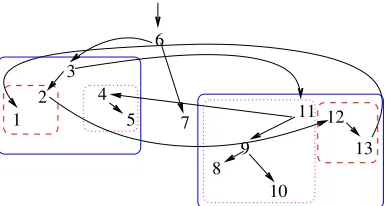
4.3 Edges (and their Crossing Point) Define Isolated Crossing Regions . . . 61
4.4 Parsing Algorithm . . . 64
4.4.1 Decomposing anIntsub-problem . . . 66
4.4.2 Decomposing anLRsub-problem . . . 69
4.4.3 Decomposing anN sub-problem . . . 70
4.4.4 Decomposing anLorRsub-problem . . . 70
4.5 Dynamic Program to find the maximum scoring 1-Endpoint-Crossing Tree . . . 72
4.6 Connections . . . 78
4.6.1 Graph Theory: All 1-Endpoint-Crossing Trees are 2-Planar . . . 78
4.6.2 Linguistics: Cross-serial Verb Constructions and Successive Cyclicity . . . 80
4.7 A Simplified Form . . . 81
4.8 Conclusions . . . 83
5 A Crossing-Sensitive Third-Order Factorization for Dependency Parsing 84 5.1 Introduction . . . 85
5.2 Preliminaries . . . 86
5.2.1 Grand-Sibling Projective Parsing . . . 87
5.2.2 Edge-factored 1-Endpoint-Crossing Parsing . . . 88
5.3 Crossing-Sensitive Factorization . . . 90
5.4 Parsing Overview . . . 94
5.4.1 Enforcing Crossing Edges . . . 94
5.4.2 Reduced Context in Presence of Crossings . . . 100
5.4.3 Summary . . . 106
5.5.1 Results . . . 108
6 Conclusions and Future Work 113
6.1 Future Directions . . . 114 6.1.1 Developing Faster Variants of 1-Endpoint-Crossing Parsing . . . . 114 6.1.2 Alternative Descriptions of 1-Endpoint-Crossing Trees . . . 116 6.1.3 Linguistic Connections . . . 118 6.1.4 Applications beyond Parsing . . . 123
A Additional Information About the Coverage of 1-Endpoint-Crossing Trees 124 A.1 English . . . 125 A.2 Danish . . . 126 A.3 Dutch . . . 127
B GrandSib-Crossing Parser Invariants 129
List of Tables
1.1 Conjunction accuracy . . . 7
1.2 Existing search spaces for dependency parsers . . . 9
1.3 Classes of trees and parsing algorithms proposed in this thesis . . . 11
1.4 Accuracy of the third-order 1-Endpoint-Crossing parser . . . 13
2.1 Results: English dependency parsing with various factorizations . . . 30
2.2 Conjunction accuracy . . . 32
2.3 Preposition accuracy . . . 32
2.4 Different ways of measuring the accuracy of edges involving conjunctions . 33 3.1 Coverage: Gap inheritance classes . . . 37
3.2 Data set sizes . . . 54
3.3 Results: Gap-minding . . . 55
3.4 Empirical coverage when the gap degree restriction is dropped. . . 56
4.1 Coverage:1-Endpoint-Crossing . . . 61
4.2 Empirical coverage without artificial root edges . . . 61
5.1 Output Spaces and Model Factorizations . . . 86
5.2 Part types for the crossing-sensitive third-order factorization . . . 91
5.3 Decomposing the example tree . . . 93
5.4 Dataset sizes . . . 108
5.6 English results . . . 112
5.7 Part types used to produce the predicted trees . . . 112
5.8 Parsing speed measured in words per second. . . 112
6.1 Summary . . . 115
6.2 Restricting the crossing point to be within a small distance of the edge . . . 116
A.1 Coverage of normalized treebanks . . . 125
List of Illustrations
1.1 A dependency parse tree . . . 1
1.2 The prepositional phrase attaches to the verb. . . 5
1.3 The prepositional phrase attaches to the noun. . . 5
1.4 Conjunction representations . . . 6
1.5 A dependency tree with crossing edges . . . 8
2.1 Examples of conjunctions . . . 20
2.2 Examples of prepositions . . . 21
3.1 Gap inheritance . . . 40
4.1 Distinct hierarchies of non-projectivity . . . 60
4.2 An edge and its crossing point form two sets of isolated crossing regions . . 62
4.3 Isolated crossing region sub-problems. . . 65
4.4 Decomposing an Int subproblem . . . 66
4.5 Constructing a 1-Endpoint-Crossing non-projective English sentence . . . . 68
4.6 Decomposing anLsub-problem . . . 71
4.7 2-planar but not 1-Endpoint-Crossing . . . 78
4.8 The crossing graphs for Figures 4.1a and 4.1b. . . 79
4.9 An example ofwh-movement . . . 81
4.10 Alternative decomposition of anLsub-problem . . . 82
5.2 A 1-Endpoint-Crossing non-projective English sentence . . . 89
5.3 Constructing a 1-Endpoint-Crossing tree . . . 89
5.4 Interior and exterior children . . . 92
5.5 Ways to build a trapezoid . . . 97
5.6 Constructing a chain of crossing edges . . . 98
5.7 Constructing a box when edges inmands’s subtrees cross each other . . . 99
5.8 Intervals with and without grandparent indices . . . 101
5.9 BadContextsand crossing regions . . . 103
5.10 Split points forLRsub-problems . . . 103
5.11 Conjunction representation styles . . . 107
Chapter 1
Introduction
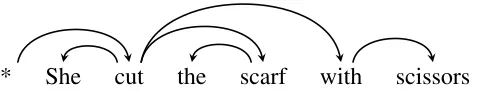
Automatic syntactic analysis of natural language has been one of the fundamental problems in natural language processing research. Dependency parses, directed trees that represents the syntactic structure of natural language sentences, have proven useful for a variety of practical applications, including machine translation (Ding and Palmer, 2005), question answering (Cui, Sun, Li, Kan, and Chua, 2005), and information extraction (Culotta and Sorensen, 2004). See Figure 1.1 for an example of a dependency parse.
* She cut the scarf with scissors
Figure 1.1: A dependency parse tree
There are some theoretical and practical issues, however, that impact the current use-fulness of today’s dependency parsers:
conjunctions in an English parse may correspond to different translations in another language, and so correctly attaching these are particularly important for a dependency parser’s usefulness. Within English dependency parsing, however, the accuracies for attaching prepositions and conjunctions are well below the overall attachment accu-racies.
2. Intractability of Current Formulations: Dependency parsing is often cast dichoto-mously as either searching over trees without any crossing dependencies (Eisner, 2000) or searching over all directed spanning trees (in which any pattern of cross-ing edges is allowed) (McDonald, Pereira, Ribarov, and Hajiˇc, 2005b). The first approach sacrifices coverage of many natural language structures, especially in lan-guages other than English. The second approach has efficient algorithms (Chu and Liu, 1965; Edmonds, 1967) with very simple statistical models that parametrize over only individual edges, but this problem becomes NP-hard in the presence of factors over siblings or grandparents in the tree (McDonald and Pereira, 2006; McDonald and Satta, 2007), which have been found to greatly improve accuracy in the English case (McDonald and Pereira, 2006; Carreras, 2007; Koo and Collins, 2010).
In this thesis, we will show how characterizations of dependency tree structures can be used to improve the tractability and accuracy of parsing. In particular, we will show that:
1. Models and features compatible with how linguistic constructions of interest are rep-resented in natural language treebanks lead to state-of-the-art accuracies for English dependency parsing and substantial improvements in the accuracy of conjunctions.
2. Novel definitions of the dependency parsing output space include the vast majority of structures seen in treebanks for a variety of natural languages, tractably allow richer features, and have efficient exact parsing algorithms.
1.1
Background: Framework
Adependency treeis a rooted, directed spanning tree that represents a set of dependencies between words in a sentence. The tree has one artificial root node and vertices that corre-spond to the words in an input sentencew1, w2,...,wn. There is an edge fromhtom ifm depends on (or modifies)h.
The goal of a dependency parser is to output the “best” dependency parse analysis given an input of a natural language sentence. Note that “outputting the best” requires:
1. Scoring: How is “best” defined? For a given tree, what is its score?
2. Searching: Given a scoring procedure, how does the parser find the best?
These two questions are coupled: different scoring functions affect the ease of search-ing, and different search spaces affect what scoring functions can be easily used. Scoring and searching become even more intertwined with a data-driven discriminative approach, in which the scoring function is not given a priori, but is learned from data by repeatedly parsing sentences from the training set, comparing the tree the search procedure found to the gold-standard tree, and then updating the scoring function accordingly.
There are exponentially many dependency trees for a sentence, making it intractable to find the best tree in the presence of arbitrary features that scope over the entire tree. Therefore, one common approach that allows efficient searching is to assume the score of a tree decomposes into the sum of scores of local parts (such as edges or constant-sized local sets of edges). This thesis and a large portion of related work characterize the parsing problem according to the following framework of structured linear models:
y∗ =argmaxy∈Y
X
p∈P(y)
w·φ(p, x) (1.1)
of the tree), φ(p, x) defines a feature vector over a local partpand the input sentencex1, andwis a weight vector. Related work and our own work here can be characterized by the choices they make for each of these variables.
A parsing algorithm computes the argmaxtree under such a model. Various combi-natorial algorithms are used to efficiently find the maximum scoring treey∗within various choices of the search spaceY.
We focus on two design decisions here: (i) the choice of the factorization function P (Section 1.2), (ii) the choice of the search space Y (Section 1.3), how these choices can complement each other (Section 1.4) and the implications of these choices for the tractability of the parsing problem and the accuracy of a trained dependency parser.
1.2
Scoring
Scoring a tree requires a factorization functionP that defines a set of local tree parts, and a score for each of these parts, based on a feature functionφand weight vectorw.
1.2.1
Factorizations
Factorizations that have been used in dependency parsing include decompositions of trees into sets of: edges (McDonald, Crammer, and Pereira, 2005a), pairs of edges representing siblings (McDonald and Pereira, 2006), pairs of edges representing siblings and pairs of edges representing outermost grandchildren (Carreras, 2007), and triples of edges repre-senting a grandparent, a parent, and two siblings (Koo and Collins, 2010).
Figures 1.2 and 1.3 show two examples of prepositional phrase attachment (the phrases
with scissorsand with stripes), which correctly attach to the verbcut and the noun scarf, respectively. For each factorization mentioned above, we consider which parts appear in nominal versus verbal attachments in the two examples.
1Assuming a discriminatively trained model in which the features can freely conditiongloballyover the
* She cut the scarf with scissors
Figure 1.2: The prepositional phrase attaches to the verb.
* She cut the scarf with stripes
Figure 1.3: The prepositional phrase attaches to the noun.
One possibility is that P decomposes any treey into independentedges. In that case, the set of parts relevant to identifying the parent of with would be identical in the two sentences: in both cases we would have one potential partEdge(cut,with)and one com-peting potential part Edge(scarf,with). These parts appear as options in both sentences and therefore the parts alone do not distinguish between the two cases.
Another possibility is that P corresponds to a sibling factorization. In this case, the verbal attachment uses the partSib(cut,with,scarf) (indicatingscarf is the adjacent in-ner sibling to with and that both modify cut), while the noun attachment uses the part Sib(scarf,with,NULL)(indicatingwithis the innermost modifier to scarf). Again, both of these parts would appear as options for both of the sentences.
Under agrandparentfactorization, the set of parts relevant to attachingwithin the two sentences finally differ. In Figure 1.2, the two potential parts areGrand(cut,with,scissors) versusGrand(scarf,with,scissors), while in Figure 1.3, two relevant potential parts are Grand(cut,with,stripes) and Grand(scarf,with,stripes). If we have features capable of capturing this distinction, we should be able to learn an appropriate weight vector so thatScore(Grand(cut,with,scissors))>Score(Grand(scarf,with,scissors)), and con-versely,Score(Grand(scarf,with,stripes))>Score(Grand(cut,with,stripes)).
in a variety of ways in different dependency treebanks. Two possible representations are in Figure 1.4. In Figure 1.4a, only factorizations which include sibling features would ever have the conjunction and both conjuncts in the same scope; in Figure 1.4b, only fac-torizations which include grandparent features would ever have the conjunction and both conjuncts in the same scope. Chapter 2 will further investigate this relationship between treebank representations of conjunctions and the accuracy of dependency parsers using various factorizations.
dogs and cats
(a) One conjunct is the sibling of the
conjunction
dogs and cats
(b) One conjunct is the grandparent of
the other conjunct
Figure 1.4: Conjunction representations
1.2.2
Features
Besides a factorization that scopes over the relevant substructures, one also needs appro-priate features. Common features for dependency parsers include the words and part-of-speech tags of the parent, child, and their surrounding words (McDonald et al., 2005a). Learning to preferGrand(cut,with,scissors)overGrand(scarf,with,scissors), and also Grand(scarf,with,stripes) over Grand(cut,with,stripes) requires features capable of capturing the relevant differences. The words stripesand scissorshave the same part-of-speech, so features based on part-of-speech tags should not differentiate between these two cases. The words themselves are different, however features based on the words themselves are unlikely to have appeared many times in the training set; generally, lexical statistics based on the training set only are typically sparse and have only a small effect on overall parsing performance (Gildea, 2001).
2008) and web counts (Bansal and Klein, 2011) may help, but might not be fully effective if a) the phenomenon are represented inconsistently in the data, or b) none of the features scope over the relevant words involved.
1.2.3
Parsing with Unlabeled Data and Relevant Factorizations
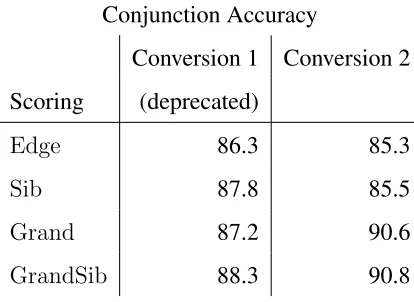
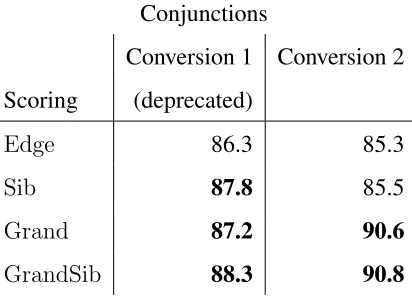
InChapter 2, we show the practicality of considering the compatibility between data repre-sentations and factorizations by modifying the parsing system of Koo and Collins (2010) to incorporate features from web-scale association statistics, and perform experiments show-ing the accuracies overall and on prepositions and conjunctions in particular for each type of factorization and each type of data representation. Table 1.1 shows how the accuracy of attaching conjunctions varies widely under different combinations of factorizations and data representations. This work achieves a new state-of-the-art for English dependencies with 93.55% correct attachments on the current standard. Furthermore, conjunctions are attached with an accuracy of 90.8% and prepositions with an accuracy of 87.4%. This chapter contains material previously published in Pitler (2012).
Conjunction Accuracy
Conversion 1 Conversion 2 Scoring (deprecated)
Edge 86.3 85.3
Sib 87.8 85.5
Grand 87.2 90.6
GrandSib 88.3 90.8
Table 1.1: Unlabeled attachment accuracy for conjunctions under different factorizations and
1.3
Searching
Dependency parsers vary in whatspace of possible tree structuresthey search over when parsing a sentence. Existing options include projective trees, all arborescences, or existing definitions of mildly non-projective trees.
1.3.1
Projective Trees
Many high-accuracy dependency parsers today (Koo and Collins, 2010; Rush and Petrov, 2012; Zhang and McDonald, 2012) search only over trees without crossing edges ( projec-tive trees). In a projective tree, each subtree (i.e., each word and its descendants) form a consecutive sequence in the input sentence. Figure 1.5 shows an example of an English sentence that isnotprojective: note that the subtree rooted atscarf does not form a single interval in the sentence, and that the edges(scarf,with)and(cut,yesterday)cross when both are drawn above the sentence.
* She cut the scarf yesterday with stripes
Figure 1.5: A dependency tree with crossing edges
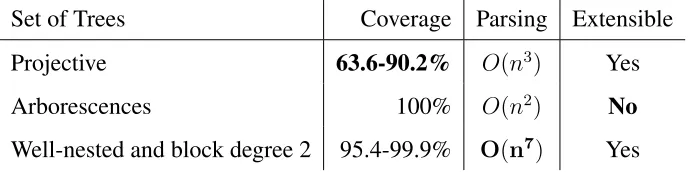
Finding the optimal tree in the set of projective trees can be done efficiently (Eisner, 2000), even when the score of a tree depends on higher order factors (McDonald and Pereira, 2006; Carreras, 2007; Koo and Collins, 2010). However, the projectivity assump-tion excludes many natural language dependency trees, especially in languages with freer word orders; for example, only 63.6% of Dutch sentences from the CoNLL-X training set are projective (Table 1.2).
2Coverage is the range of empirical coverage of sentences in the training sets of CoNLL-X for Arabic,
Set of Trees Coverage Parsing Extensible Projective 63.6-90.2% O(n3) Yes Arborescences 100% O(n2) No Well-nested and block degree 2 95.4-99.9% O(n7) Yes
Table 1.2: Existing search spaces for dependency parsers2
1.3.2
Arborescences
At the other end of the spectrum, some parsers search over all arborescences (directed spanning trees), a class of structures much larger than the set of plausible linguistic struc-tures. McDonald et al. (2005b) proposed casting the dependency parsing problem as that of finding the maximum scoring directed spanning tree, which can be found inO(n2)time (Tarjan, 1977) with a variant of the Chu-Liu-Edmonds (Chu and Liu, 1965; Edmonds, 1967) algorithm when scores are over edges only.
1.3.3
Existing Definitions of Mildly Non-projective Trees
A third alternative is to consider existing definitions ofmildly non-projective treesthat are strictly larger than the set of projective trees and strictly smaller than the set of all arbores-cences. See Kuhlmann and Nivre (2006) for a nice overview of various constraints that have been proposed and their respective coverages of natural language treebank structures. However, few of these existing definitions have corresponding exact parsing algorithms; moreover, the known parsing algorithms are orders of magnitude slower than algorithms for parsing projective trees.
For example, one definition of mildly non-projective trees is the set of well-nested dependency trees for which the words in each subtree form at most two maximal intervals (i.e., block degree 2/gap degree 1) (Kuhlmann, 2013). This definition also has a connection to a type of mildly context-sensitive grammar: all Lexicalized Tree Adjoining Grammar (LTAG) (Joshi and Schabes, 1997) derivation trees are well-nested and have gap degree at most one (Bodirsky, Kuhlmann, and M¨ohl, 2005). This set of trees is extensible and has higher coverage of treebank structures than projective trees do (95-4%-99.9%, Table 1.2), but its parsing algorithm takes O(n7) time (G´omez-Rodr´ıguez, Carroll, and Weir, 2011), which is prohibitive for practical purposes.
1.3.4
Classes of Trees Proposed in this Thesis
Each of the classes of trees discussed so far has had different tradeoffs between coverage, parsing time, and extensibility:
• Projective trees have fast parsing and extensibility, but low coverage
• Arborescences have high coverage and fast parsing, but are not extensible
• Well-nested and block degree 2 trees have high coverage and extensibility, but slow
parsing time.
Set of Trees Coverage Parsing Extensible Projective 63.6-90.2% O(n3) Yes Arborescences 100% O(n2) No Well-nested and block degree 2 95.4-99.9% O(n7) Yes and Inherit-1 (Chapter 3) 95.4-99.9% O(n6) Yes and Inherit-0 (Chapter 3) 90.4-97.7% O(n5) Yes 1-Endpoint-Crossing (Chapter 4) 95.8-99.8% O(n4) Yes
Table 1.3: Classes of trees and parsing algorithms proposed in this thesis, compared with existing
tree classes.
classes and parsing algorithms would increase the applicability of parsers to non-English languages. This thesis defines such tree classes, summarized in Table 1.3.
InChapter 3, we introducegap inheritance: a child node inherits a gap of its parent if the child has descendants in more than one of its parent’s intervals of descendants. A corpus analysis shows thatnone of the examples of well-nested trees with block degree at most two contain more than one gap inheriting child per node. Adding this1-Inheritrestriction to the class of well-nested and block degree at most two trees therefore causes no drop in coverage, yet the optimal scoring tree can be found inO(n6). We also show that0-Inherit
trees (in which no node has any gap-inheriting child) cover 90.4% or more of treebank structures and can be parsed with an O(n5) algorithm. This chapter contains material published in Pitler, Kannan, and Marcus (2012). This chapter also includes a previously unpublished result showing how the 0-Inherit property allows an extension to an arbitrary number of gaps without any increase in the complexity of the parsing algorithm.
that recursively combines forests over intervals with one exterior point that finds the opti-mal 1-Endpoint-Crossing tree. We situate the 1-Endpoint-Crossing tree class in relation to other graph theoretic descriptions, proving that 1-Endpoint-Crossing trees are a subclass of 2-page graphs (Bernhart and Kainen, 1979), or alternatively, 2-planar graphs as have been described in the transition-based parsing literature (G´omez-Rodr´ıguez and Nivre, 2010). In contrast, we show that 1-Endpoint-Crossing and 2-planarity are orthogonal to other es-tablished properties such as gap degree and well-nestedness. The work in this chapter appeared in Pitler, Kannan, and Marcus (2013).
1.4
Factorizations that Facilitate Search
Factorizations developed for projective dependency parsing include independence assump-tions that allow more efficient search over the set of projective trees. For example, the pars-ing algorithm of Eisner (2000) derives efficiency from assumpars-ing that left and right mod-ifiers of a head word are independent of each other and so can be parsed independently. The sibling factorization of McDonald and Pereira (2006) continues this assumption by only conditioning on siblings on the same side of the parent. Higher order models such as the parser of Carreras (2007) and the tri-sibling (Model 2) parser of Koo and Collins (2010) have avoided increases in the asymptotic parsing time of their algorithms by defin-ing grandparent features for only the outermost children of a parent.
that of the edge-factored 1-Endpoint-Crossing parser (Chapter 4). In experiments with a variety of languages and treebank representations, the implemented crossing-sensitive third-order 1-Endpoint-Crossing parser is significantly more accurate than the projective third-order parser in nine out of the sixteen set-ups and significantly less accurate on none. When evaluated on normalized treebanks (Zeman, Mareˇcek, Popel, Ramasamy, ˇStˇep´anek,
ˇ
Zabokrtsk´y, and Hajiˇc, 2012) with Stanford-style conjunction representations (De Marneffe and Manning, 2008), the 1-Endpoint-Crossing parser has an unlabeled attachment accuracy 0.38-3.51% higher than the third-order projective parser (Table 1.4).
Model Dutch Czech Portuguese Danish Swedish
Proj GSib 81.16 86.83 88.80 88.84 87.27 1-EC CS-GSib 84.67 88.34 90.20 89.22 88.15
Table 1.4: Overall Unlabeled Attachment Scores (UAS) for all words. Proj GSib is a third
or-der projective parser (Koo and Collins, 2010); 1-EC CS-GSib is a crossing-sensitive third-oror-der
1-Endpoint-Crossing parser (Chapter 5). Data sources: CoNLL-2006 shared task (Buchholz and
Marsi, 2006) (Danish, Dutch, Portuguese, Swedish); CoNLL-2007 shared task (Nivre et al., 2007a)
(Czech), normalized and then transformed to use the Stanford-style conjunction representation
us-ing HamleDT (Zeman et al., 2012). Bold indicates the more accurate model and models not
sig-nificantly different from the most accurate (sign test,p < .05). Languages are sorted in increasing
order of projectivity (Table A.1). For more details see Table 5.5 in Chapter 5.
1.5
Thesis Contributions
of difficult constructions in treebanks on the accuracy of trained parsers. In particular, this thesis contributes:
• An overview of the differences in representations between two different
constituency-to-dependency conversion procedures (Section 2.2)
• An empirical demonstration of the effect of varying model factorizations on the ac-curacy of overall parsing, conjunctions, and prepositions (Section 2.6)
• A demonstration that unlabeled data features lead to a statistically significant
im-provement over the prior state-of-the-art in unlabeled attachment accuracy (Section 2.6)
• A definition ofgap inheritance, and a demonstration that 1-Inheritance reduces com-plexity by a factor ofnwithoutanyloss in empirical coverage over prior work (Sec-tions 3.3-3.4)
• Exact O(n5)algorithms for finding the maximum well-nested, 0-inherit tree either
with gap degree 1 or with unbounded gap degree (Sections 3.5 and 3.8))
• A definition of 1-Endpoint-Crossing, a property over graphs with linearly ordered vertices novel to both linguistics and to graph theory (Sections 4.2 and 4.6)
• AnO(n4)exact parsing algorithm for finding the optimal 1-Endpoint-Crossing tree
under an edge-factored model (Section 4.4)
• A proof that 1-Endpoint-Crossing trees are a subclass of 2-planar graphs (Section
4.6)
• Examples that prove these are two distinct hierarchies capturing different dimensions
of non-projectivity:1-Endpoint-Crossing6⊆well-nested with block degree 2and gap-minding6⊆2-planar(Figure 4.1)
• A novel crossing-sensitive grandparent-sibling factorization that generalizes the
• A parsing algorithm that finds the optimal 1-Endpoint-Crossing tree according to this
crossing-sensitive grandparent-sibling factorization inO(n4)time (Section 5.4)
• An empirical demonstration that the third-order 1-Endpoint-Crossing parser is more
Chapter 2
Attacking Parsing Bottlenecks with
Unlabeled Data and Relevant
Factorizations
Much of this chapter was originally published in Pitler (2012).
2.1
Introduction
Prepositionsandconjunctionsare two large remaining bottlenecks in parsing. Across var-ious existing parsers, these two categories have the lowest accuracies, and mistakes made on these have consequences for downstream applications. Machine translation is sensi-tive to parsing errors involving prepositions and conjunctions, because in some languages different attachment decisions in the parse of the source language sentence produce dif-ferent translations. Preposition attachment mistakes are particularly bad when translating into Japanese (Schwartz, Aikawa, and Quirk, 2003) which uses a different postposition for different attachments; conjunction mistakes can cause word ordering mistakes when translating into Chinese (Huang, 1983).
correct resolution (Jurafsky and Martin, 2008). However, lexical statistics based on the training set only are typically sparse and have only a small effect on overall parsing perfor-mance (Gildea, 2001).Unlabeled datacan help ameliorate this sparsity problem. Backing off to cluster membership features (Koo et al., 2008) or by using association statistics from a larger corpus, such as the web (Bansal and Klein, 2011; Zhou, Zhao, Liu, and Cai, 2011), have both improved parsing.
Unlabeled data has been shown to improve the accuracy of conjunctions within complex noun phrases (Pitler, Bergsma, Lin, and Church, 2010; Bergsma et al., 2011). However, it has so far been less effective within full parsing — while first-order web-scale counts no-ticeably improved overall parsing in Bansal and Klein (2011), the accuracy on conjunctions actually decreased when the web-scale features were added (Table 4 in that paper).
In this paper we show that unlabeled datacanhelp prepositions and conjunctions, pro-vided that the dependency representation is compatible with how the parsing problem is
decomposed for learning and inference. By incorporating unlabeled data into factoriza-tions which capture the relevant dependencies for preposifactoriza-tions and conjuncfactoriza-tions, we pro-duce a parser for English which has an unlabeled attachment accuracy of 93.5%, over an 18% reduction in error over the best previously published parser (Bansal and Klein, 2011) on the current standard for dependency parsing. The best model for conjunctions attaches them with 90.8% accuracy (42.5% reduction in error over MSTParser), and the best model for prepositions with 87.4% accuracy (18.2% reduction in error over MSTParser).
2.2
Conversion to Dependency Representations
The Wall Street Journal Penn Treebank (PTB) (Marcus, Marcinkiewicz, and Santorini, 1993) contains parsed constituency trees (where each sentence is represented as a context-free-grammar derivation). Dependency parsing requires a conversion from these con-stituency trees to dependency trees. The Treebank concon-stituency trees left noun phrases (NPs) flat, although there have been subsequent projects which annotate the internal struc-ture of noun phrases (Vadas and Curran, 2007; Weischedel, Palmer, Marcus, Hovy, Prad-han, Ramshaw, Xue, Taylor, Kaufman, Franchini, et al., 2011). The presence or absence of these noun phrase internal annotations interacts with constituency-to-dependency conver-sion program in ways which have effects on conjunctions and prepositions.
We consider two such mapping regimes here:
1. PTB trees→Penn2Malt1→Dependencies
2. PTB trees patched with NP-internal annotations (Vadas and Curran, 2007)→ pen-nconverter2→Dependencies
Regime (1) is very commonly done in papers which report dependency parsing experi-ments (e.g., McDonald and Pereira (2006); Nivre, Hall, Nilsson, Chanev, Eryigit, K¨ubler, Marinov, and Marsi (2007b); Zhang and Clark (2008); Huang and Sagae (2010); Koo and Collins (2010)). Penn2Malt uses the head finding table from Yamada and Matsumoto (2003).
Regime (2) is based on the recommendations of the two converter tools; as of the date of this writing, thePenn2Maltwebsite says: “Penn2Malt has been superseded by the more sophisticated pennconverter, which we strongly recommend”. Thepennconverterwebsite “strongly recommends” patching the Treebank with the NP annotations of Vadas and Cur-ran (2007). A version ofpennconverterwas used to prepare the data for the CoNLL Shared
1http://w3.msi.vxu.se/∼nivre/research/Penn2Malt.html
Tasks of 2007-2009, so the trees produced by Regime 2 are similar (but not identical)3 to these shared tasks. As far as we are aware, Bansal and Klein (2011) is the only published work which uses both steps in Regime (2).
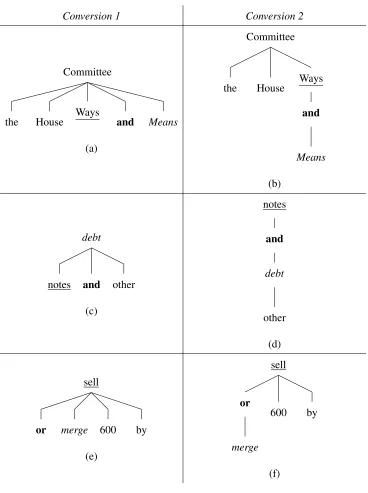
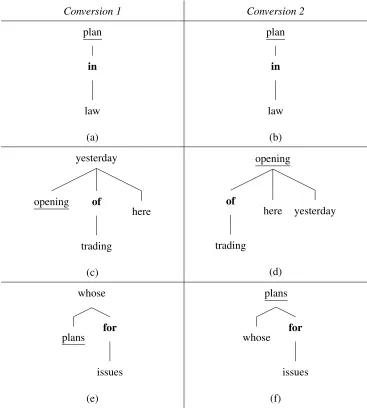
The dependency representations produced by Regime 2 are designed to be more useful for extracting semantics (Johansson and Nugues, 2007). The parsing attachment accuracy of MALTPARSER (Nivre et al., 2007b) was lower using pennconverter thanPenn2Malt, but using the output of MALTPARSER under the new format parses produces a much better semantic role labeler than using its output withPenn2Malt(Johansson and Nugues, 2007). Figures 2.1 and 2.2 show how conjunctions and prepositions, respectively, are repre-sented after the two different conversion processes. These differences are not rare–70.7% of conjunctions and 5.2% of prepositions in the development set have a different parent un-der the two conversion types. These representational differences have serious implications for how well various factorizations will be able to capture these two phenomena.
Conversion 1 Conversion 2
Committee
the House Ways and Means
(a)
Committee
the House Ways
and
Means
(b)
debt
notes and other
(c)
notes
and
debt
other
(d)
sell
or merge 600 by
(e)
sell
or
merge
600 by
(f)
Figure 2.1: Examples of conjunctions: the House Ways and Means Committee, notes and other
debt, andsell or merge 600 by. The conjunction is bolded, the left conjunct (in the linear order of
Conversion 1 Conversion 2
plan
in
law
(a)
plan
in
law
(b)
yesterday
opening of
trading
here
(c)
opening
of
trading
here yesterday
(d)
whose
plans for
issues
(e)
plans
whose for
issues
(f)
Figure 2.2: Examples of prepositions: plan in the S&L bailout law,opening of trading here
yester-day, andwhose plans for major rights issues. The preposition is bolded and the (semantic) head is
2.3
Implications of Representations on the Scope of
Fac-torization
Parsing requires a) learning to score potential parse trees, and b) given a particular scor-ing function, findscor-ing the highest scorscor-ing tree accordscor-ing to that function. The number of potential trees for a sentence is exponential, so parsing is made tractable by decompos-ing the problem into a set of local substructures which can be combined usdecompos-ing dynamic programming. Four possible factorizations are: single edges (edge-based), pairs of edges which share a parent (siblings), pairs of edges where the child of one is the parent of the other (grandparents), and triples of edges where the child of one is the parent of two others (grandparent+sibling). In this section, we discuss these factorizations and their relevance to conjunction and preposition representations.
2.3.1
Edge-based Scoring
One possible factorization corresponds to first-order parsing, in which the score of a parse treeydecomposes completely across the edges in the tree:
Score(y) = X
(h,m)∈y
Score(Edge(h, m)) (2.1)
Conjunctions: Under Conversion 1, we can see three different representations of conjunc-tions in Figures 2.1a, 2.1c, and 2.1e. Under edge-based scoring, the conjunction would be scored along withneitherof its conjuncts in 2.1a. In Figure 2.1c, the conjunction is scored along with its right conjunct only; in figure 2.1e along with its left conjunct only. The in-consistency here is likely to make learning more difficult, as what is learned is split across these three cases. Furthermore, the conjunction is connected with an edge to either zero or one of its two arguments; at least one of the arguments is completely ignored in terms of scoring the conjunction.
relationship and a conjunction relationship. For example, compare the two natural phrases
dogs and catsandreally nice. dogsandcatsare a good pair to conjoin, butcatsis not a good modifier for dogs, so there is a tension when scoring an edge like (dogs, cats): it should get a high score when actually indicating a conjunction and low otherwise. (nice, really) shows the opposite pattern–really is a good modifier fornice, but niceand really are not two words which should be conjoined. This may be partially compensated for by including features about the surrounding words (McDonald et al., 2005a), but any feature templates which would be identical across the two contexts will be in tension.
In Figures 2.1b, 2.1d and 2.1f, the conjunction participates in a directed edge with each of the conjuncts. Thus, in edge-based scoring, at least under Conversion 2 neither of the conjuncts is being ignored; however, the factorization scores each edge independently, so how compatible these two conjuncts are with each other cannot be included in the scoring of a tree.
Prepositions: For all of the examples in Figure 2.2, there is a directed edge from the head of the phrase that the preposition modifies to the preposition. Differences in head finding rules account for the differences in preposition representations. In the second example, the first conversion scheme chooses yesterday as the head of the overall NP, resulting in the edgeyesterday→of, while the second conversion scheme ignores temporal phrases when finding the head, resulting in the more semantically meaningfulopening→of. Similarly, in the third example, the prepositionforattaches to the pronounwhosein the first conversion scheme, while it attaches to the nounplansin the second.
2.3.2
Sibling Scoring
Another alternative factorization is to scoresiblingsas well as parent-child edges (McDon-ald and Pereira, 2006). Scores decompose as:
Score(y) = X
(h, m, s) (h, m)∈y,(h, s)∈y,
(s, m)∈Siblings(y)
Score(Sib(h, m, s)) (2.2)
whereSiblings(y)is the set containingorderedandadjacentsibling pairs iny: if(s, m)∈ Siblings(y), there must exist a shared parenthsuch that(h, m)∈yand(h, s)∈y,mand s must be on the same side of h, s must be closer to h thanm in the linear order of the sentence, and there must not exist any other children ofhin betweenmands.
Under this factorization, two of the three examples in Conversion 1 (and none of the examples in Conversion 2) in Figure 2.1 now include the conjunction and both con-juncts in the same score (Figures 2.1c and 2.1e). The scoring for head-modifier depen-dencies and conjunction dependepen-dencies are again being overloaded: (debt, notes, and)and (debt, and, other) are both sibling parts in Figure 2.1c, yet only one of them represents a conjunction. The position of the conjunction in the sibling is not enough to determine whether one is scoring a true conjunction relation or just the conjunction and a different sibling; in 2.1c the conjunction is on the right of its sibling argument, while in 2.1e the conjunction is on the left.
2.3.3
Grandparent Scoring
Another alternative over pairs of edges scores grandparents instead of siblings, with factor-ization:
Score(y) = X
(h, m, c) (h, m)∈y,(m, c)∈y
Score(Grand(h, m, c)) (2.3)
Under Conversion 2, we would expect this factorization to perform much better on con-junctions and prepositions than edge-based or sibling-based factorizations. Both conjunc-tions and preposiconjunc-tions are consistently represented by exactly one grandparent relation (with one relevant argument as the grandparent, the preposition/conjunction as the parent, and the other argument as the child), so this is the first factorization that has allowed the compatibility of the two arguments to affect the attachment of the preposition/conjunction. Under Conversion 1, this factorization is particularly appropriate for prepositions, but would be unlikely to help conjunctions, which have no children.
2.3.4
Grandparent-Sibling Scoring
A further widening of the factorization takes grandparents and siblings simultaneously:
Score(y) = X
(g, h, m, s) (g, h)∈y,(h, m)∈y,
(h, s)∈y,(s, m)∈Sib(y)
Score(GrandSib(g, h, m, s)) (2.4)
For projective parsing, dynamic programming for this factorization was derived in Koo and Collins (2010) (Model 1 in that paper), and for non-projective parsing, dual decomposition was used for this factorization in Koo et al. (2010).
2.4
Using Unlabeled Data Effectively
Associations from unlabeled data have the potential to improve both conjunctions and prepositions. We predict that web counts which include both conjuncts (for conjunctions), or which include both the attachment site and the object of a preposition (for prepositions) will lead to the largest improvements.
For the phrase dogs and cats, edge-based counts would measure the associations be-tween dogsand and, and and andcats, but never any web counts that include both dogs
andcats. For the phrase ate spaghetti with a fork, edge-based scoring would not use any web counts involving bothateandfork.
We useassociationsrather than raw counts. The phrasestrading and transactingversus
trading and what provide an example of the difference between associations and counts. The phrase trading and what has a higher count than the phrasetrading and transacting, buttrading and transacting are more highly associated. In this paper, we use point-wise mutual information (PMI) to measure the strength of associations of words participating in potential conjunctions or prepositions.4 For three wordsh,m,c, this is calculated with:
P M I(h, m, c) = log P(h .* m .* c)
P(h)P(m)P(c) (2.5)
The probabilities are estimated using web-scale n-gram counts, which are looked up using the tools and web-scale n-grams described in Lin, Church, Ji, Sekine, Yarowsky, Bergsma, Patil, Pitler, Lathbury, Rao, Dalwani, and Narsale (2010). Defining the joint probability us-ing wildcards (rather than the exact sequenceh m c) is crucially important, as determiners, adjectives, and other words may naturally intervene between the words of interest.
Approaches which cluster words (i.e., (Koo et al., 2008)) are also designed to identify words which are semantically related. As manually labeled parsed data is sparse, this may help generalize across similar words. However, if edges are not connected to the semantic head, cluster-based methods may be less effective. For example, the choice ofyesterdayas the head ofopening of trading here yesterday in Figure 2.2c orwhosein 2.2e may make 4PMI can be unreliable when frequency counts are small (Church and Hanks, 1990), however the data
cluster-based features less useful than if the semantic heads were chosen (opening and
plans, respectively).
2.5
Experiments
The previous section motivated the use of unlabeled data for attaching prepositions and conjunctions. We have also hypothesized that these features will be most effective when the data representation and the learning representation both capture relevant properties of prepositions and conjunctions. We predict that Conversion 2 and a factorization which includes grand-parent scoring will achieve the highest performance. In this section, we investigate the impact of unlabeled data on parsing accuracy using the two conversions and using each of the factorizations described in Section 2.3.1-2.3.4.
2.5.1
Unlabeled Data Feature Set
Clusters: We replicate the cluster-based features from (Koo et al., 2008), which includes features over all edges (h, m), grand-parent triples (h, m, c), and parent sibling triples (h, m, s). The features were all derived from the publicly available clusters produced by
running the Brown clustering algorithm (Brown, Desouza, Mercer, Pietra, and Lai, 1992) over the BLLIP corpus (Charniak, Blaheta, Ge, Hall, Hale, and Johnson, 2000, about 30 million words of Wall Street Journal text) with the Penn Treebank sentences excluded.5
Preposition and conjunction-inspired features (motivated by Section 2.4) are described below:
Web Counts: The web counts data (Lin et al., 2010) is derived from 1 trillion tokens of Web text. The source text is identical to the source text used in the data of the Google N-gram Corpus (Brants and Franz, 2006), but additional filtering of duplicate sentences and other noise was done prior to computing the counts (Lin et al., 2010). Search tools6 allow
5people.csail.mit.edu/maestro/papers/bllip-clusters.gz
6
look-ups with wildcard queries. For each set of words of interest, we compute the PMI between the words, and then include binary features for whether the mutual information is undefined, if it is negative, and whether it is greater than each positive integer.
For conjunctions, we only do this for triples of both conjunct and the conjunction (and if the conjunction isandororand the two potential conjuncts are the same coarse grained part-of-speech). For prepositions, we consider only cases in which the parent is a noun or a verb and the child is a noun (this corresponds to the cases considered by (Hindle and Rooth, 1993) and others). Prepositions use association features to score both the triple (parent, preposition, child) and all pairs within that triple. The counts features are not used if all the words involved are stopwords. For the scope of this paper we useonlythe above counts related to prepositions and conjunctions.
2.5.2
Parser
We use the Model 1 version ofdpo3, a state-of-the-art third-order dependency parser (Koo and Collins, 2010))7. We augment the feature set used with the web-counts-based features relevant to prepositions and conjunctions and the cluster-based features. The only other change to the parser’s existing feature set was the addition of binary features for the part-of-speech tag of the child of the root node, alone and conjoined with the tags of its children. For further details about the parser, see Koo and Collins (2010).
2.5.3
Experimental Set-up
Training was done on Section 2-21 of the Penn Treebank (39,832 sentences). Section 22 was used for development (1700 sentences), and Section 23 for test (2416 sentences). We use automatic part-of-speech tags for both training and testing (Ratnaparkhi, 1996). The set of potential edges was pruned using the marginals produced by a first-order parser trained using exponentiated gradient descent (Collins, Globerson, Koo, Carreras, and Bartlett, 2008) as in Koo and Collins (2010). We train the full parser for 15 iterations of averaged
7
perceptron training (Collins, 2002), choose the iteration with the best unlabeled attachment score (UAS) on the development set, and apply the model after that iteration to the test set. We also ran MSTParser (McDonald and Pereira, 2006), the Berkeley constituency parser (Petrov and Klein, 2007), and the unmodified dpo3 Model 1 (Koo and Collins, 2010) using Conversion 2 (the current recommendations) for comparison. Since the converted Penn Treebank now contains a few non-projective sentences, we ran both the projective and non-projective versions of the second order (sibling) MSTParser. The Berkeley parser was trained on the constituency trees of the PTB patched with (Vadas and Curran, 2007), and then the predicted parses were converted using pennconverter.
Evaluation Metric The main evaluation metric used here is that ofunlabeled attachment score (UAS), defined as the percentage of words that have the correct parent. Each word has exactly one parent in both the gold tree and the predicted tree, so the unlabeled attachment score is the number of words for which the parent is correct divided by the total number of words.
2.6
Results and Discussion
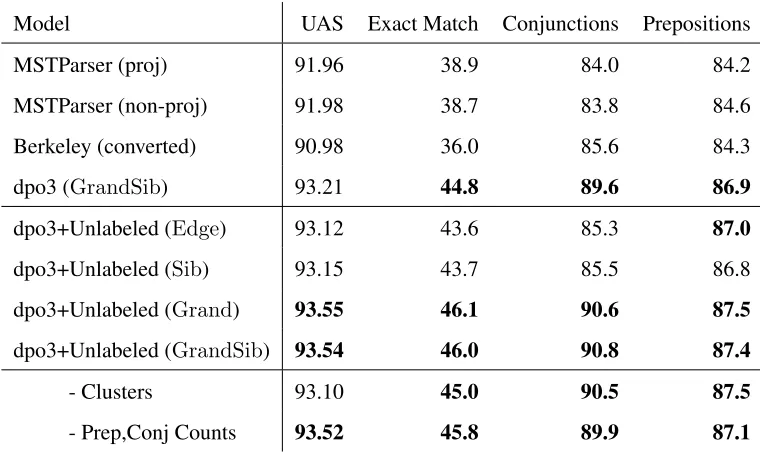
Table 2.1 shows the unlabeled attachment scores, complete sentence exact match accura-cies, and the accuracies of conjunctions and prepositions under Conversion 2.8 The incor-poration of the unlabeled data features (clusters and web counts) into thedpo3parser yields a significantly better parser thandpo3alone (93.54 UAS versus 93.21)9, and is more than a 1.5% improvement over MSTParser.
8As is standard for English dependency parsing, five punctuation symbols:,,,“,”, and. are excluded
from the results (Yamada and Matsumoto, 2003).
Model UAS Exact Match Conjunctions Prepositions
MSTParser (proj) 91.96 38.9 84.0 84.2
MSTParser (non-proj) 91.98 38.7 83.8 84.6
Berkeley (converted) 90.98 36.0 85.6 84.3
dpo3 (GrandSib) 93.21 44.8 89.6 86.9
dpo3+Unlabeled (Edge) 93.12 43.6 85.3 87.0
dpo3+Unlabeled (Sib) 93.15 43.7 85.5 86.8
dpo3+Unlabeled (Grand) 93.55 46.1 90.6 87.5
dpo3+Unlabeled (GrandSib) 93.54 46.0 90.8 87.4
- Clusters 93.10 45.0 90.5 87.5
- Prep,Conj Counts 93.52 45.8 89.9 87.1
Table 2.1: Test set accuracies under Conversion 2 of unlabeled attachment scores, complete sentence
exact match accuracies, conjunction accuracy, and preposition accuracy. Bolded items are the best
in each column, or not significantly different from the best in that column (sign test,p < .05).
2.6.1
Impact of Factorization
In all four metrics (attachment of all non-punctuation tokens, sentence accuracy, preposi-tions, and conjunctions), there is no significant difference between the version of the parser which uses the grandparent and sibling factorization (GrandSib) and the version which uses just the grandparent factorization (Grand). A parser which uses only grandparents (referred to as Model 0 in Koo and Collins (2010)) may therefore be preferable, as it con-tains far fewer parameters than a third-order parser.
2.6.2
Impact of Unlabeled Data
The unlabeled data features improved the already state-of-the-artdpo3parser in UAS, com-plete sentence accuracy, conjunctions, and prepositions. However, because the sample sizes are much smaller for the latter three cases, only the UAS improvement is statistically sig-nificant.10 Overall, the results in Table 2.1 show that while the inclusion of unlabeled data improves parser performance, increasing the size of factorization matters even more. Ab-lation experiments showed that cluster features have a larger impact on overall UAS, while count features have a larger impact on prepositions and conjunctions.
2.6.3
Comparison with Other Parsers
Thedpo3+Unlabeled parser is significantly better than both versions of MSTParser and the Berkeley parser converted to dependencies across all four evaluations. dpo3+Unlabeled has an UAS 1.5% higher than MSTParser, which has an UAS 1.0% higher than the con-verted constituency parser. The MSTParser uses sibling scoring, so it is unsurprising that it performs less well on the new conversion.
While the converted constituency parser is not as good on dependencies as MSTParser overall, note that it is over a percent and a half better than MSTParser on attaching con-junctions (85.6% versus 84.0%). Conjunction scope may benefit from parallelism and higher-level structure, which is easily accessible when joining two matching non-terminals in a context-free grammar, but much harder to determine in the local views of graph-based dependency parsers. The dependencies arising from the Berkeley constituency trees have higher conjunction accuracies than either the edge-based or sibling-based dpo3+Unlabeled parser. However, once grandparents are included in the factorization, the dpo3+Unlabeled is significantly better at attaching conjunctions than the constituency parser, attaching con-junctions with an accuracy over 90%. Therefore, some of the disadvantages of dependency parsing compared with constituency parsing can be compensated for with larger factoriza-10There are 49,892 non-punctuation tokens in the test set, compared with 2416 sentences, 1373
tions.
Conjunctions
Conversion 1 Conversion 2 Scoring (deprecated)
Edge 86.3 85.3
Sib 87.8 85.5
Grand 87.2 90.6
GrandSib 88.3 90.8
Table 2.2: Unlabeled attachment accuracy for conjunctions. Bolded items are the best in each
column, or not significantly different (sign test,p < .05).
Prepositions
Conversion 1 Conversion 2 Scoring (deprecated)
Edge 87.4 87.0
Sib 87.5 86.8
Grand 87.9 87.5
GrandSib 88.4 87.4
Table 2.3: Unlabeled attachment accuracy for prepositions. Bolded items are the best in each
col-umn, or not significantly different (sign test,p < .05).
2.6.4
Impact of Data Representation
Scoring Child=CC Parent=CC All Edges Incident to CC
Edge 85.3 90.7 78.9
Sib 85.5 91.1 80.3
Grand 90.6 92.6 85.9
GrandSib 90.8 91.6 85.6
Table 2.4: Different ways of measuring the accoracy of edges involving conjunctions: Child=CC
is the accuracy of edges in which the child is the conjunction; Parent=CC is the accuracy of edges
in which the parent is the conjunction in the gold-standard; the third column is the most strict,
counting a conjunction as correct only if the set of edges incident to it exactly match between the
gold-standard and the predicted tree (not counting excluded punctuation edges).
Conjunctions show a much stronger need for higher order factorizations than preposi-tions do. This is not too surprising, as preposipreposi-tions have more of a selectional preference than conjunctions, and so the preposition itself is more informative about where it should attach. While prepositions do improve with larger factorizations, the improvement beyond edge-based is not significant for Conversion 2. One hypothesis for why Conversion 1 shows more of an improvement is that the wider scope leads to the semantic head being included; in Conversion 2, the semantic head is chosen as the parent of the preposition, so the wider scope is less necessary.
2.6.5
Preposition Error Analysis
dpo3+Unlabeled grandparent-scoring parser with 92.4% accuracy, while those that do not fit that categorization (1703 prepositions) have the correct parent only 82.7% of the time.
Local attachments are more accurate — prepositions are attached with 94.8% accuracy if the correct parent is the immediately preceeding word (2364 cases) and only 79.1% accu-racy if it is not (1662 cases). The preference is not necessarily for low attachments though: the prepositions whose parent is not the preceeding word are attached more accurately if the parent is the root word (usually corresponding to the main verb) of the sentence (90.8%, 587 cases) than if the parent is lower in the tree (72.7%, 1075 cases).
2.7
Conclusion
Chapter 3
Dynamic Programming for Higher
Order Parsing of Gap-Minding Trees
Most of this chapter was originally published as Pitler et al. (2012). The extension to an arbitrary number of gaps is new and is presented in Section 3.8.
3.1
Introduction
We propose two new classes of trees between projective trees and the set of all spanning trees. These two classes provide a closer approximation to the set of plausible natural language dependency trees: unlike projective trees, a word can have descendants in more than one interval; unlike spanning trees, these intervals cannot be nested in arbitrary ways. We introducegap inheritance, a new structural property on trees, which provides a way to quantify the degree to which these intervals can be nested. Different levels of gap inheri-tance define each of these two classes (Section 3.3).
Gap-minding trees (the second class) have the property that all edges into an interval of descendants come from the same node. Non-contiguous intervals are therefore decou-pled given this single node, and thus an algorithm which uses only single intervals (as in projective parsing) can produce trees in which a node has descendants in multiple intervals (as in parsing for well-nested block degree 2 trees (G´omez-Rodr´ıguez et al., 2011)). A procedure for finding the optimal scoring tree in this space is given in Section 3.5, which can be searched in yet another order of magnitude faster than the1-Inheritclass.
Unlike the class of spanning trees, it is still tractable to find the optimal tree in these new spaces when higher order factors are included. An extension which finds the optimal scoring gap-minding tree with scores over pairs of adjacent edges (grandparent scoring) is given in Section 3.6. These gap-minding algorithms have been implemented in practice and empirical results are presented in Section 3.7.
3.2
Preliminaries
In this section, we review some relevant definitions from previous work that characterize degrees of non-projectivity. We also review how well these definitions cover empirical data from six languages: Arabic, Czech, Danish, Dutch, Portuguese, and Swedish. These are the six languages whose CoNLL-X shared task data are either available open source1or from the LDC2. The CoNLL-X shared task converted parsed data into a standardized format. The standardized format contains one token per line and tab-separated fields including the word, part-of-speech tag, parent and other information (seehttp://ilk.uvt.nl/ conll/example.htmlfor examples). Arabic, Czech, Danish, and Swedish data came from existing dependency treebanks, while the Dutch and Portuguese data were converted from phrase structure trees.
Definition 1. Theprojectionof a node is the set of words in the subtree rooted at it (includ-ing itself).
1http://ilk.uvt.nl/conll/free data.html
A tree isprojectiveif, for every node in the tree, that node’s projection forms a contigu-ous interval in the input sentence order.
A tree isnon-projective if the above does not hold, i.e., there exists at least one word whose descendants do not form a contiguous interval.
Definition 2. For each nodeuin the tree, a blockof the node is “a longest segment con-sisting of descendants ofu.” (Kuhlmann, 2013). Theblock-degreeofuis “the number of distinct blocks ofu”. The block degree of a tree is the maximum block degree of any of its
nodes. Thegap degreeis the number of gaps between these blocks, and so by definition is one less than the block degree. (Kuhlmann, 2013)
Note that a projective tree will have block degree 1 (gap degree 0).
Two subtreesinterleaveif there are verticesl1, r1 from one subtree andl2, r2from the other such thatl1 < l2 < r1 < r2.
Definition 3. A tree iswell-nested if no two disjointsubtrees interleave (Bodirsky et al., 2005).
Arabic Czech Danish Dutch Portuguese Swedish Parsing
Well-nested
1458 (99.9) 72321 (99.5) 5175 (99.7) 12896 (96.6) 8650 (95.4) 10955 (99.2) O(n7)
+block degree 2
+1-Inherit 1458 (99.9) 72321 (99.5) 5175 (99.7) 12896 (96.6) 8650 (95.4) 10955 (99.2) O(n6)
+0-Inherit 1394 (95.5) 70695 (97.2) 4985 (96.1) 12068 (90.4) 8481 (93.5) 10787 (97.7) O(n5)
Projective 1297 (88.8) 55872 (76.8) 4379 (84.4) 8484 (63.6) 7353 (81.1) 9963 (90.2) O(n3) # Sentences 1460 72703 5190 13349 9071 11042
Table 3.1: The number of sentences from the CoNLL-X training sets whose parse trees fall into each
of the above classes. The two new classes of structures have more coverage of empirical data than
projective structures, yet can be parsed faster than well-nested block degree 2 structures. Parsing
times assume an edge-based factorization with no pruning of edges. The corresponding algorithms
for the 1-Inherit and 0-Inherit classes are in Sections 3.4 and 3.5.