M-ary Coded Modulation Assisted Genetic Algorithm Based Multiuser
Detection for CDMA Systems
S.X. Ng, K. Yen and1L. Hanzo
Dept. of ECS, University of Southampton, SO17 1BJ, UK. Tel: +44-23-8059 3125, Fax: +44-23-8059 4508
Email: 1[email protected], http://www-mobile.ecs.soton.ac.uk
Abstract—In this contribution we propose a novel M-ary Coded Modulation assisted Genetic Algorithm based Multiuser Detec-tion (CM-GA-MUD) scheme for synchronous CDMA systems. The performance of the proposed scheme was investigated using Quadrature-Phase-Shift-Keying (QPSK), 8-level PSK (8PSK) and 16-level Quadrature Amplitude Modulation (16QAM) when com-municating over AWGN and narrowband Rayleigh fading chan-nels. When compared with the optimum MUD scheme, the GA-MUD subsystem is capable of reducing the computational com-plexity significantly. On the other hand, the CM subsystem is capable of obtaining considerable coding gains despite being fed with sub-optimal information provided by the GA-MUD output.
I. Introduction
The optimal CDMA Multiuser Detector (MUD) [1] based on the Maximum-Likelihood (ML) detection rule performs an ex-haustive search ofall the possible combinations ofthe users’ transmitted bit or symbol sequences and then selects the most likely combination as the detected bit or symbol sequence. Since an exhaustive search is conducted, the computational complex-ity ofthe detector increases exponentially with the number of users as well as with the number oflevels in the modulation scheme employed. Since a CDMA system is required to sup-port a large number ofusers, the optimum ML multiuser detec-tor is impractical to implement due to its excessive complexity. This complexity constraint led to numerous so-called subopti-mal multiuser detection [2] proposals.
Genetic Algorithms (GAs) have been used for efficiently solv-ing combinatorial optimisation problems in many applications [3]. Recently, GA assisted Multiuser Detector (MUD) has been stud-ied using Binary-Phase-Shift-Keying (BPSK) modulation in the context ofa CDMA system [4–6]. In an afford to increase the system’s performance with the aid of channel coding, but with-out increasing the required bandwidth, in this contribution we will investigate the performance of the Coded Modulation (CM) assisted Genetic Algorithm Based Multiuser Detection (CM-GA-MUD) usingM-ary modulation modes. More specifically, Quadrature-Phase-Shift-Keying (QPSK), 8-level PSK (8PSK) and 16-level Quadrature Amplitude Modulation (16QAM) were employed.
Trellis Coded Modulation (TCM) [7, 8], which is based on combining the functions of coding and modulation, is a band-width efficient scheme that has been widely recognised as an ex-cellent error control technique suitable for applications in mobile communications. Turbo Trellis Coded Modulation (TTCM) [8, 9] is a more recent channel coding scheme, which has a struc-ture similar to that ofthe family ofpower efficient binary turbo codes [8, 10], but employs TCM codes as component codes. In our TCM and TTCM schemes, random symbol interleavers were utilised for both the turbo interleaver and the channel inter-leaver. Another powerful Coded Modulation (CM) scheme util-ising bit-based channel interleaving in conjunction with Gray signal labelling, which is referred to as Bit-Interleaved Coded
Modulation (BICM), was proposed in [8, 11]. It combines con-ventional non-systematic convolutional codes with several inde-pendent bit interleavers. The number ofparallel bit-interleavers used equals the number ofcoded bits in a symbol [11]. Re-cently, iteratively decoded BICM using Set Partitioning (SP) based signal labelling, referred to as BICM-ID has also been proposed [8, 12].
The rest ofthis treatise is organised as follows. Our system overview is presented in Section II, the GA algorithm is ex-plained in Section II-A and the CM principle is summarised in Section II-B. Our simulation parameters and results are dis-cussed in Section III and finally our conclusions are offered in Section IV.
II. System Overview
In our study, each user invokes a CM encoder, which provides a block ofNmodulated symbols before spreading. We consider a synchronous CDMA uplink as illustrated in Figure 1, where K users simultaneously transmit data packets ofequal length using M-ary modulation to a single receiver. The transmitted signal ofthekthuser can be expressed in an equivalent lowpass representation as :
ˆ sk(t) =
N−1
n=0
bnkak(t−nTb), ∀k= 1, . . . , K (1)
whereak(t) is thekth user’s signature sequence,Tbis the data
symbol duration, N is the number ofdata symbols transmit-ted in a packet and bnk =
ξn
ke jθn
k represents the nth
coded-modulatedM-ary symbol ofthekth user, whereξn
k andθnk are
thekth user’s signal energy and phase ofthe nth transmitted symbol, respectively. More explicitly,bn
kdenotes a complex
CM-coded symbol in the range of0,1, . . . , M−1, where M is the number ofpossible constellation points in the M-ary modu-lation, which is equals to 4, 8 and 16 for QPSK, 8PSK and 16QAM. The superscriptncan be omitted, since no dispersion-induced interference is inflicted by symbols outside a single sym-bol durationTbin narrowband channel.
Each user’s signal ˆsk(t) is assumed to propagate over a
nar-rowband slowly Rayleigh fading channel, as shown in Figure 1 and the fading envelope of each path is statistically independent for all users. The complex lowpass channel impulse response (CIR) for the link between the kth user’s transmitter and the base station’s receiver, as shown in Figure 1, can be written as :
hk(t) =αk(t)ejφk(t)δ(t), ∀k= 1, . . . , K (2)
where the amplitude αk(t) is a Rayleigh distributed random
variable and the phase φk(t) is uniformly distributed between
[0,2π).
Flat Rayleigh
Multiuser
Detector Assisted
GA−
fading channel
User
User
User
CM
CM CM
CM
CM CM Encoder 1
Encoder 2
Encoder K
Decoder 1
Decoder 2
Decoder K
ˆ s1(t)
ˆ s2(t)
ˆ sK(t)
b1
b2
bK
a1(t)
a2(t)
aK(t)
s(t) r(t)
n(t)
z1
z2
zK
1
2
K 0Tb
Tb 0 Tb
0
a1(t)
a2(t)
aK(t)
ˆb1
ˆb2
ˆbK
Fig. 1. Block diagram of theK-user synchronous CDMA uplink model in a flat Rayleigh fading channel.
can be derived from that of the BPSK-modulated system [13], which is expressed in vectorial notation as:
Ω (b) = 2bHC∗Z−bHC∗RCb, (3) where
C = diagα1ejφ1, . . . , α KejφK
b = [b1, . . . , bK]T,
Z = ouput vector of the matched f ilters.
More specifically, (.)His the complex conjugate transpose ofthe
matrix (.) and (.)∗ is the complex conjugate ofthe matrix (.). For BPSK modulation the termbHin Equation 3 is substituted
bybT, which is the transpose ofthe matrixb, since only the real
component is considered in the context ofBPSK modulation. The decision rule for the optimum CDMA multiuser detec-tion scheme based on the maximum likelihood criterion is to choose the specific symbol combinationb, which maximises the
correlation metric ofEquation 3, yielding:
ˆ
b= arg
max
b [Ω (b)]
. (4)
Here, the optimum decision vector ˆbrepresents thehard deci-sion values for a specificK-symbol combination oftheKusers during a symbol period. Based on thehard decisionvector com-ponent ˆbkofvector ˆb, the log-likelihood channel metrics for the
CM decoder can be computed for all the M possible M-ary modulated symbols as follows:
Pm( ˆbk|bk,m) =−|
ˆ
bk−bk,m|2
2σ2 , (5)
wherem∈ {0, . . . , M−1},σ2= N0
2 is the noise’s variance and
N0is the noise’s Power Spectral Density (PSD). Note that ˆbkis a
hard decisionvalue, where ˆbkequals to one ofthe legitimateM
-ary modulated symbols, hencePm( ˆbk=bk,m|bk,m) = 0.
There-fore, the performance of thehard decision-based CM scheme is not as high as that of thesoft decision-based arrangement.
The maximisation ofEquation 3 is a combinatorial optimisa-tion problem. Specifically, Equaoptimisa-tion 3 has to be evaluated for each oftheMKpossible combinations oftheM-ary modulated
symbols for theK users, in order to find the vectorbthat max-imises the correlation metric ofEquation 3. Explicitly, since there are MK different possible vectors b, the optimum
mul-tiuser detection has a complexity that increases exponentially
with the number ofusersKand the modulation mode employed M.
In this contribution, we aim at reducing the complexity ofthe optimum MUD, which performsMK full search, by employing the sub-optimum GA-based MUD, which performs only partial search. Hence, the sub-optimum decision vector ˆb output by the GA-MUD is input to the CM decoder for generating the final estimate ofthe information.
A. The GA-assisted Multiuser Detector Subsystem
The configuration ofthe GA employed in our system is shown in Table I. For a detailed description ofthe GA-MUD, the interested readers are referred to the literature [4, 8]. A brief description ofthe GA-MUD is given below.
An initial population consisting ofP number ofso-called in-dividualsis created, where P is known as the population size. Each individual represents a legitimateK-dimensional vector of M-ary modulated symbols constituting the solution ofthe given optimisation problem. At the beginning, we employed the hard decisions offered by the matched filter outputs Z which were
denoted as: ˆ
bM F =ˆb1,M F,bˆ2,M F, . . . ,ˆbK,M F, (6)
where ˆbl,M F forl= 1, . . . , K is given by:
ˆ
bl,M F =arg
min
b zl−αle
jφlb. (7)
In Equation 7 where the multiplication by αlejφl is necessary
for coherent detection, because the phase rotation introduced by the channel has to be taken into account. A different ran-domly ‘mutated’ version [4,14] ofthe hard decision vector ˆbM F
ofEquation 6 was assigned to each ofthe individuals in the ini-tial population, where the same probability ofmutation, namely pmwas adopted for all individuals. The process of incest
pre-vention [15] is invoked, which will not allow identical individuals to mate.
Our objective function, or synonymously, fitness value is de-fined by the correlation metric ofEquation 3. Here, the legit-imate solutions are the MK possible combinations oftheK
-symbol vector b, where there are log2(M) bits in each of the
M-ary symbols. Hence, each individual will take the form of a K-symbol vector corresponding to theKusers’M-ary symbols during a single symbol interval. We will denote the pth
indi-vidual here as ˜bp(y) =˜bp,1(y), . . . ,˜bp,K(y), where ydenotes
[image:2.612.80.534.54.209.2]TABLE I
The configuration of the GA employed in our system.
Setup/Parameter Method/Value
Individual initialisation Mutation of ˆbM F of
method Equation 6
Selection method Fitness-proportionate Crossover operation Uniform crossover Mutation operation Standard binary mutation
Elitism Yes
Incest Prevention Yes Population sizeP 40, 80, 160
Mating pool sizeT T≤P depends on the no. ofnon-identical individuals Probability ofmutationpm 0.1
Termination generationY 20, 40, 80
are positive for all combinations of b for the so-called
fitness-proportionate selection scheme [3], we modify the correlation metric ofEquation 3 according to [16]:
exp{Ω (b)}= exp2bHC∗Z−bHC∗RCb. (8) The associated probability offitness-proportionate selection se-lectionpioftheith individual is defined as [3]:
pi= fTi j fj
, (9)
wherefiis the fitness value associated with theith individual.
Once a pair ofparents is selected, theuniform crossover[4, 17] andbinary mutation[14] operations are then applied to this pair ofparents. In a uniform crossover operation [17], a so-called crossover maskis invoked. The crossover mask is a vector con-sisting ofrandomly generated 1s and 0s ofequal probability, having a length equal to that ofthe individuals. Bits orM-ary symbols are exchanged between the selected pair ofparents at locations corresponding to a 1 in the crossover mask. While it was shown in [18] that the uniform crossover operation has a higher probability ofdestroying a schema, it is also capable of creating new schemata. In a binary mutation operation [14], there are only two possible values for each binary decision vari-able hosted by an individual. Hence, when mutation is invoked for a particular bit, the value of the bit is toggled to the other possible value. For example, a bit oflogical ‘1’ is changed to a logical ‘0’ and vice versa.
In order to ensure that high-merit individuals are not lost from one generation to the next, the best or a few of the best individuals are copied into the forthcoming generation, replac-ing the worst offsprreplac-ing ofthe new population. This technique is known as elitism[14]. In our application, we will terminate the GA-assisted search at theYthgeneration and the individual
associated with the highest fitness value at this point will be the detected solution.
B. The Coded Modulation Subsystem
Due to the lack ofspace, here we specify only the generator polynomials ofthe CM schemes used in this section. For a detailed description ofthe various CM schemes the interested readers are referred to the literature [8]. Specifically, [7,8,19,20] are recommended for TCM, TTCM is discussed in [8,9], BICM is considered in [8, 11, 21] and BICM-ID in [8, 12, 21, 22]
Table II shows the generator polynomials ofthe TCM and TTCM codes, which are presented in octal format. These are Recursive Systematic Convolutional (RSC) codes and the en-coder attaches only one parity bit to the information bits. More
TABLE II
The generator polynomial,Hi, of the TCM and TTCM constituent
codes in octal format.
Code Rate Coding State H0 H1 H2 H3
1/2(QPSK) TCM 64 117 26 -
-TTCM 8 13 06 -
-2/3(8PSK) TTCM 8 11 02 04
-3/4(16QAM) TTCM 8 11 02 04 10
specifically, in the context ofM-ary modulation the number of useful information Bits Per Symbol (BPS) islog2(M)−1 and
the coding rate isR= BP S
BP S+1. Table III shows the BICM and
TABLE III
The generator polynomial,gi, of the convolutional codes employed
in the BICM encoder in octal format.
Code Rate Coding State g0 g1
1/2 BICM-ID 16 23 35
(QPSK) BICM 64 133 171
BICM-ID codes’ generator polynomials in octal format, which were obtained from page 331 of [23]. These are non-systematic convolutional codes, which also produce one parity bit only. Hence, the code rates ofthese codes are similar to those ofthe TCM and TTCM codes, seen in Table II.
Soft decision trellis decoding utilising the Log-Maximum A Posteriori (Log-MAP) algorithm [24] was invoked for decoding. While the complexity ofthe CM schemes is compared in terms ofthe number ofdecoding states and the number ofdecoding iterations. More specifically, the decoding complexity for TCM, BICM, TTCM and BICM-ID areS= 2ν,S= 2ν, 2·t·Sandt·S
respectively [21], whereνis the component code’s memory,Sis the number ofdecoding states andtis the number ofiterations. The codes shown in Tables II and III exhibit similar complexity when QPSK is employed, where both TTCM and BICM-ID utilise four decoding iterations.
III. Simulation Results And Discussions
Our performance metric is the average Bit Error Ratio (BER) evaluated over the course ofseveral GA generations. The detec-tion time ofthe GA is governed by the number ofgeneradetec-tions Y required, in order to obtain a reliable decision. The com-putational complexity ofthe GA, quantified in the context of the total number ofobjective function evaluations, is related to P×Y. Since our GA-assisted multiuser detector is based on optimising the modified correlation metric ofEquation 8, the computational complexity is deemed to be acceptable, ifthere is a significant amount ofreduction in comparison to the opti-mum multiuser detector, which requiresMKobjective function
evaluations, in order to reach the optimum decision.
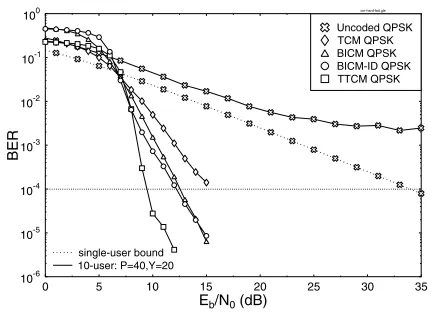
The BER versus Signal to Noise Ratio (SNR) per bit, namely Eb/N0, performance of the QPSK-based CM-GA-MUD schemes
is shown in Figures 2 and 3 for transmissions over AWGN chan-nel and uncorrelated Rayleigh fading chanchan-nel, respectively. The simulation parameters were summarised in Table I, II and III. A ’codeword length’ of1000 symbols and a spreading factor of31 chips were employed. As determined by the ’codeword length’, the turbo interleaver ofTTCM and the internal bit interleavers ofBICM and BICM-ID had a memory of1000 symbol duration. The employment ofan uncorrelated Rayleigh fading channel implies ideal channel interleaving, which has an infinitely long interleaver depth.
cm-hard-awgn.gle
0 1 2 3 4 5 6 7 8 9 10
Eb/N0(dB) 10-6
10-5 10-4 10-3 10-2 10-1 100
BER
TTCM QPSK BICM-ID QPSK BICM QPSK TCM QPSK Uncoded QPSK
[image:4.612.74.286.56.209.2]10-user: P=40,Y=20 single-user bound
Fig. 2. BER versusEb/N0 performance of the various CM-GA-MUD schemes for transmissions over the AWGN channel employing QPSK and utilising the simulation parameters of Table I, II and III. A codeword length of 1000 symbols and a spreading factor of 31 chips were employed.
cm-hard-fad.gle
0 5 10 15 20 25 30 35
Eb/N0(dB) 10-6
10-5 10-4 10-3 10-2 10-1 100
BER
TTCM QPSK BICM-ID QPSK BICM QPSK TCM QPSK Uncoded QPSK
[image:4.612.331.541.141.291.2]10-user: P=40,Y=20 single-user bound
Fig. 3. BER versus Eb/N0 performance of the various CM-GA-MUD schemes for transmissions over the uncorrelated Rayleigh fading chan-nel employing QPSK and utilising the simulation parameters of Ta-ble I, II and III. A codeword length of 1000 symbols and a spreading factor of 31 chips were employed.
associated BERs ofBPSK and QPSK are identical in terms of Eb/N0. Hence the single user bounds for QPSK modulation
shown in Figure 2 for AWGN channel and Figure 3 for un-correlated Rayleigh fading channel, are identical to that of the BPSK modulation. However, the orthogonality ofthe in-phase and quadrature-phase BPSK signals is corrupted by the MAI when a QPSK signal is transmitted in a CDMA system. Hence the BER ofQPSK signal is not identical to that ofBPSK signals in the context ofa MAI-limited CDMA environment. There-fore, the uncoded QPSK performance of aK= 10-user CDMA system is worse than that ofthe single user bounds illustrated in Figures 2 and 3.
Note that the computational complexity of the
GA-MUD is MK
P×Y = 1310.72 times lower, than that of the
optimum MUD, when supportingK= 10users employ-ing QPSK modulation. The penalty for this complexity re-duction is the BER error floor experienced by the GA-MUD schemes at high SNRs, as shown in the Figures 2 and 3. How-ever, this disadvantage is eliminated, when the CM schemes are utilised. In particular, the TTCM assisted GA-MUD con-stitutes the best candidate, followed by the BICM-ID assisted GA-MUD, as evidenced in Figures 2 and 3 for transmissions
over the AWGN and uncorrelated Rayleigh fading channels en-countered. More specifically, for a throughput of 1 BPS and a target BER of10−4, theK = 10-user TTCM-GA-MUD
as-sisted CDMA system is capable ofproviding SNR gains ofabout 4 and 25 dBs in AWGN and perfectly interleaved narrowband Rayleigh fading channels, respectively, against the single-user bounds ofthe uncoded BPSK scheme.
mtcm-hard-awgn.gle
0 1 2 3 4 5 6 7 8 9 10
Eb/N0(dB) 10-6
10-5 10-4 10-3 10-2 10-1 100
BER
16QAM : P=160,Y=80 8PSK : P=80,Y=40 QPSK : P=40,Y=20 TTCM, 10-user
10-user: GA-MUD single-user bound
Fig. 4. BER versusEb/N0performance of the TTCM-GA-MUD scheme for transmissions over the AWGN channel employing QPSK, 8PSK and 16QAM and utilising the simulation parameters of Table I, II and III. A codeword length of 1000 symbols and a spreading factor of 31 chips were employed.
mtcm-hard-xfad.gle
0 5 10 15 20 25 30 35
Eb/N0(dB) 10-6
10-5
10-4 10-3 10-2 10-1 100
BER
16QAM : P=160,Y=80 8PSK : P=80,Y=40 QPSK : P=40,Y=20 TTCM, 10-user
10-user: GA-MUD single-user bound
Fig. 5. BER versusEb/N0performance of the TTCM-GA-MUD scheme for transmissions over the uncorrelated Rayleigh fading channel em-ploying QPSK, 8PSK and 16QAM and utilising the simulation pa-rameters of Table I, II and III. A codeword length of 1000 symbols and a spreading factor of 31 chips were employed.
[image:4.612.70.288.266.425.2] [image:4.612.330.540.363.516.2]5. More specifically,the computational complexity reduc-tions obtained by the GA-MUD compared to that of the optimum MUD when supporting K= 10 users are
MK
P×Y=1.3×10
3, 6.7×10⁵ and8.6×107 for QPSK, 8PSK and 16QAM, respectively. Despite these huge complexity reduction gains, the BER penalty for TTCM-GA-MUD is only around 0.5 to 2 dBs at a BER of 10−4 compared to the
single-user benchmarker, when communicating over the AWGN and uncorrelated Rayleigh fading channels employing QPSK, 8PSK and 16QAM, as evidenced by Figures 4 and 5.
IV. Conclusion
In this contribution, TCM, TTCM, BICM and BICM-ID as-sisted GA-based MUD schemes were proposed and evaluated in performance terms when communicating over the AWGN and narrowband Rayleigh fading channels encountered. It was shown that the GA-MUD is capable ofsignificantly reducing the computational complexity ofthe optimum-MUD, but ex-periences an error floor at high SNRs due to invoking an in-sufficiently large population size and a low number ofgenera-tions. However, with the advent ofthe bandwidth efficient CM schemes proposed, this problem is eliminated. When comparing the four CM schemes at the same decoding complexity, TTCM was found to be the best candidate for assisting the operation ofthe GA-MUD system.
When higher throughputM-ary modulation schemes were in-vestigated with the advent ofTTCM-GA-MUD arrangements, we found that the complexity of TTCM-GA-MUD was dramat-ically lower than that ofthe optimum-MUD, with the penalty ofonly 0.5 to 2 dBs SNR loss compared to that ofthe TTCM single user bound.
V. Acknowledgements
The financial support ofthe European Union under the aus-pices ofthe SCOUT project and that ofthe EPSRC, Swindon UK is gratefully acknowledged.
References
[1] S. Verd´u, “Minimum probability of error for asynchronous Gaussian multiple-access channel,”IEEE Transactions on Communications, vol. 32, pp. 85–96, January 1986.
[2] S. Moshavi, “Multi-user detection for DS-CDMA communications,” IEEE Communications Magazine, vol. 34, pp. 124–136, October 1996.
[3] D. E. Goldberg,Genetic Algorithms in Search, Optimization, and Machine Learning. Reading, Massachusetts: Addison-Wesley, 1989. [4] K. Yen and L. Hanzo, “Hybrid Genetic Algorithm based Multi-user Detection schemes for synchronous CDMA systems,” inIEEE Vehic-ular Technology Conference (VTC), (Tokyo, Japan), pp. 1400–1404, 2000.
[5] K. Yen and L. Hanzo, “Genetic Algorithm Assisted Joint Multiuser Symbol Detection and Fading Channel Estimation for Synchronous CDMA Systems,”IEEE Journal on Selected Areas in Communica-tions, vol. 19, pp. 985–998, June 2001.
[6] S. Abedi and R. Tafazolli, “Genetically Modified Multiuser Detec-tion for Code Division Multiple Access Systems,”IEEE Journal on Selected Areas in Communications, vol. 20, pp. 463–473, February 2002.
[7] G. Ungerb¨ock, “Channel coding with multilevel/phase signals,” IEEE Transactions on Information Theory, vol. 28, pp. 55–67, Jan-uary 1982.
[8] L. Hanzo, T.H. Liew and B.L. Yeap,Turbo Coding, Turbo Equal-isation and Space Time Coding for Transmission over Wireless channels. New York, USA: John Willy IEEE Press, 2002. [9] P. Robertson, T. W¨orz, “Bandwidth-Efficient Turbo Trellis-Coded
Modulation Using Punctured Component Codes,”IEEE Journal on Selected Areas in Communications, vol. 16, pp. 206–218, February 1998.
[10] C. Berrou, A. Glavieux and P. Thitimajshima, “Near Shannon Limit Error-Correcting Coding and Decoding : Turbo Codes,” in Proceedings, IEEE International Conference on Communications, pp. 1064–1070, 1993.
[11] E. Zehavi, “8-PSK trellis codes for a Rayleigh fading channel,”IEEE Transactions on Communications, vol. 40, pp. 873–883, May 1992. [12] X. Li, J. A. Ritcey, “Bit-interleaved coded modulation with itera-tive decoding using soft feedback,”IEE Electronics Letters, vol. 34, pp. 942–943, May 1998.
[13] S. Verd´u,Multiuser Detection. New York, USA: Cambridge Univer-sity Press, 1998.
[14] M. Mitchell,An Introduction to Genetic Algorithms. Cambridge, Massachusetts: MIT Press, 1996.
[15] L. J. Eshelman and J. D. Schaffer, “Preventing premature conver-gence in genetic algorithms by preventing incest,” inProceedings of the Fourth International Conference on Genetic Algorithms(R. K. Belew and L. B. Booker, eds.), (California, USA), pp. 115–122, Mor-gan Kaufmann, 1991.
[16] M. J. Juntti, T. Schl¨osser, and J. O. Lilleberg, “Genetic algorithms for multiuser detection in synchronous CDMA,” inIEEE Interna-tional Symposium on Information Theory – ISIT’97, (Ulm, Ger-many), p. 492, 1997.
[17] G. Syswerda, “Uniform crossover in genetic algorithms,” in Proceed-ings of the Third International Conference on Genetic Algorithms (J. D. Schaffer, ed.), (California, USA), pp. 2–9, Morgan Kaufmann, 1989.
[18] W. Spears and K. De Jong, Foundations of Genetic Algorithms, ch. An Analysis of Multi-Point Crossover, pp. 301–315. California, USA: G. Rawlins, ed., Morgan Kaufmann, 1991.
[19] D. Divsalar and M. K. Simon, “The design of trellis coded MPSK for fading channel: Performance criteria,”IEEE Transactions on Communications, vol. 36, pp. 1004–1012, September 1988. [20] D. Divsalar and M. K. Simon, “The design of trellis coded MPSK
for fading channel: Set partitioning for optimum code design,”IEEE Transactions on Communications, vol. 36, pp. 1013–1021, Septem-ber 1988.
[21] S. X. Ng, T. H. Liew, L-L. Yang and L. Hanzo, “Comparative Study of TCM, TTCM, BICM and BICM-ID schemes,”IEEE Vehicular Technology Conference, pp. 2450–2454, May 2001.
[22] X. Li, J. A. Ritcey, “Trellis-Coded Modulation with Bit Interleav-ing and Iterative DecodInterleav-ing,”IEEE Journal on Selected Areas in Communications, vol. 17, pp. 715–724, April 1999.
[23] S. Lin and D. J. Costello, Jr, Error Control Coding: Fundamen-tals and Applications. Inc. Englewood Cliffs, New Jersey 07632: Prentice-Hall, 1983.