Themed Section: Science and Technology
Load Distribution Scheme to Split the Data on Multiple Paths
Dr. Gaytri Devi1, Dr. Shuchita Upadhyaya2
1GVM Institute of Technology and Management, DCRUST, Sonipat, Haryana, India
2Department of Computer Science and Applications, Kurukshetra University Kurukshetra, Haryana, India
ABSTRACT
Internet has become need of the hour. In the current scenario of Internet, there has been a tremendous increase in the amount of data being transferred among Internet users. This huge amount of data is termed as big data. Big Data concerns large-volume, complex, growing data sets with multiple, autonomous sources. Big data brings big insights. The most fundamental application for the Big Data is to explore the large volumes of data and extract useful information or knowledge for future business actions . Big data not only includes traditional files but also audio, video and graphics. QoS (Quality of Service) routing mechanism can play an important role for the successful transmission of these data while maintaining its quality. Using multi path strategy, QoS routing can be more valuable. If the source has multiple disjoint paths to transfer the flow, it may use multiple paths altogether by distributing the load .This paper proposes a load distribution scheme for the efficient transmission of data.
Keywords: Big Data, QoS, Load Distribution, Multipath Routing, Multiple Paths, Quality of Service, Bandwidth, Delay.
I.
INTRODUCTION
In the present scenario of Internet , the transmission of unstructured data(audio, video, graphics) is a challenging task. QoS routing can be viewed as an attractive approach to tackle this issue.
Multi-path routing scheme can be merged with QoS for the transmission of Internet applications. Multi-path routing establishes multiple routes between source and destination nodes. The function of having multiple paths is either enhancing the trustworthiness of the data transmission, or load balancing.
If the source has multiple disjoint paths to transfer the flow, it may use multiple paths altogether by distributing the load . By using this concept , congestion can be reduced and delays can be decreased a lot .
Thus keeping these all needs into mind, a load distribution scheme for multi-constrained and multi path Routing has been proposed in this paper.
The ultimate goal of this paper is to explore a scheme of optimal disjoint path selection scheme that has been proposed in [2] and propose a load distribution method to distribute the load on multiple paths.
The outline of the paper is as follows: Section 2 explains QoS & Multiple paths .Section 3 discusses the load distribution approach on disjoint paths and Section 4 concludes the paper.
II.
QOS(QUALITY OF SERVICE) &
MULTI-PATH
be desired bandwidth, delay, variation in delay experienced by receiver(jitter),packet loss that can be tolerated, number of hops, cost of links etc.
The fundamental problem of routing in a network that provides QoS guarantee is to find a path between specified source and destination node pair that simultaneously satisfies multiple QoS parameters.
These parameters are represented in the form of metrics. One metric for each constraint is to be specified like bandwidth metric, jitter (variation in delay) metric, delay metric, number of hops metric, packet loss ratio etc. from one node to all other nodes in the network. Metric for a complete path with respect to each parameter is determined by the composition rules of metrics. The three basic rules are -
(i) Additive Metric: The value of the constraint over the entire path is the addition of all links constituting path. For Example- delay, hop count, cost or jitter.
ii) Multiplicative Metric: Using this metric, the value for the complete path is multiplication of metric value of all its edges.
Examples are – reliability (1-lossratio) and error free Transmission (probability)
Multiplicative metric can be converted into additive by taking logarithm.
iii) Concave Metric: In this metric, either min edge value or max edge value is taken as constraint value for a path among all the edges of that path. For Example- Bandwidth.
For a complete path, the constraints may be required either as a constrained form or in a optimization form. In constrained form, some condition is put on constraint value e.g. Choose that path only which has delay less than or equal to 60 ms. The path obeying the condition is called feasible. On the other hand optimization refers to path having minimum or maximum value for a constraint e.g. Choose the path
that has minimum delay among all the paths. This path is called optimal path .
The further QoS issues have been discussed in[1] To provide user- or application-level Quality of Service (QoS) guarantee multipath routing strategy can be used for the transmission of QoS sensitive traffic over the network. Multipath routing means using multiple paths instead of using single path to forward the traffic. If multiple paths are being used for the transmission of the traffic then the traffic will be redirected to the backup path if active path fails. In this way robustness can be achieved. On the other hand load balancing for communication network to avoid network congestion & optimize network throughput also requires multi paths to distribute flows . Robustness & load balancing are aspects of QoS routing . So multipath can be proved very valuable for Quality of service.
Multipath approach can be merged into QoS Routing to catch its maximum advantage as in some situation a single path is not able to fulfill all the QoS requirements. The benefits of provisioning multiple QoS paths are reliable QoS support and uniformly balanced network load.
An adjacency matrix is used to define the network in this implementation. After the first minimum delay path is computed by the Dijkstras algorithm, all links in the adjacency matrix that have fallen on the computed path are made 0. The same algorithm is then executed for finding the second best possible path in terms of delay. This path will now be disjoint from the previously computed path. The same process can now be repeated to compute ‘n’ mutually exclusive paths between a source-destination pair in increasing order of delays.
Example
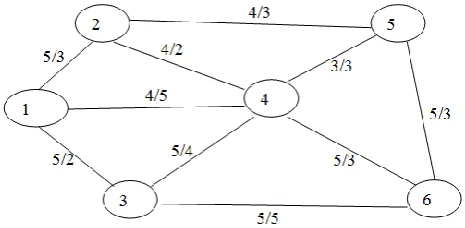
Here is a network of 6 nodes. Each edge is represented by its residual bandwidth & delay metric
Figure 1. Example Network with edges depicting bandwidth/delay
Thus bandwidth and delay matrix of Network are- Table 1. Bandwidth Matrix
1 2 3 4 5 6
1 0 5 5 4 0 0
2 5 0 0 4 4 0
3 5 0 0 5 0 5
4 4 4 5 0 3 5
5 0 4 0 3 0 5
6 0 0 5 5 5 0
Table 2. Delay Matrix 1 2 3 4 5 6
1 0 3 2 5 0 0 2 3 0 0 2 3 0 3 2 0 0 4 0 5
4 5 2 4 0 3 3 5 0 3 0 3 0 3 6 0 0 5 3 3 0
The following parameters have been assumed- Bandwidth threshold - 4
Delay threshold - 10 Source - 1
Destination – 6
The problem can be defined as - find multiple disjoint paths between 1 and 6 in the given network. The paths should follow the following conditions-
The bandwidth of the paths should be minimum 4. The delay of the paths should not exceed 10.
As bandwidth is concave metric, so each of the edges in the path found should have value greater than or equal to 4 and delay is an additive metric, so the sum of the delay of edges constituting the path should be less than or equal to 10.
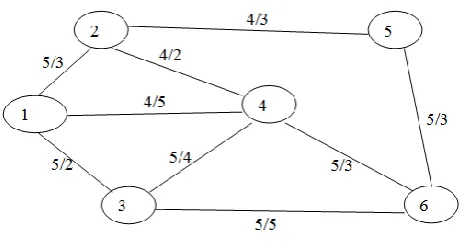
According to the algorithm, the edges are removed from the graph that does not satisfy the bandwidth requirement by setting their delay value and bandwidth value to 0.
Now the resultant network will be-
Figure 2. Filtered Network
In this network, Elimination of edges not satisfying bandwidth requirement has been done. Now the bandwidth of all the edges is equal or greater than 4. On this filtered network ,the algorithm finds those multiple disjoint paths whose delay are less than 10.
Thus, the multiple disjoint QoS paths found in the given network are as follows-
Table 3. Path Table Path Bandwidth of Path Delay of
Path
Hop-Count
1-3-6 5 7 2
1-4-6 4 8 2
1-2-5-6 4 9 3
Thus the algorithm finds multiple disjoint paths satisfying bandwidth and delay requirements in the order of increasing delay.
Now on these disjoint paths, load distribution scheme has also been suggested in next section.
III.
LOAD DISTRIBUTION SCHEME
A load-distribution algorithm divides the traffic among multiple paths for higher network utilization. Data packets are distributed over multiple routes in proportion of the priority level of paths. In this scheme the delay value will be considered as a metric
for traffic distribution .The traffic will be distributed inversely proportionally to the delay value of the paths. That is, paths with lower delay value are assigned more traffic, and paths with higher delay value are assigned less traffic. load distribution can be done according to the following process-
Algorithm-
Step1 Let the value Ri =10-delay for each path. [As the limit of delay is 10]
Step 2 Calculate the proportion of traffic by the following equation –
Where n = Total number of paths
Step 3 Divide the number of packets according to the value Pi as follows-
Numberof packets * Pi/ 100 for each path.
In our example, if the traffic load is 40 packets, then the above described algorithm will yield the following load distribution on the three selected paths. The delay values for three disjoint paths (1-3-6) , (1-4-6) and (1-2-5-6) as obtained are-
D 1 = 7, D 2 = 8 and D=9
Step 1
R1=10-7=3, R2=10-8=2 and R3 =10-9=1 Step 2
P1=3/(3+2+1)*100=50 P2=2/(3+2+1)*100=33 P3=1/(3+2+1)*100=17 Step 3
The load distribution on the two paths may be done proportionally as-
No of packets on path1 = 40*50/100= 20 No of packets on path2 = 40*33/100= 13 No of packets on path3 = 40*17/100= 7 Thus
IV.
CONCLUSION
The data created or transmitted on Internet has been growing at increasing rate. The type of data that has been transmitted requires Quality of Service for certain applications So ,there is a need to discover efficient routing schemes along with efficient load distribution for flows in the Internet. Keeping this in mind, this paper ,describes a load distribution scheme to calculate the ratio of traffic among multiple paths.
V.
REFERENCES
[1].S.Upadhaya, G.Devi,"Exploring Issues for QoS Based Routing Algorithms" published in International Journal on Computer Science and Engineering (E-ISSN : 0975-3397 ) Vol. 02, No. 05, 1792-1795,2010.
[2].S.Upadhaya, G.Devi "Quality of Service Routing: A Multi-Path Approach" published in International journal of Computer Science & Network Solutions January , 2014-Volume 2.No1 ISSN 2345-3397