© 2018 IJSRST | Volume 4 | Issue 7 | Print ISSN: 2395-6011 | Online ISSN: 2395-602X Themed Section: Science and Technology
Smart Bag
Ajinkya Laxman Abhang
1, Chetan Lotan Mahale
1, Vaibhav Ramesh Desai
1, Puspendu Biswas
21Computer Engineering, Sanghavi College of engineering, Nashik, India
2Assistant Professor, Computer Engineering, Sanghavi College of engineering, Nashik, India
ABSTRACT
Traveling persons are facing many safety problems for luggage nowadays. So in such cases they feel handicap and need help to protect them. This paper suggests a new technology with one touch system using GSM, GPS so that person never feel helpless while facing such social problems or challenges like stolen a bag. Here we introduce a device which ensures the protection of luggage in bag. The problems we will overcome here using raspberry pi, GSM, GPS and camera, electromagnetic sensor, battery.If you're carrying a bag and in case bag is stolen and bag crosses geo fencing area automatically notifications will be send through SMS to owner at the same time the images will be captured and send to database so as thief can be identified. The bags location can be traced continuously through IoT System. As switch is placed opening and closing of the bag can be recorded in our database. By using face reorganization system bag can be opened. This project consists of a android based application to trace the bags location. A bag tracking system will inform where your bag is and where it has been, how long it has been. The system uses geographic position and time information from the Global Positioning Satellites.
Keywords: Raspberry Pi, Arduino, GSM, GPS, Electromagnetic Switch, camera
I.
INTRODUCTIONThe environment in today’s world is very stressful. Thus, there is a need of a Smart Bag is immense in today’s stressful environment which is exactly what our project aims at. We propose our very innovative Smart Bag.
There can be many issues that might occur during travelling. The paper intends to look into introducing the access safety of luggage bag through tracking system by GPS that will help the bag transportation in a secure and safer way. There are also some issues which disturbs the person, like forgetting the luggage bag to overcome these all issues and problems the “Enhance Safety, Security And Tracking System” is developed that will help the person to know the details and the exact location of their bags and also will be able to secure the luggage and get live location, and keep all the records.
The proposed design provides information regarding bag locations, position on real time basis. This information can be collected by the RASPBERRY PI by using different module and dispatch it to the monitoring station where it stores the information in database and display it on graphical user interface (GUI) which is user friendly. This project consists of an android based remote bag disengaging system will provide elective, real time bag location, mapping and reporting this information value and add by improving the level of service provided. A bag tracking system will inform where your bag is and where it has been, how long it has been. The system uses geographic position and time information from the Global Positioning Satellites.
six different 12-hour orbital paths spaced so that at least five are in view from every point on the globe. Today, GPS has a wide range of other applications including tracking bag.
In this work, GPS is combined with one of the basic service of a smart phone which is GSM, more specifically SMS, in one system. An application at the User side will allow User to track a location request to a system side then retrieve the location from the request reply and shows it on a map. On the other hand, the application at the Bag side gathers the necessary information of the device that will be used to locate the smart bag. Information such as GPS coordinates and captures images via usb camera are gathered and sent to the User’s smart phone that’s preregistered on the application. The communication between the User and the Bag applications is done using Short Message Service (SMS), Captures images And GPS Tracking. SMS offers the system unique features. The system sends the location of Bag to User’s smart phone when the User wishes to check the Bag location. This paper is organized as follows. Section I is an introduction to the work. Section II reviews the related work focusing on location-based services and GSM. Section III describes in details the system development including its requirements, architecture and how the system works. Section IV is the conclusion and future work.
II.
LITERATURE SURVEYA. Baggage handling system using RFID tag and IoT: The research to develop a working model of a baggage handling system using RFID tag and IoT which will track bags, assist in locating bags, alert staff if baggage not loaded correctly, identify a bag for security personnel to track. The main advantage of the system is that it consumes less time as the passengers don’t have to wait for their baggage to turn up on the conveyer belt instead they are routed to different counters and ensures high security due to the unique identification number. [1]
B. Child Tracking System Using RFID Tag :
The system based on microcontroller is found to be more compact, user friendly and less complex. Though it is designed keeping in mind about the need for
school kids, it can extended for other purposes such as commercial & research applications. Due to the probability of high technology (Android) used this system is well software controlled. The feature makes this system is the base for future systems. In future we can use this idea of smart bag to packing system in factories, shops, super markets etc. It consist of RFID reader interfaced with microcontroller chip to maintain schedule as well as useful for bag verification, panic button, bluetooth module and for tracking purpose. Communication process is served by using android application which will be inside our android smart phone. Our phone is interfaced with Smart Bag. These features lets you build powerful and reliable product.[2]
C. Child Tracking System Using Geo-fencing and GPS :
In this paper, This is focused on the safety of children.Today child safety is an important issue across the world as child crime is rapidly growing across the world we have discussed how a smartphone provides safety and monitoring for the parents so that they can easily track their children according to their requirement. This application is developed on Android platform for this application the basic techniques. Required mentioned below: (a) Geo-Fencing (b) GPS (Global Positioning System) (c) SMS (Short Messaging Service) [3]
D. Smart Bag Using Solar and RFID Technology:
In this paper, The environment in todays world is very stressful. Thus, there is a need for a Smart Bag is very useful in todays stressful environment. Which is exactly what our project aims at? We propose our very innovative Id Smart Bag. The bag also has an RF-Id reader with microcontroller chip to check if the number of books matches the schedule for the day. Using the RF-Id we can also identify if any book is missing or if there is an extra book inside the bag.[4]
E. GPS and GSM based Passenger Tracking System:
One of the main context information is location, which enables a wide set of cell phone applications
including navigation, location-aware social
(AVL) is a system [6] that provides the tracking of vehicle. Location Based Service (LBS), Navigation and Intelligent Transportation are the hot research topics now. Daily millions of passengers travel in buses to reach his/her destination. A major concern is the family members who wish to monitor to each other when they are moving in buses. For passengers safety point of view a passenger tracking system is required. Which can track of passengers between source and destination? Mostly passenger tracking system use RFID tags for tracking. But these tracking systems are not cost effective. So a cost effective system is introduced here by using GSM and GPS, which track passengers those are inside buses. It tracks passengers on the basis of bus ticket number. Only users need to enter the valid ticket number of passengers. Users of the system can track passengers at anytime and anywhere by using mobile phone and laptop/desktop. The users of this system can get location information of passenger, only if they know ticket number. For this tracking system its duty of passengers to tell your ticket number to his/her known and family members before starting journey.[5]
III.
SYSTEM ARCHITECTUREA. GPS Global Positioning System (GPS)
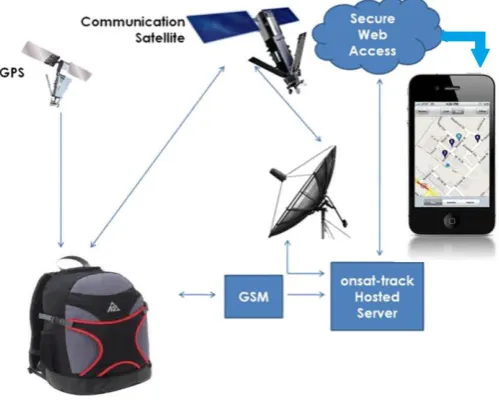
GPS is a navigational system that can pinpoint our position anywhere on the globe. The satellites transmit signals that can be detected by anyone with a GPS receiver. GPS receivers take this information and calculate the user's exact location. GSM is used for sending message about current location.
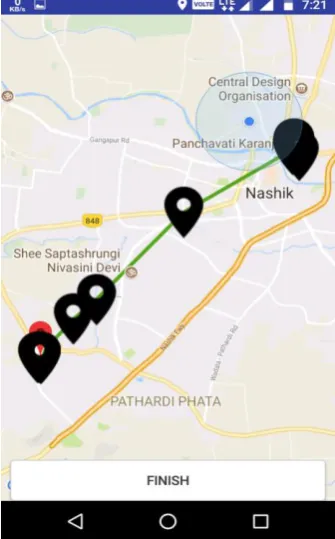
GPS is useful for tracking bag and also provides the information where the bag is currently located as well as it also informs the user how long his bag is far away from its user. SMS services used when smart phones do not support internet connectivity in this case bag is able to send a text message or exact location to the user. This system is going to help the user to track the location of their bag without informing thief because their movement is displayed on the user device through Google maps as well as they received calculated distance of their bag from themselves.
B. GSM
The GSM standard also provides separate facilities for transmitting digital data. This allows a mobile phone to act like any other computer on the Internet, sending and receiving data via the Internet Protocol. The solution for tracking and a missing bag is done with The help of GPS and GSM technologies. There are two main services are used for this application that is GPS and SMS. For location services is GPS and telephony services is SMS.
Figure 1: System Architecture
C. Geofencing
A geo-fence is a virtual perimeter for a real-world geographic area. A geo-fence could be dynamically generated as in a radius around a store or point location, or a geo-fence can be a predefined set of boundaries, like school attendance zones or neighborhood boundaries. In this application user are able to create a Geo-reference boundary according to their choice called Geo-fencing, at a single time multiple Geo-fences can be created. This application uses Google maps API to show location on map.
D. User Interface
Eclipse Which support android application development. The Reason for selecting android operating system is that now Days millions of users are using smart phones.
A. Implementation Details:
Connect camera module to the CSI port on your Raspberry Pi; this is the long thin port adjacent to the HDMI socket. Gently lift the collar on top of the CSI port (if it comes off, don’t worry, you can push it back in but try to be more gentle in future!). Slide the ribbon cable of the camera module into the port with the blue side facing the Ethernet port (or where the Ethernet port would be if you’ve got a model A/A+). Once the cable is seated in the port, press the collar back down to lock the cable in place. If done properly you should be able to easily lift the Pi by the cameras cable without it falling out. The following illustrations show a well-seated camera cable with the correct orientation.
IV.
RESULTSFigure 2: Login Screen
Figure 3: Track Bag
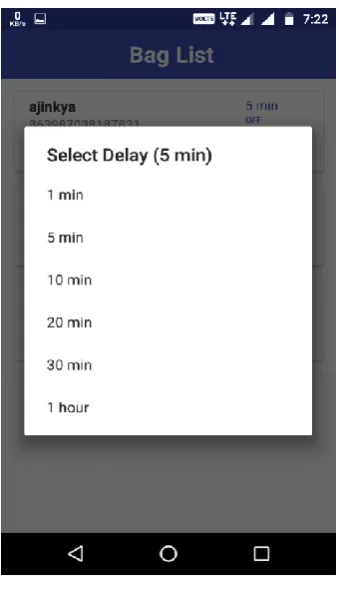
Figure 5: Update Delay
V.
CONCLUSIONIn conclusion, this application is designed for locating missing or stolen bag. The solution represented in this paper takes the advantages of smart phones which offer rich features like Google maps, GPS, SMS etc. Some of the best works implemented in past relies on SMS based tracking which is not helpful to get an accurate location in our proposed system we have provided real time tracking. We have added Geo-fencing and Emergency messaging services to enhance the system.
VI.REFERENCES
[1].
Ashwini Singh, Sakshi Meshram, Tanvi Gujar, Student Member, P.Wankhede,"Baggage Tracing and Handling System using RFID and IoT for Airports"978-1-5090-1338-8/16/2016 IEEE.[2].
Mrs.Rasika Naik, Sanjana Muppidwar, Pallavi Chavan, Siddhi Medhekar, Pooja Chindarkar "SMART BAG February 2016, Volume 3, Issue 2 JETIR (ISSN-2349-5162)".[3].
Aditi Gupta , Vibhor Harit,[email protected],[email protected] m "Child Safety & Tracking Management System" 2016 IEEE DOI 10.1109/CICT.2016.141.
[4].
Shrinidhi Gindi, Irshad Ansari, Kamal Khan, Farooqui Bilal. “Smart Bag Using Solar and RFIDTechnology” Imperial Journal of
Iinterdisciplinary Research(IJIR),Vol-2, Issue-5, 2016.
[5].
Andrea Zanella, Senior Member, IEEE, NicolaBui, Angelo Castellani,
Lorenzo Vangelista, Senior Member, IEEE, and Michele Zorzi, Fellow,”Internet of Things for Smart Cities” IEEE INTERNET OF THINGS JOURNAL, VOL. 1, NO. 1, FEBRUARY 2014
[6].
Troy C. Welker, Richard E. Huffman, Meir Pachter “Modeling Earth's gravitational gradients for GPS-free navigation” American Control Conference (ACC), 2013[7].
S. Abdullah SUPARCO “GSM Technology”Students Conference, 2002. ISCON '02.