
TRIMETAZIDINE HYDROCHLORIDE TRANSDERMAL PATCH: FORMULATION AND IN-VITRO EVALUATION
5
0
0
Full text
(2) Sarfaraz Md et al. IRJP 2012, 3 (7) Weight Variation For each formulation, three randomly selected patches were used. For weight variation test, 3 patches from each batch were weighed individually and the average weight along with standard deviation was calculated. Folding Endurance The folding endurance was measured manually for the prepared patches. A strip of patch was cut and repeatedly folded at the same place till it broke. The number of times the patch could be folded at the same place without breaking/cracking gave the value of folding endurance. Drug Content Uniformity of Patches The patches (1cm2) were cut and added to a beaker containing 100 ml of phosphate buffered saline of pH 7.4. The medium was stirred at 100 rpm with magnetic bead. The contents were filtered using whatmann filter paper and the filtrate was examined for the drug content against the reference solution consisting of placebo patches (contains no drug) at 270 nm spectrophotometrically. Tensile Strength Tensile strength of the patch was determined with Universal strength testing machine (Hounsfield, Slinfold, Horsham, U.K.). The sensitivity of the machine was 1 g. It consisted of two load cell grips. The lower one was fixed and upper one was movable. The test patch of size (4 × 1 cm2) was fixed between these cell grips and force was gradually applied till the patch broke. The tensile strength of the patch was taken directly from the dial reading in kg. Tensile strength is expressed as follows: Tensile load at break Tensile strength = -------------------------------Cross section area Partition Coefficient 6, 7 A drug solution of 4 mg/ml was prepared in n-octanol. 25 ml of this solution was taken in a separating funnel and shaken with an equal volume of phosphate buffer of pH 7.4 (aqueous phase) for 10 minutes and allowed to stand for 2 hrs. Then aqueous phase and organic phase were collected separately and centrifuged at 2000 rpm. Both the phases were analyzed for the drug concentration using U.V. spectrophotometer. Partition coefficient was calculated by taking the ratio of the drug concentration in noctanol to drug concentration in aqueous phase. Triplicate readings were taken. In vitro Release Studies8 A vertically assembled Franz diffusion cell having downstream volume of 75 ml was used. The cellophane membrane was mounted on the diffusion cell and receiver compartment was filled with 75 ml phosphate buffer of pH 7.4 and the temperature was maintained at 370C±0.50C. 5 ml of sample was withdrawn every hour and replaced with 5 ml fresh buffer to maintain sink condition and their concentration was measured in UV -spectrophotometer at 270 nm. Data Analysis9 The cumulative amount of drug release per unit area versus time was plotted. The slope of the linear portion of the plot was calculated as the flux (mg/cm2/hr.). For precisely analyzing the release properties of trimetazidine hydrochloride, the time course of release of drug across a cellophane membrane was studied using Franz diffusion cell. Pure trimetazidine hydrochloride (without the mediation of an organic solvent or drug delivery system) was used in this investigation.. Skin Irritation Studies 10 The skin irritation test was performed on twelve healthy albino rabbits weighing between 2.0 to 2.5 kg. Six rabbits each were used for testing drug reservoir and rate limiting patches. The rabbits were shaved on left and right dorsal surfaces. Aqueous solution of formalin 0.8% was used as standard irritant. Drug reservoir and rate limiting patches of 1 cm2 were used as test patches. 0.8% of formalin was applied on the left dorsal surface of each rabbit, where as the test patches were placed on identical site, on the right dorsal surface of the rabbit. The patches were removed after a period of 24 hrs with the help of alcohol swab. The skin response was examined for development of erythema and edema for each rabbit at the end of 24 hrs. Fourier Transformer Infrared Spectroscopy (FTIR) study The compatibility between drug and polymer was detected by FTIR spectra obtained on (Bruker, Canada). The pellets were prepared on KBr-press (Spectra lab, India). The spectra were recorded over the wave number range of 4000 to 500 cm-1. Stability Studies11 The selected transdermal patch were wrapped with aluminum foil and stability studies were carried out at 250±20C/60%±5%RH, 300±20C/65%±5%RH and 40±2oC/75±5%RH for three months by storing the samples in stability chamber. RESULTS AND DISCUSSION Calibration curve of trimetazidine hydrochloride in phosphate buffer (pH 7.4) solutions were constructed at λmax 270 nm with a UV-VIS spectrophotometer (UV-1700, Shimadzu Corporation, Tokyo, Japan). Analyses were done in triplicate. n-Octanol and in vitro study fluid (phosphate buffer solution, pH 7.4) were considered to be the standard system for determining the drug partition coefficient between skin and in vitro fluid. The logarithmic value of the partition coefficient (log P) was found to be 1.01 ± 0.040. The results obtained indicated that the drug possessed sufficient lipophilicity, which met the requirements of formulating it in to a transdermal patch. The patches of selected polymers were prepared. Addition of the plasticizer produced a patch of good strength. The patches were translucent and visually smooth surfaced. The developed procedure to prepare the patches was reproducible. In the present investigation, transdermal patches of trimetazidine hydrochloride were formulated using the hydrophilic polymer matrix of hydroxypropylmethylcellulose and carboxymethyl chitosan. Ethyl cellulose was used as ratecontrolling polymer. The prepared patches were characterized for physicochemical properties, in-vitro release profile and skin irritation studies in rabbits. The physicochemical properties of trimetazidine hydrochloride transdermal patches are presented in Table 2. The thickness of the transdermal patches was found to be directly proportional to the polymeric concentration. The thickness of the transdermal patches varied between 0.60±0.01 to 0.82±0.1 mm. The order of the thickness of patches was F6 > F3 >F2 >F5>F4>F1 (Table 2). The folding endurance for transdermal patches was found in the range of 60 to 152. The order of folding endurance of patches is F3 > F1 >F2 >F4>F5>F6 (Table 2). As the ratio of concentration of drug: polymer was increased tensile strength also increase. Tensile strength of transdermal patches prepared by carboxymethylchitosan and HPMC gave values in the range of 0.130 ±0.05 to 0.172± 0.03 kg/mm2. The drug content in all the formulations was found to be in between 92.60±0.13% (F5) to 95.32±0.11% (F3). The results showed that, the drug content was uniform and reproducible Page 179.
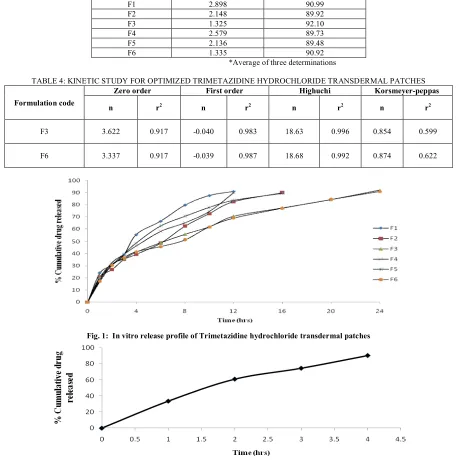
(3) Sarfaraz Md et al. IRJP 2012, 3 (7) in each batch of different transdermal patch formulations. In all the formulations, the calculated standard deviation values were very low indicating the uniformity of drug content. Transdermal patches prepared by taking different drug: polymer ratio such as 1:1, 1:1.5 and 1:2 (by making use of drug reservoir polymers like carboxymethylchitosan and HPMC) and EC (2% of polymer concentration) as rate limiting membrane were subjected for in-vitro release studies. The formulations F1 and F4 showed in-vitro release of 90.9% and 89.7% for 12 hrs. The formulations F2 and F5 showed in-vitro release of 89.9% and 89.4% for 16 hrs. The formulations F3 and F6 showed in-vitro release of 92.1% and 90.9% for 24 hrs and results are shown in Fig. 1. Among all formulations, F3 was selected as optimized formulation. Permeation study of pure drug trimetazidine hydrochloride was carried out (Fig. 2) to understand the nature and amount of drug release across the cellophane membrane and was compared with in-vitro release of best formulation. The release flux of optimized formulation F3 (1.325 mg/cm2/hr) was 40% slower than that by pure drug, indicating the role of rate controlling polymers in controlling the release of the drug from the patches (Table 3). Skin irritation studies revealed that trimetazidine hydrochloride transdermal patch F3 did not cause any noticeable sign of erythema or edema on rabbit skin throught the period of 24 hrs indicating the prepared formulation was compatible with rabbit skin (Fig. 3 & 4). The kinetic results revealed that the selected formulations F3 and F6 followed first order, as correlationcoefficient (r2) values (0.987) of first order are higher than that of zero order values (0.917)(Table 4). The stability studies were carried out for the optimized formulation (F3) at 250±20C/60%±5%RH, 300±20C/65%±5%RH and o 40±2 C/75±%5 RH for a period of three months. The drug content of F3 after stability studies was found to be 95.22, 94.10 and 93.44% respectively at different temperatures and relative humidity. This indicated that the transdermal patches remained fairly stable during stability study period. FTIR studies revealed no interactions between drug and excipients.. CONCLUSION On the basis of the in-vitro characterization it was concluded that Trimetazidine hydrochloride could be administered transdermally through matrix type TDDS developed in our laboratory. Transdermal patches containing polymers like HPMC, carboxymethyl chitosan and rate-controlling polymer of ethyl cellulose demonstrated sustained and controlled release of the drug. The drug remained intact and stable in the TDDS during storage, with no significant chemical interaction between the drug and the excipients. Further work is to establish the therapeutic utility of this system by pharmacokinetics and pharmacodynamic studies on human beings. ACKNOWLEDGEMENT We are grateful to East West Pharma, Chennai for gift sample of Trimetazidine hydrochloride and our principal Dr. H. Doddayya, N. E. T Pharmacy College, Raichur for providing excellent facility to carry out this work. REFERENCES 1. Angina pectoris. [Cited 3 march 2012]. Available from: http://www.encyclopedia.com/topic/angina_pectoris.aspx 2. Kantor PF, Lucien A, Kozak R, Lopaschuk GD. The antianginal drug trimetazidine shifts cardiac energy metabolism from fatty acid oxidation to glucose oxidation by inhibiting mitochondrial long-chain 3-ketoacyl coenzyme A tiolase. Circ Res 2000; 86:580–588. 3. Barry BW: Novel mechanisms and devices to enable successful transdermal drug delivery. Eur J Pharm Sci 2001; 14: 101–114. 4. Joshi R, Prabhu P, Shah SS. Formulation and evaluation of transdermal patches of papaverine hydrochloride. Asian J Pharm 2012; 76-86. 5. Patel NB, Sonpal RN, Mohan S, Selvaraj S. Formulation and evaluation of iontophoretic transdermal delivery of diltiazem hydrochloride. Int J Res Pharm Sci 2010; 1(3): 338-344. 6. Partition coefficient. [Cited 12 June 2012]. Available from: www.intermed.it/istbiotech/reach/A08web1992.pdf 7. Martin A, Swarbrick J, Cammarata A. Polymer Science. 3rd ed. Bombay: K. M. Varghese Company; 1991. 8. Chien YW. Systemic drug delivery of pharmacologically active molecule across the skin. 1st ed. New York: Marcel Dekker Inc; 1991 9. Ren C, Fang L, Ling L, Wang Q, Liu S, Zhao L, He Z. Design and in vivo evaluation of indapamide transdermal patch. Int J Pharm 2009: 129-135. 10. Bagchi A and Dey BK Formulation and optimization of losartan potassium transdermal patches by using different polymers. Int J pharm sci bio 2010; 1(1): 56-60 11. Costa P, Lobo JMS. Divisability of diltiazem matrix sustained release tablets. Pharm Dev Tech 2001; 6 (3): 343-51.. TABLE 1: COMPOSITION OF TRIMETAZIDINE HYDROCHLORIDE PATCHES Drug Formulation code Trimetazidine (mg) F1 F2 F3 F4 F5 F6. 240 240 240 240 240 240 Casting Solvent. Polymer. Drug polymer Ratio. Plasticizer. HPMC* Gylcerine 30% 5cps w/w of (mg) polymer (ml) --1:1 0.058 --1:1.5 0.084 --1:2 0.116 240 1:1 0.058 360 1:1.5 0.084 480 1:2 0.116 Water (3 ml) *HPMC = Hydroxypropyl methylcellulose. Carboxy methyl chitosan (mg) 240 360 480 -------. Rate Limiting Membrane Ethyl Cellulose (% w/v) 2 2 2 2 2 2 chloroform. Page 180.
(4) Sarfaraz Md et al. IRJP 2012, 3 (7) TABLE 2: PHYSICOCHEMICAL CHARACTERISTICS OF TRIMETAZIDINE HYDROCHLORIDE TRANSDERMAL PATCHES Thickness* (mm). Formulation code. Weight variation* (mg). Folding endurance†. Tensile strength*. % Drug content*. (Kg/mm2). F1. 0.60±0.01. 81.18±0.44. 140. 0.130±0.05. 93.50±0.23. F2. 0.71±0.01. 106.1±0.39. 110. 0.146±0.03. 93.05±0.75. F3. 0.78±0.02. 119.2±0.35. 152. 0.172±0.03. 95.32±0.11. F4. 0.61±0.01. 82.44±0.32. 90. 0.132±0.02. 92.87±0.12. F5. 0.70±0.02. 105.4±0.20. 67. 0.152±0.01. 92.60±0.13. F6. 0.82±0.01. 121.3±0.32. 60. 0.170±0.02. 93.75±0.20. * All values are expressed as mean ± SD, †n=3 TABLE 3: CALCULATED FLUX VALUES FOR DIFFERENT TRIMETAZIDINE HYDROCHLORIDE TRANSDERMAL PATCHES Formulation code Flux* (mg/cm2/hr) Cumulative percentage of drug released* 7.930 90.28 (4 hrs) Pure drug F1 2.898 90.99 2.148 89.92 F2 F3 1.325 92.10 F4 2.579 89.73 F5 2.136 89.48 F6 1.335 90.92 *Average of three determinations TABLE 4: KINETIC STUDY FOR OPTIMIZED TRIMETAZIDINE HYDROCHLORIDE TRANSDERMAL PATCHES Zero order First order Highuchi Korsmeyer-peppas Formulation code. n. r2. n. r2. n. r2. n. r2. F3. 3.622. 0.917. -0.040. 0.983. 18.63. 0.996. 0.854. 0.599. F6. 3.337. 0.917. -0.039. 0.987. 18.68. 0.992. 0.874. 0.622. Fig. 1: In vitro release profile of Trimetazidine hydrochloride transdermal patches. Fig. 2: In vitro release profile of Trimetazidine hydrochloride pure drug.. Page 181.
(5) Sarfaraz Md et al. IRJP 2012, 3 (7). Fig. 3: Photograph showing rabbit with applied transdermal patch F3. Fig. 4: Photograph of rabbit showing no signs of redness or erythma after removal of the patch after 24 hrs. Fig. 5: FTIR spectra of pure drug and formulation F3. Source of support: Nil, Conflict of interest: None Declared. Page 182.
(6)
Figure

Related documents
It is the (education that will empower biology graduates for the application of biology knowledge and skills acquired in solving the problem of unemployment for oneself and others
Transportation activities include personnel and freight movements and mobile plant activities.. Intertwined with these BMPs are enforceable
In view of the present satisfactory level of computerisation in commercial bank branches, it is proposed that, ‘‘payment of interest on savings bank accounts by scheduled
No.3 IP Fixed Mobile All-IP based FMC Single Platform Box Module Site or Central Office One Cabinet One Site 9KW 3×3KW Smart modularized power management 2KW
ParEEoning Manager spreads namespace across Owners by assigning leases Consistency
• Our goal is to make Pittsburgh Public Schools First Choice by offering a portfolio of quality school options that promote high student achievement in the most equitable and
College Mathematics (3 Credits) Biology (6 Credits) Arts and Humanities 3 Arts and Humanities 3 TOTAL 35 20 8.00 **Total up RED # ** Excess credits 0.00 8.00 Analyzing and
The government co ll ect s revenue f rom taxes on capital and labour income and value-added taxes on fina l demand , production taxes on intermediate inputs, and...
