Student Perceptions Of The First Course In
Accounting: Majors Versus Non-Majors
Geoffrey Tickell, Indiana University of Pennsylvania, USA Tiong Kiong Lim, Carnegie Mellon University, Australia Balasinghan Balachandran, La Trobe University, Australia
ABSTRACT
This paper contributes to the continuing debate regarding the curriculum for the first undergraduate course in accounting by examining student perceptions from studying such a course. Participants are divided into two cohorts - Accounting & Finance Majors (AFM) and Other Business Majors (OBM). Results reported in this paper indicate that teaching the introductory accounting course from a users’ perspective is likely to engender a more favorable impression from students than teaching from a preparers’ perspective. Findings indicate that the AFM cohort holds significantly more positive attitudes to the first course in accounting than does its OBM counterpart. Furthermore, AFM student perceptions do not change between the beginning and the end of the course. In contrast, the OBM students respond less favorably at the end of the course than at the beginning. Findings underscore the difficulty of developing a first course in accounting that is interesting, useful and challenging to accounting and non-accounting majors.
Keywords: First Course in Accounting; Curriculum; Student Perceptions
INTRODUCTION
urriculum designers continuously endeavour to achieve the most appropriate balance between three competing factors - the resources available (including credit hours), the breadth of study, and the depth of study (Nelson, 1995). In other words, what should be taught in the time available? The first course in accounting at university is a case-in-point. Topics taught and pedagogical methods adopted should be the most relevant and useful to students. However, unlike subsequent accounting courses, the first course in accounting has the added attribute of generally being compulsory for all business majors and possibly non-business majors. Therefore, the student mix includes those who intend to major in accounting and those who do not. The question to be asked is: Can one introductory accounting course effectively serve both cohorts of students?
There has been considerable debate surrounding accounting curricula and, more specifically, the first course in accounting (AECC, 1992; Cheng, 2007; Cherry & Mintz, 1996; Christensen, 2004; Pincus, 1997; Vangermeersch, 1997). According to the Accounting Education Change Commission (AECC), the first course in accounting is an important building block for success in future academic work because it can shape student perceptions as to what a career in accounting entails (AECC, 1992). The Commission also asserts that the first accounting course must serve the interests of students who are not going to enter the profession as well as those who are (AECC, 1990). Furthermore, the first course in accounting should be an introduction to accounting rather than introductory accounting (AECC, 1992 p. 250). It is also argued that a user perspective, rather than a preparer perspective, will benefit the greatest number of students (Williams, 1992). Although these preferences relate to accounting courses in the US, they are potentially just as applicable for accounting education in other English-speaking nations (see M. R. Mathews, 1994).
course. Their findings also reveal that student perceptions are less favourable by the end of the course for both groups. Furthermore, they document that changes in perceptions differ across instructors and suggest that instructor assignment is very important for introductory accounting courses as it can impact on the supply of accounting majors to both an accounting program and the accounting profession.
The accounting profession continues to play a key role in curriculum design by requiring accounting majors to have certain levels of technical knowledge if those majors are to be recognized as an entry-level requirement for membership of the professional accounting bodies (Myers, 2005). Accounting faculty have also had their input (see Zeff, 1989). Non-accounting faculty opinions have been noted (Cherry & Mintz, 1996). Also, alumni opinions have been researched (Carr, Chua, & Perera, 2006), yet there appears to be limited research into student views as to the first course in accounting.
This paper extends US investigations to an Australian environment by examining undergraduate student perceptions about the first course in accounting. As different teaching styles, faculty members, and assessment might bias the results when conducting a survey across different universities, our study focuses on students in one university only. This university adopts the lecture/tutorial teaching model and students complete common assessment.
At the majority of Australian-based universities, the introductory accounting course is taught from the preparer’s perspective. That is, there is a strong emphasis on general journal entries, ledger accounts, and general-purpose financial statements (e.g., income statement, balance sheet, and the statement of cash flows). The course is taught using a conceptual approach with the statements of accounting concepts having a large influence on the curriculum. Management accounting concepts (e.g., cost-volume profit analysis, relevant costing) are typically not covered. Notably, for over half of the student population, this is their last accounting course. This fact raises many questions. For example, what is the correct curriculum for this mix of students? Is the teaching style appropriate for accounting and non-accounting majors? Would it be better to have two introductory accounting courses; that is, one for accounting majors and one for other majors? As a contribution to the research literature, this study examines student perceptions about topics covered in an introductory accounting course. Knowledge of student views in this regard can assist in the design of a relevant accounting curricula and effective teaching styles.
Specifically, this research addresses the following three general research questions:
1. Do students find the introductory accounting course to be interesting, useful, and challenging?
2. Do Accounting & Finance major (AFM) students have different expectations and perceptions of the first accounting course compared with their Other Business major (OBM) counterparts?
3. Do students of each group regard the first course in accounting more, or less, favourably at the end of the semester than they did at the start?
Results reported in this paper provide evidence that students’ perceptions about the first course in accounting and the topics covered vary significantly between AFM and OBM students. Participants indicate that they enjoy topics that involve using accounting information and preparing financial statements, whereas they are less interested in the conceptual underpinnings of, and theoretical issues in, accounting (e.g., Statements of Accounting Concepts). Also, the more OBM students understand the relevance of the curriculum to their future careers, the more their interest is stimulated. The findings underscore the importance of two teaching approaches - emphasis upon relevance and experiential learning.
LITERATURE REVIEW
academics pondered as to whether the first accounting course provided an adequate job of describing the realities of the accounting profession and, as a consequence, attracted the best and brightest students into accounting majors.
Many universities and colleges in the US and elsewhere reacted to these calls for changes in the first course in accounting by changing where the emphasis lay. The AECC awarded grants to a number of universities and community colleges that undertook to redesign the Principles of Accounting I and II courses in order to teach the course from a user’s perspective rather than from the traditional preparer’s perspective (see Williams, 1992). Williams, in reporting on a $50,000 AECC grant awarded to a Community College in the US, noted that a large percentage of students taking the Principles of Accounting I course would not pursue accounting as a career. He also noted that the change in course perspective from that of the preparer to that of the user is a positive move as the user perspective will benefit the greatest number of students. Furthermore, for the accounting majors, a separate lab component would be designed to emphasize the preparer perspective and to teach the procedural aspects of accounting (p. 243). Williams stated that the design of such a course is for other colleges and universities to emulate.
Concern about the nature and focus of accounting education has also been heard outside the US. For example, in Australia in 1990, the Mathews Committee recommended that extra credit hours should be undertaken by university students before they could be admitted to the accounting profession (R. Mathews, 1990). This recommendation concurred with the adoption of the 150-hour rule in the US. Furthermore, in 2004, the New Zealand Society of Accountants endorsed the work of the AECC through their Admissions Policy publication (see Bolt-Lee & Foster, 2003).
Despite these advances during the 1990’s, Albrecht and Sack (2000) recently wrote that accounting education is plagued with many serious problems and our concern is that if those problems are not seriously addressed and overcome, they will lead to the demise of accounting education (p. 1). In a serious attempt to remedy the apparent lack of general skills accounting graduates display, the American Institute of Certified Public Accountants (AICPA) recently endorsed the development of a Core Competency Framework for entry into the accounting profession (see Bolt-Lee & Foster, 2003).
Accounting educators have not ignored these calls for change. Curriculum and instruction remain the most researched area of accounting education (Watson, Apostolou, Hassell, & Webber, 2003). However, the debate continues in relation to achieving the correct balance between training students in procedural techniques and educating students on how to use accounting information. For the first accounting course, where should the emphasis lay? Focusing on the preparer approach leads to an Introductory Accounting course where bookkeeping concepts (e.g., debits and credits) are emphasized. The alternative approach is offered in an Introduction to Accounting course where the primary objective is to enable students to learn how to use, rather than prepare, accounting information.
A series of questions can be used to illustrate these two differing curriculum perspectives. For example, is it optimal in the first course of accounting for students to learn how to reconstruct ledger accounts to determine the cash paid to suppliers of inventory so that they can prepare a statement of cash flows, or is it more appropriate in this course for students to appreciate what an outflow from investment activities implies? Further, should students be instructed on the debits and credits required for the two methods of allowing for doubtful debts or is it preferable for students to learn how firms might reduce the level of slow or non-paying debtors? These questions become even more salient when one is reminded that the first course in accounting typically comprises a mix of students whereby the majority do not intend to become accountants but will nevertheless pursue careers that will involve them making decisions based on financial information. Thus, an understanding is important, but given time constraints, to what depth or breadth?
I feel that the principles of accounting courses have mainly prepared students to take intermediate accounting. Students that don’t go on usually don’t like accounting, have forgotten bookkeeping, and have no idea how to understand accounting as an information system. This is a real problem for people who teach Principles of Finance since an understanding of accounting (not debits and credits) is essential for understanding finance (p. 109).
However, teaching the first accounting course from a preparer perspective has a significant proportion of supporters; typically accounting educators. Vangermeersch (1997) argues that without detailed, hands-on knowledge of accounting, business students will be grossly short-changed by their accounting professors (p. 581).
As noted earlier, the first course in accounting is a required course within all Australian undergraduate business/commerce degrees. A review of curricula for the first course in accounting suggests that a sizeable number of Australia’s universities teach the preparer approach while a similar number adopt the user perspective.
Justifications for teaching Introductory Accounting rather than an Introduction to Accounting are mainly attributable to time constraints. That is, accounting faculty believe that there is a need to cover the technical aspects of accounting (i.e., debits and credits) in the first course as time does not permit this important knowledge to be left until the second course in accounting. That is, if the debits and credits (and other technical aspects) are not taught in the first course in accounting but are left to the second semester course in accounting (typically only undertaken by accounting and finance majors), then the accounting and finance student majors would not have the prerequisite knowledge for what is to be covered in their second financial accounting course. It should be recognized that this line of argument places a higher value on the needs of accounting majors than on non-accounting majors.
Similarly with other university courses, the overriding aim of an introductory accounting course, especially given its compulsory status for all business majors, is for students to view accounting as a dynamic and vital area of business that requires technical expertise along with judgement and interpersonal skills (see Saudagaran, 1996). However, as noted by Marriott and Marriott (2003), the first accounting course can be an enjoyable experience for some students and a chore for others. This is both unfortunate and unnecessary.
RESEARCH QUESTIONS AND METHOD
To answer the questions raised earlier, we survey students undertaking the first course in accounting at one campus of a large Australian university over two time intervals during the semester to determine their views on the course - both their ex-ante expectations and their ex-post reflections. Presently, this university teaches accounting from the preparer perspective. Students were invited to respond to questions regarding the course content, relevance, expected difficulty, and anticipated motivation.
Responses to these questions assist in developing an appreciation of the extent to which student expectations are met by a traditional preparer-focused curriculum. Reponses also enable an understanding as to whether students’ reasons for studying accounting are associated with the likelihood of a traditional curricula and teaching approach meeting their expectations. It must be noted that this study does not allow us to conclude whether any particular curriculum is appropriate; however, it indeed provides data that can help in forming an assessment.
Students were invited to answer questions regarding course content, relevance, expected difficulty, and anticipated motivation. They responded to the survey in Weeks 2 and 12 of a 13-week semester. Notably, enrollments for the accounting course were 218.
The survey instrument is adapted from Krishnan, Bathala, Bhattacharya, and Ritchey (1999) who surveyed
In line with the methodology adopted by Geiger and Ogilby (2000), the same instrument was administered to the same group of students on two occasions; that is, Weeks 2 and 12 of a 13-week course. The instrument was handed to students attending the lecture for on-the-spot completion. It was distributed at the start of the lecture by a finance lecturer not involved in teaching first-year courses. The accounting lecturer was not present while the instrument was administered; thus, it is unlikely that student responses were influenced by the presence of the accounting lecturer. Students had 20 minutes to complete the survey and upon completion, surveys were collected and placed in an envelope by a nominated student who then handed the envelope to the finance lecturer. Students were advised on both occasions that completion of the survey was entirely voluntary and that anonymity was assured.
Demographic information is reported for both Survey I and Survey II. Any changes in the demographic data revealed between the two time intervals would be as a result of small changes in student population attending the two lectures.
Responses to Survey I were received from 150 students. This represents a response rate of 69% of enrolled students. The majority of students are female (61%; n = 92), 68% were younger than 20 years old (while 29% were between 20 and 25 years), and native languages spoken were English (35%), Asian (50%), European (5%), and Other (10%). Students were majoring in Accounting (20%), Banking & Finance (14%), Management (31%), Management Information Systems (1%), Marketing (18%), and Other (16%). Almost all students (95%) were full-time. The majority of students (55%) had not undertaken an accounting course in the past (e.g., in high school).
Responses to Survey II were received from 143 students - a 67% response rate. Females comprised 64% (n
= 92), 57% were younger than 20 years old (while 35% were between 20 and 25 years), native languages spoken were English (35%), Asian (50%), European (5%), and Other (10%). Students were majoring in Accounting (21%), Banking & Finance (14%), Management (28%), Management Information Systems (1%), Marketing (21%), and Other (11%). Almost all students (94%) were full-time. Again, the majority of students (55%) had not previously undertaken an accounting course.
Statistical tests reveal that there were non-significant differences between the respondents of Survey I and Survey II. Therefore, it is fair to conclude that almost all respondents completed both surveys.
RESULTS AND DISCUSSION
Results are presented in four sections - summary findings, topic rankings, correlation analysis, and factor analysis. For the purpose of answering the research questions, respondents are divided into two distinct cohorts - accounting and finance majors (AFM) and other business majors (OBM). The finance majors are grouped with the accounting majors as the finance majors are required to undertake two courses of accounting for their major.
SUMMARY FINDINGS
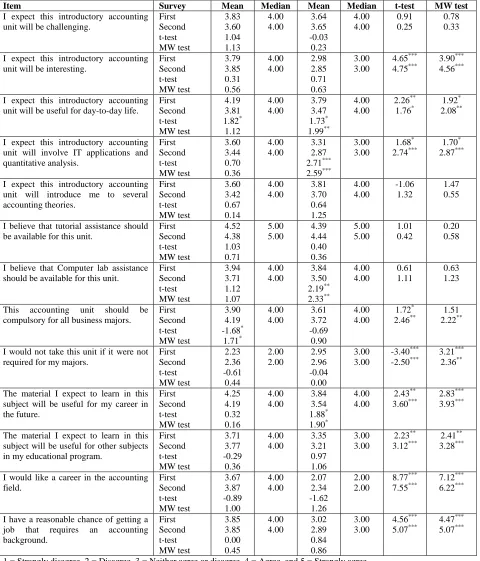
Table 1 provides mean and median responses for AFM and OBM students for Survey I and Survey II. It also provides parametric t-test statistics and non-parametric Mann-Whitney tests for the difference in responses between Survey I and Survey II for both AFM and OBM students and between AFM and OBM students for both surveys.
Table 1: Mean And Median For Survey Responses According To Group
AFM OBM
Item Survey Mean Median Mean Median t-test MW test
I expect this introductory accounting unit will be challenging.
First Second t-test MW test 3.83 3.60 1.04 1.13 4.00 4.00 3.64 3.65 -0.03 0.23 4.00 4.00 0.91 0.25 0.78 0.33
I expect this introductory accounting unit will be interesting.
First Second t-test MW test 3.79 3.85 0.31 0.56 4.00 4.00 2.98 2.85 0.71 0.63 3.00 3.00 4.65*** 4.75*** 3.90*** 4.56***
I expect this introductory accounting unit will be useful for day-to-day life.
First Second t-test MW test 4.19 3.81 1.82* 1.12 4.00 4.00 3.79 3.47 1.73* 1.99** 4.00 4.00 2.26** 1.76* 1.92* 2.08**
I expect this introductory accounting unit will involve IT applications and quantitative analysis. First Second t-test MW test 3.60 3.44 0.70 0.36 4.00 4.00 3.31 2.87 2.71*** 2.59*** 3.00 3.00 1.68* 2.74*** 1.70* 2.87***
I expect this introductory accounting unit will introduce me to several accounting theories. First Second t-test MW test 3.60 3.42 0.67 0.14 4.00 4.00 3.81 3.70 0.64 1.25 4.00 4.00 -1.06 1.32 1.47 0.55
I believe that tutorial assistance should be available for this unit.
First Second t-test MW test 4.52 4.38 1.03 0.71 5.00 5.00 4.39 4.44 0.40 0.36 5.00 5.00 1.01 0.42 0.20 0.58
I believe that Computer lab assistance should be available for this unit.
First Second t-test MW test 3.94 3.71 1.12 1.07 4.00 4.00 3.84 3.50 2.19** 2.33** 4.00 4.00 0.61 1.11 0.63 1.23
This accounting unit should be compulsory for all business majors.
First Second t-test MW test 3.90 4.19 -1.68* 1.71* 4.00 4.00 3.61 3.72 -0.69 0.90 4.00 4.00 1.72* 2.46** 1.51 2.22**
I would not take this unit if it were not required for my majors.
First Second t-test MW test 2.23 2.36 -0.61 0.44 2.00 2.00 2.95 2.96 -0.04 0.00 3.00 3.00 -3.40*** -2.50*** 3.21*** 2.36**
The material I expect to learn in this subject will be useful for my career in the future. First Second t-test MW test 4.25 4.19 0.32 0.16 4.00 4.00 3.84 3.54 1.88* 1.90* 4.00 4.00 2.43** 3.60*** 2.83*** 3.93***
The material I expect to learn in this subject will be useful for other subjects in my educational program.
First Second t-test MW test 3.71 3.77 -0.29 0.36 4.00 4.00 3.35 3.21 0.97 1.06 3.00 3.00 2.23** 3.12*** 2.41** 3.28***
I would like a career in the accounting field. First Second t-test MW test 3.67 3.87 -0.89 1.00 4.00 4.00 2.07 2.34 -1.62 1.26 2.00 2.00 8.77*** 7.55*** 7.12*** 6.22***
I have a reasonable chance of getting a job that requires an accounting background. First Second t-test MW test 3.85 3.85 0.00 0.45 4.00 4.00 3.02 2.89 0.84 0.86 3.00 3.00 4.56*** 5.07*** 4.47*** 5.07***
There are also significant differences in mean and median responses between AFM and OBM groups for both Survey I and Survey II. Notably, in both surveys, AFM students rank the following questions stronger than do OBM students: 1) This Unit Will Be Useful For Day-To-Day Life, 2) This Unit Is Interesting, 3) This Unit Will Involve IT Applications And Quantitative Analysis, 4) This Unit Should Be Compulsory For All Business Majors, 5) I Would Not Take This Unit If It Were Not Required For My Majors, 6) Material I Expect To Learn In This Subject Will Be Useful For My Career, 7) Material I Expect To Learn In This Subject Will Be Useful For Other Subjects, 8) I Would Like A Career In The Accounting Field, and 9) I Would Like To Get A Job That Requires An Accounting Background. Findings indicate that AFM’s generally view the introductory accounting course as a more valuable experience than do their OBM counterparts and that both groups have similar views about key aspects of how they prefer the unit to be taught.
Topic Rankings
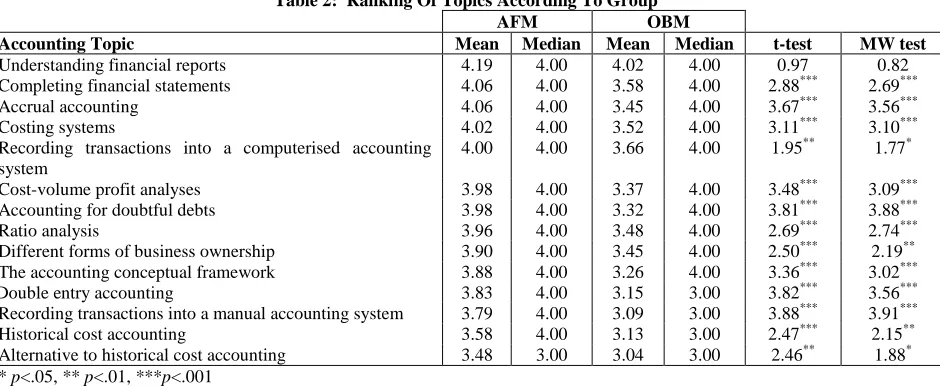
The survey invites students to indicate the importance they would assign to learning 14 accounting-related topics (e.g., double entry accounting) by using a 5-point Likert scale (1 = Strongly Disagree & 5 = Strongly agree). Table 2 ranks collected responses in Survey II. Notably, mean and median scores for all topics were 3.0 or higher with the AFM group scoring all topics higher than their OBM peers. Interestingly, significant differences are apparent between both groups on all topics except Understanding financial Reports. This topic also proved to be the
most popular for both groups (
X
= 4.19 &X
= 4.02 for AFM and OBM, respectively). The least popular topic for both groups is that of Alternatives to Historical Cost Accounting. Further perusal of Table 2 shows that both groups of students prefer to learn about completing and understanding financial statements using the accrual accounting system and involving the use of a computerized accounting package. They are least interested in being taught double entry accounting using a manual accounting system and the related accounting conceptual framework. In other words, both groups appear to be more interested in “doing” than being taught the theoretical underpinnings of financial reporting or manual bookkeeping.Table 2: Ranking Of Topics According To Group
AFM OBM
Accounting Topic Mean Median Mean Median t-test MW test
Understanding financial reports 4.19 4.00 4.02 4.00 0.97 0.82
Completing financial statements 4.06 4.00 3.58 4.00 2.88*** 2.69***
Accrual accounting 4.06 4.00 3.45 4.00 3.67*** 3.56***
Costing systems 4.02 4.00 3.52 4.00 3.11*** 3.10***
Recording transactions into a computerised accounting system
4.00 4.00 3.66 4.00 1.95** 1.77*
Cost-volume profit analyses 3.98 4.00 3.37 4.00 3.48*** 3.09***
Accounting for doubtful debts 3.98 4.00 3.32 4.00 3.81*** 3.88***
Ratio analysis 3.96 4.00 3.48 4.00 2.69*** 2.74***
Different forms of business ownership 3.90 4.00 3.45 4.00 2.50*** 2.19** The accounting conceptual framework 3.88 4.00 3.26 4.00 3.36*** 3.02***
Double entry accounting 3.83 4.00 3.15 3.00 3.82*** 3.56***
Recording transactions into a manual accounting system 3.79 4.00 3.09 3.00 3.88*** 3.91***
Historical cost accounting 3.58 4.00 3.13 3.00 2.47*** 2.15**
Alternative to historical cost accounting 3.48 3.00 3.04 3.00 2.46** 1.88* * p<.05, ** p<.01, ***p<.001
Correlation Analysis
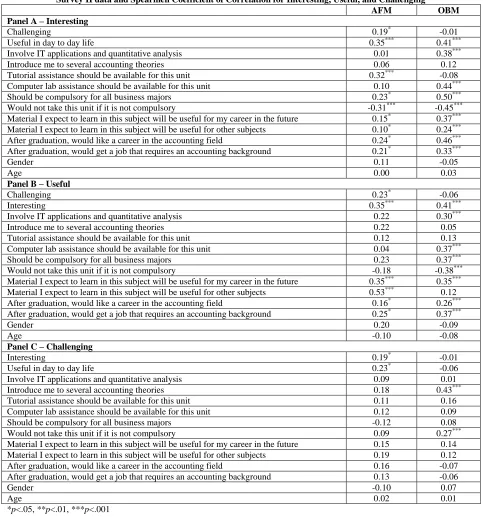
To identify any further differences between the two cohorts, we conduct a correlation analysis for AFM and OBM groups separately. As Survey II responses better reflect whether students are likely to study further courses in accounting, we conduct the correlation analysis for Survey II responses only. Panel A of Table 3 presents the correlation analysis between Interesting and other variables. Panel B presents the correlation analysis between
Table 3: Correlation Analysis According To Group
Survey II data and Spearmen Coefficient of Correlation for Interesting, Useful, and Challenging
AFM OBM
Panel A – Interesting
Challenging 0.19* -0.01
Useful in day to day life 0.35*** 0.41***
Involve IT applications and quantitative analysis 0.01 0.38***
Introduce me to several accounting theories 0.06 0.12
Tutorial assistance should be available for this unit 0.32*** -0.08
Computer lab assistance should be available for this unit 0.10 0.44***
Should be compulsory for all business majors 0.23* 0.50***
Would not take this unit if it is not compulsory -0.31*** -0.45***
Material I expect to learn in this subject will be useful for my career in the future 0.15* 0.37*** Material I expect to learn in this subject will be useful for other subjects 0.10* 0.24*** After graduation, would like a career in the accounting field 0.24* 0.46*** After graduation, would get a job that requires an accounting background 0.21* 0.33***
Gender 0.11 -0.05
Age 0.00 0.03
Panel B – Useful
Challenging 0.23* -0.06
Interesting 0.35*** 0.41***
Involve IT applications and quantitative analysis 0.22 0.30***
Introduce me to several accounting theories 0.22 0.05
Tutorial assistance should be available for this unit 0.12 0.13
Computer lab assistance should be available for this unit 0.04 0.37***
Should be compulsory for all business majors 0.23 0.37***
Would not take this unit if it is not compulsory -0.18 -0.38***
Material I expect to learn in this subject will be useful for my career in the future 0.35*** 0.35*** Material I expect to learn in this subject will be useful for other subjects 0.53*** 0.12 After graduation, would like a career in the accounting field 0.16* 0.26*** After graduation, would get a job that requires an accounting background 0.25* 0.37***
Gender 0.20 -0.09
Age -0.10 -0.08
Panel C – Challenging
Interesting 0.19* -0.01
Useful in day to day life 0.23* -0.06
Involve IT applications and quantitative analysis 0.09 0.01
Introduce me to several accounting theories 0.18 0.43***
Tutorial assistance should be available for this unit 0.11 0.16
Computer lab assistance should be available for this unit 0.12 0.09
Should be compulsory for all business majors -0.12 0.08
Would not take this unit if it is not compulsory 0.09 0.27***
Material I expect to learn in this subject will be useful for my career in the future 0.15 0.14 Material I expect to learn in this subject will be useful for other subjects 0.19 0.12 After graduation, would like a career in the accounting field 0.16 -0.07 After graduation, would get a job that requires an accounting background 0.13 -0.06
Gender -0.10 0.07
Age 0.02 0.01
*p<.05, **p<.01, ***p<.001
Not surprisingly, Interesting is negatively and significantly correlated with the statement; I Would Not Take This Unit If It Was Not Compulsory, for both AFM and OBM students. As expected, the magnitude of the correlation is greater for OBM’s (-0.45) than AFM’s (-0.31), whereas no significant relationship exists between
Useful and IT Applications and Quantitative Analysis or Computer Lab Assistance for AFM students. This implies that OBM students perceive accounting topics that are useful are those that involve IT applications and quantitative analysis and/or computer lab assistance. An analysis of responses, according to age and gender, shows no significant findings.
Overall, results reported in the correlation analysis suggest that AFM students are more enthusiastic about learning challenging introductory accounting topics than are OBM students. However, the more OBM’s see the relevance of accounting concepts to their future careers, the more interest they take in studying the first accounting course.
Factor Analysis
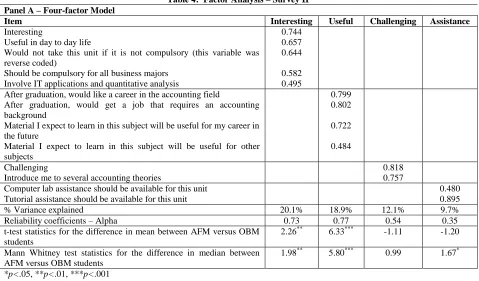
Correlation analysis of Survey II responses reveals that student perceptions vary significantly between the two groups. To test the robustness of this finding, we conduct a factor analysis of Survey II data. A four-factor model identifies the factor pattern after rotation for the total sample. The results are reported in Panel A of Table 4.
Table 4: Factor Analysis – Survey II Panel A – Four-factor Model
Item Interesting Useful Challenging Assistance
Interesting 0.744
Useful in day to day life 0.657
Would not take this unit if it is not compulsory (this variable was reverse coded)
0.644
Should be compulsory for all business majors 0.582 Involve IT applications and quantitative analysis 0.495
After graduation, would like a career in the accounting field 0.799 After graduation, would get a job that requires an accounting
background
0.802
Material I expect to learn in this subject will be useful for my career in the future
0.722
Material I expect to learn in this subject will be useful for other subjects
0.484
Challenging 0.818
Introduce me to several accounting theories 0.757
Computer lab assistance should be available for this unit 0.480
Tutorial assistance should be available for this unit 0.895
% Variance explained 20.1% 18.9% 12.1% 9.7%
Reliability coefficients – Alpha 0.73 0.77 0.54 0.35
t-test statistics for the difference in mean between AFM versus OBM students
2.26** 6.33*** -1.11 -1.20
Mann Whitney test statistics for the difference in median between AFM versus OBM students
1.98** 5.80*** 0.99 1.67*
Panel B – Two-factor Model
Item Interesting Useful
Interesting 0.733
Useful in day to day life 0.680
Would not take this unit if it is not compulsory (this variable was reverse coded) 0.779
Should be compulsory for all business majors 0.619
After graduation, would like a career in the accounting field 0.776
After graduation, would get a job that requires an accounting background 0.734 Material I expect to learn in this subject will be useful for my career in the future 0.612 Material I expect to learn in this subject will be useful for other subjects 0.754
% Variance explained 24.8% 29.7%
Reliability coefficients – Alpha 0.74 0.77
t-test statistics for the difference in mean between AFM versus OBM students 2.04** 5.89*** Mann Whitney test statistics for the difference in median between AFM versus OBM students 1.76** 5.58*** *p<.05, **p<.01, ***p<.001
One factor loads on the items Interesting, Useful in day-to-day Life, Involve IT Applications and Quantitative Analysis,This Accounting Unit Should Be Compulsory For All Business Majors, and I Would Not Take This Unit If It Was Not Compulsory. We title this factor "INTERESTING". The second factor loads on variables related with Career, Useful For Future Career and Useful For Future Subjects. This factor we title "USEFUL." The third factor loads on Challenging and Introduce Theories. This factor we name "CHALLENGING". The fourth and final factor loads on Tutorial Assistance and Computer Lab Assistance Should Be Available For This Unit. This factor is named "ASSISTANCE." These four factors explain 60.8% of the total variance.
Consistent with findings in the previous sections, analyses using t-test and Mann Whitney test statistics show that factors INTERESTING and USEFUL differ significantly between AFM and OBM participants. We do not find any significant difference in CHALLENGING and ASSISTANCE between the AFM and OBM groups. However, the reliability coefficient – Alpha - is low for these two factors. Therefore, to test the robustness of our results, we repeat the factor analysis excluding the variables loaded in factors CHALLENGING and ASSISTANCE. The results are reported in Panel B of Table 4. This further analysis generates two factors - INTERESTING and
USEFUL. These two factors account for 55% of total variance with reliability coefficients high at around 75%. As can be seen from Panel B of Table 4, there are significant differences between the two groups. Not surprisingly, AFM students feel that the accounting course is more interesting and more useful than do their OBM peers.
DISCUSSION
This study investigates student perceptions and expectations of the first course in accounting at a large Australian-based university to address three research questions (mentioned earlier). In general, survey results indicate that students expect the first course in accounting to be challenging, interesting and useful. However, OBM students are less interested and feel that the course is less useful than do the AFM group. This finding supports that of Geiger and Ogilby (2000) who find that students majoring in accounting have a more favorable perception of the introductory accounting course than do other students. Furthermore, AFM students are significantly more positive in the Survey II period that the introductory accounting course should be compulsory for all business majors than are their OBM peers.
Geiger and Ogilby (2000) find that both groups of students have slightly less favorable perceptions at the end of the semester than they had at the beginning. Interestingly, we did not find any significant difference between surveys for AFM students. However, our findings for OBM students are consistent with the findings of Geiger and Ogilby (2000) for non-accounting majors. Marriott and Marriott (2003) find that exposure to accounting at university has a negative effect on students’ attitudes toward accounting as a course of study and as a career. We do not find any significant evidence of negative effect for AFM students. However, our findings for OBM students are consistent with the findings of Marriott and Marriott (2003).
the first course in accounting as to perceptions and expectations. Results reported in this paper suggest that the two groups hold significantly different views toward the first accounting course. AFM students rank almost all topics significantly higher than do their OBM peers. The AFM cohort is also more interested in topics that are challenging and useful. These findings agree with those of Balachandran and Skully (2004) who determine that students undertaking an accounting or finance major have different perceptions and expectations about their first finance course than do students undertaking other business majors.
LIMITATIONS OF THE RESEARCH
Limitations relating to this investigation pertain to the level of knowledge held by students in both the Survey I and Survey II. For Survey I, questions about the topics taught in the first accounting course assume that students have some understanding as to what each topic is about. For example, it might be difficult for students to state whether they should learn the topic, Alternatives To Historical Cost Accounting, if they do not know what such a topic involves. Presumably, such students would score Neither Agree Nor Disagree for such an item. Furthermore, for Survey II, it is possible that students assume that topics taught to them (e.g., accrual accounting) are the important ones for their future careers and, accordingly, score these items higher than topics not taught to them (e.g., alternatives to historical cost accounting).
The other usual limitations also apply. For example, participants are from one semester and one campus of one university. Therefore, inferences to all introductory accounting student views cannot necessarily be drawn either for one university or for the national or international cohort of first-year students. Further research could test the external validity of our findings by applying a similar survey approach to different cohorts of students from different campuses, semesters, universities, and countries.
CONCLUSION
The design and delivery of an introductory accounting course remains a challenging task for accounting educators. Our research indicates that there are significant differences between the Accounting and Finance majors and the Other Business majors with regard to their perceptions and expectations of the first course in accounting. The AFM group holds significantly more positive views. Findings also suggest that significant changes over time are generally not apparent among AFM students. However, OBM students are less favourably disposed to their first accounting course at the end of the course than at the beginning. These findings are important as curriculum design and content delivery are made more difficult when faculty try to meet the expectations of two distinct groups of students for the same one-semester course. Two different courses might be the answer to this dilemma. For example, the OBM students could undertake the first course of accounting from a user perspective while AFM students could continue studying accounting courses using the preparer approach (see Malgwi, 2006). Administration and resource issues that would arise from adopting this two-course approach are beyond the scope of this paper.
This investigation is valuable in considering and receiving student feedback on the topics that are taught in the first accounting course at university and the extent to which students find this course to be interesting, useful and challenging. Whether changes are made to the course as a result of this investigation depends upon a range of issues additional to these findings. Curriculum is only one aspect of any course design. Other aspects include pedagogical approaches (e.g., case-studies, group assignments, and student presentations) and assessment methods. However, curriculum is the framework upon which the other aspects hang and is therefore the first step in developing a high quality first course in accounting.
concluded from his investigation that students took comfort in the traditional approach to learning accounting where getting the balance sheet to balance is so important (see also Mangion, 2006). Research of Christensen and others, as well as the findings of this study, reinforce the fact that designing an effective and relevant curriculum for the first course in accounting is a very challenging task.
AUTHOR INFORMATION
Geoffrey Tickell, Ph.D., CPA, is Professor of Accounting at Indiana University of Pennsylvania. He holds a Bachelor of Education and a Graduate Diploma of Business (Accounting) from Deakin University, and a Doctorate from Monash University. He has taught higher education students for over 20 years. His research interests include government sector accounting and accounting education. E-mail: [email protected] (Corresponding author)
Bala Balachandran, Ph.D., is an Associate Professor of Finance in the Graduate School of Management, La Trobe University, Australia. He obtained his PhD in Finance from the University of Birmingham, UK. His research interests include corporate disclosures, corporate governance, financial accounting, auditing, and accounting policy choice. E-mail: [email protected]
T. K. Lim, Ph.D., is Associate Teaching Professor of Finance and Policy at Carnegie Mellon University. T.K. Lim received his PhD in Finance from Monash University, Australia. He is interested in the research areas of financial forecasting, investment analysis and portfolio management, asset valuation, issues in banking sector, and financial education. E-mail: [email protected]
REFERENCES
1. AECC. (1990). Objectives of education for accountants: Position Statement No. One. Issues in Accounting Education, 5(Fall), 307-312.
2. AECC. (1992). The first course in accounting: Position Statement No. Two. Issues in Accounting Education, 7(2), 249-251.
3. Albrecht, W. S., & Sack, R. J. (2000). Accounting education: Charting the course through a perilous future.
4. Arthur Anderson & Co. (1989). Perspectives on education: Capabilities for success in the accounting profession.
5. Balachandran, B., & Skully, M. (2004). Student perceptions of introductory business finance: Accounting and finance versus other business majors. Advances in Financial Education, 2(Spring), 34-51.
6. Bedford Committee. (1986). Future accounting education: Preparing for the expanding profession. Issues in Accounting Education, Spring (168-195).
7. Bolt-Lee, C., & Foster, S. D. (2003). The core competency framework: a new element in the continuing call for accounting education change in the United States. Accounting Education, 12(1), 33-47.
8. Carr, S., Chua, F., & Perera, H. (2006). University accounting curricula: The perceptions of an alumni group. Accounting education: an international journal, 15(4), 359-376.
9. Cheng, K. W. (2007). The curriculum design in universities from the perspective of providers in accounting education. Education, 127(4), 581-590.
10. Cherry, A. A., & Mintz, S. M. (1996). The objectives and design of the first course in accounting from the perspective of nonaccounting faculty. Accounting education, 1(2), 99-111.
11. Christensen, M. (2004). The social construction of accounting: a curriculum dilemma for first year business students. Accounting education, 13(1), 119-121.
12. Geiger, M. A., & Ogilby, S. M. (2000). The first course in accounting: students' perceptions and their effect on the decision to major in accounting. Journal of Accounting Education, 18, 63-78.
13. IMA/FEI. (1994). What corporate America wants in entry-level accountants. Management Accounting, 25. 14. Krishnan, V. S., Bathala, C. T., Bahattacharya, T. K., & Ritchey, R. (1999). Teaching the introductory
finance course. Financial Practice and Education, Spring/Summer.
16. Mangion, D. (2006). Undergraduate education in social and environmental accounting in Australian universities. Accounting education: An international journal, 15(3), 335-348.
17. Marriott, P., & Marriott, N. (2003). Are we turning them on? A longitudinal study of undergraduate accounting students' attitudes towards accounting as a profession. Accounting education, 12(2), 113-133. 18. Mathews, M. R. (1994). An examination of the work of the Accounting Education Change Commission
1989-1992. Accounting Education, 3(3), 193-204.
19. Mathews, R. (1990). Accounting in higher education: Report of the review of the accounting discipline in higher education. Canberra: Department of Employment, Education and Trainingo. Document Number) 20. Myers, R. (2005). Accounting education changes course. Journal of Accountancy, 200(4), 108-113. 21. Nelson, I. T. (1995). What's new about accounting education change? An historical perspective on the
change movement. Accounting Horizons, 9(4), 62-75.
22. Pincus, K. V. (1997). Is teaching debits and credits essential in elementary accounting? Issues in Accounting Education, 12(2), 576-579.
23. Riordan, M. P., St.Pierre, E. K., & Matoney, J. (1996). Some initial empirical evidence regarding the impact of the introductory accounting sequence on the selection of accounting as a major. Accounting Education, 1(2), 127-136.
24. Saudagaran, S. (1996). The first course in accounting: An innovative approach. Issues in Accounting Education, 11(1), 83-94.
25. Vangermeersch, R. G. (1997). Dropping debits and credits in elementary accounting: A huge disservice to students. Issues in Accounting Education, 12(2), 581-583.
26. Watson, S. F., Apostolou, B. A., Hassell, J. M., & Webber, S. A. (2003). Accounting education literature review (2000-2002). Journal of accounting education, 21, 267-325.
27. Williams, D. Z. (1992). Grants awarded to two-year colleges for implementing improvements in accounting education. Issues in Accounting Education, 7(2), 241-249.