A New Method of Text Categorization and
Summarization with Fuzzy Confusion Matrix
Saswati Das
M. Tech student, Dept. of CSE NIT Durgapur.
Antara Pal
M. Tech Student, Dept. of CSE NIT Durgapur.
Dr. Goutam Sarker
Senior Member IEEE, Associate Professor
Dept. of CSE NIT Durgapur.
Abstract— Present work is a technique fuzzy text categorization followed by extractive summarization of categorized texts. At the onset, the texts of different subjects are fuzzy categorized based on relative matching with index terms of corresponding subjects. After forming the categorical groups, extractive summarization is performed on each text of each category. The fuzzy categorization is evaluated with fuzzy confusion matrix. The performance evaluation of this fuzzy categorization with Holdout method in terms of accuracy, precision, recall and f-score is appreciably high. The accuracy of summarization is evaluated using human generated summary and is fair. Also the categorization and summarization time is acceptable.
Keywords—Fuzzy Text Categorization, Fuzzy Confusion Matrix, Extractive Summarization, Term Frequency, Inter document frequency, Sentence Weight, Clustering, OCA, Holdout Method, Accuracy, Precision, Recall, F-Score
I. INTRODUCTION
Text Categorization is one of the promising area in the field of Data Mining to perform grouping of texts based on their attributes. Fuzzy Categorization of texts involves categorization according to degree of belongingness of texts to different categories. Text Summarization achieves the task of compression of the text size while preserving the overall meaning. Text summarization can be classified as extrinsic or extractive summarization and intrinsic or abstractive summarization. Abstractive summarization [11] requires understanding of semantics or meaning of sentences to build the summary whereas extractive summarization method selects subsets of important sentences in original texts, based on their weight and eliminates the redundant as well as irrelevant sentences to form the summary. In our proposed work, three operation viz. categorization, summarization and categorization followed by summarization have been carried out on a set of textual documents. Categorization does the task of categorizing different text documents into their respective categories. Summarization takes different text of same categories and summarizes them. The output produced is the compressed version of original text. In categorization followed by summarization,
the input contains different texts for categorization, the result of which is implicitly passed to the system for summarization. This is the summary of text documents belonging to each of the defined categories.
Text categorization can be used to
1. Typically organize texts or stories according to subject categories.
2. Classification of academic or research papers by technical domains and sub domains.
3. Spam filtering, where email are classified into spam and non-spam categories.
4. Email routing, sending an email sent to a general address to a specific address or mailbox depending on topic.
Text summarization can be used in
1. Summarization of news to headlines, SMS or WAP-format for mobile phones.
2. Search engines to showcase the brief/compressed description of the search result (e.g. Google search engines) .
II..THEORYOFOPERATION
A. Text Mining
Text Mining involves series of process in order to derive meaningful information, which are as follows:
a. Text Preprocessing b. Text Transformation c. Attribute Selection
d. Deriving Patterns and finally
e. Interpretation and Evaluation input data.
B. Text Preprocessing
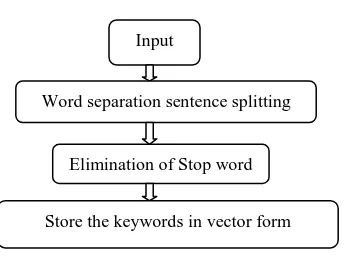
Preprocessing is the extraction of keywords from the original input document. The transformation includes word separation, removal of links, HTML or other tags, removal of stop words, punctuations.
Fig 1. Schematic of preprocessing of text
C. Text Categorization
Text categorization [8,9,10] is one of the key applications in Data Mining. It involves assignment of category to unlabeled new text document.
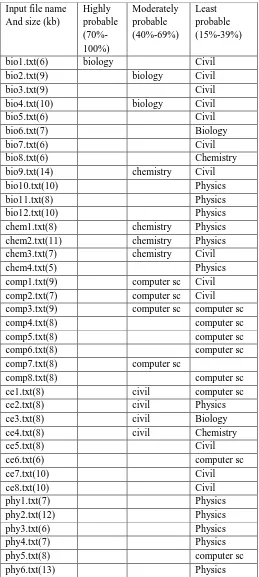
In our approach, keyword extraction has been done to categorize text. It is a supervised learning method which relies on labeled training data to achieve accuracy in classification [3,6,7,8,9,10]. Keyword extraction is achieved through preprocessing, after which the preprocessed text uses the help of keyword set of each category to decide the category of the text. Each of preprocessed text keywords is compared with predefined categorized words for their fuzzy categorization. The text are set to be „Highly Probable‟ to a certain category if its keywords matching with that very category exceeds 70%, „Moderately Probable‟ if matching is between 40% - 50% and finally „Least Probable‟ is less than 15%. The category to one having maximum match is inferred to be the category of the corresponding input text.
D. Summarization
Our approach to summarization [11] is extraction based. The system takes into account the existing words and phrases in original text to form the summary. The text document is summarized based on sentence weight.
The system calculates the frequency of keywords, which is used to get the weight of keyword. Both intra and inter document frequency [11] is calculated.
All these attributes are used ultimately to compute the weight of each sentence. Sentence which are redundant are identified by clustering [1]. From sentences in a cluster, a representative sentence is chosen (having maximum weight and minimum sentence length). Rest of the redundant sentence in each cluster is ignored.
Now, number of sentence is reduced to number of clusters formed (including singleton cluster).
Then, it arranges the sentences in descending order of their weight. 25% of sentences in weight-wise descending order are selected, while rest is deselected.
Then the selected sentences are compared with original text to find the right position of each sentence in the summary.
And then lastly, the machine generated summarized texts are compared with human generated summaries for those texts to evaluate the summary system in terms of accuracy.
E. Performance Evaluation (i) Fuzzy Categorization
In our present work we have introduced fuzzy confusion matrix in which each text has been considered to be a fuzzy member of any category, if its attribute matching exceeds a certain threshold(i.e. threshold cat = 15%). The text are graded to be highly probable to a certain category if its match with that category exceeds 70%, moderately probable if it lies between 15% and 40% and least probable if less than 15%. A match between predicted and actual category is scored the highest (if the class predicted happens to be the actual class, then the degree of fuzziness is one among the three possibilities i.e. H, M, or L).
In our previous paper [9,10] we have formulated the rules for the construction of the fuzzy confusion matrix for the two different situations (i.e. Actual Class = Predicted Class and Actual Class ≠ Predicted Class). In the present work we are updating the rule for calculating the Incremental Score (∑) for the case Actual Class ≠ Predicted Class in the following manner.
Let m and n represents the row number and column number in the two tables respectively.
Where 1 ≤ m ≤ 3, 1≤ n ≤ 3
For Actual Class = Predicted Class
∑ = [3 - (Defuzzified Difference between Actual Class and Predicted Class)] ∀ 𝑚, 𝑛.
Table I. INCREMENTAL CONSTRUCTION OF FUZZY CONFUSION MATRIX
Actual Class
Highly Probable
Moderately Probable
Least Probable Highly
Probable
+3 +2 +1
Moderate Probable
+2 +3 +2
Least Probable
+1 +2 +3
For Actual Class ≠ Predicted Class
∑ = [3 - (Defuzzified Difference between Actual Class and Predicted Class)] for m ≠ n.
Input
Word separation sentence splitting
Elimination of Stop word
Store the keywords in vector form
P
re
d
icte
d
Clas
∑ = [3 - (Defuzzified Difference between Actual Class and Predicted Class)] - (n-1) for m = n.
Table II. INCREMENTAL CONSTRUCTION OF FUZZY CONFUSION MATRIX
Actual Class
Highly Probable
Moderately Probable
Least Probable Highly
Probable
+1 +2 +3
Moderate Probable
+2 +1 +2
Least Probable
+3 +2 +1
Where the defuzzified values are Highly Probable = 3 Moderately Probable = 2 Least Probable = 1
(ii) Discrete Categorization
a. Accuracy: It is the ratio of records of all categories that are correctly classified with respect to total number of records.
For example, for two class classification
Actual Class
class1 class2 class1 a b class2 c d
accuracy = 𝑎+𝑑 𝑎+𝑏+𝑐+𝑑
Where a, b, c and d are defined in the matrix.
b. Precision: It is the ratio of the total number of records actually belonging to a category with respect to the total number of records predicted to belong to that category.
precision = 𝑎 𝑎+𝑏
c. Recall: It is the ratio of the total number of records predicted to belong to a category with respect to the total number of records actually belonging to belong to that category.
recall = 𝑎 𝑎+𝑐
d. F-score: Harmonic mean of precision and recall.
F-score = 2∗𝑝𝑟𝑒𝑐𝑖𝑠𝑖𝑜𝑛 ∗𝑟𝑒𝑐𝑎𝑙𝑙 𝑝𝑟𝑒𝑐𝑖𝑠𝑖𝑜𝑛 +𝑟𝑒𝑐𝑎𝑙𝑙
iii Summarization
Evaluation of Summarization is done by comparing the system generated summary with human generated summary which is the accuracy of summarization.
Accuracy sum =
𝑁𝑜 𝑜𝑓 𝑚𝑎𝑡𝑐 𝑒𝑑 𝑠𝑒𝑛𝑡𝑒𝑛𝑐𝑒𝑠 𝑇𝑜𝑡𝑎𝑙 𝑛𝑜 𝑜𝑓 𝑠𝑒𝑛𝑡𝑒𝑛𝑐𝑒𝑠
IV. OVERVIEW
In our present work we have used extraction of keyword for categorization which is a supervised learning method relying on labeled training data. Also to build summary, we used Extractive method.
To do this, we use the following features.
1. Keyword: The remaining words after preprocessing are the keywords.
2. Term Frequency (tf) : Denotes the frequency
of keyword in the text.
3. Representative Sentence: Similar sentences (syntactically) are clustered into a group. Among these sentences, the one having highest sentence weight to length ratio, is chosen to be the representative sentence of that cluster. The rest are considered to be redundant.
4. Normalized Term Frequency (ntfi) : The
normalized term frequency of the ith keyword ki ,
𝑛𝑡𝑓𝑖 =
𝑡𝑓𝑖
𝑡𝑓1 + 𝑡𝑓2 + 𝑡𝑓3+ … + 𝑡𝑓𝑛 ∗ wk
5. Inter Document Frequency (IDF) : The IDF of ith keyword (IDFi) is the ratio of the number of text
files in which that keyword ki is occurring i.e. (ni) and
the total number of text files(n). Therefore, IDFi =
𝑛𝑖 𝑛
6. Weight of keyword ki in a sentence si is the sum of its normalized term frequency and inter document frequency i.e. tf + IDFi .
Hence, the weight of sentence become , where there are j different keywords in i=1 sentence si . Now we perform clustering to remove redundant sentence and arrange the sentences in descending order of their weight.
𝑤𝑠𝑖 = 𝑛𝑡𝑓𝑖+ 𝐼𝐷𝐹𝑖 𝑗
𝑖=1
P
re
d
icte
d
Clas
s
P
re
d
icte
d
Clas
7. Clustering or Grouping of similar sentences: Each sentence in the text file is compared to all other sentences in the text file to form a cluster of syntactically similar sentences. Ruling out the singleton clusters, for all other clusters choose one of the sentences as the representative sentence of the cluster. The representative sentence is chosen on the basis of highest sentence weight to sentence length (in original text) ratio.
wsi =
𝑤𝑠𝑖 𝑙𝑠𝑖 𝑖𝑛 𝑡 𝑒 𝑜𝑟𝑖𝑔𝑖𝑛𝑎𝑙 𝑡𝑒𝑥𝑡
wsi = updated weight of sentence in a cluster
The one sentence having maximum wsi is selected and the rest are deselected since they are considered redundant.
8. Evaluation : Comparison of system generated summary to that of human generated summary is made to calculate the accuracy of the system.
V. ALGORITHM FOR PRESENT
TECHNIQUE
a. Algorithm for Categorization
Input : Text files of different subjects, thresholdcat = 15%. Output : Categorized text files contained in labeled folders.
Steps :
i. Extract keywords (preprocess)
ii. Perform matching of each keyword with all the labeled set of keywords (training dataset) say Dj, for 1≤ j ≤ n, where n = No Subjects taken.
iii. Find the degree of belongingness of each document
(di) (where 1≤ i ≤ m, where m is the no of input text files
taken) with each of the input keyword set Dj of predefined category.
iv. Let DB[i,j] and MF[i,j] be matrices that store the percentage matching of di with Dj and its corresponding Membership Factor(Membership Factor can be HP, MP, LP) respectively.
v. for di
if DB[i,j] ≥ 70% then MF[i,j] = HP
else if 40% ≤ DB[i,j] < 70% then MF[i,j] = MP else if 15% ≤ DB[i,j] < 40% then MF[i,j] = LP else MF[i,j] = 0 (i.e. di does not exceed the threshold)
vi. Choose the category Cj (where Cj is the corresponding category of keyword set(Dj) ) of the text file di as one which
has maximum matching with the keyword set(Dj).
b. Algorithm for Multiple Text File Summarization
Input : Text files of same topic for summarization; threshold their respective summary folder.
Output : Summary files of corresponding input files contained in their respective summary folders.
Steps :
i. Extract keywords ki.
ii. Find the term frequency of each keyword ki.
iii. Find the normalized term frequency ntfi of keyword ki.
iv. Compute the Inter Document Frequency (IDFi) i.e. the ratio of text files in which that word (ni) is presented and total number of text files (n).
v. Compute the weight of keyword as ntfi +IDFi.
vi. Compute the weight of sentence si as
𝑛𝑡𝑓𝑖+ 𝐼𝐷𝐹𝑖 𝑗
𝑖=1
where, j is the total number of keywords in the sentence.
vii. Perform clustering and find the representative sentence for each cluster based on the maximum sentence weight to length of sentence ratio i.e.
𝑚𝑎𝑥 𝑤𝑠𝑖 𝑙𝑖
wsi = weight of sentence si
li = length of sentence (si) in original text
viii. Sequentially arrange sentence according to the decreasing weights in text files. Then select first 25% sentence and each deselect others to obtain the summary.
ix. Repeat step 1 to 8 for each text files in the input folder.
c. Algorithm for Clustering
Input : Threshold , text files.
Output : A set of sentences with maximum ratio of (𝑤𝑖 𝑙𝑖).
Steps :
i. Extract weighted sentence, 𝑤𝑠𝑖 in a text file. ii. Group sentences based on the predefined threshold. iii. Calculate ratio of sentence group weight to length for
all 𝑠𝑖 belonging to group 𝐺𝑖 i.e.
𝑤𝑠𝑖
𝑙𝑖 , 1<= i<= n 𝜖 group i
n = number of sentence in group i.
iv. Select the sentence having max(𝑤𝑠𝑖
𝑙𝑖) value and deselect others.
VI. PERFORMANCE EVALUATION AND
EXPERIMENTAL RESULTS
The categorization and summarization is evaluated using an Intel(R) Xeon(R) CPU E5506 @2.13GHz having 12GB RAM and Windows 7 Ultimate 64-bit OS on MATLAB 2013a platform.
The text file contains of different subjects like Computer Science, Biology, Chemistry etc is collected from the internet (en.wikipedia.org, www.textbooksonline.tn.nic.in/books, and many more).
We have used benchmark text (en.wikipedia.org, www.ncert.nic.in/ncerts/textbook/textbook) and our own created human generated summaries for the purpose of system evaluation; due to the lack of benchmark text with their corresponding summaries in the internet.
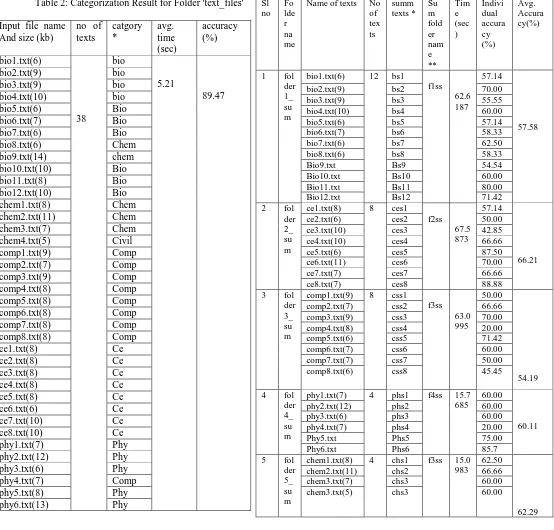
We have taken some collected sample texts in a single folder named 'text_files' containing 38 texts of different categories. The Fuzzy Categorization of same is given below:
Table 1: Fuzzy Categorization of input folder 'text_files'
Input file name And size (kb)
Highly probable (70%-100%)
Moderately probable (40%-69%)
Least probable (15%-39%)
bio1.txt(6) biology Civil
bio2.txt(9) biology Civil
bio3.txt(9) Civil
bio4.txt(10) biology Civil
bio5.txt(6) Civil
bio6.txt(7) Biology
bio7.txt(6) Civil
bio8.txt(6) Chemistry
bio9.txt(14) chemistry Civil
bio10.txt(10) Physics
bio11.txt(8) Physics
bio12.txt(10) Physics
chem1.txt(8) chemistry Physics
chem2.txt(11) chemistry Physics
chem3.txt(7) chemistry Civil
chem4.txt(5) Physics
comp1.txt(9) computer sc Civil
comp2.txt(7) computer sc Civil
comp3.txt(9) computer sc computer sc
comp4.txt(8) computer sc
comp5.txt(8) computer sc
comp6.txt(8) computer sc
comp7.txt(8) computer sc
comp8.txt(8) computer sc
ce1.txt(8) civil computer sc
ce2.txt(8) civil Physics
ce3.txt(8) civil Biology
ce4.txt(8) civil Chemistry
ce5.txt(8) Civil
ce6.txt(6) computer sc
ce7.txt(10) Civil
ce8.txt(10) Civil
phy1.txt(7) Physics
phy2.txt(12) Physics
phy3.txt(6) Physics
phy4.txt(7) Physics
phy5.txt(8) computer sc
Table 2: Categorization Result for Folder 'text_files'
Input file name And size (kb)
no of texts catgory * avg. time (sec) accuracy (%) bio1.txt(6) 38 bio 5.21 89.47
bio2.txt(9) bio
bio3.txt(9) bio
bio4.txt(10) bio
bio5.txt(6) Bio
bio6.txt(7) Bio
bio7.txt(6) Bio
bio8.txt(6) Chem
bio9.txt(14) chem
bio10.txt(10) Bio
bio11.txt(8) Bio
bio12.txt(10) Bio
chem1.txt(8) Chem
chem2.txt(11) Chem
chem3.txt(7) Chem
chem4.txt(5) Civil
comp1.txt(9) Comp
comp2.txt(7) Comp
comp3.txt(9) Comp
comp4.txt(8) Comp
comp5.txt(8) Comp
comp6.txt(8) Comp
comp7.txt(8) Comp
comp8.txt(8) Comp
ce1.txt(8) Ce
ce2.txt(8) Ce
ce3.txt(8) Ce
ce4.txt(8) Ce
ce5.txt(8) Ce
ce6.txt(6) Ce
ce7.txt(10) Ce
ce8.txt(10) Ce
phy1.txt(7) Phy
phy2.txt(12) Phy
phy3.txt(6) Phy
phy4.txt(7) Comp
phy5.txt(8) Phy
phy6.txt(13) Phy
Abbreviation Details:
bio - Biology chem - Chemistry
cse - Computer Science and Engineering ce - Civil Engineering
phy - Physics
For the summarization operation we have taken some folders each for a defined category.
Table 3: Folder wise Summarization results
Sl no Fo lde r na me
Name of texts No
of tex ts summ texts * Su m fold er nam e ** Tim e (sec ) Indivi dual accura cy (%) Avg. Accura cy(%)
1 fol
der 1_ su m
bio1.txt(6) 12 bs1
f1ss 62.6 187 57.14 57.58
bio2.txt(9) bs2 70.00
bio3.txt(9) bs3 55.55
bio4.txt(10) bs4 60.00
bio5.txt(6) bs5 57.14
bio6.txt(7) bs6 58.33
bio7.txt(6) bs7 62.50
bio8.txt(6) bs8 58.33
Bio9.txt Bs9 54.54
Bio10.txt Bs10 60.00
Bio11.txt Bs11 80.00
Bio12.txt Bs12 71.42
2 fol
der 2_ su m
ce1.txt(8) 8 ces1
f2ss 67.5 873 57.14 66.21
ce2.txt(6) ces2 50.00
ce3.txt(10) ces3 42.85
ce4.txt(10) ces4 66.66
ce5.txt(6) ces5 87.50
ce6.txt(11) ces6 70.00
ce7.txt(7) ces7 66.66
ce8.txt(7) ces8 88.88
3 fol
der 3_ su m
comp1.txt(9) 8 css1
f3ss 63.0 995 50.00 54.19
comp2.txt(7) css2 66.66
comp3.txt(9) css3 70.00
comp4.txt(8) css4 20.00
comp5.txt(6) css5 71.42
comp6.txt(7) css6 60.00
comp7.txt(7) css7 50.00
comp8.txt(6) css8 45.45
4 fol
der 4_ su m
phy1.txt(7) 4 phs1 f4ss 15.7
685
60.00
60.11
phy2.txt(12) phs2 60.00
phy3.txt(6) phs3 60.00
phy4.txt(7) phs4 20.00
Phy5.txt Phs5 75.00
Phy6.txt Phs6 85.7
5 fol
der 5_ su m
chem1.txt(8) 4 chs1 f3ss 15.0
983
62.50
62.29
chem2.txt(11) chs2 66.66
chem3.txt(7) chs3 60.00
chem3.txt(5) chs3 60.00
Abbreviation Details :
bio - Biology chem - Chemistry
cse - Computer Science and Engineering ce - Civil Engineering
Table 4: categorization followed by summarization.
Input file name And size (kb)
no of texts
catgory * summary files **
time (sec)
bio1.txt(6)
38
Bio bs1
503.13
bio2.txt(9) Bio bs2
bio3.txt(9) Bio bs3
bio4.txt(10) Bio bs4
bio5.txt(6) Bio Bs5
bio6.txt(7) Bio Bs6
bio7.txt(6) Bio Bs7
bio8.txt(6) Chem Bs8
bio9.txt(14) Chem. Bs9
bio10.txt(10) Bio bs10
bio11.txt(8) Bio Bs11
bio12.txt(10) Bio bs12
chem1.txt(8) Chem Chs1
chem2.txt(11) Chem Chs2
chem3.txt(7) Chem Chs3
chem4.txt(5) Civil Chs4
comp1.txt(9) Comp Css1
comp2.txt(7) Comp css2
comp3.txt(9) Comp css3
comp4.txt(8) Comp css4
comp5.txt(8) Comp Css5
comp6.txt(8) Comp Css6
comp7.txt(8) Comp Css7
comp8.txt(8) Comp Css8
ce1.txt(8) Ce Ces1
ce2.txt(8) Ce Ces2
ce3.txt(8) Ce Ces3
ce4.txt(8) Ce Ces4
ce5.txt(8) Ce ces5
ce6.txt(6) Ce ces6
ce7.txt(10) Ce ces7
ce8.txt(10) Ce ces8
phy1.txt(7) Phy Phs1
phy2.txt(12) Phy Phs2
phy3.txt(6) Phy Phs3
phy4.txt(7) Cse Phs4
phy5.txt(8) Phy Phs5
phy6.txt(13) Phy Phs6
Abbreviation Details : * bio - Biology chem - Chemistry
cse - Computer Science and Engineering ce - Civil Engineering
phy - Physics
** Extension for all summarized text files are .txtsum.txt
bs : Summarized text files of biology ces - Summarized text files of Civil
css - Summarized text files of Computer Science and Engineering
phs - Summarized text files of Physics chs - Summarized text files of Chemical
Table5: FUZZY CONFUSION MATRIX
Actual→ Predicted↓
physics chemistry biology civil Computer
H M L H M L H M L H M L H M L
Physics H 0 0 0 0 0 0 0 0 0 0 0 0 0 0 0
M 0 1 0 0 0 0 0 0 0 0 0 0 0 0 0
L 0 0 5 0 2 1 0 0 3 0 1 0 0 0 0
Chemistry H 0 0 0 0 0 0 0 0 0 0 0 0 0 0 0
M 0 0 0 0 3 0 0 0 1 0 0 0 0 0 0
L 0 0 0 0 0 0 0 0 1 0 1 0 0 0 0
Biology H 0 0 0 0 0 0 1 0 0 0 0 0 0 0 0
M 0 0 0 0 0 0 0 2 0 0 0 0 0 0 0
L 0 0 0 0 0 0 0 0 1 0 1 0 0 0 0
Civil H 0 0 0 0 0 0 0 0 0 0 0 0 0 0 0
M 0 0 0 0 0 0 0 0 0 0 4 0 0 0 0
L 0 0 0 0 1 0 1 2 4 0 0 3 0 2 0
computer H 0 0 0 0 0 0 0 0 0 0 0 0 0 0 0
M 0 0 0 0 0 0 0 0 0 0 0 0 0 4 0
L 0 1 0 0 0 0 0 0 0 0 1 1 0 0 4
Table6: PERFORMANCE EVALUATION WITH HOLDOUT METHOD
Acuuracy = 56.06%
category Precision(%) Recall(%)
f-score(%)
Physics 64.28 90 74.99
Chemistry 60 56.25 58.06
Biology 85.71 31.57 46.14
civil 45.65 70 55.26
Computer sc 82.76 85.71 84.20
Table 7: DISCRETE CONFUSION MATRIX Actual Class physi
cs
Chemistr y
Biolog y
Civi l
Comput er sc
physics 5 0 0 0 0
Chemistr y
0 3 2 0 0
Biology 0 0 10 0 0
Civil 0 1 0 8 0
Compute r sc
1 0 0 0 8
Table8: PERFORMANCE EVALUATION OF DISCRETE CONFUSION MATRIX
Acuuracy = 89.47%
category Precision(%) Recall(%)
f-score(%)
Physics 100 83.33 90.90
Chemistry 60 75 66.66
Biology 100 83.33 90.90
civil 88.88 100 94.12
Computer sc 88.88 100 94.12
VIII. CONCLUSION
We have designed and developed a combined keyword based fuzzy categorization and extractive
P
re
d
ic
te
d
C
la
summarization technique which categorizes input text into different category and thereafter summarizes them.
The fuzzy categorization is based on keyword extraction and subsequent matching and summarization is done based on weight of sentences. It deselects the redundant sentences through optimal clustering to produce a concise and meaningful summary.
As the summarization is not abstractive, it may consider two semantically some sentences with different keywords as different, thus slightly degrading the summary quality.
The time for fuzzy categorization and summarization is affordable. Different performance metrics for categorization and summarization is good.
X. REFERENCES
[1] Sarker, G.(2010),An Unsupervised Natural Clustering with Optimal Conceptual Affinity, Journal of Intelligent Systems,19(3), 289-300. DOI: 10.1515/JISYS.2010.19.3.289
[2] Sarker, G.(2007),A Heuristic Based Hybrid Clustering for Natural Classification, International Journal of Computer, Information Technology and Engineering (IJCITAE),1(2), 79-86.
[3] Sarker, G.(2008),A Heuristic Based Hybrid Clustering, Institution of Engineers (I), Computer Engineering Division,Vol. 89, 7- 10.
[4] Sarker, G.(2010),An Unsupervised Natural Clustering with Optimal Conceptual Affinity, Journal of Intelligent Systems,19(3), 289-300. DOI: 10.1515/JISYS.2010.19.3.289
[5] Sarker, G.(2013),An Optimal Back Propagation Network for Face Identification and Localization ,International Journal of Computers and Applications (IJCA),ACTA Press, Canada.,35(2).,DOI 10.2316 / Journal .202.2013.2.202 – 3388.
[6] Sarker, G., Dhua, S., Besra, M. (2015),A Learning Based Handwritten Text Categorization,2015 International Conference on Advances in Computer Engineering and Applications, (ICACEA – 2015). ISSN: 978-1-4673-6910-7/15/$31.00 © 2015 IEEE.
[7] Sarker, G., Besra, M., Dhua, S.(2015),A Programming Based Handwritten Text Identification. 2015 International Conference on Advances in Computer Engineering and Applications, (ICACEA – 2015). ISSN: 978-1-4673-6910-7/15/$31.00 © 2015 IEEE.
[8] Sarker, G., Besra, M., Dhua, S.(2015),A Malsburg Learning BP Network Combination for Handwritten Alpha Numeral Recognition,2015 International Conference on Advances in Computer Engineering and Applications, (ICACEA – 2015). ISSN: 978-1-4673-6911-4/15/$31.00 © 2015 IEEE.
[9] Sarker, G., Dhua, S., Besra, M. (2015), An Optimal Clustering for Fuzzy Categorization of Cursive Handwritten Text with Weight Learning in Textual Attributes, 2015 IEEE 2nd International
Conference on Recent Trends in Information Systems (ReTIS – 2015) held at Jadavpur University Kolkata INDIA 9-11 July, 2015, ISSN: 978-1-4799-8349-0/15/$31.00 ©2015 IEEE, pp. 6-11.
[10] Sarker, G., A Weight Learning Technique for Cursive Handwritten Text Categorization with Fuzzy Confusion Matrix – 2016 International Conference on Control, Instrumentation, Energy & Communication (CIEC), held at Kolkata, 978-1-5090-0035-7/16/$31.00 © 2016 IEEE,Jan. 20-30, 2016, pp 188-192.
[11] Sarker G., A New Technique For Extraction Based Text Summarization – 31stIndian Engineering Congress, 15-18 December, Kolkata 2016, The Institution of Engineers (India), pp 99-104.
[12] Sarker, G., Besra, M., Dhua, S.(2015),A Malsburg Learning BP Network Combination for Handwritten Alpha Numeral Recognition,2015 International Conference on Advances in Computer Engineering and Applications, (ICACEA – 2015). ISSN: 978-1-4673-6911-4/15/$31.00 © 2015 IEEE.
[13] S. Mori, C.Y. Suen and K. Kamamoto, “Historical
review of OCR research and development” Proc. of IEEE, Vol. 80, pp. 1029–1058, July 1992.
[14] S. Impedovo, L. Ottaviano and S. Occhinegro, “Optical character recognition”, International Journal Pattern Recognition and Artificial Intelligence, Vol. 5(1-2), pp. 1–24, 1991
[15] C. L. Liu and H. Fujisawa, “Classification and Learning for Character Recognition: Comparison of Methods and Remaining Problems”, Int. Workshop on Neural Networks and Learning in Document Analysis and Recognition, Seoul, 2005.
[16] R. Plamondon and S. N. Srihari, “On-Line and Off-Line Handwriting Recognition: A Comprehensive Survey”, IEEE Transaction on Pattern Analysis and Machine Intelligence, Vol. 22, No. 1, Jan 2000.
[17] F. V. D. Heijden, “Edge and line Feature Extraction Based on Covariance Model”, IEEE Transaction On Pattern Analtysis And Machine Intelligence Vol.11, No.1, January 1995.
[18] J.Pradeep, E.Srinivasan, and S.Himavathi, “Diagonal Based Feature Extraction For Handwritten Alphabets Recognition System Using Neural Network”, International Journal of Computer Science & Information Technology (IJCSIT), Vol. 3, No. 1, Feb 2011.
[19] O. Rohlik, P. Mautner, V. Matousek and J. Kemph, “HMM Based Handwritten Text Recognition Using Biometrical Data Acquisition Pen”, Proceedings 2003 IEEE International Symposium on Computational Intelligence in Robotics and Automation July 16-20,
2003, Kobe, Japan.