Title: Developing ‘know how’: a participatory approach to assessment of placement learning. Author(s): Cooper, Susan
Copyright, publisher and additional information:
This is an Accepted Manuscript of an article published by Journal of Vocational Education & Trainingon 22/08/2014 available online:
http://www.tandfonline.com/10.1080/13636820.2014.948906
DOI:http://dx.doi.org/10.1080/13636820.2014.948906
1
Developing ‘Know How': A Participatory Approach to Assessment of Placement Learning
The professional qualification for youth work is awarded through undergraduate and post graduate programmes of study, both of which involve substantial elements of supervised practice. The requirements for this practice element are set out by the National Youth Agency (NYA 2010) who confers the professional qualification. At undergraduate level the practice element consists of 888 hours of supervised practice spanning the three years of the programme. At postgraduate level there is a requirement for students to complete 592 hours of supervised practice. This paper focuses on an undergraduate programme delivered in a university in England, and in particular on the assessment regime attached to the full-time placement element in the second year of the BA (Hons) programme. Three twenty credit modules are attached to the placement, and each is assessed differently. The first module coded ‘DP7’ is assessed by a written assessment of 3000 words, entitled ‘evaluative recordings’, which requires students to critically evaluate an aspect of their practice. The second module coded ‘DP8’ is assessed by a combination of a 2000 word written self assessment, which evaluates the student’s learning across the placement, and a 30 minute presentation, requiring the student to evaluate an aspect of the placement experience in the light of wider policy issues. The third and final module of this placement, coded ‘DP9’ is assessed by a 3000 word essay in which students were required to evaluate a particular project they delivered whilst on placement.
It had been noted over a number of years that discrepancies existed between the quality of youth work many students delivered whilst on placement and the academic grades that those students received for the written work associated with the placement modules. Youth work qualifying programmes involve assessment of practice skills and abilities (See LSI YW00 National Occupational Standards) as well as knowledge and understanding. However it was also noted on reflection that the assessment regime was rather narrow and focused almost exclusively on academic written tasks and the programme offered limited formal feedback on practice based skills and at no point offered a formal grading of practice.
Part of the culture about not grading practice appears to be a reluctance to make formal judgments about youth workers’ abilities, based on a belief that they are all equal - the professional qualification (JNC) does not discriminate between workers - you are either qualified or not. On the contrary as educators and trainers, it is argued that actually we all know a good youth worker when we see one, and we make judgments about the students we teach all the time, whether we make them public or not. Students and supervisors also make judgments about how good they think they are. Indeed the formative feedback during the three- way meetings is all about recognising strengths and identifying and
2
there seemed to be reluctance, certainly in our institution, to formalise this process and incorporate it into the assessment and grade the practice of students on placement.
The impetus for seeking to change our system was twofold: Firstly a realisation that a number of other degrees operate systems for grading practice and thus a precedent existed on degree programmes for awarding academic marks for practical skills, for example in Speech and Language Therapy and in Outdoor Adventure, at our university. Secondly and importantly a realisation that other youth work degree programmes did in fact grade practice too (for example University of Ulster, De Montford University). In 2010 a new assessment process was introduced for DP9 which attempted to address this by grading the practice associated with the delivery of a youth work project1. A pilot for a new system of grading practice was introduced in 2009 / 10 and from September 2010 a new format for our full time placement was in place.
Assessment of Module DP9 by ‘Critical Review of Practice’
The Critical Review relates to a specific, distinct piece of work undertaken by the student on the placement, their ‘project’, and focuses on their planning, delivery and evaluation of the project and a critique of the methods used. The critical review takes place in the final 3 way meeting between the university tutor, the practice supervisor and the student. The student begins their critical review by talking about their project, using guidance provided to frame their talk. This then develops into a ‘professional discussion’ about the ‘quality of the student’s practice’ in which all three participate. At the end of this discussion, each participant independently decides on and then declares their mark, in a specific and prescribed order – student, then supervisor and then university tutor. A negotiation then begins, if necessary, to agree a final mark based on the grading criteria.
The initial grading criteria for the critical review process were developed by the teaching team, using the criteria developed by the University of Ulster as the starting point. This was piloted in 2009/10 and as a result of positive feedback from students and supervisors, a module modification was made to adopt this participatory approach to the grading of practice. Students and supervisors were briefed in regards to the changes prior to the placements and an assessment mark sheet was developed to ‘capture’ the assessment process in the final 3 way placement meeting.
Feedback from supervisors following the first year of implementation was that they felt the process was interesting, challenging, and was good preparation for practice. However they did they did feel they needed more guidance in terms of grading the student’s practice. We responded to this request from supervisors by producing amended and expanded
1
3
assessment criteria which was introduced in 2011/12. Feedback from the supervisors’ evaluation meeting following the 2011/12 placements was that the expanded criteria had been useful in supporting the process of grading practice (see appendix 1). To improve the process further, supervisors felt that guidance in terms of the actual process within the three-way meeting would be beneficial. We responded to this by producing a Process Sheet which was distributed to students, supervisors and tutor at the pre-placement briefing sessions in 2012/13.
Findings
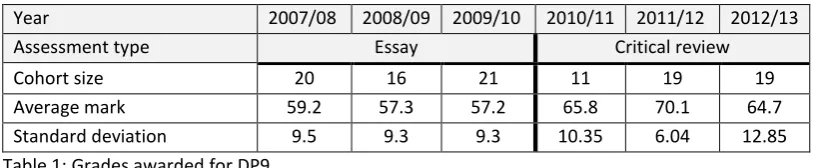
The data on six years of student achievement on the module DP9 is presented (Table 1). The first three years (2007/08, 08 / 09 and 09/10) show the marks derived from the original assessment task (the submission of a 3000 written evaluation of the ‘project’). The second three year data set (2010/11, 11/12 and 12/13) are derived from the new assessment task (the critical review process).
Year 2007/08 2008/09 2009/10 2010/11 2011/12 2012/13
Assessment type Essay Critical review
Cohort size 20 16 21 11 19 19
Average mark 59.2 57.3 57.2 65.8 70.1 64.7
Standard deviation 9.5 9.3 9.3 10.35 6.04 12.85 Table 1: Grades awarded for DP9
It is immediately apparent that the marks achieved using the critical reviews are consistently higher than those achieved via the essay. An increase in the annual standard deviation value can also been seen and this may be a consequence of the increased numbers of ‘assessors’ involved in the collaborative process. The higher marks achieved in 2011/12 may have been as a result of issuing the expanded marking criteria which enabled students and supervisors to be more confident in awarding higher grades (and avoid the bunching around the 1st class banding that is often the case). The low standard deviation figure for 2011/12 (6.04) is interesting, perhaps suggesting that that the spread of marks was narrow in comparison to other years and thus reflective of ‘a good cohort’. The 2012/13 marks reflect more closely those of 2010/11 and may be about the process ‘settling in’ or perhaps a response to the issuing of the Process Sheet, the standard deviation here is the largest across the six years indicating the broadest range of marks for this cohort .
4 Year Cohort
size (n)
Average Module score
DP7 DP8 DP9
2007/08 20 59.4 58.3 59.2 Essay
2008/09 16 61.3 59.1 57.3
2009/10 21 61.7 61.7 58.8
2010/11 11 56.2 59.6 65.8 Critical
Review
2011/12 19 57.2 58.9 70.1
2012/13 19 56.8 59 64.7
Table2: Comparison of grades across all three placement modules
We looked to compare the scores achieved in the Critical Review assessment (DP9) with those achieved in the other two placement modules (DP7 and DP8). In the two years prior to the change to critical review assessment the marks in DP7 and DP8 were consistently higher than those in DP9. Closer examination showed that in 2010/11, 55% of the cohort students achieved their highest grade in DP9 whereas only 11% scored their highest mark in DP7 (the 3000 word written assessment). In 2011/12, 79% of the cohort achieved their highest grade in DP9, with 17% achieving their highest grade in DP7. In 2012/13, 61% of students achieved their highest grade in DP9 and 11% scored their highest mark in DP7.
Discussion
It is difficult to provide definitive explanations as to why students consistently score higher in the new assessment format. Firstly consideration should be given to the basic difference between written and verbal assessments, and it is possible that this is in part why students achieve better grades. Secondly however consideration should be given to the possibility that students actually do better in the new assessment (critical review) as it more accurately assesses their expertise. Arguably their expertise, as youth and community work
practitioners is ‘in practice’, and not necessarily in academic writing. Therefore it is possible that an assessment format which better reflects their expertise is geared towards practice, involving genuine discussions, enables students to perform better.
Our initial research and reflections on this innovative assessment format lead us to conclude that it is of merit. However the situation is complex, and one does need a degree of
5
case, then the critical review can arguably be considered as an assessment tool for learning instead of an assessment tool of learning (McNamara, 2013).
Alternatively it may be that the ‘critical review’ became a dual effort with the student and supervisor working together on the ‘what and how’ the student presented in the critical review process. This potentially could have involved trial runs, a bit like ‘teaching to the test’; this may be a cynical view perhaps but potentially valid in the days of accountability and performativity. Although it should be said that our initial findings did not show any evidence of this and supervisors, students and University tutors alike engaged in a genuine dialogue. As one of the supervisors suggested:
“it is important for students to develop the skills to critically appraise their own work and be able to communicate this confidently in a wider professional context (…) the Critical Review is appropriate to the developmental needs of the Level 2 students in that it challenges their practitioner perceptions of themselves and their work in a critically progressive way.”
Students almost unanimously preferred this style of assessment, for example:
“It allowed me to express, in my own words and using language I was comfortable with what I had done during placement and why in a way that sometimes written assignments or classroom presentations don’t allow for. It was an opportunity for me to show how proud I was of what I had achieved and also allowed me to be challenged about why I had used certain interventions or theories and in referring to specific situations that had occurred on placement - I was able to back up and justify what I had done with my fieldwork supervisor being testament to that.”
Another factor worthy of exploration is that perhaps the ‘process’ itself helped to account for these higher marks. Perhaps students were provided with an increased understanding of the criteria, given a better understanding of what “success” might look like before the fact and a consideration of what indicators the student might use to help them assess the ‘value’ of their project. It may be the degree of participation in the assessment process develops a sense of ownership and the associated responsibility. The proposition is that the
participatory nature of the assessment process enables an extension of learning, as Forss, Rebien and Carlsson (2002, 33) argue ‘those who do evaluation learn from evaluation’. Springett (2001, 148) supports this further by claiming that ‘If evaluation is viewed as critical praxis, then learning and change become the focus. The emphasis is no longer on proving but on improving.’ Suárez-Herrera, Springett and Kagan (2009) argue that the interaction and communication between stakeholders engaged in evaluative networks constitute a superior way of learning.
6
the project, and the preparation for critical review assessment process in the preparatory meetings held between students, supervisors and university tutors (3 way meetings) may have encouraged supervisors to invest more time and energy in supporting the student in their project. In other words the level of mentoring, guiding and leading by supervisors rose in direct correlation to their sense of responsibility for the assessment of the student.
Collaborative marking: Is it safe?
The critical review positions all three stakeholders, supervisor, tutor and student, as grade assessors. This raises questions in relation to quality assurance and the reliability of the assessment. Standardised grading criteria was used to address these issues yet the question as to whether all stakeholders had a consistent perception of what they were assessing and what standards were expected remained. In order to examine this in more detail,
comparison of stakeholder grades was made across all three years.
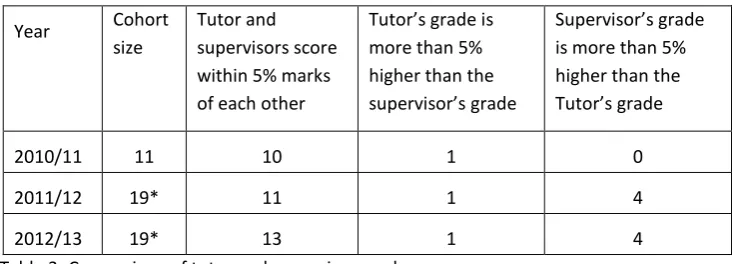
Firstly, we look at the grades awarded by the university tutor and the placement supervisors across the three years (see table 3).
Year Cohort size
Tutor and supervisors score within 5% marks of each other
Tutor’s grade is more than 5% higher than the supervisor’s grade
Supervisor’s grade is more than 5% higher than the Tutor’s grade
2010/11 11 10 1 0
2011/12 19* 11 1 4
2012/13 19* 13 1 4
Table 3: Comparison of tutor and supervisor grades
(* in 2011/12 there were 3 void cases where individual scores were not recorded, in 2012/13 there was one void case where individual scores were not recorded.)
In the first year of operation (2010/11), there was very little difference in the marks awarded. In 91% of cases the difference between the grades awarded by the tutor and supervisors differed by 5% or less. In the second year (2011/12), following the issue of the expanded grade criteria, 69% of cases fell within the 5% margin. Where the difference between the tutor and supervisor was more than this, in the majority of cases the
supervisors awarded higher grades than the tutors. In 2012/13, in 72% of cases, supervisors and tutors agreed within plus or minus 5% of each other, where the difference was more than 5%, again supervisors were grading higher than tutors.
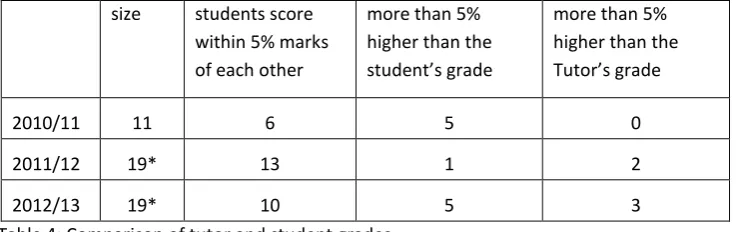
Next, in Table 4, we consider the grades given by the tutors and the students.
7 size students score
within 5% marks of each other
more than 5% higher than the student’s grade
more than 5% higher than the Tutor’s grade
2010/11 11 6 5 0
2011/12 19* 13 1 2
2012/13 19* 10 5 3
Table 4: Comparison of tutor and student grades
(* in 2011/12 there were 3 void cases where individual scores were not recorded, in 2012/13 there was one void case where individual scores were not recorded.)
Here a marked difference was seen between the first and second years of using the critical review. In 2010/11 there was significant difference between the tutor and student mark, in 45% of cases tutors awarded grades more than 5% higher than students. This changed in 2011/12, following the issue of the expanded criteria, to a position where 81% of grades awarded were within the 5% margin. In 2012/13 56% of cases fell within the 5% difference margin, but interestingly when the margin was greater than 5%, there were almost as many cases where the tutor marked higher as to those in which the student marked higher. These changes are interesting in that they may tell us something about the issue of power within the process. It is argued that the issue of power is often inadequately addressed in
participatory evaluation practices (Whitmore et al., 2006) and we may have been guilty of that in the first year. Students may have graded themselves ‘lower’ because of a reluctance to claim ‘expertise’ before their tutor or supervisor. It may be that the expanded criteria provided in 2011/12 enabled students to feel more comfortable and more confident in assessing themselves as it may have provided them with an appropriate language to make their claim.
Finally, a comparison of student and supervisors grades provides a changing picture (see Table 5).
Year Cohort size
Supervisors and students score within 5% marks of each other
Supervisor’s grade is more than 5% higher than the student’s grade
Student’s grade is more than 5% higher than the Supervisor’s grade
2010/11 11 7 4 0
2011/12 19* 9 5 2
2012/13 19* 9 7 2
Table 5: Comparison of tutor and student grades
8
In the first year (2010/11) 64% of cases saw the supervisors and students awarding grades within the 5 % margin. 56% of cases in 2011/12 fell within the 5% margin and 2012/13 saw a further drop to 50%. Interestingly the number of cases where the student grades
themselves higher than the supervisor has remained pretty consistent across the last two years. It remains to be the case that where the difference is bigger than 5%, supervisors are more than twice as likely to award a higher mark. This may be reflective of the power differential as discussed earlier, or perhaps supervisors have more confidence in awarding higher marks than the student.
Reflections
The examination of the outcomes of the critical review assessment task has been
encouraging. The critical review has real-world relevance, in that students, supervisors and tutors engage in a collaborative endeavor. Learning and context are not separated as they are in the more traditional essay assessment task, rather in an experience of participation knowledge is constructed (Hargreaves, 2007). The examination has provided valuable insights.
SupervisorParticipation and Trust
Supervisors responded positively to the change of assessment, despite the fact that it could be seen as an additional responsibility, and may impact on the nature of their ‘supervisory’ relationship with the student. We have learnt that we can ‘trust’ supervisors to grade practice in accordance with published criteria. The data presented above demonstrates a close alignment between tutor and supervisor grades. It could be argued that supervisors may not have the specialised skills in assessment (McNamara, 2013), however clearly when provided with standard criteria to be applied to assessment, this has not been the case. The fact that supervisors are qualified, experienced and available for and committed to
supervision is an essential aspect in terms of achieving reliable collaborative assessment. At this point it is useful to remind ourselves that assessment always involves both
description and judgment (Nevo, 1995). Judgment is based on criteria which in the majority of cases are determined by values, social norms and personal preferences of the evaluator and thus is subjective. Assessing student learning via the grading of essays relies, in the main, on the judgment of the tutor alone, the critical review involves all three stakeholders in making the judgment and hence it could be argued then that this process offers a more robust form of assessment. One supervisor’s comment highlights the collaborative aspect and the transparency within collaborative assessment;
9
Critical review: Assessment as learning
The feedback from students has also been very positive. The empowering nature of collaborative and participatory aspects (O’Sullivan, 2004) was evident as shown in this student’s comment
“Of all the assessments throughout the degree, this is the one that I enjoyed the most... It enabled me to be autonomous in the fact that I chose the subject of the review, the pace and direction in which it went and it gave me the space to highlight strengths and weaknesses that I had recognised and reflected upon in preparation for the review.”
This suggests that students see themselves as active partners in the assessment process as they determine the nature of critical review and because they interact with the supervisor and the tutor to demonstrate that they can use their knowledge and resources (Nevo, 2013). Dialogue between all three is an intrinsic part and lies at the heart of the critical review. We are mindful however that dialogue cannot exist without humility; it cannot exist in relations of arrogance (Ledwith and Springett, 2010). If we are to adopt more
participatory forms of assessment then we, as academics, need to respect the values, knowledge and experience of others. The student’s comment also supports a claim that participatory assessment processes, such as this one, can enhance understanding and develops skills. The critical review provides an opportunity for students to develop their capacity to take initiative in evaluating their own work (Lynch et al. 2012) and this is
particularly relevant at a time when higher education is tasked with providing opportunities for students to develop lifelong learning skills that lead to graduate employability skills (Rourke, 2013).
In summary, two aspects of this assessment process are both innovative and empowering. Firstly the student-centred aspect; we have argued that this assessment task encourages students’ ownership of their practice. This is empowering for students, it requires them to name their practice and this enables them to value it. The requirement to formally place a grade on it reinforces this. We think it is significant that the student has to offer the grade first as part of the critical review. The second aspect is the engagement of the ‘the field’. The assessment process is also empowering for supervisors as it places them on an equal footing in terms of the extent to which they grade the students work. The participatory nature of the process ‘demystifies assessment’ and begins to break down barriers between academia and the field of practice.
A number of questions remain:
Firstly in our view, it is not a question of whether we should grade practice as our
10
now graded using this participatory method of assessing practice. As such therefore the grading of practice (via the critical review in DP9) makes up 1/12 of the final degree mark). The question is posed: whether it should in fact not be more?
Secondly there is a question of whether we are actually grading practice? Arguably what we are actually doing is grading a ‘verbal articulation of practice’ not actually grading practice itself. Should we actually grade practice? We think there is an argument to suggest that our method is actually better than the grading of practice. As a supervisor’s comment makes clear: ‘what is the point in knowing it [and for that matter, being able to do it] if you can't articulate it’ – what this assessment encourages and develops is the student's ability to articulate the practice of youth work with its subtleties, intricacies, and complexities. Students do not nearly deliver youth work in instrumental technocratic fashion, as Young makes clear: ‘‘Youth workers do not merely deliver youth work. They define it, interpret it, and develop it.’ (Young, 1999:7). What this assessment task the young to shed light on is what we mean by practice knowledge
Another important question which arises from this research is: What are we actually doing, within this review process? For example ‘how’ and ‘what’ are we actually measuring in this assessment process… which in turn raises questions about the relationship between theory and practice. We use these terms readily and we think matter-of-factly. One of the things that this process has begun to question is what we mean by theory. Gilbert Ryle in his classic text ‘The Concept of Mind’ (1949) suggests that the way we think about theory is confused because we tend to talk about theory when it is the finished article and forget the process by which theory is brought about - how theories are ‘built’… he uses the analogy of a farmer making a path who:
is able to saunter easily up-and-down it. That is what the path was made for. But the work of making the path was not a process of sauntering easily, but one of marking the ground, digging, fetching loads of gravel, rolling, draining. He dug and rolled where there was yet no path so that he might in the end have a path on which he could saunter without any more digging or rolling. Similarly a person who has a theory can, among other things, expound to himself, or the world, the whole theory or any part of it; he can, so to speak, saunter in prose from any part to any other part of it. But the work of building the theory was a job of making paths where as yet there were none. The point of the analogy is. Epistemologists very frequently describe the labours of building theories in terms appropriate only to the business of going over or teaching theory that one already has (Ryle, 1949: 272).
11
applied be and rooted in practice – and lastly and perhaps more importantly students need to be encouraged to think about and articulate their own understanding of theory - not theory in the abstract but theory as it relates directly and specifically to their practice. They need to ‘build their own theories’ - not a fresh and uninformed, but the ideas they read about need to relate specifically to their lived experience of practice. Perhaps in this sense, theory is not a path that we provide for them but a path that they mark out for themselves. Finally as Schön rightly argues the domain of practice is often far from the rarified air associated with theory, suggesting that it is often best described as the ‘swampy lowlands’ where practitioners need to negotiate a way forward (1983:54).
It would probably be alleged by many youth and community work lecturers, as well as lecturers of other vocationally related programmes that: ‘this is what we do’, we apply theory to practice, and we integrate theory with examples from practice. However our reflections on the experience of this assessment process have raised fundamental questions about the relationship between theory and practice. In relation to this we would wish to make the following claims: Firstly that at the very least asking students to talk about their practice - as opposed to writing about it - means that it is at least ‘one less step’ removed from practice. Perhaps this is also helped by the process taking place in the placement agency, where it is more easily brought to life. However secondly through this new assessment process the practice, and therefore implicitly, as well as explicitly, the theory related to it, is more ‘real’. This is because it is not merely being espoused, it is being utilised usefully to explain and articulate issues that are being grappled with. In Ryle’s terms the theory is being made, constructed, put to the test not merely sauntered upon or
regurgitated.
There is an interesting parallel with the other verbal assessment tasks for this
12
So this assessment task asks fundamental questions about what we mean by theory and how we present it to students. It is too often presented as something abstract that they have to locate their practice into, rather than something that is real to them, fundamentally related to their own experience of practice and more importantly still is to be constructed and made sense of in practice.
There is also a related question about what we mean by knowledge; on this point we think Ryle (1949) is also useful. He makes a distinction between knowing how and knowing that (Ryle, 1949: 26 -60). He argues that these are fundamentally different ways of knowing. Knowing that, sometimes referred to as propositional knowledge is ‘the knowledge of true propositions or facts’ (Ryle, 1949: 27). There are those who argue (Stanley 2010, 2011 Stanley & Williamson, 2001) ) that know how is just another type of knowing that, i.e. any practice can be reduced to a set of propositions which describe the best way that a
particular practice in question can be performed. This view is referred to as intellectualist (Winch, 2010; Fantl, 2011) as it presumes that all intelligent practice is explicable in terms of and reducible to a set of intellectual propositions about the quality of such a practice. However we would argue and we think our experience of grading practice provides
evidence to the contrary or as Fantl argues: ‘Know how is not a species of knowledge-that. There is no set of propositions that constitutes what you know when you know how to do something (Fantl, 2011: 121).
If it was a case that know-how was reducible to a set of propositions know-how would become mere technique and ability to apply a particular set of actions regardless of circumstances. One of the reasons why know-how is not reducible to a set of propositions (of knowing that) is that it is dependent upon context within which the actions are
performed. Such a context requires judgment and discretion, as Winch points out:
Those who know how to do something do not therefore just know how to practice a technique, they also know how to carry out the act that they wish to perform in the circumstances in which they have to perform it. That often involves the exercise of judgment and discretion …and much of their success derives from the degree of judgment and discretion that is brought to bear on their performance. (Winch, 2010: 559).
So, for example few would disagree with the statement of propositional knowledge (or the ‘knowledge that’): ‘youth workers utilise everyday conversation to informally educate young people’ however the ‘knowledge of how’ youth workers actually utilise everyday
13
Finally our research has also begun to ask questions about what it is we mean by ‘practice’ - how we both conceive of it and assess it, and the relationship between ‘knowledge’ and ‘skills’ . On the programme we have intentionally avoided a focus on National Occupational Standards or assessments of competencies. We did not want to embrace what we felt was a technocratic assessment process and we think retrospectively and with hindsight this distinction between ‘knowing how’ and ‘knowing that’ begins to provide some theoretical basis upon which to object to abstractions of practice which attempt to describe and evaluate practice independent of the context within which it takes place
Our attempts therefore at ‘grading of practice’ are explicitly not a technical assessment of practice skills but are a more complex evaluation of ‘know how’, which is context dependent and requires youth works to make what Eruat (1994:17) describes as ‘wise judgment*s+ under conditions of considerable uncertainty”. Instead we think what we are trying to develop and grade is a particular type of ‘practice knowledge’.
As we saw earlier with what is perhaps an unhelpful separation of theory from practice, we also see in the relationship between to knowledge and skills. Knowledge (more often than not, portrayed as ‘knowledge that’ which is abstract or propositional knowledge) is often divorced from the complexity of practice. And what are often referred to as the ‘skills’ of practice are removed from the constant requirement to think about what one is doing in an uncertain, ever-changing and complex environment and this has the tendency to be reduce them to mere technique. We would question whether youth work ‘practice’ is not much more than this and whether it is sufficient to describe youth work practice as a set of ‘skills’ (Sapin, 2009). Again Ryle is useful here, in his discussion of the relationship between skills and their resulting actions; he suggests very often we are not talking about skills at all but ‘a disposition or complex of dispositions’ (1949: 33). The difference between a skill and
disposition is a disposition cannot result in an ‘intelligent’ action without a considerable amount of thought … we are perhaps as youth workers disposed to conversation - perhaps conversation is not a skill at all… It is perhaps of note that Mark Smith (1994) in his
articulation of the informal education does place a particular emphasis on dispositions what he describes as ‘our particular orientations and commitments’ (1994: 136) and talks about our repertoire but skills are conspicuous by their absence.
Conclusion
14
that’ above ‘knowing how’ (Ryle, 1949). The critical review of practice that has been developed is not a technical assessment of skills, not is it an arbitrary application of theory to practice but an evaluation of ‘know how’… which appreciates the complexities and uncertainties of the practice environment and genuinely develops ‘practice knowledge’ and students’ agency.
References
Dewey (1916) Education and Democracy. Middlesex: Echo Library
Eraut, M. (1994) Developing Professional Knowledge and Competence, Oxon: RoutledgeFalmer
Forss, K., Rebien C. and Carlsson, J., (2002) ‘Process use of evaluations: Types of use that precede lessons learned and feedback’ in Evaluation, Vol. 8(1), pp. 29–45
Fantl , J. (2011) Ryle’s Regress Defended in Philosophical Studies, Vol.156, pp.121–130
Hargreaves, E. (2007)’The validity of collaborative assessment for learning’ in Assessment in Education, Vol. 14 (2), pp. 185-199
Ledwith, M. and Springett, J. (2010) Participatory Practice. Community-based action for transformative change, Bristol: The Policy Press
LSI YW00 Youth Work National Occupational Standards (2012), accessed at www.excellencegateway.org.uk/node/24758, accessed on 14.02.14
Lynch, R., Mannix McNamarra, P. and Seery, N. (2012) ‘Promoting deep learning in a teacher education programme through self- and peer-assessment and feedback’ in European Journal of Teacher Education, Vol.35 (2), pp. 179-197
McNamara, J. (2013)’The challenge of assessing professional competence in work integrated learning’ in Assessment & Evaluation in Higher Education, Vol. 38(2), pp.183-197
Nevo, D. (2013) ‘Evaluation in education’ in I. Shaw, J. Greene, and M. Mark (Eds) The Sage Handbook of Evaluation, London: Sage Publications Ltd, pp. 441-460
Nevo, D. (1995) School-based Evaluation: A Dialogue for School Improvement, Oxford: Pergamon
15
Ord, (2007) Youth Work Process Product and Practice: developing an authentic curriculum in work with young people, Lyme Regis: RHP
O’Sullivan, R. (2004) Practicing Evaluation: A Collaborative Approach, London: Sage publications Ltd
Rourke, A. (2013) ‘Assessment ‘as’ learning: The role that peer and self-review can play towards enhancing student learning’ in The International Journal of Technology, Knowledge and Society, Vol.8 (3), pp. 1-12
Ryle, G. (1949) The Concept of Mind, London: Penguin Books
Sapin, K. (2009) Essential Skills for Youth Work Practice. London: Sage
Schön, D., (1983) The Reflective Practitioner: How professionals think in action, London: Temple Smith
Smith (1994) Local Education: community conversation and praxis. Buckingham: OUP
Springett, J. (2001) ‘Appropriate approaches to the evaluation of Health Promotion’ in Critical Public Health, Vol. 11(2), pp.139 -151
Stanley, J. (2010). Ryle on knowing how. Oberlin colloquium in philosophy. Oberlin, OH.
Stanley, J. (2011). Know how. Oxford: Oxford University Press.
Stanley, J., & Williamson, T. (2001). Knowing how. The Journal of Philosophy, 98, 411–444.
Suárez-Herrera, J., Springett, J. and Kagan, C. (2009) ‘Critical Connections between
Participatory Evaluation, Organizational Learning and Intentional Change in Pluralistic Organizations.’ in Evaluation, Vol.15(3), pp.321–342
Whitmore, E., Guijt, I., Mertens, D., Imms, P., Chinman, M. and Wandersman, A. (2006) ‘Embedding improvements, lived experience and social justice in evaluation practice’ in I. Shaw, J. Greene, and M. Mark (Eds) The Sage Handbook of Evaluation, London: Sage Publications Ltd, pp. 340-359
Winch, C. (2010) Vocational Education, Knowing How and Intelligence Concepts Journal of Philosophy of Education, Vol. 44, No. 4, 2010