Use of Practical Sets Theory kits in Teaching
and its Effects on Students Performance
Olumuyiwa, O. Fagbohun
1,
Ilesanmi Oluwafemi
21Associate Professor, Department of Electrical Engineering, Faculty of Engineering,
Ekiti State University, Ado-Ekiti, Nigeria.
2
Senior Lecturer, Department of Electrical Engineering, Faculty of Engineering, Ekiti State University, Ado-Ekiti, Nigeria.
Abstract- To demystify the abstractness of introducing students to the theory of Sets and its applications at the senior secondary level and lower undergraduate programs with the use of practical kits in teaching, for better results is the aim of this work. The Sets Theory Model Trainer which consists of 6 circular plates, modeled in a form to give sets A, B, C, D, base configurations with cut-offs giving A n B, B n C, C n A, B n D, D n C and A n B n C bases, a sample space board of about 800mm x 610mm, an element of numerals printed on triangular and square plates, and alphabet elements printed or embossed on square and circular plates, all with different colors to represent different instructions, with multi colored sets intersection plates are discussed in which the objects shapes elements are printed on circular plates for variety of practical work on the principle of Sets Theory. The whole Set bases and the elements are configured for pinning unto the sample space. An assessment of students performance on the set theory applications was conducted in 8 secondary schools for 3 years without the use of practical kits and 2 years for the use of the practical kits, and it was discovered from the sampled Schools in use of the kits, that the total number of students attempt to questions on the Sets Theory in the whole class range between 92% and 98%, with between 81% to 91% correct solutions obtained, with 4 and 5 contact class teachings of 45minutes per class in comparison to the earlier 5 to 7 class teachings without the use of practical kits with between 22% and 40% of the total population of the school class well grounded in the methods of solutions of set theory problems.
Keywords: Practical teaching, Sets theory, Application kits, Response, Performance.
I. INTRODUCTION
Introducing students into Set Theory in the classroom without a practical way of carrying the students along from a practical point of view makes the subject looks so abstract, hard and uninteresting [1]. Thus, the Sets Theory practical model trainer is designed to introduce the students to the theory of Sets and its applications in the real sense of live, using practical method of introduction to the
subject of Sets theory , in order to enhance the learning of the subject, and solving the abstract nature the subject normally posed in the mind of students, and its assimilation been made easier and highly simplified knowing fully well that seeing is believing!. It is to be used to introduce students to
topics as [1]-[4] ;Definitions and Notations in sets,
Finite and infinite sets, Equivalence and equality of sets, Null and empty sets, Subsets and supersets, Comparability of sets, Universal sets, Sets of sets, Power sets, Venn-euler diagrams, Union of sets, Intersection of sets, Difference of sets, Complements of sets, Application of venn diagrams, Two set problem, Three set problems, Laws on operations with sets [5]- [7].
II. MATERIALS AND METHOD
The Sets Theory Model Trainer which consists of 6 circular plates, modeled in a form to give sets A, B, C, D, base configurations with cut-offs giving A n B, B n C, C n A, B n D, D n C and A n B n C bases, a sample space board of about 800mm x 610mm, an element of numerals printed on triangular and square plates, and alphabet elements printed or embossed on square and circular plates, all with different colors to represent different instructions, with multi colored sets intersection plates [1],[7],[8]. Objects shapes element printed on circular plates and star configurations for variety of practical work on the principle of Sets Theory. The whole Set bases and the elements are configured for pinning unto the sample space. To demonstrate the use of the practical teaching device to reinforce the principle of Sets theory in the mind of students,
Given a sample space of letter A to Z i.e. {A,B,C.D.E.F.G.H.I.J.K.L,M,N,0,P,Q,R,S,T,U-V,W,X,Y,Z}
with
Set B= {D.E.H.I.J.K.L}
Set C= {F.J.K.N.P.R.S.B.C}
We can solve for A n B, B n C, C n A, A n B n C , B n C –An B n C; A u B , B u C , C u A - ( A u B )' , (A u C)', ( B u C )' etc, using the practical device for Sets theory in a participatory form, using the following methods;
1. The sets sample space board and stand was places in front of the classroom (preferably on a bench) with the 2 standing pillars installed with the 2 screws supplied [1]. The screw connects the pillars through the holes drilled on the board, as shown in Figure 1
Figure 1: Sample space board on its stand
2. The alphanumeric elements A-Z and 1-10 were used to formate the elements of the sample space, with the supplied pins. This step was clearly explained to the students, to understand the meaning of elements in a sample space called the universal elements and elements outside it, before going to the next step[1,8,9]. All possible arrangement representing the elements in the sample space were discussed, as shown in Figure 2.
3. To begin with a set of some numbers in the sample space, we place the set A plate which consist of Set A plate subset and A n B plate as shown in Figure 3 to form a complete circle round all the possible elements contained in set A, with students participation, and full clarification to understand that all elements in Set A are member of the sample space been addressed.
Figure 2: Sample space board with its stand on a table plane with its universal elements pinned with the tumble nails provided.
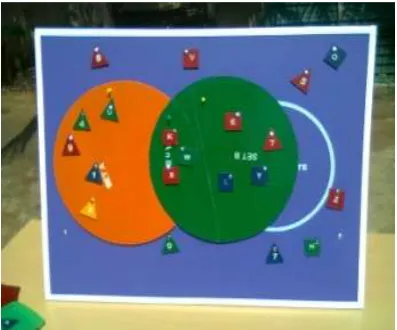
4. For 2 sets combinations of possibilities A&B [1],[5], the Set A plate which consists of a subset A plate and an A n B plate is placed on the sample space board and we look for the elements that makes up the Set A on the sample space board, in which the elements belonging to set A were transferred and place on the set A plate[1],[8],[10]. Set A and Set B plates with their elements forming the 2 rounded up circles are as shown in Figure 4 .
Figure 3. Set A elements on its plates forming the first rounded up circle
placed on A n B plate and the left over is transferred to subset A plate[1],[9],[10],[11], as shown in Figure 4. Since the set B plates elements are not complete it is removed and transferred to its subset B plate.
Figure 4: Set A and Set B plates with their elements
6. When the subset A plate with its elements and A n B plate and subset B plate are combined together to form a complete circle, the orientation shown in the figure 4 above is arrived at in which a complete circle for set A is formed, and complete circle for set B is equally formed, and the removable differently colored plate shows its relationship with subset A and B plates as shown. Thus in a practical form the A n B elements can easily be seen and verified.
7. For union of sets , i.e [A u B] interpretation from the orientation in the figure 4 , the elements that appear on the surface of A and B becomes the elements of the Union of A and B i.e. (A,B,C,D,E,F,G,H, I,J,K,L) elements.
8. To find B n C elements from the arrangement of Figure 4, the elements making up the set B are first set-up on its subset B plate, from the sample space board elements. For the set C on the subset B plate , the elements are equally set-up, but on searching the board, we realize that some elements are missing which can be found on the set B board, this implies that the missing elements represents the common elements for both B and C. and thus, because of the incompleteness of C plate elements on its plate , its elements are transferred to its subset C plate , in which when joined , it makes a form on the sample space board , the B n C plate same, and contains the elements common to both B
and C .i.e. B n C elements are ( F,J,K ). B u C is
found from the plates to be
(D,F,H,I,J,K,L,N,P,R.S) .
Figure 5. A configuration of A u B – A n B
Same principle is used to find C n A giving (B,C,F) on its surface. It is to be noted that subset A , B plates can equally be used as subset C and D plates for 2 sets configuration.
9. The elements on plate A i.e subset A plate represents (A n B') and subset B plate represents (A' n B) elements .From the configuration on the sample space board , it is clearly seen that the elements that are not in subset A plate , A n B plate , subset B plate are in the rectangular sample space board which is represented by (A u B )' that is , the elements that are not in A or B plates but in the
sample space which can be seen as
(M,0,Q,T.U.V.W,X,Y,Z). Other configurations that can be easily explained with the trainer are that:
(A u B)' = A' n B' and (A n B)' - A' n B'.
A u B' . A" u B ,or ( B u C )' =B' n C' etc.
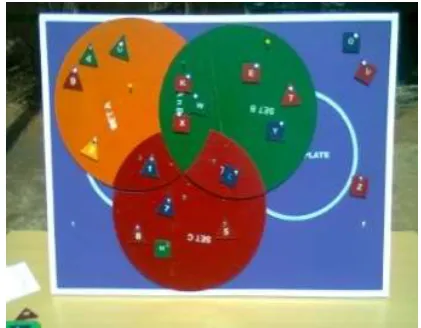
Figure 6: Set A, Set B and Set C plates with their elements and with the plates of B n C and C n A removed.
Figure 7: Set A , Set B and Set C plates with their elements and the plates of C n A and A n B n C removed, and B n C placed.
11. The Set C plate elements are looked for on the Sample space board and discovered not complete in which case some are in Subset A plate , Subset B plate, and (A n B) plate. Therefore since the Set C elements are incomplete on the Sample space board, the elements that are seen on sample space board are transferred to the Subset C plate. The elements that are in (A n B) plate which equally belongs to Set C plate are taking out and placed on (A n B n C) plate, the ones that belongs to both Sets A and Set C are placed on plate —, and ones belonging to B and C are placed on plate --. When all these plates are pinned together, the configuration shown is arrived at.
Figure 8: Set A, Set B and Set C plates with their elements with the plates of C n A and B n C placed, and A n B n C removed.
Figure 9: Set A, Set B and Set C plates and their elements forming the 3 rounded up circles. The element not in the 3 circles is termed (A u B u C)'
III. RESULTS AND DISCUSSION ON STUDENTS PERFORMANCE
In a sampled 8 secondary schools with the use of the practical kits in teaching students sets theory, with a class range of 82 to 124 students at Senior Secondary final class SS3 classes per school, with the same teacher administering the subject over the years, the following results were obtained.
Table 1: Year 2011 Sampled Schools report on student’s response to questions on Sets theory before the use of practical kits
School A
School B
School C
School D
School E
School F
School G
School H Total number of students in
class
102 94 76 95 81 62 53 72
Total number 45mins/Class teachings
7 6 7 5 6 6 5 6
Number of students that
attempted Sets theory
questions
70 45 38 34 38 34 33 43
Number of students that got correct answers to questions
33 22 18 21 18 20 19 25
Percentage of students that attempted questions on Sets theory (%)
68.62 47.87 50.00 35.79 46.91 54.84 62.26 59.72
Percentage of students that accurately solved problems on Sets (%)
47.14 48.89 47.37 61.76 47.37 58.82 57.58 58.14
Overall Percentage of
students that accurately
solved problems on Sets out of total class (%)
37.25 24.40 23.68 22.11 22.22 32.26 35.85 34.72
Table 2: Year 2012 Sampled Schools report on students response to questions on Sets theory before the use of practical kits
School A
School B
School C
School D
School E
School F
School G
School H Total number of students in
class
91 108 89 76 99 87 72 93
Total number 45mins/Class teachings
7 6 7 5 6 6 5 6
Number of students that
attempted Sets theory
questions
64 67 52 44 32 41 34 51
Number of students that got correct answers to questions
38 31 27 25 19 24 22 32
Percentage of students that attempted questions on Sets theory (%)
70.33 62.03 58.42 57.89 32.32 47.12 47.22 54.83
Percentage of students that accurately solved problems on Sets (%)
59.38 46.26 51.92 56.81 59.37 58.53 64.70 62.74
Overall Percentage of
students that accurately
solved problems on Sets out of total class (%)
41.76 28.70 30.33 32.89 19.19 27.58 30.55 34.40
on sets theory for solving , in which case, between 47% and 62% of those students that tried to solve the problems arrived at a required accurate solution. It was also discovered that between 22% and 38% of the total population of the schools at the senior level were well grounded in the methods
students population in their final year class, senior secondary school, attempted to pick the problems on sets theory for solving , in which case, between 46% and 65% of those students that tried to solve the problems arrived at a required accurate solution. It was also discovered that between 19% and 42% of the total population of the schools at the senior level were well grounded in the methods of solutions of set theory problems. For year 2013, it was discovered that between 35% and 70% of the total students population in their final year class, senior secondary school, attempted to pick
the problems on sets theory for solving , in which case, between 47% and 62% of those students that tried to solve the problems arrived at a required accurate solution. It was also discovered that between 22% and 40% of the total population of the schools at the senior level were well grounded in the methods of solutions of set theory problems.
However, in year 2014, set theory practical training kits as detailed above were administered in the teaching of the new set of final year senior secondary school students, with the same teacher,
Table 3: Year 2013 Sampled Schools report on students response to questions on Sets theory before the use of practical kits
School A
School B
School C
School D
School E
School F
School G
School H Total number of students in
class
102 94 76 95 81 62 53 72
Total number 45mins/Class teachings
7 6 7 5 6 6 5 6
Number of students that
attempted Sets theory
questions
70 45 38 34 38 34 37 43
Number of students that got correct answers to questions
38 22 18 21 18 20 21 25
Percentage of students that attempted questions on Sets theory (%)
68.63 47.87 50.00 35.79 46.91 54.84 69.81 59.72
Percentage of students that accurately solved problems on Sets (%)
54.28 48.89 47.37 61.76 47.37 58.82 56.76 58.14
Overall Percentage of
students that accurately
solved problems on Sets out of total class (%)
37.25 23.40 23.68 22.10 22.22 32.26 39.62 34.72
Table 4: Year 2014 Sampled Schools report on students response to questions on Sets theory with the use of practical kits
School A
School B
School C
School D
School E
School F
School G
School H Total number of students in
class
114 101 92 99 74 81 76 89
Total number 45mins/Class teachings
4 5 4 4 5 5 5 4
Number of students that
attempted Sets theory
questions
106 97 88 94 71 79 74 82
Number of students that got correct answers to questions
88 72 78 81 68 70 66 77
Percentage of students that attempted questions on Sets theory (%)
Percentage of students that accurately solved problems on Sets (%)
83.02 74.23 88.64 86.17 95.77 88.61 89.19 93.90
Overall Percentage of
students that accurately
solved problems on Sets out of total class (%)
77.19 71.29 84.78 81.82 91.89 86.42 86.84 86.51
Table 5: Year 2015 Sampled Schools report on students response to questions on Sets theory with the use of practical kits
School A
School B
School C
School D
School E
School F
School G
School H Total number of students in
class
101 113 74 87 89 99 67 76
Total number 45mins/Class teachings
4 5 4 4 5 5 5 4
Number of students that
attempted Sets theory
questions
97 108 74 87 85 94 66 73
Number of students that got correct answers to questions
91 94 63 71 74 83 62 70
Percentage of students that attempted questions on Sets theory (%)
96.04 95.57 100 100 95.50 94.95 98.51 96.05
Percentage of students that accurately solved problems on Sets (%)
93.81 87.04 85.13 81.61 87.06 88.30 93.94 95.89
Overall Percentage of
students that accurately
solved problems on Sets out of total class (%)
90.10 83.18 85.13 81.61 83.15 83.84 92.54 92.10
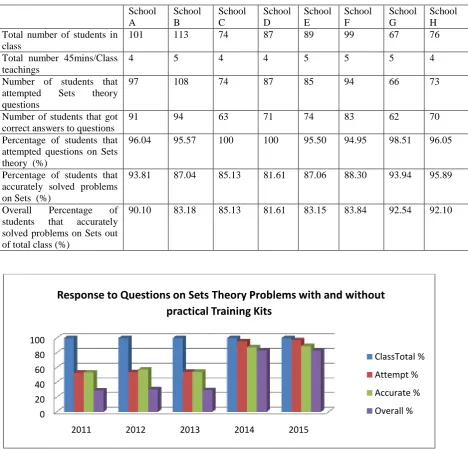
Figure 6: Class Percentage of response to questions on Sets theory in 5 years.
and the following results were obtained. Between 92% and 98% of the total students population in their final year class, senior secondary school, attempted to pick the problems on sets theory for solving , in which case, between 74% and 96% of
those students that tried to solve the problems arrived at a required accurate solution. It was also discovered that between 71% and 92% of the total population of the schools at the senior level were 0
20 40 60 80 100
2011 2012 2013 2014 2015
Response to Questions on Sets Theory Problems with and without
practical Training Kits
ClassTotal %
Attempt %
Accurate %
well grounded in the methods of solutions of set theory problems.
To confirm the impact of the application of set practical training kits in the study of the subject to students, another data were obtained for the year 2015, in which case, it was discovered that between 94% and 100% of the total students population in their final year class, senior secondary school, attempted to pick the problems on sets theory for solving , in which case, between 81% and 96% of those students that tried to solve the problems arrived at a required accurate solution. It was also discovered that between 81% and 93% of the total population of the schools at the senior level were well grounded in the methods of solutions of set theory problems. The 5 year assessment chart of performance index is as shown in Figure 6, of the response of the students to the solving of Sets theory, in which case, it is very clear that the impact of the application of the practical kits in the teaching of the theories of Sets had a great influence on the students performance. Thus, it is of note to say, that the application of practical kits in the teaching of set theory to students at the upper senior secondary level, had a great impact on the students assimilation of the subject matter, and necessary for new generation classes for easier understanding.
On the average, From Table 1, we deduce that out of 635 total number of students in their final year in 8 different secondary Schools in year 2011, an average of 53.25% of the total number of students sampled attempted to solve questions on sets theory, with 53.38% of the students attempting the questions, arriving at an accurate solution to the problems, and an average of 29.06% of the total class of 635 students obtaining an accurate solution to the problems. Table 2 shows the results obtained for the year 2012 with the same sampled 8 schools with 715 number of students in their final year senior secondary level classes, in which case, an average of 53..77% of the total number of students sampled attempted to solve questions on sets theory, with 57.46% of the students attempting the questions, arriving at an accurate solution to the problems, and an average of 30.68% of the total class of 715 students obtaining an accurate solution to the problems. In year 2013, Table 3 shows the results obtained with the same sampled 8 schools with 635 number of students in their final year senior secondary level classes, in which case,
an average of 54.19% of the total number of students sampled attempted to solve questions on sets theory, with 54.17% of the students attempting the questions, arriving at an accurate solution to the problems, and an average of 29.41% of the total class of 635 students obtaining an accurate solution to the problems. For year 2014, with the use of sets theory training kits as discussed in the teaching of the students as a practical way of introduction to the subject, out of a total class of 726 students in the sampled schools, Table 4 shows the results with an average of 95.33% of the total number of students sampled attempted to solve questions on sets theory, with 87.44% of the students attempting the questions, arriving at an accurate solution to the problems, and an average of 83.34% of the total class of 726 students obtaining an accurate solution to the problems. The same trend of result was validated in year 2015, with 706 students in the sampled schools, in which case, as derived from Table 5, an average of 97.08% of the total number of students sampled attempted to solve questions on sets theory, with 89.09% of the students attempting the questions, arriving at an accurate solution to the problems, and an average of 83.08% of the total class of 706 students obtaining an accurate solution to the problems. An histogram chart of the results obtained between the year 2011 to 2015, on the selected schools for sampling is as shown in Figure 10. The graph of Figure 10 shows that in year 2014 and 2015, there is a great improvement in class response to teachers teaching in Sets theory, leading to a high attempt of questions and accurate solutions obtained. Thus, it is of note to say, that the application of practical kits in the teaching of sets theory to students at the upper senior secondary level, had a great impact on the students assimilation of the subject matter, and necessary for new generation classes for easier understanding.
IV. CONCLUSION
local government areas of Ekiti and Ondo State of Nigeria, with considerable class population to have a great impact on the understanding and response level of students to its methods of approach in problem solving, than without; in which case, a good percentage of between 92% and 98% total students responded to all its practicing questions, with between 81% and 91% correct solutions obtained. The total class contact meetings was equally reduced from between 5 to 7 contacts, to 4
and 5 contact meetings. It is therefore
recommended that practical kits in Sets theory should be employed in all Senior Secondary Schools in the teaching of the subject matter, to impact more knowledge of its use in daily affairs in the training of Students.
REFERENCES
[1] O.O. Fagbohun , ―Set Theory Model Trainer‖ Technical report on Development, Prototype analysis, and field of application, with Patent on invention certification No. RP 16214 of 11- 08 -05‖ Federal Republic of Nigeria, Presidential seal of 26 -01 -06, 2005.
[2] M.N. David-Osuagwu, C. Anemelu, L. Onyeozili New General Mathematics for Senior Secondary School. Africana First Publishers Ltd, 2nd edition, 2007.
[3] J.B. Channon, et al , " New general mathematics for West Africa senior secondary schools 1", Pearson Education Limited.4th edition, 2008.
[4] J.B. Channon, et al , " New general mathematics for West Africa senior secondary schools 2", Pearson Education Limited.4th edition, 2008.
[5] J.B. Channon, et al , " New general mathematics for West Africa senior secondary schools 3", Pearson Education Limited.4th edition, 2008.
[6] O.O. Fagbohun, ―Probability Theory practical training kits‖ Technical report on Development, Prototype analysis, and field of application, , with Patent on invention certification No. RP 16215 of 11- 08 -05 ―,Federal Republic of Nigeria Presidential seal of 01 - 11 -05, 2005.
[7] O.O. Fagbohun, ―Simultaneous equations and Matrices practical training kits‖ Technical report on Development, Prototype analysis, and field of application, with Patent on invention certification No. RP 16435 of 11- 08 -05 ‖ Federal Republic of Nigeria, Presidential seal of 11 - 04 -06 , 2005. [8] A.R.T. William "An Introduction to Set Theory" , Macmillan and Co. 3rd Edition. 2008.
[9] Kreyzig Erwin "Advanced Engineering Mathematics", John Wiley and Sons Inc., 9th edition. 2009.
[10] K.A. Stroud, "Engineering Mathematics" . Macmillan and Co. 7th edition. 2010.