Published online March 18, 2015 (http://www.sciencepublishinggroup.com/j/ijass) doi: 10.11648/j.ijass.s.2014020601.14
ISSN: 2376-7014 (Print); ISSN: 2376-7022 (Online)
The GEM unification theory of the vacuum: Did
dimensional collapse trigger the big bang
John E. Brandenburg
Morninginstar Applied Physics, Vienna, Virginia, USA
Email address:
To cite this article:
John E. Brandenburg. The GEM Unification Theory of the Vacuum: Did Dimensional Collapse Trigger the Big Bang. International Journal of Astrophysics and Space Science. Special Issue: Quantum Vacuum, Fundamental Arena of the Universe: Models, Applications and Perspectives. Vol. 2, No. 6-1, 2014, pp. 24-38. doi: 10.11648/j.ijass.s.2014020601.14
Abstract:
The GEM (Gravity EM) unification theory builds on the Sakharov and Kaluza-Klein approaches to unify all four force fields of nature: Gravity, EM, Strong, and Weak using Feynman Path integral formalism. The model is rudimentary, and can be called a “Bohr Model” of unification. It is basically found that Gravity and the other forces can be understood as quantum electrodynamics. In particular the proton emerges as a fundamental particle despite being composed of quarks and is the principle interaction vertex of the Higgs boson, which is seen here as direct consequence of a hidden 5th dimension, where the Higgs mass is due to 5th dimensional compactification. Collapse and compactification of a 5th dimension is argued as the triggering event for the Big Bang. A particle mass formula based on Feynman Path Integrals including paths across the hidden 5th dimension gives the proton and electron masses to high accuracy and finds the charged bosons responsible for the short range nuclear forces. The masses calculated for the particles are as follows: the charged pion mπ = 2 me /α ≅140.0 MeV and W boson: mw =2σ mp = 80.4 GeV. The ηc meson mη =2985 GeV is identified with the 5th dimension compactification force mediated by the Radion field. The Higgs boson associated with this mass inducing field is the most general EM+Radion scattering quanta off the hidden dimension size with a mass mp/α ≅ 127.7 GeV. This results in a structural resonance ŻHiggs = rp where ŻHiggs is the Compton radius of the Higgs boson and ŻHiggs =ℏc/mHiggsc2 the rp electro-dynamic length of the proton rp=e2/mpc2. Vacuum decay results from this value of the Higgs boson mass, which is a key parameter in a mass system that creates the proton-electron mass system and thus hydrogen in the Big Bang. The vacuum is found to decay into proton-electron pairs and to give an “eternally inflating” cosmos of Hubble Time TH ≅ ( 9/α )1/3 π/2 e2 /(4πεoGmemp ) re/c = 1.2 x10¹⁰ years. The predicted value of the CBR(Cosmic Background Radiation) temperature from this vacuum decay is TCBR ≅ (4cGme2/(3σTh2σStefan-Boltz.)1/3 = 2.65K Support for this consists of observation of the failure of the Sunaeyev-Zeldovich effect, where distant galaxies are not observed to cast shadows in the CBR indicating a source for the CBR in the vacuum itself in the line of sight to more distant galaxies.Keywords:
GEM Unification Theory, Mie Scattering, Structural Resonance, Kaluza-Klein Theory, Radion Vacuum Decay, Suneayev-Zeldovich Effect1. Introduction
“
everything is geometry,”
John Archibald Wheeler
The vacuum, in modern quantum mechanical understanding, is not empty. It is instead alive with virtual particles, including electromagnetic waves organized as photons. This vacuum activity, here called the ZPF (Zero Point Fluctuation) was first identified by Einstein. The best calculations of its energy density yield vast numbers: “the most embarrassing number in physics” of 10 96J/m3,
indicating that matter, with an average density in the cosmos of 1 GeV/m3 (one hydrogen atom per cubic meter) is merely a perturbation on the vacuum. Thus, if we can formulate a physical theory of the vacuum, matter, in the form of subatomic particles might be recovered as a perturbation around the vacuum state. It is the goal of this article to formulate and present such a theory.
2
4
o p e cH
Gm m
r
R
e
πε
≅
(1)Where G is the Newton Gravitation Constant, mp and me are the proton and electron mass respectively, εo is the electric permittivity of space and rc is the classical electron radius rc = e2/(4πεo) and RH is the Hubble radius , which is the Hubble Time TH times the speed of light : RH = cTH
2 2
8
1
3
p H
Gm nR
c
π
Ω =
≅
(2)Where n is the number density of hydrogen in space. We also correlate this with critical optical thickness of the
cosmos
2
8
1
3
c H
Th H
nr R
nR
π
σ
=
≅
(3)Where σTh = 8πrc2/3 is the Thompson scattering cross-section for EM radiation. Equating equation 2 Equation 3 and assuming the hydrogen in space is fully ionized we obtain Eq. 1. Therefore, the Dirac condition is consistent with the critical density of matter in the universe for gravational interactions, being correlated with the EM critical scattering thickness of the Cosmos. Accordingly, the Dirac realation is consistent with a comos where gravity interactions are a form EM interaction and the visible universe is both critically interacting gravitationally and electromagnetically.
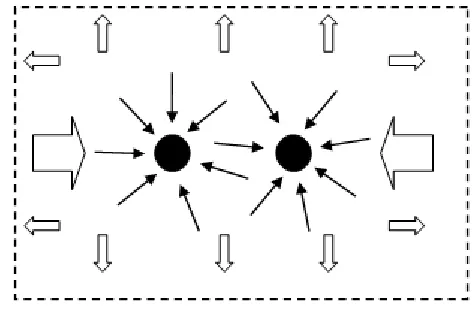
Two bright objects in dark box repel each other Two dark objects in a bright box attract each other Figure 1. The Sakharov model of gravity.
This physical concept of gravity as a statistical electromagnetic interaction related to “radiation pressure” from the quantum ZPF (Zero Point Fluctuation) was proposed by Sakharov (1967) and can be understood from Figure 1, where in the case of two bright objects in a box with dark walls, the two objects repell each other due to mutual radiation pressure with a 1/r2 force dependence, in the second case two dark objects are placed in a box with bright walls and attract each other due to mutual shadowing with a 1/r2 force dependence. Sakharov went further, using the Hilbert Action Principle
4
16
R
W dx
G
π
=
∫
(4a)where R/16πG is an energy density to be minimized, and which yields the vacuum equations of Einstein’s General Relativity. Sakharov treated the action, R/16πG, having units of energy density, as a physical energy density due to the distortion of the ZPF by curved spacetime and used this to derive a formula for the Newton Gravitation Constant with the Planck scale forming the short wavelength limit of integration. This yielded :
2 3
p
r c
G
=
ℏ
(4b) Where rP = (ℏG/c3)1/2 is the Planck mass from the ZPF, which demonstrates that self-consistency of the concept. Gravity can thus be considered as a consequence of the curvature of spacetime, with the fabric of spacetime being considered electromagnetic. However, in order to introduce electromagnetism explicitly one must introduce a hidden Kaluza-Klein dimension. This changes the Hilbert Action Principle, and for the case of a vacuum it becomes5
16
4
F F
R
W
dx
G
αβ αβ
π
=
∫
+
(4c)Where Fαβ is the Faraday EM tensor.
o
p
U
r
c
G
2 4
1
=
(4c)Where Uo is the Plack energy density U0= ℏc/rP4.
particles. We now turn to the question of “what triggered the Big Bang” that became the expansion of the universe. This can be interpreted as the sudden appearance of charged massive particles from the vacuum, along with entropy. The concept that such a hidden dimension can lead to the appearance of other particles and forces and proposed in the GEM (Grandis et Medianis) “the unity of the great and middle” theory1- 5. The GEM theory unites the “middle” or subatomic scale of particles with “great” scales of both the Cosmos and Planck Scale. The GEM theory is combination of two concepts- the hidden 5th dimension concept of the Kaluza-Klein6 theory unifying gravity and electromagnetism, and the Sakharov7 concept of an electro-dynamic vacuum spacetime-vacuum as the origin of an electro-dynamic gravity.
Mikio Kako8 has recently conjectured that the Big Bang was due to appearance of the Higgs Boson which caused particles to acquire mass. But was this appearance of the Higgs merely another consequence of a change in physics? Here, we make a deeper, howbeit rudimentary, inquiry into the origin of mass as due to the appearance of a hidden 5th dimension, and we find that the Higgs Boson falls out as a consequence of the appearance of compactified 5th dimension, and gains its own mass from it, rather than being a direct cause of particles acquiring mass. However, the Higgs is obviously associated with the mass generating mechanism of the 5th dimension and so is part of circle of cause and effect. In this GEM model, which we will refer to as a “Bohr Model” of unification, the Big Bang was triggered by a collapse or shattering of a formerly infinite 5th dimension, breaking up large scale coherence in that dimension and thus increasing entropy, by spreading action over a range of scales. The appearance of this compactified 5th dimension led to particles, including the Higgs Boson, to acquire mass and the Cosmos we experience.
Based on studies of primordial nucleo-synthesis in the early fireball, the physics of the universe has remained unchanged since the first fractions of a second of the primordial explosion. However, in order for the Big Bang to occur, physical laws must have undergone a change. It now appears possible to understand a mechanism by which the Big Bang was triggered, leading to the universe we now know. It can be postulated that a universe of 5 dimensions, all infinite, existed, and that one of the dimensions that existed then underwent a catastrophic collapse and compactified, becoming a curled up or hidden dimension6. The driver for this collapse was apparently an increase in entropy and lessening of action, two fundamental principles that determine dynamics in our present universe, this change also gave rise to mass and electric charge. This can be seen mathematically by a model of a universe filled with a massless quanta, that is a vacuum, with a metric tensor:
2 ab
g A A A
A τυ τ υ τ υ ξ κ ξ κ γ ξ κ ξ + =
(5) Where A is the electric 4 potential the indices, a and b, run
from 1-5, κ=16πG/c4, gτυ is the familiar 4 metric tensor and ξ is a parameter that determines the size of the 5th dimension, with ξ=1 being a compactified universe and ξξξξ = S being the primordial infinite 5th dimensional universe. We have then a Lagrangian for a set of massless scalar quanta, with MP = (ℏc/G)1/2 being the Planck mass, a mass that can arise
spontaneously out of the vacuum:
((((
))))
∫∫∫∫
∂∂∂∂ ∂∂∂∂ −−−−==== d x
M h
L ab 5
b a P 2 γγγγ φγ φγφγ φγ
φφφφ (6)
The minimization of this Lagrangian leads to a simple Klein-Gordon wave equation for massless quanta in flat space8:
0
ab b
a
∂∂∂∂
====
∂∂∂∂
φφφφ
γγγγ
(7)However, if we allow the fifth dimension to become compact so that all dependence on the 5th dimension becomes the form:
) r 2 /( x r i exp( ) x ( o 5 r r ππππ φφφφ φφφφ====
∑
∑
∑
∑
νννν (8) Where r is an integer index and r0 is the size of the hidden dimension. Then the particles in the quantum Lagrangian acquire both mass and charge:∫∫∫∫
−−−− −−−− −−−− ∂∂∂∂==== d x
r 2 r ) A r 2 ir ( M h L 5 2 o 2 o a P 2 γγγγ φφφφ ππππ φφφφ κκκκ ξξξξ
ππππ υυυυ (9)
Where the electric charge is identified as:
o
r
2
r
e
ππππ
κκκκ
ξξξξ
====
(10)and the characterisitic mass :
2 o
c
r
2
r
h
m
ππππ
====
(11)So that for field free space, we have:
0
h
c
m
2 ab ba
====
++++
∂∂∂∂
∂∂∂∂
φφφφ
γγγγ
φφφφ
(12)electrodynamic and vacuum polarization and thus renormalization must occur.. For instance for a value of ξ = r = 1 and κ being its normal vacuum value the electron charge e requires the hidden dimension size ro to be of the order of the Planck radius, however, without renormalization this would require the mass scale to be the Planck mass. However, here we will consider that part of the mass is due to interaction with the polarized vacuum around the charge and this must reduce, or renormalize, the mass. So, for now, we will consider that renormalization occurs and erases this problem of charge-to-mass in the Kaluza-Klein theory. . This is equivalent to the model of a “quartic potential” ,triggered by the appearance of a Higgs Boson, that gives particles non-zero masses that are none-the-less lowest energy stateX, due to a gravitation-like negative self-potential. An analogous model occurs in cosmology where the proton density no ≅ψ2, that is: a quantum probability squared, contributes to the mass-energy of the universe by the equation for energy density
2 2
8
2 43
p p
G
w
=
ψ
m c
−
π
m
ψ
(13)where for Ω=1 the second term becomes c2.
Another way this can be looked at is that a renormalization occurs due to quantum vacuum polartization over wavelengths from the Planck length to the size of the hidden dimension ro so that we have, similar to the calculation for the self-energy of the electron:
1
ln
≅
−
α
π
p o
r
r
(14)
This can be considered to allow both e and ro to be free from each other for our purposes. Therefore, the compactification of a 5th dimension automatically produces charged massive particles in our spacetime dimension. Since the appearance of the electron charge leads to an action e2/c << ℏ that is less than Planck’s constant, i.e. the fine structure
constant α =e2/(c ℏ) =1/137 <<1, the compactification
leading to the electric charge, and particle mass, is consistent with the overarching principle of minimization of action in nature. This minimum action principle underlies all physics as we understand, including everything done in this paper.
We will consider, consistent with the success of quantum electro-dynamics, that all particles are imbedded in a spacetime that is itself electro-dynamic. This means charged particles will produce “vacuum polarization” in the fabric of spacetime around themselves, over many scales of length, as if it was a conventional dielectric. This leads to observable quantities such as charge or mass “at a distance” being renormalized versions of a “bare charge” or mass measured at short distance scales. Because this process is governed by quantum uncertainty, sums over these renormalization effects lead to characteristic terms of the form ln(rin/ruv) where rin is the low energy “infrared” limit of the effects, and ruv is some cutoff at the high energy “ultraviolet”, which in an
ordinary dilectric would be the molecular spacing of the dielectric but here in the vacuum is rP , the Planck length. This is entirely consistent with the GEM view of the gravity as electro-dynamic, gravity being the curvature of spacetime, which is itself, is electro-dynamic. Thus the price of analyzing field unification in terms of paricle masses and charges observed “at a distance” is to understand that quantities such as “classical radii” are actually averages or sums over vacuum electro-dynamic effects ranging down from the subatomic to to the Planck scale. Therefore, even though we will consider that charged particles exist in an electro-dynamic vacuum and have charge and mass “at a distance” that are well characterized, we will consider that such particles come into existence through process deeply removed from direct observation and operating over many deeply subatomic length scales.
We will also consider that spacetime is not just 4 dimensional, having three distinct spatial dimensions and one of time, but that an additional “compactified” 5th dimension exists as a degree of freedom. This 5th spatial dimension, whose consequence is the existence of massive particles, is restricted compared to the other dimensions, but none-the-less is a degree of freedom capable of variation.
However, it is not enough to merely create conditions for charged massive particles to exist, they must be born in a process that conserves both charge and vacuum quantum numbers. Attempts have been made to connect these processes with the Higgs mechanism for producing mass but these have been so far unsuccessful. However, in the GEM unification theory a connection has been found, and will now be discussed.
1.1.
Hawking-Feynman Path Integral ApproachPreviously1, it was found that the introduction of a compactified (“curled up”) 5th dimension led to the proton and electron as the two basic particles of the cosmos and that the electrostatic structures associated with them gave rise to Mie resonances that created quanta corresponding to the charged bosons associated with the Strong and Weak forces: the charged pion and the W boson. The masses of these particles were predicted to high accuracy. We also found the Higgs Boson by similar methods to high accuracy. We are led by these results to consider the birth of particles from the vacuum, together with the force fields between them, as somehow leading to the Big Bang.
scenario can be achieved without gravity fields appearing as well as the Higgs interaction. However, we can understand this switch-on scenario in a different way, via Kaluza-Klein theory- which contains a scalar Radion scalar field similar to the Higgs field and also contains the metric curvature of spacetime so that the Higgs interaction and gravity are coupled and can switch-on together.
The collapse of one dimension of a 5 dimensional vacuum cosmos, with 4 infinite spatial dimensions, and one time dimension, into a compactified form, leading to a conventional 4 spacetime-dimensional cosmos with a compactified 5th dimension, can lead to particles assuming their present day masses in a cosmos full of hot plasma of plus and minus charged particles. Such an event greatly increases the entropy of the universe from the 5-vacuum state that preceded it. In one instant of time the cosmos went from being very simple and smooth to disordered and full of particles moving chaotically. Thus, the new, Big-Bang cosmos was favored thermodynamically over the old infinite 5 cosmos, because it contains more entropy. This complexity can be understood as a sum over possible histories starting with the time when no Radion field exists, indicating that the possible histories, even for an individual particle, are themselves complex. The transition of spacetime from being smooth to that a spacetime containing a hidden dimension and thus being full of dust-like regions of tightly curved spacetime, also we shall see, leads to both long range and short range forces between particles.
Force is the result of gradients in potentials. By introducing highly curved space at small radii, transitioning to uncurved space at infinity, away from the particles, gradients in spacetime curvature and thus infinite range forces are created. At short ranges, we shall also see, quantum resonances caused by preferred paths around structures or quantum Mie scattering off of structures associated with the particles and hidden dimension sizes, that create short range quantum force fields. Because the quanta created by quantum Mie scattering is of non-zero masses and thus they are confined by Heisenberg’s Uncertainty principle to finite range. Thus the Klauza-Klein approach, where the birth of a collapsed dimension can trigger particle masses and also long and short range forces can unify the force fields of nature and explain particle mass as an interaction similar to the other interactions. In truth, all particle interactions with a potential, thus changing particle energy, change mass though the E=mc2 relation, it is just the Higgs interaction which changes the mass most dramatically. Therefore, not-unsurprisingly, this approach can also unify the Higgs interaction with the other four particle interactions and recover the mass of its signature particle, the Higgs boson. The force of these forces vary with spatial separation in normal three-space, however, the Higgs interaction, or Radion field, varies with the separation of particles in the 5th dimension.
The search for unification is the search for the most fundamental theory of particles and fields in the cosmos. Thus, we attempt to use the most fundamental formalism of
quantum mechanics, the Feynman Path8 Integral formalism to achieve results. In Feynman path integral physics, the idea of resonance and geometry are combined, and in its extension to a 5th dimensional space, mass and spacetime geometry are connected. Here we will use formalisms proposed by Hawking to establish our basic results. A curious quantity termed “Ultra-charge” is identified as spin quanta plus charge quanta: uc= s+ q, and appears to represent topological information involved in some path integrals. The foundation of this new mathematical model is the results of the GEM theory.
The GEM theory is a geometric theory, that is an alloy of the Sakharov8 and Kaluza-Klein theory7 approaches to the unification of EM and gravity, the two long-range forces of nature. The theory is fairly primitive, being described as a “Bohr Model” of field unification at this point, by analogy to the early simple model of the quantum mechanics of the hydrogen atom. However, the GEM theory is successful in explaining the basic relationship of EM and gravity force fields. this creates the fabric of spacetime that is electromagnetic, and obtains the field equations of both with the 5th dimension of Kaluza-Klein and by linking the existence of the proton and electron.These particles are at the lowest energy end members of the Lepton and Baryon families as a pair of fields, to the existence of the force field pair of gravity and EM. The GEM theory finds the value of G and the mass of the proton in terms of the Planck mass, both to high accuracy, without free parameters, as a result. Here we reformulate the GEM theory in the form of Feynman Path Integrals9. Time and space are completely separable in the Feynman formalism, unlike other relativistic approaches where they are mixed. This means the flow of time in Feynman path integrals is forward and entropy must increase due to the sum over possible paths. This can be shown to be equivalent to the Schrodinger Wave Equation solutions in quantum mechanics. The Feynman Path Integrals method works by three basic rules:
The Probability for an event is given by the squared length of a complex number called the "probability amplitude".
The Probability Amplitude is given by adding together the contributions of all the histories in configuration space.
The contribution of a history to the amplitude is proportional to exp( iS/ℏ) where S is the action of that history, given by the time integral of the Lagrangian L along the corresponding path between times t2 and t1.
∫∫∫∫
==== 2
1 t
t Ldt
s (15)
∫∫∫∫
==== 2 1 t t Ldth (16)
An example of this approach is defining the closed orbital paths of electrons inside a hydrogen atom, where this formalism gives the same results as the Bohr model, and hence the same predicted spectra. In general, the Feynman method can be considered as transforming the quantum evolution of a system in time with that of a statistical ensemble of possible states of a system, with more likely states dominating its evolution.
In our application of the Feynman Path Integral method to the GEM model we must include paths that lie in the 5th dimension. Since these paths are short compared to the Compton wavelength of the particles, and lie within a curled up dimension, we will assume, in keeping with the Heisenberg Uncertainty Principle that these paths involve relativistic motion at high energy and thus determine the mass of the particle itself. Thus, we identify the 5th dimensional pathways in the Feynman Path Integral with the Higgs Mechanism. The Higgs field in a conventional field theory, is a potential permeating all space that couples to the particles and gives them their masses. Since the field does not vary in ordinary space or time dimensions, we can assign it to an independent 5th dimension. Since changes in mass cannot be separated from spacetime geometry we will use the Hawking formalism10 of Feynman’s Path Integral to allow spacetime to change over the integrals, and by this obtain a formula for particle masses. This can be compared to the Einstein concept of a particle following a geodesic, or the shortest path through a curved spacetime. In the Feynman-Hawking formalism, the geodesic path is the most favored but spacetime is allowed to fluctuate around its normal smooth character. Due to the complexity of this type of theory, we will proceed quickly and semi-heuristically, and so will arrive at a mass formula. We will be guided in this by the principle that results be physically simple to interpret and will not violate Maxwell’s equations and will lead to an increase of entropy in the universe, and thus be a favored process.
In order to work with spacetime curvatures, Hawking first integrates over the volume containing a particle and converts into a Gaussian-like surface integral.
Following Hawking we can calculate a probability of a final field and particle configuration at time t2 based on initial configuration at time t1, with all possible fields φ and all possible spacetime metrics g, by taking a path integral I of the action between the two times:
) / ] , g [ I i exp( ) ( D ), g ( D t , , g | t , ,
g2 2 2 1 1 1>=>=>=>=
∫∫∫∫
<<<< φφφφ φφφφ φφφφ φφφφ ℏ (17)
∫∫∫∫
⋅⋅⋅⋅ ==== ==== ' s 2 o 2 s d g G 4 c I c mππππ (18)
Where m is the particle mass, G is the Newton gravitation constant, and surface s’ bounds the volume containing the particle. Hawking then uses the surface integral to calculate
the mass inside it. This use of gravity to identify particle masses within a spacetime volume cannot be done without an important assumption: that is high frequency gravitons, which are allowed by the Heisenberg Uncertainty principle, and which themselves have mass, will not contribute to the mass of the space containing the particle.
Therefore, in order to avoid unphysical instability of spacetime to forming black holes, we make the fundamental GEM Assumption that high frequency gravitons are unstable to decay into EM photons and thus high frequency gravitons, with wavelengths of the order of classical particle radii and below, are suppressed by EM-gravity unification and can make no contribution other than small perturbations. With this primary assumption made, and following Hawking’s formula in a simplified form, we obtain, in the limit of vacuum fields: go and φo, for both electromagnetic and gravity fields, with corrections due to excited fields of first: g~ and φ~ and second order: g≈ and φ≈:
∫∫∫∫
∫∫∫∫
∫∫∫∫
++++ ++++ ≈≈≈≈ ≈≈≈≈ ≅≅≅≅ 2 1 2 1 2 1 t t t t ~ ~ t t oo, )dt L(g , )dt L(g , )dt... g
( L c
m ℓ φφφφ φφφφ φφφφ (19)
Where ℓ is some physically relevant length derived from the volume of integration for the surface integral. Here we now invoke the Kaluza-Klein 5th dimension and identify the rest mass of the particle as the path integral over a 5th dimensional path. Following the formalism of compactified dimensions proposed by Klein we will write the Lagrangian as:
))
e
/
q
(
ln
exp(
c
M
)
,
g
(
L
oφφφφ
o====
Planck−−−−
σσσσ
(20) where σσσσ is identified as the proton-electron mass splitting parameter, and we use the GEM identification of the 5th dimension as electric charge, and so normalized path length is identified as q over e, where e is the electronic charge. This can be identified with Radion, or dilation factor of the new hidden dimension11.We obtain then, in Hawking’s expansion around vacuum or near vacuum fields, the first order term:
2
1 2
2
(
,
)
exp( ln ( / ))
t
o o
t
Planck
c
m c
L g
dt
M
c
q e
ϕ
σ
≅
=
−
∫
ℓ
(21)1.2.
Particles From the Vacuum: The GEMS ApproachWe have the vacuum quantities associated with the Planck scale: 3 P G r c
= ℏ (22a)
P
c M
G
v
q = ℏc (22c) The simplest result then would use the vacuum derived Planck charge qv as the length of the path in the 5th dimension. Using this we could obtain the proton mass as the simplest result.
We must now consider other constraints to such a theory. Nothing, especially the cosmos itself, is by definition simple. In particular, the appearance of one particle does not increase entropy in the universe, and entropy requires complexity. Also, we must consider that a charged particle cannot simply pop out of the vacuum without violating the electromagnetic constraint of charge neutrality. So the same simple process of a path integral allowing the appearance of a proton must also allow the appearance of an electron to balance it and to maximize entropy. Therefore, we must have the proton appear as part of a system that includes the electron, so that hydrogen results:
p e
q = −q (23a) ,
p e
q =e − =e q (23b) Another constraint occurs because the path length in the vacuum that cannot be simply a distance, but must be a spacetime interval. In the vacuum state all particles must be masses and move at the speed of light and have a spacetime interval of zero:
2 2 2 2
( )
o o o o
r = x +y +z (23c) 2 2 2
0 o o
r −c t = (23d) It is seen that the appearance of the new hidden dimension occurs in a form analogous to the splitting of a canceling charge pair of particles from the vacuum, by splitting of a quantized light-like, or vacuum, space-time interval of length zero. In the GEM theory the hidden dimension size, where the hidden dimension can mix with the non-hidden dimensions, is the quantized particle size. The hidden dimension quantities are thus able to mix with the normal spacetime quantities because they are similar at smaller scales. This will lead to, as we experience them, two particle types. One is associated with the time-like portion of the constrained interval, leading to a one-dimensional character, an electron, and another of equal size with a space-like character having three constrained sub-dimensions, a proton. The gravitation constant G, functions in the vacuum as the “interpreter” of charge into either mass or distance. Thus, ironically, charge and mass, the source terms for EM and gravity, are unified already in the vacuum quantity G, which has units of charge to mass ratio squared in the esu system used here.
4 /
q G c =r (24a) 2 ( / 4)( 2 2 2)
o x y z
r = G c q +q +q (24b)
2 2 2 4 2
( / )
o o t
r =c t = G c q (24c) Therefore, the quantized vacuum scale length, the Planck length, gives birth to a quantized larger scale hidden dimension. Because the quantized hidden dimension is an image of macroscopic space-time in a light-like interval, and its structure is part of a split “lightlike” spacetime where charge q is analogous to macroscopic dimensions as a length, we have charge conservation and interval conservation. We obtain from these conditions the following constraints on the charges of the particles:
o t x y z
q = − =q q +q +q (25)
2 2 2 2 2
o t x y z
q =q =q +q +q (26) where the subscripts denote the corresponding time or space dimensions in the unconstrained Cosmos. Thus, the space-like portion of the split interval, the proton, has three sub-dimensions that we interpret as quarks or sub-charges, while the electron acts like a single entity.
Therefore, with the constraints of charge neutrality and spacetime interval being conserved, we go forward and see the formation of the electron-proton system from the vacuum. Based on the concept of an expansion in orders from Eq. due to path integrals in the presence of vacuum, and then first-order and higher-first-orders of field and spacetime excitations, we can understand electron and proton appear as opposing path integrals off a main path integral over qPlanck . One path yields more mass and gives positive charge and the other opposing path takes away mass and gives negative charge.
We can then see from this the fundamental concepts of the GEM theory:
exp( )
o o
q
m m
eϕ
= ± (27)
Where the angle φo = ln σ where σ= 42.8503… = (mp/me)1/2. Extension of this mass model in Eq. 10 can be achieved (Brandenburg 2011) to include a definition of mo in terms of the Planck mass, and where we use the normalized Planck charge qP/e =α1/2 gives us the expression:
exp( P 1 ln ) exp( p ln )
P
q q
m M
e σ e σ
= ± − ± (28)
So the simplest result:
exp( Pln )
P
q
m M
e σ
= − (29)
This leads to a simple expression for the proton mass in terms of the Planck mass:
1/ 2 24
1.713 10
p P
m =M σ−α− = x − g (30)
1/ 2
ln o p 42.8503
e P r m m r = =
(31a)
1/ 2
24
ln 1.713 10
p o P P m r x g M r α− − − = =
(31b)
Which can be inverted to yield the formula for the Newton Gravitation constant:
1/ 2 2
8 2 2
exp 2
6.668 10 /
p e p e e m G m m m
x dynes cm g
α − = − = − (32)
Hawking presents a formalism that an expansion of the integral can be made so that the first terms are associated with the vacuum fields and the next terms are due to excitations of higher-order. In the GEMS theory then we can associate the first order excitations with paths in ordinary space and the 5th dimension on surfaces defined by the vacuum fields. These surfaces are defined by the vacuum fields around the particles defined as thin shells with mass charge and spin. Thus, except for the infinitesimal thickness of the shell, the fields are those of a vacuum. These are then spheres of the classical radii of the particles. The first sphere has a radius of the hidden dimension and is determined by the electron charge and the mesoscale mass:
o p e
m = m m (33a) 2 2 o o e r m c
= (33b)
where mo=3.904 x10⁻²⁹kg and ro =6.58x10⁻¹⁷m.
GEM theory linked the appearance of the electronic charge and classical particle radius, as a hidden dimension size, ro, to the appearance of the mass scale of the subatomic particles, the electron and protons. We can interpret the adding of mass and reducing of mass as fundamental events involving pathways in the 5th dimension. However, for this to be true the path integral in the 5th dimension must have a different normalization than in normal 4 spacetime.
2. Results and Discussion
These orders of perturbation on spacetime and fields result in separate particles within the same Gaussian surface, and thus add to the mass in increments, for the mass of an electron or proton we have:
2 / ln 2 / ln
2 2
0
2 / ln / ln
2 1
o
r
q e c q e o
q e q e
o
o
dr r
c c
I m c e m c e
c c
e e
r m
m c e e
m e σ σ σ σ ± ± ± ± = = = = =
∫
(34a) , , / o om=σm +q or m=m σ (34b)
These path integrals, leading to quantum excitations with canceling changes in charge and spin have by our change in UC = ∆Q = ∆q-∆s so ∆Q = 0.
A conventional path integral, with normalization h exists, this one on a curved path around a classical radii we can write this as for a path around an electron radius, if we assume the resulting quantized excitation will be charged but have no spin then we have a change in UC = ∆Q = ∆s so ∆Q = 1 so a factor of ½ must be attached to the classical radius
rc
2
2 2 2
2 0
2 2 2
1 2 2 o r c c e e
dr r e m
I m c m c m c
h c h c h m c m
π π π α
=
∫
= = = = (35a)2 e/
m= m α (35b) We can also make a path in ordinary 4 space but with a 5th dimension normalization, across the classical radius of the proton. Once again, if we assume the resulting quantized excitation will be charged but have no spin then we once again have a change in UC = ∆Q = ∆s so ∆Q = 1 so a factor of ½ must be attached to the classical radius rc
2 / ln 2 / ln
2 2
0
2 / ln / ln
2 1
2 o
r
q e c q e c
q e q e
c
p
dr r
c c
I m c e m c e
c c
e e
r m
m c e e
m e σ σ σ σ + + + + = = = = =
∫
(36a) 2 pm= σm (36b) This is the W boson, carrier of the Weak force12. This means that the ratio of masses of the W boson and the charged pion, both UC changing excitations, will be a pure number involving only σσσσ, and α:
3
574.3
W
M
mπ± =σ α= (37) 2
2 2 2
2 0
2 2 2
1 o r o o o o
dr r e m
I m c m c mc
h c h c h m c m
π π π α
=
∫
= = = = (38a)1 o/
m =m α (38b) Finally we can do a second order integral, a path integral across the radii associated first-order excitation, such a second-order excitation could be expected to be unstable and more short lived than the first order excitation path integral quantum.
Like many two-step processes, a second path is apparent , but this path reverses the change in UC that resulted in the proton so ∆Q =-1 so that it takes away both spin and charge and thus involves only a “neutral” classical radii of the proton so the factor of 2 disappears.
2
2 2 2
2 0
2 2 2
1 o r po c p p r
dr e m
I mc mc mc
h c h c h m c m
π π π α
=
∫
= = = = (39a)/ /
p o
This is the Higgs boson, which can be interpreted as a second order quantized excitation off the hidden dimension with zero change in UC so ∆Q = 0. Therefore, the Higgs boson in this theory occurs as a second order ∆Q = 0 excitation off the hidden dimension, The Higgs Boson can be interpreted as the first particle which displays the Radion quantum in a “bare” state. This particle is unique in that it represents the Radion field that creates the hidden 5th dimension everywhere is spacetime. However, it is not a “God particle”, it is merely a particle representing the hidden 5th dimension and carrying an important force, like pion or photon, which, like gravity or EM, shapes the cosmos.
Accordingly, the proton and electron can be considered as 1st order Radion interactions with the particle that exists at the hidden 5th dimension.
1
,
p e o
m
m
=
m
σ
± (40)These particles are stable however, the first order QED interaction or mion off the hidden dimension size ro = re/σ is the lowest lying charmonium state ηc of mass:
/
/
3000.6
o e
m
η=
m
α
=
m
σ α
≅
MeV
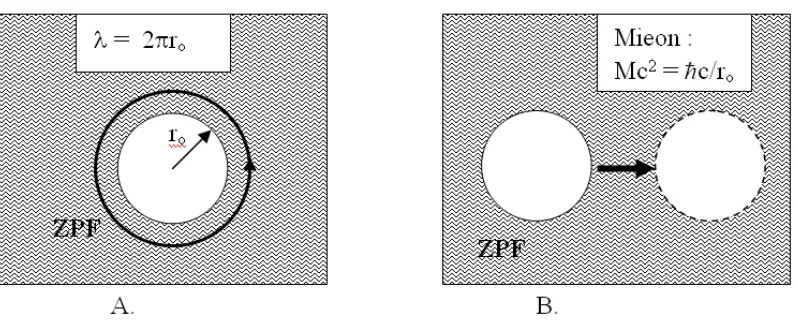
(41)where the measured mass is mη = 2985MeV, or with .7%. It is this scalar meson which appears to provide the pressure to hold together the hidden 5th dimension and carry the 5th force. It will be found that both the proton and electron, being stable charged particles, have a zero frequency electrostatic radius of ½ their classical radii, and that both of these give rise to short lived quantum mieon particles due to either Radion or QED interactions, from the proton we have the mieon of mass:
2
80.409
W p
m
=
m
σ
≅
GeV
(42)Whereas the measured value is mW (meas.) = 80.398GeV or with 1.3 parts per ten thousand. This is the lightest of the W Weak force bosons that carries the weak force. The QED first order mieon off the electron is the π meson, carrier of the strong force. This will be discussed in the next section in
more detail.
2
e/
140.05
m
π±=
m
α
=
MeV
(43) Where the measured value is mπ± (meas.) = 139.60MeV or within 0.3%. This suggests electron may be affected by the Strong Force. If so, this would manifest itself in anomalous energy shifts in K shell spectra in heavy atoms. Thus, the ratio of the two boson masses should be mW / mπ± = α σ 3 =574.3 versus the measured value of 574.2.The ηc (eta-c) meson is an important particle despite being unstable outside the neighborhood of the 5th dimension and so it is reasonable that it would have its own mieon. The next order mieon type particle associated with the 5th dimension would then be second-order mieon, corresponding:
127.69
H c
m
=
m
ησ
≅
GeV
(44)This is then the Higgs-Boson, which is a quantum that can be associated with the Radion or mass inducing field. It can also be considered as the “most general” excitation of hidden dimension size ro, involving both 4-dimensional paths and the 5th dimsnion at the same time. Thus, the 1st order interactions off the 5th dimension are the electron, proton, and eta-c meson, the 2nd order interactions off the 5th dimension are the π-meson, and the Z boson. The most generalized excitation, involving both “long way around” and “short-cut” in the 5th dimension is the Higgs-Boson. The pion and Z boson mediate the strong and weak force, and the Higgs-Boson may serve as the carrier of the Radion field in energy range near the 5th dimension.
This means the ratio of charged mieon bosons should be:
3
574.3 W
M
mπ± =σ α= (45) Where the measured value of this ratio of masses is 574.2, thus, the mieon model is highly accurate. Therefore, based on simple quantum models, we can derive the Strong and Weak nuclear force from concepts flowing from the GEM theory. However, much complexity has been neglected.
This particle could be expected to be charge-neutral like the mesoscale mass. However, it is now recognized that the GEM theory created a doorway to understanding with two short-range forces of nature the Weak and Strong nuclear forces, because in unifying gravity and EM in a geometric theory, it produced a geometric scale regime for nuclear particles and the regime for their interactions. The GEM theory produced the picture of EM forces not only between charged objects but also between uncharged structures that can be extended to include short-range nuclear forces.
2.1.
The Internal Color-Charge-Dynamics of the ProtonThe proton has inside its radius of approximately rc, three dynamic entities, quarks, as a reflection of the space-like structure is acquires when the 5th dimension split the vacuum spacetime interval. The quarks are inseparable, and cannot be seen in isolation. In the GEMS theory this is due to the fact that the proton is a three-dimensional object and cannot be made into something of lower dimensionality, just like a rubber ball can be squashed but not reduced to infinitesimal thickness, when released from pressure it rebounds to its normal spherical shape. What also occurs in the GEMS
theory is that the proton is isotropic and spherical and this means that the quarks are best modeled as chaotically mixed at all times. In the GEMS theory the proton is full of entropy.
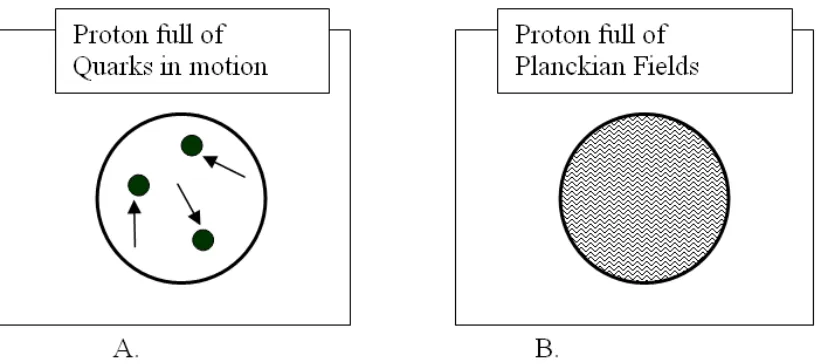
We can therefore model the proton, since we consider it full of chaotic EM fields as a spherical shell of radius rc full of Planckian radiation fields, one field for each of the 3 color charge fields (see Figure 3.). We will consider that the electric charge resides on the surface of the shell, which is full of neutral π mesons. We will consider the shell to be thin. We will assume an emissivity of close to one ε≅1.0 so the Black Body model will be valid. We will choose the temperature of the Planckian fields to be kT = mπc2 = 264mec2, the mass of the neutral pion. Black Body modes of longer wavelength than the radius of a spherical cavity are cut off, however, the wavelength of energy maximum for a Planckian distribution is approximately 1/5 that of λ = kT/(hc) =9.183 x 10⁻¹³ cm where h is the normal form of Planck’s constant. A cutoff of wavelengths longer than that corresponding to kT thus leaves approximately 96.6% of the energy in shorter wavelength modes intact, thus such a cutoff does not violate our Planckian assumption.
Figure 3. A. A model of the proton has having three rapidly and chaotically moving quarks. B. A model of the fields in the proton as being at maximum entropy, due to quark free motion, that is: Planckian.
Therefore, we will assume the proton is full of EM energy W in 3 Planckian modes or colors in a volume Vc of a sphere of radius rc:
=
6 34)
(
)
(
15
8
3
966
.
0
hc
kT
V
W
cπ
(46)Here the Planckian modes must be considered independent, so they simply add to each other. Using the fact that rc (mπoc2/hc) =1/6.518, we obtain approximately:
=
5 2 33)
2
.
264
(
45
16
966
.
0
6
o c e
r
c
m
W
π
λ
π
π
(47a)5 2 5 2
16 264.2
6 (0.966)
45 276.90
6 (1.03)
e
e
W m c
m c
π π
π
=
=
(47b)
2 e 5
c
m
6
W
≅≅≅≅
ππππ
(47c)independent Planckian fields of temperature corresponding to the rest energy of the neutral π meson. This means that entropy exists even in the subatomic scale.
2.2. Quarks and the Subdimensions of the 5th Dimension and the GEM-Strong Theory
Quarks in three colors appear naturally in the GEM theory. As was previously discussed the Kaluza-Klein fifth dimension can be considered to be a new dimension which can replace either time or space in a light-like interval, as was seen in Eq. 5a, b. The fifth-dimension then becomes a constrained image of either the time or space portion of spacetime and thus has four sub-dimensions. The electron corresponds to a “time-like” or scalar entity while the proton corresponds to a space-like component, having three sub-dimensions. We can minimize the volume of this three-space, given the two constraints of charge conservation and the conservation of mesoscale radius, defined in Eq. 5a,b, which is a constraint on the sum of the quark charges, and sum of the squares of quark charges. We have then the constrained relaxation of the system, in the form a Lagrange multiplier system:
2 2 2
1 2 3 1( 1 2 3) 2( 1 2 3)
q q q +λ q +q +q +λ q + +q q (48) Where we minimize the three-volume formed by the quark charges: q1q2q3, subject to the constraints that their total charge is that of the electron (in electron units)
1 2 3 1
q + +q q = (49) And the sum of their squares is also unitary, so the classical radius of the compound particle is that of an electron:
2 2 2 1 2 3 1
q +q +q = (50) We have then, upon varying the values of q1, q2, q3 respectively, the three equations:
1 2 2 1 3 2 0
q q + λq +λ = (51)
1 3 2 1 2 2 0
q q + λq +λ = (52)
3 2 2 1 1 2 0
q q + λq +λ = (53) which have the solutions:
1 2
1 2
3 9
λ = λ = − (54)
1 2 3
1 2
,
3 3
q = − q =q = (55)
This corresponds to the standard quark model, and the second solution is that of an electron with q1 =-1 and q2 and q3 =0. Thus in solving the problem of the structure of a 5th dimension, one finds that its 3-volume, upon being minimized, with constraints, yields the charges of the quark
system. Thus, the GEM theory is actually compatible with the standard model.
In the GEM theory, the splitting apart of the proton and electron is correlated to the splitting apart of the gravity and EM forces. In the Standard Model context, this means that baryon and lepton number: B and L respectively, are not conserved but their difference (B-L) is conserved and the non-conservation of B and L separately occurs at the Planck scale, where gravity and EM unify. The appearance of charge and mass at the subatomic scale occurs with the appearance and deployment of the 5th dimension, which slightly smaller than the EM cross-section of the electron. This means that, instead of subatomic particles being considered points, they must be treated as objects of definite size similar to the 5th dimension radius. This means that in the presence of the vacuum ZPF the structural sizes of the particles support resonances, and these resonances in-turn take on a quantum existence of their own.
In quantum electrodynamics, it is found that the sizes of various quantum objects can be understood as being created through orders of EM interaction. The Bohr radius of the hydrogen atom, and the Compton radius of the electron, for instance, can be found as the electron classical radius re =e2/mec2 for instance, can be found as the 1/α2, and 1/α respectively times the electron classical radius. However, the electrostatic radius for the electron is ½ the electron classical radius. This factor of ½ can be understood as the difference between monopole or “scalar” EM interactions, which cannot propagate farther than re and dipole “vector” EM waves which can propagate. This means the ratio of charged mieon bosons should be:
3
574.3 W
M
mπ± =σ α= (56) Where the measured value of this ratio of masses is 574.2, thus, the mieon model is highly accurate.
Therefore, based on simple quantum models, we can derive the Strong and Weak nuclear force from concepts flowing from the GEM theory. However, much complexity has been neglected.
2.3 Vacuum Decay, the Higgs Mass, and Sunyeaev_Zeldovich Effect
system, also leads to instability in the vacuum. It can be said that does lead to an explosion, the “Big Bang”, and the cosmos we observe is its result. However, in the GEM theory, after the Big Bang, the residual vacuum instability leads only to a “afterglow” or “benign vacuum decay” characterized by the appearance of proton-electron pairs out of the vacuum at a slow rate. This can be seen from the following analysis:
We will assume, in keeping with the Dirac Condition, that the universe is a critical gravitation condition with critical density of hydrogen, nc:
1
8
3
2
Ω
≅
=
H p c
T
Gm
n
π
(57)And also is in an “eternal inflation” or “steady state condition” such that an inflation field keeps allowing particles to pop out of the vacuum uniformly throughout the cosmos to maintain the critical density nc
1
3 Ω≅
=
H c
T n
nɺ (58)
We now assume a probability of a GEM photon being absorbed and re-emitted to affect a mass transition.
2
4 e
m Gm
PGEM o p e
πε
= (59)
We also define α as the probability of EM photon being absorbed and re-emitted by a particle of electric charge e. Then, be defining a Compton wavelength of mass mo : Żo = ℏ/(moc) we can define a quantum density fluctuation density, times the probability of a double mass transition and EM photon scattering:
2 4 2
4 GEM
e GEM
o
P
r
c
P
c
n
=
=
α
ασ
λ
α
ɺ
(60)This density fluctuation time is the density increase in space due to the GEM process of “vacuum decay” into hydrogen. By equating Eq. X and XI we can solve for the undetermined parameter of the Hubble Time.
1/3
4 2
10
9 1 1
8 4
1.2 10
e H
o p e r e T
Gm m c x yrs
π σα α
πε
=
≅
(61)
Let us assume that when the electron-proton pair is born they form an electric dipole radiator with the electron being the active radiator. We will assume the proton-electron pair is born in a zero-energy state, that it is born ionized but “cold”. We assume that the EM radiation emitted during this process is a black body spectrum emitted by the electron and the radiation pressure is just enough to overcome the electron self-gravity
2 2
e Th
R Gm
P
σ
≅ (62) Where PR is the radiation pressure and σTh is the Thompson electron cross section for low frequency EM wave scattering. We can estimate the temperature TR of the EM radiation field. This becomes the CBR ( Cosmic Background Radiation) temperature .4 3
4 R SB
R T
c
P =
σ
(63)K c
Gm T
Th SB
e
CBR 2.65
4
3 2 1/4
=
=
σ
σ
(64)Therefore, CBR is actually only partly due to the Big Bang but also due to vacuum decay that causes new proton-electron pairs to be emitted into the universe. Evidence for this this is seen in striking absence of the SZ (Sunyeav-Zelodvich) effect for galaxies of large red-shift 14. The SZ effect, the expected distortion of the CBR by dense plasmas in galaxies, disappears for galaxies for large red-shift 15 , as would be expected if the CBR was due to vacuum decay in the line-of –sight to the faraway galaxies. The CBR would exhibit the expected SZ effect for nearby galaxies, as is observed.. Therefore, evidence of GEM vacuum decay is present.
3. Conclusions
Therefore, the process of unification of the fields, whose most recent progress was the unification of the Weak and EM forces by Glashow, Weinberg and Salam16 , has been continued. An attempt to unify the Strong Weak and EM forces has been made, but failed because it rested on the supposed non-fundamental character of the proton, being composed of quarks, and predicted its instability17. However, this instability has not been observed, lending support to the GEM theory viewpoint: that the proton must be treated paradoxically as both an ensemble of quarks and also as a fundamental entity, like the electron.
In the GEM theory, the Higgs Boson, exists as a consequence of the existence of the 5th dimension of spacetime and draws its own mass from this length scale. The Higgs is the “most general “excitation of the hidden dimension size, being a scattering on all degrees of freedom simultaneously, both normal spacetime and the 5th dimension, giving a mass prediction of M higgs = σmo/α = 12* GeV , a mass prediction with 1.5% of the measured value of 126 GeV 8. This leads also to the important relation of ŻHiggs = rp , indicating the connection of the Higgs to the proton, the particle making up the known mass of the universe.