ISSN: 2231-5381
http://www.ijettjournal.org
Page 153
Importance of Teaching Innovation & Creativity
in Engineering and Management
Dr Asha Thakur1, Monika Shekhawat21Rashtrasant Tukadoji Maharaj Nagpur University, Faculty of Commerce
E-503 Shiv Heights Prithvirajnagar Beltarodi Road , Nagpur, India 440034
2
Rashtrasant Tukadoji Maharaj Nagpur University, Faculty of Commerce, Plot No 18 Printers Nagar II, Sitabari, Sanganer, Jaipur, India 302017
Abstract— In Technical education, there are many reasons for
motivating people to learn engineering, and management. Most of the technical universities are expected to provide opportunities that encourage and nurture creativity in engineering and management students. If education become enjoyable and adventuress then it can generate interest in the students and motivate them to stay back rather than burden and boredom. In this paper some of the main issues for teaching Innovation in engineering and management will be explored. This paper reviews the current purpose of teaching, teaching creativity, creative techniques and role of innovator that tend to foster knowledge in engineering and management students.
Keywords—collaboration, creativity, innovation, innovators,
creative thinking
INTRODUCTION
Teaching innovation means the process of coming up with new ideas, theories, collaboration and solutions that can be shared in the classroom. Reimers-Hild and King (2009) described components of innovation as fun, creative, diverse, collaborative, and perceptive. Innovation and creativity are two unified words. Creativity is an essential part of innovation. Teaching creativity means creative efforts done by the teacher to bring out the innovation in classroom. In the 21st Century Innovation has become an essential component for endurance and success. Globalization and the Rapid technological change in education sector have created a need for change in teaching style, which leads to continuous innovation. Good & Experienced engineering and Management faculties have come out from the traditional way of teaching and learning. They should be innovative in finding ways to enhance the knowledge and skills of the student community. The faculties should become catalyst. The time has come to redesign our education system to adjust to the global effects So Changes in teaching methodology is also one of the important factor which takes place quickly in education sector, due to changing requirements and aspirations of people. Teaching Innovation has become live approach for college teaching and professional teaching. Many institutions and colleges are Hiring People who are dedicated to Innovation for effective teaching but if they start training of Teaching Innovation for their faculties rather than experts outsourcing, and try to imbibe some creativity in them. .Technical education has a very definite purpose and hence requires more dedicated and expert teachers.
A. Purpose of engineering education
1) To prepare graduates for research
2) To prepare and train them for employment in engineering industry
3) To prepare engineering citizens for society
4) To update students according to the changing technology 1)
B. Purpose of Management education
1) To educate future managers
2) To prepare graduates employment in corporate world 3) To provide graduates the competitive edge in a competitive world
4) To develop technical expertise and business savvy quickly 5) To turn graduates into leaders in an emerging field 6) To develop students personality as a whole
According to above mentioned purposes innovation and creativity have become essential factor in teaching.
I. TEACHINGINNOVATION
A teacher tries the best way to impart knowledge among students so that they can use it & understand it. So, communication methods [6] that serve this purpose without losing the objective could be considered as innovative methods of teaching. The use of these methods in educational institutions not only improve education, but also empower people and galvanize the effort to achieve the human development goal for the nation. There are a number of ways that teachers can go around the system and offer students an innovative mindset. This study emphasizes basic element of innovative teaching [7] like innovative culture and effective teaching practices
A. Innovative Culture
Innovative culture refers to optimum collaboration between the teacher and environment.
Engineering and management Institutions are Integrating Innovation into their Cultures by adapting the following:
1) Placing a Priority on teaching Innovation in classroom
ISSN: 2231-5381
http://www.ijettjournal.org
Page 154
3) Establish Innovation Metrics and Reward Innovationfor faculties
4) Focus on overall Vitality and enthusiasm in teaching 5) Educating faculties about Creativity and Innovation
with teach-in aids
6) Designating a person at Top Level of the institute Dedicated to Innovation (ie: Chief Innovation officer) 7) Designing Workshops and Group Activities designed
to Stimulate Creativity and Innovation
8) Rewarding Most Creative person in the institute (Everyone in the institute should know)
9) Keeping an Innovation Journal
10) Holding Innovation Days, Jams & Contests (kind of a Science Fair for Innovation!)
11) Creating Web-based Innovation Programmes and Portals
12) Promote faculties to Spend time on research Activities
13) Actively Participating in Open Innovation (people at various levels of the institute should involved) 14) Freeing up Resources for New Innovations
B. Effective Teaching Practice
Different people have different perspectives of effective teaching. Effective teaching means optimum collaboration between the teacher and student. Effective teachers are those who accomplish the goals which they set for themselves and others.
Here are several approaches or techniques for effective teaching, both general and specific to certain fields.
1) Problem-Based Learning approach:
Problem based learning Overton [14] involves asking a question to a group of students who are provided with resources. It is widely used in management education. 2) Project-Based Learning approach: Project-based learning Graham [12] mostly used in engineering education it begins with an assignment given to the student to carry out a final product —a design, a model, a device or a computer simulation.
3) Student Centered Learning approach: it refers to provide opportunity to students to take control of their own learning. This approach helps the innovator to identify students learning goals and how they organize their learning. Sheffield Hallam University [15]
4) Active Learning approach: Active Learning Bonwell and Eison, [1] means students are involved in doing things and actively participating in the lecture room or laboratory during study or project work.
5) Co-operative Learning approach:
It refers to the student benefits of learning in collaboration with other students. Innovator poses a question after teaching a particular topic and gives all students a few minutes to consider their own answer. After whole discussion one Student formulates a joint answer which combines the best features of their individual solutions.
6) E-learning approach:
In this approach student uses a computer or mobile device to access learning materials and the teacher uses technology to help with the delivery of teaching.
7) Personal Development approach
PD classes encourage the students to reflect on their learning, their achievements and their career development goals with help of different techniques like self introduction, icebreakers, GD & mock interviews.
II. TEACHINGCREATIVITY
Teaching creativity is not the only required element for technocrats, but it is a great deal of creative effort to bring out the most creative thinking in the classrooms. Creative innovator creates an appropriate learning environment. Creative engineers and managers should be able to reengineer or reconstruct the available data and generate specific solution to scientific, engineering and social problems related to their field.
A. Stages of creativity
According to taylor creativity is perceived as a hierarchy from a low to progressive higher level [8]
Taylor’s hierarchy of creativity
Taylor’s hierarchy of creativity is often portrayed in the shape of a pyramid with the lowest, most fundamental levels of creativity at the bottom and the highest for emergent at the top Level 1: expressive creativity: Encourage students for unique idea
Level 2: technical creativity: Encourage students for creation of products with consummate skills
Level 3: Inventive creativity: Encourage students to develop new use of old things or new ways of uses
Level 4: innovative creativity: Encourage students to develop fundamental principles and thoughts
Level 5: emergent creativity: Encourage students to develop most realistic principles
Emerge nt creativit
Innovative creativity
Inventive creativity
Technical creativity
ISSN: 2231-5381
http://www.ijettjournal.org
Page 155
For Engineering and management students teacher shouldencourage them for setting the goal at level 5 low level to level 1 highest level so that they may be able to implement engineering and management principles and theories in realistic manner. Most basic level of creativity must be met before the individual strongly desires the secondary or higher level creativity.
B. Creative Techniques for Encouraging Innovation in the Classroom (Especially For Engineering & Management Student)
1) StatementBusting
Statement busting is an unquestioned, assumed truth. It is mainly effective when one person is fixed in current thinking paradigms or has run out of ideas. In this technique everyone makes assumptions about the world around us and with addressing previously unquestioned assumptions it stimulates creative thinking like Operations & production Management is a subject which cannot be taught without referring to practical examples from the industries.
How: Innovator instructs the students to write down List of all assumptions associated with a task, for example, Engineering student are able to design a car for handicap people that is impossible without thinking of all previous beliefs and assumption.
2) Brainstorming
It is a useful tool to expand creative solutions to a problem, Brainstorming can help define an issue, analyze a problem and possible solutions
How: Organize brainstorming sessions with students for example a brainstorming session with engineering and management students and topic is techno-savvy software and their managerial implication in 21st century.
3) Concept Mapping
It is a map about concept that represents knowledge in graphic form. It is based on Networks diagrams which consist of nods and links, which represent relationships between concepts. it is useful in generating ideas, designing complex structures and assess students’ understanding.
How: Novak, J. & Cañas, A. (2006) explains the theory underlying concept maps and how to construct and use them. Innovator should create a focus question in classroom specifying the issue map. List the key concepts that apply to the area of knowledge. Put the most general, concepts at the top of the list, and most specific at the bottom. Example: programme evaluation and review techniques are best example of concept map in engineering and management courses.
4) Role-playing
In role-playing exercises, each student takes the role of a person affected by an issue. It provides a platform to the students what they have learned and how they should correlate it with live situation.
How: Provide topics to the students and information or clear role descriptions so that students can play their roles with confidence. For example, in teaching accounting & cost management the role of accountant can be explained by this technique. Balance sheets and income statement can be given to students and asked them to assume the role. Here the real entries are made by the student. Similar kind of methods can be applied in engineering and science courses.
5) Storyboarding
It is a technique to compared students thoughts out on a wall as they work on a project or solve a problem. It can helpful for planning & ideas communications. Students learned from this method how one idea relates to another idea, and how synchronize them.
How: Use index cards of different topics or Post-it on a whiteboard. After completion of the project students should analyze all cards how they relate to another. Example: a project work on functions of management (POSDCORB)
6) Do It
Do it stands for Define problems, be Open to many possible alternatives, identify the best alternative and then transform it into effective action. This method calculates strengths and weakness of problem and analyze student’s problem solving ability.
HOW: provide specific topic to the students so that they enhance their creativity and problem solving ability. Example: case study method
7) Decision Tree
A decision tree is a image based and analytical decision support tool
Example: A decision tree used in finance and quantitative classes for deciding the better investment strategy or option.
8) Multimedia
In this technique innovator can use multimedia to communicate the subject material in effective way. There are many multimedia technologies like Adobe Photoshop, hyperlink, audio animation, video, MSpower point, window movie maker, flash slide show software etc. pictures, music, color, will help to recollect information for long time.
How: assign presentation to a group with help of different multimedia tool.
9) Z to A technique
This technique includes the application part of concept first [3]. It can help students understand how an expert categorizes concepts and their relationships.
ISSN: 2231-5381
http://www.ijettjournal.org
Page 156
later students would get interest in knowing what isrecruitment and selection. 10) Mnemmonics
In this technique teacher taught students only words as a replacement of sentence, and once they come to a basic understanding of the particular concept then the teacher will explain in sentences. These words called mnemonics or its associated meaning in words. Example: Microsoft has pioneer advantage to bring new window technology in the world first. Here pioneer is a mnemmonic word.
11) Case debates
This method can apply to the groups of students when more than one case will be discussed among group members. As this is an extension of common case discussion approach, and student found that they understood the anatomy of cases and gained deep managerial insights. Emerging issues from all cases will guide to develop analytical insights on the students. Example: Cases on capital punishment and life imprisonment will enlighten the importance of life among members who will discussed
12) Computer Simulations
This technique is useful for engineers as well as managers also. Innovator uses different computer aided methods (like CAD/CAM/LAN/operating system) related to different subjects and students are required to solve problem by using computer tool. for example: LAN/window games related to marketing, finance investment for management course and hardware/ software designing games for engineering course
13) Icebreaker
It is an activity that requires people to comfortably interact with each other. Innovator used it to warm up the conversation among participants in a class, or team building session, or other event.
HOW: for personality development of engineering and
management students generally used by training & placement department.
C. Interconnection
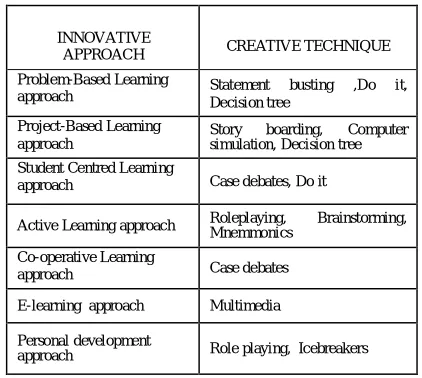
Table 1 Relationship between innovation & creativity
INNOVATIVE
APPROACH CREATIVE TECHNIQUE
Problem-Based Learning
approach Statement Decision tree busting ,Do it,
Project-Based Learning approach
Story boarding, Computer
simulation, Decision tree
Student Centred Learning
approach Case debates, Do it
Active Learning approach Roleplaying, Brainstorming,
Mnemmonics
Co-operative Learning
approach Case debates
E-learning approach Multimedia
Personal development
approach Role playing, Icebreakers
D. Role
Role of innovator to develop creative process in students 1) Unknown to known: innovator motivates the students for gathering information and uses them for new research 2) Risk taker: innovator provides the students opportunities in teaching time and remove their fear factor of failure
3) Stories of inventions: innovator incorporates theories with stories of inventors
4) Disappointment avoidance: innovator awares the students about great scientist who have face thousand of opposition in starting time.
5) Brainstorming sessions: innovator provides opportunities for new ideas
6) Role model: innovator develops a role model
integration of personal strength among students
7) Over- belief : innovator provides the students opportunities to evaluate their problem solving methods
III. CONCLUSION
In the new teaching standard, the role of innovator is more important than teachers. The concepts of communicating information in electronic form instead on pap er and less writing implemented in classroom are emerging learning methods for engineering education as well as management education. Nowadays role of the teacher is changing to innovator. This changing role of education is to be anticipated with the creative techniques in teaching and finally to generate technologically-savvy engineers and managers. So, teaching depends upon successful mode of communication and Innovation through innovator, but there must be some sort of creative techniques in teaching which can also be practiced to improve higher education.
ACKNOWLEDGMENT
I would first like to thank Dr. asha thakur for her knowledge and guidance throughout the writing of this paper.
REFERENCES
[1] Bonwell, C.C., and Eison, J.A., Active Learning: Creating
Excitement in the Classroom (1991).
[2] Pearson Mastering Engineering series (2010)
[3] J.P. Guilford, The Nature of Human Intelligence, McGraw-Hill,
New York (1967)
[4] J.R. Rossiter, and G.L. Lilien, New ‘brainstorming’ principles,
Aust. J. Management, 19, 1994, pp. 61-72
[5] Sweeney, Jill, O'Donoghue, T., Whitehead, C., Teaching in Higher
Education, 1470-1294, Volume 9, Issue 3, 2004, Pages 311 – 323
[6] D. Ramchandra Mane improving teaching efficiency by using
“activity tool” for mba students (innovative teaching methodology/ pedagogy) IARS, Vol. 3, No. 2, 2013
[7] Liu and Dieter J. Schonwetter. “Teaching Creativity in
engineering” international journal of Eng. Edu vol 20, No 5, pp 801-808, 2004
[8] S.J.E Christiano and M.R. Ramires, Creativity in the Classroom:
ISSN: 2231-5381
http://www.ijettjournal.org
Page 157
[9] Dr. Rajagopal, Innovative Teaching Practices in Management
Education, from (TES) organized by AACSB at Tampa, Florida, 2008
[10] McWilliam, E. (2009). Teaching for Creativity: From Sage to
Guide to Meddler. Asia Pacific Journal of Education, 29:(3), 281 – 293.
[11] Kwek, S.H. (2011). Innovation in the Classroom: Design Thinking
for 21st
century
[12] Graham,(2010)http://web.mit.edu/gordonelp/ukpjblwhitepaper201
0.pdf[accessed 6 April 2010]
[13] National Academy of Engineering (2009) What is Engineering and
what do engineers do?
http://www.nae.edu/15/FAQ/Whatisengineeringandwhatdoengineersdo.aspx
[14] Overton,T.L.(2005)
http:/www.heacademy.ac.uk/assets/ps/documents/primers/primers ps0087_problem_based_learning_2005.pdf
[15] Sheffield Hallam University; Centre for Excellence in Teaching
and Learning in Learner Autonomy: