ISSN: 2231-5381
http://www.ijettjournal.org
Page 298An Efficient and High Performance Based
Cooperative Communication in WSN
1Boyina Vinod ,2 Tatapudi Prabhakara Rao
1Final Year M.Tech Student,Dept. of CSE, Aditya Institute of Technology and Management(AITAM), Tekkali, Srikakulam,
Andhra Pradesh
2
Sr.Asst.Professor, Dept. of CSE, Aditya Institute of Technology and Management(AITAM), Tekkali, Srikakulam, Andhra Pradesh
Abstract: Cooperative communication over wireless sensor networks is a challenging task and an interesting research issue in recent trends of senor networks. Even though various approach available for cooperative communication, performance is always a main factor. In this paper we are proposing an efficient and empirical model of cache implementation with efficient routing mechanism through evolutionary approach. We are using the metrics of signal strength and channel capacity for communication cost, instead of simple node weights for accuracy and efficiency for transmission. Cache implementation improves the performance by retrieving previously accessed data packets instead of making an additional round trip.
Index terms: Cooperative communication, MANET, Evolutionary algorithm, signal strength, channel capacity
I. INTRODUCTION
Various electronic devices like i phones, Android phones, electronic books and other usage are rapidly increasing day by day. In the regular architecture these devices downloads the content from the content provider via communication service provider, cost involved can be paid by the end user or content provider [1][2].
In order to encourage the End-Consumers (EC) to cache previously downloaded content and to share it with other end-consumers, a peer-to-peer rebate mechanism is proposed [3]. This mechanism can serve as an incentive so that the end-consumers are enticed to participate in cooperative content caching in spite of the storage and energy costs. In order for cooperative caching to provide cost benefits, this peer-to-peer rebate must be dimensioned to be smaller than the content download cost paid to the CSP. This rebate should be factored in the content provider’s overall cost [4].
Due to their limited storage, mobile handheld devices are not expected to store all downloaded content for long. This means after downloading and using a purchased electronic content, a device may remove it from the storage. For example in Amazon Kindle clients (iPhone, iPad, etc.) an archive mode is available using which a user simply removes a book after reading it, although it remains archived as a purchased item in
Amazon’s cloud server. Under the above pricing and data storage model a key question for cooperative caching is: How to store contents in nodes such that the average content provisioning cost in the network is minimized.
Since its introduction, the Web has been constantly growing and so has the load on the Internet and Web servers. To overcome these obstacles, different techniques, like caching, have been introduced. Web caching has proven to be a valuable tool. Three features of Web caching make it attractive to all Web participants, including users, network managers, and content creators [Davison 2001]:
—Caching reduces network band width usage. —Caching reduces user-perceived delays. —Caching reduces loads on the origin server.
One central problem in Web caching is the cache replacement strategy. Cache takes place when the cache becomes full and old objects1 must be removed to make space for new ones.
II. RELATED WORK
Cooperative caching has been applied to different contexts, such as Web caches/proxies and file systems. These schemes can be categorized as hierarchical, Directory-based, and hash table-based approaches. Harvest [4] organizes Web caches hierarchically. A user's request is forwarded up the cache hierarchy until cache hits at some level. As a directory-based approach, Summary [5] keeps directory information of which cache has what content. When cache miss happens, the request is forwarded to the cache which contains the requested data potentially. For hash table based approach, in Squirrel [6], data items or their location information are cached on the correspondent home nodes, and the home nodes are assigned and located using distributed hash tables. Those schemes have been evaluated and demonstrated performance improvement for Web accessing. However, these schemes are designed for Internet caching, which generally considers the cooperation between dedicated cache servers with high speed network connections [7][8].
ISSN: 2231-5381
http://www.ijettjournal.org
Page 299 topology and inefficient multi-hop communications make itextremely difficult to maintain information for traditional structures [9].
In traditional approach of cache implementation data can be initially requested to server node or destination node, destination node forwards the data packets to proxy and then forwarded to requested node. If input node makes the same request again, it can be retrieved from the cache instead of requesting the server again. But disadvantage of the previous approach is, data only available to the node which made the initial request but not available to the all nodes. Simple cache not only improves the performance, efficient routing protocol can increase the performance along with cache [10].
To realize the optimal object placement under homogeneous object request model we propose the following Split Cache policy in which the available cache space in each device is divided into a duplicate segment (fraction) and a unique segment. In the first segment, nodes can store the most popular objects without worrying about the object duplication and in the second segment only unique objects are allowed to be stored [11]. The parameter _ in (0 …. 1) indicates the fraction of cache that is used for storing duplicated objects. With the Split Cache replacement policy, soon after an object is downloaded from the CP’s server, it is categorized as a unique object as
there is only one copy of this object in the network. Also, when a node downloads an object from another SWNET node, that object is categorized as a duplicated object as there are now at least two copies of that object in the network [12].
III. PROPOSED WORK
In this proposed architecture we introduced an evolutionary algorithm for optimal cooperative communication between the nodes with the parameters channel capacity and signal strength and cache implementation for accessing the previously accessed or transmitted data, it leads to the communication cost between the nodes, here genetic algorithm finds the optimal communication cost by applying the process of optimal chromosome or path selection and mutation operators between the nodes, after the mutation again calculate the communication cost between the source and destination nodes followed by relay nodes
In node communication establishment module we construct a general node to node communication through the socket programming, Every node can communicate with each other .data packet can be transmitted from source node to destination node, each node acts as server, it can accept the any connection and receives the data packets from any other node and transmits the data packets to other node.
Figure1: Node construction
Evolutionary algorithm:
Genetic Algorithm is an evolutionary algorithm uses genetic operator to generate the offspring of the existing population. This section describes three operators of Genetic Algorithms that were used in GA algorithm: selection, crossover and mutation.
Selection: The selection operator chooses a chromosome in the current population according to the fitness function and
copies it without changes into the new population.GA algorithm used route wheel selection where the fittest members of each generation are more chance to select.
Crossover: The crossover operator, according to a certain probability, produces two new chromosomes from two selected chromosomes by swapping segments of genes GA.
Node6 Node1
Node3
Node4 Node2
ISSN: 2231-5381
http://www.ijettjournal.org
Page 300 Mutation:Mutation operations swaps genes or nodes within the chromosome or path and computes fitness function, if the fitness value is optimal than the previous solution then it can be treated as optimal solution. Evolutionary algorithm for efficient cooperative communication over nodes in MANET with the parameters channel capacity and signal
strength, it leads to the communication cost between the nodes, here genetic algorithm finds the optimal communication cost by applying the process of optimal chromosome or path selection and mutation operators between the nodes, after the mutation again calculate the communication cost between the source and destination nodes followed by relay nodes.
Fig 2 : Architecture
Cache Implementation
Time complexity and response time are prime factors while implementation of protocols in wireless sensor networks, because accuracy and speed are important even though protocol is efficient in terms of performance.
Cache maintains frequently or previously accessed information for future purpose. It ultimately reduces round trip, response time for requested node, instead of making a new request to destination node.
The above figure shows complete architecture of the proposed work, Source node makes the request to the centralized server through cache if data not available in cache. Centralized server computes the optimal path by computing optimal cost and transfers the data packets through the path. If requested data packet available at cache, no need to connect to centralized server.
Empirical cost computation
During the cooperative communication between the nodes, nodes communicate with each other with optimal path, which is generated by evolutionary approach, when a node transmits the data to receiver request made to evolutionary processing module for path computation and it computes all the paths between the sources to destination and selects the optimal path and transmits the data.
Communication cost = Signal strength + channel capacity
Obtains the optimal path which has the best communication cost and transmits the data over the path. Step1: Initially Source node selects the destination to transmit data packets
Step2: Request received by the processing module and generates the paths in topology.
Step3: The Processing module computes the path with their signal strength and channel capacity
Step4: Compute communication cost with signal strength and channel capacity for fitness
Source Node Centralized
Server Destination Node
Cache
IntermediateNode 2.
Request
3. Compute Path
4. Forward Request
5. Data Packets
6. Data Packets 7. Forward
data Packets 8. Same
Request 9.
Response
ISSN: 2231-5381
http://www.ijettjournal.org
Page 301 Step5: select optimal path (optimal communication cost)and transmits the data.
Experimental Analysis:
For experimental analysis we implemented our proposed mechanism in Java platform with some static number of nodes, communicates through socket programming. Every node initially makes a request for optimal path in terms of signal strength and channel capacity for cost computation as follows
Communication cost=Signal strength + channel capacity
Parameter Description
dBme Estimated received signal strength -113 Minimum received power
-40 Average path loss factor per decile r Distance node - cell tower
R Mean radius of the node
Channel capacity is
[bits/s],
Where is the received signal-to-noise ratio
(SNR).
Let us consider some A, B,C,D,E and F are communicated through programming as multi user network programming, every individual individually maintains their signal strength and channel capacity ,whenever a node tries to transmit data packet initially it computes optimal path in terms of signal strength and channel capacity
Consider an example of nodes A,B,C,D,E,F and if a node(gene) ’A’ wants to transfer the data to the receiver ’F’ , The processing module computes the all the
available paths from source to destination and applies the fitness function and obtains the optimal path and transmits the data over that path, the following Evolutionary approach as shown below
Path1: ABCDEF
Path2: ABEDCF
Path3: AEDCBF
Path4: ACDBEF
Now compute the fitness value based on the signal strength and channel capacity as communication cost and Obtains the optimal path which has the best communication cost and transmits the data over the path. Let us consider random values of signal strength and channel capacities of B,E and C are 0.4,0.6,0.3,0.5,0.4,0.9 respectively, now communication cost as follows
Path1 Comm. Cost = 0.4+0.6=1
Path2 Comm. Cost= 0.3+0.5=0.8
Path3 Comm. Cost= 0.4+0.9=1.3
By the following computation, now the sub path as A,C because C has maximum communication cost then continue process until it reaches destination node.
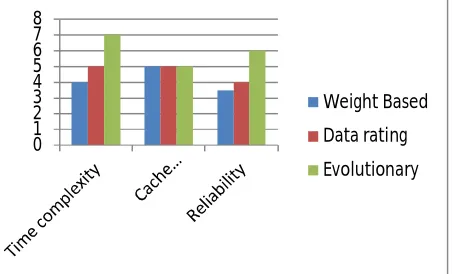
Our experimental results shows efficient results than the traditional approaches in terms of route computation and cache implementation, we compared the paths and time complexity generated by various factors like weight computation, data rating computation and our proposed approaches, Our proposed results shows efficient results than the previous approaches as follows
Fig 3: Comparative analysis
0 1 2 3 4 5 6 7 8
Weight Based
Data rating
ISSN: 2231-5381
http://www.ijettjournal.org
Page 302 Time complexity reduced than the traditionalapproaches, rate of success rate is more and cache improves the performance by reducing response time.
IV. CONCLUSION
Finally we are concluding our research work with efficient cache implementation and evolutionary routing protocol based on signal strength and channel capacity for calculation of communication cost. Our primary factors give optimal performance than the traditional weight based approaches an cache improves the performance by reducing the response time of the requested node.
REFERENCES
[1] distributed cooperative caching in social wireless networks . mahmoud taghizadeh, kristopher micinski, charles ofria, eric torng, and subirbiswas.
[2] improving on-demand data access efficiency in manets with cooperative caching by yu du.
[3] a survey of web cache replacement strategies stefan podlipnig and laszlo bo¨ szo¨ rmenyi.
[4] a. chankhunthod and p. b. danzig and c. neerdaels and m. f. schwartz and k.j. worrell, \a hierarchical internet object cache," in usenix annual technical conference, 1996.
98
[5] l. fan and p. cao and j. almeida and a. z. broder, \summary cache: a scalable wide-area web cache sharing protocol," ieee/acm transactions on networking, vol. 8, no. 3, pp. 281{293, 2000.
[6] s. iyer and a. rowstron and p. druschel, \squirrel: a decentralized peer-to-peer web cache," in podc, 2002.
[7] s. podlipnig and l. boszormenyi, “a survey of web cache replacement strategies,” acm computing surveys, vol. 35, pp. 374-398, 2003. [8] a. chaintreau, p. hui, j. crowcroft, c. diot, r. gass, and j. scott,“impact of human mobility on opportunistic forwarding algorithms,” ieee trans. mobile computing, vol. 6, no. 6,pp. 606-620, june 2007.
[9] “bu-web-client - six months of web client traces,” http://www.cs.bu.edu/techreports/1999-011-usertrace-98.gz, 2012. [10] a. wolman, m. voelker, a. karlin, and h. levy, “on the scale and performance of cooperative web caching,” proc. 17th acm symp. operating systems principles, pp. 16-31, 1999.
[11] s. dykes and k. robbins, “a viability analysis of cooperative proxy caching,” proc. ieee infocom, 2001.
[12] m. korupolu and m. dahlin, “coordinated placement and replacement for large-scale distributed caches,” ieee trans. knowledge and data eng., vol. 14, no. 6, pp. 1317-1329, nov. 2002.
BIOGRAPHIES
Boyina Vinod completed B.Tech degree in
Information Technology
from Sarada Institute Of Science
Technology And Management(SISTAM) and He is pursuing M.Tech degree in the Department of Computer Science and Engineering, from Aditya Institute of Technology And Management (AITAM), Tekkali, A.P, and India. His Interested areas are Computer Networks and Mobile computing.