DOI: 10.14738/abr.72.6201.
Witjaksana, B., Ratnawati, T., & Abdul Rahim, M. (2019).Activity Based Management Change Order Model-Based Economic Value Added Through The Effectiveness And Efficiency To Improve The Financial Performance Of Building Construction Projects In Surabaya City. Archives of Business Research, 7(2), 153-170.
Activity Based Management Change Order Model-Based
Economic Value Added Through The Effectiveness And
Efficiency To Improve The Financial Performance Of Building
Construction Projects In Surabaya City
Budi Witjaksana
Doctoral student, Faculty of Economics,
17 AGUSTUS 1945 Surabaya University, Surabaya, Indonesia
Tri Ratnawati
Lecturer of Accounting Department, Faculty of Economics, 17 AGUSTUS 1945 Surabaya University, Surabaya, Indonesia
Muslimin Abdul Rahim
Lecturer of the Industrial Engineering Department, Industrial Engineering, 17 AGUSTUS 1945 Surabaya University, Surabaya, Indonesia
ABSTRACT
The purpose of this study to determine the effect of Activity-Based Management Change Order (ABMCO) and Economic Value Added (EVA), to the effectiveness and efficiency of building construction projects. To know the impact of efficacy and to the performance of doing construction project; to see the impact of EVA on the performance of doing construction project; as well as to determine the influence of ABMCO affect the EVA building construction project. This research approach uses quantitative and qualitative approaches commonly called Mixed Methode. The population in this study is the Contractor registered in the Construction Services Development Board of Indonesia (LPJK) of Surabaya as much as 121 contractors. The method of sample selection in this study using a non-probability sampling method with a purposive sampling technique. The criteria used in this study are (1) Have K1-K3 Classification; (2) The maximum number of project work during 2016 is 2.5 Billion; and (3) Minimum 1 (one) time to work on the project in 2016. The sample used in this research is 93 (ninety-three) contractors. The analysis technique chosen to analyze the data and test the hypothesis in this research is The Structural Equation Model (SEM) with a Partial Least Square (PLS) software. The result of this research can conclude that the Activity Based Management Change Order variable (ABMCO) and Economic Value Added (EVA) have a significant effect on the effectiveness and efficiency of building construction project while the Activity-Based Management Change Order (ABMCO) variable has no significant impact on construction project performance. Effectiveness significantly influence the performance of building construction projects; Efficiency has no significant effect on the performance of building construction projects, and Economic Value Added (EVA) variables significantly influence the performance of doing construction projects and Activity-Based Management Change Order (ABMCO) variables significantly affect Economic Value Added (EVA).
Keywords: Activity-Based Management Change Order (ABMCO), Economic Value Added (EVA), Effectiveness, Efficiency, Construction Project Performance
INTRODUCTION
does not increase profit and improve value-added activity resulting in a decrease in costs. The purpose of this research is to know the influence of Activity-Based Management Change Order (ABMCO) and Economic Value Added (EVA) of the effectiveness and efficiency of the project of construction of the building. To find out the efficacy and influence against the performance of construction projects building; to know the importance of the Economic Value Added (EVA) against the performance of construction projects building; as well as to know the impact of the ABMCO effect [1]; The company's performance mostly measured by analysis based on the financial ratio for a specific period. This type of measurement is highly dependent upon the accounting methods used in preparing the financial statement. Therefore a company's performance often looks good and improving over time, but in reality, its performance is deteriorating.
criteria, i.e., cost, time, quality, performance or safety. The methods used to achieve these criteria are outlined in a table with the most critical factors to be employed. The chapter also discusses essential indicators of performance, which can be essential milestones, reporting points or performance or payment targets. [5].
LITERATURE REVIEW Construction
The construction defined as the order/arrangement of the building elements whose position each part by its function. About construction, which envisaged are high rise buildings, bridges, dams, dams, highways, irrigation buildings, airstrips and others ([6]. Project-success criteria can vary depending on the emphasis placed on the main project criteria, i.e., cost, time, quality, performance or safety. The methods used to achieve these criteria are outlined in a table with the most important factors to be employed. [5].
Activity Based Management Change Order (ABMCO)
Activity Based Management Change Order (ABMCO) is a concept to know that if the company uses its resources, then the company must first understand the activities that occur within the company, the activities that consume resources through identification of cost drivers or cost drivers. Activity Based Management Change Order (ABMCO) is an integrated and comprehensive approach that keeps the attention of management centered on the activities undertaken with the aim of increasing the value of the customer and the profits earned by giving that value, that the Activity Based Management Change Order (ABMCO) model has two dimensions, namely the cost dimension and process dimension. [1].
Economic Value Added (EVA)
the theoretical basis of the concept, forms of application and possibilities of application in practice. The gathered data and the transformation of this data from the form provided by the accounting into the desired patterns, respectively into the structures of Economic Value Added plays a key role in these processes. This paper aims to present one of the possible methods of calculating the EVA indicator in conditions of Slovak companies and accounting legislation in Slovakia. Primary data, as well as secondary data, were used for this paper, along with various methods such as analysis, synthesis, deduction, etc. [9]
Change Order
thought farthest from an owner's mind when their project is being advertised to bid, careful bid preparation, follow-through documents, and preservation and retention of appropriate records are important for an endeavor as complex as a construction project. An owner and his or her design consultants must prepare succinct, detailed documents all along the path from soliciting bids through bid acceptance and on to preconstruction, construction, and post-construction, not anticipating any serious problems along the way but prepared to deal with them if and when they occur.[13]
Project Performance
The construction industry is generally considered to have underperformed compared to other industries. Not only that, the UK construction industry has been criticized for not performing at the same level as that of other developed countries. About this, the UK working groups on Key Performance Indicators (KPIs) have identified ten parameters for benchmarking projects, to achieve a good performance, in response to Egan's report. These consist of seven project performance indicators, namely: construction cost, construction time, cost predictability, time predictability, defects, client satisfaction with the product and client satisfaction with the service; and three company performance indicators, namely: safety, profitability, and productivity. Most of these indicators can regarded as having results orientation, except for predictability of design cost and time, and predictability of construction cost and time, which can regarded as procurement orientated, and safety, which can be regarded as process orientated. It is the contention* of this paper that successful construction project performance can divide along three orientations: procurement, process, and result orientations. Also, although these indicators provide a generic framework criterion for successful construction project performance, this current paper will provide a review of measurements developed to assess project performance and propose a model that will help to identify the performance of the stakeholders involved in a construction project [14].
The question of whether success can measured and the purpose of it discussed. In any discussion on progress, it is essential that a distinction is made between project success and the success of the project management effort, bearing in mind that good project management can contribute towards project success but is unlikely to be able to prevent failure. The most appropriate criteria for success are the project objectives. The degree to which these objectives can met determines the success or failure of a project. The rules for the success of the project management effort tends to be restricted to cost, time and quality/performance. When measuring project success, one must consider the objectives of all stakeholders throughout the project life cycle and at all levels in the management hierarchy. Therefore, to believe that, with such a multitude of purposes, one can objectively measure the success of a project is somewhat an illusion[15].
Project sponsorship: providing the direct link between the executive and the project or program manager, focused on the whole project lifecycle; (3) Project Management Office (PMO): providing oversight and strategic reporting capabilities; (4) projects and program support: the active support and management of projects and programs are the measures of an effective governance system. The purpose of the framework described in this paper is to guide organizations in the development of effective project governance to optimize the management of projects.[16]
RESEARCH METHOD Research Approach
This research approach uses quantitative and qualitative approaches commonly called the Mixed Method. According to the opinion [17] states that the method of research combination (Mixed Method) is a research method that combines or combine quantitative methods with qualitative methods to be used jointly in a research activity, so that obtained data more comprehensive, valid, reliable and objective. The purpose of the Mixed Methods is to identify the concept component (sub concept) through quantitative data analysis and then collect qualitative data to expand the available information [17].
Population and Sample
The community can defined as a generalization region consisting of objects or subjects that have a certain quantity and characteristics set by the researchers to be studied and then drawn conclusions [18]. The population in this study is the Contractor registered in the Construction Services Development Board of Indonesia (LPJK) Surabaya as much as 121 contractors. The sample is part of the number and characteristics possessed by the population [18]. The method of sample selection in this study using a non-probability sampling method with a purposive sampling technique is the technique of determining the sample with specific considerations [18]. The criteria used in this study are:
1) Has K1-K3 Classification
2) Total project work for 2016 max 2.5 Billion. 3) Minimum 1 time is working on a project in 2016.
To calculate the number of samples to be used, Slovin formula according to (Sekaran & Bougie, 2014), are :
n =
2
1 Ne N + Information:
N = Total Population n = Number of Samples e = Percent of inaccuracy 5%
n =
)) 05 , 0 ( 121 ( 1
121 2 +
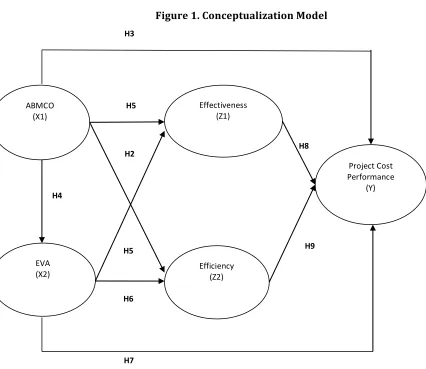
H5
H2
H5
H6 H3
H8
H9
H7 H4
ABMCO (X1)
EVA (X2)
Effectiveness (Z1)
Efficiency (Z2)
Project Cost Performance
(Y) Model Conceptualization
Figure 1. Conceptualization Model
Unit of Analysis
The unit of analysis is the smallest unit of the research object, desired by the researcher as a classification of data collection (Sujoko Efferin .2004). There are various units of analysis; the researcher should be able to determine the unit of study that best suits his needs. While the Unit of data analysis in this research is using an informant, while the informant in this research is:
1) Chairman of Gapensi 2) Contractor Association 3) Senior Contractor
Research Instruments
In qualitative research, the instrument or research tool is the researcher himself (Kuncoro, M. 2003). The device used in this study is an interview guide based on construction project management. Interview guides are used to find out what steps are being used to improve the performance of building construction projects, which include:
1) Workers must maintain balance in the project environment.
2) Maximize resources including labor, materials, and equipment. Before building the project, workers must collect a certain amount of resources needed.
3) Determine what goals to follow and plans to cover including cost & budgeting, task scheduling, opportunities and performance of workers.
RESULTS AND DISCUSSION Description of Research Results
Descriptive Analysis of Respondents' Answer
Description of respondent's answers obtained from the magnitude of the mean class interval, using a scale range, so it can be known where the average rating of respondents to each variable in question. An example of the scope of the mean scale shown as follows:
Class interval = Highest Value – Lowest Value Number of Class
= 5 – 1 = 0,8 5
With the result of the class interval 0.8, it can be concluded the average criteria of respondents' answers are:
1.00 - <1.80 = Never 1.81 - <2.60 = Rarely 2.61 - <3.40 = Sometimes 3.41 - <4.20 = Often 4.21 - <5.00 = Very often
The mean scale is used to assess the answers to questions in the questionnaire. As explained in the operational definition of variables in this study include Activity-Based Management Change Order (ABMCO) (X1), Economic Value Added (EVA) (X2), Effectiveness (Z1), Efficiency (Z2), and Project Performance (Y) following :
Descriptive Analysis of Variable Activity-Based Management Change Order (ABMCO). As explained in the definition of Activity-Based Management Change Order (ABMCO) which is one independent variable with two statements shown in table 1.
Table 1. Respondents Response Results Against Activity-Based Management Change Order Variables (ABMCO) (X1)
No Statement of Mean
1 Provide cost information on resources, activities, products, and customers on the project 3.17 2 Provide information about what activities undertook in the project 3.70 Overall Mean Variable Activity-Based Management Change Order (ABMCO) (X1) 3.44
Based on table 1 above can be concluded that the variable Activity-Based Management Change Order (ABMCO) (X1) has the highest average value of 3.70 contained in the statement "Provide information about what activities undertook in the project." While the overall Activity Based, Management Change Order (ABMCO) (X1) variable has an average value of 3.44. Descriptive Analysis of Variable Economic Value Added (EVA) (X2). As explained in the definition of Economic Value Added (EVA) (X2) which is one independent variable with two statements shown in table 2 as follows:
Table 2. Respondents Response Results Against Variable Economic Value Added (EVA) (X2)
No Statement of Mean
1 Able to meet all operating costs and capital costs 3.64
2 Reduction of capital expenditures from optimal net operating profit 4.19
Based on Table 2, it shows that the Economic Value Added (EVA) (X2) variable has the highest average value of 4.19 in the 2nd statement which reads "Reduction of capital cost from optimal net operating profit," which means the respondent gives an assessment "Often." Whereas in general the statement of the Economic Value Added (EVA) (X2) variable gets the overall average value of 93 respondents of 3.92, which means the respondent gives a "Frequent" rating in class interval 3.41 - <4.20. Descriptive Analysis of Effectiveness Variables (Z1). As explained in the definition of Effectiveness (Z1) which is one independent variable with eight statements shown in table 3 as follows:
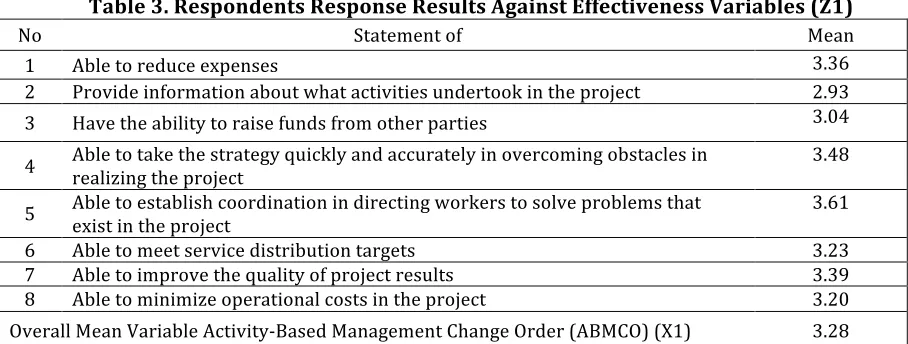
Table 3. Respondents Response Results Against Effectiveness Variables (Z1)
No Statement of Mean
1 Able to reduce expenses 3.36
2 Provide information about what activities undertook in the project 2.93
3 Have the ability to raise funds from other parties 3.04
4 Able to take the strategy quickly and accurately in overcoming obstacles in realizing the project 3.48
5 Able to establish coordination in directing workers to solve problems that exist in the project 3.61
6 Able to meet service distribution targets 3.23
7 Able to improve the quality of project results 3.39
8 Able to minimize operational costs in the project 3.20
Overall Mean Variable Activity-Based Management Change Order (ABMCO) (X1) 3.28
Based on Table 3, it shows that the Respondent Response variable on the Effectiveness Variable (Z1) has the highest average value that is equal to 3.61 in the 5th statement which reads "Able to form coordination in directing workers to solve problems that exist in the project", which means respondents gave the assessment "Often". Whereas in general the variable Effectiveness (Z1) statements got an overall average value of 93 respondents of 3.28, which means the respondent gave a "Sometimes" rating in the 2.61 - 3.40 class interval. Descriptive Analysis of Efficiency Variables (Z2). As explained in the definition of Efficiency (Z2) which is one independent variable with three statements shown in table 4 as follows:
Table 4. Respondents Response Results Against Variable Efficiency (Z2)
No Statement of Mean
1 The project is run to save the use of resources in the activities of the organization 3.66
2 Projects with low cost but with a fixed expectation 3.27
3 The project is capable of producing maximum output 3.60
Overall Mean Variable Efficiency (Z2) 3.51
Table 5. Respondents Response Results Against Project Financial Performance Variables (Y)
No Statement of Mean
Project Cost
1 Ability to control the budget for project implementation costs 3.64 2 Labor payments and project operations incurred during the duration of the project 4.19 3 Quickly detect changes and cost deviations in project implementation 3.73
4 Project cost as per contract documents and agreement 3.68
Project Time
5 Conformity of the project to the work schedule of contract documents, agreement 3.79
6 The project does not deviate schedule 3.36
7 Implementation of the project by the scheduled performance index 2.93 Project Quality
8 There is no penalty, complaint or claim on the quality of the project work 3.04 9 All parties involved in project implementation are satisfied 3.48 10 The quality of the project as per the contract of technical specification, agreement 3.61
Overall Mean Variable Project Financial Performance (Y) 3.55
Based on Table 5, it shows that in Project Performance (Y) variables the majority of respondents stated "Labor payments and project operations issued during project duration," which
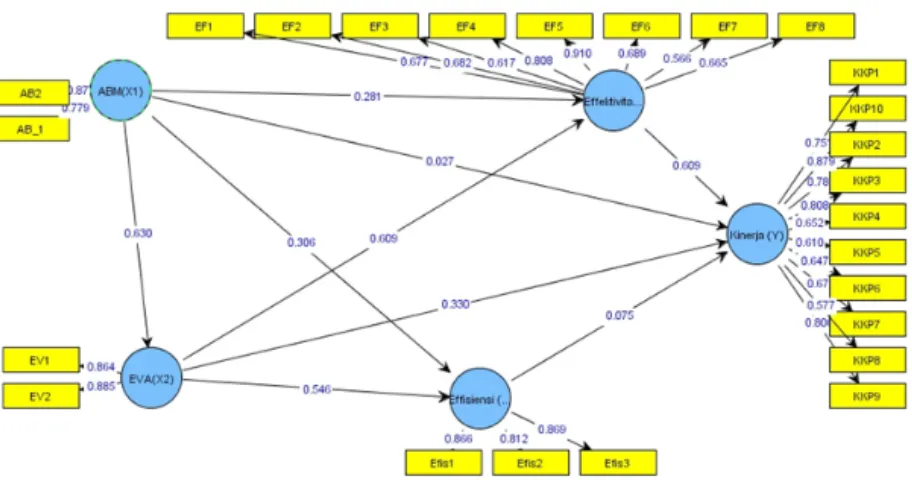
Figure 2. PLS Research Model
Has the highest average value of 4.19, which means respondents provide "Often" ratings. Whereas in general, the statement of Project Financial Performance (Y) variables got an average score of respondents of 3.55, which means respondents gave a "Frequent" rating in class intervals of 3.41 - <4.20.
Inner Model Test or Structural Model Test
This test is used to evaluate the relationship between latent constructs as hypothesized in the study, based on the PLS output, the following images obtained:
Hypothesis testing
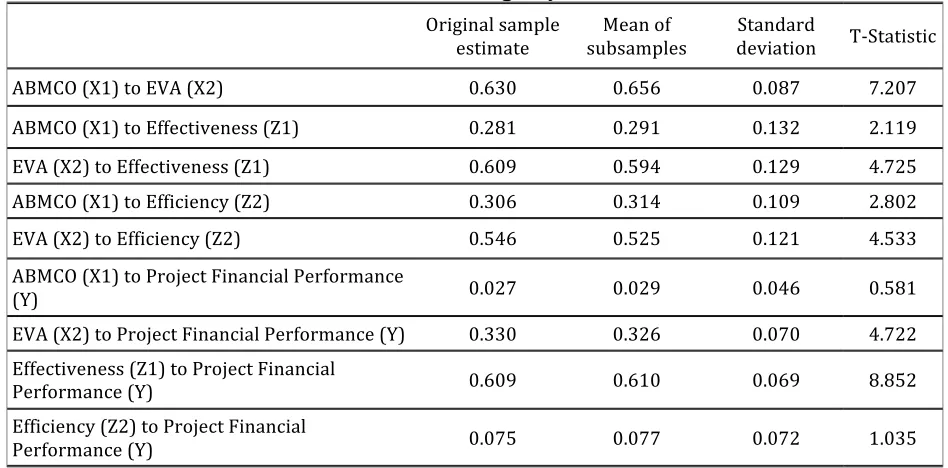
To answer the research hypothesis can be seen t-statistic in Table 6 below:
Table 6. Interagency Tables
Original sample estimate subsamples Mean of deviation Standard T-Statistic
ABMCO (X1) to EVA (X2) 0.630 0.656 0.087 7.207
ABMCO (X1) to Effectiveness (Z1) 0.281 0.291 0.132 2.119
EVA (X2) to Effectiveness (Z1) 0.609 0.594 0.129 4.725
ABMCO (X1) to Efficiency (Z2) 0.306 0.314 0.109 2.802
EVA (X2) to Efficiency (Z2) 0.546 0.525 0.121 4.533
ABMCO (X1) to Project Financial Performance
(Y) 0.027 0.029 0.046 0.581
EVA (X2) to Project Financial Performance (Y) 0.330 0.326 0.070 4.722 Effectiveness (Z1) to Project Financial
Performance (Y) 0.609 0.610 0.069 8.852
Efficiency (Z2) to Project Financial
Performance (Y) 0.075 0.077 0.072 1.035
The test results show that:
1) First Hypothesis
H1: ABMCO affects the effectiveness of building construction projects
Figure 3. The first hypothesis
The first hypothesis in the research proved the truth because the results of data analysis showed that the value of t is 2.119 which means higher than 1.96, so it can said that ABMCO has a significant positive effect on the effectiveness with a big influence of 0.281.
2) Second Hypothesis
o H2: ABMCO affects the effectiveness of building construction projects
Figure 4. The second hypothesis
The second hypothesis in the research proved correct because the results of data analysis show that the value of t is 2.802 which means higher than 1.96, so it can be said that ABMCO has a significant positive effect on Efficiency with a big influence of 0.306.
3) Third Hypothesis
Figure 5. The third hypothesis
The third hypothesis in the research proved correct because the results of data analysis showed that the value of t is 4.725 which means higher than 1.96, so it can said that EVA has a significant positive effect on the effectiveness with a big influence of 0.609.
4) Fourth Hypothesis
H4: EVA affects the efficiency of building construction projects
Figure 6. Fourth Hypothesis
The fourth hypothesis in the research proved correct because the results of data analysis showed that the value of t equal to 4,533 which means higher than 1.96, so it can say that EVA has a significant positive effect on Efficiency by having a big influence of 0.546.
5) The Fifth Hypothesis
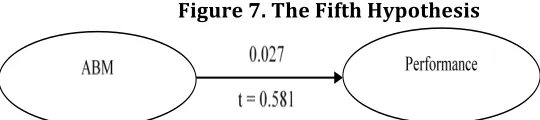
H5: ABMCO affects the Project Financial Performance of building construction projects
Figure 7. The Fifth Hypothesis
The fifth hypothesis in the study is not proven, because the result of data analysis shows that the value of t is 0.581 which means smaller than 1.96, so it can be said that ABMCO has no significant influence on Project Financial Performance.
6) The Sixth Hypothesis
H6: Effectiveness affects Project Financial Performance of building construction projects
Figure 8. The Sixth Hypothesis
has a significant positive effect on Project Financial Performance with considerable influence of 0.609.
7) The Seventh Hypothesis
H7: Efficiency affects the Project Financial Performance of building construction projects
Figure 9. The Seventh Hypothesis
The seventh hypothesis in the research is not proven right, because the result of data analysis shows that the value of t is 1.035 which means smaller than 1.96, so it can said that Efficiency has no significant influence on Project Financial Performance.
8) The Eighth Hypothesis
H8: EVA affect the Project Financial Performance of building construction projects
Figure 10. The Eighth Hypothesis
The eighth hypothesis in the research proved to be true because the results of data analysis showed that the value of t is 4.722 which means higher than 1.96, so it can said that EVA has a significant influence on Project Financial Performance with a big power of 0.330.
9) The Ninth Hypothesis
H9: ABMCO affects EVA building construction project
Figure 11. The Ninth Hypothesis
The ninth hypothesis in the research proved correct because the results of data analysis showed that the value of t 7207 which means higher than 1.96, so it can say that ABMCO has a significant influence on EVA with a big power of 0.630.
Structural Model Testing (Inner model)
Q2 = 1 – [(1 – R1)*(1 – R2)*(1 – R3)*(1 – R4)]
= 1 – [(1 – 0.397)*(1 – 0.665)*(1 – 0.603)*(1 – 0.950)]
= 1 – [(0.603)*(0.335)*(0.397)*(0.050)]
= 1 - [0.004101]
= 0.996
indicates that the "good" model, R2 of 0.33 indicates that the "moderate" model, R2 of 0.19 indicates that the model is "weak" (Ghozali, 2012). The PLS output as described below:
Table 7: R-square value
Construct R-square
ABMCO (X1)
EVA (X2) 0.397
Effectiveness (Z1) 0.665
Efficiency (Z2) 0.603
Project Financial Performance (Y) 0.950
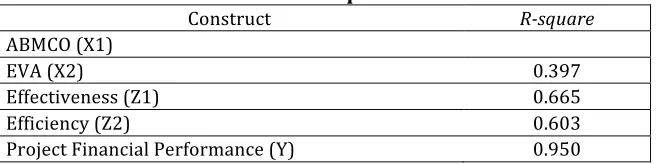
For latent variables, ABMCO affecting EVA variable has value R2 equal to 0,397 indicating that model "Moderate." Variable ABMCO and EVA influence variable Effectiveness have value R2 equal to 0.665 indicating "Good" model, also ABMCO variable, EVA, Efficiency and Project performance affects the Efficiency variable having R2 value of 0.603 indicating "Good" model, while ABMCO, EVA and Efficiency affect the Efficiency variable in structural model has R2 value equal to 0.603 indicating that model "Moderate".
The suitability of the structural model can be seen from Q2, as follows:
Figure 12. The structural model can seen from Q2
CONCLUSION
Relationship Activity-Based Management Change Order (ABMCO) with Effectiveness
Based on the results of the study note that ABMCO a significant effect on effectiveness. Seen from the value of t-statistics of 2,119 which means higher than 1.96, which indicates the use of Activity-Based Management Change Order (ABMCO) that the more strategic will be able to improve the effectiveness of the project. Activity Based Management Change Order (ABMCO) is an integrated and comprehensive approach that keeps the attention of management centered on the activities undertaken, with the aim of increasing the value of the customer and the profits earned by providing that value. In other words, Activity-Based Management Change Order (ABMCO) focuses on managing activities to promote business efficiency and effectiveness, as well as to improve not only the value received by customers but also provide profit for the company.
The results of this study support the findings of research conducted by Nursaid cited by Menik (2015) who examines Management Accounting Information Systems, Activity Based Based Management (ABM) To Assess Efficiency and Effectiveness for Decision Making Project Management Housing in Surabaya. Where the results found that Activity-based management has a significant effect on the effectiveness of operations in residential projects in East Java.
Based on the description above it can be concluded that the first hypothesis reads "ABMCO affect the effectiveness of building construction projects" otherwise accepted.
Relationship Activity-Based Management Change Order (ABMCO) with Efficiency
Based on the results of the study note that the Activity Based Management Change Order (ABMCO) has a significant effect on efficiency. Can see from the t-statistic value of 2,802 which means higher than 1.96, which means that the more strategic use of Activity-Based Management Change Order (ABMCO) will be able to improve project efficiency. In other words, Activity-Based Management Change Order (ABMCO) operationally can improve operating efficiency and asset usage rate and lower cost. The focus is to do things right and do more activity.
The significant effect of the Activity Based Management Change Order (ABMCO) on efficiency shows that efficiency improvement can made with an excellent Activity-Based Management Change Order (ABMCO) implementation. With Activity-Based Management Change Order (ABMCO), a company can evaluate the cost and value of a process activity so that there will be an improved competitive position and increased process efficiency. According to (Blocher 2007) that to achieve low-cost producer, a company should not use nonvalue-added activities in its operations so that the concept of Activity Based Management Change Order (ABMCO) can accomplishd this goal.
The result of the analysis shows that the Activity Based Management Change Order (ABMCO) variable has a positive influence to project efficiency. Means that project efficiency can established through the implementation of the Activity-Based Management Change Order (ABMCO). Where the better the application of Activity-Based Management Change Order (ABMCO) then the efficiency of the project will increase, in line with research (Ikin, Solikin, 2008). Stating that by implementing Activity Based Management (ABM), also can be used as a measure of financial performance and non- finance, the company will be able to effect the costs incurred in the company's operations by eliminating nonvalue-added activities.
The results of this study support the findings of research conducted by Nursaid quoted by Menik (2015. Who examines the Management Accounting Information System, Activity-Based Management Based (ABM) To Assess Efficiency and Efficiency to Decision Making Project Management Housing in Surabaya, where the results found that Activity-Based Management has a significant effect on the efficiency of operations in residential projects in East Java.
Based on the description above it can be concluded that the first hypothesis reads "Activity-Based Management Change Order (ABMCO) affect the efficiency of building construction projects" otherwise accepted.
Relationship Economic Value Added (EVA) with Effectiveness
effectiveness of the project. In other words, Economic Value Added (EVA) can improve project effectiveness.
The significant effect of Economic Value Added (EVA) to Effectiveness shows that Effectiveness improvement can be made with the existence of a good Economic Value Added (EVA). The result of the analysis indicates that the variable of Economic Value Added (EVA) has a positive influence on project effectiveness. Means that project effectiveness can be established through good Economic Value Added (EVA). Based on the description above it can be concluded that the first hypothesis reads "Economic Value Added (EVA) effect on the effectiveness of building construction projects" otherwise accepted.
Relationship Economic Value Added (EVA) with Efficiency
Based on the results of the study note that Economic Value Added (EVA) has a significant effect on efficiency. Can be seen from the value of t-statistics of 4,533 which means higher than 1.96 which means Economic Value Added (EVA) that the better will be able to improve project efficiency. In other words, EVA can improve project efficiency.
The significant effect of Economic Value Added (EVA) on efficiency shows that efficiency improvement can made with good EVA. The result of the analysis indicates that the variable of Economic Value Added (EVA) has a positive influence on project efficiency. Means that project efficiency can be established through good Economic Value Added (EVA).
Based on the description above it can be concluded that the first hypothesis reads "Economic Value Added (EVA) effect on the efficiency of building construction projects" otherwise accepted.
Relationship Activity-Based Management Change Order (ABMCO) with Project Financial Performance
Based on the results of the study note that ABMCO has no significant effect on project performance. Can be seen from the t-statistic value of 0.581 which means smaller than 1.96. The positive direction of Activity-Based Management Change Order (ABMCO) on project performance indicates that there is a unidirectional relationship which means the increased Activity-Based Management Change Order (ABMCO) will be able to improve project performance.
Based on the description above it can be concluded that the first hypothesis reads "Activity-Based Management Change Order (ABMCO) affect the performance of building construction projects" otherwise not accepted.
Relationship Effectiveness with Project Financial Performance
Based on the results of the study note that Effectiveness significantly affects the performance of the project. Can be seen from the t-statistics of 8,852 which means higher than 1.96 which means that useful plans will be able to improve project performance. In other words, the effectiveness of a method will be able to enhance project performance.
that project performance can be established through the effectiveness of project implementation.
Based on the description above it can be concluded that the first hypothesis reads "Effectiveness effect on the performance of building construction projects" otherwise accepted.
Relationship Efficiency with Project Financial Performance
Based on the results of the study note that efficiency does not significantly affect the performance of the project. Can be seen from the t-statistics of 1,035 which means smaller than 1.96. The positive direction of ability to project performance indicates that there is a unidirectional relationship which means increasing efficiency will be able to improve project performance.
Based on the description above it can be concluded that the first hypothesis reads "Efficiency effect on the performance of building construction projects" otherwise not accepted.
Relationship Economic Value Added (EVA) Relationship with Project Financial Performance
Based on the results of the research note that Economic Value Added (EVA) has a significant effect on the performance of the project. Can see from the value of t-statistics of 4722 which means higher than 1.96 which means Economic Value Added (EVA) the better will be able to improve project performance. In other words, Economic Value Added (EVA) can improve project performance.
The significant effect of Economic Value Added (EVA) on performance shows that performance improvement can made with good Economic Value Added (EVA). The result of the analysis indicates that the variable of Economic Value Added (EVA) has a positive influence on project performance. Means that project performance can established through sound Economic Value Added (EVA).
Based on the description above it can be concluded that the first hypothesis reads "Economic Value Added (EVA) effect on the performance of building construction projects" otherwise accepted.
Relationship Activity-Based Management Change Order (ABMCO) with Economic Value Added (EVA)
Based on the results of the study note that the Activity Based Management Change Order (ABMCO) has a significant effect on Economic Value Added (EVA). Can see from the value of t-statistics of 7207 which means higher than 1.96 which involves the implementation of Activity-Based Management Change Order (ABMCO) which the better will be able to increase Economic Value Added (EVA).
Based on the description above it can be concluded that the first hypothesis reads "Activity-Based Management Change Order (ABMCO) effect on Economic Value Added (EVA) building construction project" otherwise accepted.
SUGGESTION
To improved project performance, it is necessary to enhance the effectiveness of project implementation through the Activity-Based Management (ABMCO) process; provide cost information and provide information about what activities undertook in the project
References
D. R. Hansen and M. M. Mowen, Cost Management Accounting & Control. 2006.
Lisa Linawati Utomo, “Economic Value Added Sebagai Ukuran Keberhasilan Kinerja Manajemen Perusahaan,”
Journal Akuntansi. dan Keuangan., 1999.
L. Peter and M. Skidmore, “Approaches to Organisational Effectiveness and their Applications to Construction Organisations,” 12th Annu. Conf. Annu. Gen. Meet. Assoc. Res. Constr. Manag., 1996.
R. Kenley, “Productivity improvement in the construction process,” Construction Management and Economics. 2014.
E. I. A. Lester, “Project-Success Criteria,” in Project Management, Planning, and Control, 2017. M. Mirnayani, ST, “Manajemen Konstruksi,” Modul Perkuliahan, 2015.
H. Sunardi, “Pengaruh penilaian kinerja dengan ROI dan EVA terhadap return Saham pada Perusahaan yang tergabung Dalam index LQ 45 di bursa efek Indonesia,” J. Account., 2010.
F. Weissenrieder, “Value-Based Management: Economic Value Added or Cash Value Added?,” Soc. Sci. Res. Netw., 1997.
S. Jakub, B. Viera, and K. Eva, “Economic Value Added as a Measurement Tool of Financial Performance,” Procedia
Econ. Financ., 2015.
E. Serag, A. Oloufa, L. Malone, and E. Radwan, “Model for Quantifying the Impact of Change Orders on Project Cost for U.S. Roadwork Construction,” J. Constr. Eng. Manag., 2010.
E. R. Fisk and W. D. Reynolds, “Claims and Disputes,” in Construction project administration, 2006. American Institute of Architects California Council, “Integrated Project Delivery : A Guide,” 2007. S. M. Levy, Construction Process Planning and Management. 2010.
R. Takim and A. Akintoye, “PERFORMANCE INDICATORS FOR SUCCESSFUL CONSTRUCTION PROJECT PERFORMANCE,” Assoc. Res. Constr. Manag., 2002.
A. de Wit, “Measurement of project success,” Int. J. Proj. Manag., 1988.
E. G. Too and P. Weaver, “The management of project management: A conceptual framework for project governance,” Int. J. Proj. Manag., 2014.